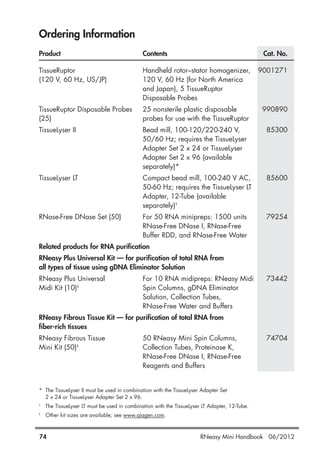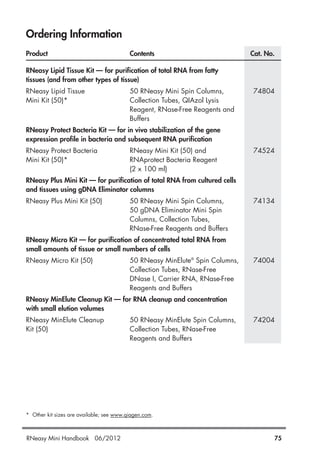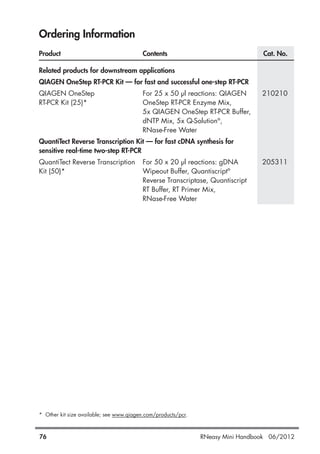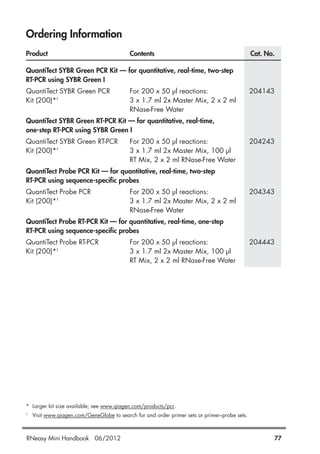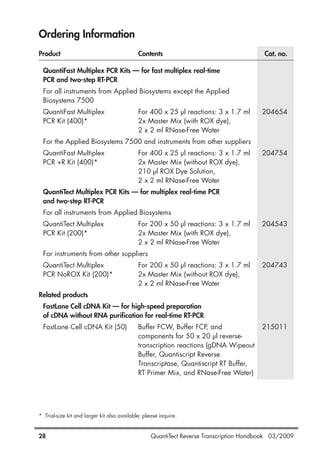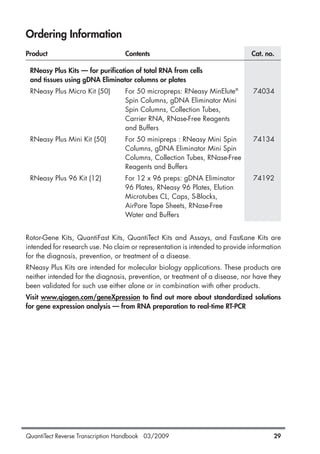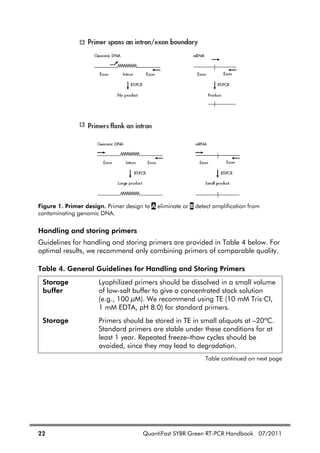
RNeasy®
Mini Handbook
RNeasy Mini Kit
For purification of total RNA from animal cells,
animal tissues, bacteria, and yeast, and for RNA cleanup
RNeasy Protect Mini Kit
For immediate stabilization of RNA in harvested
animal tissues and subsequent total RNA purification
RNeasy Plant Mini Kit
For purification of total RNA from plants and
filamentous fungi
Fourth Edition June 2012
Sample & Assay Technologies
QIAGEN Sample and Assay Technologies
QIAGEN is the leading provider of innovative sample and assay technologies, enabling
the isolation and detection of contents of any biological sample. Our advanced,
high-quality products and services ensure success from sample to result.
QIAGEN sets standards in:
■ Purification of DNA, RNA, and proteins
■ Nucleic acid and protein assays
■ microRNA research and RNAi
■ Automation of sample and assay technologies
Our mission is to enable you to achieve outstanding success and breakthroughs. For
more information, visit www.qiagen.com.
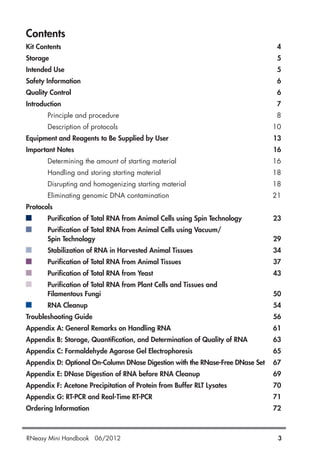
Contents
Kit Contents 4
Storage 5
Intended Use 5
Safety Information 6
Quality Control 6
Introduction 7
Principle and procedure 8
Description of protocols 10
Equipment and Reagents to Be Supplied by User 13
Important Notes 16
Determining the amount of starting material 16
Handling and storing starting material 18
Disrupting and homogenizing starting material 18
Eliminating genomic DNA contamination 21
Protocols
Purification of Total RNA from Animal Cells using Spin Technology 23
Purification of Total RNA from Animal Cells using Vacuum/
Spin Technology 29
Stabilization of RNA in Harvested Animal Tissues 34
Purification of Total RNA from Animal Tissues 37
Purification of Total RNA from Yeast 43
Purification of Total RNA from Plant Cells and Tissues and
Filamentous Fungi 50
RNA Cleanup 54
Troubleshooting Guide 56
Appendix A: General Remarks on Handling RNA 61
Appendix B: Storage, Quantification, and Determination of Quality of RNA 63
Appendix C: Formaldehyde Agarose Gel Electrophoresis 65
Appendix D: Optional On-Column DNase Digestion with the RNase-Free DNase Set 67
Appendix E: DNase Digestion of RNA before RNA Cleanup 69
Appendix F: Acetone Precipitation of Protein from Buffer RLT Lysates 70
Appendix G: RT-PCR and Real-Time RT-PCR 71
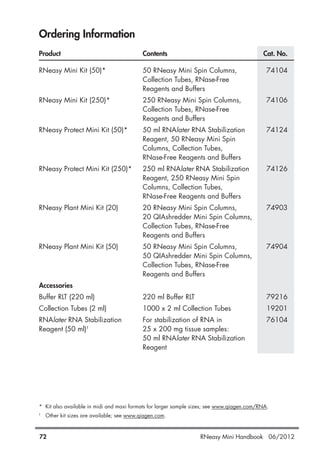
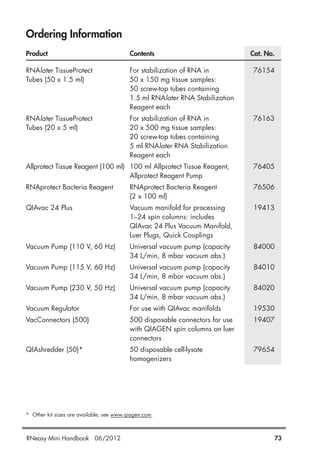
Ordering Information 72
RNeasy Mini Handbook 06/2012 3
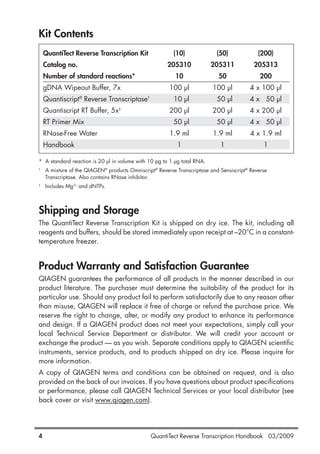
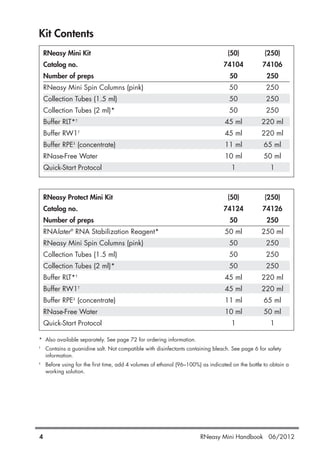
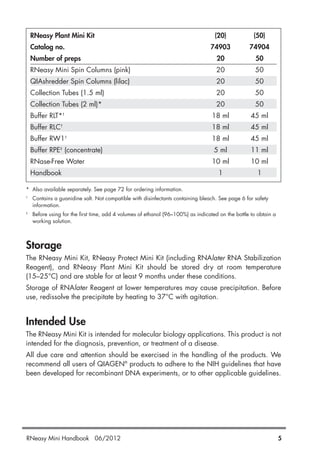
Kit Contents
RNeasy Mini Kit (50) (250)
Catalog no. 74104 74106
Number of preps 50 250
RNeasy Mini Spin Columns (pink) 50 250
Collection Tubes (1.5 ml) 50 250
Collection Tubes (2 ml)* 50 250
Buffer RLT*†
45 ml 220 ml
Buffer RW1†
45 ml 220 ml
Buffer RPE‡
(concentrate) 11 ml 65 ml
RNase-Free Water 10 ml 50 ml
Quick-Start Protocol 1 1
RNeasy Protect Mini Kit (50) (250)
Catalog no. 74124 74126
Number of preps 50 250
RNAlater®
RNA Stabilization Reagent* 50 ml 250 ml
RNeasy Mini Spin Columns (pink) 50 250
Collection Tubes (1.5 ml) 50 250
Collection Tubes (2 ml)* 50 250
Buffer RLT*†
45 ml 220 ml
Buffer RW1†
45 ml 220 ml
Buffer RPE‡
(concentrate) 11 ml 65 ml
RNase-Free Water 10 ml 50 ml
Quick-Start Protocol 1 1
* Also available separately. See page 72 for ordering information.
†
Contains a guanidine salt. Not compatible with disinfectants containing bleach. See page 6 for safety
information.
‡
Before using for the first time, add 4 volumes of ethanol (96–100%) as indicated on the bottle to obtain a
working solution.
4 RNeasy Mini Handbook 06/2012
RNeasy Plant Mini Kit (20) (50)
Catalog no. 74903 74904
Number of preps 20 50
RNeasy Mini Spin Columns (pink) 20 50
QIAshredder Spin Columns (lilac) 20 50
Collection Tubes (1.5 ml) 20 50
Collection Tubes (2 ml)* 20 50
Buffer RLT*†
18 ml 45 ml
Buffer RLC†
18 ml 45 ml
Buffer RW1†
18 ml 45 ml
Buffer RPE‡
(concentrate) 5 ml 11 ml
RNase-Free Water 10 ml 10 ml
Handbook 1 1
* Also available separately. See page 72 for ordering information.
†
Contains a guanidine salt. Not compatible with disinfectants containing bleach. See page 6 for safety
information.
‡
Before using for the first time, add 4 volumes of ethanol (96–100%) as indicated on the bottle to obtain a
working solution.
Storage
The RNeasy Mini Kit, RNeasy Protect Mini Kit (including RNAlater RNA Stabilization
Reagent), and RNeasy Plant Mini Kit should be stored dry at room temperature
(15–25°C) and are stable for at least 9 months under these conditions.
Storage of RNAlater Reagent at lower temperatures may cause precipitation. Before
use, redissolve the precipitate by heating to 37°C with agitation.
Intended Use
The RNeasy Mini Kit is intended for molecular biology applications. This product is not
intended for the diagnosis, prevention, or treatment of a disease.
All due care and attention should be exercised in the handling of the products. We
recommend all users of QIAGEN®
products to adhere to the NIH guidelines that have
been developed for recombinant DNA experiments, or to other applicable guidelines.
RNeasy Mini Handbook 06/2012 5
6 RNeasy Mini Handbook 06/2012
Safety Information
When working with chemicals, always wear a suitable lab coat, disposable gloves,
and protective goggles. For more information, please consult the appropriate safety data
sheets (SDSs). These are available online in convenient and compact PDF format at
www.qiagen.com/safety where you can find, view, and print the SDS for each QIAGEN
kit and kit component.
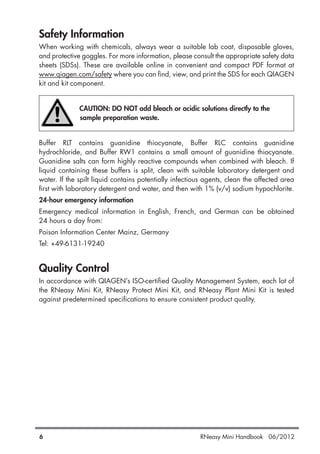
CAUTION: DO NOT add bleach or acidic solutions directly to the
sample preparation waste.
Buffer RLT contains guanidine thiocyanate, Buffer RLC contains guanidine
hydrochloride, and Buffer RW1 contains a small amount of guanidine thiocyanate.
Guanidine salts can form highly reactive compounds when combined with bleach. If
liquid containing these buffers is split, clean with suitable laboratory detergent and
water. If the spilt liquid contains potentially infectious agents, clean the affected area
first with laboratory detergent and water, and then with 1% (v/v) sodium hypochlorite.
24-hour emergency information
Emergency medical information in English, French, and German can be obtained
24 hours a day from:
Poison Information Center Mainz, Germany
Tel: +49-6131-19240
Quality Control
In accordance with QIAGEN’s ISO-certified Quality Management System, each lot of
the RNeasy Mini Kit, RNeasy Protect Mini Kit, and RNeasy Plant Mini Kit is tested
against predetermined specifications to ensure consistent product quality.
RNeasy Mini Handbook 06/2012 7
Introduction
The RNeasy Mini Handbook provides protocols for use with the following kits:
RNeasy Mini Kit — for purification of total RNA from animal cells, animal tissues,
and yeast, and for cleanup of RNA from crude RNA preps and enzymatic
reactions (e.g., DNase digestion, proteinase digestion, RNA ligation, and labeling
reaction)
RNeasy Protect Mini Kit — for immediate stabilization of RNA in harvested animal
tissues and subsequent purification of total RNA
RNeasy Plant Mini Kit — for purification of total RNA from plant cells and tissues
and filamentous fungi
The RNeasy Mini Kit can also be used to purify total RNA from bacteria. In this case,
we strongly recommend using the kit in combination with RNAprotect®
Bacteria Reagent
(available separately), which provides in vivo stabilization of RNA in bacteria to ensure
reliable gene expression analysis. Various protocols for stabilizing and purifying RNA
from different bacteria species are included in the RNAprotect Bacteria Reagent
Handbook. The RNeasy Mini Kit and RNAprotect Bacteria Reagent can also be
purchased together as the RNeasy Protect Bacteria Mini Kit. For ordering
information, see pages 74–75. It is also possible to use the RNeasy Mini Kit to purify
cytoplasmic RNA from animal cells. The protocol can be downloaded at
www.qiagen.com/literature/protocols/RNeasyMini.aspx.
The RNeasy Kits are designed to purify RNA from small amounts of starting material.
They provide a fast and simple method for preparing up to 100 µg total RNA per
sample. The purified RNA is ready for use in downstream applications such as:
RT-PCR and real-time RT-PCR
Differential display
cDNA synthesis
Northern, dot, and slot blot analyses
Primer extension
Poly A+
RNA selection
RNase/S1 nuclease protection
Microarrays
RNA-Seq
The RNeasy Kits allow the parallel processing of multiple samples in less than
30 minutes. Time-consuming and tedious methods, such as CsCl step-gradient
ultracentrifugation and alcohol precipitation, or methods involving the use of toxic
substances, such as phenol and/or chloroform, are replaced by the RNeasy procedure.
Principle and procedure
RNA purification using RNeasy technology
The RNeasy procedure represents a well-established technology for RNA purification.
This technology combines the selective binding properties of a silica-based membrane
with the speed of microspin technology. A specialized high-salt buffer system allows up
to 100 µg of RNA longer than 200 bases to bind to the RNeasy silica membrane.
Biological samples are first lysed and homogenized in the presence of a highly
denaturing guanidine-thiocyanate–containing buffer, which immediately inactivates
RNases to ensure purification of intact RNA. Ethanol is added to provide appropriate
binding conditions, and the sample is then applied to an RNeasy Mini spin column,
where the total RNA binds to the membrane and contaminants are efficiently washed
away. High-quality RNA is then eluted in 30–100 µl water.
With the RNeasy procedure, all RNA molecules longer than 200 nucleotides are
purified. The procedure provides an enrichment for mRNA since most RNAs <200
nucleotides (such as 5.8S rRNA, 5S rRNA, and tRNAs, which together comprise
15–20% of total RNA) are selectively excluded. The size distribution of the purified RNA
is comparable to that obtained by centrifugation through a CsCl cushion, where small
RNAs do not sediment efficiently. Protocols for purification of small RNA using RNeasy
Kits are available at www.qiagen.com/goto/microRNAprotocols.
In this handbook, different protocols are provided for different starting materials. The
protocols differ primarily in the lysis and homogenization of the sample and in the
adjustment of the conditions for binding RNA to the RNeasy membrane. Once the
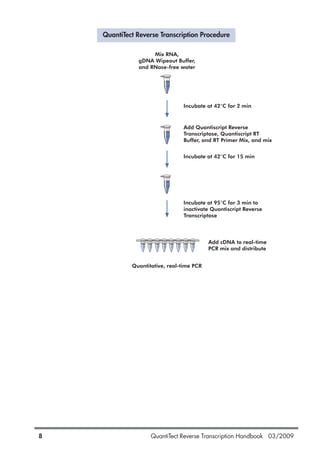
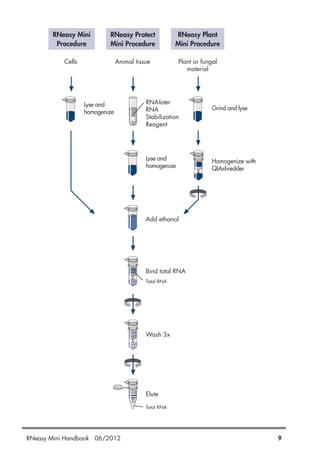
sample is bound to the membrane, the protocols are similar (see flowchart, next page).
RNA stabilization using RNAlater technology
RNA stabilization is an absolute prerequisite for reliable gene expression analysis.
Immediate stabilization of RNA in biological samples is necessary because, directly
after harvesting the samples, changes in the gene expression pattern occur due to
specific and nonspecific RNA degradation as well as to transcriptional induction. Such
changes need to be avoided for all reliable quantitative gene expression analyses, such
as microarray analyses, quantitative RT-PCR, such as TaqMan®
and LightCycler®
technology, and other nucleic acid-based technologies.
8 RNeasy Mini Handbook 06/2012
RNeasy Mini
Procedure
RNeasy Protect
Mini Procedure
RNeasy Plant
Mini Procedure
RNeasy Mini Handbook 06/2012 9
The RNeasy Protect Mini Kit is supplied with RNAlater RNA Stabilization Reagent,
which represents a novel technology for the immediate preservation of the gene
expression pattern in animal tissues, enabling reliable gene expression analysis. After
harvesting, tissues are immediately submerged in RNAlater RNA Stabilization Reagent,
which rapidly permeates the tissues to stabilize and protect cellular RNA in situ. The
reagent preserves RNA for up to 1 day at 37°C, 7 days at room temperature
(15–25°C), or 4 weeks at 2–8°C, allowing transportation, storage, and shipping of
samples without ice or dry ice. Alternatively, the samples can be archived at –20°C or
–80°C. During storage or transport in RNAlater RNA Stabilization Reagent, even at
elevated temperatures (e.g., room temperature or 37°C), the cellular RNA remains
intact and undegraded. RNAlater technology allows large numbers of samples to be
easily processed and replaces inconvenient, dangerous, and equipment-intensive
methods, such as snap-freezing of samples in liquid nitrogen, storage at –80°C, cutting
and weighing on dry ice, or immediate processing of harvested samples.
Note: RNAlater RNA Stabilization Reagent is not for stabilization of RNA in animal
cells, whole blood, plasma, or serum.
Description of protocols
Purification of Total RNA from Animal Cells Using Spin Technology
Up to 1 x 10⁷
cells, depending on the cell line, are disrupted in Buffer RLT and
homogenized. An overview of disruption and homogenization methods is given on
pages 18–21. Ethanol is then added to the lysate, creating conditions that promote
selective binding of RNA to the RNeasy membrane. The sample is then applied to the
RNeasy Mini spin column. Total RNA binds to the membrane, contaminants are
efficiently washed away, and high-quality RNA is eluted in RNase-free water. All bind,
wash, and elution steps are performed by centrifugation in a microcentrifuge.
Purification of Total RNA from Animal Cells Using Vacuum/Spin Technology
Up to 1 x 10⁶
cells, depending on the cell line, are disrupted in Buffer RLT and
homogenized. An overview of disruption and homogenization methods is given on
pages 18–21. Ethanol is then added to the lysate, creating conditions that promote
selective binding of RNA to the RNeasy membrane. The sample is then applied to the
RNeasy Mini spin column. Total RNA binds to the membrane, contaminants are
efficiently washed away, and high-quality RNA is eluted in RNase-free water. The bind
and wash steps are performed on a QIAvac 24 or QIAvac 24 Plus manifold, and the
final elution step is performed by centrifugation in a microcentrifuge.
10 RNeasy Mini Handbook 06/2012
Stabilization of RNA in Harvested Animal Tissues
This protocol describes how to stabilize RNA in harvested animal tissues using RNAlater
RNA Stabilization Reagent. Purification of total RNA from the stabilized tissues can be
subsequently carried out according to “Protocol: Purification of Total RNA from Animal
Tissues” (page 37).
Purification of Total RNA from Animal Tissues
Fresh, frozen, or RNAlater stabilized tissue (up to 30 mg, depending on the tissue type)
is disrupted in Buffer RLT and homogenized. An overview of disruption and
homogenization methods is given on pages 18–21. Ethanol is then added to the lysate,
creating conditions that promote selective binding of RNA to the RNeasy membrane.
The sample is then applied to the RNeasy Mini spin column. Total RNA binds to the
membrane, contaminants are efficiently washed away, and high-quality RNA is eluted
in RNase-free water.
Purification of Total RNA from Yeast
This protocol is for the purification of total RNA from up to 5 x 10⁷
yeast cells. Two
alternative methods of disrupting yeast cell walls are provided: enzymatic lysis or
mechanical disruption. In general, both methods function equally well. For some
applications, enzymatic lysis might be preferable since no additional laboratory
equipment is required. Mechanical disruption, however, is well-suited for time-course
experiments where enzymatic digestion incubations are not practical.
The enzymatic lysis method uses zymolase or lyticase digestion of the cell walls to
convert cells to spheroplasts, which are then used in the RNeasy procedure. For samples
of up to 5 x 10⁷
yeast cells, spheroplasts are separated from the digestion mixture by
centrifugation before being lysed. For samples of up to 2 x 10⁷
yeast cells, the digestion
mixture is used directly in the RNeasy procedure without prior separation of the
spheroplasts. After addition of Buffer RLT and ethanol, samples are loaded onto the
RNeasy Mini spin column. Total RNA binds to the RNeasy membrane, contaminants are
efficiently washed away, and high-quality RNA is eluted in RNase-free water.
Using the mechanical disruption method, yeast cells are lysed and homogenized by
high-speed agitation in the TissueLyser LT, TissueLyser II, or other bead mill in the presence
of glass beads and Buffer RLT. Ethanol is added to the lysate, creating conditions that
promote selective binding of RNA to the RNeasy membrane. The sample is then applied
to the RNeasy Mini spin column. Total RNA binds to the membrane, contaminants are
efficiently washed away, and high-quality RNA is eluted in RNase-free water.
RNeasy Mini Handbook 06/2012 11
Purification of Total RNA from Plant Cells and Tissues and Filamentous Fungi
Up to 100 mg of sample is first ground in liquid nitrogen and then lysed under highly
denaturing conditions. The RNeasy Plant Mini Kit provides a choice of lysis buffers:
Buffer RLT and Buffer RLC, which contain guanidine thiocyanate and guanidine
hydrochloride, respectively. The higher cell disruption and denaturing properties of
Buffer RLT frequently make it the buffer of choice. However, some tissues, such as milky
endosperm of maize or mycelia of filamentous fungi, solidify in Buffer RLT, making the
extraction of RNA impossible. In these cases, Buffer RLC should be used instead. After
lysis with either buffer, samples are centrifuged through a QIAshredder homogenizer.
This simultaneously removes insoluble material and reduces the viscosity of the lysates
by disrupting gelatinous material often formed in plant and fungal lysates. Ethanol is
added to the cleared lysate, creating conditions which promote selective binding of
RNA to the RNeasy membrane. The sample is then applied to the RNeasy Mini spin
column. Total RNA binds to the membrane, contaminants are efficiently washed away,
and high-quality RNA is eluted in RNase-free water.
RNA Cleanup
This protocol can be used to purify RNA from enzymatic reactions (e.g., DNase
digestion, RNA labeling) or to desalt RNA samples (up to 100 µg RNA). Buffer RLT and
ethanol are added to the sample to create conditions that promote selective binding of
RNA to the RNeasy membrane. The sample is then applied to the RNeasy Mini spin
column. Total RNA binds to the membrane, contaminants are efficiently washed away,
and high-quality RNA is eluted in RNase-free water.
Automated purification
Purification of RNA can be fully automated on the QIAcube®
. The innovative QIAcube uses
advanced technology to process QIAGEN spin columns, enabling seamless integration
of automated, low-throughput sample prep into your laboratory workflow. Sample
preparation using the QIAcube follows the same steps as the manual procedure (i.e.,
lyse, bind, wash, and elute), enabling you to continue using the RNeasy Mini Kit for
purification of high-quality RNA. For more information about the automated procedure,
see the relevant protocol sheet available at www.qiagen.com/MyQIAcube.
The QIAcube is preinstalled with protocols for purification of plasmid DNA, genomic
DNA, RNA, viral nucleic acids, and proteins, plus DNA and RNA cleanup. The range
of protocols available is continually expanding, and additional QIAGEN protocols can
be downloaded free of charge at www.qiagen.com/MyQIAcube.
12 RNeasy Mini Handbook 06/2012
Equipment and Reagents to Be Supplied by User
When working with chemicals, always wear a suitable lab coat, disposable gloves,
and protective goggles. For more information, consult the appropriate safety data sheets
(SDSs), available from the product supplier.
For all protocols
14.3 M β-mercaptoethanol (β-ME) (commercially available solutions are usually
14.3 M)
Sterile, RNase-free pipet tips
Microcentrifuge (with rotor for 2 ml tubes)
96–100% ethanol*
Disposable gloves
Equipment for sample disruption and homogenization (see pages 18–21).
Depending on the method chosen, one or more of the following are required:
Trypsin and PBS
QIAshredder homogenizer (see ordering information, page 73
Blunt needle and syringe
Mortar and pestle
TissueLyser LT or TissueLyser II (see ordering information, page 73)
Rotor–stator homogenizer
For RNA purification from animal cells
70% ethanol*
For RNA purification from animal cells using vacuum technology
QIAvac 24 (no longer available); QIAvac 24 Plus (cat. no. 19413); or other vacuum
manifold with luer connectors and capable of dealing with vacuum pressures of
–800 to –900 mbar
QIAGEN Vacuum Pump (see page 73 for ordering information); or other vacuum
pump capable of generating a vacuum pressure of –800 to –900 mbar and with
a capacity of 18–20 liter/min
Note: Use of insufficient vacuum pressure may reduce RNA yield and purity. The
RNeasy procedure requires higher vacuum pressures compared with other
QIAGEN procedures. Most water pumps or house vacuums do not provide
sufficient vacuum pressure.
* Do not use denatured alcohol, which contains other substances such as methanol or methylethylketone.
RNeasy Mini Handbook 06/2012 13
Optional: Vacuum Regulator (cat. no. 19530) to measure the pressure difference
between the inside and outside of a vacuum system
A vacuum pressure of –800 to –900 mbar should develop when RNeasy Mini spin
columns are used on the vacuum manifold. Vacuum pressures exceeding
–900 mbar should be avoided. The vacuum pressure is the pressure difference
between the inside of the manifold and the atmosphere (standard atmospheric
pressure: 1013 mbar or 760 mm Hg) and can be regulated and measured using
a pressure gauge or vacuum regulator. Vacuum recommendations are given in
negative units to indicate the required reduction in pressure with respect to the
atmosphere.
Optional: VacConnectors (cat. no. 19407)
These disposable connectors fit between the RNeasy Mini spin columns and the
luer extensions on the QIAvac 24 or QIAvac 24 Plus. They prevent direct contact
between the RNeasy Mini spin columns and luer connectors during RNA purification,
avoiding any cross-contamination between samples. VacConnectors are discarded
after single use.
For RNA purification from animal tissues
70% ethanol*
Optional: Dithiothreitol (DTT)
For RNA purification from yeast using enzymatic lysis
70% ethanol*
Buffer for enzymatic lysis
In most cases, Buffer Y1 (containing sorbitol, EDTA, β-ME, and lyticase or
zymolase) can be used. See the protocol on page 45 for details on preparing
Buffer Y1.
For RNA purification from yeast using mechanical disruption
70% ethanol*
Glass beads, 0.45–0.55 mm diameter
Concentrated nitric acid, deionized water, and baking oven
TissueLyser LT, TissueLyser II, or other bead-mill homogenizer
* Do not use denatured alcohol, which contains other substances such as methanol or methylethylketone.
14 RNeasy Mini Handbook 06/2012
For RNA purification from plants and fungi
Liquid nitrogen
Mortar and pestle (alternatively, TissueLyser LT, TissueLyser II, or other bead-mill
homogenizer)
Suppliers of equipment for disruption and homogenization*
Rotor–stator homogenizers can be purchased from:
BioSpec Products, Inc. (www.biospec.com): Tissue-Tearor™ homogenizer
Charles Ross & Son Company (www.mixers.com)
IKA (www.ika.de): ULTRA-TURRAX®
dispersers
KINEMATICA AG (www.kinematica.ch) or Brinkmann Instruments, Inc.
(www.brinkmann.com): POLYTRON®
laboratory dispersing devices
Omni International, Inc. (www.omni-inc.com)
Silverson (www.silverson.com)
VirTis (www.virtis.com)
Bead-mill homogenizers and stainless steel and tungsten carbide beads can be pur-
chased from:
QIAGEN (TissueLyser system, see page 73 for ordering information)
Glass, stainless steel, and tungsten carbide beads can be purchased from:
Retsch (www.retsch.de)
* This is not a complete list of suppliers and does not include many important vendors of biological supplies.
RNeasy Mini Handbook 06/2012 15
Important Notes
Determining the amount of starting material
It is essential to use the correct amount of starting material to obtain optimal RNA yield
and purity. The maximum amount that can be used is determined by:
The type of sample and its RNA content
The volume of Buffer RLT required for efficient lysis
The RNA binding capacity of the RNeasy spin column
When processing samples containing high amounts of RNA, less than the maximum
amount of starting material shown in Table 1 should be used, so that the RNA binding
capacity of the RNeasy spin column is not exceeded.
When processing samples containing average or low amounts of RNA, the maximum
amount of starting material shown in Table 1 can be used. However, even though the
RNA binding capacity of the RNeasy spin column is not reached, the maximum amount
of starting material must not be exceeded. Otherwise, lysis will be incomplete and
cellular debris may interfere with the binding of RNA to the RNeasy spin column
membrane, resulting in lower RNA yield and purity.
More information on using the correct amount of starting material is given in each
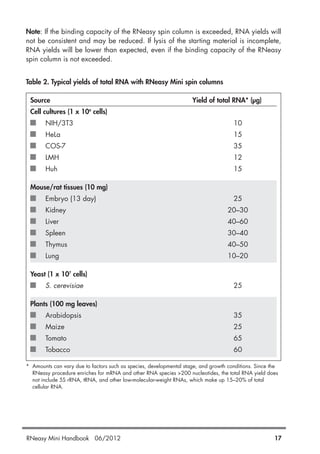
protocol. Table 2 shows expected RNA yields from various sources.
Table 1. RNeasy Mini spin column specifications
Maximum binding capacity 100 µg RNA
Maximum loading volume 700 µl
RNA size distribution RNA >200 nucleotides
Minimum elution volume 30 µl
Maximum amount of starting material
Animal cells 1 x 10⁷
*
Animal tissues 30 mg*
Yeast 5 x 10⁷
*
Plant tissues 100 mg
Filamentous fungi 100 mg
* For larger sample sizes, RNeasy Kits and RNeasy Protect Kits are available in midi and maxi formats. For
details, visit www.qiagen.com/RNA.
16 RNeasy Mini Handbook 06/2012
Note: If the binding capacity of the RNeasy spin column is exceeded, RNA yields will
not be consistent and may be reduced. If lysis of the starting material is incomplete,
RNA yields will be lower than expected, even if the binding capacity of the RNeasy
spin column is not exceeded.
Table 2. Typical yields of total RNA with RNeasy Mini spin columns
Source Yield of total RNA* (µg)
Cell cultures (1 x 10⁶
cells)
NIH/3T3 10
HeLa 15
COS-7 35
LMH 12
Huh 15
Mouse/rat tissues (10 mg)
Embryo (13 day) 25
Kidney 20–30
Liver 40–60
Spleen 30–40
Thymus 40–50
Lung 10–20
Yeast (1 x 10⁷
cells)
S. cerevisiae 25
Plants (100 mg leaves)
Arabidopsis 35
Maize 25
Tomato 65
Tobacco 60
* Amounts can vary due to factors such as species, developmental stage, and growth conditions. Since the
RNeasy procedure enriches for mRNA and other RNA species >200 nucleotides, the total RNA yield does
not include 5S rRNA, tRNA, and other low-molecular-weight RNAs, which make up 15–20% of total
cellular RNA.
RNeasy Mini Handbook 06/2012 17
Handling and storing starting material
RNA in animal and plant tissues is not protected after harvesting until the sample is
treated with RNAlater RNA Stabilization Reagent (animal tissues only), flash-frozen, or
disrupted and homogenized in the presence of RNase-inhibiting or denaturing
reagents. Otherwise, unwanted changes in the gene expression profile will occur. It is
therefore important that tissue samples are immediately frozen in liquid nitrogen and
stored at –70°C, or immediately immersed in RNAlater RNA Stabilization Reagent.
Alternatively, use Allprotect Tissue Reagent, which provides immediate stabilization of
DNA, RNA, and protein in tissues samples at room temperature.
The procedures for tissue harvesting and RNA protection should be carried out as
quickly as possible. Frozen tissue samples should not be allowed to thaw during
handling or weighing. After disruption and homogenization in Buffer RLT (lysis buffer),
samples can be stored at –70°C for months.
Animal and yeast cells can be pelleted and then stored at –70°C until required for RNA
purification. However, if performing RNA purification from yeast cells with enzymatic
lysis, only freshly harvested samples can be used.
Disrupting and homogenizing starting material
Efficient disruption and homogenization of the starting material is an absolute
requirement for all total RNA purification procedures. Disruption and homogenization
are 2 distinct steps:
Disruption: Complete disruption of cell walls and plasma membranes of cells and
organelles is absolutely required to release all the RNA contained in the sample.
Different samples require different methods to achieve complete disruption.
Incomplete disruption results in significantly reduced RNA yields.
Homogenization: Homogenization is necessary to reduce the viscosity of the
lysates produced by disruption. Homogenization shears high-molecular-weight
genomic DNA and other high-molecular-weight cellular components to create a
homogeneous lysate. Incomplete homogenization results in inefficient binding of
RNA to the RNeasy spin column membrane and therefore significantly reduced
RNA yields.
Some disruption methods simultaneously homogenize the sample, while others require
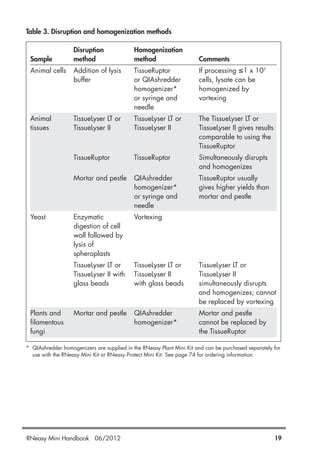
an additional homogenization step. Table 3 (page 19) gives an overview of different
disruption and homogenization methods, and is followed by a detailed description of
each method. This information can be used as a guide to choose the appropriate
methods for your starting material.
Note: After storage in RNAlater RNA Stabilization Reagent, tissues become slightly
harder than fresh or thawed tissues. Disruption and homogenization of these tissues,
however, is usually not a problem.
18 RNeasy Mini Handbook 06/2012
Table 3. Disruption and homogenization methods
Disruption Homogenization
Sample method method Comments
Animal cells Addition of lysis TissueRuptor If processing ≤1 x 10⁵
buffer or QIAshredder cells, lysate can be
homogenizer* homogenized by
or syringe and vortexing
needle
Animal TissueLyser LT or TissueLyser LT or The TissueLyser LT or
tissues TissueLyser II TissueLyser II TissueLyser II gives results
comparable to using the
TissueRuptor
TissueRuptor TissueRuptor Simultaneously disrupts
and homogenizes
Mortar and pestle QIAshredder TissueRuptor usually
homogenizer* gives higher yields than
or syringe and mortar and pestle
needle
Yeast Enzymatic Vortexing
digestion of cell
wall followed by
lysis of
spheroplasts
TissueLyser LT or TissueLyser LT or TissueLyser LT or
TissueLyser II with TissueLyser II TissueLyser II
glass beads with glass beads simultaneously disrupts
and homogenizes; cannot
be replaced by vortexing
Plants and Mortar and pestle QIAshredder Mortar and pestle
filamentous homogenizer* cannot be replaced by
fungi the TissueRuptor
* QIAshredder homogenizers are supplied in the RNeasy Plant Mini Kit and can be purchased separately for
use with the RNeasy Mini Kit or RNeasy Protect Mini Kit. See page 74 for ordering information.
RNeasy Mini Handbook 06/2012 19
Disruption and homogenization using the TissueLyser system
In bead-milling, cells and tissues can be disrupted by rapid agitation in the presence of
beads and lysis buffer. Disruption and simultaneous homogenization occur by the
shearing and crushing action of the beads as they collide with the cells. Disruption
efficiency is influenced by:
Size and composition of beads
Ratio of buffer to beads
Amount of starting material
Speed and configuration of the TissueLyser LT or TissueLyser II
Disintegration time
For animal tissues, the optimal beads are 3–7 mm diameter stainless steel beads, and
for yeast cells, the optimal beads are 0.5 mm diameter glass beads. It is essential that
glass beads are prewashed in concentrated nitric acid. All other disruption parameters
must be determined empirically for each application. The protocol for RNA purification
from yeast (page 43) describes how to perform mechanical disruption of yeast cells with
glass beads. For guidelines on disruption and homogenization of animal tissues using
the TissueLyser system, refer to the TissueLyser LT Handbook or the TissueLyser Handbook.
For other bead mills, please refer to suppliers’ guidelines for further details.
Plant tissues can be disrupted using the TissueLyser LT or TissueLyser II, in combination
with stainless steel or tungsten carbide beads. In this case, plant material, beads, and
disruption vessels must all be precooled in liquid nitrogen, and disruption is performed
without lysis buffer.
Disruption and homogenization using the TissueRuptor or other rotor–stator homogenizers
Rotor–stator homogenizers thoroughly disrupt and simultaneously homogenize, in the
presence of lysis buffer, single samples of animal tissues in 15–90 seconds depending
on the toughness and size of the sample. Rotor–stator homogenizers can also be used
to homogenize cell lysates. The rotor turns at a very high speed, causing the sample to
be disrupted and homogenized by a combination of turbulence and mechanical
shearing. Foaming of the sample should be kept to a minimum by using properly sized
vessels, keeping the tip of the homogenizer submerged, and holding the immersed tip
to the side of the tube. Rotor–stator homogenizers are available in different sizes and
operate with differently sized probes. Probes with diameters of 5 mm and 7 mm are
suitable for volumes up to 300 µl and can be used for homogenization in
microcentrifuge tubes. Probes with a diameter of 10 mm or above require larger tubes.
In addition, round-bottomed tubes allow more efficient homogenization than conical-
bottomed tubes.
20 RNeasy Mini Handbook 06/2012
Disruption using a mortar and pestle
For disruption using a mortar and pestle, freeze the animal or plant tissue immediately
in liquid nitrogen and grind to a fine powder under liquid nitrogen. Transfer the
suspension (tissue powder and liquid nitrogen) into a liquid-nitrogen–cooled,
appropriately sized tube and allow the liquid nitrogen to evaporate without allowing
the sample to thaw. Add lysis buffer and continue as quickly as possible with the
homogenization according to one of the 2 methods below.
Note: Grinding the sample using a mortar and pestle will disrupt the sample, but will
not homogenize it. Homogenization must be performed afterwards.
Homogenization using QIAshredder homogenizers
Using QIAshredder homogenizers is a fast and efficient way to homogenize cell and
tissue lysates without cross-contamination of samples. Up to 700 µl of lysate is loaded
onto a QIAshredder spin column placed in a 2 ml collection tube, and spun for
2 minutes at maximum speed in a microcentrifuge. The lysate is homogenized as it
passes through the spin column. QIAshredder spin columns are supplied in the RNeasy
Plant Mini Kit and can be purchased separately for use with the RNeasy Mini Kit and
RNeasy Protect Mini Kit. See page 74 for ordering information.
Homogenization using a syringe and needle
Cell and tissue lysates can be homogenized using a syringe and needle. Lysate is
passed through a 20-gauge (0.9 mm) needle attached to a sterile plastic syringe at least
5–10 times or until a homogeneous lysate is achieved. Increasing the volume of lysis
buffer may be required to facilitate handling and minimize loss.
Eliminating genomic DNA contamination
Generally, DNase digestion is not required with RNeasy Kits since RNeasy silica-
membrane technology efficiently removes most of the DNA without DNase treatment.
However, further DNA removal may be necessary for certain RNA applications that are
sensitive to very small amounts of DNA (e.g., TaqMan RT-PCR analysis with a
low-abundance target). In these cases, residual DNA can be removed by optional on-
column DNase digestion using the RNase-Free DNase Set (see Appendix D, page 67).
The DNase is efficiently removed in subsequent wash steps. Alternatively, residual DNA
can be removed by a DNase digestion after RNA purification (see Appendix E,
page 69). The DNase digestion can then be cleaned up, if desired, using “Protocol:
RNA Cleanup” (page 54).
The RNeasy Plus Mini Kit, which is designed for RNA purification from animal cells and
tissues, integrates unique gDNA Eliminator spin columns with RNeasy technology.
Genomic DNA is effectively removed in a single, rapid centrifugation step, avoiding
the need for DNase digestion. See page 74 for ordering information.
RNeasy Mini Handbook 06/2012 21
22 RNeasy Mini Handbook 06/2012
If the purified RNA will be used in real-time, two-step RT-PCR, we recommend using the
QuantiTect®
Reverse Transcription Kit. The kit provides a fast and convenient procedure,
enabling cDNA synthesis and genomic DNA removal in only 20 minutes. For ordering
information, see page 76.
AnimalCells
Spin
Protocol: Purification of Total RNA from Animal Cells
using Spin Technology
This protocol requires the RNeasy Mini Kit.
Determining the correct amount of starting material
It is essential to use the correct amount of starting material to obtain optimal RNA yield
and purity. The minimum amount is generally 100 cells, while the maximum amount
depends on:
The RNA content of the cell type
The RNA binding capacity of the RNeasy spin column (100 µg RNA)
The volume of Buffer RLT required for efficient lysis (the maximum volume of Buffer
RLT that can be used limits the maximum amount of starting material to 1 x 10⁷
cells)
RNA content can vary greatly between cell types. The following examples illustrate how
to determine the maximum amount of starting material:
COS cells have high RNA content (approximately 35 µg RNA per 106
cells). Do
not use more than 3 x 10⁶
cells, otherwise the RNA binding capacity of the RNeasy
spin column will be exceeded.
HeLa cells have average RNA content (approximately 15 µg RNA per 106
cells).
Do not use more than 7 x 10⁶
cells, otherwise the RNA binding capacity of the
RNeasy spin column will be exceeded.
NIH/3T3 cells have low RNA content (approximately 10 µg RNA per 106
cells).
The maximum amount of starting material (1 x 10⁷
cells) can be used.
If processing a cell type not listed in Table 2 (page 17) and if there is no information
about its RNA content, we recommend starting with no more than 3–4 x 10⁶
cells.
Depending on RNA yield and purity, it may be possible to increase the cell number in
subsequent preparations.
Do not overload the RNeasy spin column, as this will significantly reduce RNA yield and
purity.
Counting cells is the most accurate way to quantitate the amount of starting material.
As a guide, the number of HeLa cells obtained in various culture vessels after confluent
growth is given in Table 4.
RNeasy Mini Handbook 06/2012 23
AnimalCells
Spin
24 RNeasy Mini Handbook 06/2012
Table 4. Growth area and number of HeLa Cells in various culture vessels
Cell-culture vessel Growth area (cm2
)* Number of cells†
Multiwell-plates
96-well 0.32–0.6 4–5 x 10⁴
48-well 1 1 x 10⁵
24-well 2 2.5 x 10⁵
12-well 4 5 x 10⁵
6-well 9.5 1 x 10⁶
Dishes
35 mm 8 1 x 10⁶
60 mm 21 2.5 x 10⁶
100 mm 56 7 x 10⁶
145–150 mm 145 2 x 10⁷
Flasks
40–50 ml 25 3 x 10⁶
250–300 ml 75 1 x 10⁷
650–750 ml 162–175 2 x 10⁷
* Per well, if multiwell plates are used; varies slightly depending on the supplier.
†
Cell numbers are given for HeLa cells (approximate length = 15 µm), assuming confluent growth. Cell
numbers will vary for different kinds of animal cells, which vary in length from 10 to 30 µm.
Important points before starting
If using the RNeasy Kit for the first time, read “Important Notes” (page 16).
If working with RNA for the first time, read Appendix A (page 61).
Cell pellets can be stored at –70°C for later use or used directly in the procedure.
Determine the number of cells before freezing. Frozen cell pellets should be
thawed slightly so that they can be dislodged by flicking the tube in step 2.
Homogenized cell lysates from step 3 can be stored at –70°C for several months.
Frozen lysates should be incubated at 37°C in a water bath until completely
thawed and salts are dissolved. Avoid prolonged incubation, which may
compromise RNA integrity. If any insoluble material is visible, centrifuge for 5 min
at 3000–5000 x g. Transfer supernatant to a new RNase-free glass or
polypropylene tube, and continue with step 4.
AnimalCells
Spin
Buffer RLT may form a precipitate upon storage. If necessary, redissolve by
warming, and then place at room temperature (15–25°C).
Buffer RLT and Buffer RW1 contain a guanidine salt and are therefore not
compatible with disinfecting reagents containing bleach. See page 6 for safety
information.
Perform all steps of the procedure at room temperature. During the procedure,
work quickly.
Perform all centrifugation steps at 20–25°C in a standard microcentrifuge. Ensure
that the centrifuge does not cool below 20°C.
Things to do before starting
If purifying RNA from cell lines rich in RNases, we recommend adding
β-mercaptoethanol (β-ME) to Buffer RLT before use. Add 10 µl β-ME per 1 ml Buffer
RLT. Dispense in a fume hood and wear appropriate protective clothing. Buffer RLT
containing β-ME can be stored at room temperature (15–25°C) for up to 1 month.
Buffer RPE is supplied as a concentrate. Before using for the first time, add
4 volumes of ethanol (96–100%) as indicated on the bottle to obtain a working
solution.
If performing optional on-column DNase digestion, prepare DNase I stock solution
as described in Appendix D (page 67).
Procedure
1. Harvest cells according to step 1a or 1b.
1a. Cells grown in suspension (do not use more than 1 x 10⁷
cells):
Determine the number of cells. Pellet the appropriate number of cells by
centrifuging for 5 min at 300 x g in a centrifuge tube (not supplied). Carefully
remove all supernatant by aspiration, and proceed to step 2.
Note: Incomplete removal of cell-culture medium will inhibit lysis and dilute the
lysate, affecting the conditions for binding of RNA to the RNeasy membrane. Both
effects may reduce RNA yield.
RNeasy Mini Handbook 06/2012 25
AnimalCells
Spin
26 RNeasy Mini Handbook 06/2012
1b. Cells grown in a monolayer (do not use more than 1 x 10⁷
cells):
Cells can be either lysed directly in the cell-culture vessel (up to 10 cm diameter) or
trypsinized and collected as a cell pellet prior to lysis. Cells grown in cell-culture
flasks should always be trypsinized.
To lyse cells directly:
Determine the number of cells. Completely aspirate the cell-culture medium, and
proceed immediately to step 2.
Note: Incomplete removal of cell-culture medium will inhibit lysis and dilute the
lysate, affecting the conditions for binding of RNA to the RNeasy membrane. Both
effects may reduce RNA yield.
To trypsinize and collect cells:
Determine the number of cells. Aspirate the medium, and wash the cells with PBS.
Aspirate the PBS, and add 0.1–0.25% trypsin in PBS. After the cells detach from
the dish or flask, add medium (containing serum to inactivate the trypsin), transfer
the cells to an RNase-free glass or polypropylene centrifuge tube (not supplied),
and centrifuge at 300 x g for 5 min. Completely aspirate the supernatant, and
proceed to step 2.
Note: Incomplete removal of cell-culture medium will inhibit lysis and dilute the
lysate, affecting the conditions for binding of RNA to the RNeasy membrane. Both
effects may reduce RNA yield.
2. Disrupt the cells by adding Buffer RLT.
For pelleted cells, loosen the cell pellet thoroughly by flicking the tube. Add the
appropriate volume of Buffer RLT (see Table 5). Vortex or pipet to mix, and proceed
to step 3.
Note: Incomplete loosening of the cell pellet may lead to inefficient lysis and
reduced RNA yields.
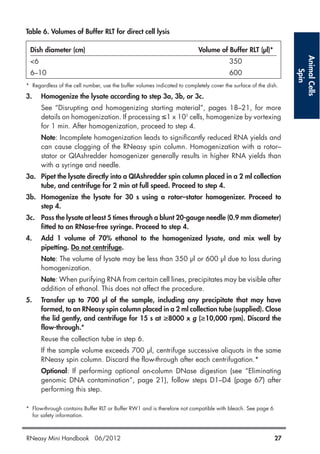
Table 5. Volumes of Buffer RLT for lysing pelleted cells
Number of pelleted cells Volume of Buffer RLT (µl)
<5 x 10⁶
350
5 x 10⁶
– 1 x 10⁷
600
For direct lysis of cells grown in a monolayer, add the appropriate volume of Buffer
RLT (see Table 6) to the cell-culture dish. Collect the lysate with a rubber policeman.
Pipet the lysate into a microcentrifuge tube (not supplied). Vortex or pipet to mix,
and ensure that no cell clumps are visible before proceeding to step 3.
AnimalCells
Spin
Table 6. Volumes of Buffer RLT for direct cell lysis
Dish diameter (cm) Volume of Buffer RLT (µl)*
<6 350
6–10 600
* Regardless of the cell number, use the buffer volumes indicated to completely cover the surface of the dish.
3. Homogenize the lysate according to step 3a, 3b, or 3c.
See “Disrupting and homogenizing starting material”, pages 18–21, for more
details on homogenization. If processing ≤1 x 10⁵
cells, homogenize by vortexing
for 1 min. After homogenization, proceed to step 4.
Note: Incomplete homogenization leads to significantly reduced RNA yields and
can cause clogging of the RNeasy spin column. Homogenization with a rotor–
stator or QIAshredder homogenizer generally results in higher RNA yields than
with a syringe and needle.
3a. Pipet the lysate directly into a QIAshredder spin column placed in a 2 ml collection
tube, and centrifuge for 2 min at full speed. Proceed to step 4.
3b. Homogenize the lysate for 30 s using a rotor–stator homogenizer. Proceed to
step 4.
3c. Pass the lysate at least 5 times through a blunt 20-gauge needle (0.9 mm diameter)
fitted to an RNase-free syringe. Proceed to step 4.
4. Add 1 volume of 70% ethanol to the homogenized lysate, and mix well by
pipetting. Do not centrifuge.
Note: The volume of lysate may be less than 350 µl or 600 µl due to loss during
homogenization.
Note: When purifying RNA from certain cell lines, precipitates may be visible after
addition of ethanol. This does not affect the procedure.
5. Transfer up to 700 µl of the sample, including any precipitate that may have
formed, to an RNeasy spin column placed in a 2 ml collection tube (supplied). Close
the lid gently, and centrifuge for 15 s at ≥8000 x g (≥10,000 rpm). Discard the
flow-through.*
Reuse the collection tube in step 6.
If the sample volume exceeds 700 µl, centrifuge successive aliquots in the same
RNeasy spin column. Discard the flow-through after each centrifugation.*
Optional: If performing optional on-column DNase digestion (see “Eliminating
genomic DNA contamination”, page 21), follow steps D1–D4 (page 67) after
performing this step.
* Flow-through contains Buffer RLT or Buffer RW1 and is therefore not compatible with bleach. See page 6
for safety information.
RNeasy Mini Handbook 06/2012 27
AnimalCells
Spin
28 RNeasy Mini Handbook 06/2012
6. Add 700 µl Buffer RW1 to the RNeasy spin column. Close the lid gently, and
centrifuge for 15 s at ≥8000 x g (≥10,000 rpm) to wash the spin column
membrane. Discard the flow-through.*
Reuse the collection tube in step 7.
Note: After centrifugation, carefully remove the RNeasy spin column from the
collection tube so that the column does not contact the flow-through. Be sure to
empty the collection tube completely.
Skip this step if performing optional on-column DNase digestion (page 67).
7. Add 500 µl Buffer RPE to the RNeasy spin column. Close the lid gently, and
centrifuge for 15 s at ≥8000 x g (≥10,000 rpm) to wash the spin column membrane.
Discard the flow-through.
Reuse the collection tube in step 8.
Note: Buffer RPE is supplied as a concentrate. Ensure that ethanol is added to
Buffer RPE before use (see “Things to do before starting”).
8. Add 500 µl Buffer RPE to the RNeasy spin column. Close the lid gently, and
centrifuge for 2 min at ≥8000 x g (≥10,000 rpm) to wash the spin column membrane.
The long centrifugation dries the spin column membrane, ensuring that no ethanol
is carried over during RNA elution. Residual ethanol may interfere with
downstream reactions.
Note: After centrifugation, carefully remove the RNeasy spin column from the
collection tube so that the column does not contact the flow-through. Otherwise,
carryover of ethanol will occur.
9. Optional: Place the RNeasy spin column in a new 2 ml collection tube (supplied),
and discard the old collection tube with the flow-through. Close the lid gently, and
centrifuge at full speed for 1 min.
Perform this step to eliminate any possible carryover of Buffer RPE, or if residual
flow-through remains on the outside of the RNeasy spin column after step 8.
10. Place the RNeasy spin column in a new 1.5 ml collection tube (supplied). Add
30–50 µl RNase-free water directly to the spin column membrane. Close the lid
gently, and centrifuge for 1 min at ≥8000 x g (≥10,000 rpm) to elute the RNA.
11. If the expected RNA yield is >30 µg, repeat step 10 using another 30–50 µl RNase-
free water, or using the eluate from step 10 (if high RNA concentration is required).
Reuse the collection tube from step 10.
If using the eluate from step 10, the RNA yield will be 15–30% less than that
obtained using a second volume of RNase-free water, but the final RNA
concentration will be higher.
* Flow-through contains Buffer RLT or Buffer RW1 and is therefore not compatible with bleach. See page 6
for safety information.
AnimalCells
Vacuum/Spin
Protocol: Purification of Total RNA from Animal Cells
using Vacuum/Spin Technology
This protocol requires the RNeasy Mini Kit.
Determining the correct amount of starting material
See “Determining the correct amount of starting material”, page 16.
Important points before starting
If using the RNeasy Kit for the first time, read “Important Notes” (page 16).
If working with RNA for the first time, read Appendix A (page 61).
Cell pellets can be stored at –70°C for later use or used directly in the procedure.
Determine the number of cells before freezing. Frozen cell pellets should be
thawed slightly so that they can be dislodged by flicking the tube in step 2.
Homogenized cell lysates from step 3 can be stored at –70°C for several months.
Frozen lysates should be incubated at 37°C in a water bath until completely
thawed and salts are dissolved. Avoid prolonged incubation, which may
compromise RNA integrity. If any insoluble material is visible, centrifuge for 5 min
at 3000–5000 x g. Transfer supernatant to a new RNase-free glass or
polypropylene tube, and continue with step 4.
Buffer RLT may form a precipitate upon storage. If necessary, redissolve by
warming, and then place at room temperature (15–25°C).
Buffer RLT and Buffer RW1 contain a guanidine salt and are therefore not
compatible with disinfecting reagents containing bleach. See page 6 for safety
information.
Perform all steps of the procedure at room temperature. During the procedure,
work quickly.
Perform all centrifugation steps at 20–25°C in a standard microcentrifuge. Ensure
that the centrifuge does not cool below 20°C.
Do not use more than 106
cells per prep. The cell numbers in each prep should be
similar (no more than a twofold difference between the highest and lowest) to allow
uniform flow rates on the vacuum manifold.
Between loading steps, switch off the vacuum and ventilate the manifold to
maintain uniform conditions for each sample. This can be done with a vacuum
regulator inserted between the vacuum source and the vacuum manifold.
Always use caution and wear safety glasses when working near a vacuum
manifold under pressure.
Always leave the lids of the RNeasy spin columns open while applying vacuum.
RNeasy Mini Handbook 06/2012 29
AnimalCells
Vacuum/Spin
30 RNeasy Mini Handbook 06/2012
The flow-through from each vacuum step is collected in the QIAvac 24 Plus or in
the QIAvac 24 base. Each can hold the waste from 24 samples. At the end of the
procedure, discard the liquid waste and clean the vacuum manifold as described
in the QIAvac 24 Plus Handbook or QIAvac Handbook. If using other vacuum
manifolds, follow the supplier’s instructions.
Things to do before starting
If purifying RNA from cell lines rich in RNases, we recommend adding
β-mercaptoethanol (β-ME) to Buffer RLT before use. Add 10 µl β-ME per 1 ml Buffer
RLT. Dispense in a fume hood and wear appropriate protective clothing. Buffer RLT
containing β-ME can be stored at room temperature (15–25°C) for up to 1 month.
Buffer RPE is supplied as a concentrate. Before using for the first time, add
4 volumes of ethanol (96–100%) as indicated on the bottle to obtain a working
solution.
If performing optional on-column DNase digestion, prepare DNase I stock solution
as described in Appendix D (page 67).
Set up the vacuum manifold according to the supplier’s instructions. If using the
QIAvac Plus 24, refer to the QIAvac 24 Plus Handbook. If using the QIAvac 24,
refer to the QIAvac Handbook. Insert each RNeasy spin column into a luer
connector.
Procedure
1. Harvest cells according to step 1a or 1b.
1a. Cells grown in suspension (do not use more than 1 x 10⁶
cells):
Determine the number of cells. Pellet the appropriate number of cells by
centrifuging for 5 min at 300 x g in a centrifuge tube (not supplied). Carefully
remove all supernatant by aspiration, and proceed to step 2.
Note: Incomplete removal of cell-culture medium will inhibit lysis and dilute the
lysate, affecting the conditions for binding of RNA to the RNeasy membrane. Both
effects may reduce RNA yield.
AnimalCells
Vacuum/Spin
1b. Cells grown in a monolayer (do not use more than 1 x 10⁶
cells):
Cells can be either lysed directly in the cell-culture vessel (up to 10 cm diameter) or
trypsinized and collected as a cell pellet prior to lysis. Cells grown in cell-culture
flasks should always be trypsinized.
To lyse cells directly:
Determine the number of cells. Completely aspirate the cell-culture medium, and
proceed immediately to step 2.
Note: Incomplete removal of cell-culture medium will inhibit lysis and dilute the
lysate, affecting the conditions for binding of RNA to the RNeasy membrane. Both
effects may reduce RNA yield.
To trypsinize and collect cells:
Determine the number of cells. Aspirate the medium, and wash the cells with PBS.
Aspirate the PBS, and add 0.1–0.25% trypsin in PBS. After the cells detach from
the dish or flask, add medium (containing serum to inactivate the trypsin), transfer
the cells to an RNase-free glass or polypropylene centrifuge tube (not supplied),
and centrifuge at 300 x g for 5 min. Completely aspirate the supernatant, and
proceed to step 2.
Note: Incomplete removal of cell-culture medium will inhibit lysis and dilute the
lysate, affecting the conditions for binding of RNA to the RNeasy membrane. Both
effects may reduce RNA yield.
2. Disrupt the cells by adding Buffer RLT.
For pelleted cells, loosen the cell pellet thoroughly by flicking the tube. Add 350 µl
Buffer RLT. Vortex or pipet to mix, and proceed to step 3.
Note: Incomplete loosening of the cell pellet may lead to inefficient lysis and
reduced RNA yields.
For direct lysis of cells grown in a monolayer, add 350 µl Buffer RLT to the cell-
culture dish (if 350 µl is not enough to cover the dish, use 600 µl Buffer RLT instead;
be sure then to use 600 µl of 70% ethanol in step 4). Collect the lysate with a rubber
policeman. Pipet the lysate into a microcentrifuge tube (not supplied). Vortex or
pipet to mix, and ensure that no cell clumps are visible before proceeding to step 3.
3. Homogenize the lysate according to step 3a, 3b, or 3c.
See “Disrupting and homogenizing starting material”, pages 18–21, for more
details on homogenization. If processing ≤1 x 10⁵
cells, homogenize by vortexing
for 1 min. After homogenization, proceed to step 4.
Note: Incomplete homogenization leads to significantly reduced RNA yields and
can cause clogging of the RNeasy spin column. Homogenization with a rotor–
stator or QIAshredder homogenizer generally results in higher RNA yields than
with a syringe and needle.
RNeasy Mini Handbook 06/2012 31
AnimalCells
Vacuum/Spin
32 RNeasy Mini Handbook 06/2012
3a. Pipet the lysate directly into a QIAshredder spin column placed in a 2 ml collection
tube, and centrifuge for 2 min at full speed. Proceed to step 4.
3b. Homogenize the lysate for 30 s using a rotor–stator homogenizer. Proceed to
step 4.
3c. Pass the lysate at least 5 times through a blunt 20-gauge needle (0.9 mm diameter)
fitted to an RNase-free syringe. Proceed to step 4.
4. Add 1 volume of 70% ethanol to the homogenized lysate, and mix well by
pipetting. Do not centrifuge.
Note: The volume of lysate may be less than 350 µl or 600 µl due to loss during
homogenization.
Note: When purifying RNA from certain cell lines, precipitates may be visible after
addition of ethanol. This does not affect the procedure.
5. Transfer 700 µl of each sample from step 4, including any precipitate that may
have formed, to each RNeasy spin column on the vacuum manifold.
6. Switch on the vacuum. Apply vacuum until transfer is complete. Switch off the
vacuum and ventilate the vacuum manifold.
Make sure that the vacuum manifold is assembled correctly before loading. The
flow-through is collected in the QIAvac 24 Plus or the QIAvac 24 base.* If a spin
column clogs, switch off the vacuum, ventilate, and try again. If it still clogs,
continue with “Protocol: Purification of Total RNA from Animal Cells Using Spin
Technology”, page 23.
Note: Be sure to switch off the vacuum and ventilate the manifold between
pipetting steps to maintain uniform conditions for each sample.
7. If necessary, repeat steps 5 and 6 with the remaining volume (approx. 500 µl) of
each sample.
The flow-through is collected in the QIAvac 24 Plus or the QIAvac 24 base.*
8. Add 700 µl Buffer RW1 to each RNeasy spin column.
9. Switch on the vacuum. Apply vacuum until transfer is complete. Switch off the
vacuum and ventilate the vacuum manifold.
The flow-through is collected in the QIAvac 24 Plus or the QIAvac 24 base.*
10. Add 500 µl Buffer RPE to each RNeasy spin column.
Note: Buffer RPE is supplied as a concentrate. Ensure that ethanol is added to
Buffer RPE before use (see “Things to do before starting”).
11. Switch on the vacuum. Apply vacuum until transfer is complete. Switch off the
vacuum and ventilate the vacuum manifold.
The flow-through is collected in the QIAvac 24 Plus or the QIAvac 24 base.
* Flow-through contains Buffer RLT or Buffer RW1 and is therefore not compatible with bleach. See page 6
for safety information.
AnimalCells
Vacuum/Spin
12. Add 500 µl Buffer RPE to each RNeasy spin column.
13. Switch on the vacuum. Apply vacuum until transfer is complete. Switch off the
vacuum and ventilate the vacuum manifold.
The flow-through is collected in the QIAvac 24 Plus or the QIAvac 24 base.
14. Remove the RNeasy spin columns from the vacuum manifold, and place each in a
2 ml collection tube (supplied). Close the lids gently, and centrifuge at full speed
for 1 min.
15. Place each RNeasy spin column in a new 1.5 ml collection tube (supplied). Add
30–50 µl RNase-free water directly to each spin column membrane. Close the lids
gently, and centrifuge for 1 min at ≥8000 x g (≥10,000 rpm) to elute the RNA.
16. If the expected RNA yield is >30 µg, repeat step 15 using another 30–50 µl RNase-
free water, or using the eluate from step 15 (if high RNA concentration is required).
Reuse the collection tubes from step 15.
If using the eluate from step 15, the RNA yield will be 15–30% less than that
obtained using a second volume of RNase-free water, but the final RNA
concentration will be higher.
RNeasy Mini Handbook 06/2012 33
Stabilization
34 RNeasy Mini Handbook 06/2012
Protocol: Stabilization of RNA in Harvested Animal
Tissues
This protocol describes how to stabilize and store human and animal tissues in RNAlater
RNA Stabilization Reagent, included in the RNeasy Protect Mini Kit. For RNA
purification from stabilized tissues, see “Protocol: Purification of Total RNA from Animal
Tissues”, page 37.
Important notes about RNAlater RNA Stabilization Reagent
RNA in harvested animal tissue is not protected until the tissue is completely submerged
in a sufficient volume of RNAlater RNA Stabilization Reagent. After harvesting, the
tissue should be immediately placed in at least 10 volumes of the reagent (or
approximately 10 µl reagent per 1 mg tissue). Larger volumes can be used if necessary
or desired. Smaller volumes may lead to RNA degradation during storage. Storage
containers should be wide enough so that the reagent covers the entire tissue. Storage
containers or tubes with large diameters may require more reagent to completely cover
the tissue. The procedures for tissue harvesting and RNA stabilization should be carried
out as quickly as possible.
Tissue size is critical for successful RNA stabilization with RNAlater RNA Stabilization
Reagent. Immediately upon contact, the reagent diffuses into the surface layer and outer
portions of solid tissues. To ensure rapid and reliable stabilization of RNA even in the
inner parts of solid tissues, the sample must be cut into slices less than 0.5 cm thick. The
slices can be any convenient size, provided one dimension of the sample is <0.5 cm.
If the slices are thicker than 0.5 cm, the reagent will diffuse too slowly into the interior
of the sample and RNA degradation will occur. Small organs such as rat kidney and
spleen or most mouse organs (except liver) do not require slicing: the entire organ can
be placed in RNAlater RNA Stabilization Reagent.
The following guide may help you to determine the amount of RNAlater RNA
Stabilization Reagent required for RNA stabilization:
A cube of rat kidney with a 5 mm edge length ([5 mm]3
= 125 mm3
= 125 µl)
weighs 150–175 mg and requires at least 1.5–1.75 ml of the reagent.
A 3 mm cube ([3 mm]3
= 27 mm3
= 27 µl) of most animal tissues weighs 30–35 mg
and requires at least 300–350 µl of the reagent.
Although weighing tissues is generally more accurate, RNA in unstabilized tissues will
degrade during weighing. In some cases, however, it may be more convenient to
quickly estimate the weight of tissue pieces. Average weights of various entire adult
mouse organs and the corresponding amounts of RNAlater RNA Stabilization Reagent
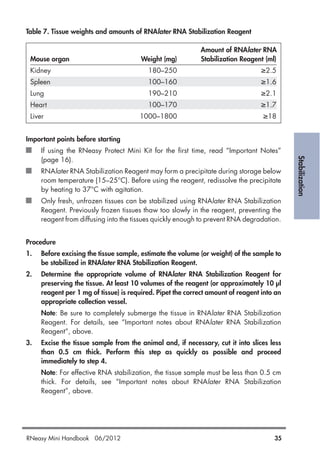
to use are given in Table 7.
Stabilization
Table 7. Tissue weights and amounts of RNAlater RNA Stabilization Reagent
Amount of RNAlater RNA
Mouse organ Weight (mg) Stabilization Reagent (ml)
Kidney 180–250 ≥2.5
Spleen 100–160 ≥1.6
Lung 190–210 ≥2.1
Heart 100–170 ≥1.7
Liver 1000–1800 ≥18
Important points before starting
If using the RNeasy Protect Mini Kit for the first time, read “Important Notes”
(page 16).
RNAlater RNA Stabilization Reagent may form a precipitate during storage below
room temperature (15–25°C). Before using the reagent, redissolve the precipitate
by heating to 37°C with agitation.
Only fresh, unfrozen tissues can be stabilized using RNAlater RNA Stabilization
Reagent. Previously frozen tissues thaw too slowly in the reagent, preventing the
reagent from diffusing into the tissues quickly enough to prevent RNA degradation.
Procedure
1. Before excising the tissue sample, estimate the volume (or weight) of the sample to
be stabilized in RNAlater RNA Stabilization Reagent.
2. Determine the appropriate volume of RNAlater RNA Stabilization Reagent for
preserving the tissue. At least 10 volumes of the reagent (or approximately 10 µl
reagent per 1 mg of tissue) is required. Pipet the correct amount of reagent into an
appropriate collection vessel.
Note: Be sure to completely submerge the tissue in RNAlater RNA Stabilization
Reagent. For details, see “Important notes about RNAlater RNA Stabilization
Reagent”, above.
3. Excise the tissue sample from the animal and, if necessary, cut it into slices less
than 0.5 cm thick. Perform this step as quickly as possible and proceed
immediately to step 4.
Note: For effective RNA stabilization, the tissue sample must be less than 0.5 cm
thick. For details, see “Important notes about RNAlater RNA Stabilization
Reagent”, above.
RNeasy Mini Handbook 06/2012 35
Stabilization
36 RNeasy Mini Handbook 06/2012
4. Completely submerge the tissue piece(s) in the collection vessel containing
RNAlater RNA Stabilization Reagent from step 2.
Note: The tissue sample must be immediately submerged in RNAlater RNA
Stabilization Reagent to protect the RNA.
5. Store the tissue submerged in RNAlater RNA Stabilization Reagent for up to
4 weeks at 2–8°C, up to 7 days at 15–25°C, or up to 1 day at 37°C.
For archival storage at –20°C, first incubate the tissue overnight in the reagent at
2–8°C. Then transfer the tissue, in the reagent, to –20°C for storage.
For archival storage at –80°C, first incubate the tissue overnight in the reagent at
2–8°C. Then remove the tissue from the reagent, and transfer it to –80°C for
storage.
Note: Lower temperatures are recommended for longer storage (e.g., 2–8°C for
up to 4 weeks instead of 37°C or room temperature (15–25°C); –20°C or –80°C
for longer storage).
Tissues stored in RNAlater RNA Stabilization Reagent at –20°C may not freeze.
The low temperature may cause the formation of crystals or a precipitate in the
reagent. This will not affect subsequent RNA purification. There is no need to
redissolve the precipitate.
RNAlater stabilized tissues stored at –20°C or –80°C can be thawed at room
temperature and frozen again for up to 20 freeze–thaw cycles without affecting
RNA quality or yield.
If transporting tissue samples in RNAlater RNA Stabilization Reagent, ensure that
the tissues always remain submerged in the reagent. Either keep the tubes upright
during transport or fill the tubes completely with RNAlater RNA Stabilization
Reagent.
6. After storage, continue with “Protocol: Purification of Total RNA from Animal
Tissues” (page 37).
AnimalTissues
Protocol: Purification of Total RNA from Animal Tissues
This protocol requires the RNeasy Mini Kit or RNeasy Protect Mini Kit.
Determining the correct amount of starting material
It is essential to use the correct amount of starting material to obtain optimal RNA yield
and purity. A maximum amount of 30 mg fresh or frozen tissue or 15–20 mg RNAlater
stabilized tissue (which is partially dehydrated) can generally be processed. For most
tissues, the RNA binding capacity of the RNeasy spin column and the lysing capacity
of Buffer RLT will not be exceeded by these amounts. Average RNA yields from various
tissues are given in Table 2 (page 17).
Some tissues, such as spleen, parts of brain, lung, and thymus are more difficult to lyse
or tend to form precipitates during RNA purification. The volume of Buffer RLT may need
to be increased to facilitate complete homogenization and to avoid significantly
reduced RNA yields, DNA contamination, or clogging of the RNeasy spin column. See
the procedure below for details.
RNA yields from fibrous tissues, such as skeletal muscle, heart, and skin, may be low
due to the abundance of contractile proteins, connective tissue, and collagen. For
maximum RNA yields from these tissues, we recommend using the RNeasy Fibrous
Tissue Mini Kit instead. See page 74 for ordering information.
Greater RNA yields from fatty tissues, such as brain and adipose tissue, can be
achieved using the RNeasy Lipid Tissue Mini Kit, which uses QIAzol Lysis Reagent for
optimal tissue lysis. See page 74 for ordering information.
If there is no information about the nature of your starting material, we recommend
starting with no more than 10 mg tissue. Depending on RNA yield and purity, it may
be possible to use up to 30 mg tissue in subsequent preparations.
Do not overload the RNeasy spin column, as this will significantly reduce RNA yield and
quality.
Weighing tissue is the most accurate way to quantitate the amount of starting material.
As a guide, a 3 mm cube (27 mm3
) of most animal tissues weighs 30–35 mg.
Important points before starting
If using the RNeasy Kit for the first time, read “Important Notes” (page 16).
If working with RNA for the first time, read Appendix A (page 61).
For optimal results, stabilize harvested tissues immediately in RNAlater RNA
Stabilization Reagent (see protocol on page 34). Tissues can be stored in the
reagent for up to 1 day at 37°C, 7 days at 15–25°C, or 4 weeks at 2–8°C, or
archived at –20°C or –80°C.
RNeasy Mini Handbook 06/2012 37
AnimalTissues
38 RNeasy Mini Handbook 06/2012
Fresh, frozen, or RNAlater stabilized tissues can be used. Tissues can be stored at
–70°C for several months. Flash-freeze tissues in liquid nitrogen, and immediately
transfer to –70°C. Do not allow tissues to thaw during weighing or handling prior
to disruption in Buffer RLT. Homogenized tissue lysates from step 4 can also be
stored at –70°C for several months. Incubate frozen lysates at 37°C in a water
bath until completely thawed and salts are dissolved before continuing with step
5. Avoid prolonged incubation, which may compromise RNA integrity.
If desired, more than 30 mg tissue can be disrupted and homogenized at the start
of the procedure (increase the volume of Buffer RLT proportionately). Use a portion
of the homogenate corresponding to no more than 30 mg tissue for RNA
purification, and store the rest at –80°C.
Buffer RLT may form a precipitate upon storage. If necessary, redissolve by
warming, and then place at room temperature (15–25°C).
Buffer RLT and Buffer RW1 contain a guanidine salt and are therefore not
compatible with disinfecting reagents containing bleach. See page 6 for safety
information.
Perform all steps of the procedure at room temperature. During the procedure,
work quickly.
Perform all centrifugation steps at 20–25°C in a standard microcentrifuge. Ensure
that the centrifuge does not cool below 20°C.
Things to do before starting
β-Mercaptoethanol (β-ME) must be added to Buffer RLT before use. Add 10 µl
β-ME per 1 ml Buffer RLT. Dispense in a fume hood and wear appropriate
protective clothing. Buffer RLT containing β-ME can be stored at room temperature
(15–25°C) for up to 1 month.
Alternatively, add 20 µl of 2 M dithiothreitol (DTT) per 1 ml Buffer RLT. The stock
solution of 2 M DTT in water should be prepared fresh or frozen in single-use
aliquots. Buffer RLT containing DTT can be stored at room temperature for up to
1 month.
Buffer RPE is supplied as a concentrate. Before using for the first time, add
4 volumes of ethanol (96–100%) as indicated on the bottle to obtain a working
solution.
If performing optional on-column DNase digestion, prepare DNase I stock solution
as described in Appendix D (page 67).
AnimalTissues
Procedure
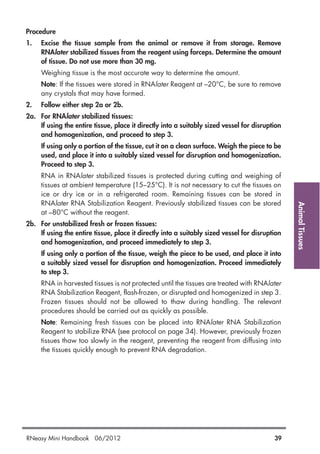
1. Excise the tissue sample from the animal or remove it from storage. Remove
RNAlater stabilized tissues from the reagent using forceps. Determine the amount
of tissue. Do not use more than 30 mg.
Weighing tissue is the most accurate way to determine the amount.
Note: If the tissues were stored in RNAlater Reagent at –20°C, be sure to remove
any crystals that may have formed.
2. Follow either step 2a or 2b.
2a. For RNAlater stabilized tissues:
If using the entire tissue, place it directly into a suitably sized vessel for disruption
and homogenization, and proceed to step 3.
If using only a portion of the tissue, cut it on a clean surface. Weigh the piece to be
used, and place it into a suitably sized vessel for disruption and homogenization.
Proceed to step 3.
RNA in RNAlater stabilized tissues is protected during cutting and weighing of
tissues at ambient temperature (15–25°C). It is not necessary to cut the tissues on
ice or dry ice or in a refrigerated room. Remaining tissues can be stored in
RNAlater RNA Stabilization Reagent. Previously stabilized tissues can be stored
at –80°C without the reagent.
2b. For unstabilized fresh or frozen tissues:
If using the entire tissue, place it directly into a suitably sized vessel for disruption
and homogenization, and proceed immediately to step 3.
If using only a portion of the tissue, weigh the piece to be used, and place it into
a suitably sized vessel for disruption and homogenization. Proceed immediately
to step 3.
RNA in harvested tissues is not protected until the tissues are treated with RNAlater
RNA Stabilization Reagent, flash-frozen, or disrupted and homogenized in step 3.
Frozen tissues should not be allowed to thaw during handling. The relevant
procedures should be carried out as quickly as possible.
Note: Remaining fresh tissues can be placed into RNAlater RNA Stabilization
Reagent to stabilize RNA (see protocol on page 34). However, previously frozen
tissues thaw too slowly in the reagent, preventing the reagent from diffusing into
the tissues quickly enough to prevent RNA degradation.
RNeasy Mini Handbook 06/2012 39
AnimalTissues
40 RNeasy Mini Handbook 06/2012
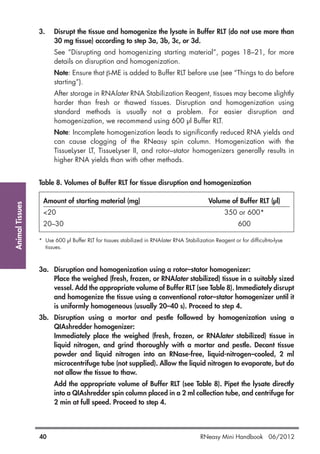
3. Disrupt the tissue and homogenize the lysate in Buffer RLT (do not use more than
30 mg tissue) according to step 3a, 3b, 3c, or 3d.
See “Disrupting and homogenizing starting material”, pages 18–21, for more
details on disruption and homogenization.
Note: Ensure that β-ME is added to Buffer RLT before use (see “Things to do before
starting”).
After storage in RNAlater RNA Stabilization Reagent, tissues may become slightly
harder than fresh or thawed tissues. Disruption and homogenization using
standard methods is usually not a problem. For easier disruption and
homogenization, we recommend using 600 µl Buffer RLT.
Note: Incomplete homogenization leads to significantly reduced RNA yields and
can cause clogging of the RNeasy spin column. Homogenization with the
TissueLyser LT, TissueLyser II, and rotor–stator homogenizers generally results in
higher RNA yields than with other methods.
Table 8. Volumes of Buffer RLT for tissue disruption and homogenization
Amount of starting material (mg) Volume of Buffer RLT (µl)
<20 350 or 600*
20–30 600
* Use 600 µl Buffer RLT for tissues stabilized in RNAlater RNA Stabilization Reagent or for difficult-to-lyse
tissues.
3a. Disruption and homogenization using a rotor–stator homogenizer:
Place the weighed (fresh, frozen, or RNAlater stabilized) tissue in a suitably sized
vessel. Add the appropriate volume of Buffer RLT (see Table 8). Immediately disrupt
and homogenize the tissue using a conventional rotor–stator homogenizer until it
is uniformly homogeneous (usually 20–40 s). Proceed to step 4.
3b. Disruption using a mortar and pestle followed by homogenization using a
QIAshredder homogenizer:
Immediately place the weighed (fresh, frozen, or RNAlater stabilized) tissue in
liquid nitrogen, and grind thoroughly with a mortar and pestle. Decant tissue
powder and liquid nitrogen into an RNase-free, liquid-nitrogen–cooled, 2 ml
microcentrifuge tube (not supplied). Allow the liquid nitrogen to evaporate, but do
not allow the tissue to thaw.
Add the appropriate volume of Buffer RLT (see Table 8). Pipet the lysate directly
into a QIAshredder spin column placed in a 2 ml collection tube, and centrifuge for
2 min at full speed. Proceed to step 4.
AnimalTissues
3c. Disruption using a mortar and pestle followed by homogenization using a needle
and syringe:
Immediately place the weighed (fresh, frozen, or RNAlater stabilized) tissue in
liquid nitrogen, and grind thoroughly with a mortar and pestle. Decant tissue
powder and liquid nitrogen into an RNase-free, liquid-nitrogen–cooled, 2 ml
microcentrifuge tube (not supplied). Allow the liquid nitrogen to evaporate, but do
not allow the tissue to thaw.
Add the appropriate volume of Buffer RLT (see Table 8), and homogenize by
passing the lysate at least 5 times through a blunt 20-gauge needle fitted to an
RNase-free syringe. Proceed to step 4.
3d. Disruption and homogenization using the TissueLyser LT or TissueLyser II:
See the TissueLyser LT Handbook or the TissueLyser Handbook. Then proceed to
step 4.
4. Centrifuge the lysate for 3 min at full speed. Carefully remove the supernatant by
pipetting, and transfer it to a new microcentrifuge tube (not supplied). Use only this
supernatant (lysate) in subsequent steps.
In some preparations, very small amounts of insoluble material will be present after
the 3 min centrifugation, making the pellet invisible.
5. Add 1 volume of 70% ethanol* to the cleared lysate, and mix immediately by
pipetting. Do not centrifuge. Proceed immediately to step 6.
Note: The volume of lysate may be less than 350 µl or 600 µl due to loss during
homogenization and centrifugation in steps 3 and 4.
Note: Precipitates may be visible after addition of ethanol. This does not affect the
procedure.
6. Transfer up to 700 µl of the sample, including any precipitate that may have
formed, to an RNeasy spin column placed in a 2 ml collection tube (supplied). Close
the lid gently, and centrifuge for 15 s at ≥8000 x g (≥10,000 rpm). Discard the
flow-through.†
Reuse the collection tube in step 7.
If the sample volume exceeds 700 µl, centrifuge successive aliquots in the same
RNeasy spin column. Discard the flow-through after each centrifugation.†
Optional: If performing optional on-column DNase digestion (see “Eliminating
genomic DNA contamination”, page 21), follow steps D1–D4 (page 67) after
performing this step.
* Using 50% ethanol (instead of 70% ethanol) may increase RNA yields from liver samples.
†
Flow-through contains Buffer RLT or Buffer RW1 and is therefore not compatible with bleach. See page 6
for safety information.
RNeasy Mini Handbook 06/2012 41
AnimalTissues
42 RNeasy Mini Handbook 06/2012
7. Add 700 µl Buffer RW1 to the RNeasy spin column. Close the lid gently, and
centrifuge for 15 s at ≥8000 x g (≥10,000 rpm) to wash the spin column membrane.
Discard the flow-through.*
Reuse the collection tube in step 8.
Note: After centrifugation, carefully remove the RNeasy spin column from the
collection tube so that the column does not contact the flow-through. Be sure to
empty the collection tube completely.
Skip this step if performing optional on-column DNase digestion (page 67).
8. Add 500 µl Buffer RPE to the RNeasy spin column. Close the lid gently, and
centrifuge for 15 s at ≥8000 x g (≥10,000 rpm) to wash the spin column membrane.
Discard the flow-through.
Reuse the collection tube in step 9.
Note: Buffer RPE is supplied as a concentrate. Ensure that ethanol is added to
Buffer RPE before use (see “Things to do before starting”).
9. Add 500 µl Buffer RPE to the RNeasy spin column. Close the lid gently, and
centrifuge for 2 min at ≥8000 x g (≥10,000 rpm) to wash the spin column membrane.
The long centrifugation dries the spin column membrane, ensuring that no ethanol
is carried over during RNA elution. Residual ethanol may interfere with
downstream reactions.
Note: After centrifugation, carefully remove the RNeasy spin column from the
collection tube so that the column does not contact the flow-through. Otherwise,
carryover of ethanol will occur.
10. Optional: Place the RNeasy spin column in a new 2 ml collection tube (supplied),
and discard the old collection tube with the flow-through. Close the lid gently, and
centrifuge at full speed for 1 min.
Perform this step to eliminate any possible carryover of Buffer RPE, or if residual
flow-through remains on the outside of the RNeasy spin column after step 9.
11. Place the RNeasy spin column in a new 1.5 ml collection tube (supplied). Add
30–50 µl RNase-free water directly to the spin column membrane. Close the lid
gently, and centrifuge for 1 min at ≥8000 x g (≥10,000 rpm) to elute the RNA.
12. If the expected RNA yield is >30 µg, repeat step 11 using another 30–50 µl RNase-
free water, or using the eluate from step 11 (if high RNA concentration is required).
Reuse the collection tube from step 11.
If using the eluate from step 11, the RNA yield will be 15–30% less than that
obtained using a second volume of RNase-free water, but the final RNA
concentration will be higher.
* Flow-through contains Buffer RLT or Buffer RW1 and is therefore not compatible with bleach. See page 6
for safety information.
Yeast
Protocol: Purification of Total RNA from Yeast
This protocol requires the RNeasy Mini Kit.
Disrupting yeast cells
This protocol for purifying total RNA from yeast provides 2 alternative methods of
disrupting the walls of yeast cells:
Enzymatic lysis: This method requires digestion of the cell wall with zymolase or
lyticase to convert cells to spheroplasts. For samples of up to 5 x 10⁷
yeast cells,
spheroplasts are separated from the digestion mixture by centrifugation before
being lysed. For samples of up to 2 x 10⁷
yeast cells, the digestion mixture is used
directly in the RNeasy procedure without prior separation of the spheroplasts.
Mechanical disruption: This method uses high-speed agitation in the TissueLyser LT,
TissueLyser II, or other bead mill in the presence of glass beads and Buffer RLT to
lyse yeast cells and release RNA.
In general, both methods function equally well. For some applications, enzymatic lysis
might be preferable since no additional laboratory equipment is required. Mechanical
disruption, however, is well-suited for time-course experiments where enzymatic
digestion incubations are not practical.
Determining the correct amount of starting material
It is essential to use the correct amount of starting material to obtain optimal RNA yield
and purity. The maximum amount depends on:
The RNA binding capacity of the RNeasy spin column (100 µg RNA)
The volume of Buffer RLT required for efficient lysis (the maximum volume of Buffer
RLT that can be used limits the maximum amount of starting material to 5 x 10⁷
yeast cells)
When processing cultures containing high amounts of RNA, fewer cells should be used,
so that the RNA binding capacity of the RNeasy spin column is not exceeded. When
processing cultures containing lower amounts of RNA, the maximum number of cells
can be used. However, even though the RNA binding capacity of the RNeasy spin
column is not reached, using more cells would lead to incomplete lysis, resulting in lower
RNA yield and purity.
Usually 2 x 10⁶
– 5 x 10⁷
yeast cells can be processed. Depending on the strain and
growth conditions, 30–100 µg RNA can be expected from 4 x 10⁷
cells.
If there is no information about the RNA content of your starting material, we
recommend starting with no more than 2 x 10⁷
yeast cells. Depending on RNA yield
and purity, it may be possible to increase the cell number in subsequent preparations.
RNeasy Mini Handbook 06/2012 43
Yeast
44 RNeasy Mini Handbook 06/2012
Do not overload the RNeasy spin column, as this will significantly reduce RNA yield and
purity.
Yeast growth is usually measured using a spectrophotometer. However, it is very difficult
to give specific and reliable recommendations for the relationship between OD values
and cell numbers in yeast cultures. Cell density is influenced by a variety of factors (e.g.,
species, media, and shaker speed), and OD readings of cultures measure light
scattering rather than absorption. Measurements of light scattering are highly
dependent on the distance between the sample and the detector and therefore readings
vary between different types of spectrophotometer. In addition, different species show
different OD values at defined wavelengths (e.g., 600 nm or 436 nm).
We therefore recommend calibrating the spectrophotometer by comparing OD
measurements at appropriate wavelengths with viable cell densities determined by
plating experiments (e.g., Ausubel, F.M. et al., eds. [1991] Current Protocols in
Molecular Biology. New York: Wiley Interscience). OD readings should be between
0.05 and 0.3 to ensure significance. Samples with readings above 0.3 should be
diluted so that the readings fall within this range; the dilution factor should then be used
to calculate the number of cells per milliliter.
The following values may be used as a rough guide. An S. cerevisiae culture containing
1–2 x 10⁷
cells per milliliter, diluted 1 in 4, gives an OD600 value of approximately 0.25
with a Beckman DU®
-7400 spectrophotometer or 0.125 with a Beckman DU-40
spectrophotometer. These correspond to calculated OD values of 1 or 0.5, respectively,
for 1–2 x 10⁷
yeast cells per milliliter.
Important points before starting
If using the RNeasy Kit for the first time, read “Important Notes” (page 16).
If working with RNA for the first time, read Appendix A (page 61).
Yeast cells should be harvested in log-phase growth. If performing enzymatic lysis
(step 1a or 1b), use only freshly harvested cells. If performing mechanical
disruption, cell pellets can be stored at –70°C for later use or used directly in the
procedure. Homogenized cell lysates from step 1c can be stored at –70°C for
several months. Frozen lysates should be incubated at 37°C in a water bath until
completely thawed and salts are dissolved. Avoid prolonged incubation, which
may compromise RNA integrity. Proceed to step 2.
Buffer RLT may form a precipitate upon storage. If necessary, redissolve by
warming, and then place at room temperature (15–25°C).
Buffer RLT and Buffer RW1 contain a guanidine salt and are therefore not
compatible with disinfecting reagents containing bleach. See page 6 for safety
information.
After enzymatic lysis or mechanical disruption, perform all steps of the procedure
at room temperature. During the procedure, work quickly.
Yeast
After harvesting the cells, perform all centrifugation steps at 20–25°C in a
standard microcentrifuge. Ensure that the centrifuge does not cool below 20°C.
Things to do before starting
β-Mercaptoethanol (β-ME) must be added to Buffer RLT before use. Add 10 µl
β-ME per 1 ml Buffer RLT. Dispense in a fume hood and wear appropriate
protective clothing. Buffer RLT containing β-ME can be stored at room temperature
(15–25°C) for up to 1 month.
Buffer RPE is supplied as a concentrate. Before using for the first time, add
4 volumes of ethanol (96–100%) as indicated on the bottle to obtain a working
solution.
If performing optional on-column DNase digestion, prepare DNase I stock solution
as described in Appendix D (page 67).
If performing enzymatic lysis (step 1a or 1b), prepare Buffer Y1 as follows. Prepare
a solution containing 1 M sorbitol and 0.1 M EDTA, pH 7.4. Just before use, add
0.1% β-ME and lyticase/zymolase (final concentration of 50 U per 1 x 10⁷
cells).
Depending on the yeast strain and enzyme used, the incubation time, enzyme
concentration, and composition of Buffer Y1 may vary. Please follow the guidelines
of the enzyme supplier.
If performing mechanical disruption (step 1c), prepare acid-washed glass beads,
0.45–0.55 mm diameter, by soaking in concentrated nitric acid for 1 hour in a
fume hood, washing extensively with deionized water, and drying in a baking
oven.
Procedure
1. Prepare yeast lysate according to step 1a (enzymatic lysis for ≤5 x 10⁷
cells), step
1b (enzymatic lysis for ≤2 x 10⁷
cells), or step 1c (mechanical disruption).
1a. Enzymatic lysis of ≤5 x 10⁷
freshly harvested cells (do not use more than 5 x 10⁷
cells):
Harvest the cells in a 12 ml or 15 ml centrifuge tube by centrifuging at
1000 x g for 5 min at 4°C. Decant the supernatant, and carefully remove any
remaining media by aspiration. If the centrifuge will be used later in this
procedure, heat it to 20–25°C.
Note: Incomplete removal of medium will affect digestion of the cell wall.
Resuspend the cells in 2 ml freshly prepared Buffer Y1 containing lyticase or
zymolase. Incubate for 10–30 min at 30°C with gentle shaking to generate
spheroplasts. Spheroplasts must be handled gently.
RNeasy Mini Handbook 06/2012 45
Yeast
46 RNeasy Mini Handbook 06/2012
Depending on the yeast strain used, the incubation time, amount of enzyme,
and composition of Buffer Y1 may vary. For optimal results, follow the
guidelines of the enzyme supplier. Complete spheroplasting is essential for
efficient lysis.
Centrifuge for 5 min at 300 x g to pellet the spheroplasts. Carefully remove
and discard the supernatant.
Note: Incomplete removal of the supernatant will inhibit lysis and dilute the
lysate, affecting the conditions for binding of RNA to the RNeasy membrane.
Both effects may reduce RNA yield.
Add 350 µl Buffer RLT and vortex vigorously to lyse the spheroplasts. If
insoluble material is visible, centrifuge for 2 min at full speed, and use only
the supernatant in subsequent steps.
Note: Ensure that β-ME is added to Buffer RLT before use (see “Things to do
before starting”).
Add 1 volume (usually 350 µl) of 70% ethanol to the homogenized lysate, and
mix well by pipetting. Do not centrifuge. Proceed immediately to step 2.
Precipitates may be visible after addition of ethanol. This does not affect the
procedure.
1b. Enzymatic lysis of ≤2 x 10⁷
freshly harvested cells (do not use more than 2 x 10⁷
cells):
Harvest the cells in a 12 ml or 15 ml centrifuge tube by centrifuging at
1000 x g for 5 min at 4°C. Decant the supernatant, and carefully remove any
remaining media by aspiration. If the centrifuge will be used later in this
procedure, heat it to 20–25°C.
Note: Incomplete removal of medium will affect digestion of the cell wall.
Resuspend the cells in 100 µl freshly prepared Buffer Y1 containing lyticase
or zymolase. Incubate for 10–30 min at 30°C with gentle shaking to generate
spheroplasts. Spheroplasts must be handled gently.
Depending on the yeast strain used, the incubation time, amount of enzyme,
and composition of Buffer Y1 may vary. For optimal results, follow the
guidelines of the enzyme supplier. Complete spheroplasting is essential for
efficient lysis.
Add 350 µl Buffer RLT and vortex vigorously to lyse the spheroplasts. If
insoluble material is visible, centrifuge for 2 min at full speed, and use only
the supernatant in subsequent steps.
Note: Ensure that β-ME is added to Buffer RLT before use (see “Things to do
before starting”).
Add 250 µl ethanol (96–100%) to the homogenized lysate, and mix well by
pipetting. Do not centrifuge. Proceed immediately to step 2.
Yeast
Precipitates may be visible after addition of ethanol. This does not affect the
procedure.
1c. Mechanical disruption of cells (do not use more than 5 x 10⁷
cells):
Add approximately 600 µl of acid-washed glass beads to a tube that fits the
TissueLyser LT, TissueLyser II, or other bead mill (see page 20 for details).
Harvest the cells by centrifuging at 1000 x g for 5 min at 4°C. Decant the
supernatant, and carefully remove any remaining media by aspiration. If the
centrifuge will be used later in this procedure, heat it to 20–25°C.
Note: Incomplete removal of the supernatant will inhibit lysis and dilute the
lysate, affecting the conditions for binding of RNA to the RNeasy membrane.
Both effects may reduce RNA yield.
Loosen the cell pellet thoroughly by flicking the tube. Add 600 µl Buffer RLT,
and vortex to resuspend the cell pellet. Add the sample to the acid-washed
glass beads.
Note: Ensure that β-ME is added to Buffer RLT before use (see “Things to do
before starting”).
Vortex and agitate the sample at top speed in the TissueLyser LT, TissueLyser II,
or other bead mill with cooling until cells are completely disrupted.
Most small-capacity bead mills do not have a cooling mechanism and
therefore require the user to stop the bead mill regularly and cool the sample
on ice. The time required for cell disruption and the length and frequency of
the cooling intervals may vary depending on the type of bead mill used.
Please refer to the supplier’s instructions.
Note: Do not replace bead-milling with vortexing, as this significantly reduces
RNA yield.
Remove the sample from the TissueLyser LT, TissueLyser II, or bead mill, and
allow the beads to settle. Transfer the lysate (usually 350 µl) to a new
microcentrifuge tube (not supplied). Centrifuge for 2 min at full speed, and
transfer the supernatant to a new microcentrifuge tube (not supplied). Use
only the supernatant in subsequent steps.
Add 1 volume of 70% ethanol to the homogenized lysate, and mix well by
pipetting. Do not centrifuge. Proceed to step 2.
Note: The volume of lysate may be less than 350 µl due to loss during
homogenization.
Note: Precipitates may be visible after addition of ethanol. This does not
affect the procedure.
RNeasy Mini Handbook 06/2012 47
Yeast
48 RNeasy Mini Handbook 06/2012
2. Transfer the sample (usually 700 µl), including any precipitate that may have
formed, to an RNeasy spin column placed in a 2 ml collection tube (supplied). Close
the lid gently, and centrifuge for 15 s at ≥8000 x g (≥10,000 rpm). Discard the
flow-through.*
Reuse the collection tube in step 3.
If the sample volume exceeds 700 µl, centrifuge successive aliquots in the same
RNeasy spin column. Discard the flow-through after each centrifugation.*
Optional: If performing optional on-column DNase digestion (see “Eliminating
genomic DNA contamination”, page 21), follow steps D1–D4 (page 67) after
performing this step.
3. Add 700 µl Buffer RW1 to the RNeasy spin column. Close the lid gently, and
centrifuge for 15 s at ≥8000 x g (≥10,000 rpm) to wash the spin column membrane.
Discard the flow-through.*
Reuse the collection tube in step 4.
Note: After centrifugation, carefully remove the RNeasy spin column from the
collection tube so that the column does not contact the flow-through. Be sure to
empty the collection tube completely.
Skip this step if performing optional on-column DNase digestion (page 67).
4. Add 500 µl Buffer RPE to the RNeasy spin column. Close the lid gently, and
centrifuge for 15 s at ≥8000 x g (≥10,000 rpm) to wash the spin column membrane.
Discard the the flow-through.
Reuse the collection tube in step 5.
Note: Buffer RPE is supplied as a concentrate. Ensure that ethanol is added to
Buffer RPE before use (see “Things to do before starting”).
5. Add 500 µl Buffer RPE to the RNeasy spin column. Close the lid gently, and
centrifuge for 2 min at ≥8000 x g (≥10,000 rpm) to wash the spin column membrane.
The long centrifugation dries the spin column membrane, ensuring that no ethanol
is carried over during RNA elution. Residual ethanol may interfere with
downstream reactions.
Note: After centrifugation, carefully remove the RNeasy spin column from the
collection tube so that the column does not contact the flow-through. Otherwise,
carryover of ethanol will occur.
* Flow-through contains Buffer RLT or Buffer RW1 and is therefore not compatible with bleach. See page 6
for safety information.
Yeast
6. Optional: Place the RNeasy spin column in a new 2 ml collection tube (supplied),
and discard the old collection tube with the flow-through. Close the lid gently, and
centrifuge at full speed for 1 min.
Perform this step to eliminate any possible carryover of Buffer RPE, or if residual
flow-through remains on the outside of the RNeasy spin column after step 5.
7. Place the RNeasy spin column in a new 1.5 ml collection tube (supplied). Add
30–50 µl RNase-free water directly to the spin column membrane. Close the lid
gently, and centrifuge for 1 min at ≥8000 x g (≥10,000 rpm) to elute the RNA.
8. If the expected RNA yield is >30 µg, repeat step 7 using another 30–50 µl RNase-
free water, or using the eluate from step 7 (if high RNA concentration is required).
Reuse the collection tube from step 7.
If using the eluate from step 7, the RNA yield will be 15–30% less than that
obtained using a second volume of RNase-free water, but the final RNA
concentration will be higher.
RNeasy Mini Handbook 06/2012 49
PlantsandFungi
50 RNeasy Mini Handbook 06/2012
Protocol: Purification of Total RNA from Plant Cells and
Tissues and Filamentous Fungi
This protocol requires the RNeasy Plant Mini Kit.
Determining the correct amount of starting material
It is essential to use the correct amount of starting material to obtain optimal RNA yield
and purity. A maximum amount of 100 mg plant material or 1 x 10⁷
cells can generally
be processed. For most plant materials, the RNA binding capacity of the RNeasy spin
column and the lysing capacity of Buffer RLT will not be exceeded by these amounts.
Average RNA yields from various plant materials are given in Table 2 (page 17).
If there is no information about the nature of your starting material, we recommend
starting with no more than 50 mg plant material or 3–4 x 10⁶
cells. Depending on RNA
yield and purity, it may be possible to use up to 100 mg plant material or up to 1 x 10⁷
cells in subsequent preparations.
Do not overload the RNeasy spin column, as this will significantly reduce RNA yield and
quality.
Counting cells or weighing tissue is the most accurate way to quantitate the amount of
starting material. As a guide, a 1.5 cm diameter leaf disc weighs 25–75 mg.
Important points before starting
If using the RNeasy Plant Mini Kit for the first time, read “Important Notes”
(page 16).
If working with RNA for the first time, read Appendix A (page 61).
Fresh or frozen tissues can be used. Tissues can be stored at –70°C for several
months. Flash-freeze tissues in liquid nitrogen, and immediately transfer to –70°C.
Do not allow tissues to thaw during weighing or handling prior to disruption in
Buffer RLT. Homogenized tissue lysates from step 4 can also be stored at –70°C
for several months. Incubate frozen lysates at 37°C in a water bath until completely
thawed and salts are dissolved before continuing with step 5. Avoid prolonged
incubation, which may compromise RNA integrity.
The RNeasy Plant Mini Kit provides a choice of lysis buffers: Buffer RLT and Buffer
RLC, which contain guanidine thiocyanate and guanidine hydrochloride,
respectively. In most cases, Buffer RLT is the lysis buffer of choice due to the greater
cell disruption and denaturation properties of guanidine thiocyanate. However,
depending on the amount and type of secondary metabolites in some tissues (such
as milky endosperm of maize or mycelia of filamentous fungi), guanidine
thiocyanate can cause solidification of the sample, making extraction of RNA
impossible. In these cases, Buffer RLC should be used.
PlantsandFungi
Buffer RLT may form a precipitate upon storage. If necessary, redissolve by
warming, and then place at room temperature (15–25°C).
Buffer RLT, Buffer RLC, and Buffer RW1 contain a guanidine salt and are therefore
not compatible with disinfecting reagents containing bleach. See page 6 for safety
information.
Perform all steps of the procedure at room temperature. During the procedure,
work quickly.
Perform all centrifugation steps at 20–25°C in a standard microcentrifuge. Ensure
that the centrifuge does not cool below 20°C.
Things to do before starting
β-Mercaptoethanol (β-ME) must be added to Buffer RLT or Buffer RLC before use.
Add 10 µl β-ME per 1 ml Buffer RLT or Buffer RLC. Dispense in a fume hood and
wear appropriate protective clothing. Buffer RLT or Buffer RLC containing β-ME can
be stored at room temperature (15–25°C) for up to 1 month.
Buffer RPE is supplied as a concentrate. Before using for the first time, add
4 volumes of ethanol (96–100%) as indicated on the bottle to obtain a working
solution.
If performing optional on-column DNase digestion, prepare DNase I stock solution
as described in Appendix D (page 67).
Procedure
1. Determine the amount of plant material. Do not use more than 100 mg.
Weighing tissue is the most accurate way to determine the amount.
2. Immediately place the weighed tissue in liquid nitrogen, and grind thoroughly with
a mortar and pestle. Decant tissue powder and liquid nitrogen into an RNase-free,
liquid-nitrogen–cooled, 2 ml microcentrifuge tube (not supplied). Allow the liquid
nitrogen to evaporate, but do not allow the tissue to thaw. Proceed immediately to
step 3.
RNA in plant tissues is not protected until the tissues are flash-frozen in liquid
nitrogen. Frozen tissues should not be allowed to thaw during handling. The
relevant procedures should be carried out as quickly as possible.
RNeasy Mini Handbook 06/2012 51
PlantsandFungi
52 RNeasy Mini Handbook 06/2012
3. Add 450 µl Buffer RLT or Buffer RLC (see “Important points before starting”) to a
maximum of 100 mg tissue powder. Vortex vigorously.
A short 1–3 min incubation at 56°C may help to disrupt the tissue. However, do
not incubate samples with a high starch content at elevated temperatures,
otherwise swelling of the sample will occur.
Note: Ensure that β-ME is added to Buffer RLT or Buffer RLC before use (see “Things
to do before starting”).
4. Transfer the lysate to a QIAshredder spin column (lilac) placed in a 2 ml collection
tube, and centrifuge for 2 min at full speed. Carefully transfer the supernatant of
the flow-through to a new microcentrifuge tube (not supplied) without disturbing
the cell-debris pellet in the collection tube. Use only this supernatant in subsequent
steps.
It may be necessary to cut off the end of the pipet tip to facilitate pipetting of the
lysate into the QIAshredder spin column. Centrifugation through the QIAshredder
spin column removes cell debris and simultaneously homogenizes the lysate.
While most of the cell debris is retained on the QIAshredder spin column, a very
small amount of cell debris will pass through and form a pellet in the collection
tube. Be careful not to disturb this pellet when transferring the lysate to the new
microcentrifuge tube.
5. Add 0.5 volume of ethanol (96–100%) to the cleared lysate, and mix immediately
by pipetting. Do not centrifuge. Proceed immediately to step 6.
Note: The volume of lysate may be less than 450 µl due to loss during
homogenization.
Note: Precipitates may be visible after addition of ethanol. This does not affect the
procedure.
6. Transfer the sample (usually 650 µl), including any precipitate that may have
formed, to an RNeasy spin column (pink) placed in a 2 ml collection tube (supplied).
Close the lid gently, and centrifuge for 15 s at ≥8000 x g (≥10,000 rpm). Discard
the flow-through.*
Reuse the collection tube in step 7.
If the sample volume exceeds 700 µl, centrifuge successive aliquots in the same
RNeasy spin column. Discard the flow-through after each centrifugation.*
Optional: If performing optional on-column DNase digestion (see “Eliminating
genomic DNA contamination”, page 21), follow steps D1–D4 (page 67) after
performing this step.
* Flow-through contains Buffer RLT, Buffer RLC, or Buffer RW1 and is therefore not compatible with bleach.
See page 6 for safety information.
PlantsandFungi
7. Add 700 µl Buffer RW1 to the RNeasy spin column. Close the lid gently, and
centrifuge for 15 s at ≥8000 x g (≥10,000 rpm) to wash the spin column membrane.
Discard the flow-through.*
Reuse the collection tube in step 8.
Note: After centrifugation, carefully remove the RNeasy spin column from the
collection tube so that the column does not contact the flow-through. Be sure to
empty the collection tube completely.
Skip this step if performing optional on-column DNase digestion (page 67).
8. Add 500 µl Buffer RPE to the RNeasy spin column. Close the lid gently, and
centrifuge for 15 s at ≥8000 x g (≥10,000 rpm) to wash the spin column membrane.
Discard the flow-through.
Reuse the collection tube in step 9.
Note: Buffer RPE is supplied as a concentrate. Ensure that ethanol is added to
Buffer RPE before use (see “Things to do before starting”).
9. Add 500 µl Buffer RPE to the RNeasy spin column. Close the lid gently, and
centrifuge for 2 min at ≥8000 x g (≥10,000 rpm) to wash the spin column membrane.
The long centrifugation dries the spin column membrane, ensuring that no ethanol
is carried over during RNA elution. Residual ethanol may interfere with
downstream reactions.
Note: After centrifugation, carefully remove the RNeasy spin column from the
collection tube so that the column does not contact the flow-through. Otherwise,
carryover of ethanol will occur.
10. Optional: Place the RNeasy spin column in a new 2 ml collection tube (supplied),
and discard the old collection tube with the flow-through. Close the lid gently, and
centrifuge at full speed for 1 min.
Perform this step to eliminate any possible carryover of Buffer RPE, or if residual
flow-through remains on the outside of the RNeasy spin column after step 9.
11. Place the RNeasy spin column in a new 1.5 ml collection tube (supplied). Add
30–50 µl RNase-free water directly to the spin column membrane. Close the lid
gently, and centrifuge for 1 min at ≥8000 x g (≥10,000 rpm) to elute the RNA.
12. If the expected RNA yield is >30 µg, repeat step 11 using another 30–50 µl RNase-
free water, or using the eluate from step 11 (if high RNA concentration is required).
Reuse the collection tube from step 11.
If using the eluate from step 11, the RNA yield will be 15–30% less than that
obtained using a second volume of RNase-free water, but the final RNA
concentration will be higher.
* Flow-through contains Buffer RLT, Buffer RLC, or Buffer RW1 and is therefore not compatible with bleach.
See page 6 for safety information.
RNeasy Mini Handbook 06/2012 53
RNACleanup
54 RNeasy Mini Handbook 06/2012
Protocol: RNA Cleanup
The RNeasy Mini Kit can be used to clean up RNA previously isolated by different
methods or after enzymatic reactions, such as labeling or DNase digestion.
Determining the correct amount of starting material
A maximum of 100 µg RNA can be cleaned up in this protocol. This amount
corresponds to the RNA binding capacity of the RNeasy spin column.
Important points before starting
If using the RNeasy Kit for the first time, read “Important Notes” (page 16).
If working with RNA for the first time, read Appendix A (page 61).
Buffer RLT may form a precipitate upon storage. If necessary, redissolve by
warming, and then place at room temperature (15–25°C).
Buffer RLT contains a guanidine salt and is therefore not compatible with
disinfecting reagents containing bleach. See page 6 for safety information.
Perform all steps of the procedure at room temperature. During the procedure,
work quickly.
Perform all centrifugation steps at 20–25°C in a standard microcentrifuge. Ensure
that the centrifuge does not cool below 20°C.
Things to do before starting
Buffer RPE is supplied as a concentrate. Before using for the first time, add
4 volumes of ethanol (96–100%) as indicated on the bottle to obtain a working
solution.
If performing optional on-column DNase digestion, prepare DNase I stock solution
as described in Appendix D (page 67).
Procedure
1. Adjust the sample to a volume of 100 µl with RNase-free water. Add 350 µl Buffer
RLT, and mix well.
2. Add 250 µl ethanol (96–100%) to the diluted RNA, and mix well by pipetting. Do
not centrifuge. Proceed immediately to step 3.
RNACleanup
3. Transfer the sample (700 µl) to an RNeasy Mini spin column placed in a 2 ml
collection tube (supplied). Close the lid gently, and centrifuge for 15 s at
≥8000 x g (≥10,000 rpm). Discard the flow-through.*
Reuse the collection tube in step 4.
Note: After centrifugation, carefully remove the RNeasy spin column from the
collection tube so that the column does not contact the flow-through. Be sure to
empty the collection tube completely.
Optional: If performing optional on-column DNase digestion (see “Eliminating
genomic DNA contamination”, page 21), follow steps D1–D4 (page 67) after
performing this step.
4. Add 500 µl Buffer RPE to the RNeasy spin column. Close the lid gently, and
centrifuge for 15 s at ≥8000 x g (≥10,000 rpm) to wash the spin column membrane.
Discard the flow-through.
Reuse the collection tube in step 5.
Note: Buffer RPE is supplied as a concentrate. Ensure that ethanol is added to
Buffer RPE before use (see “Things to do before starting”).
5. Add 500 µl Buffer RPE to the RNeasy spin column. Close the lid gently, and
centrifuge for 2 min at ≥8000 x g (≥10,000 rpm) to wash the spin column membrane.
The long centrifugation dries the spin column membrane, ensuring that no ethanol
is carried over during RNA elution. Residual ethanol may interfere with
downstream reactions.
Note: After centrifugation, carefully remove the RNeasy spin column from the
collection tube so that the column does not contact the flow-through. Otherwise,
carryover of ethanol will occur.
6. Optional: Place the RNeasy spin column in a new 2 ml collection tube (supplied),
and discard the old collection tube with the flow-through. Close the lid gently, and
centrifuge at full speed for 1 min.
Perform this step to eliminate any possible carryover of Buffer RPE, or if residual
flow-through remains on the outside of the RNeasy spin column after step 5.
7. Place the RNeasy spin column in a new 1.5 ml collection tube (supplied). Add
30–50 µl RNase-free water directly to the spin column membrane. Close the lid
gently, and centrifuge for 1 min at ≥8000 x g (≥10,000 rpm) to elute the RNA.
8. If the expected RNA yield is >30 µg, repeat step 7 using another 30–50 µl RNase-
free water, or using the eluate from step 7 (if high RNA concentration is required).
Reuse the collection tube from step 7.
If using the eluate from step 7, the RNA yield will be 15–30% less than that
obtained using a second volume of RNase-free water, but the final RNA
concentration will be higher.
* Flow-through contains Buffer RLT and is therefore not compatible with bleach. See page 6 for safety information.
RNeasy Mini Handbook 06/2012 55
Troubleshooting Guide
This troubleshooting guide may be helpful in solving any problems that may arise. For
more information, see also the Frequently Asked Questions page at our Technical Support
Center: www.qiagen.com/FAQ/FAQList.aspx. The scientists in QIAGEN Technical
Services are always happy to answer any questions you may have about either the
information and protocols in this handbook or sample and assay technologies (for contact
information, see back cover or visit www.qiagen.com).
Comments and suggestions
Clogged RNeasy spin column
a) Inefficient disruption See “Disrupting and homogenizing starting
and/or homogenization material” (pages 18–21) for details on
disruption and homogenization methods.
Increase g-force and centrifugation time if
necessary.
In subsequent preparations, reduce the
amount of starting material (see protocols)
and/or increase the volume of lysis buffer
and the homogenization time.
If working with tissues rich in proteins, we
recommend using the RNeasy Fibrous Tissue
Mini Kit (see page 74 for ordering
information).
b) Too much starting material In subsequent preparations, reduce the
amount of starting material. It is essential to
use the correct amount of starting material
(see protocols).
c) Centrifugation before adding Centrifuge the lysate before adding ethanol,
ethanol not performed (protocols and use only this supernatant in subsequent
for tissues and mechanical steps (see protocols). Pellets contain cell
disruption of yeast) debris that can clog the RNeasy spin column.
56 RNeasy Mini Handbook 06/2012
Comments and suggestions
d) Centrifugation temperature too low The centrifugation temperature should be
20–25°C. Some centrifuges may cool to
below 20°C even when set at 20°C. This
can cause formation of precipitates that can
clog the RNeasy spin column. If this
happens, set the centrifugation temperature
to 25°C. Warm the ethanol-containing
lysate to 37°C before transferring it to the
RNeasy spin column.
Low RNA yield
a) Insufficient disruption and See “Disrupting and homogenizing starting
homogenization material” (pages 18–21) for details on
disruption and homogenization methods.
Increase g-force and centrifugation time if
necessary.
In subsequent preparations, reduce the
amount of starting material (see protocols)
and/or increase the volume of lysis buffer
and the homogenization time.
If working with tissues rich in proteins, we
recommend using the RNeasy Fibrous Tissue
Mini Kit (see page 74 for ordering
information).
b) Too much starting material In subsequent preparations, reduce the
amount of starting material. It is essential to
use the correct amount of starting material
(see protocols).
c) RNA still bound to RNeasy Repeat RNA elution, but incubate the
spin column membrane RNeasy spin column on the benchtop for
10 min with RNase-free water before
centrifuging.
RNeasy Mini Handbook 06/2012 57
Comments and suggestions
d) Ethanol carryover During the second wash with Buffer RPE, be
sure to centrifuge at ≥8000 x g (≥10,000
rpm) for 2 min at 20–25°C to dry the
RNeasy spin column membrane. After
centrifugation, carefully remove the column
from the collection tube so that the column
does not contact the flow-through.
Otherwise, carryover of ethanol will occur.
To eliminate any chance of possible ethanol
carryover, place the RNeasy spin column in
a new 2 ml collection tube and perform the
optional 1-min centrifugation step as
described in the protocols.
e) Incomplete removal of cell-culture When processing cultured cells, ensure
medium (cell samples) complete removal of the cell-culture medium
after harvesting cells (see protocols).
Low A260/A280 value
Water used to dilute RNA for Use 10 mM Tris·Cl, pH 7.5, not RNase-free
A260/A280 measurement water, to dilute the sample before measuring
purity (see Appendix B, page 63).
RNA degraded
a) Harvested animal tissue not Submerge the tissue in the appropriate
immediately stabilized volume of RNAlater RNA Stabilization
Reagent immediately after harvesting.
b) Too much animal tissue for Reduce the amount of tissue or increase the
proper stabilization amount of RNAlater RNA Stabilization
Reagent used for stabilization (see protocol
on page 34).
c) Animal tissue too thick for Cut large samples into slices less than
stabilization 0.5 cm thick for stabilization in RNAlater
RNA Stabilization Reagent.
d) Frozen animal tissue used for Use only fresh, unfrozen tissue for
stabilization stabilization in RNAlater RNA Stabilization
Reagent.
e) Storage duration in RNAlater RNAlater stabilized tissue can be stored for
RNA Stabilization Reagent up to 1 day at 37°C, up to 7 days at
exceeded 15–25°C, or up to 4 weeks at 2–8°C, and
can be archived at –20°C or –80°C.
58 RNeasy Mini Handbook 06/2012
Comments and suggestions
f) Inappropriate handling of Ensure that tissue samples are properly
starting material stabilized and stored in RNAlater RNA
Stabilization Reagent.
For frozen cell pellets or frozen tissue
samples, ensure that they were flash-frozen
immediately in liquid nitrogen and properly
stored at –70°C. Perform the RNeasy
procedure quickly, especially the first few
steps.
See Appendix A (page 61), “Handling and
storing starting material” (page 18), and the
RNAlater protocol (page 34).
g) RNase contamination Although all RNeasy buffers have been
tested and are guaranteed RNase-free,
RNases can be introduced during use. Be
certain not to introduce any RNases during
the RNeasy procedure or later handling. See
Appendix A (page 61) for general remarks
on handling RNA.
Do not put RNA samples into a vacuum
dryer that has been used in DNA
preparations where RNases may have been
used.
DNA contamination in downstream experiments
a) Optimal procedure not used For animal cells, we recommend purifying
(cell samples) cytoplasmic RNA for applications where the
absence of DNA contamination is critical,
since intact nuclei are removed at the start of
the procedure. The protocol can be
downloaded at www.qiagen.com/
literature/protocols/RNeasyMini.aspx.
b) No incubation with Buffer RW1 In subsequent preparations, incubate the
RNeasy spin column for 5 min at room
temperature (15–25°C) after addition of
Buffer RW1 and before centrifuging.
RNeasy Mini Handbook 06/2012 59
Comments and suggestions
c) No DNase treatment Perform optional on-column DNase
digestion using the RNase-Free DNase Set
(see Appendix D, page 67) at the point
indicated in the individual protocols.
Alternatively, after the RNeasy procedure,
DNase digest the RNA eluate. After
inactivating the DNase by heat treatment,
the RNA can be either used directly in the
downstream application without further
treatment, or repurified using the RNA
cleanup protocol (page 54).
RNA does not perform well in downstream experiments
a) Salt carryover during elution Ensure that Buffer RPE is at 20–30°C.
When reusing collection tubes between
washing steps, remove residual flow-through
from the rim by blotting on clean paper
towels.
b) Ethanol carryover During the second wash with Buffer RPE, be
sure to centrifuge at ≥8000 x g (≥10,000
rpm) for 2 min at 20–25°C to dry the
RNeasy spin column membrane. After
centrifugation, carefully remove the column
from the collection tube so that the column
does not contact the flow-through.
Otherwise, carryover of ethanol will occur.
To eliminate any chance of possible ethanol
carryover, place the RNeasy spin column in
a new 2 ml collection tube and perform the
optional 1-min centrifugation step as
described in the protocols.
60 RNeasy Mini Handbook 06/2012
Appendix A: General Remarks on Handling RNA
Handling RNA
Ribonucleases (RNases) are very stable and active enzymes that generally do not
require cofactors to function. Since RNases are difficult to inactivate and even minute
amounts are sufficient to destroy RNA, do not use any plasticware or glassware without
first eliminating possible RNase contamination. Great care should be taken to avoid
inadvertently introducing RNases into the RNA sample during or after the purification
procedure. To create and maintain an RNase-free environment, the following precautions
must be taken during pretreatment and use of disposable and nondisposable vessels
and solutions while working with RNA.
General handling
Proper microbiological, aseptic technique should always be used when working with
RNA. Hands and dust particles may carry bacteria and molds and are the most common
sources of RNase contamination. Always wear latex or vinyl gloves while handling
reagents and RNA samples to prevent RNase contamination from the surface of the skin
or from dusty laboratory equipment. Change gloves frequently and keep tubes closed
whenever possible. Keep purified RNA on ice when aliquots are pipetted for
downstream applications.
To remove RNase contamination from bench surfaces, nondisposable plasticware, and
laboratory equipment (e.g., pipets and electrophoresis tanks), use of RNaseKiller (cat. no
2500080) from 5 PRIME (www.5prime.com) is recommended. RNase contamination
can alternatively be removed using general laboratory reagents. To decontaminate
plasticware, rinse with 0.1 M NaOH, 1 mM EDTA* followed by RNase-free water (see
"Solutions", page 62), or rinse with chloroform* if the plasticware is chloroform-resist-
ant. To decontaminate electrophoresis tanks, clean with detergent (e.g., 0.5% SDS),*
rinse with RNase-free water, rinse with ethanol (if the tanks are ethanol-resistant), and
allow to dry.
Disposable plasticware
The use of sterile, disposable polypropylene tubes is recommended throughout the
procedure. These tubes are generally RNase-free and do not require pretreatment to
inactivate RNases.
* When working with chemicals, always wear a suitable lab coat, disposable gloves, and protective goggles.
For more information, consult the appropriate safety data sheets (SDSs), available from the product supplier.
RNeasy Mini Handbook 06/2012 61
Glassware
Glassware should be treated before use to ensure that it is RNase-free. Glassware used
for RNA work should be cleaned with a detergent,* thoroughly rinsed, and oven baked
at 240°C for at least 4 hours (overnight, if more convenient) before use. Autoclaving
alone will not fully inactivate many RNases. Alternatively, glassware can be treated with
DEPC* (diethyl pyrocarbonate), as described in "Solutions" below.
Solutions
Solutions (water and other solutions) should be treated with 0.1% DEPC. DEPC is a
strong, but not absolute, inhibitor of RNases. It is commonly used at a concentration of
0.1% to inactivate RNases on glass or plasticware or to create RNase-free solutions and
water. DEPC inactivates RNases by covalent modification. Add 0.1 ml DEPC to 100 ml
of the solution to be treated and shake vigorously to bring the DEPC into solution. Let
the solution incubate for 12 hours at 37°C. Autoclave for 15 minutes to remove any
trace of DEPC. DEPC will react with primary amines and cannot be used directly to treat
Tris* buffers. DEPC is highly unstable in the presence of Tris buffers and decomposes
rapidly into ethanol and CO2. When preparing Tris buffers, treat water with DEPC first,
and then dissolve Tris to make the appropriate buffer. Trace amounts of DEPC will
modify purine residues in RNA by carbethoxylation. Carbethoxylated RNA is translated
with very low efficiency in cell-free systems. However, its ability to form DNA:RNA or
RNA:RNA hybrids is not seriously affected unless a large fraction of the purine residues
have been modified. Residual DEPC must always be eliminated from solutions or vessels
by autoclaving or heating to 100°C for 15 minutes.
Note: RNeasy buffers are guaranteed RNase-free without using DEPC treatment and are
therefore free of any DEPC contamination.
* When working with chemicals, always wear a suitable lab coat, disposable gloves, and protective goggles.
For more information, consult the appropriate safety data sheets (SDSs), available from the product supplier.
62 RNeasy Mini Handbook 06/2012
Appendix B: Storage, Quantification, and
Determination of Quality of RNA
Storage of RNA
Purified RNA may be stored at –20°C or –70°C in RNase-free water. Under these
conditions, no degradation of RNA is detectable after 1 year.
Quantification of RNA
The concentration of RNA should be determined by measuring the absorbance at
260 nm (A260) in a spectrophotometer (see “Spectrophotometric quantification of RNA”
below). For small amounts of RNA, however, it may be difficult to determine amounts
photometrically. Small amounts of RNA can be accurately quantified using an Agilent®
2100 Bioanalyzer®
, quantitative RT-PCR, or fluorometric quantification.
Spectrophotometric quantification of RNA
To ensure significance, A260 readings should be greater than 0.15. An absorbance of
1 unit at 260 nm corresponds to 44 µg of RNA per ml (A260=1 → 44 µg/ml). This
relation is valid only for measurements at a neutral pH. Therefore, if it is necessary to
dilute the RNA sample, this should be done in a buffer with neutral pH.* As discussed
below (see “Purity of RNA”, page 64), the ratio between the absorbance values at 260
and 280 nm gives an estimate of RNA purity.
When measuring RNA samples, be certain that cuvettes are RNase-free, especially if
the RNA is to be recovered after spectrophotometry. This can be accomplished by
washing cuvettes with 0.1 M NaOH, 1 mM EDTA,* followed by washing with RNase-
free water (see “Solutions”, page 62). Use the buffer in which the RNA is diluted to zero
the spectrophotometer. An example of the calculation involved in RNA quantification is
shown below:
Volume of RNA sample = 100 µl
Dilution = 10 µl of RNA sample + 490 µl of 10 mM Tris·Cl,* pH 7.0 (1/50
dilution)
Measure absorbance of diluted sample in a 1 ml cuvette (RNase-free)
A260 = 0.2
Concentration of RNA sample = 44 µg/ml x A260 x dilution factor
= 44 µg/ml x 0.2 x 50
= 440 µg/ml
* When working with chemicals, always wear a suitable lab coat, disposable gloves, and protective goggles.
For more information, consult the appropriate safety data sheets (SDSs), available from the product supplier.
RNeasy Mini Handbook 06/2012 63
Total amount = concentration x volume in milliliters
= 440 µg/ml x 0.1 ml
= 44 µg of RNA
Purity of RNA
The ratio of the readings at 260 nm and 280 nm (A260/A280) provides an estimate of
the purity of RNA with respect to contaminants that absorb in the UV spectrum, such as
protein. However, the A260/A280 ratio is influenced considerably by pH. Since water is
not buffered, the pH and the resulting A260/A280 ratio can vary greatly. Lower pH results
in a lower A260/A280 ratio and reduced sensitivity to protein contamination.* For
accurate values, we recommend measuring absorbance in 10 mM Tris·Cl, pH 7.5. Pure
RNA has an A260/A280 ratio of 1.9–2.1†
in 10 mM Tris·Cl, pH 7.5. Always be sure to
calibrate the spectrophotometer with the same solution used for dilution.
For determination of RNA concentration, however, we recommend dilution of the
sample in a buffer with neutral pH since the relationship between absorbance and
concentration (A260 reading of 1 = 44 µg/ml RNA) is based on an extinction coefficient
calculated for RNA at neutral pH (see “Spectrophotometric quantification of RNA”,
page 63).
DNA contamination
No currently available purification method can guarantee that RNA is completely free
of DNA, even when it is not visible on an agarose gel. While RNeasy Kits will remove
the vast majority of cellular DNA, trace amounts may still remain, depending on the
amount and nature of the sample.
For analysis of very low-abundance targets, any interference by residual DNA
contamination can be detected by performing real-time RT-PCR control experiments in
which no reverse transcriptase is added prior to the PCR step. To prevent any interfer-
ence by DNA in gene expression analysis real-time RTPCR applications, such as with
Applied Biosystems®
and Rotor-Gene®
instruments, we recommend designing primers that
anneal at intron splice junctions so that genomic DNA will not be amplified. QuantiTect
Primer Assays from QIAGEN are designed for SYBR Green based real-time RT-PCR
analysis of RNA sequences (without detection of genomic DNA) where possible (the
assays can be ordered online at www.qiagen.com/GeneGlobe). For real-time RT-PCR
assays where amplification of genomic DNA cannot be avoided, we recommend using
the QuantiTect Reverse Transcription Kit for reverse transcription. The kit integrates fast
cDNA synthesis with rapid removal of genomic DNA contamination.
* Wilfinger, W.W., Mackey, M., and Chomczynski, P. (1997) Effect of pH and ionic strength on the
spectrophotometric assessment of nucleic acid purity. BioTechniques 22, 474.
†
Values up to 2.3 are routinely obtained for pure RNA (in 10 mM Tris·Cl, pH 7.5) with some
spectrophotometers.
64 RNeasy Mini Handbook 06/2012
Alternatively, gene expression analysis can be performed using QuantiFast®
Probe
Assays and the QuantiFast Probe RT-PCR Plus Kit, which includes an integrated genomic
DNA removal step.
The protocol for purification of cytoplasmic RNA from animal cells (available at
www.qiagen.com/literature/protocols/RNeasyMini.aspx) is particularly advantageous
in applications where the absence of DNA contamination is critical, since intact nuclei
are removed. Using this protocol, DNase digestion is generally not required: most of
the DNA is removed with the nuclei, and RNeasy technology efficiently removes nearly
all of the remaining small amounts of DNA without DNase treatment. However, even
further DNA removal may be desirable for certain RNA applications that are sensitive
to very small amounts of DNA (e.g., TaqMan RT-PCR analysis with a low-abundance
target). Using the cytoplasmic RNA protocol with optional DNase digestion results in
undetectable levels of DNA, even in sensitive quantitative RT-PCR analyses.
Integrity of RNA
The integrity and size distribution of total RNA purified with RNeasy Kits can be checked
by denaturing agarose gel electrophoresis and ethidium bromide* staining or by using
an Agilent 2100 bioanalyzer. The respective ribosomal RNAs should appear as sharp
bands or peaks. The apparent ratio of 28S rRNA to 18S RNA should be approximately
2:1. If the ribosomal bands or peaks of a specific sample are not sharp, but appear as
a smear towards smaller sized RNAs, it is likely that the sample suffered major
degradation either before or during RNA purification.
Appendix C: Formaldehyde Agarose Gel
Electrophoresis
The following protocol for formaldehyde agarose (FA) gel electrophoresis is routinely
used at QIAGEN and gives enhanced sensitivity for gel and subsequent analysis (e.g.,
northern blotting). A key feature is the concentrated RNA loading buffer that allows a
larger volume of RNA sample to be loaded onto the gel than conventional protocols
(e.g., Sambrook, J. et al. [1989] Molecular cloning — a laboratory manual. 2nd ed.
Cold Spring Harbor, NY: Cold Spring Harbor Laboratory Press).
* When working with chemicals, always wear a suitable lab coat, disposable gloves, and protective goggles.
For more information, consult the appropriate safety data sheets (SDSs), available from the product supplier.
RNeasy Mini Handbook 06/2012 65
FA gel preparation
To prepare FA gel (1.2% agarose) of size 10 x 14 x 0.7 cm, mix:
1.2 g agarose*
10 ml 10x FA gel buffer (see composition below)
Add RNase-free water to 100 ml
If smaller or larger gels are needed, adjust the quantities of components proportionately.
Heat the mixture to melt agarose. Cool to 65°C in a water bath. Add 1.8 ml of 37%
(12.3 M) formaldehyde* and 1 µl of a 10 mg/ml ethidium bromide* stock solution.
Mix thoroughly and pour onto gel support. Prior to running the gel, equilibrate in 1x FA
gel running buffer (see composition below) for at least 30 min.
RNA sample preparation for FA gel electrophoresis
Add 1 volume of 5x RNA loading buffer (see composition below) to 4 volumes of RNA
sample (e.g., 10 µl of loading buffer and 40 µl of RNA) and mix.
Incubate for 3–5 min at 65°C, chill on ice, and load onto the equilibrated FA gel.
Gel running conditions
Run gel at 5–7 V/cm in 1x FA gel running buffer.
Composition of FA gel buffers
10x FA gel buffer
200 mM 3-[N-morpholino]propanesulfonic acid (MOPS) (free acid)*
50 mM sodium acetate*
10 mM EDTA*
pH to 7.0 with NaOH*
1x FA gel running buffer
100 ml 10x FA gel buffer
20 ml 37% (12.3 M) formaldehyde
880 ml RNase-free water
* When working with chemicals, always wear a suitable lab coat, disposable gloves, and protective goggles.
For more information, consult the appropriate safety data sheets (SDSs), available from the product supplier.
66 RNeasy Mini Handbook 06/2012
5x RNA loading buffer
16 µl saturated aqueous bromophenol blue solution*†
80 µl 500 mM EDTA, pH 8.0
720 µl 37% (12.3 M) formaldehyde
2 ml 100% glycerol*
3.084 ml formamide*
4 ml 10 x FA gel buffer
RNase-free water to 10 ml
Stability: approximately 3 months at 4°C
Appendix D: Optional On-Column DNase Digestion
with the RNase-Free DNase Set
The RNase-Free DNase Set (cat. no. 79254) provides efficient on-column digestion of
DNA during RNA purification. The DNase is efficiently removed in subsequent wash
steps.
Note: Standard DNase buffers are not compatible with on-column DNase digestion.
Use of other buffers may affect the binding of RNA to the RNeasy membrane, reducing
RNA yield and integrity.
Lysis and homogenization of the sample and binding of RNA to the RNeasy membrane
are performed according to the standard protocols. After washing with a reduced
volume of Buffer RW1, the RNA is treated with DNase I while bound to the RNeasy
membrane. The DNase I is removed by a second wash with Buffer RW1. Washing with
Buffer RPE and elution of RNA are then performed according to the standard protocols.
Important points before starting
Generally, DNase digestion is not required since RNeasy technology efficiently
removes most of the DNA without DNase treatment. However, further DNA
removal may be necessary for certain RNA applications that are sensitive to very
small amounts of DNA (e.g., TaqMan RT-PCR analysis with a low-abundant target).
DNA can also be removed by a DNase digestion following RNA purification.
Do not vortex the reconstituted DNase I. DNase I is especially sensitive to physical
denaturation. Mixing should only be carried out by gently inverting the tube.
* When working with chemicals, always wear a suitable lab coat, disposable gloves, and protective goggles.
For more information, consult the appropriate safety data sheets (SDSs), available from the product supplier.
†
To make a saturated solution, add solid bromophenol blue to distilled water. Mix and continue to add more
bromophenol blue until no more will dissolve. Centrifuge to pellet the undissolved powder, and carefully
pipet the saturated supernatant.
RNeasy Mini Handbook 06/2012 67
Things to do before starting
Prepare DNase I stock solution before using the RNase-Free DNase Set for the first
time. Dissolve the lyophilized DNase I (1500 Kunitz units) in 550 µl of the RNase-
free water provided. To avoid loss of DNase I, do not open the vial. Inject RNase-
free water into the vial using an RNase-free needle and syringe. Mix gently by
inverting the vial. Do not vortex.
For long-term storage of DNase I, remove the stock solution from the glass vial,
divide it into single-use aliquots, and store at –20°C for up to 9 months. Thawed
aliquots can be stored at 2–8°C for up to 6 weeks. Do not refreeze the aliquots
after thawing.
Procedure
Prepare and load samples onto the RNeasy spin column as indicated in the individual
protocols. Instead of performing the first wash step, follow steps D1–D4 below.
D1. Add 350 µl Buffer RW1 to the RNeasy spin column. Close the lid gently, and
centrifuge for 15 s at ≥8000 x g (≥10,000 rpm) to wash the spin column membrane.
Discard the flow-through.*
Reuse the collection tube in step D4.
D2. Add 10 µl DNase I stock solution (see above) to 70 µl Buffer RDD. Mix by gently
inverting the tube, and centrifuge briefly to collect residual liquid from the sides of
the tube.
Buffer RDD is supplied with the RNase-Free DNase Set.
Note: DNase I is especially sensitive to physical denaturation. Mixing should only
be carried out by gently inverting the tube. Do not vortex.
D3. Add the DNase I incubation mix (80 µl) directly to the RNeasy spin column
membrane, and place on the benchtop (20–30°C) for 15 min.
Note: Be sure to add the DNase I incubation mix directly to the RNeasy spin
column membrane. DNase digestion will be incomplete if part of the mix sticks to
the walls or the O-ring of the spin column.
D4. Add 350 µl Buffer RW1 to the RNeasy spin column. Close the lid gently, and
centrifuge for 15 s at ≥8000 x g (≥10,000 rpm). Discard the flow-through.*
Continue with the first Buffer RPE wash step in the relevant protocol.
Note: In most of the protocols, the immediately following Buffer RW1 wash step is
skipped (as indicated in the protocol). Continue with the first Buffer RPE wash step.
* Flow-through contains Buffer RW1 and is therefore not compatible with bleach. See page 6 for safety information.
68 RNeasy Mini Handbook 06/2012
Appendix E: DNase Digestion of RNA before RNA
Cleanup
This protocol describes how to use the RNase-Free DNase Set (cat. no. 79254) to digest
contaminating DNA in RNA solutions prior to RNA cleanup. DNase digestion can
alternatively be carried out during RNA cleanup (see Appendix D, page 67). For
samples highly contaminated with DNA, we recommend DNase digestion in solution,
as it is more efficient than on-column DNase digestion.
Important points before starting
Generally, DNase digestion is not required since RNeasy technology efficiently
removes most of the DNA without DNase treatment. However, further DNA
removal may be necessary for certain RNA applications that are sensitive to very
small amounts of DNA (e.g., TaqMan RT-PCR analysis with a low-abundant target).
Do not vortex the reconstituted DNase I. DNase I is especially sensitive to physical
denaturation. Mixing should only be carried out by gently inverting the tube.
Things to do before starting
Prepare DNase I stock solution before using the RNase-Free DNase Set for the first
time. Dissolve the lyophilized DNase I (1500 Kunitz units) in 550 µl of the RNase-
free water provided. To avoid loss of DNase I, do not open the vial. Inject RNase-
free water into the vial using an RNase-free needle and syringe. Mix gently by
inverting the vial. Do not vortex.
For long-term storage of DNase I, remove the stock solution from the glass vial,
divide it into single-use aliquots, and store at –20°C for up to 9 months. Thawed
aliquots can be stored at 2–8°C for up to 6 weeks. Do not refreeze the aliquots
after thawing.
Procedure
E1. Mix the following in a microcentrifuge tube:
≤87.5 µl RNA solution (contaminated with genomic DNA)
10 µl Buffer RDD
2.5 µl DNase I stock solution
Make the volume up to 100 µl with RNase-free water.
The reaction volumes can be doubled if necessary (to 200 µl final volume).
E2. Incubate on the benchtop (20–25°C) for 10 min.
E3. Clean up the RNA according to “Protocol: RNA Cleanup” on page 54.
RNeasy Mini Handbook 06/2012 69
Appendix F: Acetone Precipitation of Protein from
Buffer RLT Lysates
This protocol is designed for acetone precipitation of protein from cell lysates prepared
using Buffer RLT. The precipitated, denatured protein is suitable for applications such as
SDS-PAGE, western blotting, and 2D gel electrophoresis.
Equipment and reagents to be supplied by user*
Ice
Benchtop centrifuge
Acetone
Optional: Ethanol
Buffer for downstream application (e.g., loading buffer for SDS-PAGE gel)
Important point before starting
DO NOT use trichloroacetic acid (TCA) to precipitate protein from Buffer RLT lysates.
This buffer contains guanidine thiocyanate, which can form highly reactive
compounds when combined with acidic solutions.
Procedure
F1. Prepare cell lysate and centrifuge it through an RNeasy spin column, as described
in the protocols in this handbook.
F2. Add 4 volumes of ice-cold acetone to the flow-through from the RNeasy spin
column.
F3. Incubate for 30 min on ice or at –20°C.
F4. Centrifuge for 10 min at maximum speed in a benchtop centrifuge. Discard the
supernatant and air-dry the pellet.†
F5. Optional: Wash the pellet with 100 µl ice-cold ethanol and air-dry.
Do not overdry the pellet as this may make resuspension more difficult.
F6. Resuspend the pellet in the buffer for your downstream application.
Sodium dodecyl sulfate (SDS) causes guanidine salts to precipitate. In case the
pellet contains traces of guanidine thiocyanate, load the sample onto an
SDS-PAGE gel immediately after heating for 7 minutes at 95°C.
* When working with chemicals, always wear a suitable lab coat, disposable gloves, and protective goggles.
For more information, consult the appropriate safety data sheets (SDSs), available from the product supplier.
†
Supernatant contains guanidine thiocyanate and is therefore not compatible with bleach. See page 6 for
safety information.
70 RNeasy Mini Handbook 06/2012
Appendix G: RT-PCR and Real-Time RT-PCR
RT-PCR
To perform PCR using RNA as a starting template, the RNA must first be reverse
transcribed into cDNA in a reverse transcription (RT) reaction. RT and PCR can be
carried out either sequentially in the same tube (one-step RT-PCR) or separately (two-step
RT-PCR).
One-step RT-PCR requires gene-specific primers. For this application, QIAGEN offers the
QIAGEN OneStep RT-PCR Kit, which enables one-step RT-PCR of any RNA template
without optimization.
Two-step RT-PCR is generally carried out using oligo-dT and ramdom primers in the RT
step and gene-specific primers in the PCR step. For the RT step, QIAGEN offers the
QuantiTect Reverse Transcription Kit for efficient and sensitive reverse transcription. For
the PCR step, QIAGEN offers enzymes that minimize PCR optimization:
Taq DNA Polymerase — for PCR without a hot start
HotStarTaq®
DNA Polymerase — for PCR with a hot start
HotStarTaq Plus DNA Polymerase — for PCR with a hot start and a fast 5-min
enzyme activation time
For more information on QIAGEN products for one-step RT-PCR and two-step RT-PCR,
visit www.qiagen.com/products/pcr.
Real-time RT-PCR
The range of QuantiTect Kits and Assays guarantee highly specific and sensitive results
in real-time RT-PCR on any real-time cycler and require no optimization of reaction and
cycling conditions. QuantiTect Kits are available for two-step and one-step RT-PCR and
are compatible with detection by SYBR®
Green I dye or by sequence-specific probes
(e.g., TaqMan and FRET probes). Multiplex RT-PCR of up to 4 targets is also possible.
Predesigned, validated QuantiTect Assays are supplied as primer sets or primer–probe
sets and are easily ordered online at www.qiagen.com/GeneGlobe. For more
information on QuantiTect Kits and Assays, visit www.qiagen.com/geneXpression.
RNeasy Mini Handbook 06/2012 71
Ordering Information
Product Contents Cat. No.
RNeasy Mini Kit (50)* 50 RNeasy Mini Spin Columns, 74104
Collection Tubes, RNase-Free
Reagents and Buffers
RNeasy Mini Kit (250)* 250 RNeasy Mini Spin Columns, 74106
Collection Tubes, RNase-Free
Reagents and Buffers
RNeasy Protect Mini Kit (50)* 50 ml RNAlater RNA Stabilization 74124
Reagent, 50 RNeasy Mini Spin
Columns, Collection Tubes,
RNase-Free Reagents and Buffers
RNeasy Protect Mini Kit (250)* 250 ml RNAlater RNA Stabilization 74126
Reagent, 250 RNeasy Mini Spin
Columns, Collection Tubes,
RNase-Free Reagents and Buffers
RNeasy Plant Mini Kit (20) 20 RNeasy Mini Spin Columns, 74903
20 QIAshredder Mini Spin Columns,
Collection Tubes, RNase-Free
Reagents and Buffers
RNeasy Plant Mini Kit (50) 50 RNeasy Mini Spin Columns, 74904
50 QIAshredder Mini Spin Columns,
Collection Tubes, RNase-Free
Reagents and Buffers
Accessories
Buffer RLT (220 ml) 220 ml Buffer RLT 79216
Collection Tubes (2 ml) 1000 x 2 ml Collection Tubes 19201
RNAlater RNA Stabilization For stabilization of RNA in 76104
Reagent (50 ml)†
25 x 200 mg tissue samples:
50 ml RNAlater RNA Stabilization
Reagent
* Kit also available in midi and maxi formats for larger sample sizes; see www.qiagen.com/RNA.
†
Other kit sizes are available; see www.qiagen.com.
72 RNeasy Mini Handbook 06/2012
Ordering Information
Product Contents Cat. No.
RNAlater TissueProtect For stabilization of RNA in 76154
Tubes (50 x 1.5 ml) 50 x 150 mg tissue samples:
50 screw-top tubes containing
1.5 ml RNAlater RNA Stabilization
Reagent each
RNAlater TissueProtect For stabilization of RNA in 76163
Tubes (20 x 5 ml) 20 x 500 mg tissue samples:
20 screw-top tubes containing
5 ml RNAlater RNA Stabilization
Reagent each
Allprotect Tissue Reagent (100 ml) 100 ml Allprotect Tissue Reagent, 76405
Allprotect Reagent Pump
RNAprotect Bacteria Reagent RNAprotect Bacteria Reagent 76506
(2 x 100 ml)
QIAvac 24 Plus Vacuum manifold for processing 19413
1–24 spin columns: includes
QIAvac 24 Plus Vacuum Manifold,
Luer Plugs, Quick Couplings
Vacuum Pump (110 V, 60 Hz) Universal vacuum pump (capacity 84000
34 L/min, 8 mbar vacuum abs.)
Vacuum Pump (115 V, 60 Hz) Universal vacuum pump (capacity 84010
34 L/min, 8 mbar vacuum abs.)
Vacuum Pump (230 V, 50 Hz) Universal vacuum pump (capacity 84020
34 L/min, 8 mbar vacuum abs.)
Vacuum Regulator For use with QIAvac manifolds 19530
VacConnectors (500) 500 disposable connectors for use 19407
with QIAGEN spin columns on luer
connectors
QIAshredder (50)* 50 disposable cell-lysate 79654
homogenizers
* Other kit sizes are available; see www.qiagen.com.
RNeasy Mini Handbook 06/2012 73
Ordering Information
Product Contents Cat. No.
TissueRuptor Handheld rotor–stator homogenizer, 9001271
(120 V, 60 Hz, US/JP) 120 V, 60 Hz (for North America
and Japan), 5 TissueRuptor
Disposable Probes
TissueRuptor Disposable Probes 25 nonsterile plastic disposable 990890
(25) probes for use with the TissueRuptor
TissueLyser II Bead mill, 100-120/220-240 V, 85300
50/60 Hz; requires the TissueLyser
Adapter Set 2 x 24 or TissueLyser
Adapter Set 2 x 96 (available
separately)*
TissueLyser LT Compact bead mill, 100-240 V AC, 85600
50-60 Hz; requires the TissueLyser LT
Adapter, 12-Tube (available
separately)†
RNase-Free DNase Set (50) For 50 RNA minipreps: 1500 units 79254
RNase-Free DNase I, RNase-Free
Buffer RDD, and RNase-Free Water
Related products for RNA purification
RNeasy Plus Universal Kit — for purification of total RNA from
all types of tissue using gDNA Eliminator Solution
RNeasy Plus Universal For 10 RNA midipreps: RNeasy Midi 73442
Midi Kit (10)‡
Spin Columns, gDNA Eliminator
Solution, Collection Tubes,
RNase-Free Water and Buffers
RNeasy Fibrous Tissue Kit — for purification of total RNA from
fiber-rich tissues
RNeasy Fibrous Tissue 50 RNeasy Mini Spin Columns, 74704
Mini Kit (50)‡
Collection Tubes, Proteinase K,
RNase-Free DNase I, RNase-Free
Reagents and Buffers
* The TissueLyser II must be used in combination with the TissueLyser Adapter Set
2 x 24 or TissueLyser Adapter Set 2 x 96.
†
The TissueLyser LT must be used in combination with the TissueLyser LT Adapter, 12-Tube.
‡
Other kit sizes are available; see www.qiagen.com.
74 RNeasy Mini Handbook 06/2012
Ordering Information
Product Contents Cat. No.
RNeasy Lipid Tissue Kit — for purification of total RNA from fatty
tissues (and from other types of tissue)
RNeasy Lipid Tissue 50 RNeasy Mini Spin Columns, 74804
Mini Kit (50)* Collection Tubes, QIAzol Lysis
Reagent, RNase-Free Reagents and
Buffers
RNeasy Protect Bacteria Kit — for in vivo stabilization of the gene
expression profile in bacteria and subsequent RNA purification
RNeasy Protect Bacteria RNeasy Mini Kit (50) and 74524
Mini Kit (50)* RNAprotect Bacteria Reagent
(2 x 100 ml)
RNeasy Plus Mini Kit — for purification of total RNA from cultured cells
and tissues using gDNA Eliminator columns
RNeasy Plus Mini Kit (50) 50 RNeasy Mini Spin Columns, 74134
50 gDNA Eliminator Mini Spin
Columns, Collection Tubes,
RNase-Free Reagents and Buffers
RNeasy Micro Kit — for purification of concentrated total RNA from
small amounts of tissue or small numbers of cells
RNeasy Micro Kit (50) 50 RNeasy MinElute®
Spin Columns, 74004
Collection Tubes, RNase-Free
DNase I, Carrier RNA, RNase-Free
Reagents and Buffers
RNeasy MinElute Cleanup Kit — for RNA cleanup and concentration
with small elution volumes
RNeasy MinElute Cleanup 50 RNeasy MinElute Spin Columns, 74204
Kit (50) Collection Tubes, RNase-Free
Reagents and Buffers
* Other kit sizes are available; see www.qiagen.com.
RNeasy Mini Handbook 06/2012 75
Ordering Information
Product Contents Cat. No.
Related products for downstream applications
QIAGEN OneStep RT-PCR Kit — for fast and successful one-step RT-PCR
QIAGEN OneStep For 25 x 50 µl reactions: QIAGEN 210210
RT-PCR Kit (25)* OneStep RT-PCR Enzyme Mix,
5x QIAGEN OneStep RT-PCR Buffer,
dNTP Mix, 5x Q-Solution®
,
RNase-Free Water
QuantiTect Reverse Transcription Kit — for fast cDNA synthesis for
sensitive real-time two-step RT-PCR
QuantiTect Reverse Transcription For 50 x 20 µl reactions: gDNA 205311
Kit (50)* Wipeout Buffer, Quantiscript®
Reverse Transcriptase, Quantiscript
RT Buffer, RT Primer Mix,
RNase-Free Water
* Other kit size available; see www.qiagen.com/products/pcr.
76 RNeasy Mini Handbook 06/2012
Ordering Information
Product Contents Cat. No.
QuantiTect SYBR Green PCR Kit — for quantitative, real-time, two-step
RT-PCR using SYBR Green I
QuantiTect SYBR Green PCR For 200 x 50 µl reactions: 204143
Kit (200)*†
3 x 1.7 ml 2x Master Mix, 2 x 2 ml
RNase-Free Water
QuantiTect SYBR Green RT-PCR Kit — for quantitative, real-time,
one-step RT-PCR using SYBR Green I
QuantiTect SYBR Green RT-PCR For 200 x 50 µl reactions: 204243
Kit (200)*†
3 x 1.7 ml 2x Master Mix, 100 µl
RT Mix, 2 x 2 ml RNase-Free Water
QuantiTect Probe PCR Kit — for quantitative, real-time, two-step
RT-PCR using sequence-specific probes
QuantiTect Probe PCR For 200 x 50 µl reactions: 204343
Kit (200)*†
3 x 1.7 ml 2x Master Mix, 2 x 2 ml
RNase-Free Water
QuantiTect Probe RT-PCR Kit — for quantitative, real-time, one-step
RT-PCR using sequence-specific probes
QuantiTect Probe RT-PCR For 200 x 50 µl reactions: 204443
Kit (200)*†
3 x 1.7 ml 2x Master Mix, 100 µl
RT Mix, 2 x 2 ml RNase-Free Water
* Larger kit size available; see www.qiagen.com/products/pcr.
†
Visit www.qiagen.com/GeneGlobe to search for and order primer sets or primer–probe sets.
RNeasy Mini Handbook 06/2012 77
78 RNeasy Mini Handbook 06/2012
Ordering Information
Product Contents Cat. No.
QuantiTect Multiplex PCR Kits — for quantitative, multiplex, real-time,
two-step RT-PCR using sequence-specific probes
QuantiTect Multiplex PCR For 200 x 50 µl reactions: 204543
Kit (200)*†‡
3 x 1.7 ml 2x Master Mix
(contains ROX dye), 2 x 2 ml
RNase-Free Water
QuantiTect Multiplex For 200 x 50 µl reactions: 204743
PCR NoROX Kit (200)*†§
3 x 1.7 ml 2x Master Mix
(contains no ROX dye),
2 x 2 ml RNase-Free Water
QuantiTect Multiplex RT-PCR Kits — for quantitative, multiplex,
real-time, one-step RT-PCR using sequence-specific probes
QuantiTect Multiplex RT-PCR For 200 x 50 µl reactions: 204643
Kit (200)*†‡
3 x 1.7 ml 2x Master Mix
(contains ROX dye), 100 µl RT Mix,
2 x 2 ml RNase-Free Water
QuantiTect Multiplex RT-PCR NR For 200 x 50 µl reactions: 204843
Kit (200)*†§
3 x 1.7 ml 2x Master Mix
(contains no ROX dye), 100 µl RT
Mix, 2 x 2 ml RNase-Free Water
For up-to-date licensing information and product-specific disclaimers, see the respective
QIAGEN kit handbook or user manual. QIAGEN kit handbooks and user manuals are
available at www.qiagen.com or can be requested from QIAGEN Technical Services
or your local distributor.
* Larger kit size available; see www.qiagen.com/products/pcr.
†
Visit www.qiagen.com/GeneGlobe to search for and order primer–probe sets.
‡
Recommended for ABI PRISM®
and Applied Biosystems cyclers.
§
Recommended for all other cyclers.
Trademarks:
QIAGEN®
, QIAcube®
, GeneGlobe®
, HotStarTaq®
, MinElute®
, Q-Solution®
, QuantiFast®
, Quantiscript®
, QuantiTect®
,
Rotor-Gene®
, RNAprotect®
, RNeasy®
(QIAGEN Group); ABI PRISM®
(Applera Corporation or its subsidiaries);
Agilent®
, Bioanalyzer®
, (Agilent Technologies, Inc.); Applied Biosystems®
(Applied Biosystems LCC); DU®
(Beckman Coulter, Inc.); LightCycler®
, TaqMan®
(Roche Group); Polytron®
(Kinematica AG); SYBR®
(Molecular
Probes, Inc.); Tissue-Tearor™ (BioSpec Products, Inc.); Ultra Turrax®
(IKA-Werke GmbH & Co. KG).
“RNAlater®
” is a trademark of AMBION, Inc., Austin, Texas and is covered by various U.S. and foreign patents.
Limited License Agreement for RNeasy Mini Kit and RNeasy Protect Mini Kit
Use of this product signifies the agreement of any purchaser or user of the product to the following terms:
1. The product may be used solely in accordance with the protocols provided with the product and this handbook
and for use with components contained in the kit only. QIAGEN grants no license under any of its intellectual
property to use or incorporate the enclosed components of this kit with any components not included within
this kit except as described in the protocols provided with the product, this handbook, and additional protocols
available at www.qiagen.com. Some of these additional protocols have been provided by QIAGEN users
for QIAGEN users. These protocols have not been thoroughly tested or optimized by QIAGEN. QIAGEN
neither guarantees them nor warrants that they do not infringe the rights of third-parties.
2. Other than expressly stated licenses, QIAGEN makes no warranty that this kit and/or its use(s) do not
infringe the rights of third-parties.
3. This kit and its components are licensed for one-time use and may not be reused, refurbished, or resold.
4. QIAGEN specifically disclaims any other licenses, expressed or implied other than those expressly stated.
5. The purchaser and user of the kit agree not to take or permit anyone else to take any steps that could lead
to or facilitate any acts prohibited above. QIAGEN may enforce the prohibitions of this Limited License
Agreement in any Court, and shall recover all its investigative and Court costs, including attorney fees, in
any action to enforce this Limited License Agreement or any of its intellectual property rights relating to the
kit and/or its components.
For updated license terms, see www.qiagen.com.
© 2001–2012 QIAGEN, all rights reserved.
Sample & Assay Technologies1072935 06/2012
www.qiagen.com
Australia ■ techservice-au@qiagen.com
Austria ■ techservice-at@qiagen.com
Belgium ■ techservice-bnl@qiagen.com
Brazil ■ suportetecnico.brasil@qiagen.com
Canada ■ techservice-ca@qiagen.com
China ■ techservice-cn@qiagen.com
Denmark ■ techservice-nordic@qiagen.com
Finland ■ techservice-nordic@qiagen.com
France ■ techservice-fr@qiagen.com
Germany ■ techservice-de@qiagen.com
Hong Kong ■ techservice-hk@qiagen.com
India ■ techservice-india@qiagen.com
Ireland ■ techservice-uk@qiagen.com
Italy ■ techservice-it@qiagen.com
Japan ■ techservice-jp@qiagen.com
Korea (South) ■ techservice-kr@qiagen.com
Luxembourg ■ techservice-bnl@qiagen.com
Mexico ■ techservice-mx@qiagen.com
The Netherlands ■ techservice-bnl@qiagen.com
Norway ■ techservice-nordic@qiagen.com
Singapore ■ techservice-sg@qiagen.com
Sweden ■ techservice-nordic@qiagen.com
Switzerland ■ techservice-ch@qiagen.com
UK ■ techservice-uk@qiagen.com
USA ■ techservice-us@qiagen.com
QuantiTect®
Reverse Transcription
Handbook
For cDNA synthesis with integrated removal of genomic
DNA contamination
For use in real-time two-step RT-PCR
March 2009
Sample & Assay Technologies
1056039_HB 19.03.2009 14:01 Uhr Seite 1
QIAGEN Sample and Assay Technologies
QIAGEN is the leading provider of innovative sample and assay technologies, enabling
the isolation and detection of contents of any biological sample. Our advanced,
high-quality products and services ensure success from sample to result.
QIAGEN sets standards in:
■ Purification of DNA, RNA, and proteins
■ Nucleic acid and protein assays
■ microRNA research and RNAi
■ Automation of sample and assay technologies
Our mission is to enable you to achieve outstanding success and breakthroughs. For
more information, visit www.qiagen.com.
1056039_HB 19.03.2009 14:01 Uhr Seite 2
QuantiTect Reverse Transcription Handbook 03/2009 3
Contents
Kit Contents 4
Shipping and Storage 4
Product Warranty and Satisfaction Guarantee 4
Product Use Limitations 5
Technical Assistance 5
Safety Information 5
Quality Control 6
Product Description 6
Introduction 7
Principle and procedure 7
Enzymatic activities of reverse transcriptase 9
Equipment and Reagents to Be Supplied by User 10
Protocol
■ Reverse Transcription with Elimination of Genomic DNA for Quantitative,
Real-Time PCR 11
Troubleshooting Guide 14
Appendix A: General Remarks on Handling RNA 18
Appendix B: Preparation, Storage, Quantification, and Determination
of Quality of RNA 20
Appendix C: Quantitative, Real-Time Two-Step RT-PCR 23
Appendix D: Recommended Controls for Quantitative, Real-Time RT-PCR 24
References 25
Ordering Information 26
1056039_HB 19.03.2009 14:01 Uhr Seite 3
Kit Contents
QuantiTect Reverse Transcription Kit (10) (50) (200)
Catalog no. 205310 205311 205313
Number of standard reactions* 10 50 200
gDNA Wipeout Buffer, 7x 100 µl 100 µl 4 x 100 µl
Quantiscript®
Reverse Transcriptase†
10 µl 50 µl 4 x 50 µl
Quantiscript RT Buffer, 5x‡
200 µl 200 µl 4 x 200 µl
RT Primer Mix 50 µl 50 µl 4 x 50 µl
RNase-Free Water 1.9 ml 1.9 ml 4 x 1.9 ml
Handbook 1 1 1
* A standard reaction is 20 µl in volume with 10 pg to 1 µg total RNA.
†
A mixture of the QIAGEN®
products Omniscript®
Reverse Transcriptase and Sensiscript®
Reverse
Transcriptase. Also contains RNase inhibitor.
‡
Includes Mg2+
and dNTPs.
Shipping and Storage
The QuantiTect Reverse Transcription Kit is shipped on dry ice. The kit, including all
reagents and buffers, should be stored immediately upon receipt at –20°C in a constant-
temperature freezer.
Product Warranty and Satisfaction Guarantee
QIAGEN guarantees the performance of all products in the manner described in our
product literature. The purchaser must determine the suitability of the product for its
particular use. Should any product fail to perform satisfactorily due to any reason other
than misuse, QIAGEN will replace it free of charge or refund the purchase price. We
reserve the right to change, alter, or modify any product to enhance its performance
and design. If a QIAGEN product does not meet your expectations, simply call your
local Technical Service Department or distributor. We will credit your account or
exchange the product — as you wish. Separate conditions apply to QIAGEN scientific
instruments, service products, and to products shipped on dry ice. Please inquire for
more information.
A copy of QIAGEN terms and conditions can be obtained on request, and is also
provided on the back of our invoices. If you have questions about product specifications
or performance, please call QIAGEN Technical Services or your local distributor (see
back cover or visit www.qiagen.com).
QuantiTect Reverse Transcription Handbook 03/20094
1056039_HB 19.03.2009 14:01 Uhr Seite 4
QuantiTect Reverse Transcription Handbook 03/2009 5
Product Use Limitations
The QuantiTect Reverse Transcription Kit is intended for research use. No claim or
representation is intended to provide information for the diagnosis, prevention, or
treatment of a disease.
All due care and attention should be exercised in the handling of the products. We
recommend all users of QIAGEN products to adhere to the NIH guidelines that have
been developed for recombinant DNA experiments, or to other applicable guidelines.
Technical Assistance
At QIAGEN, we pride ourselves on the quality and availability of our technical support.
Our Technical Service Departments are staffed by experienced scientists with extensive
practical and theoretical expertise in sample and assay technologies and the use of
QIAGEN products. If you have any questions or experience any difficulties regarding
the QuantiTect Reverse Transcription Kit or QIAGEN products in general, please do not
hesitate to contact us.
QIAGEN customers are a major source of information regarding advanced or
specialized uses of our products. This information is helpful to other scientists as well as
to the researchers at QIAGEN. We therefore encourage you to contact us if you have
any suggestions about product performance or new applications and techniques.
For technical assistance and more information, please see our Technical Support
Center at www.qiagen.com/Support or call one of the QIAGEN Technical Service
Departments or local distributors (see back cover or visit www.qiagen.com).
Safety Information
When working with chemicals, always wear a suitable lab coat, disposable gloves,
and protective goggles. For more information, please consult the appropriate material
safety data sheets (MSDSs). These are available online in convenient and compact PDF
format at www.qiagen.com/Support/MSDS.aspx where you can find, view, and print
the MSDS for each QIAGEN kit and kit component.
24-hour emergency information
Emergency medical information in English, French, and German can be obtained 24
hours a day from:
Poison Information Center Mainz, Germany
Tel: +49-6131-19240
1056039_HB 19.03.2009 14:01 Uhr Seite 5
Quality Control
In accordance with QIAGEN’s ISO-certified Quality Management System, each lot of
QuantiTect Reverse Transcription Kit is tested against predetermined specifications to
ensure consistent product quality.
Product Description
Component Description
gDNA Wipeout Buffer, 7x Buffer for effective elimination of genomic DNA
contamination from starting RNA samples.
Quantiscript Reverse Developed for use in real-time two-step RT-PCR.
Transcriptase Contains an optimized mixture of the QIAGEN products
Omniscript Reverse Transcriptase and Sensiscript Reverse
Transcriptase, which are recombinant heterodimeric
enzymes expressed in E. coli. Also contains RNase
inhibitor, a 50 kDa protein that strongly inhibits RNases A,
B, and C as well as human placental RNases.
Quantiscript RT Buffer, 5x Buffer optimized for reverse transcription with
Quantiscript Reverse Transcriptase; contains dNTPs.
RT Primer Mix Optimized blend of oligo-dT and random primers
dissolved in water. RT Primer Mix allows high cDNA
yields from all regions of RNA transcripts, even from
5' regions.
RNase-Free Water Ultrapure quality, PCR-grade
QuantiTect Reverse Transcription Handbook 03/20096
1056039_HB 19.03.2009 14:01 Uhr Seite 6
QuantiTect Reverse Transcription Handbook 03/2009 7
Introduction
The QuantiTect Reverse Transcription Kit provides a fast and convenient procedure for
efficient reverse transcription and effective genomic DNA elimination. The kit is
dedicated for use in real-time two-step RT-PCR, and provides high cDNA yields for
sensitive quantification of even low-abundance transcripts.
Principle and procedure
The QuantiTect Reverse Transcription procedure takes only 20 minutes and comprises
2 main steps: elimination of genomic DNA and reverse transcription (see flowchart,
next page).
Elimination of genomic DNA
The purified RNA sample is briefly incubated in gDNA Wipeout Buffer at 42°C for
2 minutes to effectively remove contaminating genomic DNA. In contrast to other
methods, the RNA sample is then used directly in reverse transcription.
Accurate results in real-time RT-PCR depend on the use of primers or probes designed
to eliminate or minimize detection of genomic DNA. If such primers or probes are not
available, then genomic DNA contamination in RNA samples must be eliminated.
Reverse transcription
After genomic DNA elimination, the RNA sample is ready for reverse transcription using
a master mix prepared from Quantiscript Reverse Transcriptase, Quantiscript RT Buffer,
and RT Primer Mix. The entire reaction takes place at 42°C and is then inactivated at
95°C. In contrast to other methods, additional steps for RNA denaturation, primer
annealing, and RNase H digestion are not necessary.
Quantiscript Reverse Transcriptase has a high affinity for RNA and is optimized for
efficient and sensitive cDNA synthesis from 10 pg to 1 µg of RNA. This high RNA
affinity, in combination with Quantiscript RT Buffer, enables high cDNA yields, even
from templates with high GC-content or complex secondary structure.
RT Primer Mix ensures cDNA synthesis from all regions of RNA transcripts, even from
5' regions. This allows high yields of cDNA template for real-time PCR analysis
regardless of where the target region is located on the transcript.
1056039_HB 19.03.2009 14:01 Uhr Seite 7
QuantiTect Reverse Transcription Handbook 03/20098
Mix RNA,
gDNA Wipeout Buffer,
and RNase-free water
Incubate at 42°C for 2 min
Add Quantiscript Reverse
Transcriptase, Quantiscript RT
Buffer, and RT Primer Mix, and mix
Add cDNA to real-time
PCR mix and distribute
Quantitative, real-time PCR
Incubate at 42°C for 15 min
Incubate at 95°C for 3 min to
inactivate Quantiscript Reverse
Transcriptase
QuantiTect Reverse Transcription Procedure
1056039_HB 19.03.2009 14:01 Uhr Seite 8
QuantiTect Reverse Transcription Handbook 03/2009 9
Enzymatic activities of reverse transcriptase
Reverse transcriptase enzymes are generally derived from RNA-containing retroviruses
such as avian myeloblastosis virus (AMV), Moloney murine leukemia virus (MMLV), or
human immunodeficiency virus (HIV). Quantiscript Reverse Transcriptase is from a new
source.
Figure 1. cDNA synthesis. Quantiscript Reverse Transcriptase in first-strand cDNA synthesis.
In general, reverse transcriptase is a multifunctional enzyme with 3 distinct enzymatic
activities: an RNA-dependent DNA polymerase, a hybrid-dependent exoribonuclease
(RNase H), and a DNA-dependent DNA polymerase. In vivo, the combination of these
3 activities allows transcription of the single-stranded RNA genome into double-
stranded DNA for retroviral infection. For reverse transcription in vitro (Figure 1), the
first 2 activities are utilized to produce single-stranded cDNA:
■ RNA-dependent DNA-polymerase activity (reverse transcription) transcribes cDNA
from an RNA template. This activity of Quantiscript Reverse Transcriptase allows
synthesis of cDNA for use in quantitative, real-time PCR.
■ RNase H activity of Quantiscript Reverse Transcriptase specifically degrades only
the RNA in RNA:DNA hybrids. Therefore, this RNase H activity affects RNA
hybridized to cDNA, but has no effect on pure RNA. A separate RNA degradation
step using RNase H enzyme is not necessary prior to real-time PCR. Furthermore,
the Quantiscript RNase H activity, acting during reverse transcription, may
improve the sensitivity of subsequent real-time PCR.
mRNA
mRNA
mRNA
cDNA
cDNA
AAAAAA
AAAAAA
AAAAAA
Primer annealing
Reverse transcription
(RNA-dependent DNA polymerase)
RNA degradation
(RNase H)
Quantitative, real-time PCR
1056039_HB 19.03.2009 14:01 Uhr Seite 9
QuantiTect Reverse Transcription Handbook 03/200910
Equipment and Reagents to Be Supplied by User
When working with chemicals, always wear a suitable lab coat, disposable gloves,
and protective goggles. For more information, consult the appropriate material safety
data sheets (MSDSs), available from the product supplier.
For genomic DNA elimination and reverse transcription:
■ Plastic tubes (for 20 µl reactions)
■ Ice
■ Heating block or water bath (capable of reaching 95°C)
■ Vortexer
■ Microcentrifuge
■ Optional: gene-specific primers
For quantitative, real-time PCR:
■ Optimized kit for quantitative, real-time PCR, which includes Taq polymerase;
quantitative, real-time PCR buffer; primers; probe or SYBR®
Green I dye; and
nucleotides (for details, see Appendix C, page 23).
■ QIAGEN offers optimized, ready-to-run kits for highly specific and sensitive real-
time PCR:
■ Rotor-Gene®
Kits — for ultrafast results on the Rotor-Gene Q
■ QuantiFast®
Kits — for fast cycling on instruments from other suppliers
■ QuantiTect Kits — for standard cycling on instruments from other suppliers;
includes optional UNG pretreatment
Kits are available for SYBR Green, probe, or multiplex detection. For more details,
visit www.qiagen.com/PCR. For ordering information, see page 26.
1056039_HB 19.03.2009 14:01 Uhr Seite 10
Protocol: Reverse Transcription with Elimination of
Genomic DNA for Quantitative, Real-Time PCR
Important points before starting
■ The protocol is optimized for use with 10 pg to 1 µg of RNA. If using >1 µg RNA,
scale up the reaction linearly to the appropriate volume.
■ Set up all reactions on ice to minimize the risk of RNA degradation.
■ RNase inhibitor and dNTPs are already included in the kit components. Do not add
additional RNase inhibitor and dNTPs.
■ RT Primer Mix (supplied) or gene-specific primers (not supplied) should be used.
RT Primer Mix is optimized to provide high cDNA yields for all regions of RNA
transcripts. If using gene-specific primers, we recommend using a final
concentration of 0.7 µM or testing a range of final concentrations from 0.5 µM
to 1 µM.
■ For convenience, premix RT Primer Mix and 5x Quantiscript RT Buffer in a 1:4 ratio
if RT Primer Mix will be used routinely for reverse transcription. This premix is
stable when stored at –20°C.
■ Separate denaturation and annealing steps are not necessary before starting the
reverse-transcription reaction.
■ If using a reaction volume of 200 µl or greater for reverse transcription, make sure
the reaction tube is efficiently heated (e.g., if using a heating block, carefully fill
each well with a drop of water so that heat can be efficiently transferred from the
block to the tube).
■ After reverse transcription, the reaction must be inactivated by incubation at 95°C
for 3 minutes.
■ If working with RNA for the first time, read Appendix A, page 18.
■ For details on performing real-time PCR after reverse transcription, see Appendix
C, page 23. For details on appropriate controls, see Appendix D, page 24.
■ Users of the FastLane®
Cell cDNA Kit: If you have purchased the QuantiTect Reverse
Transcription Kit in order to perform additional reverse-transcription reactions with
the FastLane Cell cDNA Kit, follow the protocol in the FastLane Cell cDNA
Handbook. Do not follow the protocol in the QuantiTect Reverse Transcription
Handbook.
Things to do before starting
■ Dissolve any precipitates in gDNA Wipeout Buffer by vortexing. If necessary,
briefly incubate the buffer at 37°C until the precipitates dissolve.
Protocol
QuantiTect Reverse Transcription Handbook 03/2009 11
1056039_HB 19.03.2009 14:01 Uhr Seite 11
Procedure
1. Thaw template RNA on ice. Thaw gDNA Wipeout Buffer, Quantiscript Reverse
Transcriptase, Quantiscript RT Buffer, RT Primer Mix, and RNase-free water at room
temperature (15–25°C).
Mix each solution by flicking the tubes. Centrifuge briefly to collect residual liquid
from the sides of the tubes, and then store on ice.
2. Prepare the genomic DNA elimination reaction on ice according to Table 1.
Mix and then store on ice.
Note: If setting up more than one reaction, prepare a volume of master mix 10%
greater than that required for the total number of reactions to be performed. Then
distribute the appropriate volume of master mix into individual tubes followed by
each RNA sample. Keep the tubes on ice.
Note: The protocol is for use with 10 pg to 1 µg RNA. If using >1 µg RNA, scale
up the reaction linearly. For example, if using 2 µg RNA, double the volumes of
all reaction components for a final 28 µl reaction volume.
Table 1. Genomic DNA elimination reaction components
Component Volume/reaction Final concentration
gDNA Wipeout Buffer, 7x 2 µl 1x
Template RNA Variable (up to 1 µg*)
RNase-free water Variable
Total volume 14 µl –
* This amount corresponds to the entire amount of RNA present, including any rRNA, mRNA, viral RNA, and
carrier RNA present, and regardless of the primers used or cDNA analyzed.
3. Incubate for 2 min at 42°C. Then place immediately on ice.
Note: Do not incubate at 42°C for longer than 10 min.
4. Prepare the reverse-transcription master mix on ice according to Table 2.
Mix and then store on ice. The reverse-transcription master mix contains all
components required for first-strand cDNA synthesis except template RNA.
Note: If setting up more than one reaction, prepare a volume of master mix 10%
greater than that required for the total number of reactions to be performed.
Note: The protocol is for use with 10 pg to 1 µg RNA. If using >1 µg RNA, scale
up the reaction linearly. For example, if using 2 µg RNA, double the volumes of
all reaction components for a final 40 µl reaction volume.
Protocol
QuantiTect Reverse Transcription Handbook 03/200912
1056039_HB 19.03.2009 14:01 Uhr Seite 12
Protocol
QuantiTect Reverse Transcription Handbook 03/2009 13
Table 2. Reverse-transcription reaction components
Component Volume/reaction Final concentration
Reverse-transcription master mix
Quantiscript Reverse Transcriptase* 1 µl
Quantiscript RT Buffer, 5x†‡
4 µl 1x
RT Primer Mix‡
1 µl
Template RNA
Entire genomic DNA 14 µl (add at step 5)
elimination reaction (step 3)
Total volume 20 µl –
* Also contains RNase inhibitor.
†
Includes Mg2+
and dNTPs.
‡
For convenience, premix RT Primer Mix and 5x Quantiscript RT Buffer in a 1:4 ratio if RT Primer Mix will be
used routinely for reverse transcription. This premix is stable when stored at –20°C. Use 5 µl of the premix
per 20 µl reaction.
5. Add template RNA from step 3 (14 µl) to each tube containing reverse-transcription
master mix.
Mix and then store on ice.
6. Incubate for 15 min at 42°C.
In some rare cases (e.g., if the RT-PCR product is longer than 200 bp or if analyzing
RNAs with a very high degree of secondary structure), increasing the incubation
time up to 30 min may increase cDNA yields.
7. Incubate for 3 min at 95°C to inactivate Quantiscript Reverse Transcriptase.
8. Add an aliquot of each finished reverse-transcription reaction to real-time PCR mix
(see Appendix C, page 23).
Store reverse-transcription reactions on ice and proceed directly with real-time
PCR, or for long-term storage, store reverse-transcription reactions at –20°C.
For real-time PCR, we recommend using a Rotor-Gene Kit, QuantiFast Kit, or
QuantiTect Kit (see page 10).
1056039_HB 19.03.2009 14:01 Uhr Seite 13
QuantiTect Reverse Transcription Handbook 03/200914
Troubleshooting Guide
This troubleshooting guide may be helpful in solving any problems that may arise. For
more information, see also the Frequently Asked Questions page at our Technical
Support Center: www.qiagen.com/FAQ/FAQList.aspx. The scientists in QIAGEN
Technical Services are always happy to answer any questions you may have about
either the information and protocol in this handbook or sample and assay technologies
(for contact information, see back cover or visit www.qiagen.com).
Comments and suggestions
No product, or product detected late in real-time PCR (problems occurring during
reverse transcription)
a) Pipetting error or missing Check the pipets used for experimental setup.
reagent when setting up Mix all reagents well after thawing, and repeat
reverse-transcription reaction the reverse-transcription reaction.
b) Incorrect setup of Be sure to set up the reaction on ice.
reverse-transcription reaction
c) Volume of reverse-transcription Adding a high volume of reverse-transcription
reaction added to the reaction to the PCR mix may reduce amplification
real-time PCR was too high efficiency and the linearity of the reaction.
Generally, the volume of reverse-transcription
reaction added should not exceed 10% of the
final PCR volume.
d) Temperature of Reverse transcription should be carried out at
reverse-transcription reaction 42°C. Check the temperature of your heating
block or water bath. In rare cases, when
analyzing RNAs with a very high degree of
secondary structure, it may be advantageous to
increase the temperature up to 50°C. However,
temperatures >42°C will reduce the activity of
Quantiscript Reverse Transcriptase and therefore
affect the cDNA yield.
e) Short incubation time The standard reverse-transcription reaction
requires a 15-min incubation. In rare cases,
when analyzing RNAs with a very high degree
of secondary structure or if the RT-PCR product
is longer than 200 bp, it may be advantageous
to increase the incubation time to 30 min.
1056039_HB 19.03.2009 14:01 Uhr Seite 14
QuantiTect Reverse Transcription Handbook 03/2009 15
Comments and suggestions
f) Poor quality or incorrect Check the concentration, integrity, and purity of
amount of template RNA for the template RNA (see Appendix B, page 20)
reverse-transcription reaction before starting the protocol. Mix well after
thawing the template RNA. Even minute amounts
of RNases can affect synthesis of cDNA and
sensitivity in RT-PCR, particularly with small
amounts of RNA.
g) RNA concentration too high Quantiscript Reverse Transcriptase is designed
or too low for use with 10 pg to 1 µg RNA. If using >1 µg
RNA, scale up the reaction linearly to the
appropriate volume.
h) RNA denatured Denaturation of the template RNA is not
necessary. If denaturation was performed, the
integrity of the RNA may be affected.
i) Incorrect concentration or If using a gene-specific primer for reverse
degradation of primers for transcription, check the concentration and
reverse-transcription reaction integrity of the primer. If necessary, perform
reverse transcription with different primer
concentrations or use the supplied RT Primer Mix.
If using RT Primer Mix, be sure to use 1 µl of RT
Primer Mix in a 20 µl reaction.
j) Incubation temperature Reverse transcription should be carried out at
too high 42°C. Higher temperatures may reduce the
length of cDNA products or the activity of
Quantiscript Reverse Transcriptase. Check the
temperature of your heating block or water bath.
FastLane Cell cDNA Kit users
k) Wrong protocol followed If using the QuantiTect Reverse Transcription Kit
to perform additional reverse-transcription
reactions with the FastLane Cell cDNA Kit,
follow the protocol in the FastLane Cell cDNA
Handbook.
No product, or product detected late in real-time PCR, or only primer–dimers
detected (problems occurring during real-time PCR)
a) PCR annealing time too short Use the annealing time specified in the protocol
for the real-time PCR kit you are using.
b) PCR extension time too short Use the extension time specified in the protocol
for the real-time PCR kit you are using.
1056039_HB 19.03.2009 14:01 Uhr Seite 15
QuantiTect Reverse Transcription Handbook 03/200916
Comments and suggestions
c) Mg2+
concentration in Always start with the Mg2+
concentration
PCR not optimal recommended in the protocol for the real-time
PCR kit you are using. Perform titration in
0.5 mM steps.
d) Pipetting error or missing Check the concentrations and storage conditions
reagent when setting up PCR of reagents, including primers and cDNA.
e) Taq DNA Polymerase not Ensure that the cycling program includes the hot
activated with a hot start start activation step for Taq DNA polymerase; for
details, check the instructions supplied with the
polymerase.
f) PCR product too long For optimal results, PCR products should be
100–150 bp in length and should not exceed
300 bp.
g) Primer design for real-time Check for the presence of PCR products by gel
PCR not optimal electrophoresis or melting curve analysis. If no
specific PCR products are detected, review the
primer design.
h) Primer concentration Use the primer concentrations recommended in
for real-time PCR not optimal the protocol for the real-time PCR kit you are
using.
i) Insufficient number of cycles Increase the number of cycles.
j) PCR annealing temperature Decrease annealing temperature in 3°C steps.
too high
k) PCR annealing temperature Increase annealing temperature in 2°C steps.
too low
l) No detection activated Check that fluorescence detection was activated
in the cycling program.
m) Wrong detection step Ensure that fluorescence detection takes place
during the extension step of the PCR cycling
program.
n) Real-time PCR Check for possible degradation of primers/probes
primers/probes degraded on a denaturing polyacrylamide gel.
o) Wrong dye layer/filter chosen Ensure that the appropriate layer/filter is activated.
p) Insufficient starting template Increase the amount of template cDNA, if possible.
q) Primer–dimers coamplified Include an additional data acquisition step in the
in real-time PCR with SYBR cycling program to avoid the detection of
Green I primer–dimers.
1056039_HB 19.03.2009 14:01 Uhr Seite 16
QuantiTect Reverse Transcription Handbook 03/2009 17
Comments and suggestions
r) Detection temperature too Ensure that the detection temperature is at least
high in optional data 3°C lower than the Tm of the specific product.
acquisition step for real-time When establishing a new primer-template
PCR with SYBR Green I system, always perform a 3-step cycling reaction
first, without the optional fourth step.
Multiple peaks in melting temperature analysis/multiple PCR products
Reaction set up at room To avoid nonspecific primer annealing, set up the
temperature real-time PCR in cooled reaction vessels and/or
use a Taq DNA polymerase which requires a hot
start.
High fluorescence in “No RT” control reactions
Contamination with Check that the genomic DNA elimination step
genomic DNA with gDNA Wipeout Buffer was performed
correctly: check the temperature of your heating
block or water bath and the concentration of the
reaction components.
When purifying RNA, we recommend using
RNeasy®
Plus Kits, which use gDNA Eliminator
columns or plates to remove genomic DNA
contamination (see page 29 for ordering
information).
No linearity in ratio of CT value/crossing point to log of the template amount
a) Template amount too high Do not exceed maximum recommended amounts
of template cDNA. For details, see the protocol
for the real-time PCR kit you are using.
b) Template amount too low Increase amount of template RNA, if possible.
High fluorescence in “No Template” control
a) Contamination of reagents Discard reaction components and repeat with
new reagents.
b) Contamination during Take appropriate safety precautions (e.g., use
reaction setup filter tips).
Varying fluorescence intensity
a) Real-time cycler contaminated Decontaminate the real-time cycler according to
the supplier’s instructions.
b) Real-time cycler no longer Recalibrate the real-time cycler according to the
calibrated supplier’s instructions.
1056039_HB 19.03.2009 14:01 Uhr Seite 17
QuantiTect Reverse Transcription Handbook 03/200918
Appendix A: General Remarks on Handling RNA
Handling RNA
Ribonucleases (RNases) are very stable and active enzymes that generally do not
require cofactors to function. Since RNases are difficult to inactivate and even minute
amounts are sufficient to degrade RNA, do not use any plasticware or glassware
without first eliminating possible RNase contamination. Although the QuantiTect Reverse
Transcription Kit contains RNase inhibitor, we still recommend that care should be taken
to avoid inadvertently introducing RNases into the RNA sample during or after the
purification procedure. In order to create and maintain an RNase-free environment, the
following precautions must be taken during pretreatment and use of disposable and
nondisposable vessels and solutions while working with RNA.
General handling
Proper microbiological, aseptic technique should always be used when working with
RNA. Hands and dust particles may carry bacteria and molds and are the most common
sources of RNase contamination. Always wear latex or vinyl gloves while handling
reagents and RNA samples to prevent RNase contamination from the surface of the skin
or from dusty laboratory equipment. Change gloves frequently and keep tubes closed
whenever possible.
Disposable plasticware
The use of sterile, disposable polypropylene tubes is recommended throughout the
procedure. These tubes are generally RNase-free and do not require pretreatment to
inactivate RNases.
Nondisposable plasticware
Nondisposable plasticware should be treated before use to ensure that it is RNase-free.
Plasticware should be thoroughly rinsed with 0.1 M NaOH,* 1 mM EDTA* followed
by RNase-free water (see “Solutions”, page 19). Alternatively, chloroform-resistant
plasticware can be rinsed with chloroform* to inactivate RNases.
* When working with chemicals, always wear a suitable lab coat, disposable gloves, and protective
goggles. For more information, consult the appropriate material data sheets (MSDSs), available from the
product supplier.
1056039_HB 19.03.2009 14:01 Uhr Seite 18
QuantiTect Reverse Transcription Handbook 03/2009 19
Glassware
Glassware should be treated before use to ensure that it is RNase-free. Glassware used
for RNA work should be cleaned with a detergent,* thoroughly rinsed, and oven baked
at 240°C for 4 hours or more (overnight, if more convenient) before use. Autoclaving
alone will not fully inactivate many RNases. Alternatively, glassware can be treated
with DEPC* (diethyl pyrocarbonate). Fill glassware with 0.1% DEPC (0.1% in water),
allow to stand overnight (12 hours) at 37°C, and then autoclave or heat to 100°C for
15 minutes to eliminate residual DEPC.
Solutions
Solutions (water and other solutions) should be treated with 0.1% DEPC. DEPC is a
strong, but not absolute, inhibitor of RNases. It is commonly used at a concentration of
0.1% to inactivate RNases on glass or plasticware or to create RNase-free solutions and
water. DEPC inactivates RNases by covalent modification. Add 0.1 ml DEPC to 100 ml
of the solution to be treated and shake vigorously to bring the DEPC into solution. Let
the solution incubate for 12 hours at 37°C. Autoclave for 15 minutes to remove any
trace of DEPC. DEPC will react with primary amines and cannot be used directly to treat
Tris* buffers. DEPC is highly unstable in the presence of Tris buffers and decomposes
rapidly into ethanol and CO2. When preparing Tris buffers, treat water with DEPC first,
and then dissolve Tris to make the appropriate buffer. Trace amounts of DEPC will
modify purine residues in RNA by carbethoxylation. Carbethoxylated RNA is translated
with very low efficiency in cell-free systems. However, its ability to form DNA:RNA or
RNA:RNA hybrids is not seriously affected unless a large fraction of the purine residues
have been modified. Residual DEPC must always be eliminated from solutions or vessels
by autoclaving or heating to 100°C for 15 minutes.
Note: QIAGEN solutions, such as Quantiscript RT Buffer and RNase-free water, are
guaranteed RNase-free without using DEPC treatment and are therefore free of any
DEPC contamination.
* When working with chemicals, always wear a suitable lab coat, disposable gloves, and protective
goggles. For more information, consult the appropriate material data sheets (MSDSs), available from the
product supplier.
1056039_HB 19.03.2009 14:01 Uhr Seite 19
QuantiTect Reverse Transcription Handbook 03/200920
Appendix B: Preparation, Storage, Quantification,
and Determination of Quality of RNA
Preparation of RNA
Reverse transcriptases are used in vitro for first-strand cDNA synthesis with RNA as the
starting template. The efficiency of the reaction is highly dependent on the quality and
quantity of the starting RNA template.
It is important to have intact RNA as starting template. Even trace amounts of
contaminating RNases in the RNA sample can cause RNA cleavage, resulting in
shortened cDNA products. Chemical impurities, such as protein, poly-anions (e.g.,
heparin), salts, EDTA, ethanol, and phenol, can affect the activity and processivity of
the reverse transcriptase. To ensure reproducible and efficient reverse transcription, it is
important to determine the quality and quantity of the starting RNA (see below).
For best results, we recommend starting with RNA purified using silica-gel–membrane
technology. For ordering information, see page 29.
Storage of RNA
Purified RNA may be stored at –20°C or –70°C in water. Under these conditions, no
degradation of RNA is detectable after 1 year.
Quantification of RNA
The concentration of RNA should be determined by measuring the absorbance at
260 nm (A260) in a spectrophotometer. To ensure significance, readings should be
greater than 0.15. An absorbance of 1 unit at 260 nm corresponds to 44 µg of RNA
per ml (A260=1 → 44 µg/ml). This relation is valid only for measurements at a neutral
pH. Therefore, if it is necessary to dilute the RNA sample, this should be done in a buffer
with neutral pH. As discussed below (see “Purity of RNA”, page 21), the ratio between
the absorbance values at 260 and 280 nm gives an estimate of RNA purity.
When measuring RNA samples, be certain that cuvettes are RNase-free, especially if
the RNA is to be recovered after spectrophotometry. This can be accomplished by
washing cuvettes with 0.1 M NaOH,* 1 mM EDTA* followed by washing with
RNase-free water (see “Solutions”, page 19). Use the buffer in which the RNA is diluted
to zero the spectrophotometer.
* When working with chemicals, always wear a suitable lab coat, disposable gloves, and protective
goggles. For more information, consult the appropriate material data sheets (MSDSs), available from the
product supplier.
1056039_HB 19.03.2009 14:01 Uhr Seite 20
QuantiTect Reverse Transcription Handbook 03/2009 21
An example of the calculation involved in RNA quantification is shown below:
Volume of RNA sample = 100 µl
Dilution = 20 µl of RNA sample + 180 µl of 10 mM Tris·Cl,* pH 7.0 (1/10 dilution)
Measure absorbance of diluted sample in a 0.2 ml cuvette (RNase-free):
A260 = 0.2
Concentration of RNA sample = 44 µg/ml x A260 x dilution factor
= 44 µg/ml x 0.2 x 10
= 88 µg/ml
Total amount = concentration x volume of sample in ml
= 88 µg/ml x 0.1 ml
= 8.8 µg of RNA
Purity of RNA
The ratio of the readings at 260 nm and 280 nm (A260/A280) provides an estimate of
the purity of RNA with respect to contaminants that absorb in the UV, such as protein.
However, the A260/A280 ratio is influenced considerably by pH. Since water is not
buffered, the pH and the resulting A260/A280 ratio can vary greatly. Lower pH results in
a lower A260/A280 ratio and reduced sensitivity to protein contamination.†
For accurate
values, we recommend measuring absorbance in 10 mM Tris·Cl, pH 7.5. Pure RNA
has an A260/A280 ratio of 1.9–2.1‡
in 10 mM Tris·Cl, pH 7.5. Always be sure to
calibrate the spectrophotometer with the same solution.
For determination of RNA concentration, however, we still recommend dilution of the
sample in a buffer with neutral pH since the relationship between absorbance and
concentration (A260 reading of 1 = 44 µg/ml RNA) is based on an extinction coefficient
calculated for RNA at neutral pH (see “Quantification of RNA”, page 20).
* When working with chemicals, always wear a suitable lab coat, disposable gloves, and protective
goggles. For more information, consult the appropriate material data sheets (MSDSs), available from the
product supplier.
†
Wilfinger, W.W., Mackey, M., and Chomczynski, P. (1997) Effect of pH and ionic strength on the
spectrophotometric assessment of nucleic acid purity. BioTechniques 22, 474.
‡
Values up to 2.3 are routinely obtained for pure RNA (in 10 mM Tris·Cl, pH 7.5) with some
spectrophotometers.
1056039_HB 19.03.2009 14:01 Uhr Seite 21
QuantiTect Reverse Transcription Handbook 03/200922
Integrity of RNA
The integrity and size distribution of total RNA can be checked by denaturing agarose
gel electrophoresis and ethidium bromide staining* or by using the QIAxcel®
system
(www.qiagen.com/QIAxcel) or Agilent®
2100 bioanalyzer. The respective ribosomal
RNAs should appear as sharp bands or peaks. The apparent ratio of 28S rRNA to 18S
rRNA should be approximately 2:1. If the ribosomal bands or peaks of a specific
sample are not sharp, but appear as a smear towards smaller sized RNAs, it is likely
that the sample suffered major degradation either before or during RNA purification.
The Agilent 2100 bioanalyzer also provides an RNA Integrity Number (RIN) as a useful
measure of RNA integrity. Ideally, the RIN should be close to 10, but in many cases
(particularly with tissue samples), RNA quality is greatly influenced by how well the
original sample was preserved.
* When working with chemicals, always wear a suitable lab coat, disposable gloves, and protective
goggles. For more information, consult the appropriate material data sheets (MSDSs), available from the
product supplier.
1056039_HB 19.03.2009 14:01 Uhr Seite 22
QuantiTect Reverse Transcription Handbook 03/2009 23
Appendix C: Quantitative, Real-Time Two-Step RT-PCR
For the quantification of RNA transcripts, quantitative, real-time RT-PCR is the most
sensitive and reliable method. Real-time RT-PCR begins with the reverse transcription of
RNA into cDNA, and is followed by PCR amplification of the cDNA. RNA is transcribed
into single-stranded cDNA using random primers, gene-specific primers, or oligo-dT
primers that specifically hybridize to the poly-A tail of mRNAs. The quantity of cDNA is
determined during the exponential phase of PCR by the detection of fluorescence
signals that exceed a certain threshold. Fluorescence signals are generated by
fluorophores incorporated into the PCR product (e.g., in assays using SYBR Green I dye)
or by fluorophores which are coupled to short oligonucleotide probes (i.e., in probe-
based assays). In real-time RT-PCR, the level of RNA transcripts is calculated from the
number of the PCR cycle at which the threshold is exceeded. This cycle is called the
threshold cycle or the crossing point. For reliable results in quantitative, real-time PCR
of cDNA generated using the QuantiTect Reverse Transcription Kit, we recommend
using a Rotor-Gene Kit, QuantiFast Kit, or QuantiTect Kit (see page 10 for more
information).
In quantitative, real-time two-step RT-PCR, cDNA is first synthesized by reverse
transcription. An aliquot of the finished reverse-transcription reaction is then used for
PCR. Reverse transcription and PCR are performed sequentially in 2 separate reaction
tubes. With the QuantiTect Reverse Transcription Kit, RT Primer Mix (supplied) or gene-
specific primers (not supplied) can be used to synthesize cDNA for quantitative, real-
time two-step RT-PCR. In addition, cDNA can be stored for later analysis.
C1. Carry out reverse transcription according to the protocol on page 11, using the
QuantiTect Reverse Transcription Kit and 10 pg to 1 µg RNA.
C2. Add an aliquot of each finished reverse-transcription reaction to real-time PCR mix.
Note: No more than 1/10 of the final PCR volume should derive from the finished
reverse-transcription reaction. For example, for a 50 µl PCR assay, use ≤5 µl of the
finished reverse-transcription reaction.
C3. Carry out real-time PCR as recommended by the supplier.
We recommend using a Rotor-Gene Kit, QuantiFast Kit, or QuantiTect Kit (see
page 10).
1056039_HB 19.03.2009 14:01 Uhr Seite 23
QuantiTect Reverse Transcription Handbook 03/200924
Appendix D: Recommended Controls for Quantitative,
Real-Time RT-PCR
No RT control
With the QuantiTect Reverse Transcription Kit, genomic DNA is efficiently removed in
a single step. However, all reverse-transcription experiments should include a negative
control to test for contaminating genomic DNA. Genomic DNA contamination can be
detected by performing a control reaction in which no reverse transcription is possible.
This control contains all components including template RNA, except for Quantiscript
Reverse Transcriptase. Reverse transcription therefore cannot take place and the only
template available is contaminating genomic DNA. In rare cases in which genomic
DNA is still amplified, detection of contaminating DNA can be eliminated with specially
designed primers or probes (Figure 2).
Primer spans an intron/exon boundary
Probe spans an intron/exon boundary
Figure 2. Primer/probe design. Primer/probe design to eliminate signals from contaminating genomic DNA.
1056039_HB 19.03.2009 14:01 Uhr Seite 24
QuantiTect Reverse Transcription Handbook 03/2009 25
Positive control
In some cases, it may be necessary to include a positive control containing a known
concentration of template. This is usually a substitute for absolute standards and is
used only to test for presence or absence of the target, but does not yield detailed
quantitative information. Ensure that the positive control contains at least the minimum
amount of RNA required for accurate detection.
No template control (NTC)
All real-time PCR quantification experiments should include an NTC containing all the
components of the reaction except for the template. This enables detection of carryover
contamination from previous experiments.
References
QIAGEN maintains a large, up-to-date online database of scientific publications
utilizing QIAGEN products. Comprehensive search options allow you to find the articles
you need, either by a simple keyword search or by specifying the application, research
area, title, etc.
For a complete list of references, visit the QIAGEN Reference Database online at
www.qiagen.com/RefDB/search.asp or contact QIAGEN Technical Services or your
local distributor.
1056039_HB 19.03.2009 14:01 Uhr Seite 25
QuantiTect Reverse Transcription Handbook 03/200926
Ordering Information
Product Contents Cat. no.
QuantiTect Reverse For 10 x 20 µl reactions: gDNA 205310
Transcription Kit (10) Wipeout Buffer, Quantiscript Reverse
Transcriptase, Quantiscript RT Buffer,
RT Primer Mix, and RNase-Free Water
QuantiTect Reverse For 50 x 20 µl reactions: gDNA 205311
Transcription Kit (50) Wipeout Buffer, Quantiscript Reverse
Transcriptase, Quantiscript RT Buffer,
RT Primer Mix, and RNase-Free Water
QuantiTect Reverse For 200 x 20 µl reactions: gDNA 205313
Transcription Kit (200) Wipeout Buffer, Quantiscript Reverse
Transcriptase, Quantiscript RT Buffer,
RT Primer Mix, and RNase-Free Water
Accessories
QuantiTect Primer Assays — for use in real-time RT-PCR
with SYBR Green detection (search for and order assays at
www.qiagen.com/GeneGlobe)
QuantiTect Primer For 200 x 50 µl reactions or Varies
Assay (200)* 400 x 25 µl reactions: 10x QuantiTect
Primer Assay (lyophilized)
Rotor-Gene SYBR Green PCR Kit — for ultrafast real-time PCR
and two-step RT-PCR using SYBR Green I on the Rotor-Gene Q
Rotor-Gene SYBR For 400 x 25 µl reactions: 3 x 1.7 ml 204074
Green PCR Kit (400)†
2x Master Mix, 2 x 2 ml RNase-Free
Water
QuantiFast SYBR Green PCR Kit — for fast real-time PCR
and two-step RT-PCR using SYBR Green I
QuantiFast SYBR Green For 400 x 25 µl reactions: 3 x 1.7 ml 204054
PCR Kit (400)†
2x Master Mix (with ROX dye),
2 x 2 ml RNase-Free Water
* Assays also available in 96- or 384-well plates; please inquire.
†
Trial-size kit and larger kit also available; please inquire.
1056039_HB 19.03.2009 14:01 Uhr Seite 26
QuantiTect Reverse Transcription Handbook 03/2009 27
Ordering Information
Product Contents Cat. no.
QuantiTect SYBR Green PCR Kit — for real-time PCR
and two-step RT-PCR using SYBR Green I
QuantiTect SYBR Green For 200 x 50 µl reactions: 3 x 1.7 ml 204143
PCR Kit (200)* 2x Master Mix (with ROX dye),
2 x 2 ml RNase-Free Water
Rotor-Gene Probe PCR Kit — for ultrafast real-time PCR
and two-step RT-PCR using sequence-specific probes
on the Rotor-Gene Q
Rotor-Gene Probe For 400 x 25 µl reactions: 3 x 1.7 ml 204374
PCR Kit (400)* 2x Master Mix, 2 x 2 ml RNase-Free
Water
QuantiFast Probe PCR Kits — for fast real-time PCR
and two-step RT-PCR using sequence-specific probes
For all instruments from Applied Biosystems except the Applied
Biosystems®
7500
QuantiFast Probe PCR For 400 x 25 µl reactions: 3 x 1.7 ml 204254
Kit (400)* 2x Master Mix (with ROX dye),
2 x 2 ml RNase-Free Water
For the Applied Biosystems 7500 and instruments from other suppliers
QuantiFast Probe PCR For 400 x 25 µl reactions: 3 x 1.7 ml 204354
+ROX Vial Kit (400)* 2x Master Mix (without ROX dye),
210 µl ROX Dye Solution,
2 x 2 ml RNase-Free Water
QuantiTect Probe PCR Kit — for real-time PCR
and two-step RT-PCR using sequence-specific probes
QuantiTect Probe PCR For 200 x 50 µl reactions: 3 x 1.7 ml 204343
Kit (200)* 2x Master Mix (with ROX dye),
2 x 2 ml RNase-Free Water
Rotor-Gene Multiplex PCR Kit — for ultrafast multiplex
real-time PCR and two-step RT-PCR on the Rotor-Gene Q
Rotor-Gene Multiplex For 400 x 25 µl reactions: 3 x 1.7 ml 204774
PCR Kit (400)* 2x Master Mix, 2 x 2 ml RNase-Free
Water
* Trial-size kit and larger kit also available; please inquire.
1056039_HB 19.03.2009 14:01 Uhr Seite 27
QuantiTect Reverse Transcription Handbook 03/200928
Ordering Information
Product Contents Cat. no.
QuantiFast Multiplex PCR Kits — for fast multiplex real-time
PCR and two-step RT-PCR
For all instruments from Applied Biosystems except the Applied
Biosystems 7500
QuantiFast Multiplex For 400 x 25 µl reactions: 3 x 1.7 ml 204654
PCR Kit (400)* 2x Master Mix (with ROX dye),
2 x 2 ml RNase-Free Water
For the Applied Biosystems 7500 and instruments from other suppliers
QuantiFast Multiplex For 400 x 25 µl reactions: 3 x 1.7 ml 204754
PCR +R Kit (400)* 2x Master Mix (without ROX dye),
210 µl ROX Dye Solution,
2 x 2 ml RNase-Free Water
QuantiTect Multiplex PCR Kits — for multiplex real-time PCR
and two-step RT-PCR
For all instruments from Applied Biosystems
QuantiTect Multiplex For 200 x 50 µl reactions: 3 x 1.7 ml 204543
PCR Kit (200)* 2x Master Mix (with ROX dye),
2 x 2 ml RNase-Free Water
For instruments from other suppliers
QuantiTect Multiplex For 200 x 50 µl reactions: 3 x 1.7 ml 204743
PCR NoROX Kit (200)* 2x Master Mix (without ROX dye),
2 x 2 ml RNase-Free Water
Related products
FastLane Cell cDNA Kit — for high-speed preparation
of cDNA without RNA purification for real-time RT-PCR
FastLane Cell cDNA Kit (50) Buffer FCW, Buffer FCP, and 215011
components for 50 x 20 µl reverse-
transcription reactions (gDNA Wipeout
Buffer, Quantiscript Reverse
Transcriptase, Quantiscript RT Buffer,
RT Primer Mix, and RNase-Free Water)
* Trial-size kit and larger kit also available; please inquire.
1056039_HB 19.03.2009 14:01 Uhr Seite 28
QuantiTect Reverse Transcription Handbook 03/2009 29
Ordering Information
Product Contents Cat. no.
RNeasy Plus Kits — for purification of total RNA from cells
and tissues using gDNA Eliminator columns or plates
RNeasy Plus Micro Kit (50) For 50 micropreps: RNeasy MinElute®
74034
Spin Columns, gDNA Eliminator Mini
Spin Columns, Collection Tubes,
Carrier RNA, RNase-Free Reagents
and Buffers
RNeasy Plus Mini Kit (50) For 50 minipreps : RNeasy Mini Spin 74134
Columns, gDNA Eliminator Mini Spin
Columns, Collection Tubes, RNase-Free
Reagents and Buffers
RNeasy Plus 96 Kit (12) For 12 x 96 preps: gDNA Eliminator 74192
96 Plates, RNeasy 96 Plates, Elution
Microtubes CL, Caps, S-Blocks,
AirPore Tape Sheets, RNase-Free
Water and Buffers
Rotor-Gene Kits, QuantiFast Kits, QuantiTect Kits and Assays, and FastLane Kits are
intended for research use. No claim or representation is intended to provide information
for the diagnosis, prevention, or treatment of a disease.
RNeasy Plus Kits are intended for molecular biology applications. These products are
neither intended for the diagnosis, prevention, or treatment of a disease, nor have they
been validated for such use either alone or in combination with other products.
Visit www.qiagen.com/geneXpression to find out more about standardized solutions
for gene expression analysis — from RNA preparation to real-time RT-PCR
1056039_HB 19.03.2009 14:01 Uhr Seite 29
QuantiTect Reverse Transcription Handbook 03/200930
Notes
1056039_HB 19.03.2009 14:01 Uhr Seite 30
Trademarks: QIAGEN®
, QIAxcel®
, FastLane®
, MinElute®
, Omniscript®
, QuantiFast®
, Quantiscript®
, QuantiTect®
, RNeasy®
,
Sensiscript®
(QIAGEN Group); Agilent®
(Agilent Technologies, Inc.); Applied Biosystems®
(Applera Corporation or its subsidiaries);
Rotor-Gene®
(Corbett Research Pty Ltd); SYBR®
(Molecular Probes, Inc.). Registered names, trademarks, etc. used in this document,
even when not specifically marked as such, are not to be considered unprotected by law.
Limited License Agreement
Use of this product signifies the agreement of any purchaser or user of the QuantiTect Reverse Transcription Kit to the following
terms:
1. The QuantiTect Reverse Transcription Kit may be used solely in accordance with the QuantiTect Reverse Transcription Handbook
and for use with components contained in the Kit only. QIAGEN grants no license under any of its intellectual property to use
or incorporate the enclosed components of this Kit with any components not included within this Kit except as described in the
QuantiTect Reverse Transcription Handbook and additional protocols available at www.qiagen.com.
2. Other than expressly stated licenses, QIAGEN makes no warranty that this Kit and/or its use(s) do not infringe the rights of
third-parties.
3. This Kit and its components are licensed for one-time use and may not be reused, refurbished, or resold.
4. QIAGEN specifically disclaims any other licenses, expressed or implied other than those expressly stated.
5. The purchaser and user of the Kit agree not to take or permit anyone else to take any steps that could lead to or facilitate any
acts prohibited above. QIAGEN may enforce the prohibitions of this Limited License Agreement in any Court, and shall recov-
er all its investigative and Court costs, including attorney fees, in any action to enforce this Limited License Agreement or any
of its intellectual property rights relating to the Kit and/or its components.
For updated license terms, see www.qiagen.com.
© 2005–2009 QIAGEN, all rights reserved.
1056039_HB 19.03.2009 14:01 Uhr Seite 31
Sample & Assay Technologies
www.qiagen.com
Australia ■ Orders 03-9840-9800 ■ Fax 03-9840-9888 ■ Technical 1-800-243-066
Austria ■ Orders 0800/28-10-10 ■ Fax 0800/28-10-19 ■ Technical 0800/28-10-11
Belgium ■ Orders 0800-79612 ■ Fax 0800-79611 ■ Technical 0800-79556
Brazil ■ Orders 0800-557779 ■ Fax 55-11-5079-4001 ■ Technical 0800-557779
Canada ■ Orders 800-572-9613 ■ Fax 800-713-5951 ■ Technical 800-DNA-PREP (800-362-7737)
China ■ Orders 0086-21-3865-3865 ■ Fax 0086-21-3865-3965 ■ Technical 800-988-0325, 800-988-0327
Denmark ■ Orders 80-885945 ■ Fax 80-885944 ■ Technical 80-885942
Finland ■ Orders 0800-914416 ■ Fax 0800-914415 ■ Technical 0800-914413
France ■ Orders 01-60-920-926 ■ Fax 01-60-920-925 ■ Technical 01-60-920-930 ■ Offers 01-60-920-928
Germany ■ Orders 02103-29-12000 ■ Fax 02103-29-22000 ■ Technical 02103-29-12400
Hong Kong ■ Orders 800 933 965 ■ Fax 800 930 439 ■ Technical 800 930 425
Ireland ■ Orders 1800-555-049 ■ Fax 1800-555-048 ■ Technical 1800-555-061
Italy ■ Orders 02-33430-420 ■ Fax 02-33430-426 ■ Technical 800-787980
Japan ■ Telephone 03-6890-7300 ■ Fax 03-5547-0818 ■ Technical 03-6890-7300
Korea (South) ■ Orders 1544 7145 ■ Fax 1544 7146 ■ Technical 1544 7145
Luxembourg ■ Orders 8002-2076 ■ Fax 8002-2073 ■ Technical 8002-2067
Mexico ■ Orders 01-800-7742-639 ■ Fax 01-800-1122-330 ■ Technical 01-800-7742-639
The Netherlands ■ Orders 0800-0229592 ■ Fax 0800-0229593 ■ Technical 0800-0229602
Norway ■ Orders 800-18859 ■ Fax 800-18817 ■ Technical 800-18712
Singapore ■ Orders 65-67775366 ■ Fax 65-67785177 ■ Technical 65-67775366
Spain ■ Orders 91-630-7050 ■ Fax 91-630-5145 ■ Technical 91-630-7050
Sweden ■ Orders 020-790282 ■ Fax 020-790582 ■ Technical 020-798328
Switzerland ■ Orders 055-254-22-11 ■ Fax 055-254-22-13 ■ Technical 055-254-22-12
UK ■ Orders 01293-422-911 ■ Fax 01293-422-922 ■ Technical 01293-422-999
USA ■ Orders 800-426-8157 ■ Fax 800-718-2056 ■ Technical 800-DNA-PREP (800-362-7737)
1056039 03/2009
1056039_HB 19.03.2009 14:01 Uhr Seite 32
July 2011
Sample & Assay Technologies
QuantiFast®
SYBR®
Green RT-PCR
Handbook
For fast, quantitative, real-time, one-step
RT-PCR using SYBR Green I
QIAGEN Sample and Assay Technologies
QIAGEN is the leading provider of innovative sample and assay technologies,
enabling the isolation and detection of contents of any biological sample. Our
advanced, high-quality products and services ensure success from sample to
result.
QIAGEN sets standards in:
Purification of DNA, RNA, and proteins
Nucleic acid and protein assays
microRNA research and RNAi
Automation of sample and assay technologies
Our mission is to enable you to achieve outstanding success and
breakthroughs. For more information, visit www.qiagen.com.
QuantiFast SYBR Green RT-PCR Handbook 07/2011 3
Contents
Kit Contents 4
Shipping and Storage 4
Product Use Limitations 5
Product Warranty and Satisfaction Guarantee 5
Technical Assistance 5
Safety Information 6
Product Description 7
Quality Control 7
Introduction 8
One-step RT-PCR 8
Protocol
Real-Time, One-Step RT-PCR 11
Troubleshooting Guide 14
Appendix A: Preparation, Quantification, Determination of Quality,
and Storage of RNA 18
Appendix B: Assay Design and Handling Primers 20
Appendix C: Quantifying Gene Expression Levels and Generating
Standard Curves 24
Absolute and relative quantification 24
Generating standard curves 25
Appendix D: Controls 27
Appendix E: Data Analysis 28
Appendix F: Collecting Well Factors on Bio-Rad iQ Cyclers 34
Ordering Information 36
4 QuantiFast SYBR Green RT-PCR Handbook 07/2011
Kit Contents
QuantiFast SYBR Green RT-PCR Kit (400) (2000)
Catalog no. 204154 204156
Number of reactions (25 l/20 l/10 l) 400/500/
1000
2000/2500/
5000
2x QuantiFast SYBR Green RT-PCR Master Mix,
containing:
HotStarTaq®
Plus DNA Polymerase
QuantiFast SYBR Green RT-PCR Buffer
dNTP mix (dATP, dCTP, dGTP, dTTP)
ROX™ passive reference dye
3 x 1.7 ml 25 ml
QuantiFast RT Mix, a mixture of the QIAGEN
products:
Omniscript®
Reverse Transcriptase
Sensiscript®
Reverse Transcriptase
100 l 0.5 ml
RNase-Free Water 2 x 1.9 ml 20 ml
Handbook 1 1
Shipping and Storage
The QuantiFast SYBR Green RT-PCR Kit is shipped on dry ice. The kit should be
stored immediately upon receipt at –20ºC in a constant-temperature freezer
and protected from light. When the kit is stored under these conditions and
handled correctly, performance is guaranteed until the expiration date (see the
quality-control label inside the kit box or on the kit envelope). 2x QuantiFast
SYBR Green RT-PCR Master Mix can also be protected from light and stored at
2–8ºC for up to 1 month without showing any reduction in performance.
To maintain optimal performance of the QuantiFast SYBR Green RT-PCR Kit for
2000 x 25 l reactions, we recommend storing the 25 ml master mix and the
0.5 ml RT mix as appropriately sized aliquots in sterile, polypropylene tubes.
QuantiFast SYBR Green RT-PCR Handbook 07/2011 5
Product Use Limitations
The QuantiFast SYBR Green RT-PCR Kit is intended for molecular biology
applications. This product is not intended for the diagnosis, prevention, or
treatment of a disease.
All due care and attention should be exercised in the handling of the products.
We recommend all users of QIAGEN products to adhere to the NIH guidelines
that have been developed for recombinant DNA experiments, or to other
applicable guidelines.
Product Warranty and Satisfaction Guarantee
QIAGEN guarantees the performance of all products in the manner described
in our product literature. The purchaser must determine the suitability of the
product for its particular use. Should any product fail to perform satisfactorily
due to any reason other than misuse, QIAGEN will replace it free of charge or
refund the purchase price. We reserve the right to change, alter, or modify any
product to enhance its performance and design. If a QIAGEN product does not
meet your expectations, simply call your local Technical Service Department or
distributor. We will credit your account or exchange the product — as you wish.
Separate conditions apply to QIAGEN scientific instruments, service products,
and to products shipped on dry ice. Please inquire for more information.
A copy of QIAGEN terms and conditions can be obtained on request, and is
also provided on the back of our invoices. If you have questions about product
specifications or performance, please call QIAGEN Technical Services or your
local distributor (see back cover).
Technical Assistance
At QIAGEN we pride ourselves on the quality and availability of our technical
support. Our Technical Service Departments are staffed by experienced
scientists with extensive practical and theoretical expertise in molecular biology
and the use of QIAGEN products. If you have any questions or experience any
difficulties regarding the QuantiFast SYBR Green RT-PCR Kit or QIAGEN
products in general, please do not hesitate to contact us.
QIAGEN customers are a major source of information regarding advanced or
specialized uses of our products. This information is helpful to other scientists as
well as to the researchers at QIAGEN. We therefore encourage you to contact
us if you have any suggestions about product performance or new applications
and techniques.
6 QuantiFast SYBR Green RT-PCR Handbook 07/2011
For technical assistance and more information, please see our Technical
Support Center at www.qiagen.com/Support or call one of the QIAGEN
Technical Service Departments or local distributors (see back cover or visit
www.qiagen.com).
Safety Information
When working with chemicals, always wear a suitable lab coat, disposable
gloves, and protective goggles. For more information, please consult the
appropriate material safety data sheets (MSDSs). These are available online in
convenient and compact PDF format at www.qiagen.com/ts/msds.asp where
you can find, view, and print the MSDS for each QIAGEN kit and kit
component.
24-hour emergency information
Emergency medical information in English, French, and German can be
obtained 24 hours a day from:
Poison Information Center Mainz, Germany
Tel: +49-6131-19240
QuantiFast SYBR Green RT-PCR Handbook 07/2011 7
Product Description
2x QuantiFast SYBR Green RT-PCR Master Mix contains:
Component Description
HotStarTaq Plus DNA
Polymerase:
HotStarTaq Plus DNA Polymerase is a modified
form of a recombinant 94 kDa DNA polymerase,
originally isolated from Thermus aquaticus.
HotStarTaq Plus DNA Polymerase is provided in
an inactive state and has no enzymatic activity at
ambient temperature. The enzyme is activated by
a 5-minute, 95ºC incubation step.
QuantiFast SYBR Green
RT-PCR Buffer:
Contains Tris·Cl, KCl, (NH4)2SO4, MgCl2, and
additives enabling fast cycling, including Q-Bond
QuantiFast SYBR Green
RT-PCR Buffer:
Contains Tris·Cl, KCl, (NH4)2SO4, MgCl2, and
additives enabling fast cycling, including Q-Bond
dNTP mix: Contains dATP, dCTP, dGTP, and dTTP of
ultrapure quality
Fluorescent dyes: SYBR Green I and ROX
QuantiFast RT Mix: Contains an optimized mixture of the QIAGEN
products Omniscript Reverse Transcriptase and
Sensiscript Reverse Transcriptase, both of which
are recombinant heterodimeric enzymes
expressed in E. coli.
RNase-free water: Ultrapure quality, PCR-grade
Quality Control
In accordance with QIAGEN’s ISO-certified Quality Management System, each
lot of QuantiFast SYBR Green RT-PCR Kit is tested against predetermined
specifications to ensure consistent product quality.
8 QuantiFast SYBR Green RT-PCR Handbook 07/2011
Introduction
The QuantiFast SYBR Green RT-PCR Kit provides rapid real-time quantification
of RNA targets in an easy-to-handle format. The fluorescent dye SYBR Green I
in the master mix enables the analysis of many different targets without having
to synthesize target-specific labeled probes. High specificity and sensitivity in
RT-PCR are achieved by the use of the hot-start enzyme, HotStarTaq Plus DNA
Polymerase, together with a specialized fast RT-PCR buffer. The buffer also
contains ROX dye, which allows fluorescence normalization on certain cyclers.
The optimized Omniscript and Sensiscript blend for the reverse-transcription
step further enhances sensitivity. Short cycling steps without loss of PCR
sensitivity and efficiency are enabled by Q-Bond®
, a patent-pending additive in
the RT-PCR buffer.
The kit has been optimized for use with any real-time cycler, including cyclers
with standard ramping rates and cyclers with rapid ramping rates:
Applied Biosystems: ABI PRISM®
7000, 7700, and 7900, Applied
Biosystems®
7300 and 7500, GeneAmp®
5700, ViiA™ 7 Real-Time PCR
System, StepOne™ and StepOnePlus™ Real-Time PCR Systems
Bio-Rad: iCycler iQ®
, iQ5, MyiQ™, DNA Engine Opticon®
, DNA Engine
Opticon 2, CFX96™ Real-Time PCR Detection System, CFX384™ Real-Time
PCR Detection System
Cepheid: SmartCycler®
QIAGEN: Rotor-Gene®
cyclers
Eppendorf: Mastercycler®
ep realplex
Roche: LightCycler®
1.x, LightCycler 2.0, LightCycler 480
Agilent (formerly Stratagene): Mx3000P®
, Mx3005P®
, Mx4000®
This handbook contains a general protocol for use with all these systems.
One-step RT-PCR
Use of 2x QuantiFast SYBR Green RT-PCR Master Mix together with QuantiFast
RT Mix allows both reverse transcription and PCR to take place in a single tube.
All reagents required for both reactions are added at the beginning, so there is
no need to open the tube once the reverse-transcription reaction has been
started.
The components of 2x QuantiFast SYBR Green RT-PCR Master Mix include
HotStarTaq Plus DNA Polymerase, QuantiFast SYBR Green RT-PCR Buffer, SYBR
Green I, and ROX passive reference dye (see descriptions below). QuantiFast RT
Mix contains an Omniscript and Sensiscript blend (see descriptions below).
QuantiFast SYBR Green RT-PCR Handbook 07/2011 9
Omniscript and Sensiscript
QuantiFast RT Mix contains an optimized Omniscript and Sensiscript blend.
Both enzymes exhibit a high affinity for RNA, facilitating transcription through
secondary structures that may inhibit other reverse transcriptases. Omniscript is
designed for reverse transcription of RNA amounts greater than 50 ng, and
Sensiscript is optimized for use with very small amounts of RNA (<50 ng). This
enzyme combination provides highly efficient and sensitive reverse transcription
over a wide range of RNA template amounts.
HotStarTaq Plus DNA Polymerase
HotStarTaq Plus DNA Polymerase is a modified form of QIAGEN Taq DNA
Polymerase, and is provided in an inactive state and has no enzymatic activity
at ambient temperature. The enzyme remains completely inactive during the
reverse-transcription reaction and does not interfere with it. This prevents
formation of misprimed RT-PCR products and primer–dimers during reaction
setup, reverse transcription, and the first denaturation step. The enzyme is
activated after the reverse-transcription step by a 5-minute, 95ºC incubation
step. The hot start also inactivates the reverse-transcriptase enzymes, ensuring
temporal separation of reverse transcription and PCR, and allowing both steps
to be performed sequentially in a single tube. In addition, the concentration of
the polymerase in the master mix is optimized to allow short extension times in
the combined annealing/extension step of each PCR cycle.
QuantiFast SYBR Green RT-PCR Buffer
QuantiFast SYBR Green RT-PCR Buffer is specifically designed for fast-cycling,
real-time, one-step RT-PCR using SYBR Green I. A novel additive in the buffer,
Q-Bond, allows short cycling times on standard cyclers and on fast cyclers with
rapid ramping rates. Q-Bond increases the affinity of Taq DNA polymerases for
short single-stranded DNA, reducing the time required for primer annealing to
a few seconds. This allows a combined annealing/extension step of only 30
seconds. In addition, the unique composition of the buffer supports the melting
behavior of DNA, enabling short denaturation and annealing/extension times.
QuantiFast SYBR Green RT-PCR Buffer is also based on the unique QIAGEN
OneStep RT-PCR buffer system. The buffer contains a balanced combination of
KCl and (NH4)2SO4, which promotes a high ratio of specific to nonspecific
primer binding during the annealing step of each PCR cycle. This creates
stringent primer annealing conditions, leading to increased PCR specificity.
When using this buffer, primer annealing is only marginally influenced by the
MgCl2 concentration, so optimization by titration of Mg2+
is not required.
10 QuantiFast SYBR Green RT-PCR Handbook 07/2011
SYBR Green I
2x QuantiFast SYBR Green RT-PCR Master Mix contains an optimized
concentration of the fluorescent dye SYBR Green I. SYBR Green I binds all
double-stranded DNA molecules, emitting a fluorescent signal on binding. 2x
QuantiFast SYBR Green RT-PCR Master Mix can be stored at –20ºC without loss
of SYBR Green I fluorescence activity. The excitation and emission maxima of
SYBR Green I are at 494 nm and 521 nm, respectively, which are compatible
with use on any real-time cycler.
Passive reference dye
For certain real-time cyclers, the presence of ROX passive reference dye in real-
time PCR compensates for non-PCR–related variations in fluorescence detection.
Fluorescence from ROX dye does not change during the course of real-time
PCR, but provides a stable baseline to which PCR-related fluorescent signals are
normalized. Thus, ROX dye compensates for differences in fluorescence
detection between wells due to slight variations in reaction volume or to
differences in well position.
The use of ROX dye is necessary for all instruments from Applied Biosystems
and is optional for the Mx3000P, Mx3005P, and Mx4000. Instruments from
Bio-Rad, Cepheid, QIAGEN, Eppendorf, and Roche do not require ROX dye.
The presence of ROX dye in the master mix does not interfere with real-time
PCR on any instrument, since the dye is not involved in the reaction and has an
emission spectrum completely different from that of SYBR Green I.
QuantiFast SYBR Green RT-PCR Handbook 07/2011 11
Protocol: Real-Time, One-Step RT-PCR
Important points before starting
The QuantiFast SYBR Green RT-PCR Kit has been developed for use in a
two-step cycling protocol, with a denaturation step at 95ºC and a
combined annealing/extension step at 60ºC. This protocol will also work
for primers with a Tm well below 60ºC.
For the highest efficiency in real-time RT-PCR using SYBR Green I, targets
should ideally be 60–200 bp in length.
After reverse transcription, the PCR step of the RT-PCR must start with an
initial incubation step of 5 minutes at 95ºC to activate HotStarTaq Plus
DNA Polymerase.
Set up all reactions on ice to avoid premature cDNA synthesis.
For 96-well block cyclers, we recommend a final reaction volume of 25 l.
For capillary cyclers, we recommend a final reaction volume of 20 l. For
384-well block cyclers, we strongly recommend a final reaction volume of
10 l.
Always start with the Mg2+
concentration as provided in 2x QuantiFast
SYBR Green RT-PCR Master Mix.
If using QuantiTect Primer Assays, the final concentration in the reaction
should be 1x. Also, follow the cycling protocol in Table 2.
If using the iCycler iQ, iQ5, or MyiQ, well factors must be collected at the
beginning of each experiment. Well factors are used to compensate for any
system or pipetting nonuniformity. For details, refer to the user manual
supplied with the instrument or Appendix F (page 34).
Procedure
1. Thaw 2x QuantiFast SYBR Green RT-PCR Master Mix, template RNA,
primers, and RNase-free water. Mix the individual solutions, and
place them on ice. QuantiFast RT Mix should be taken from –20ºC
immediately before use, always kept on ice, and returned to storage
at –20ºC immediately after use.
2. Prepare a reaction mix according to Table 1.
Keep samples on ice while preparing the reaction mix.
Note: We strongly recommend starting with the Mg2+
concentration as
provided in 2x QuantiFast SYBR Green RT-PCR Master Mix.
12 QuantiFast SYBR Green RT-PCR Handbook 07/2011
Table 1. Reaction Setup
Volume/reaction
Component
96-well
block
Capillary
cycler
384-well
block
Final
concentration
2x QuantiFast SYBR
Green RT-PCR Master
Mix
12.5 l 10 l 5 l 1x
Primer A* Variable Variable Variable 1 M
Primer B* Variable Variable Variable 1 M
QuantiFast RT Mix 0.25 l 0.2 l 0.1 l
Template RNA (added
at step 4)
Variable Variable Variable 100 ng/
reaction
RNase-free water Variable Variable Variable
Total reaction
volume
25 l 20 l 10 l
* If using QuantiTect Primer Assays, the final concentration in the reaction should be 1x.
3. Mix the reaction mix thoroughly and dispense appropriate volumes
into PCR vessels or plates.
Keep the PCR vessels or plates on ice.
4. Add template RNA ( 100 ng/reaction) to the individual PCR vessels
or wells containing the reaction mix.
5. Program your real-time cycler according to the program outlined in
Table 2.
Data acquisition should be performed during the combined annealing/
extension step.
QuantiFast SYBR Green RT-PCR Handbook 07/2011 13
Table 2. Real-Time Cycler Conditions
Step Time Temperature
Ramp
rate
Additional
comments
Reverse
transcription
10 min 50ºC
PCR initial
activation step
5 min 95ºC Maximal/
fast mode
HotStarTaq Plus
DNA Polymerase is
activated by this
heating step
Two-step cycling
Denaturation 10 s 95ºC Maximal/
fast mode
Combined
annealing/
extension
30 s 60ºC* Maximal/
fast mode
Perform
fluorescence data
collection
Number of cycles 35–40 The number of
cycles depends on
the amount of
template RNA
* This temperature should also be used for QuantiTect Primer Assays and for all primer sets
with a Tm well below 60ºC.
6. Place the PCR vessels or plates in the real-time cycler and start the
cycling program.
7. Optional: Perform melting curve analysis of the RT-PCR product(s) to
verify their specificity and identity.
Melting curve analysis is an analysis step built into the software of real-time
cyclers. Please follow instructions provided by the supplier.
8. Optional: Check the specificity of the RT-PCR product(s) by agarose
gel electrophoresis.
A step-by-step guide to software setup for your cycler can be found at
www.qiagen.com/FastPCR
14 QuantiFast SYBR Green RT-PCR Handbook 07/2011
Troubleshooting Guide
This troubleshooting guide may be helpful in solving any problems that may
arise. The scientists in QIAGEN Technical Services are always happy to answer
any questions you may have about either the information and protocol in this
handbook or molecular biology applications (see back cover for contact
information).
Comments and suggestions
No product, or product detected late in RT-PCR, or only primer–dimers
detected
a) PCR annealing/
extension time too
short
Use the recommended annealing/extension time
of 30 s.
b) Mg2+
concentration
adjusted
Do not adjust the Mg2+
concentration in 2x
QuantiFast SYBR Green RT-PCR Master Mix.
c) HotStarTaq Plus DNA
Polymerase not
activated
Ensure that the cycling program includes the
HotStarTaq Plus DNA Polymerase activation step
(5 min at 95ºC) as described in the protocol.
d) RT step not performed Ensure that the cycling program includes the RT
step (10 min at 50ºC) as described in the
protocol.
e) Pipetting error or
missing reagent
Check the concentrations and storage conditions
of the reagents, including primers and template
nucleic acid. See Appendix B, page 20, for
details on evaluating the concentration of
primers. Repeat the PCR.
f) Wrong or no detection
step
Ensure that fluorescence detection takes place
during the combined annealing/extension step.
g) Primer concentration
not optimal
Use each primer at a concentration of 1 M, as
described in the protocol. If using a 10x
QuantiTect Primer Assay, the final concentration
in the reaction should be 1x.
Check the concentrations of primers by
spectrophotometry (see Appendix B, page 20).
QuantiFast SYBR Green RT-PCR Handbook 07/2011 15
Comments and suggestions
h) Reaction volume too
high
For 96-well block cyclers, we recommend a final
reaction volume of 25 l. For capillary cyclers,
we recommend a final reaction volume of 20 l.
For 384-well block cyclers, we strongly
recommend a final reaction volume of 10 l.
i) Problems with starting
template
Check the concentration, storage conditions, and
quality of the starting template (see Appendix A,
page 18).
If necessary, make new serial dilutions of
template nucleic acid from the stock solutions.
Repeat the RT-PCR using the new dilutions.
j) Insufficient amount of
starting template
Increase the amount of template, if possible.
Ensure that sufficient copies of the target nucleic
acids are present in your sample.
k) Insufficient number of
cycles
Increase the number of cycles in steps of
5 cycles.
l) RT-PCR product too
long
For optimal results, RT-PCR products should be
between 60 and 200 bp. RT-PCR products
should not exceed 300 bp.
m) Primer design not
optimal
Check for RT-PCR products by melting curve
analysis (see Appendix E, page 28) or gel
electrophoresis. If no specific RT-PCR products
are detected, review the primer design guidelines
(see Appendix B, page 20). Alternatively, use
QuantiTect Primer Assays, which are
predesigned primer sets for real-time RT-PCR
(see Ordering Information, page 36).
n) No detection activated Check that fluorescence detection was activated
in the cycling program.
o) Primers degraded Check for possible degradation of primers on a
denaturing polyacrylamide gel.
16 QuantiFast SYBR Green RT-PCR Handbook 07/2011
Comments and suggestions
Applied Biosystems, Bio-Rad, QIAGEN, and Agilent systems only:
p) Wrong detection
channel/filter chosen
Ensure that the correct detection channel is
activated or the correct filter set is chosen for
SYBR Green I.
LightCycler systems only:
q) Chosen fluorescence
gains too low
When using software versions earlier than 3.5,
ensure fluorescence gain for channel 1 is set to
“15”.
Primer–dimers and/or nonspecific RT-PCR products
a) Mg2+
concentration
adjusted
Do not adjust the Mg2+
concentration in 2x
QuantiFast SYBR Green RT-PCR Master Mix.
b) Primer design not
optimal
Check for RT-PCR products by melting curve
analysis (see Appendix E, page 28) or gel
electrophoresis. If no specific RT-PCR products
are detected, review the primer design guidelines
(see Appendix B, page 20). Alternatively, use
QuantiTect Primer Assays, which are
predesigned primer sets for real-time RT-PCR
(see Ordering Information, page 36).
c) RT-PCR product too
long
For optimal results, RT-PCR products should be
between 60 and 200 bp. RT-PCR products
should not exceed 300 bp.
d) Primers degraded Check for possible degradation of primers on a
denaturing polyacrylamide gel.
e) Contamination of RNA
sample with genomic
DNA
Design primers that span exon–exon boundaries,
so that only cDNA targets can be amplified and
detected. Alternatively, use QuantiTect Primer
Assays, which are predesigned primer sets that
avoid amplification of genomic DNA where
possible (see Ordering Information, page 36).
Alternatively, treat the RNA sample with DNase
to digest the contaminating genomic DNA.
QuantiFast SYBR Green RT-PCR Handbook 07/2011 17
Comments and suggestions
Applied Biosystems, Bio-Rad, and Agilent systems:
f) Wavy curve at high
template amounts for
highly expressed
targets
In the analysis settings, reduce the number of
cycles used for background calculation (if your
real-time cycler allows you to do so) or reduce
the amount of template.
LightCycler systems only:
g) RT-PCR mix not in
capillary tip
Centrifuge the capillary to bring the RT-PCR mix
into the capillary tip.
h) Capillary not pushed
down completely
Ensure that the capillary is completely pushed
down in the LightCycler carousel.
i) Wrong detection
channel
Make sure that the correct channel is chosen.
18 QuantiFast SYBR Green RT-PCR Handbook 07/2011
Appendix A: Preparation, Quantification,
Determination of Quality, and Storage of RNA
Template preparation and quality
Since PCR consists of multiple rounds of enzymatic reactions, it is more sensitive
to impurities such as proteins, phenol/chloroform, salts, and EDTA than single-
step enzyme-catalyzed reactions. Purity of nucleic acid templates is particularly
important for real-time PCR, since contaminants can interfere with fluorescence
detection. QIAGEN offers a complete range of RNA purification systems,
ensuring the highest-quality templates for real-time RT-PCR, including RNeasy®
Kits for preparation of RNA from various sources, and Oligotex®
Kits (low-
throughput) and TurboCapture Kits (high-throughput) for mRNA purification.
QIAGEN also offers a range of BioRobot®
systems for automated purification of
RNA. For more information about these products, visit www.qiagen.com.
Determining concentration and purity of RNA
The concentration of RNA should be determined by measuring the absorbance
at 260 nm (A260) in a spectrophotometer. For accuracy, absorbance readings at
260 nm should fall between 0.15 and 1.0. An absorbance reading of 1.0 at
260 nm in a 1 cm detection path corresponds to an RNA concentration of
40 g/ml.
Note that absorbance measurements cannot discriminate between DNA and
RNA. Depending on the method used for template preparation, RNA may be
contaminated with DNA, and this will result in misleadingly high A260 values. It
is particularly important to bear this in mind when preparing standards for
absolute quantification (see Appendix C, page 24).
The ratio between the absorbance values at 260 nm and 280 nm gives an
estimate of the purity of RNA. To determine RNA purity, we recommend
measuring absorbance in 10 mM Tris·Cl,* pH 7.5. Pure RNA has a A260/A280
ratio of 1.9–2.1.†
Lower ratios indicate the presence of contaminants such as
proteins.
* When working with chemicals, always wear a suitable lab coat, disposable gloves, and
protective goggles. For more information, please consult the appropriate material safety data
sheets (MSDSs), available from the product supplier.
†
Values up to 2.3 are routinely obtained for pure RNA (in 10 mM Tris·Cl, pH 7.5) with some
spectrophotometers.
QuantiFast SYBR Green RT-PCR Handbook 07/2011 19
Storage of RNA
Purified RNA should be stored at –20ºC or –70ºC in RNase-free water. When
RNA is purified using QIAGEN kits, no degradation is detectable for at least
1 year under these conditions. Diluted solutions of nucleic acids (e.g., dilution
series used as standards) should be stored in aliquots and thawed once only.
We recommend storage of aliquots in siliconized tubes where possible. This
avoids adsorption of nucleic acids to the tube walls, which would reduce the
concentration of nucleic acids in solution.
20 QuantiFast SYBR Green RT-PCR Handbook 07/2011
Appendix B: Assay Design and Handling Primers
Important factors for successful quantitative, real-time RT-PCR include the
design of optimal primer pairs, the use of appropriate primer concentrations,
and the correct storage of primers.
Assay design
For guaranteed results in gene expression analysis experiments, we recommend
using QuantiTect Primer Assays (see Ordering Information, page 36). If
designing your own primers, please follow the guidelines provided in Table 3.
Since fluorescence from SYBR Green I increases strongly upon binding of the
dye to any double-stranded DNA, it is particularly important to minimize
nonspecific primer annealing by careful primer design.
Table 3. General Guidelines for Design of Primers
Length 18–30 nucleotides
GC content 40–60%
Tm For best results, use commercially available oligo-design
software such as OLIGO 6 (oligo.net) or Web-based tools
such as Primer3 (frodo.wi.mit.edu/cgi-bin/primer3/
primer3_www.cgi)* to determine primer Tms.
Simplified formula for estimating melting temperature (Tm):
Tm = 2ºC x (number of [A+T]) + 4ºC x (number of [G+C])
Whenever possible, design primer pairs with similar Tm
values.
Sequence Always check the specificity of primers by performing a
BLAST®
search (www.ncbi.nlm.nih.gov/blast). Ensure
that primer sequences are unique for your template
sequence.
Ensure the length of the PCR product is less than 200
bp.
Table continued on next page
* Rozen, S. and Skaletsky, H.J. (2000) Primer3 on the WWW for general users and for
biologist programmers. In: Krawetz, S. and Misener, S., eds. Bioinformatics Methods and
Protocols: Methods in Molecular Biology. Totowa, NJ: Humana Press, pp. 365–386.
QuantiFast SYBR Green RT-PCR Handbook 07/2011 21
Table 3. Continued
Sequence Avoid complementarity of 2 or more bases at the 3'
ends of primer pairs to minimize primer–dimer
formation.
Avoid mismatches between the 3' end of primers and
the template sequence.
Avoid runs of 3 or more Gs or Cs at the 3' end.
Avoid a 3'-end T. Primers with a T at the 3' end have a
greater tolerance of mismatch.
Avoid complementary sequences within a primer
sequence and between the primer pair.
Commercially available computer software (e.g.,
OLIGO 6) or Web-based tools (e.g., Primer3) can be
used for primer design. Use the software to minimize
the likelihood of formation of stable primer–dimers.
Special
consider-
ations for
design of RT-
PCR primers
and probes
Design primers so that one half hybridizes to the 3' end
of one exon and the other half to the 5' end of the
adjacent exon (see Figure 1). The primers will therefore
anneal to cDNA synthesized from spliced mRNAs, but
not to genomic DNA, eliminating detection of
contaminating DNA.
Alternatively, RT-PCR primers should be designed to
flank a region that contains at least one intron. Products
amplified from cDNA (no introns) will be smaller than
those amplified from genomic DNA (containing introns).
If possible, select a target with very long introns: the
RNA target may then be preferentially amplified
because of the higher PCR efficiency of this shorter PCR
product without introns. If genomic DNA is detected
(i.e., presence of amplification product in “No RT”
control), treat the template RNA with RNase-free DNase.
Alternatively, redesign primers to avoid amplification of
genomic DNA.
22 QuantiFast SYBR Green RT-PCR Handbook 07/2011
Figure 1. Primer design. Primer design to A eliminate or B detect amplification from
contaminating genomic DNA.
Handling and storing primers
Guidelines for handling and storing primers are provided in Table 4 below. For
optimal results, we recommend only combining primers of comparable quality.
Table 4. General Guidelines for Handling and Storing Primers
Storage
buffer
Lyophilized primers should be dissolved in a small volume
of low-salt buffer to give a concentrated stock solution
(e.g., 100 M). We recommend using TE (10 mM Tris·Cl,
1 mM EDTA, pH 8.0) for standard primers.
Storage Primers should be stored in TE in small aliquots at –20ºC.
Standard primers are stable under these conditions for at
least 1 year. Repeated freeze–thaw cycles should be
avoided, since they may lead to degradation.
Table continued on next page
QuantiFast SYBR Green RT-PCR Handbook 07/2011 23
Table 4. Continued
Dissolving
primers
Before opening a tube containing lyophilized primer, spin
the tube briefly to collect all material at the bottom of the
tube. To dissolve the primer, add the required volume of
TE, mix, and leave for 20 minutes to allow the primer to
completely dissolve. Mix again and determine the
concentration by spectrophotometry as described below.
We do not recommend dissolving primers in water. They
are less stable in water and some may not dissolve easily.
Concentration Spectrophotometric conversion for primers:
1 A260 unit = 20–30 g/ml
To check primer concentration, the molar extinction
coefficient ( 260) can be used:
A260 = 260 x molar concentration of primer
If the 260 value is not given on the data sheet supplied
with the primers, it can be calculated from the primer
sequence using the following formula:
260 = 0.89 x [(A x 15,480) + (C x 7340) + (G x 11,760)
+ (T x 8850)]
Example
Concentration of diluted primer: 1 M = 1 x 10⁻⁶
M
Primer length: 24 nucleotides with 6 each of A, C, G, and
T bases
Calculation of expected A260: 0.89 x [(6 x 15,480) +
(6 x 7340) + (6 x 11,760) + (6 x 8850)] x (1 x 10⁻⁶
)
= 0.232
The measured A260 should be within +/– 30% of the
theoretical value. If the measured A260 is very different to
the theoretical value, we recommend recalculating the
concentration of the primers, or having the primers
resynthesized.
Primer quality The quality of 18–30mers can be checked on a 15%
denaturing polyacrylamide gel; a single band should be
seen. Please contact QIAGEN Technical Services or your
local distributor (see back cover) for a protocol.
24 QuantiFast SYBR Green RT-PCR Handbook 07/2011
Appendix C: Quantifying Gene Expression Levels
and Generating Standard Curves
This appendix provides information on quantification of target nucleic acids.
Further information can be found in Critical Factors for Successful Real-Time
PCR. To obtain a copy, contact QIAGEN Technical Services, or visit
www.qiagen.com/literature/defaultbrochures.aspx to download a PDF.
Absolute and relative quantification
Target nucleic acids can be quantified using either absolute quantification or
relative quantification. Absolute quantification determines the absolute amount
of a target (expressed as a copy number or concentration), whereas relative
quantification determines the ratio between the amount of a target and the
amount of a reference nucleic acid, usually a suitable housekeeping gene. This
normalized value can then be used to compare, for example, differential gene
expression in different samples.
Absolute quantification
The absolute amount of a target nucleic acid is determined using external
standards. The sequence of the standards is usually the same as or very similar
to the target sequence, but the primer binding sites of the standards must be
identical to those in the target sequence. This ensures that both the standards
and the target are amplified with equivalent efficiencies, which is essential for
absolute quantification. A standard curve (plot of CT value/crossing point
against log of amount of standard) is generated using different dilutions of the
standard. The target and each of the standards are amplified in separate tubes.
The CT value of the target is compared with the standard curve, allowing
calculation of the initial amount of the target. It is important to select an
appropriate standard (see page 25).
Relative quantification
With this method, the amounts of the target genes and the reference gene
within the same sample are determined, and ratios are calculated between
each target gene and the reference gene. These normalized values can then be
used to compare, for example, differential gene expression in different samples.
The most common application of this method is analysis of gene expression or,
more generally, determination of the abundance of RNA targets. The expression
level of the reference gene, such as a housekeeping gene, must not vary under
different experimental conditions, or in different states of the same tissue
(e.g., “disease” versus “normal” samples). The level is therefore used as a
reference value for quantification. The quantification procedure differs
depending on whether the target genes and the reference gene are amplified
QuantiFast SYBR Green RT-PCR Handbook 07/2011 25
with comparable or different efficiencies. For determination of PCR efficiency,
see below.
Different amplification efficiencies
The amplification efficiencies of target and reference genes are
sometimes different due to differences in primer binding sites, PCR
product sequences, and PCR product sizes. If this is the case, we
recommend generating several standard curves (see below), one for each
target or reference gene. The standards can be, for example, total RNA
prepared from a reference cell line. The amounts of the target genes and
the reference gene are determined by comparing their CT values with the
corresponding standard curve. Ratios can then be calculated between
each target gene and the reference gene. Since the expression of the
reference gene remains the same between different samples, the ratio of
the target genes to the reference gene will vary depending on the
expression of the target genes (e.g., in different tissues).
Comparable amplification efficiencies
If the amplification efficiencies of the target and reference genes are the
same, only the standard curve for the reference gene needs to be
generated. The amounts of the target and reference genes are
determined by comparing their CT values with this standard curve.
Alternatively, the comparative or CT method can be used. This involves
comparing CT values, and does not require preparation of standard
curves. This method can only be used if the amplification efficiencies of
the target and reference genes are nearly equivalent.
Determination of PCR efficiency
To compare the amplification efficiencies of, for example, 2 target genes
(targets A and B), prepare different dilutions each target. Amplify the
different dilutions by real-time RT-PCR. Subtract the CT values of target A
from the CT values of target B. Plot the differences in CT values against
the logarithm of amount of target. If the slope of the resulting straight line
is <0.1, the amplification efficiencies are comparable.
Generating standard curves
Standard curves can be used in both absolute and relative quantification. To
generate a standard curve, at least 5 different amounts of the standard should
be quantified, and the amount of unknown target should fall within the range of
the standard curve. Reactions should be carried out in at least triplicate,
especially when quantifying standards of low copy number.
26 QuantiFast SYBR Green RT-PCR Handbook 07/2011
Standards
For absolute quantification of RNA molecules (see page 24), the copy number
or concentration of the nucleic acids used as standards must be known. In
addition, standards should show the following features:
Primer binding sites identical to the target to be quantified
Sequence between primer binding sites identical or highly similar to target
sequence
Sequences upstream and downstream from the amplified sequence
identical or similar to “natural” target
For quantification of RNA, we strongly recommend using RNA molecules as
standards. Depending on the sequence and structure of the target and the
efficiency of reverse transcription, only a proportion of the target RNA will be
reverse transcribed. The DNA generated during reverse transcription serves as
the template for amplification in the subsequent PCR. The use of RNA standards
takes the variable efficiency of the RT reaction into account.
RNA standards can be created by cloning part or all of the transcript of interest
into a standard cloning vector. The insert can be generated by RT-PCR from
total RNA or mRNA, or by PCR from cDNA. The cloning vector must contain an
RNA polymerase promoter such as T7, SP6, or T3. Ensure that in vitro
transcription of the insert leads to generation of the sense transcript. After in
vitro transcription, plasmid DNA must be removed completely with RNase-free
DNase, since residual plasmid DNA will lead to errors in spectrophotometric
determination of RNA concentration and will also serve as a template in the
subsequent PCR. Furthermore, ensure that the RNA used as a standard does not
contain any degradation products or aberrant transcripts by checking that it
migrates as a single band in gel electrophoresis.
After determination of RNA concentration by spectrophotometry, the copy
number of standard RNA molecules can be calculated using the following
formula:
(X g/ l RNA / [transcript length in nucleotides x 340]) x 6.022 x 1023
= Y
molecules/ l
Example
Transcript length: 500 nucleotides
Concentration: 30 ng/ l = 30 x 10–9
g/ l
Calculation: (30 x 10–9
g/ l / [500 x 340]) x 6.022 x 1023
= 1.1 x 10¹¹
molecules/ l
An alternative to the use of in vitro transcripts as RNA standards is the use of a
defined RNA preparation (e.g., from a cell line or virus preparation), for which
the absolute concentration of the target has already been determined.
QuantiFast SYBR Green RT-PCR Handbook 07/2011 27
Appendix D: Controls
No template control (NTC)
All quantification experiments should include an NTC, containing all the
components of the reaction except for the template. This enables detection of
contamination.
RT control
All RT-PCR experiments should include a negative control to test for
contaminating DNA. However, detection of this contamination can be
eliminated by using suitable primers (see Table 3, pages 20). If it is not possible
to use such primers, DNA contamination can be detected by performing a
control reaction in which no reverse transcription is possible. The control RT
reaction contains all components including template RNA, except for the reverse
transcriptase enzyme. Reverse transcription therefore cannot take place. When
an aliquot of this control is used as a template in PCR, the only template
available is contaminating DNA.
Positive control
In some cases it may be necessary to include a positive control, containing a
known concentration of template. This is usually a substitute for absolute
standards and is used to test only for presence or absence of the target, but
does not yield detailed quantitative information. Ensure that the positive control
contains at least the minimum amount of DNA required for accurate detection.
28 QuantiFast SYBR Green RT-PCR Handbook 07/2011
Appendix E: Data Analysis
When carrying out data analysis, follow the recommendations provided by the
manufacturer of your real-time cycler. Fundamental guidelines for data analysis
and some important considerations are given below.
General considerations for data analysis
Real-time PCR data are produced as sigmoidal-shaped amplification plots
(when using a linear scale), in which fluorescence is plotted against the number
of cycles (Figure 2, page 29).
The threshold cycle (CT value) serves as a tool for calculation of the starting
template amount in each sample. This is the cycle in which there is the first
detectable significant increase in fluorescence.
The optimal threshold setting depends on the reaction chemistries used for
PCR. Therefore, an optimal threshold setting established for another kit
may not be suitable for the QuantiFast SYBR Green RT-PCR Kit, and may
need to be adjusted.
The method for determination of CT values differs depending on the
real-time cycler used. Check the handbook or the software help file for
your real-time cycler for details on threshold settings.
Whenever possible, select the option for automatic calculation of threshold
and baseline for your real-time cycler. However, note that the default
values for data analysis in the cycler software will not always
provide the most accurate results.
Most real-time cyclers contain a function that determines the noise level in
early cycles, where there is no detectable increase in fluorescence due to
PCR products (usually referred to as the baseline settings). Adjust the
settings for this function.
QuantiFast SYBR Green RT-PCR Handbook 07/2011 29
Figure 2. Typical amplification plot. Amplification plots showing increases in fluorescence
from 2 samples (A and B). Sample A contains a higher amount of starting template than
sample B.
Applied Biosystems instruments
Before performing data analysis on Applied Biosystems instruments, read the
important points below. For further details, refer to the handbook,
supplementary literature, or software help file for the instrument being used.
ABI PRISM 7900
The following points only apply to SDS software version 2.1 or higher. If
you work with a version earlier than 2.1, we recommend updating your
SDS software to the most recent version.
The analysis settings for the baseline and threshold need to be set.
Details on data analysis are available in the SDS 2.1 online help
(from the “Help” menu, select “SDS Online Help” and enter a search
term).
If you observe wells with a CT value that strongly deviates from those
of replicate wells when using the automatic analysis settings, you
should record the positions of these unusual wells and reanalyze the
plate.
If you observe problems using the automatic calculation option, you
may configure the analysis settings manually. Note that the default
30 QuantiFast SYBR Green RT-PCR Handbook 07/2011
values for the analysis settings entered in the software will not
always provide the most accurate results.
ABI PRISM 7700
The following points only apply to SDS software version 1.7 or higher. If
you work with a version earlier than 1.7, we recommend updating your
SDS software to the most recent version.
Check baseline and threshold settings.
Analyze the plate. You may wish to save this setup in a separate file.
Export the CT values for the assays if you want to perform data
analysis (e.g., using a spreadsheet program).
Note that the default values for the analysis settings entered in
the software will not always provide the most accurate results.
ABI PRISM 7000
The following points only apply to software version 1.1 or higher. If you
work with a version earlier than 1.1, we recommend updating your SDS
software to the most recent version.
The analysis settings for the baseline and threshold need to be set.
Details on data analysis are provided in the online help (from the
“Help” menu, select “Contents and Index” and enter a search term).
If you observe wells with a CT value that strongly deviates from those
of replicate wells, you should record the positions of these unusual
wells and reanalyze the plate.
If you observe problems using the automatic option, you may
configure the analysis settings manually. Note that the default
values for the analysis settings entered in the software will not
always provide the most accurate results.
QuantiFast SYBR Green RT-PCR Handbook 07/2011 31
Applied Biosystems 7300
The following points only apply to software version 1.22 or higher. If you
work with a version earlier than 1.22, we recommend updating your SDS
software to the most recent version.
The analysis settings for the baseline and threshold need to be set.
Details on data analysis are provided in the online help (from the
“Help” menu, select “Contents and Index” and enter a search term).
If you observe wells with a CT value that strongly deviates from those
of replicate wells, you should record the positions of these unusual
wells and reanalyze the plate.
If you observe problems using the automatic option, you may
configure the analysis settings manually. Note that the default
values for the analysis settings entered in the software will not
always provide the most accurate results.
Applied Biosystems 7500
The following points only apply to software version 1.22 or higher. If you
work with a version earlier than 1.22, we recommend updating your SDS
software to the most recent version.
The analysis settings for the baseline and threshold need to be set.
If you observe wells with a CT value that strongly deviates from those
of replicate wells, you should record the positions of these unusual
wells and reanalyze the plate.
If you observe problems using the automatic option, you may
configure the analysis settings manually. Note that the default
values for the analysis settings entered in the software will not
always provide the most accurate results.
Details on data analysis are provided in the online help (from the
“Help” menu, select “Contents and Index” and enter a search term).
32 QuantiFast SYBR Green RT-PCR Handbook 07/2011
LightCycler system
There are 2 different methods of calculating crossing points: the fit point and
the second derivative maximum method.
Fit point method: The principle of this method is the same as that used for
the Applied Biosystems instruments. Use the arithmetic
mode of baseline adjustment when analyzing data
obtained with SYBR Green I.
Noise band: The noise band must be set according to the
threshold in the log-linear phase of PCR.
Fit points: These are a defined number of reading points
in the log-linear phase, used for calculation of a straight
line that represents the linear portion of the amplification
plot. The number of fit points can be changed by the user.
Crossing point: This is the cycle at which the straight line
(calculated using fit points) crosses the noise band.
Second derivative
maximum
method:
The point at which the maximal increase of fluorescence
within the log-linear phase takes place is calculated by
determining the second derivative maxima of the
amplification curves. The software calculates at which
cycle number this point is reached. It is not necessary to
set a noise band.
Standard curves
Standard samples with known template amounts are defined in the
“sample setup” view. The results from all wells defined as standards are
used following the run for the generation of a standard curve. The CTs or
crossing points are plotted against the log of the template amount,
resulting in a straight line. CT values for these samples and the standard
curve are then used to calculate the amount of starting template in
experimental samples.
Experiment report
The experiment report is a summary of the PCR results. At the end of
experiments, sample names, template amounts, CT values or crossing
points, and standard deviations are listed.
QuantiFast SYBR Green RT-PCR Handbook 07/2011 33
Melting curves
All cyclers can perform a melting curve (except for the ABI PRISM 7700 with
sequence detection software earlier than 1.7).
To carry out melting curve analysis, the temperature is increased very slowly
from a low temperature (e.g., 65ºC) to a high temperature (e.g., 95ºC). At low
temperatures, all PCR products are double stranded, so SYBR Green I binds to
them and fluorescence is high, whereas at high temperatures, PCR products are
denatured, resulting in rapid decreases in fluorescence.
The fluorescence is measured continuously as the temperature is increased and
plotted against temperature. A curve is produced, because fluorescence
decreases slightly through the lower end of the temperature range, but
decreases much more rapidly at higher temperatures as the melting
temperatures of nonspecific and specific PCR products are reached. The
detection systems calculate the first derivatives of the curves, resulting in curves
with peaks at the respective Tms. Curves with peaks at a Tm lower than that of
the specific PCR product indicate the formation of primer–dimers, while diverse
peaks with different Tms or plateaus indicate production of nonspecific products
or a smear.
Figure 3. Melting curve analysis. Melting curve analysis of 2 samples (A and B). Sample A
yields only 1 peak resulting from the specific amplification product (primer–dimers not
coamplified). Sample B shows a peak from the specific product and a peak at a lower
temperature from amplification of primer–dimers.
34 QuantiFast SYBR Green RT-PCR Handbook 07/2011
Appendix F: Collecting Well Factors on Bio-Rad iQ
Cyclers
Bio-Rad®
iQ cyclers (e.g., iCycler iQ, iQ5, and MyiQ) need to collect well
factors at the start of each real-time PCR experiment to compensate for any
excitation or pipetting nonuniformity. When performing SYBR Green based real-
time PCR, dynamic well factors cannot be collected from the experimental
plate unless the PCR master mix has been spiked with fluorescein, an additional
fluorophore. This is because SYBR Green fluoresces insufficiently in the initial
PCR step, where there is insufficient double-stranded DNA to bind SYBR Green
and allow fluorescence. Alternatively, external well factors can be collected
from an external well factor plate containing only fluorescein solution. In our
experience, collecting external well factors is a more reliable and convenient
alternative to collecting dynamic well factors when using QuantiFast SYBR
Green Kits on Bio-Rad cyclers.
If using a QuantiFast SYBR Green Kit on the iCycler iQ system, follow the
procedure below to prepare and run an external well factor plate.
Procedure
F1. Dilute 10x External Well Factor Solution (Bio-Rad, cat. no. 170-8794;
contains fluorescein) to a 1x concentration with distilled water.
F2. Distribute the diluted solution into the wells of a PCR plate and seal
with optically clear sealing film.
The volume of diluted solution per well depends on the real-time PCR
volume. For example, if the PCR volume will be 25 l, then distribute 25 l
of diluted solution per well.
F3. Briefly centrifuge the external well factor plate, place it into the Bio-
Rad iQ cycler, and close the lid.
F4. Select the SYBR Green thermal protocol and plate setup files, and
click “Run with selected Protocol”.
F5. In the “RunPrep” screen, select External Plate as “Well Factor” and
click “Begin Run”.
The iCycler iQ system automatically inserts a 3-cycle protocol,
External.tmo in front of your thermal protocol to collect optical data.
QuantiFast SYBR Green RT-PCR Handbook 07/2011 35
F6. After well factors are calculated, the Bio-Rad iQ cycler pauses.
Replace the external well factor plate with your experimental plate.
Click “Continue Running Protocol” to start your experiment.
Note: Once the external well factor plate is prepared, it can be reused
several times (over 250 times) until the iCycler iQ system indicates that the
fluorophore intensity is insufficient to calculate well factors. Store the
external well factor plate at –20ºC between experiments, and thaw and
centrifuge it before use. Be sure to protect the plate from exposure to light
when not in use.
36 QuantiFast SYBR Green RT-PCR Handbook 07/2011
Ordering Information
Product Contents Cat. no.
QuantiFast SYBR Green
RT-PCR Kit (400)
For 400 x 25 l reactions: 3 x 1.7 ml 2x
Master Mix (contains ROX dye), 100 l
RT Mix, 2 x 1.9 ml RNase-Free Water
204154
QuantiFast SYBR Green
RT-PCR Kit (2000)
For 2000 x 25 l reactions: 25 ml 2x
Master Mix (contains ROX dye), 0.5 ml
RT Mix, 20 ml RNase-Free Water
204156
Accessories
QuantiTect Primer Assays — for use in real-time RT-PCR
with SYBR Green detection (search for and order assays at
www.qiagen.com/GeneGlobe)
QuantiTect Primer
Assay (200)
For 200 x 50 l reactions or 400 x 25
l reactions: 10x QuantiTect Primer
Assay (lyophilized)
Varies
Related products
QuantiFast SYBR Green PCR Kit — for fast, quantitative,
real-time PCR and two-step RT-PCR using SYBR Green I
QuantiFast SYBR Green
PCR Kit (80)
For 80 x 25 l reactions: 1 ml 2x
Master Mix (contains ROX dye), 1.9 ml
RNase-Free Water
204052
QuantiFast SYBR Green
PCR Kit (400)
For 400 x 25 l reactions: 3 x 1.7 ml 2x
Master Mix (contains ROX dye), 2 x
1.9 ml RNase-Free Water
204054
QuantiFast SYBR Green
PCR Kit (2000)
For 2000 x 25 l reactions: 25 ml 2x
Master Mix (contains ROX dye), 20 ml
RNase-Free Water
204056
QuantiFast Probe RT-PCR Kits — for fast, quantitative, real-
time, one-step RT-PCR using sequence-specific probes
For all instruments from Applied Biosystems except the Applied
Biosystems 7500:
QuantiFast Probe RT-
PCR Kit (400)
For 400 x 25 l reactions: 3 x 1.7 ml 2x
Master Mix (contains ROX dye), 100 l
RT Mix, 2 x 1.9 ml RNase-Free Water
204454
QuantiFast SYBR Green RT-PCR Handbook 07/2011 37
Product Contents Cat. no.
QuantiFast Probe RT-
PCR Kit (2000)
For 2000 x 25 l reactions: 25 ml 2x
Master Mix (contains ROX dye), 0.5 ml
RT Mix, 20 ml RNase-Free Water
204456
For the Applied Biosystems 7500 and instruments from Bio-Rad,
Cepheid, QIAGEN, Eppendorf, Roche, and Agilent:
QuantiFast Probe RT-
PCR +ROX Vial Kit
(400)
For 400 x 25 l reactions: 3 x 1.7 ml 2x
Master Mix (without ROX dye), 210 l
ROX Dye Solution, 100 l RT Mix,
1.9 ml RNase-Free Water
204554
QuantiFast Probe RT-
PCR +ROX Vial Kit
(2000)
For 2000 x 25 l reactions: 25 ml 2x
Master Mix (without ROX dye), 1.05 ml
ROX Dye Solution, 0.5 ml RT Mix, 20
ml RNase-Free Water
204556
QuantiFast Probe PCR Kits — for fast, quantitative, real-
time PCR and two-step RT-PCR using sequence-specific
probes
For all instruments from Applied Biosystems except the Applied
Biosystems 7500:
QuantiFast Probe PCR
Kit (80)
For 80 x 25 l reactions: 1 ml 2x
Master Mix (contains ROX dye), 1.9 ml
RNase-Free Water
204252
QuantiFast Probe PCR
Kit (400)
For 400 x 25 l reactions: 3 x 1.7 ml 2x
Master Mix (contains ROX dye), 2 x
1.9 ml RNase-Free Water
204254
QuantiFast Probe PCR
Kit (2000)
For 2000 x 25 l reactions: 25 ml 2x
Master Mix (contains ROX dye), 20 ml
RNase-Free Water
204256
For the Applied Biosystems 7500 and instruments from Bio-Rad,
Cepheid, QIAGEN, Eppendorf, Roche, and Agilent:
QuantiFast Probe PCR
+ROX Vial Kit (80)
For 80 x 25 l reactions: 1 ml 2x
Master Mix (without ROX dye), 45 l
ROX Dye Solution, 1.9 ml RNase-Free
Water
204352
38 QuantiFast SYBR Green RT-PCR Handbook 07/2011
Product Contents Cat. no.
QuantiFast Probe PCR
+ROX Vial Kit (400)
For 400 x 25 l reactions: 3 x 1.7 ml 2x
Master Mix (without ROX dye), 210 l
ROX Dye Solution, 2 x 1.9 ml RNase-
Free Water
204354
QuantiFast Probe PCR
+ROX Vial Kit (2000)
For 2000 x 25 l reactions: 25 ml 2x
Master Mix (without ROX dye), 1.05 ml
ROX Dye Solution, 20 ml RNase-Free
Water
204356
QuantiTect Reverse Transcription Kit — for fast cDNA
synthesis for sensitive real-time two-step RT-PCR
QuantiTect Reverse
Transcription Kit (50)
For 50 x 20 l reactions: gDNA
Wipeout Buffer, Quantiscript®
Reverse
Transcriptase, Quantiscript RT Buffer,
RT Primer Mix, and RNase-Free Water
205311
QuantiTect Reverse
Transcription Kit (200)
For 200 x 20 l reactions: gDNA
Wipeout Buffer, Quantiscript Reverse
Transcriptase, Quantiscript RT Buffer,
RT Primer Mix, and RNase-Free Water
205313
RNeasy Mini Kit — for purification of total RNA from animal
cells, animal tissues, and yeast, and for RNA cleanup
RNeasy Mini Kit (50)* 50 RNeasy Mini Spin Columns,
Collection Tubes (1.5 ml and 2 ml),
RNase-Free Reagents and Buffers
74104
RNeasy Plus Mini Kit — for purification of total RNA from
animal cells and tissues using gDNA Eliminator columns
RNeasy Plus Mini Kit
(50)
50 RNeasy Mini Spin Columns, 50
gDNA Eliminator Mini Spin Columns,
Collection Tubes, RNase-Free Reagents
and Buffers
74134
Oligotex Direct mRNA Mini Kit — for purification of poly A+
mRNA directly from animal cells or tissues
Oligotex Direct mRNA
Mini Kit (12)*
For 12 mRNA minipreps: 420 l
Oligotex Suspension, Small Spin
Columns, Collection Tubes (1.5 ml),
RNase-Free Reagents and Buffers
72022
* Other kit sizes and formats available; please inquire.
QuantiFast SYBR Green RT-PCR Handbook 07/2011 39
Product Contents Cat. no.
TurboCapture 96 mRNA Kit — for rapid and easy mRNA
purification from cultured cells in 96-well format
TurboCapture 96
mRNA Kit (1)*
1 x TurboCapture 96 mRNA Plate, and
RNase-Free Buffers
72250
RNeasy Protect Bacteria Mini Kit — for in vivo stabilization
of the gene expression profile in bacteria and subsequent
RNA purification
RNeasy Protect Bacteria
Mini Kit (50)†
RNeasy Mini Kit (50) and RNAprotect®
Bacteria Reagent (2 x 100 ml)
74524
For up-to-date licensing information and product-specific disclaimers, see the
respective QIAGEN kit handbook or user manual. QIAGEN kit handbooks and
user manuals are available at www.qiagen.com or can be requested from
QIAGEN Technical Services or your local distributor.
Visit www.qiagen.com/geneXpression to find out more about
standardized solutions for gene expression analysis — from RNA
preparation to real-time RT-PCR
* Other kit sizes and formats available; please inquire.
†
Other kit format available; please inquire.
40 QuantiFast SYBR Green RT-PCR Handbook 07/2011
Notes
QuantiFast SYBR Green RT-PCR Handbook 07/2011 41
Notes
42 QuantiFast SYBR Green RT-PCR Handbook 07/2011
Notes
Trademarks: QIAGEN®
, BioRobot®
, HotStarTaq®
, Oligotex®
, Omniscript®
, Q-Bond®
, QuantiFast®
, Quantiscript®
, QuantiTect®
, RNAprotect®
, RNeasy®
,
Rotor-Gene®
, Sensiscript®
(QIAGEN Group); Mx3000P®
, Mx3005P®
, Mx4000®
(Agilent Technologies); SmartCycler®
(Cepheid); CFX96™, CFX384™,
DNA Engine Opticon®
, iCycler iQ®
, MyiQ™ (Bio-Rad Laboratories, Inc.); Mastercycler®
(Eppendorf AG); ABI PRISM®
, Applied Biosystems®
,
GeneAmp®
, ROX™, StepOne™, StepOnePlus™, SYBR®
, ViiA™ (Life Technologies Corporation); BLAST®
(National Library of Medicine); LightCycler®
(Roche Group). Registered names, trademarks, etc. used in this document, even when not specifically marked as such, are not to be considered
unprotected by law.
Oligotex Kits are not available in Japan.
Use of this product (QuantiFast SYBR Green RT-PCR Kit) is covered by one or more of the following US patents and corresponding patent claims
outside the US: 5,994,056 and 6,171,785. The purchase of this product includes a limited, nontransferable immunity from suit under the foregoing
patent claims for using only this amount of product for the purchaser's own internal research. No right under any other patent claim and no right to
perform commercial services of any kind, including without limitation reporting the results of purchaser's activities for a fee or other commercial
consideration, is conveyed expressly, by implication, or by estoppel. This product is for research use only. Diagnostic uses under Roche patents
require a separate license from Roche. Further information on purchasing licenses may be obtained by contacting the Director of Licensing, Applied
Biosystems, 850 Lincoln Centre Drive, Foster City, California 94404, USA.
The purchase of this product (QuantiFast SYBR Green RT-PCR Kit) includes a limited, non-transferable license under U.S. Patent No. 5,871,908 and
all continuations and divisionals, and corresponding claims in patents and patent applications outside the United States, owned by Roche
Diagnostics GmbH, for internal research use for non-in vitro diagnostics applications with authorized reagents with regard to Melting Curve Analysis.
No right is conveyed, expressly, by implication or estoppel, under any other patent or patent claims owned by Roche Diagnostics GmbH, or by any
other Party.
NOTICE TO PURCHASER: LIMITED LICENSE
The purchase of this product (QuantiFast SYBR Green RT-PCR Kit) includes a limited, non-transferable right to use the purchased amount of the
product to perform Applied Biosystem’s patented Passive Reference Method for the purchaser's own internal research. No right under any other
patent claim and no right to perform commercial services of any kind, including without limitation reporting the results of purchaser's activities for a
fee or other commercial consideration, is conveyed expressly, by implication, or by estoppel. This product is for research use only. For information on
obtaining additional rights, please contact outlicensing@lifetech.com or Out Licensing, Life Technologies, 5791 Van Allen Way, Carlsbad, California
92008.
© 2007–2011 QIAGEN, all rights reserved.
1068906 07/2011 Sample & Assay Technologies
www.qiagen.com
Australia Orders 1-800-243-800 Fax 03-9840-9888 Technical 1-800-243-066
Austria Orders 0800-28-10-10 Fax 0800-28-10-19 Technical 0800-28-10-11
Belgium Orders 0800-79612 Fax 0800-79611 Technical 0800-79556
Brazil Orders 0800-557779 Fax 55-11-5079-4001 Technical 0800-557779
Canada Orders 800-572-9613 Fax 800-713-5951 Technical 800-DNA-PREP (800-362-7737)
China Orders 86-21-3865-3865 Fax 86-21-3865-3965 Technical 800-988-0325
Denmark Orders 80-885945 Fax 80-885944 Technical 80-885942
Finland Orders 0800-914416 Fax 0800-914415 Technical 0800-914413
France Orders 01-60-920-926 Fax 01-60-920-925 Technical 01-60-920-930 Offers 01-60-920-928
Germany Orders 02103-29-12000 Fax 02103-29-22000 Technical 02103-29-12400
Hong Kong Orders 800 933 965 Fax 800 930 439 Technical 800 930 425
Ireland Orders 1800 555 049 Fax 1800 555 048 Technical 1800 555 061
Italy Orders 800-789-544 Fax 02-334304-826 Technical 800-787980
Japan Telephone 03-6890-7300 Fax 03-5547-0818 Technical 03-6890-7300
Korea (South) Orders 080-000-7146 Fax 02-2626-5703 Technical 080-000-7145
Luxembourg Orders 8002-2076 Fax 8002-2073 Technical 8002-2067
Mexico Orders 01-800-7742-639 Fax 01-800-1122-330 Technical 01-800-7742-436
The Netherlands Orders 0800-0229592 Fax 0800-0229593 Technical 0800-0229602
Norway Orders 800-18859 Fax 800-18817 Technical 800-18712
Singapore Orders 1800-742-4362 Fax 65-6854-8184 Technical 1800-742-4368
Spain Orders 91-630-7050 Fax 91-630-5145 Technical 91-630-7050
Sweden Orders 020-790282 Fax 020-790582 Technical 020-798328
Switzerland Orders 055-254-22-11 Fax 055-254-22-13 Technical 055-254-22-12
UK Orders 01293-422-911 Fax 01293-422-922 Technical 01293-422-999
USA Orders 800-426-8157 Fax 800-718-2056 Technical 800-DNA-PREP (800-362-7737)

Qiagen handbooks

  • 1.
    RNeasy® Mini Handbook RNeasy MiniKit For purification of total RNA from animal cells, animal tissues, bacteria, and yeast, and for RNA cleanup RNeasy Protect Mini Kit For immediate stabilization of RNA in harvested animal tissues and subsequent total RNA purification RNeasy Plant Mini Kit For purification of total RNA from plants and filamentous fungi Fourth Edition June 2012 Sample & Assay Technologies
  • 2.
    QIAGEN Sample andAssay Technologies QIAGEN is the leading provider of innovative sample and assay technologies, enabling the isolation and detection of contents of any biological sample. Our advanced, high-quality products and services ensure success from sample to result. QIAGEN sets standards in: ■ Purification of DNA, RNA, and proteins ■ Nucleic acid and protein assays ■ microRNA research and RNAi ■ Automation of sample and assay technologies Our mission is to enable you to achieve outstanding success and breakthroughs. For more information, visit www.qiagen.com.
  • 3.
    Contents Kit Contents 4 Storage5 Intended Use 5 Safety Information 6 Quality Control 6 Introduction 7 Principle and procedure 8 Description of protocols 10 Equipment and Reagents to Be Supplied by User 13 Important Notes 16 Determining the amount of starting material 16 Handling and storing starting material 18 Disrupting and homogenizing starting material 18 Eliminating genomic DNA contamination 21 Protocols Purification of Total RNA from Animal Cells using Spin Technology 23 Purification of Total RNA from Animal Cells using Vacuum/ Spin Technology 29 Stabilization of RNA in Harvested Animal Tissues 34 Purification of Total RNA from Animal Tissues 37 Purification of Total RNA from Yeast 43 Purification of Total RNA from Plant Cells and Tissues and Filamentous Fungi 50 RNA Cleanup 54 Troubleshooting Guide 56 Appendix A: General Remarks on Handling RNA 61 Appendix B: Storage, Quantification, and Determination of Quality of RNA 63 Appendix C: Formaldehyde Agarose Gel Electrophoresis 65 Appendix D: Optional On-Column DNase Digestion with the RNase-Free DNase Set 67 Appendix E: DNase Digestion of RNA before RNA Cleanup 69 Appendix F: Acetone Precipitation of Protein from Buffer RLT Lysates 70 Appendix G: RT-PCR and Real-Time RT-PCR 71 Ordering Information 72 RNeasy Mini Handbook 06/2012 3
  • 4.
    Kit Contents RNeasy MiniKit (50) (250) Catalog no. 74104 74106 Number of preps 50 250 RNeasy Mini Spin Columns (pink) 50 250 Collection Tubes (1.5 ml) 50 250 Collection Tubes (2 ml)* 50 250 Buffer RLT*† 45 ml 220 ml Buffer RW1† 45 ml 220 ml Buffer RPE‡ (concentrate) 11 ml 65 ml RNase-Free Water 10 ml 50 ml Quick-Start Protocol 1 1 RNeasy Protect Mini Kit (50) (250) Catalog no. 74124 74126 Number of preps 50 250 RNAlater® RNA Stabilization Reagent* 50 ml 250 ml RNeasy Mini Spin Columns (pink) 50 250 Collection Tubes (1.5 ml) 50 250 Collection Tubes (2 ml)* 50 250 Buffer RLT*† 45 ml 220 ml Buffer RW1† 45 ml 220 ml Buffer RPE‡ (concentrate) 11 ml 65 ml RNase-Free Water 10 ml 50 ml Quick-Start Protocol 1 1 * Also available separately. See page 72 for ordering information. † Contains a guanidine salt. Not compatible with disinfectants containing bleach. See page 6 for safety information. ‡ Before using for the first time, add 4 volumes of ethanol (96–100%) as indicated on the bottle to obtain a working solution. 4 RNeasy Mini Handbook 06/2012
  • 5.
    RNeasy Plant MiniKit (20) (50) Catalog no. 74903 74904 Number of preps 20 50 RNeasy Mini Spin Columns (pink) 20 50 QIAshredder Spin Columns (lilac) 20 50 Collection Tubes (1.5 ml) 20 50 Collection Tubes (2 ml)* 20 50 Buffer RLT*† 18 ml 45 ml Buffer RLC† 18 ml 45 ml Buffer RW1† 18 ml 45 ml Buffer RPE‡ (concentrate) 5 ml 11 ml RNase-Free Water 10 ml 10 ml Handbook 1 1 * Also available separately. See page 72 for ordering information. † Contains a guanidine salt. Not compatible with disinfectants containing bleach. See page 6 for safety information. ‡ Before using for the first time, add 4 volumes of ethanol (96–100%) as indicated on the bottle to obtain a working solution. Storage The RNeasy Mini Kit, RNeasy Protect Mini Kit (including RNAlater RNA Stabilization Reagent), and RNeasy Plant Mini Kit should be stored dry at room temperature (15–25°C) and are stable for at least 9 months under these conditions. Storage of RNAlater Reagent at lower temperatures may cause precipitation. Before use, redissolve the precipitate by heating to 37°C with agitation. Intended Use The RNeasy Mini Kit is intended for molecular biology applications. This product is not intended for the diagnosis, prevention, or treatment of a disease. All due care and attention should be exercised in the handling of the products. We recommend all users of QIAGEN® products to adhere to the NIH guidelines that have been developed for recombinant DNA experiments, or to other applicable guidelines. RNeasy Mini Handbook 06/2012 5
  • 6.
    6 RNeasy MiniHandbook 06/2012 Safety Information When working with chemicals, always wear a suitable lab coat, disposable gloves, and protective goggles. For more information, please consult the appropriate safety data sheets (SDSs). These are available online in convenient and compact PDF format at www.qiagen.com/safety where you can find, view, and print the SDS for each QIAGEN kit and kit component. CAUTION: DO NOT add bleach or acidic solutions directly to the sample preparation waste. Buffer RLT contains guanidine thiocyanate, Buffer RLC contains guanidine hydrochloride, and Buffer RW1 contains a small amount of guanidine thiocyanate. Guanidine salts can form highly reactive compounds when combined with bleach. If liquid containing these buffers is split, clean with suitable laboratory detergent and water. If the spilt liquid contains potentially infectious agents, clean the affected area first with laboratory detergent and water, and then with 1% (v/v) sodium hypochlorite. 24-hour emergency information Emergency medical information in English, French, and German can be obtained 24 hours a day from: Poison Information Center Mainz, Germany Tel: +49-6131-19240 Quality Control In accordance with QIAGEN’s ISO-certified Quality Management System, each lot of the RNeasy Mini Kit, RNeasy Protect Mini Kit, and RNeasy Plant Mini Kit is tested against predetermined specifications to ensure consistent product quality.
  • 7.
    RNeasy Mini Handbook06/2012 7 Introduction The RNeasy Mini Handbook provides protocols for use with the following kits: RNeasy Mini Kit — for purification of total RNA from animal cells, animal tissues, and yeast, and for cleanup of RNA from crude RNA preps and enzymatic reactions (e.g., DNase digestion, proteinase digestion, RNA ligation, and labeling reaction) RNeasy Protect Mini Kit — for immediate stabilization of RNA in harvested animal tissues and subsequent purification of total RNA RNeasy Plant Mini Kit — for purification of total RNA from plant cells and tissues and filamentous fungi The RNeasy Mini Kit can also be used to purify total RNA from bacteria. In this case, we strongly recommend using the kit in combination with RNAprotect® Bacteria Reagent (available separately), which provides in vivo stabilization of RNA in bacteria to ensure reliable gene expression analysis. Various protocols for stabilizing and purifying RNA from different bacteria species are included in the RNAprotect Bacteria Reagent Handbook. The RNeasy Mini Kit and RNAprotect Bacteria Reagent can also be purchased together as the RNeasy Protect Bacteria Mini Kit. For ordering information, see pages 74–75. It is also possible to use the RNeasy Mini Kit to purify cytoplasmic RNA from animal cells. The protocol can be downloaded at www.qiagen.com/literature/protocols/RNeasyMini.aspx. The RNeasy Kits are designed to purify RNA from small amounts of starting material. They provide a fast and simple method for preparing up to 100 µg total RNA per sample. The purified RNA is ready for use in downstream applications such as: RT-PCR and real-time RT-PCR Differential display cDNA synthesis Northern, dot, and slot blot analyses Primer extension Poly A+ RNA selection RNase/S1 nuclease protection Microarrays RNA-Seq The RNeasy Kits allow the parallel processing of multiple samples in less than 30 minutes. Time-consuming and tedious methods, such as CsCl step-gradient ultracentrifugation and alcohol precipitation, or methods involving the use of toxic substances, such as phenol and/or chloroform, are replaced by the RNeasy procedure.
  • 8.
    Principle and procedure RNApurification using RNeasy technology The RNeasy procedure represents a well-established technology for RNA purification. This technology combines the selective binding properties of a silica-based membrane with the speed of microspin technology. A specialized high-salt buffer system allows up to 100 µg of RNA longer than 200 bases to bind to the RNeasy silica membrane. Biological samples are first lysed and homogenized in the presence of a highly denaturing guanidine-thiocyanate–containing buffer, which immediately inactivates RNases to ensure purification of intact RNA. Ethanol is added to provide appropriate binding conditions, and the sample is then applied to an RNeasy Mini spin column, where the total RNA binds to the membrane and contaminants are efficiently washed away. High-quality RNA is then eluted in 30–100 µl water. With the RNeasy procedure, all RNA molecules longer than 200 nucleotides are purified. The procedure provides an enrichment for mRNA since most RNAs <200 nucleotides (such as 5.8S rRNA, 5S rRNA, and tRNAs, which together comprise 15–20% of total RNA) are selectively excluded. The size distribution of the purified RNA is comparable to that obtained by centrifugation through a CsCl cushion, where small RNAs do not sediment efficiently. Protocols for purification of small RNA using RNeasy Kits are available at www.qiagen.com/goto/microRNAprotocols. In this handbook, different protocols are provided for different starting materials. The protocols differ primarily in the lysis and homogenization of the sample and in the adjustment of the conditions for binding RNA to the RNeasy membrane. Once the sample is bound to the membrane, the protocols are similar (see flowchart, next page). RNA stabilization using RNAlater technology RNA stabilization is an absolute prerequisite for reliable gene expression analysis. Immediate stabilization of RNA in biological samples is necessary because, directly after harvesting the samples, changes in the gene expression pattern occur due to specific and nonspecific RNA degradation as well as to transcriptional induction. Such changes need to be avoided for all reliable quantitative gene expression analyses, such as microarray analyses, quantitative RT-PCR, such as TaqMan® and LightCycler® technology, and other nucleic acid-based technologies. 8 RNeasy Mini Handbook 06/2012
  • 9.
    RNeasy Mini Procedure RNeasy Protect MiniProcedure RNeasy Plant Mini Procedure RNeasy Mini Handbook 06/2012 9
  • 10.
    The RNeasy ProtectMini Kit is supplied with RNAlater RNA Stabilization Reagent, which represents a novel technology for the immediate preservation of the gene expression pattern in animal tissues, enabling reliable gene expression analysis. After harvesting, tissues are immediately submerged in RNAlater RNA Stabilization Reagent, which rapidly permeates the tissues to stabilize and protect cellular RNA in situ. The reagent preserves RNA for up to 1 day at 37°C, 7 days at room temperature (15–25°C), or 4 weeks at 2–8°C, allowing transportation, storage, and shipping of samples without ice or dry ice. Alternatively, the samples can be archived at –20°C or –80°C. During storage or transport in RNAlater RNA Stabilization Reagent, even at elevated temperatures (e.g., room temperature or 37°C), the cellular RNA remains intact and undegraded. RNAlater technology allows large numbers of samples to be easily processed and replaces inconvenient, dangerous, and equipment-intensive methods, such as snap-freezing of samples in liquid nitrogen, storage at –80°C, cutting and weighing on dry ice, or immediate processing of harvested samples. Note: RNAlater RNA Stabilization Reagent is not for stabilization of RNA in animal cells, whole blood, plasma, or serum. Description of protocols Purification of Total RNA from Animal Cells Using Spin Technology Up to 1 x 10⁷ cells, depending on the cell line, are disrupted in Buffer RLT and homogenized. An overview of disruption and homogenization methods is given on pages 18–21. Ethanol is then added to the lysate, creating conditions that promote selective binding of RNA to the RNeasy membrane. The sample is then applied to the RNeasy Mini spin column. Total RNA binds to the membrane, contaminants are efficiently washed away, and high-quality RNA is eluted in RNase-free water. All bind, wash, and elution steps are performed by centrifugation in a microcentrifuge. Purification of Total RNA from Animal Cells Using Vacuum/Spin Technology Up to 1 x 10⁶ cells, depending on the cell line, are disrupted in Buffer RLT and homogenized. An overview of disruption and homogenization methods is given on pages 18–21. Ethanol is then added to the lysate, creating conditions that promote selective binding of RNA to the RNeasy membrane. The sample is then applied to the RNeasy Mini spin column. Total RNA binds to the membrane, contaminants are efficiently washed away, and high-quality RNA is eluted in RNase-free water. The bind and wash steps are performed on a QIAvac 24 or QIAvac 24 Plus manifold, and the final elution step is performed by centrifugation in a microcentrifuge. 10 RNeasy Mini Handbook 06/2012
  • 11.
    Stabilization of RNAin Harvested Animal Tissues This protocol describes how to stabilize RNA in harvested animal tissues using RNAlater RNA Stabilization Reagent. Purification of total RNA from the stabilized tissues can be subsequently carried out according to “Protocol: Purification of Total RNA from Animal Tissues” (page 37). Purification of Total RNA from Animal Tissues Fresh, frozen, or RNAlater stabilized tissue (up to 30 mg, depending on the tissue type) is disrupted in Buffer RLT and homogenized. An overview of disruption and homogenization methods is given on pages 18–21. Ethanol is then added to the lysate, creating conditions that promote selective binding of RNA to the RNeasy membrane. The sample is then applied to the RNeasy Mini spin column. Total RNA binds to the membrane, contaminants are efficiently washed away, and high-quality RNA is eluted in RNase-free water. Purification of Total RNA from Yeast This protocol is for the purification of total RNA from up to 5 x 10⁷ yeast cells. Two alternative methods of disrupting yeast cell walls are provided: enzymatic lysis or mechanical disruption. In general, both methods function equally well. For some applications, enzymatic lysis might be preferable since no additional laboratory equipment is required. Mechanical disruption, however, is well-suited for time-course experiments where enzymatic digestion incubations are not practical. The enzymatic lysis method uses zymolase or lyticase digestion of the cell walls to convert cells to spheroplasts, which are then used in the RNeasy procedure. For samples of up to 5 x 10⁷ yeast cells, spheroplasts are separated from the digestion mixture by centrifugation before being lysed. For samples of up to 2 x 10⁷ yeast cells, the digestion mixture is used directly in the RNeasy procedure without prior separation of the spheroplasts. After addition of Buffer RLT and ethanol, samples are loaded onto the RNeasy Mini spin column. Total RNA binds to the RNeasy membrane, contaminants are efficiently washed away, and high-quality RNA is eluted in RNase-free water. Using the mechanical disruption method, yeast cells are lysed and homogenized by high-speed agitation in the TissueLyser LT, TissueLyser II, or other bead mill in the presence of glass beads and Buffer RLT. Ethanol is added to the lysate, creating conditions that promote selective binding of RNA to the RNeasy membrane. The sample is then applied to the RNeasy Mini spin column. Total RNA binds to the membrane, contaminants are efficiently washed away, and high-quality RNA is eluted in RNase-free water. RNeasy Mini Handbook 06/2012 11
  • 12.
    Purification of TotalRNA from Plant Cells and Tissues and Filamentous Fungi Up to 100 mg of sample is first ground in liquid nitrogen and then lysed under highly denaturing conditions. The RNeasy Plant Mini Kit provides a choice of lysis buffers: Buffer RLT and Buffer RLC, which contain guanidine thiocyanate and guanidine hydrochloride, respectively. The higher cell disruption and denaturing properties of Buffer RLT frequently make it the buffer of choice. However, some tissues, such as milky endosperm of maize or mycelia of filamentous fungi, solidify in Buffer RLT, making the extraction of RNA impossible. In these cases, Buffer RLC should be used instead. After lysis with either buffer, samples are centrifuged through a QIAshredder homogenizer. This simultaneously removes insoluble material and reduces the viscosity of the lysates by disrupting gelatinous material often formed in plant and fungal lysates. Ethanol is added to the cleared lysate, creating conditions which promote selective binding of RNA to the RNeasy membrane. The sample is then applied to the RNeasy Mini spin column. Total RNA binds to the membrane, contaminants are efficiently washed away, and high-quality RNA is eluted in RNase-free water. RNA Cleanup This protocol can be used to purify RNA from enzymatic reactions (e.g., DNase digestion, RNA labeling) or to desalt RNA samples (up to 100 µg RNA). Buffer RLT and ethanol are added to the sample to create conditions that promote selective binding of RNA to the RNeasy membrane. The sample is then applied to the RNeasy Mini spin column. Total RNA binds to the membrane, contaminants are efficiently washed away, and high-quality RNA is eluted in RNase-free water. Automated purification Purification of RNA can be fully automated on the QIAcube® . The innovative QIAcube uses advanced technology to process QIAGEN spin columns, enabling seamless integration of automated, low-throughput sample prep into your laboratory workflow. Sample preparation using the QIAcube follows the same steps as the manual procedure (i.e., lyse, bind, wash, and elute), enabling you to continue using the RNeasy Mini Kit for purification of high-quality RNA. For more information about the automated procedure, see the relevant protocol sheet available at www.qiagen.com/MyQIAcube. The QIAcube is preinstalled with protocols for purification of plasmid DNA, genomic DNA, RNA, viral nucleic acids, and proteins, plus DNA and RNA cleanup. The range of protocols available is continually expanding, and additional QIAGEN protocols can be downloaded free of charge at www.qiagen.com/MyQIAcube. 12 RNeasy Mini Handbook 06/2012
  • 13.
    Equipment and Reagentsto Be Supplied by User When working with chemicals, always wear a suitable lab coat, disposable gloves, and protective goggles. For more information, consult the appropriate safety data sheets (SDSs), available from the product supplier. For all protocols 14.3 M β-mercaptoethanol (β-ME) (commercially available solutions are usually 14.3 M) Sterile, RNase-free pipet tips Microcentrifuge (with rotor for 2 ml tubes) 96–100% ethanol* Disposable gloves Equipment for sample disruption and homogenization (see pages 18–21). Depending on the method chosen, one or more of the following are required: Trypsin and PBS QIAshredder homogenizer (see ordering information, page 73 Blunt needle and syringe Mortar and pestle TissueLyser LT or TissueLyser II (see ordering information, page 73) Rotor–stator homogenizer For RNA purification from animal cells 70% ethanol* For RNA purification from animal cells using vacuum technology QIAvac 24 (no longer available); QIAvac 24 Plus (cat. no. 19413); or other vacuum manifold with luer connectors and capable of dealing with vacuum pressures of –800 to –900 mbar QIAGEN Vacuum Pump (see page 73 for ordering information); or other vacuum pump capable of generating a vacuum pressure of –800 to –900 mbar and with a capacity of 18–20 liter/min Note: Use of insufficient vacuum pressure may reduce RNA yield and purity. The RNeasy procedure requires higher vacuum pressures compared with other QIAGEN procedures. Most water pumps or house vacuums do not provide sufficient vacuum pressure. * Do not use denatured alcohol, which contains other substances such as methanol or methylethylketone. RNeasy Mini Handbook 06/2012 13
  • 14.
    Optional: Vacuum Regulator(cat. no. 19530) to measure the pressure difference between the inside and outside of a vacuum system A vacuum pressure of –800 to –900 mbar should develop when RNeasy Mini spin columns are used on the vacuum manifold. Vacuum pressures exceeding –900 mbar should be avoided. The vacuum pressure is the pressure difference between the inside of the manifold and the atmosphere (standard atmospheric pressure: 1013 mbar or 760 mm Hg) and can be regulated and measured using a pressure gauge or vacuum regulator. Vacuum recommendations are given in negative units to indicate the required reduction in pressure with respect to the atmosphere. Optional: VacConnectors (cat. no. 19407) These disposable connectors fit between the RNeasy Mini spin columns and the luer extensions on the QIAvac 24 or QIAvac 24 Plus. They prevent direct contact between the RNeasy Mini spin columns and luer connectors during RNA purification, avoiding any cross-contamination between samples. VacConnectors are discarded after single use. For RNA purification from animal tissues 70% ethanol* Optional: Dithiothreitol (DTT) For RNA purification from yeast using enzymatic lysis 70% ethanol* Buffer for enzymatic lysis In most cases, Buffer Y1 (containing sorbitol, EDTA, β-ME, and lyticase or zymolase) can be used. See the protocol on page 45 for details on preparing Buffer Y1. For RNA purification from yeast using mechanical disruption 70% ethanol* Glass beads, 0.45–0.55 mm diameter Concentrated nitric acid, deionized water, and baking oven TissueLyser LT, TissueLyser II, or other bead-mill homogenizer * Do not use denatured alcohol, which contains other substances such as methanol or methylethylketone. 14 RNeasy Mini Handbook 06/2012
  • 15.
    For RNA purificationfrom plants and fungi Liquid nitrogen Mortar and pestle (alternatively, TissueLyser LT, TissueLyser II, or other bead-mill homogenizer) Suppliers of equipment for disruption and homogenization* Rotor–stator homogenizers can be purchased from: BioSpec Products, Inc. (www.biospec.com): Tissue-Tearor™ homogenizer Charles Ross & Son Company (www.mixers.com) IKA (www.ika.de): ULTRA-TURRAX® dispersers KINEMATICA AG (www.kinematica.ch) or Brinkmann Instruments, Inc. (www.brinkmann.com): POLYTRON® laboratory dispersing devices Omni International, Inc. (www.omni-inc.com) Silverson (www.silverson.com) VirTis (www.virtis.com) Bead-mill homogenizers and stainless steel and tungsten carbide beads can be pur- chased from: QIAGEN (TissueLyser system, see page 73 for ordering information) Glass, stainless steel, and tungsten carbide beads can be purchased from: Retsch (www.retsch.de) * This is not a complete list of suppliers and does not include many important vendors of biological supplies. RNeasy Mini Handbook 06/2012 15
  • 16.
    Important Notes Determining theamount of starting material It is essential to use the correct amount of starting material to obtain optimal RNA yield and purity. The maximum amount that can be used is determined by: The type of sample and its RNA content The volume of Buffer RLT required for efficient lysis The RNA binding capacity of the RNeasy spin column When processing samples containing high amounts of RNA, less than the maximum amount of starting material shown in Table 1 should be used, so that the RNA binding capacity of the RNeasy spin column is not exceeded. When processing samples containing average or low amounts of RNA, the maximum amount of starting material shown in Table 1 can be used. However, even though the RNA binding capacity of the RNeasy spin column is not reached, the maximum amount of starting material must not be exceeded. Otherwise, lysis will be incomplete and cellular debris may interfere with the binding of RNA to the RNeasy spin column membrane, resulting in lower RNA yield and purity. More information on using the correct amount of starting material is given in each protocol. Table 2 shows expected RNA yields from various sources. Table 1. RNeasy Mini spin column specifications Maximum binding capacity 100 µg RNA Maximum loading volume 700 µl RNA size distribution RNA >200 nucleotides Minimum elution volume 30 µl Maximum amount of starting material Animal cells 1 x 10⁷ * Animal tissues 30 mg* Yeast 5 x 10⁷ * Plant tissues 100 mg Filamentous fungi 100 mg * For larger sample sizes, RNeasy Kits and RNeasy Protect Kits are available in midi and maxi formats. For details, visit www.qiagen.com/RNA. 16 RNeasy Mini Handbook 06/2012
  • 17.
    Note: If thebinding capacity of the RNeasy spin column is exceeded, RNA yields will not be consistent and may be reduced. If lysis of the starting material is incomplete, RNA yields will be lower than expected, even if the binding capacity of the RNeasy spin column is not exceeded. Table 2. Typical yields of total RNA with RNeasy Mini spin columns Source Yield of total RNA* (µg) Cell cultures (1 x 10⁶ cells) NIH/3T3 10 HeLa 15 COS-7 35 LMH 12 Huh 15 Mouse/rat tissues (10 mg) Embryo (13 day) 25 Kidney 20–30 Liver 40–60 Spleen 30–40 Thymus 40–50 Lung 10–20 Yeast (1 x 10⁷ cells) S. cerevisiae 25 Plants (100 mg leaves) Arabidopsis 35 Maize 25 Tomato 65 Tobacco 60 * Amounts can vary due to factors such as species, developmental stage, and growth conditions. Since the RNeasy procedure enriches for mRNA and other RNA species >200 nucleotides, the total RNA yield does not include 5S rRNA, tRNA, and other low-molecular-weight RNAs, which make up 15–20% of total cellular RNA. RNeasy Mini Handbook 06/2012 17
  • 18.
    Handling and storingstarting material RNA in animal and plant tissues is not protected after harvesting until the sample is treated with RNAlater RNA Stabilization Reagent (animal tissues only), flash-frozen, or disrupted and homogenized in the presence of RNase-inhibiting or denaturing reagents. Otherwise, unwanted changes in the gene expression profile will occur. It is therefore important that tissue samples are immediately frozen in liquid nitrogen and stored at –70°C, or immediately immersed in RNAlater RNA Stabilization Reagent. Alternatively, use Allprotect Tissue Reagent, which provides immediate stabilization of DNA, RNA, and protein in tissues samples at room temperature. The procedures for tissue harvesting and RNA protection should be carried out as quickly as possible. Frozen tissue samples should not be allowed to thaw during handling or weighing. After disruption and homogenization in Buffer RLT (lysis buffer), samples can be stored at –70°C for months. Animal and yeast cells can be pelleted and then stored at –70°C until required for RNA purification. However, if performing RNA purification from yeast cells with enzymatic lysis, only freshly harvested samples can be used. Disrupting and homogenizing starting material Efficient disruption and homogenization of the starting material is an absolute requirement for all total RNA purification procedures. Disruption and homogenization are 2 distinct steps: Disruption: Complete disruption of cell walls and plasma membranes of cells and organelles is absolutely required to release all the RNA contained in the sample. Different samples require different methods to achieve complete disruption. Incomplete disruption results in significantly reduced RNA yields. Homogenization: Homogenization is necessary to reduce the viscosity of the lysates produced by disruption. Homogenization shears high-molecular-weight genomic DNA and other high-molecular-weight cellular components to create a homogeneous lysate. Incomplete homogenization results in inefficient binding of RNA to the RNeasy spin column membrane and therefore significantly reduced RNA yields. Some disruption methods simultaneously homogenize the sample, while others require an additional homogenization step. Table 3 (page 19) gives an overview of different disruption and homogenization methods, and is followed by a detailed description of each method. This information can be used as a guide to choose the appropriate methods for your starting material. Note: After storage in RNAlater RNA Stabilization Reagent, tissues become slightly harder than fresh or thawed tissues. Disruption and homogenization of these tissues, however, is usually not a problem. 18 RNeasy Mini Handbook 06/2012
  • 19.
    Table 3. Disruptionand homogenization methods Disruption Homogenization Sample method method Comments Animal cells Addition of lysis TissueRuptor If processing ≤1 x 10⁵ buffer or QIAshredder cells, lysate can be homogenizer* homogenized by or syringe and vortexing needle Animal TissueLyser LT or TissueLyser LT or The TissueLyser LT or tissues TissueLyser II TissueLyser II TissueLyser II gives results comparable to using the TissueRuptor TissueRuptor TissueRuptor Simultaneously disrupts and homogenizes Mortar and pestle QIAshredder TissueRuptor usually homogenizer* gives higher yields than or syringe and mortar and pestle needle Yeast Enzymatic Vortexing digestion of cell wall followed by lysis of spheroplasts TissueLyser LT or TissueLyser LT or TissueLyser LT or TissueLyser II with TissueLyser II TissueLyser II glass beads with glass beads simultaneously disrupts and homogenizes; cannot be replaced by vortexing Plants and Mortar and pestle QIAshredder Mortar and pestle filamentous homogenizer* cannot be replaced by fungi the TissueRuptor * QIAshredder homogenizers are supplied in the RNeasy Plant Mini Kit and can be purchased separately for use with the RNeasy Mini Kit or RNeasy Protect Mini Kit. See page 74 for ordering information. RNeasy Mini Handbook 06/2012 19
  • 20.
    Disruption and homogenizationusing the TissueLyser system In bead-milling, cells and tissues can be disrupted by rapid agitation in the presence of beads and lysis buffer. Disruption and simultaneous homogenization occur by the shearing and crushing action of the beads as they collide with the cells. Disruption efficiency is influenced by: Size and composition of beads Ratio of buffer to beads Amount of starting material Speed and configuration of the TissueLyser LT or TissueLyser II Disintegration time For animal tissues, the optimal beads are 3–7 mm diameter stainless steel beads, and for yeast cells, the optimal beads are 0.5 mm diameter glass beads. It is essential that glass beads are prewashed in concentrated nitric acid. All other disruption parameters must be determined empirically for each application. The protocol for RNA purification from yeast (page 43) describes how to perform mechanical disruption of yeast cells with glass beads. For guidelines on disruption and homogenization of animal tissues using the TissueLyser system, refer to the TissueLyser LT Handbook or the TissueLyser Handbook. For other bead mills, please refer to suppliers’ guidelines for further details. Plant tissues can be disrupted using the TissueLyser LT or TissueLyser II, in combination with stainless steel or tungsten carbide beads. In this case, plant material, beads, and disruption vessels must all be precooled in liquid nitrogen, and disruption is performed without lysis buffer. Disruption and homogenization using the TissueRuptor or other rotor–stator homogenizers Rotor–stator homogenizers thoroughly disrupt and simultaneously homogenize, in the presence of lysis buffer, single samples of animal tissues in 15–90 seconds depending on the toughness and size of the sample. Rotor–stator homogenizers can also be used to homogenize cell lysates. The rotor turns at a very high speed, causing the sample to be disrupted and homogenized by a combination of turbulence and mechanical shearing. Foaming of the sample should be kept to a minimum by using properly sized vessels, keeping the tip of the homogenizer submerged, and holding the immersed tip to the side of the tube. Rotor–stator homogenizers are available in different sizes and operate with differently sized probes. Probes with diameters of 5 mm and 7 mm are suitable for volumes up to 300 µl and can be used for homogenization in microcentrifuge tubes. Probes with a diameter of 10 mm or above require larger tubes. In addition, round-bottomed tubes allow more efficient homogenization than conical- bottomed tubes. 20 RNeasy Mini Handbook 06/2012
  • 21.
    Disruption using amortar and pestle For disruption using a mortar and pestle, freeze the animal or plant tissue immediately in liquid nitrogen and grind to a fine powder under liquid nitrogen. Transfer the suspension (tissue powder and liquid nitrogen) into a liquid-nitrogen–cooled, appropriately sized tube and allow the liquid nitrogen to evaporate without allowing the sample to thaw. Add lysis buffer and continue as quickly as possible with the homogenization according to one of the 2 methods below. Note: Grinding the sample using a mortar and pestle will disrupt the sample, but will not homogenize it. Homogenization must be performed afterwards. Homogenization using QIAshredder homogenizers Using QIAshredder homogenizers is a fast and efficient way to homogenize cell and tissue lysates without cross-contamination of samples. Up to 700 µl of lysate is loaded onto a QIAshredder spin column placed in a 2 ml collection tube, and spun for 2 minutes at maximum speed in a microcentrifuge. The lysate is homogenized as it passes through the spin column. QIAshredder spin columns are supplied in the RNeasy Plant Mini Kit and can be purchased separately for use with the RNeasy Mini Kit and RNeasy Protect Mini Kit. See page 74 for ordering information. Homogenization using a syringe and needle Cell and tissue lysates can be homogenized using a syringe and needle. Lysate is passed through a 20-gauge (0.9 mm) needle attached to a sterile plastic syringe at least 5–10 times or until a homogeneous lysate is achieved. Increasing the volume of lysis buffer may be required to facilitate handling and minimize loss. Eliminating genomic DNA contamination Generally, DNase digestion is not required with RNeasy Kits since RNeasy silica- membrane technology efficiently removes most of the DNA without DNase treatment. However, further DNA removal may be necessary for certain RNA applications that are sensitive to very small amounts of DNA (e.g., TaqMan RT-PCR analysis with a low-abundance target). In these cases, residual DNA can be removed by optional on- column DNase digestion using the RNase-Free DNase Set (see Appendix D, page 67). The DNase is efficiently removed in subsequent wash steps. Alternatively, residual DNA can be removed by a DNase digestion after RNA purification (see Appendix E, page 69). The DNase digestion can then be cleaned up, if desired, using “Protocol: RNA Cleanup” (page 54). The RNeasy Plus Mini Kit, which is designed for RNA purification from animal cells and tissues, integrates unique gDNA Eliminator spin columns with RNeasy technology. Genomic DNA is effectively removed in a single, rapid centrifugation step, avoiding the need for DNase digestion. See page 74 for ordering information. RNeasy Mini Handbook 06/2012 21
  • 22.
    22 RNeasy MiniHandbook 06/2012 If the purified RNA will be used in real-time, two-step RT-PCR, we recommend using the QuantiTect® Reverse Transcription Kit. The kit provides a fast and convenient procedure, enabling cDNA synthesis and genomic DNA removal in only 20 minutes. For ordering information, see page 76.
  • 23.
    AnimalCells Spin Protocol: Purification ofTotal RNA from Animal Cells using Spin Technology This protocol requires the RNeasy Mini Kit. Determining the correct amount of starting material It is essential to use the correct amount of starting material to obtain optimal RNA yield and purity. The minimum amount is generally 100 cells, while the maximum amount depends on: The RNA content of the cell type The RNA binding capacity of the RNeasy spin column (100 µg RNA) The volume of Buffer RLT required for efficient lysis (the maximum volume of Buffer RLT that can be used limits the maximum amount of starting material to 1 x 10⁷ cells) RNA content can vary greatly between cell types. The following examples illustrate how to determine the maximum amount of starting material: COS cells have high RNA content (approximately 35 µg RNA per 106 cells). Do not use more than 3 x 10⁶ cells, otherwise the RNA binding capacity of the RNeasy spin column will be exceeded. HeLa cells have average RNA content (approximately 15 µg RNA per 106 cells). Do not use more than 7 x 10⁶ cells, otherwise the RNA binding capacity of the RNeasy spin column will be exceeded. NIH/3T3 cells have low RNA content (approximately 10 µg RNA per 106 cells). The maximum amount of starting material (1 x 10⁷ cells) can be used. If processing a cell type not listed in Table 2 (page 17) and if there is no information about its RNA content, we recommend starting with no more than 3–4 x 10⁶ cells. Depending on RNA yield and purity, it may be possible to increase the cell number in subsequent preparations. Do not overload the RNeasy spin column, as this will significantly reduce RNA yield and purity. Counting cells is the most accurate way to quantitate the amount of starting material. As a guide, the number of HeLa cells obtained in various culture vessels after confluent growth is given in Table 4. RNeasy Mini Handbook 06/2012 23
  • 24.
    AnimalCells Spin 24 RNeasy MiniHandbook 06/2012 Table 4. Growth area and number of HeLa Cells in various culture vessels Cell-culture vessel Growth area (cm2 )* Number of cells† Multiwell-plates 96-well 0.32–0.6 4–5 x 10⁴ 48-well 1 1 x 10⁵ 24-well 2 2.5 x 10⁵ 12-well 4 5 x 10⁵ 6-well 9.5 1 x 10⁶ Dishes 35 mm 8 1 x 10⁶ 60 mm 21 2.5 x 10⁶ 100 mm 56 7 x 10⁶ 145–150 mm 145 2 x 10⁷ Flasks 40–50 ml 25 3 x 10⁶ 250–300 ml 75 1 x 10⁷ 650–750 ml 162–175 2 x 10⁷ * Per well, if multiwell plates are used; varies slightly depending on the supplier. † Cell numbers are given for HeLa cells (approximate length = 15 µm), assuming confluent growth. Cell numbers will vary for different kinds of animal cells, which vary in length from 10 to 30 µm. Important points before starting If using the RNeasy Kit for the first time, read “Important Notes” (page 16). If working with RNA for the first time, read Appendix A (page 61). Cell pellets can be stored at –70°C for later use or used directly in the procedure. Determine the number of cells before freezing. Frozen cell pellets should be thawed slightly so that they can be dislodged by flicking the tube in step 2. Homogenized cell lysates from step 3 can be stored at –70°C for several months. Frozen lysates should be incubated at 37°C in a water bath until completely thawed and salts are dissolved. Avoid prolonged incubation, which may compromise RNA integrity. If any insoluble material is visible, centrifuge for 5 min at 3000–5000 x g. Transfer supernatant to a new RNase-free glass or polypropylene tube, and continue with step 4.
  • 25.
    AnimalCells Spin Buffer RLT mayform a precipitate upon storage. If necessary, redissolve by warming, and then place at room temperature (15–25°C). Buffer RLT and Buffer RW1 contain a guanidine salt and are therefore not compatible with disinfecting reagents containing bleach. See page 6 for safety information. Perform all steps of the procedure at room temperature. During the procedure, work quickly. Perform all centrifugation steps at 20–25°C in a standard microcentrifuge. Ensure that the centrifuge does not cool below 20°C. Things to do before starting If purifying RNA from cell lines rich in RNases, we recommend adding β-mercaptoethanol (β-ME) to Buffer RLT before use. Add 10 µl β-ME per 1 ml Buffer RLT. Dispense in a fume hood and wear appropriate protective clothing. Buffer RLT containing β-ME can be stored at room temperature (15–25°C) for up to 1 month. Buffer RPE is supplied as a concentrate. Before using for the first time, add 4 volumes of ethanol (96–100%) as indicated on the bottle to obtain a working solution. If performing optional on-column DNase digestion, prepare DNase I stock solution as described in Appendix D (page 67). Procedure 1. Harvest cells according to step 1a or 1b. 1a. Cells grown in suspension (do not use more than 1 x 10⁷ cells): Determine the number of cells. Pellet the appropriate number of cells by centrifuging for 5 min at 300 x g in a centrifuge tube (not supplied). Carefully remove all supernatant by aspiration, and proceed to step 2. Note: Incomplete removal of cell-culture medium will inhibit lysis and dilute the lysate, affecting the conditions for binding of RNA to the RNeasy membrane. Both effects may reduce RNA yield. RNeasy Mini Handbook 06/2012 25
  • 26.
    AnimalCells Spin 26 RNeasy MiniHandbook 06/2012 1b. Cells grown in a monolayer (do not use more than 1 x 10⁷ cells): Cells can be either lysed directly in the cell-culture vessel (up to 10 cm diameter) or trypsinized and collected as a cell pellet prior to lysis. Cells grown in cell-culture flasks should always be trypsinized. To lyse cells directly: Determine the number of cells. Completely aspirate the cell-culture medium, and proceed immediately to step 2. Note: Incomplete removal of cell-culture medium will inhibit lysis and dilute the lysate, affecting the conditions for binding of RNA to the RNeasy membrane. Both effects may reduce RNA yield. To trypsinize and collect cells: Determine the number of cells. Aspirate the medium, and wash the cells with PBS. Aspirate the PBS, and add 0.1–0.25% trypsin in PBS. After the cells detach from the dish or flask, add medium (containing serum to inactivate the trypsin), transfer the cells to an RNase-free glass or polypropylene centrifuge tube (not supplied), and centrifuge at 300 x g for 5 min. Completely aspirate the supernatant, and proceed to step 2. Note: Incomplete removal of cell-culture medium will inhibit lysis and dilute the lysate, affecting the conditions for binding of RNA to the RNeasy membrane. Both effects may reduce RNA yield. 2. Disrupt the cells by adding Buffer RLT. For pelleted cells, loosen the cell pellet thoroughly by flicking the tube. Add the appropriate volume of Buffer RLT (see Table 5). Vortex or pipet to mix, and proceed to step 3. Note: Incomplete loosening of the cell pellet may lead to inefficient lysis and reduced RNA yields. Table 5. Volumes of Buffer RLT for lysing pelleted cells Number of pelleted cells Volume of Buffer RLT (µl) <5 x 10⁶ 350 5 x 10⁶ – 1 x 10⁷ 600 For direct lysis of cells grown in a monolayer, add the appropriate volume of Buffer RLT (see Table 6) to the cell-culture dish. Collect the lysate with a rubber policeman. Pipet the lysate into a microcentrifuge tube (not supplied). Vortex or pipet to mix, and ensure that no cell clumps are visible before proceeding to step 3.
  • 27.
    AnimalCells Spin Table 6. Volumesof Buffer RLT for direct cell lysis Dish diameter (cm) Volume of Buffer RLT (µl)* <6 350 6–10 600 * Regardless of the cell number, use the buffer volumes indicated to completely cover the surface of the dish. 3. Homogenize the lysate according to step 3a, 3b, or 3c. See “Disrupting and homogenizing starting material”, pages 18–21, for more details on homogenization. If processing ≤1 x 10⁵ cells, homogenize by vortexing for 1 min. After homogenization, proceed to step 4. Note: Incomplete homogenization leads to significantly reduced RNA yields and can cause clogging of the RNeasy spin column. Homogenization with a rotor– stator or QIAshredder homogenizer generally results in higher RNA yields than with a syringe and needle. 3a. Pipet the lysate directly into a QIAshredder spin column placed in a 2 ml collection tube, and centrifuge for 2 min at full speed. Proceed to step 4. 3b. Homogenize the lysate for 30 s using a rotor–stator homogenizer. Proceed to step 4. 3c. Pass the lysate at least 5 times through a blunt 20-gauge needle (0.9 mm diameter) fitted to an RNase-free syringe. Proceed to step 4. 4. Add 1 volume of 70% ethanol to the homogenized lysate, and mix well by pipetting. Do not centrifuge. Note: The volume of lysate may be less than 350 µl or 600 µl due to loss during homogenization. Note: When purifying RNA from certain cell lines, precipitates may be visible after addition of ethanol. This does not affect the procedure. 5. Transfer up to 700 µl of the sample, including any precipitate that may have formed, to an RNeasy spin column placed in a 2 ml collection tube (supplied). Close the lid gently, and centrifuge for 15 s at ≥8000 x g (≥10,000 rpm). Discard the flow-through.* Reuse the collection tube in step 6. If the sample volume exceeds 700 µl, centrifuge successive aliquots in the same RNeasy spin column. Discard the flow-through after each centrifugation.* Optional: If performing optional on-column DNase digestion (see “Eliminating genomic DNA contamination”, page 21), follow steps D1–D4 (page 67) after performing this step. * Flow-through contains Buffer RLT or Buffer RW1 and is therefore not compatible with bleach. See page 6 for safety information. RNeasy Mini Handbook 06/2012 27
  • 28.
    AnimalCells Spin 28 RNeasy MiniHandbook 06/2012 6. Add 700 µl Buffer RW1 to the RNeasy spin column. Close the lid gently, and centrifuge for 15 s at ≥8000 x g (≥10,000 rpm) to wash the spin column membrane. Discard the flow-through.* Reuse the collection tube in step 7. Note: After centrifugation, carefully remove the RNeasy spin column from the collection tube so that the column does not contact the flow-through. Be sure to empty the collection tube completely. Skip this step if performing optional on-column DNase digestion (page 67). 7. Add 500 µl Buffer RPE to the RNeasy spin column. Close the lid gently, and centrifuge for 15 s at ≥8000 x g (≥10,000 rpm) to wash the spin column membrane. Discard the flow-through. Reuse the collection tube in step 8. Note: Buffer RPE is supplied as a concentrate. Ensure that ethanol is added to Buffer RPE before use (see “Things to do before starting”). 8. Add 500 µl Buffer RPE to the RNeasy spin column. Close the lid gently, and centrifuge for 2 min at ≥8000 x g (≥10,000 rpm) to wash the spin column membrane. The long centrifugation dries the spin column membrane, ensuring that no ethanol is carried over during RNA elution. Residual ethanol may interfere with downstream reactions. Note: After centrifugation, carefully remove the RNeasy spin column from the collection tube so that the column does not contact the flow-through. Otherwise, carryover of ethanol will occur. 9. Optional: Place the RNeasy spin column in a new 2 ml collection tube (supplied), and discard the old collection tube with the flow-through. Close the lid gently, and centrifuge at full speed for 1 min. Perform this step to eliminate any possible carryover of Buffer RPE, or if residual flow-through remains on the outside of the RNeasy spin column after step 8. 10. Place the RNeasy spin column in a new 1.5 ml collection tube (supplied). Add 30–50 µl RNase-free water directly to the spin column membrane. Close the lid gently, and centrifuge for 1 min at ≥8000 x g (≥10,000 rpm) to elute the RNA. 11. If the expected RNA yield is >30 µg, repeat step 10 using another 30–50 µl RNase- free water, or using the eluate from step 10 (if high RNA concentration is required). Reuse the collection tube from step 10. If using the eluate from step 10, the RNA yield will be 15–30% less than that obtained using a second volume of RNase-free water, but the final RNA concentration will be higher. * Flow-through contains Buffer RLT or Buffer RW1 and is therefore not compatible with bleach. See page 6 for safety information.
  • 29.
    AnimalCells Vacuum/Spin Protocol: Purification ofTotal RNA from Animal Cells using Vacuum/Spin Technology This protocol requires the RNeasy Mini Kit. Determining the correct amount of starting material See “Determining the correct amount of starting material”, page 16. Important points before starting If using the RNeasy Kit for the first time, read “Important Notes” (page 16). If working with RNA for the first time, read Appendix A (page 61). Cell pellets can be stored at –70°C for later use or used directly in the procedure. Determine the number of cells before freezing. Frozen cell pellets should be thawed slightly so that they can be dislodged by flicking the tube in step 2. Homogenized cell lysates from step 3 can be stored at –70°C for several months. Frozen lysates should be incubated at 37°C in a water bath until completely thawed and salts are dissolved. Avoid prolonged incubation, which may compromise RNA integrity. If any insoluble material is visible, centrifuge for 5 min at 3000–5000 x g. Transfer supernatant to a new RNase-free glass or polypropylene tube, and continue with step 4. Buffer RLT may form a precipitate upon storage. If necessary, redissolve by warming, and then place at room temperature (15–25°C). Buffer RLT and Buffer RW1 contain a guanidine salt and are therefore not compatible with disinfecting reagents containing bleach. See page 6 for safety information. Perform all steps of the procedure at room temperature. During the procedure, work quickly. Perform all centrifugation steps at 20–25°C in a standard microcentrifuge. Ensure that the centrifuge does not cool below 20°C. Do not use more than 106 cells per prep. The cell numbers in each prep should be similar (no more than a twofold difference between the highest and lowest) to allow uniform flow rates on the vacuum manifold. Between loading steps, switch off the vacuum and ventilate the manifold to maintain uniform conditions for each sample. This can be done with a vacuum regulator inserted between the vacuum source and the vacuum manifold. Always use caution and wear safety glasses when working near a vacuum manifold under pressure. Always leave the lids of the RNeasy spin columns open while applying vacuum. RNeasy Mini Handbook 06/2012 29
  • 30.
    AnimalCells Vacuum/Spin 30 RNeasy MiniHandbook 06/2012 The flow-through from each vacuum step is collected in the QIAvac 24 Plus or in the QIAvac 24 base. Each can hold the waste from 24 samples. At the end of the procedure, discard the liquid waste and clean the vacuum manifold as described in the QIAvac 24 Plus Handbook or QIAvac Handbook. If using other vacuum manifolds, follow the supplier’s instructions. Things to do before starting If purifying RNA from cell lines rich in RNases, we recommend adding β-mercaptoethanol (β-ME) to Buffer RLT before use. Add 10 µl β-ME per 1 ml Buffer RLT. Dispense in a fume hood and wear appropriate protective clothing. Buffer RLT containing β-ME can be stored at room temperature (15–25°C) for up to 1 month. Buffer RPE is supplied as a concentrate. Before using for the first time, add 4 volumes of ethanol (96–100%) as indicated on the bottle to obtain a working solution. If performing optional on-column DNase digestion, prepare DNase I stock solution as described in Appendix D (page 67). Set up the vacuum manifold according to the supplier’s instructions. If using the QIAvac Plus 24, refer to the QIAvac 24 Plus Handbook. If using the QIAvac 24, refer to the QIAvac Handbook. Insert each RNeasy spin column into a luer connector. Procedure 1. Harvest cells according to step 1a or 1b. 1a. Cells grown in suspension (do not use more than 1 x 10⁶ cells): Determine the number of cells. Pellet the appropriate number of cells by centrifuging for 5 min at 300 x g in a centrifuge tube (not supplied). Carefully remove all supernatant by aspiration, and proceed to step 2. Note: Incomplete removal of cell-culture medium will inhibit lysis and dilute the lysate, affecting the conditions for binding of RNA to the RNeasy membrane. Both effects may reduce RNA yield.
  • 31.
    AnimalCells Vacuum/Spin 1b. Cells grownin a monolayer (do not use more than 1 x 10⁶ cells): Cells can be either lysed directly in the cell-culture vessel (up to 10 cm diameter) or trypsinized and collected as a cell pellet prior to lysis. Cells grown in cell-culture flasks should always be trypsinized. To lyse cells directly: Determine the number of cells. Completely aspirate the cell-culture medium, and proceed immediately to step 2. Note: Incomplete removal of cell-culture medium will inhibit lysis and dilute the lysate, affecting the conditions for binding of RNA to the RNeasy membrane. Both effects may reduce RNA yield. To trypsinize and collect cells: Determine the number of cells. Aspirate the medium, and wash the cells with PBS. Aspirate the PBS, and add 0.1–0.25% trypsin in PBS. After the cells detach from the dish or flask, add medium (containing serum to inactivate the trypsin), transfer the cells to an RNase-free glass or polypropylene centrifuge tube (not supplied), and centrifuge at 300 x g for 5 min. Completely aspirate the supernatant, and proceed to step 2. Note: Incomplete removal of cell-culture medium will inhibit lysis and dilute the lysate, affecting the conditions for binding of RNA to the RNeasy membrane. Both effects may reduce RNA yield. 2. Disrupt the cells by adding Buffer RLT. For pelleted cells, loosen the cell pellet thoroughly by flicking the tube. Add 350 µl Buffer RLT. Vortex or pipet to mix, and proceed to step 3. Note: Incomplete loosening of the cell pellet may lead to inefficient lysis and reduced RNA yields. For direct lysis of cells grown in a monolayer, add 350 µl Buffer RLT to the cell- culture dish (if 350 µl is not enough to cover the dish, use 600 µl Buffer RLT instead; be sure then to use 600 µl of 70% ethanol in step 4). Collect the lysate with a rubber policeman. Pipet the lysate into a microcentrifuge tube (not supplied). Vortex or pipet to mix, and ensure that no cell clumps are visible before proceeding to step 3. 3. Homogenize the lysate according to step 3a, 3b, or 3c. See “Disrupting and homogenizing starting material”, pages 18–21, for more details on homogenization. If processing ≤1 x 10⁵ cells, homogenize by vortexing for 1 min. After homogenization, proceed to step 4. Note: Incomplete homogenization leads to significantly reduced RNA yields and can cause clogging of the RNeasy spin column. Homogenization with a rotor– stator or QIAshredder homogenizer generally results in higher RNA yields than with a syringe and needle. RNeasy Mini Handbook 06/2012 31
  • 32.
    AnimalCells Vacuum/Spin 32 RNeasy MiniHandbook 06/2012 3a. Pipet the lysate directly into a QIAshredder spin column placed in a 2 ml collection tube, and centrifuge for 2 min at full speed. Proceed to step 4. 3b. Homogenize the lysate for 30 s using a rotor–stator homogenizer. Proceed to step 4. 3c. Pass the lysate at least 5 times through a blunt 20-gauge needle (0.9 mm diameter) fitted to an RNase-free syringe. Proceed to step 4. 4. Add 1 volume of 70% ethanol to the homogenized lysate, and mix well by pipetting. Do not centrifuge. Note: The volume of lysate may be less than 350 µl or 600 µl due to loss during homogenization. Note: When purifying RNA from certain cell lines, precipitates may be visible after addition of ethanol. This does not affect the procedure. 5. Transfer 700 µl of each sample from step 4, including any precipitate that may have formed, to each RNeasy spin column on the vacuum manifold. 6. Switch on the vacuum. Apply vacuum until transfer is complete. Switch off the vacuum and ventilate the vacuum manifold. Make sure that the vacuum manifold is assembled correctly before loading. The flow-through is collected in the QIAvac 24 Plus or the QIAvac 24 base.* If a spin column clogs, switch off the vacuum, ventilate, and try again. If it still clogs, continue with “Protocol: Purification of Total RNA from Animal Cells Using Spin Technology”, page 23. Note: Be sure to switch off the vacuum and ventilate the manifold between pipetting steps to maintain uniform conditions for each sample. 7. If necessary, repeat steps 5 and 6 with the remaining volume (approx. 500 µl) of each sample. The flow-through is collected in the QIAvac 24 Plus or the QIAvac 24 base.* 8. Add 700 µl Buffer RW1 to each RNeasy spin column. 9. Switch on the vacuum. Apply vacuum until transfer is complete. Switch off the vacuum and ventilate the vacuum manifold. The flow-through is collected in the QIAvac 24 Plus or the QIAvac 24 base.* 10. Add 500 µl Buffer RPE to each RNeasy spin column. Note: Buffer RPE is supplied as a concentrate. Ensure that ethanol is added to Buffer RPE before use (see “Things to do before starting”). 11. Switch on the vacuum. Apply vacuum until transfer is complete. Switch off the vacuum and ventilate the vacuum manifold. The flow-through is collected in the QIAvac 24 Plus or the QIAvac 24 base. * Flow-through contains Buffer RLT or Buffer RW1 and is therefore not compatible with bleach. See page 6 for safety information.
  • 33.
    AnimalCells Vacuum/Spin 12. Add 500µl Buffer RPE to each RNeasy spin column. 13. Switch on the vacuum. Apply vacuum until transfer is complete. Switch off the vacuum and ventilate the vacuum manifold. The flow-through is collected in the QIAvac 24 Plus or the QIAvac 24 base. 14. Remove the RNeasy spin columns from the vacuum manifold, and place each in a 2 ml collection tube (supplied). Close the lids gently, and centrifuge at full speed for 1 min. 15. Place each RNeasy spin column in a new 1.5 ml collection tube (supplied). Add 30–50 µl RNase-free water directly to each spin column membrane. Close the lids gently, and centrifuge for 1 min at ≥8000 x g (≥10,000 rpm) to elute the RNA. 16. If the expected RNA yield is >30 µg, repeat step 15 using another 30–50 µl RNase- free water, or using the eluate from step 15 (if high RNA concentration is required). Reuse the collection tubes from step 15. If using the eluate from step 15, the RNA yield will be 15–30% less than that obtained using a second volume of RNase-free water, but the final RNA concentration will be higher. RNeasy Mini Handbook 06/2012 33
  • 34.
    Stabilization 34 RNeasy MiniHandbook 06/2012 Protocol: Stabilization of RNA in Harvested Animal Tissues This protocol describes how to stabilize and store human and animal tissues in RNAlater RNA Stabilization Reagent, included in the RNeasy Protect Mini Kit. For RNA purification from stabilized tissues, see “Protocol: Purification of Total RNA from Animal Tissues”, page 37. Important notes about RNAlater RNA Stabilization Reagent RNA in harvested animal tissue is not protected until the tissue is completely submerged in a sufficient volume of RNAlater RNA Stabilization Reagent. After harvesting, the tissue should be immediately placed in at least 10 volumes of the reagent (or approximately 10 µl reagent per 1 mg tissue). Larger volumes can be used if necessary or desired. Smaller volumes may lead to RNA degradation during storage. Storage containers should be wide enough so that the reagent covers the entire tissue. Storage containers or tubes with large diameters may require more reagent to completely cover the tissue. The procedures for tissue harvesting and RNA stabilization should be carried out as quickly as possible. Tissue size is critical for successful RNA stabilization with RNAlater RNA Stabilization Reagent. Immediately upon contact, the reagent diffuses into the surface layer and outer portions of solid tissues. To ensure rapid and reliable stabilization of RNA even in the inner parts of solid tissues, the sample must be cut into slices less than 0.5 cm thick. The slices can be any convenient size, provided one dimension of the sample is <0.5 cm. If the slices are thicker than 0.5 cm, the reagent will diffuse too slowly into the interior of the sample and RNA degradation will occur. Small organs such as rat kidney and spleen or most mouse organs (except liver) do not require slicing: the entire organ can be placed in RNAlater RNA Stabilization Reagent. The following guide may help you to determine the amount of RNAlater RNA Stabilization Reagent required for RNA stabilization: A cube of rat kidney with a 5 mm edge length ([5 mm]3 = 125 mm3 = 125 µl) weighs 150–175 mg and requires at least 1.5–1.75 ml of the reagent. A 3 mm cube ([3 mm]3 = 27 mm3 = 27 µl) of most animal tissues weighs 30–35 mg and requires at least 300–350 µl of the reagent. Although weighing tissues is generally more accurate, RNA in unstabilized tissues will degrade during weighing. In some cases, however, it may be more convenient to quickly estimate the weight of tissue pieces. Average weights of various entire adult mouse organs and the corresponding amounts of RNAlater RNA Stabilization Reagent to use are given in Table 7.
  • 35.
    Stabilization Table 7. Tissueweights and amounts of RNAlater RNA Stabilization Reagent Amount of RNAlater RNA Mouse organ Weight (mg) Stabilization Reagent (ml) Kidney 180–250 ≥2.5 Spleen 100–160 ≥1.6 Lung 190–210 ≥2.1 Heart 100–170 ≥1.7 Liver 1000–1800 ≥18 Important points before starting If using the RNeasy Protect Mini Kit for the first time, read “Important Notes” (page 16). RNAlater RNA Stabilization Reagent may form a precipitate during storage below room temperature (15–25°C). Before using the reagent, redissolve the precipitate by heating to 37°C with agitation. Only fresh, unfrozen tissues can be stabilized using RNAlater RNA Stabilization Reagent. Previously frozen tissues thaw too slowly in the reagent, preventing the reagent from diffusing into the tissues quickly enough to prevent RNA degradation. Procedure 1. Before excising the tissue sample, estimate the volume (or weight) of the sample to be stabilized in RNAlater RNA Stabilization Reagent. 2. Determine the appropriate volume of RNAlater RNA Stabilization Reagent for preserving the tissue. At least 10 volumes of the reagent (or approximately 10 µl reagent per 1 mg of tissue) is required. Pipet the correct amount of reagent into an appropriate collection vessel. Note: Be sure to completely submerge the tissue in RNAlater RNA Stabilization Reagent. For details, see “Important notes about RNAlater RNA Stabilization Reagent”, above. 3. Excise the tissue sample from the animal and, if necessary, cut it into slices less than 0.5 cm thick. Perform this step as quickly as possible and proceed immediately to step 4. Note: For effective RNA stabilization, the tissue sample must be less than 0.5 cm thick. For details, see “Important notes about RNAlater RNA Stabilization Reagent”, above. RNeasy Mini Handbook 06/2012 35
  • 36.
    Stabilization 36 RNeasy MiniHandbook 06/2012 4. Completely submerge the tissue piece(s) in the collection vessel containing RNAlater RNA Stabilization Reagent from step 2. Note: The tissue sample must be immediately submerged in RNAlater RNA Stabilization Reagent to protect the RNA. 5. Store the tissue submerged in RNAlater RNA Stabilization Reagent for up to 4 weeks at 2–8°C, up to 7 days at 15–25°C, or up to 1 day at 37°C. For archival storage at –20°C, first incubate the tissue overnight in the reagent at 2–8°C. Then transfer the tissue, in the reagent, to –20°C for storage. For archival storage at –80°C, first incubate the tissue overnight in the reagent at 2–8°C. Then remove the tissue from the reagent, and transfer it to –80°C for storage. Note: Lower temperatures are recommended for longer storage (e.g., 2–8°C for up to 4 weeks instead of 37°C or room temperature (15–25°C); –20°C or –80°C for longer storage). Tissues stored in RNAlater RNA Stabilization Reagent at –20°C may not freeze. The low temperature may cause the formation of crystals or a precipitate in the reagent. This will not affect subsequent RNA purification. There is no need to redissolve the precipitate. RNAlater stabilized tissues stored at –20°C or –80°C can be thawed at room temperature and frozen again for up to 20 freeze–thaw cycles without affecting RNA quality or yield. If transporting tissue samples in RNAlater RNA Stabilization Reagent, ensure that the tissues always remain submerged in the reagent. Either keep the tubes upright during transport or fill the tubes completely with RNAlater RNA Stabilization Reagent. 6. After storage, continue with “Protocol: Purification of Total RNA from Animal Tissues” (page 37).
  • 37.
    AnimalTissues Protocol: Purification ofTotal RNA from Animal Tissues This protocol requires the RNeasy Mini Kit or RNeasy Protect Mini Kit. Determining the correct amount of starting material It is essential to use the correct amount of starting material to obtain optimal RNA yield and purity. A maximum amount of 30 mg fresh or frozen tissue or 15–20 mg RNAlater stabilized tissue (which is partially dehydrated) can generally be processed. For most tissues, the RNA binding capacity of the RNeasy spin column and the lysing capacity of Buffer RLT will not be exceeded by these amounts. Average RNA yields from various tissues are given in Table 2 (page 17). Some tissues, such as spleen, parts of brain, lung, and thymus are more difficult to lyse or tend to form precipitates during RNA purification. The volume of Buffer RLT may need to be increased to facilitate complete homogenization and to avoid significantly reduced RNA yields, DNA contamination, or clogging of the RNeasy spin column. See the procedure below for details. RNA yields from fibrous tissues, such as skeletal muscle, heart, and skin, may be low due to the abundance of contractile proteins, connective tissue, and collagen. For maximum RNA yields from these tissues, we recommend using the RNeasy Fibrous Tissue Mini Kit instead. See page 74 for ordering information. Greater RNA yields from fatty tissues, such as brain and adipose tissue, can be achieved using the RNeasy Lipid Tissue Mini Kit, which uses QIAzol Lysis Reagent for optimal tissue lysis. See page 74 for ordering information. If there is no information about the nature of your starting material, we recommend starting with no more than 10 mg tissue. Depending on RNA yield and purity, it may be possible to use up to 30 mg tissue in subsequent preparations. Do not overload the RNeasy spin column, as this will significantly reduce RNA yield and quality. Weighing tissue is the most accurate way to quantitate the amount of starting material. As a guide, a 3 mm cube (27 mm3 ) of most animal tissues weighs 30–35 mg. Important points before starting If using the RNeasy Kit for the first time, read “Important Notes” (page 16). If working with RNA for the first time, read Appendix A (page 61). For optimal results, stabilize harvested tissues immediately in RNAlater RNA Stabilization Reagent (see protocol on page 34). Tissues can be stored in the reagent for up to 1 day at 37°C, 7 days at 15–25°C, or 4 weeks at 2–8°C, or archived at –20°C or –80°C. RNeasy Mini Handbook 06/2012 37
  • 38.
    AnimalTissues 38 RNeasy MiniHandbook 06/2012 Fresh, frozen, or RNAlater stabilized tissues can be used. Tissues can be stored at –70°C for several months. Flash-freeze tissues in liquid nitrogen, and immediately transfer to –70°C. Do not allow tissues to thaw during weighing or handling prior to disruption in Buffer RLT. Homogenized tissue lysates from step 4 can also be stored at –70°C for several months. Incubate frozen lysates at 37°C in a water bath until completely thawed and salts are dissolved before continuing with step 5. Avoid prolonged incubation, which may compromise RNA integrity. If desired, more than 30 mg tissue can be disrupted and homogenized at the start of the procedure (increase the volume of Buffer RLT proportionately). Use a portion of the homogenate corresponding to no more than 30 mg tissue for RNA purification, and store the rest at –80°C. Buffer RLT may form a precipitate upon storage. If necessary, redissolve by warming, and then place at room temperature (15–25°C). Buffer RLT and Buffer RW1 contain a guanidine salt and are therefore not compatible with disinfecting reagents containing bleach. See page 6 for safety information. Perform all steps of the procedure at room temperature. During the procedure, work quickly. Perform all centrifugation steps at 20–25°C in a standard microcentrifuge. Ensure that the centrifuge does not cool below 20°C. Things to do before starting β-Mercaptoethanol (β-ME) must be added to Buffer RLT before use. Add 10 µl β-ME per 1 ml Buffer RLT. Dispense in a fume hood and wear appropriate protective clothing. Buffer RLT containing β-ME can be stored at room temperature (15–25°C) for up to 1 month. Alternatively, add 20 µl of 2 M dithiothreitol (DTT) per 1 ml Buffer RLT. The stock solution of 2 M DTT in water should be prepared fresh or frozen in single-use aliquots. Buffer RLT containing DTT can be stored at room temperature for up to 1 month. Buffer RPE is supplied as a concentrate. Before using for the first time, add 4 volumes of ethanol (96–100%) as indicated on the bottle to obtain a working solution. If performing optional on-column DNase digestion, prepare DNase I stock solution as described in Appendix D (page 67).
  • 39.
    AnimalTissues Procedure 1. Excise thetissue sample from the animal or remove it from storage. Remove RNAlater stabilized tissues from the reagent using forceps. Determine the amount of tissue. Do not use more than 30 mg. Weighing tissue is the most accurate way to determine the amount. Note: If the tissues were stored in RNAlater Reagent at –20°C, be sure to remove any crystals that may have formed. 2. Follow either step 2a or 2b. 2a. For RNAlater stabilized tissues: If using the entire tissue, place it directly into a suitably sized vessel for disruption and homogenization, and proceed to step 3. If using only a portion of the tissue, cut it on a clean surface. Weigh the piece to be used, and place it into a suitably sized vessel for disruption and homogenization. Proceed to step 3. RNA in RNAlater stabilized tissues is protected during cutting and weighing of tissues at ambient temperature (15–25°C). It is not necessary to cut the tissues on ice or dry ice or in a refrigerated room. Remaining tissues can be stored in RNAlater RNA Stabilization Reagent. Previously stabilized tissues can be stored at –80°C without the reagent. 2b. For unstabilized fresh or frozen tissues: If using the entire tissue, place it directly into a suitably sized vessel for disruption and homogenization, and proceed immediately to step 3. If using only a portion of the tissue, weigh the piece to be used, and place it into a suitably sized vessel for disruption and homogenization. Proceed immediately to step 3. RNA in harvested tissues is not protected until the tissues are treated with RNAlater RNA Stabilization Reagent, flash-frozen, or disrupted and homogenized in step 3. Frozen tissues should not be allowed to thaw during handling. The relevant procedures should be carried out as quickly as possible. Note: Remaining fresh tissues can be placed into RNAlater RNA Stabilization Reagent to stabilize RNA (see protocol on page 34). However, previously frozen tissues thaw too slowly in the reagent, preventing the reagent from diffusing into the tissues quickly enough to prevent RNA degradation. RNeasy Mini Handbook 06/2012 39
  • 40.
    AnimalTissues 40 RNeasy MiniHandbook 06/2012 3. Disrupt the tissue and homogenize the lysate in Buffer RLT (do not use more than 30 mg tissue) according to step 3a, 3b, 3c, or 3d. See “Disrupting and homogenizing starting material”, pages 18–21, for more details on disruption and homogenization. Note: Ensure that β-ME is added to Buffer RLT before use (see “Things to do before starting”). After storage in RNAlater RNA Stabilization Reagent, tissues may become slightly harder than fresh or thawed tissues. Disruption and homogenization using standard methods is usually not a problem. For easier disruption and homogenization, we recommend using 600 µl Buffer RLT. Note: Incomplete homogenization leads to significantly reduced RNA yields and can cause clogging of the RNeasy spin column. Homogenization with the TissueLyser LT, TissueLyser II, and rotor–stator homogenizers generally results in higher RNA yields than with other methods. Table 8. Volumes of Buffer RLT for tissue disruption and homogenization Amount of starting material (mg) Volume of Buffer RLT (µl) <20 350 or 600* 20–30 600 * Use 600 µl Buffer RLT for tissues stabilized in RNAlater RNA Stabilization Reagent or for difficult-to-lyse tissues. 3a. Disruption and homogenization using a rotor–stator homogenizer: Place the weighed (fresh, frozen, or RNAlater stabilized) tissue in a suitably sized vessel. Add the appropriate volume of Buffer RLT (see Table 8). Immediately disrupt and homogenize the tissue using a conventional rotor–stator homogenizer until it is uniformly homogeneous (usually 20–40 s). Proceed to step 4. 3b. Disruption using a mortar and pestle followed by homogenization using a QIAshredder homogenizer: Immediately place the weighed (fresh, frozen, or RNAlater stabilized) tissue in liquid nitrogen, and grind thoroughly with a mortar and pestle. Decant tissue powder and liquid nitrogen into an RNase-free, liquid-nitrogen–cooled, 2 ml microcentrifuge tube (not supplied). Allow the liquid nitrogen to evaporate, but do not allow the tissue to thaw. Add the appropriate volume of Buffer RLT (see Table 8). Pipet the lysate directly into a QIAshredder spin column placed in a 2 ml collection tube, and centrifuge for 2 min at full speed. Proceed to step 4.
  • 41.
    AnimalTissues 3c. Disruption usinga mortar and pestle followed by homogenization using a needle and syringe: Immediately place the weighed (fresh, frozen, or RNAlater stabilized) tissue in liquid nitrogen, and grind thoroughly with a mortar and pestle. Decant tissue powder and liquid nitrogen into an RNase-free, liquid-nitrogen–cooled, 2 ml microcentrifuge tube (not supplied). Allow the liquid nitrogen to evaporate, but do not allow the tissue to thaw. Add the appropriate volume of Buffer RLT (see Table 8), and homogenize by passing the lysate at least 5 times through a blunt 20-gauge needle fitted to an RNase-free syringe. Proceed to step 4. 3d. Disruption and homogenization using the TissueLyser LT or TissueLyser II: See the TissueLyser LT Handbook or the TissueLyser Handbook. Then proceed to step 4. 4. Centrifuge the lysate for 3 min at full speed. Carefully remove the supernatant by pipetting, and transfer it to a new microcentrifuge tube (not supplied). Use only this supernatant (lysate) in subsequent steps. In some preparations, very small amounts of insoluble material will be present after the 3 min centrifugation, making the pellet invisible. 5. Add 1 volume of 70% ethanol* to the cleared lysate, and mix immediately by pipetting. Do not centrifuge. Proceed immediately to step 6. Note: The volume of lysate may be less than 350 µl or 600 µl due to loss during homogenization and centrifugation in steps 3 and 4. Note: Precipitates may be visible after addition of ethanol. This does not affect the procedure. 6. Transfer up to 700 µl of the sample, including any precipitate that may have formed, to an RNeasy spin column placed in a 2 ml collection tube (supplied). Close the lid gently, and centrifuge for 15 s at ≥8000 x g (≥10,000 rpm). Discard the flow-through.† Reuse the collection tube in step 7. If the sample volume exceeds 700 µl, centrifuge successive aliquots in the same RNeasy spin column. Discard the flow-through after each centrifugation.† Optional: If performing optional on-column DNase digestion (see “Eliminating genomic DNA contamination”, page 21), follow steps D1–D4 (page 67) after performing this step. * Using 50% ethanol (instead of 70% ethanol) may increase RNA yields from liver samples. † Flow-through contains Buffer RLT or Buffer RW1 and is therefore not compatible with bleach. See page 6 for safety information. RNeasy Mini Handbook 06/2012 41
  • 42.
    AnimalTissues 42 RNeasy MiniHandbook 06/2012 7. Add 700 µl Buffer RW1 to the RNeasy spin column. Close the lid gently, and centrifuge for 15 s at ≥8000 x g (≥10,000 rpm) to wash the spin column membrane. Discard the flow-through.* Reuse the collection tube in step 8. Note: After centrifugation, carefully remove the RNeasy spin column from the collection tube so that the column does not contact the flow-through. Be sure to empty the collection tube completely. Skip this step if performing optional on-column DNase digestion (page 67). 8. Add 500 µl Buffer RPE to the RNeasy spin column. Close the lid gently, and centrifuge for 15 s at ≥8000 x g (≥10,000 rpm) to wash the spin column membrane. Discard the flow-through. Reuse the collection tube in step 9. Note: Buffer RPE is supplied as a concentrate. Ensure that ethanol is added to Buffer RPE before use (see “Things to do before starting”). 9. Add 500 µl Buffer RPE to the RNeasy spin column. Close the lid gently, and centrifuge for 2 min at ≥8000 x g (≥10,000 rpm) to wash the spin column membrane. The long centrifugation dries the spin column membrane, ensuring that no ethanol is carried over during RNA elution. Residual ethanol may interfere with downstream reactions. Note: After centrifugation, carefully remove the RNeasy spin column from the collection tube so that the column does not contact the flow-through. Otherwise, carryover of ethanol will occur. 10. Optional: Place the RNeasy spin column in a new 2 ml collection tube (supplied), and discard the old collection tube with the flow-through. Close the lid gently, and centrifuge at full speed for 1 min. Perform this step to eliminate any possible carryover of Buffer RPE, or if residual flow-through remains on the outside of the RNeasy spin column after step 9. 11. Place the RNeasy spin column in a new 1.5 ml collection tube (supplied). Add 30–50 µl RNase-free water directly to the spin column membrane. Close the lid gently, and centrifuge for 1 min at ≥8000 x g (≥10,000 rpm) to elute the RNA. 12. If the expected RNA yield is >30 µg, repeat step 11 using another 30–50 µl RNase- free water, or using the eluate from step 11 (if high RNA concentration is required). Reuse the collection tube from step 11. If using the eluate from step 11, the RNA yield will be 15–30% less than that obtained using a second volume of RNase-free water, but the final RNA concentration will be higher. * Flow-through contains Buffer RLT or Buffer RW1 and is therefore not compatible with bleach. See page 6 for safety information.
  • 43.
    Yeast Protocol: Purification ofTotal RNA from Yeast This protocol requires the RNeasy Mini Kit. Disrupting yeast cells This protocol for purifying total RNA from yeast provides 2 alternative methods of disrupting the walls of yeast cells: Enzymatic lysis: This method requires digestion of the cell wall with zymolase or lyticase to convert cells to spheroplasts. For samples of up to 5 x 10⁷ yeast cells, spheroplasts are separated from the digestion mixture by centrifugation before being lysed. For samples of up to 2 x 10⁷ yeast cells, the digestion mixture is used directly in the RNeasy procedure without prior separation of the spheroplasts. Mechanical disruption: This method uses high-speed agitation in the TissueLyser LT, TissueLyser II, or other bead mill in the presence of glass beads and Buffer RLT to lyse yeast cells and release RNA. In general, both methods function equally well. For some applications, enzymatic lysis might be preferable since no additional laboratory equipment is required. Mechanical disruption, however, is well-suited for time-course experiments where enzymatic digestion incubations are not practical. Determining the correct amount of starting material It is essential to use the correct amount of starting material to obtain optimal RNA yield and purity. The maximum amount depends on: The RNA binding capacity of the RNeasy spin column (100 µg RNA) The volume of Buffer RLT required for efficient lysis (the maximum volume of Buffer RLT that can be used limits the maximum amount of starting material to 5 x 10⁷ yeast cells) When processing cultures containing high amounts of RNA, fewer cells should be used, so that the RNA binding capacity of the RNeasy spin column is not exceeded. When processing cultures containing lower amounts of RNA, the maximum number of cells can be used. However, even though the RNA binding capacity of the RNeasy spin column is not reached, using more cells would lead to incomplete lysis, resulting in lower RNA yield and purity. Usually 2 x 10⁶ – 5 x 10⁷ yeast cells can be processed. Depending on the strain and growth conditions, 30–100 µg RNA can be expected from 4 x 10⁷ cells. If there is no information about the RNA content of your starting material, we recommend starting with no more than 2 x 10⁷ yeast cells. Depending on RNA yield and purity, it may be possible to increase the cell number in subsequent preparations. RNeasy Mini Handbook 06/2012 43
  • 44.
    Yeast 44 RNeasy MiniHandbook 06/2012 Do not overload the RNeasy spin column, as this will significantly reduce RNA yield and purity. Yeast growth is usually measured using a spectrophotometer. However, it is very difficult to give specific and reliable recommendations for the relationship between OD values and cell numbers in yeast cultures. Cell density is influenced by a variety of factors (e.g., species, media, and shaker speed), and OD readings of cultures measure light scattering rather than absorption. Measurements of light scattering are highly dependent on the distance between the sample and the detector and therefore readings vary between different types of spectrophotometer. In addition, different species show different OD values at defined wavelengths (e.g., 600 nm or 436 nm). We therefore recommend calibrating the spectrophotometer by comparing OD measurements at appropriate wavelengths with viable cell densities determined by plating experiments (e.g., Ausubel, F.M. et al., eds. [1991] Current Protocols in Molecular Biology. New York: Wiley Interscience). OD readings should be between 0.05 and 0.3 to ensure significance. Samples with readings above 0.3 should be diluted so that the readings fall within this range; the dilution factor should then be used to calculate the number of cells per milliliter. The following values may be used as a rough guide. An S. cerevisiae culture containing 1–2 x 10⁷ cells per milliliter, diluted 1 in 4, gives an OD600 value of approximately 0.25 with a Beckman DU® -7400 spectrophotometer or 0.125 with a Beckman DU-40 spectrophotometer. These correspond to calculated OD values of 1 or 0.5, respectively, for 1–2 x 10⁷ yeast cells per milliliter. Important points before starting If using the RNeasy Kit for the first time, read “Important Notes” (page 16). If working with RNA for the first time, read Appendix A (page 61). Yeast cells should be harvested in log-phase growth. If performing enzymatic lysis (step 1a or 1b), use only freshly harvested cells. If performing mechanical disruption, cell pellets can be stored at –70°C for later use or used directly in the procedure. Homogenized cell lysates from step 1c can be stored at –70°C for several months. Frozen lysates should be incubated at 37°C in a water bath until completely thawed and salts are dissolved. Avoid prolonged incubation, which may compromise RNA integrity. Proceed to step 2. Buffer RLT may form a precipitate upon storage. If necessary, redissolve by warming, and then place at room temperature (15–25°C). Buffer RLT and Buffer RW1 contain a guanidine salt and are therefore not compatible with disinfecting reagents containing bleach. See page 6 for safety information. After enzymatic lysis or mechanical disruption, perform all steps of the procedure at room temperature. During the procedure, work quickly.
  • 45.
    Yeast After harvesting thecells, perform all centrifugation steps at 20–25°C in a standard microcentrifuge. Ensure that the centrifuge does not cool below 20°C. Things to do before starting β-Mercaptoethanol (β-ME) must be added to Buffer RLT before use. Add 10 µl β-ME per 1 ml Buffer RLT. Dispense in a fume hood and wear appropriate protective clothing. Buffer RLT containing β-ME can be stored at room temperature (15–25°C) for up to 1 month. Buffer RPE is supplied as a concentrate. Before using for the first time, add 4 volumes of ethanol (96–100%) as indicated on the bottle to obtain a working solution. If performing optional on-column DNase digestion, prepare DNase I stock solution as described in Appendix D (page 67). If performing enzymatic lysis (step 1a or 1b), prepare Buffer Y1 as follows. Prepare a solution containing 1 M sorbitol and 0.1 M EDTA, pH 7.4. Just before use, add 0.1% β-ME and lyticase/zymolase (final concentration of 50 U per 1 x 10⁷ cells). Depending on the yeast strain and enzyme used, the incubation time, enzyme concentration, and composition of Buffer Y1 may vary. Please follow the guidelines of the enzyme supplier. If performing mechanical disruption (step 1c), prepare acid-washed glass beads, 0.45–0.55 mm diameter, by soaking in concentrated nitric acid for 1 hour in a fume hood, washing extensively with deionized water, and drying in a baking oven. Procedure 1. Prepare yeast lysate according to step 1a (enzymatic lysis for ≤5 x 10⁷ cells), step 1b (enzymatic lysis for ≤2 x 10⁷ cells), or step 1c (mechanical disruption). 1a. Enzymatic lysis of ≤5 x 10⁷ freshly harvested cells (do not use more than 5 x 10⁷ cells): Harvest the cells in a 12 ml or 15 ml centrifuge tube by centrifuging at 1000 x g for 5 min at 4°C. Decant the supernatant, and carefully remove any remaining media by aspiration. If the centrifuge will be used later in this procedure, heat it to 20–25°C. Note: Incomplete removal of medium will affect digestion of the cell wall. Resuspend the cells in 2 ml freshly prepared Buffer Y1 containing lyticase or zymolase. Incubate for 10–30 min at 30°C with gentle shaking to generate spheroplasts. Spheroplasts must be handled gently. RNeasy Mini Handbook 06/2012 45
  • 46.
    Yeast 46 RNeasy MiniHandbook 06/2012 Depending on the yeast strain used, the incubation time, amount of enzyme, and composition of Buffer Y1 may vary. For optimal results, follow the guidelines of the enzyme supplier. Complete spheroplasting is essential for efficient lysis. Centrifuge for 5 min at 300 x g to pellet the spheroplasts. Carefully remove and discard the supernatant. Note: Incomplete removal of the supernatant will inhibit lysis and dilute the lysate, affecting the conditions for binding of RNA to the RNeasy membrane. Both effects may reduce RNA yield. Add 350 µl Buffer RLT and vortex vigorously to lyse the spheroplasts. If insoluble material is visible, centrifuge for 2 min at full speed, and use only the supernatant in subsequent steps. Note: Ensure that β-ME is added to Buffer RLT before use (see “Things to do before starting”). Add 1 volume (usually 350 µl) of 70% ethanol to the homogenized lysate, and mix well by pipetting. Do not centrifuge. Proceed immediately to step 2. Precipitates may be visible after addition of ethanol. This does not affect the procedure. 1b. Enzymatic lysis of ≤2 x 10⁷ freshly harvested cells (do not use more than 2 x 10⁷ cells): Harvest the cells in a 12 ml or 15 ml centrifuge tube by centrifuging at 1000 x g for 5 min at 4°C. Decant the supernatant, and carefully remove any remaining media by aspiration. If the centrifuge will be used later in this procedure, heat it to 20–25°C. Note: Incomplete removal of medium will affect digestion of the cell wall. Resuspend the cells in 100 µl freshly prepared Buffer Y1 containing lyticase or zymolase. Incubate for 10–30 min at 30°C with gentle shaking to generate spheroplasts. Spheroplasts must be handled gently. Depending on the yeast strain used, the incubation time, amount of enzyme, and composition of Buffer Y1 may vary. For optimal results, follow the guidelines of the enzyme supplier. Complete spheroplasting is essential for efficient lysis. Add 350 µl Buffer RLT and vortex vigorously to lyse the spheroplasts. If insoluble material is visible, centrifuge for 2 min at full speed, and use only the supernatant in subsequent steps. Note: Ensure that β-ME is added to Buffer RLT before use (see “Things to do before starting”). Add 250 µl ethanol (96–100%) to the homogenized lysate, and mix well by pipetting. Do not centrifuge. Proceed immediately to step 2.
  • 47.
    Yeast Precipitates may bevisible after addition of ethanol. This does not affect the procedure. 1c. Mechanical disruption of cells (do not use more than 5 x 10⁷ cells): Add approximately 600 µl of acid-washed glass beads to a tube that fits the TissueLyser LT, TissueLyser II, or other bead mill (see page 20 for details). Harvest the cells by centrifuging at 1000 x g for 5 min at 4°C. Decant the supernatant, and carefully remove any remaining media by aspiration. If the centrifuge will be used later in this procedure, heat it to 20–25°C. Note: Incomplete removal of the supernatant will inhibit lysis and dilute the lysate, affecting the conditions for binding of RNA to the RNeasy membrane. Both effects may reduce RNA yield. Loosen the cell pellet thoroughly by flicking the tube. Add 600 µl Buffer RLT, and vortex to resuspend the cell pellet. Add the sample to the acid-washed glass beads. Note: Ensure that β-ME is added to Buffer RLT before use (see “Things to do before starting”). Vortex and agitate the sample at top speed in the TissueLyser LT, TissueLyser II, or other bead mill with cooling until cells are completely disrupted. Most small-capacity bead mills do not have a cooling mechanism and therefore require the user to stop the bead mill regularly and cool the sample on ice. The time required for cell disruption and the length and frequency of the cooling intervals may vary depending on the type of bead mill used. Please refer to the supplier’s instructions. Note: Do not replace bead-milling with vortexing, as this significantly reduces RNA yield. Remove the sample from the TissueLyser LT, TissueLyser II, or bead mill, and allow the beads to settle. Transfer the lysate (usually 350 µl) to a new microcentrifuge tube (not supplied). Centrifuge for 2 min at full speed, and transfer the supernatant to a new microcentrifuge tube (not supplied). Use only the supernatant in subsequent steps. Add 1 volume of 70% ethanol to the homogenized lysate, and mix well by pipetting. Do not centrifuge. Proceed to step 2. Note: The volume of lysate may be less than 350 µl due to loss during homogenization. Note: Precipitates may be visible after addition of ethanol. This does not affect the procedure. RNeasy Mini Handbook 06/2012 47
  • 48.
    Yeast 48 RNeasy MiniHandbook 06/2012 2. Transfer the sample (usually 700 µl), including any precipitate that may have formed, to an RNeasy spin column placed in a 2 ml collection tube (supplied). Close the lid gently, and centrifuge for 15 s at ≥8000 x g (≥10,000 rpm). Discard the flow-through.* Reuse the collection tube in step 3. If the sample volume exceeds 700 µl, centrifuge successive aliquots in the same RNeasy spin column. Discard the flow-through after each centrifugation.* Optional: If performing optional on-column DNase digestion (see “Eliminating genomic DNA contamination”, page 21), follow steps D1–D4 (page 67) after performing this step. 3. Add 700 µl Buffer RW1 to the RNeasy spin column. Close the lid gently, and centrifuge for 15 s at ≥8000 x g (≥10,000 rpm) to wash the spin column membrane. Discard the flow-through.* Reuse the collection tube in step 4. Note: After centrifugation, carefully remove the RNeasy spin column from the collection tube so that the column does not contact the flow-through. Be sure to empty the collection tube completely. Skip this step if performing optional on-column DNase digestion (page 67). 4. Add 500 µl Buffer RPE to the RNeasy spin column. Close the lid gently, and centrifuge for 15 s at ≥8000 x g (≥10,000 rpm) to wash the spin column membrane. Discard the the flow-through. Reuse the collection tube in step 5. Note: Buffer RPE is supplied as a concentrate. Ensure that ethanol is added to Buffer RPE before use (see “Things to do before starting”). 5. Add 500 µl Buffer RPE to the RNeasy spin column. Close the lid gently, and centrifuge for 2 min at ≥8000 x g (≥10,000 rpm) to wash the spin column membrane. The long centrifugation dries the spin column membrane, ensuring that no ethanol is carried over during RNA elution. Residual ethanol may interfere with downstream reactions. Note: After centrifugation, carefully remove the RNeasy spin column from the collection tube so that the column does not contact the flow-through. Otherwise, carryover of ethanol will occur. * Flow-through contains Buffer RLT or Buffer RW1 and is therefore not compatible with bleach. See page 6 for safety information.
  • 49.
    Yeast 6. Optional: Placethe RNeasy spin column in a new 2 ml collection tube (supplied), and discard the old collection tube with the flow-through. Close the lid gently, and centrifuge at full speed for 1 min. Perform this step to eliminate any possible carryover of Buffer RPE, or if residual flow-through remains on the outside of the RNeasy spin column after step 5. 7. Place the RNeasy spin column in a new 1.5 ml collection tube (supplied). Add 30–50 µl RNase-free water directly to the spin column membrane. Close the lid gently, and centrifuge for 1 min at ≥8000 x g (≥10,000 rpm) to elute the RNA. 8. If the expected RNA yield is >30 µg, repeat step 7 using another 30–50 µl RNase- free water, or using the eluate from step 7 (if high RNA concentration is required). Reuse the collection tube from step 7. If using the eluate from step 7, the RNA yield will be 15–30% less than that obtained using a second volume of RNase-free water, but the final RNA concentration will be higher. RNeasy Mini Handbook 06/2012 49
  • 50.
    PlantsandFungi 50 RNeasy MiniHandbook 06/2012 Protocol: Purification of Total RNA from Plant Cells and Tissues and Filamentous Fungi This protocol requires the RNeasy Plant Mini Kit. Determining the correct amount of starting material It is essential to use the correct amount of starting material to obtain optimal RNA yield and purity. A maximum amount of 100 mg plant material or 1 x 10⁷ cells can generally be processed. For most plant materials, the RNA binding capacity of the RNeasy spin column and the lysing capacity of Buffer RLT will not be exceeded by these amounts. Average RNA yields from various plant materials are given in Table 2 (page 17). If there is no information about the nature of your starting material, we recommend starting with no more than 50 mg plant material or 3–4 x 10⁶ cells. Depending on RNA yield and purity, it may be possible to use up to 100 mg plant material or up to 1 x 10⁷ cells in subsequent preparations. Do not overload the RNeasy spin column, as this will significantly reduce RNA yield and quality. Counting cells or weighing tissue is the most accurate way to quantitate the amount of starting material. As a guide, a 1.5 cm diameter leaf disc weighs 25–75 mg. Important points before starting If using the RNeasy Plant Mini Kit for the first time, read “Important Notes” (page 16). If working with RNA for the first time, read Appendix A (page 61). Fresh or frozen tissues can be used. Tissues can be stored at –70°C for several months. Flash-freeze tissues in liquid nitrogen, and immediately transfer to –70°C. Do not allow tissues to thaw during weighing or handling prior to disruption in Buffer RLT. Homogenized tissue lysates from step 4 can also be stored at –70°C for several months. Incubate frozen lysates at 37°C in a water bath until completely thawed and salts are dissolved before continuing with step 5. Avoid prolonged incubation, which may compromise RNA integrity. The RNeasy Plant Mini Kit provides a choice of lysis buffers: Buffer RLT and Buffer RLC, which contain guanidine thiocyanate and guanidine hydrochloride, respectively. In most cases, Buffer RLT is the lysis buffer of choice due to the greater cell disruption and denaturation properties of guanidine thiocyanate. However, depending on the amount and type of secondary metabolites in some tissues (such as milky endosperm of maize or mycelia of filamentous fungi), guanidine thiocyanate can cause solidification of the sample, making extraction of RNA impossible. In these cases, Buffer RLC should be used.
  • 51.
    PlantsandFungi Buffer RLT mayform a precipitate upon storage. If necessary, redissolve by warming, and then place at room temperature (15–25°C). Buffer RLT, Buffer RLC, and Buffer RW1 contain a guanidine salt and are therefore not compatible with disinfecting reagents containing bleach. See page 6 for safety information. Perform all steps of the procedure at room temperature. During the procedure, work quickly. Perform all centrifugation steps at 20–25°C in a standard microcentrifuge. Ensure that the centrifuge does not cool below 20°C. Things to do before starting β-Mercaptoethanol (β-ME) must be added to Buffer RLT or Buffer RLC before use. Add 10 µl β-ME per 1 ml Buffer RLT or Buffer RLC. Dispense in a fume hood and wear appropriate protective clothing. Buffer RLT or Buffer RLC containing β-ME can be stored at room temperature (15–25°C) for up to 1 month. Buffer RPE is supplied as a concentrate. Before using for the first time, add 4 volumes of ethanol (96–100%) as indicated on the bottle to obtain a working solution. If performing optional on-column DNase digestion, prepare DNase I stock solution as described in Appendix D (page 67). Procedure 1. Determine the amount of plant material. Do not use more than 100 mg. Weighing tissue is the most accurate way to determine the amount. 2. Immediately place the weighed tissue in liquid nitrogen, and grind thoroughly with a mortar and pestle. Decant tissue powder and liquid nitrogen into an RNase-free, liquid-nitrogen–cooled, 2 ml microcentrifuge tube (not supplied). Allow the liquid nitrogen to evaporate, but do not allow the tissue to thaw. Proceed immediately to step 3. RNA in plant tissues is not protected until the tissues are flash-frozen in liquid nitrogen. Frozen tissues should not be allowed to thaw during handling. The relevant procedures should be carried out as quickly as possible. RNeasy Mini Handbook 06/2012 51
  • 52.
    PlantsandFungi 52 RNeasy MiniHandbook 06/2012 3. Add 450 µl Buffer RLT or Buffer RLC (see “Important points before starting”) to a maximum of 100 mg tissue powder. Vortex vigorously. A short 1–3 min incubation at 56°C may help to disrupt the tissue. However, do not incubate samples with a high starch content at elevated temperatures, otherwise swelling of the sample will occur. Note: Ensure that β-ME is added to Buffer RLT or Buffer RLC before use (see “Things to do before starting”). 4. Transfer the lysate to a QIAshredder spin column (lilac) placed in a 2 ml collection tube, and centrifuge for 2 min at full speed. Carefully transfer the supernatant of the flow-through to a new microcentrifuge tube (not supplied) without disturbing the cell-debris pellet in the collection tube. Use only this supernatant in subsequent steps. It may be necessary to cut off the end of the pipet tip to facilitate pipetting of the lysate into the QIAshredder spin column. Centrifugation through the QIAshredder spin column removes cell debris and simultaneously homogenizes the lysate. While most of the cell debris is retained on the QIAshredder spin column, a very small amount of cell debris will pass through and form a pellet in the collection tube. Be careful not to disturb this pellet when transferring the lysate to the new microcentrifuge tube. 5. Add 0.5 volume of ethanol (96–100%) to the cleared lysate, and mix immediately by pipetting. Do not centrifuge. Proceed immediately to step 6. Note: The volume of lysate may be less than 450 µl due to loss during homogenization. Note: Precipitates may be visible after addition of ethanol. This does not affect the procedure. 6. Transfer the sample (usually 650 µl), including any precipitate that may have formed, to an RNeasy spin column (pink) placed in a 2 ml collection tube (supplied). Close the lid gently, and centrifuge for 15 s at ≥8000 x g (≥10,000 rpm). Discard the flow-through.* Reuse the collection tube in step 7. If the sample volume exceeds 700 µl, centrifuge successive aliquots in the same RNeasy spin column. Discard the flow-through after each centrifugation.* Optional: If performing optional on-column DNase digestion (see “Eliminating genomic DNA contamination”, page 21), follow steps D1–D4 (page 67) after performing this step. * Flow-through contains Buffer RLT, Buffer RLC, or Buffer RW1 and is therefore not compatible with bleach. See page 6 for safety information.
  • 53.
    PlantsandFungi 7. Add 700µl Buffer RW1 to the RNeasy spin column. Close the lid gently, and centrifuge for 15 s at ≥8000 x g (≥10,000 rpm) to wash the spin column membrane. Discard the flow-through.* Reuse the collection tube in step 8. Note: After centrifugation, carefully remove the RNeasy spin column from the collection tube so that the column does not contact the flow-through. Be sure to empty the collection tube completely. Skip this step if performing optional on-column DNase digestion (page 67). 8. Add 500 µl Buffer RPE to the RNeasy spin column. Close the lid gently, and centrifuge for 15 s at ≥8000 x g (≥10,000 rpm) to wash the spin column membrane. Discard the flow-through. Reuse the collection tube in step 9. Note: Buffer RPE is supplied as a concentrate. Ensure that ethanol is added to Buffer RPE before use (see “Things to do before starting”). 9. Add 500 µl Buffer RPE to the RNeasy spin column. Close the lid gently, and centrifuge for 2 min at ≥8000 x g (≥10,000 rpm) to wash the spin column membrane. The long centrifugation dries the spin column membrane, ensuring that no ethanol is carried over during RNA elution. Residual ethanol may interfere with downstream reactions. Note: After centrifugation, carefully remove the RNeasy spin column from the collection tube so that the column does not contact the flow-through. Otherwise, carryover of ethanol will occur. 10. Optional: Place the RNeasy spin column in a new 2 ml collection tube (supplied), and discard the old collection tube with the flow-through. Close the lid gently, and centrifuge at full speed for 1 min. Perform this step to eliminate any possible carryover of Buffer RPE, or if residual flow-through remains on the outside of the RNeasy spin column after step 9. 11. Place the RNeasy spin column in a new 1.5 ml collection tube (supplied). Add 30–50 µl RNase-free water directly to the spin column membrane. Close the lid gently, and centrifuge for 1 min at ≥8000 x g (≥10,000 rpm) to elute the RNA. 12. If the expected RNA yield is >30 µg, repeat step 11 using another 30–50 µl RNase- free water, or using the eluate from step 11 (if high RNA concentration is required). Reuse the collection tube from step 11. If using the eluate from step 11, the RNA yield will be 15–30% less than that obtained using a second volume of RNase-free water, but the final RNA concentration will be higher. * Flow-through contains Buffer RLT, Buffer RLC, or Buffer RW1 and is therefore not compatible with bleach. See page 6 for safety information. RNeasy Mini Handbook 06/2012 53
  • 54.
    RNACleanup 54 RNeasy MiniHandbook 06/2012 Protocol: RNA Cleanup The RNeasy Mini Kit can be used to clean up RNA previously isolated by different methods or after enzymatic reactions, such as labeling or DNase digestion. Determining the correct amount of starting material A maximum of 100 µg RNA can be cleaned up in this protocol. This amount corresponds to the RNA binding capacity of the RNeasy spin column. Important points before starting If using the RNeasy Kit for the first time, read “Important Notes” (page 16). If working with RNA for the first time, read Appendix A (page 61). Buffer RLT may form a precipitate upon storage. If necessary, redissolve by warming, and then place at room temperature (15–25°C). Buffer RLT contains a guanidine salt and is therefore not compatible with disinfecting reagents containing bleach. See page 6 for safety information. Perform all steps of the procedure at room temperature. During the procedure, work quickly. Perform all centrifugation steps at 20–25°C in a standard microcentrifuge. Ensure that the centrifuge does not cool below 20°C. Things to do before starting Buffer RPE is supplied as a concentrate. Before using for the first time, add 4 volumes of ethanol (96–100%) as indicated on the bottle to obtain a working solution. If performing optional on-column DNase digestion, prepare DNase I stock solution as described in Appendix D (page 67). Procedure 1. Adjust the sample to a volume of 100 µl with RNase-free water. Add 350 µl Buffer RLT, and mix well. 2. Add 250 µl ethanol (96–100%) to the diluted RNA, and mix well by pipetting. Do not centrifuge. Proceed immediately to step 3.
  • 55.
    RNACleanup 3. Transfer thesample (700 µl) to an RNeasy Mini spin column placed in a 2 ml collection tube (supplied). Close the lid gently, and centrifuge for 15 s at ≥8000 x g (≥10,000 rpm). Discard the flow-through.* Reuse the collection tube in step 4. Note: After centrifugation, carefully remove the RNeasy spin column from the collection tube so that the column does not contact the flow-through. Be sure to empty the collection tube completely. Optional: If performing optional on-column DNase digestion (see “Eliminating genomic DNA contamination”, page 21), follow steps D1–D4 (page 67) after performing this step. 4. Add 500 µl Buffer RPE to the RNeasy spin column. Close the lid gently, and centrifuge for 15 s at ≥8000 x g (≥10,000 rpm) to wash the spin column membrane. Discard the flow-through. Reuse the collection tube in step 5. Note: Buffer RPE is supplied as a concentrate. Ensure that ethanol is added to Buffer RPE before use (see “Things to do before starting”). 5. Add 500 µl Buffer RPE to the RNeasy spin column. Close the lid gently, and centrifuge for 2 min at ≥8000 x g (≥10,000 rpm) to wash the spin column membrane. The long centrifugation dries the spin column membrane, ensuring that no ethanol is carried over during RNA elution. Residual ethanol may interfere with downstream reactions. Note: After centrifugation, carefully remove the RNeasy spin column from the collection tube so that the column does not contact the flow-through. Otherwise, carryover of ethanol will occur. 6. Optional: Place the RNeasy spin column in a new 2 ml collection tube (supplied), and discard the old collection tube with the flow-through. Close the lid gently, and centrifuge at full speed for 1 min. Perform this step to eliminate any possible carryover of Buffer RPE, or if residual flow-through remains on the outside of the RNeasy spin column after step 5. 7. Place the RNeasy spin column in a new 1.5 ml collection tube (supplied). Add 30–50 µl RNase-free water directly to the spin column membrane. Close the lid gently, and centrifuge for 1 min at ≥8000 x g (≥10,000 rpm) to elute the RNA. 8. If the expected RNA yield is >30 µg, repeat step 7 using another 30–50 µl RNase- free water, or using the eluate from step 7 (if high RNA concentration is required). Reuse the collection tube from step 7. If using the eluate from step 7, the RNA yield will be 15–30% less than that obtained using a second volume of RNase-free water, but the final RNA concentration will be higher. * Flow-through contains Buffer RLT and is therefore not compatible with bleach. See page 6 for safety information. RNeasy Mini Handbook 06/2012 55
  • 56.
    Troubleshooting Guide This troubleshootingguide may be helpful in solving any problems that may arise. For more information, see also the Frequently Asked Questions page at our Technical Support Center: www.qiagen.com/FAQ/FAQList.aspx. The scientists in QIAGEN Technical Services are always happy to answer any questions you may have about either the information and protocols in this handbook or sample and assay technologies (for contact information, see back cover or visit www.qiagen.com). Comments and suggestions Clogged RNeasy spin column a) Inefficient disruption See “Disrupting and homogenizing starting and/or homogenization material” (pages 18–21) for details on disruption and homogenization methods. Increase g-force and centrifugation time if necessary. In subsequent preparations, reduce the amount of starting material (see protocols) and/or increase the volume of lysis buffer and the homogenization time. If working with tissues rich in proteins, we recommend using the RNeasy Fibrous Tissue Mini Kit (see page 74 for ordering information). b) Too much starting material In subsequent preparations, reduce the amount of starting material. It is essential to use the correct amount of starting material (see protocols). c) Centrifugation before adding Centrifuge the lysate before adding ethanol, ethanol not performed (protocols and use only this supernatant in subsequent for tissues and mechanical steps (see protocols). Pellets contain cell disruption of yeast) debris that can clog the RNeasy spin column. 56 RNeasy Mini Handbook 06/2012
  • 57.
    Comments and suggestions d)Centrifugation temperature too low The centrifugation temperature should be 20–25°C. Some centrifuges may cool to below 20°C even when set at 20°C. This can cause formation of precipitates that can clog the RNeasy spin column. If this happens, set the centrifugation temperature to 25°C. Warm the ethanol-containing lysate to 37°C before transferring it to the RNeasy spin column. Low RNA yield a) Insufficient disruption and See “Disrupting and homogenizing starting homogenization material” (pages 18–21) for details on disruption and homogenization methods. Increase g-force and centrifugation time if necessary. In subsequent preparations, reduce the amount of starting material (see protocols) and/or increase the volume of lysis buffer and the homogenization time. If working with tissues rich in proteins, we recommend using the RNeasy Fibrous Tissue Mini Kit (see page 74 for ordering information). b) Too much starting material In subsequent preparations, reduce the amount of starting material. It is essential to use the correct amount of starting material (see protocols). c) RNA still bound to RNeasy Repeat RNA elution, but incubate the spin column membrane RNeasy spin column on the benchtop for 10 min with RNase-free water before centrifuging. RNeasy Mini Handbook 06/2012 57
  • 58.
    Comments and suggestions d)Ethanol carryover During the second wash with Buffer RPE, be sure to centrifuge at ≥8000 x g (≥10,000 rpm) for 2 min at 20–25°C to dry the RNeasy spin column membrane. After centrifugation, carefully remove the column from the collection tube so that the column does not contact the flow-through. Otherwise, carryover of ethanol will occur. To eliminate any chance of possible ethanol carryover, place the RNeasy spin column in a new 2 ml collection tube and perform the optional 1-min centrifugation step as described in the protocols. e) Incomplete removal of cell-culture When processing cultured cells, ensure medium (cell samples) complete removal of the cell-culture medium after harvesting cells (see protocols). Low A260/A280 value Water used to dilute RNA for Use 10 mM Tris·Cl, pH 7.5, not RNase-free A260/A280 measurement water, to dilute the sample before measuring purity (see Appendix B, page 63). RNA degraded a) Harvested animal tissue not Submerge the tissue in the appropriate immediately stabilized volume of RNAlater RNA Stabilization Reagent immediately after harvesting. b) Too much animal tissue for Reduce the amount of tissue or increase the proper stabilization amount of RNAlater RNA Stabilization Reagent used for stabilization (see protocol on page 34). c) Animal tissue too thick for Cut large samples into slices less than stabilization 0.5 cm thick for stabilization in RNAlater RNA Stabilization Reagent. d) Frozen animal tissue used for Use only fresh, unfrozen tissue for stabilization stabilization in RNAlater RNA Stabilization Reagent. e) Storage duration in RNAlater RNAlater stabilized tissue can be stored for RNA Stabilization Reagent up to 1 day at 37°C, up to 7 days at exceeded 15–25°C, or up to 4 weeks at 2–8°C, and can be archived at –20°C or –80°C. 58 RNeasy Mini Handbook 06/2012
  • 59.
    Comments and suggestions f)Inappropriate handling of Ensure that tissue samples are properly starting material stabilized and stored in RNAlater RNA Stabilization Reagent. For frozen cell pellets or frozen tissue samples, ensure that they were flash-frozen immediately in liquid nitrogen and properly stored at –70°C. Perform the RNeasy procedure quickly, especially the first few steps. See Appendix A (page 61), “Handling and storing starting material” (page 18), and the RNAlater protocol (page 34). g) RNase contamination Although all RNeasy buffers have been tested and are guaranteed RNase-free, RNases can be introduced during use. Be certain not to introduce any RNases during the RNeasy procedure or later handling. See Appendix A (page 61) for general remarks on handling RNA. Do not put RNA samples into a vacuum dryer that has been used in DNA preparations where RNases may have been used. DNA contamination in downstream experiments a) Optimal procedure not used For animal cells, we recommend purifying (cell samples) cytoplasmic RNA for applications where the absence of DNA contamination is critical, since intact nuclei are removed at the start of the procedure. The protocol can be downloaded at www.qiagen.com/ literature/protocols/RNeasyMini.aspx. b) No incubation with Buffer RW1 In subsequent preparations, incubate the RNeasy spin column for 5 min at room temperature (15–25°C) after addition of Buffer RW1 and before centrifuging. RNeasy Mini Handbook 06/2012 59
  • 60.
    Comments and suggestions c)No DNase treatment Perform optional on-column DNase digestion using the RNase-Free DNase Set (see Appendix D, page 67) at the point indicated in the individual protocols. Alternatively, after the RNeasy procedure, DNase digest the RNA eluate. After inactivating the DNase by heat treatment, the RNA can be either used directly in the downstream application without further treatment, or repurified using the RNA cleanup protocol (page 54). RNA does not perform well in downstream experiments a) Salt carryover during elution Ensure that Buffer RPE is at 20–30°C. When reusing collection tubes between washing steps, remove residual flow-through from the rim by blotting on clean paper towels. b) Ethanol carryover During the second wash with Buffer RPE, be sure to centrifuge at ≥8000 x g (≥10,000 rpm) for 2 min at 20–25°C to dry the RNeasy spin column membrane. After centrifugation, carefully remove the column from the collection tube so that the column does not contact the flow-through. Otherwise, carryover of ethanol will occur. To eliminate any chance of possible ethanol carryover, place the RNeasy spin column in a new 2 ml collection tube and perform the optional 1-min centrifugation step as described in the protocols. 60 RNeasy Mini Handbook 06/2012
  • 61.
    Appendix A: GeneralRemarks on Handling RNA Handling RNA Ribonucleases (RNases) are very stable and active enzymes that generally do not require cofactors to function. Since RNases are difficult to inactivate and even minute amounts are sufficient to destroy RNA, do not use any plasticware or glassware without first eliminating possible RNase contamination. Great care should be taken to avoid inadvertently introducing RNases into the RNA sample during or after the purification procedure. To create and maintain an RNase-free environment, the following precautions must be taken during pretreatment and use of disposable and nondisposable vessels and solutions while working with RNA. General handling Proper microbiological, aseptic technique should always be used when working with RNA. Hands and dust particles may carry bacteria and molds and are the most common sources of RNase contamination. Always wear latex or vinyl gloves while handling reagents and RNA samples to prevent RNase contamination from the surface of the skin or from dusty laboratory equipment. Change gloves frequently and keep tubes closed whenever possible. Keep purified RNA on ice when aliquots are pipetted for downstream applications. To remove RNase contamination from bench surfaces, nondisposable plasticware, and laboratory equipment (e.g., pipets and electrophoresis tanks), use of RNaseKiller (cat. no 2500080) from 5 PRIME (www.5prime.com) is recommended. RNase contamination can alternatively be removed using general laboratory reagents. To decontaminate plasticware, rinse with 0.1 M NaOH, 1 mM EDTA* followed by RNase-free water (see "Solutions", page 62), or rinse with chloroform* if the plasticware is chloroform-resist- ant. To decontaminate electrophoresis tanks, clean with detergent (e.g., 0.5% SDS),* rinse with RNase-free water, rinse with ethanol (if the tanks are ethanol-resistant), and allow to dry. Disposable plasticware The use of sterile, disposable polypropylene tubes is recommended throughout the procedure. These tubes are generally RNase-free and do not require pretreatment to inactivate RNases. * When working with chemicals, always wear a suitable lab coat, disposable gloves, and protective goggles. For more information, consult the appropriate safety data sheets (SDSs), available from the product supplier. RNeasy Mini Handbook 06/2012 61
  • 62.
    Glassware Glassware should betreated before use to ensure that it is RNase-free. Glassware used for RNA work should be cleaned with a detergent,* thoroughly rinsed, and oven baked at 240°C for at least 4 hours (overnight, if more convenient) before use. Autoclaving alone will not fully inactivate many RNases. Alternatively, glassware can be treated with DEPC* (diethyl pyrocarbonate), as described in "Solutions" below. Solutions Solutions (water and other solutions) should be treated with 0.1% DEPC. DEPC is a strong, but not absolute, inhibitor of RNases. It is commonly used at a concentration of 0.1% to inactivate RNases on glass or plasticware or to create RNase-free solutions and water. DEPC inactivates RNases by covalent modification. Add 0.1 ml DEPC to 100 ml of the solution to be treated and shake vigorously to bring the DEPC into solution. Let the solution incubate for 12 hours at 37°C. Autoclave for 15 minutes to remove any trace of DEPC. DEPC will react with primary amines and cannot be used directly to treat Tris* buffers. DEPC is highly unstable in the presence of Tris buffers and decomposes rapidly into ethanol and CO2. When preparing Tris buffers, treat water with DEPC first, and then dissolve Tris to make the appropriate buffer. Trace amounts of DEPC will modify purine residues in RNA by carbethoxylation. Carbethoxylated RNA is translated with very low efficiency in cell-free systems. However, its ability to form DNA:RNA or RNA:RNA hybrids is not seriously affected unless a large fraction of the purine residues have been modified. Residual DEPC must always be eliminated from solutions or vessels by autoclaving or heating to 100°C for 15 minutes. Note: RNeasy buffers are guaranteed RNase-free without using DEPC treatment and are therefore free of any DEPC contamination. * When working with chemicals, always wear a suitable lab coat, disposable gloves, and protective goggles. For more information, consult the appropriate safety data sheets (SDSs), available from the product supplier. 62 RNeasy Mini Handbook 06/2012
  • 63.
    Appendix B: Storage,Quantification, and Determination of Quality of RNA Storage of RNA Purified RNA may be stored at –20°C or –70°C in RNase-free water. Under these conditions, no degradation of RNA is detectable after 1 year. Quantification of RNA The concentration of RNA should be determined by measuring the absorbance at 260 nm (A260) in a spectrophotometer (see “Spectrophotometric quantification of RNA” below). For small amounts of RNA, however, it may be difficult to determine amounts photometrically. Small amounts of RNA can be accurately quantified using an Agilent® 2100 Bioanalyzer® , quantitative RT-PCR, or fluorometric quantification. Spectrophotometric quantification of RNA To ensure significance, A260 readings should be greater than 0.15. An absorbance of 1 unit at 260 nm corresponds to 44 µg of RNA per ml (A260=1 → 44 µg/ml). This relation is valid only for measurements at a neutral pH. Therefore, if it is necessary to dilute the RNA sample, this should be done in a buffer with neutral pH.* As discussed below (see “Purity of RNA”, page 64), the ratio between the absorbance values at 260 and 280 nm gives an estimate of RNA purity. When measuring RNA samples, be certain that cuvettes are RNase-free, especially if the RNA is to be recovered after spectrophotometry. This can be accomplished by washing cuvettes with 0.1 M NaOH, 1 mM EDTA,* followed by washing with RNase- free water (see “Solutions”, page 62). Use the buffer in which the RNA is diluted to zero the spectrophotometer. An example of the calculation involved in RNA quantification is shown below: Volume of RNA sample = 100 µl Dilution = 10 µl of RNA sample + 490 µl of 10 mM Tris·Cl,* pH 7.0 (1/50 dilution) Measure absorbance of diluted sample in a 1 ml cuvette (RNase-free) A260 = 0.2 Concentration of RNA sample = 44 µg/ml x A260 x dilution factor = 44 µg/ml x 0.2 x 50 = 440 µg/ml * When working with chemicals, always wear a suitable lab coat, disposable gloves, and protective goggles. For more information, consult the appropriate safety data sheets (SDSs), available from the product supplier. RNeasy Mini Handbook 06/2012 63
  • 64.
    Total amount =concentration x volume in milliliters = 440 µg/ml x 0.1 ml = 44 µg of RNA Purity of RNA The ratio of the readings at 260 nm and 280 nm (A260/A280) provides an estimate of the purity of RNA with respect to contaminants that absorb in the UV spectrum, such as protein. However, the A260/A280 ratio is influenced considerably by pH. Since water is not buffered, the pH and the resulting A260/A280 ratio can vary greatly. Lower pH results in a lower A260/A280 ratio and reduced sensitivity to protein contamination.* For accurate values, we recommend measuring absorbance in 10 mM Tris·Cl, pH 7.5. Pure RNA has an A260/A280 ratio of 1.9–2.1† in 10 mM Tris·Cl, pH 7.5. Always be sure to calibrate the spectrophotometer with the same solution used for dilution. For determination of RNA concentration, however, we recommend dilution of the sample in a buffer with neutral pH since the relationship between absorbance and concentration (A260 reading of 1 = 44 µg/ml RNA) is based on an extinction coefficient calculated for RNA at neutral pH (see “Spectrophotometric quantification of RNA”, page 63). DNA contamination No currently available purification method can guarantee that RNA is completely free of DNA, even when it is not visible on an agarose gel. While RNeasy Kits will remove the vast majority of cellular DNA, trace amounts may still remain, depending on the amount and nature of the sample. For analysis of very low-abundance targets, any interference by residual DNA contamination can be detected by performing real-time RT-PCR control experiments in which no reverse transcriptase is added prior to the PCR step. To prevent any interfer- ence by DNA in gene expression analysis real-time RTPCR applications, such as with Applied Biosystems® and Rotor-Gene® instruments, we recommend designing primers that anneal at intron splice junctions so that genomic DNA will not be amplified. QuantiTect Primer Assays from QIAGEN are designed for SYBR Green based real-time RT-PCR analysis of RNA sequences (without detection of genomic DNA) where possible (the assays can be ordered online at www.qiagen.com/GeneGlobe). For real-time RT-PCR assays where amplification of genomic DNA cannot be avoided, we recommend using the QuantiTect Reverse Transcription Kit for reverse transcription. The kit integrates fast cDNA synthesis with rapid removal of genomic DNA contamination. * Wilfinger, W.W., Mackey, M., and Chomczynski, P. (1997) Effect of pH and ionic strength on the spectrophotometric assessment of nucleic acid purity. BioTechniques 22, 474. † Values up to 2.3 are routinely obtained for pure RNA (in 10 mM Tris·Cl, pH 7.5) with some spectrophotometers. 64 RNeasy Mini Handbook 06/2012
  • 65.
    Alternatively, gene expressionanalysis can be performed using QuantiFast® Probe Assays and the QuantiFast Probe RT-PCR Plus Kit, which includes an integrated genomic DNA removal step. The protocol for purification of cytoplasmic RNA from animal cells (available at www.qiagen.com/literature/protocols/RNeasyMini.aspx) is particularly advantageous in applications where the absence of DNA contamination is critical, since intact nuclei are removed. Using this protocol, DNase digestion is generally not required: most of the DNA is removed with the nuclei, and RNeasy technology efficiently removes nearly all of the remaining small amounts of DNA without DNase treatment. However, even further DNA removal may be desirable for certain RNA applications that are sensitive to very small amounts of DNA (e.g., TaqMan RT-PCR analysis with a low-abundance target). Using the cytoplasmic RNA protocol with optional DNase digestion results in undetectable levels of DNA, even in sensitive quantitative RT-PCR analyses. Integrity of RNA The integrity and size distribution of total RNA purified with RNeasy Kits can be checked by denaturing agarose gel electrophoresis and ethidium bromide* staining or by using an Agilent 2100 bioanalyzer. The respective ribosomal RNAs should appear as sharp bands or peaks. The apparent ratio of 28S rRNA to 18S RNA should be approximately 2:1. If the ribosomal bands or peaks of a specific sample are not sharp, but appear as a smear towards smaller sized RNAs, it is likely that the sample suffered major degradation either before or during RNA purification. Appendix C: Formaldehyde Agarose Gel Electrophoresis The following protocol for formaldehyde agarose (FA) gel electrophoresis is routinely used at QIAGEN and gives enhanced sensitivity for gel and subsequent analysis (e.g., northern blotting). A key feature is the concentrated RNA loading buffer that allows a larger volume of RNA sample to be loaded onto the gel than conventional protocols (e.g., Sambrook, J. et al. [1989] Molecular cloning — a laboratory manual. 2nd ed. Cold Spring Harbor, NY: Cold Spring Harbor Laboratory Press). * When working with chemicals, always wear a suitable lab coat, disposable gloves, and protective goggles. For more information, consult the appropriate safety data sheets (SDSs), available from the product supplier. RNeasy Mini Handbook 06/2012 65
  • 66.
    FA gel preparation Toprepare FA gel (1.2% agarose) of size 10 x 14 x 0.7 cm, mix: 1.2 g agarose* 10 ml 10x FA gel buffer (see composition below) Add RNase-free water to 100 ml If smaller or larger gels are needed, adjust the quantities of components proportionately. Heat the mixture to melt agarose. Cool to 65°C in a water bath. Add 1.8 ml of 37% (12.3 M) formaldehyde* and 1 µl of a 10 mg/ml ethidium bromide* stock solution. Mix thoroughly and pour onto gel support. Prior to running the gel, equilibrate in 1x FA gel running buffer (see composition below) for at least 30 min. RNA sample preparation for FA gel electrophoresis Add 1 volume of 5x RNA loading buffer (see composition below) to 4 volumes of RNA sample (e.g., 10 µl of loading buffer and 40 µl of RNA) and mix. Incubate for 3–5 min at 65°C, chill on ice, and load onto the equilibrated FA gel. Gel running conditions Run gel at 5–7 V/cm in 1x FA gel running buffer. Composition of FA gel buffers 10x FA gel buffer 200 mM 3-[N-morpholino]propanesulfonic acid (MOPS) (free acid)* 50 mM sodium acetate* 10 mM EDTA* pH to 7.0 with NaOH* 1x FA gel running buffer 100 ml 10x FA gel buffer 20 ml 37% (12.3 M) formaldehyde 880 ml RNase-free water * When working with chemicals, always wear a suitable lab coat, disposable gloves, and protective goggles. For more information, consult the appropriate safety data sheets (SDSs), available from the product supplier. 66 RNeasy Mini Handbook 06/2012
  • 67.
    5x RNA loadingbuffer 16 µl saturated aqueous bromophenol blue solution*† 80 µl 500 mM EDTA, pH 8.0 720 µl 37% (12.3 M) formaldehyde 2 ml 100% glycerol* 3.084 ml formamide* 4 ml 10 x FA gel buffer RNase-free water to 10 ml Stability: approximately 3 months at 4°C Appendix D: Optional On-Column DNase Digestion with the RNase-Free DNase Set The RNase-Free DNase Set (cat. no. 79254) provides efficient on-column digestion of DNA during RNA purification. The DNase is efficiently removed in subsequent wash steps. Note: Standard DNase buffers are not compatible with on-column DNase digestion. Use of other buffers may affect the binding of RNA to the RNeasy membrane, reducing RNA yield and integrity. Lysis and homogenization of the sample and binding of RNA to the RNeasy membrane are performed according to the standard protocols. After washing with a reduced volume of Buffer RW1, the RNA is treated with DNase I while bound to the RNeasy membrane. The DNase I is removed by a second wash with Buffer RW1. Washing with Buffer RPE and elution of RNA are then performed according to the standard protocols. Important points before starting Generally, DNase digestion is not required since RNeasy technology efficiently removes most of the DNA without DNase treatment. However, further DNA removal may be necessary for certain RNA applications that are sensitive to very small amounts of DNA (e.g., TaqMan RT-PCR analysis with a low-abundant target). DNA can also be removed by a DNase digestion following RNA purification. Do not vortex the reconstituted DNase I. DNase I is especially sensitive to physical denaturation. Mixing should only be carried out by gently inverting the tube. * When working with chemicals, always wear a suitable lab coat, disposable gloves, and protective goggles. For more information, consult the appropriate safety data sheets (SDSs), available from the product supplier. † To make a saturated solution, add solid bromophenol blue to distilled water. Mix and continue to add more bromophenol blue until no more will dissolve. Centrifuge to pellet the undissolved powder, and carefully pipet the saturated supernatant. RNeasy Mini Handbook 06/2012 67
  • 68.
    Things to dobefore starting Prepare DNase I stock solution before using the RNase-Free DNase Set for the first time. Dissolve the lyophilized DNase I (1500 Kunitz units) in 550 µl of the RNase- free water provided. To avoid loss of DNase I, do not open the vial. Inject RNase- free water into the vial using an RNase-free needle and syringe. Mix gently by inverting the vial. Do not vortex. For long-term storage of DNase I, remove the stock solution from the glass vial, divide it into single-use aliquots, and store at –20°C for up to 9 months. Thawed aliquots can be stored at 2–8°C for up to 6 weeks. Do not refreeze the aliquots after thawing. Procedure Prepare and load samples onto the RNeasy spin column as indicated in the individual protocols. Instead of performing the first wash step, follow steps D1–D4 below. D1. Add 350 µl Buffer RW1 to the RNeasy spin column. Close the lid gently, and centrifuge for 15 s at ≥8000 x g (≥10,000 rpm) to wash the spin column membrane. Discard the flow-through.* Reuse the collection tube in step D4. D2. Add 10 µl DNase I stock solution (see above) to 70 µl Buffer RDD. Mix by gently inverting the tube, and centrifuge briefly to collect residual liquid from the sides of the tube. Buffer RDD is supplied with the RNase-Free DNase Set. Note: DNase I is especially sensitive to physical denaturation. Mixing should only be carried out by gently inverting the tube. Do not vortex. D3. Add the DNase I incubation mix (80 µl) directly to the RNeasy spin column membrane, and place on the benchtop (20–30°C) for 15 min. Note: Be sure to add the DNase I incubation mix directly to the RNeasy spin column membrane. DNase digestion will be incomplete if part of the mix sticks to the walls or the O-ring of the spin column. D4. Add 350 µl Buffer RW1 to the RNeasy spin column. Close the lid gently, and centrifuge for 15 s at ≥8000 x g (≥10,000 rpm). Discard the flow-through.* Continue with the first Buffer RPE wash step in the relevant protocol. Note: In most of the protocols, the immediately following Buffer RW1 wash step is skipped (as indicated in the protocol). Continue with the first Buffer RPE wash step. * Flow-through contains Buffer RW1 and is therefore not compatible with bleach. See page 6 for safety information. 68 RNeasy Mini Handbook 06/2012
  • 69.
    Appendix E: DNaseDigestion of RNA before RNA Cleanup This protocol describes how to use the RNase-Free DNase Set (cat. no. 79254) to digest contaminating DNA in RNA solutions prior to RNA cleanup. DNase digestion can alternatively be carried out during RNA cleanup (see Appendix D, page 67). For samples highly contaminated with DNA, we recommend DNase digestion in solution, as it is more efficient than on-column DNase digestion. Important points before starting Generally, DNase digestion is not required since RNeasy technology efficiently removes most of the DNA without DNase treatment. However, further DNA removal may be necessary for certain RNA applications that are sensitive to very small amounts of DNA (e.g., TaqMan RT-PCR analysis with a low-abundant target). Do not vortex the reconstituted DNase I. DNase I is especially sensitive to physical denaturation. Mixing should only be carried out by gently inverting the tube. Things to do before starting Prepare DNase I stock solution before using the RNase-Free DNase Set for the first time. Dissolve the lyophilized DNase I (1500 Kunitz units) in 550 µl of the RNase- free water provided. To avoid loss of DNase I, do not open the vial. Inject RNase- free water into the vial using an RNase-free needle and syringe. Mix gently by inverting the vial. Do not vortex. For long-term storage of DNase I, remove the stock solution from the glass vial, divide it into single-use aliquots, and store at –20°C for up to 9 months. Thawed aliquots can be stored at 2–8°C for up to 6 weeks. Do not refreeze the aliquots after thawing. Procedure E1. Mix the following in a microcentrifuge tube: ≤87.5 µl RNA solution (contaminated with genomic DNA) 10 µl Buffer RDD 2.5 µl DNase I stock solution Make the volume up to 100 µl with RNase-free water. The reaction volumes can be doubled if necessary (to 200 µl final volume). E2. Incubate on the benchtop (20–25°C) for 10 min. E3. Clean up the RNA according to “Protocol: RNA Cleanup” on page 54. RNeasy Mini Handbook 06/2012 69
  • 70.
    Appendix F: AcetonePrecipitation of Protein from Buffer RLT Lysates This protocol is designed for acetone precipitation of protein from cell lysates prepared using Buffer RLT. The precipitated, denatured protein is suitable for applications such as SDS-PAGE, western blotting, and 2D gel electrophoresis. Equipment and reagents to be supplied by user* Ice Benchtop centrifuge Acetone Optional: Ethanol Buffer for downstream application (e.g., loading buffer for SDS-PAGE gel) Important point before starting DO NOT use trichloroacetic acid (TCA) to precipitate protein from Buffer RLT lysates. This buffer contains guanidine thiocyanate, which can form highly reactive compounds when combined with acidic solutions. Procedure F1. Prepare cell lysate and centrifuge it through an RNeasy spin column, as described in the protocols in this handbook. F2. Add 4 volumes of ice-cold acetone to the flow-through from the RNeasy spin column. F3. Incubate for 30 min on ice or at –20°C. F4. Centrifuge for 10 min at maximum speed in a benchtop centrifuge. Discard the supernatant and air-dry the pellet.† F5. Optional: Wash the pellet with 100 µl ice-cold ethanol and air-dry. Do not overdry the pellet as this may make resuspension more difficult. F6. Resuspend the pellet in the buffer for your downstream application. Sodium dodecyl sulfate (SDS) causes guanidine salts to precipitate. In case the pellet contains traces of guanidine thiocyanate, load the sample onto an SDS-PAGE gel immediately after heating for 7 minutes at 95°C. * When working with chemicals, always wear a suitable lab coat, disposable gloves, and protective goggles. For more information, consult the appropriate safety data sheets (SDSs), available from the product supplier. † Supernatant contains guanidine thiocyanate and is therefore not compatible with bleach. See page 6 for safety information. 70 RNeasy Mini Handbook 06/2012
  • 71.
    Appendix G: RT-PCRand Real-Time RT-PCR RT-PCR To perform PCR using RNA as a starting template, the RNA must first be reverse transcribed into cDNA in a reverse transcription (RT) reaction. RT and PCR can be carried out either sequentially in the same tube (one-step RT-PCR) or separately (two-step RT-PCR). One-step RT-PCR requires gene-specific primers. For this application, QIAGEN offers the QIAGEN OneStep RT-PCR Kit, which enables one-step RT-PCR of any RNA template without optimization. Two-step RT-PCR is generally carried out using oligo-dT and ramdom primers in the RT step and gene-specific primers in the PCR step. For the RT step, QIAGEN offers the QuantiTect Reverse Transcription Kit for efficient and sensitive reverse transcription. For the PCR step, QIAGEN offers enzymes that minimize PCR optimization: Taq DNA Polymerase — for PCR without a hot start HotStarTaq® DNA Polymerase — for PCR with a hot start HotStarTaq Plus DNA Polymerase — for PCR with a hot start and a fast 5-min enzyme activation time For more information on QIAGEN products for one-step RT-PCR and two-step RT-PCR, visit www.qiagen.com/products/pcr. Real-time RT-PCR The range of QuantiTect Kits and Assays guarantee highly specific and sensitive results in real-time RT-PCR on any real-time cycler and require no optimization of reaction and cycling conditions. QuantiTect Kits are available for two-step and one-step RT-PCR and are compatible with detection by SYBR® Green I dye or by sequence-specific probes (e.g., TaqMan and FRET probes). Multiplex RT-PCR of up to 4 targets is also possible. Predesigned, validated QuantiTect Assays are supplied as primer sets or primer–probe sets and are easily ordered online at www.qiagen.com/GeneGlobe. For more information on QuantiTect Kits and Assays, visit www.qiagen.com/geneXpression. RNeasy Mini Handbook 06/2012 71
  • 72.
    Ordering Information Product ContentsCat. No. RNeasy Mini Kit (50)* 50 RNeasy Mini Spin Columns, 74104 Collection Tubes, RNase-Free Reagents and Buffers RNeasy Mini Kit (250)* 250 RNeasy Mini Spin Columns, 74106 Collection Tubes, RNase-Free Reagents and Buffers RNeasy Protect Mini Kit (50)* 50 ml RNAlater RNA Stabilization 74124 Reagent, 50 RNeasy Mini Spin Columns, Collection Tubes, RNase-Free Reagents and Buffers RNeasy Protect Mini Kit (250)* 250 ml RNAlater RNA Stabilization 74126 Reagent, 250 RNeasy Mini Spin Columns, Collection Tubes, RNase-Free Reagents and Buffers RNeasy Plant Mini Kit (20) 20 RNeasy Mini Spin Columns, 74903 20 QIAshredder Mini Spin Columns, Collection Tubes, RNase-Free Reagents and Buffers RNeasy Plant Mini Kit (50) 50 RNeasy Mini Spin Columns, 74904 50 QIAshredder Mini Spin Columns, Collection Tubes, RNase-Free Reagents and Buffers Accessories Buffer RLT (220 ml) 220 ml Buffer RLT 79216 Collection Tubes (2 ml) 1000 x 2 ml Collection Tubes 19201 RNAlater RNA Stabilization For stabilization of RNA in 76104 Reagent (50 ml)† 25 x 200 mg tissue samples: 50 ml RNAlater RNA Stabilization Reagent * Kit also available in midi and maxi formats for larger sample sizes; see www.qiagen.com/RNA. † Other kit sizes are available; see www.qiagen.com. 72 RNeasy Mini Handbook 06/2012
  • 73.
    Ordering Information Product ContentsCat. No. RNAlater TissueProtect For stabilization of RNA in 76154 Tubes (50 x 1.5 ml) 50 x 150 mg tissue samples: 50 screw-top tubes containing 1.5 ml RNAlater RNA Stabilization Reagent each RNAlater TissueProtect For stabilization of RNA in 76163 Tubes (20 x 5 ml) 20 x 500 mg tissue samples: 20 screw-top tubes containing 5 ml RNAlater RNA Stabilization Reagent each Allprotect Tissue Reagent (100 ml) 100 ml Allprotect Tissue Reagent, 76405 Allprotect Reagent Pump RNAprotect Bacteria Reagent RNAprotect Bacteria Reagent 76506 (2 x 100 ml) QIAvac 24 Plus Vacuum manifold for processing 19413 1–24 spin columns: includes QIAvac 24 Plus Vacuum Manifold, Luer Plugs, Quick Couplings Vacuum Pump (110 V, 60 Hz) Universal vacuum pump (capacity 84000 34 L/min, 8 mbar vacuum abs.) Vacuum Pump (115 V, 60 Hz) Universal vacuum pump (capacity 84010 34 L/min, 8 mbar vacuum abs.) Vacuum Pump (230 V, 50 Hz) Universal vacuum pump (capacity 84020 34 L/min, 8 mbar vacuum abs.) Vacuum Regulator For use with QIAvac manifolds 19530 VacConnectors (500) 500 disposable connectors for use 19407 with QIAGEN spin columns on luer connectors QIAshredder (50)* 50 disposable cell-lysate 79654 homogenizers * Other kit sizes are available; see www.qiagen.com. RNeasy Mini Handbook 06/2012 73
  • 74.
    Ordering Information Product ContentsCat. No. TissueRuptor Handheld rotor–stator homogenizer, 9001271 (120 V, 60 Hz, US/JP) 120 V, 60 Hz (for North America and Japan), 5 TissueRuptor Disposable Probes TissueRuptor Disposable Probes 25 nonsterile plastic disposable 990890 (25) probes for use with the TissueRuptor TissueLyser II Bead mill, 100-120/220-240 V, 85300 50/60 Hz; requires the TissueLyser Adapter Set 2 x 24 or TissueLyser Adapter Set 2 x 96 (available separately)* TissueLyser LT Compact bead mill, 100-240 V AC, 85600 50-60 Hz; requires the TissueLyser LT Adapter, 12-Tube (available separately)† RNase-Free DNase Set (50) For 50 RNA minipreps: 1500 units 79254 RNase-Free DNase I, RNase-Free Buffer RDD, and RNase-Free Water Related products for RNA purification RNeasy Plus Universal Kit — for purification of total RNA from all types of tissue using gDNA Eliminator Solution RNeasy Plus Universal For 10 RNA midipreps: RNeasy Midi 73442 Midi Kit (10)‡ Spin Columns, gDNA Eliminator Solution, Collection Tubes, RNase-Free Water and Buffers RNeasy Fibrous Tissue Kit — for purification of total RNA from fiber-rich tissues RNeasy Fibrous Tissue 50 RNeasy Mini Spin Columns, 74704 Mini Kit (50)‡ Collection Tubes, Proteinase K, RNase-Free DNase I, RNase-Free Reagents and Buffers * The TissueLyser II must be used in combination with the TissueLyser Adapter Set 2 x 24 or TissueLyser Adapter Set 2 x 96. † The TissueLyser LT must be used in combination with the TissueLyser LT Adapter, 12-Tube. ‡ Other kit sizes are available; see www.qiagen.com. 74 RNeasy Mini Handbook 06/2012
  • 75.
    Ordering Information Product ContentsCat. No. RNeasy Lipid Tissue Kit — for purification of total RNA from fatty tissues (and from other types of tissue) RNeasy Lipid Tissue 50 RNeasy Mini Spin Columns, 74804 Mini Kit (50)* Collection Tubes, QIAzol Lysis Reagent, RNase-Free Reagents and Buffers RNeasy Protect Bacteria Kit — for in vivo stabilization of the gene expression profile in bacteria and subsequent RNA purification RNeasy Protect Bacteria RNeasy Mini Kit (50) and 74524 Mini Kit (50)* RNAprotect Bacteria Reagent (2 x 100 ml) RNeasy Plus Mini Kit — for purification of total RNA from cultured cells and tissues using gDNA Eliminator columns RNeasy Plus Mini Kit (50) 50 RNeasy Mini Spin Columns, 74134 50 gDNA Eliminator Mini Spin Columns, Collection Tubes, RNase-Free Reagents and Buffers RNeasy Micro Kit — for purification of concentrated total RNA from small amounts of tissue or small numbers of cells RNeasy Micro Kit (50) 50 RNeasy MinElute® Spin Columns, 74004 Collection Tubes, RNase-Free DNase I, Carrier RNA, RNase-Free Reagents and Buffers RNeasy MinElute Cleanup Kit — for RNA cleanup and concentration with small elution volumes RNeasy MinElute Cleanup 50 RNeasy MinElute Spin Columns, 74204 Kit (50) Collection Tubes, RNase-Free Reagents and Buffers * Other kit sizes are available; see www.qiagen.com. RNeasy Mini Handbook 06/2012 75
  • 76.
    Ordering Information Product ContentsCat. No. Related products for downstream applications QIAGEN OneStep RT-PCR Kit — for fast and successful one-step RT-PCR QIAGEN OneStep For 25 x 50 µl reactions: QIAGEN 210210 RT-PCR Kit (25)* OneStep RT-PCR Enzyme Mix, 5x QIAGEN OneStep RT-PCR Buffer, dNTP Mix, 5x Q-Solution® , RNase-Free Water QuantiTect Reverse Transcription Kit — for fast cDNA synthesis for sensitive real-time two-step RT-PCR QuantiTect Reverse Transcription For 50 x 20 µl reactions: gDNA 205311 Kit (50)* Wipeout Buffer, Quantiscript® Reverse Transcriptase, Quantiscript RT Buffer, RT Primer Mix, RNase-Free Water * Other kit size available; see www.qiagen.com/products/pcr. 76 RNeasy Mini Handbook 06/2012
  • 77.
    Ordering Information Product ContentsCat. No. QuantiTect SYBR Green PCR Kit — for quantitative, real-time, two-step RT-PCR using SYBR Green I QuantiTect SYBR Green PCR For 200 x 50 µl reactions: 204143 Kit (200)*† 3 x 1.7 ml 2x Master Mix, 2 x 2 ml RNase-Free Water QuantiTect SYBR Green RT-PCR Kit — for quantitative, real-time, one-step RT-PCR using SYBR Green I QuantiTect SYBR Green RT-PCR For 200 x 50 µl reactions: 204243 Kit (200)*† 3 x 1.7 ml 2x Master Mix, 100 µl RT Mix, 2 x 2 ml RNase-Free Water QuantiTect Probe PCR Kit — for quantitative, real-time, two-step RT-PCR using sequence-specific probes QuantiTect Probe PCR For 200 x 50 µl reactions: 204343 Kit (200)*† 3 x 1.7 ml 2x Master Mix, 2 x 2 ml RNase-Free Water QuantiTect Probe RT-PCR Kit — for quantitative, real-time, one-step RT-PCR using sequence-specific probes QuantiTect Probe RT-PCR For 200 x 50 µl reactions: 204443 Kit (200)*† 3 x 1.7 ml 2x Master Mix, 100 µl RT Mix, 2 x 2 ml RNase-Free Water * Larger kit size available; see www.qiagen.com/products/pcr. † Visit www.qiagen.com/GeneGlobe to search for and order primer sets or primer–probe sets. RNeasy Mini Handbook 06/2012 77
  • 78.
    78 RNeasy MiniHandbook 06/2012 Ordering Information Product Contents Cat. No. QuantiTect Multiplex PCR Kits — for quantitative, multiplex, real-time, two-step RT-PCR using sequence-specific probes QuantiTect Multiplex PCR For 200 x 50 µl reactions: 204543 Kit (200)*†‡ 3 x 1.7 ml 2x Master Mix (contains ROX dye), 2 x 2 ml RNase-Free Water QuantiTect Multiplex For 200 x 50 µl reactions: 204743 PCR NoROX Kit (200)*†§ 3 x 1.7 ml 2x Master Mix (contains no ROX dye), 2 x 2 ml RNase-Free Water QuantiTect Multiplex RT-PCR Kits — for quantitative, multiplex, real-time, one-step RT-PCR using sequence-specific probes QuantiTect Multiplex RT-PCR For 200 x 50 µl reactions: 204643 Kit (200)*†‡ 3 x 1.7 ml 2x Master Mix (contains ROX dye), 100 µl RT Mix, 2 x 2 ml RNase-Free Water QuantiTect Multiplex RT-PCR NR For 200 x 50 µl reactions: 204843 Kit (200)*†§ 3 x 1.7 ml 2x Master Mix (contains no ROX dye), 100 µl RT Mix, 2 x 2 ml RNase-Free Water For up-to-date licensing information and product-specific disclaimers, see the respective QIAGEN kit handbook or user manual. QIAGEN kit handbooks and user manuals are available at www.qiagen.com or can be requested from QIAGEN Technical Services or your local distributor. * Larger kit size available; see www.qiagen.com/products/pcr. † Visit www.qiagen.com/GeneGlobe to search for and order primer–probe sets. ‡ Recommended for ABI PRISM® and Applied Biosystems cyclers. § Recommended for all other cyclers.
  • 79.
    Trademarks: QIAGEN® , QIAcube® , GeneGlobe® ,HotStarTaq® , MinElute® , Q-Solution® , QuantiFast® , Quantiscript® , QuantiTect® , Rotor-Gene® , RNAprotect® , RNeasy® (QIAGEN Group); ABI PRISM® (Applera Corporation or its subsidiaries); Agilent® , Bioanalyzer® , (Agilent Technologies, Inc.); Applied Biosystems® (Applied Biosystems LCC); DU® (Beckman Coulter, Inc.); LightCycler® , TaqMan® (Roche Group); Polytron® (Kinematica AG); SYBR® (Molecular Probes, Inc.); Tissue-Tearor™ (BioSpec Products, Inc.); Ultra Turrax® (IKA-Werke GmbH & Co. KG). “RNAlater® ” is a trademark of AMBION, Inc., Austin, Texas and is covered by various U.S. and foreign patents. Limited License Agreement for RNeasy Mini Kit and RNeasy Protect Mini Kit Use of this product signifies the agreement of any purchaser or user of the product to the following terms: 1. The product may be used solely in accordance with the protocols provided with the product and this handbook and for use with components contained in the kit only. QIAGEN grants no license under any of its intellectual property to use or incorporate the enclosed components of this kit with any components not included within this kit except as described in the protocols provided with the product, this handbook, and additional protocols available at www.qiagen.com. Some of these additional protocols have been provided by QIAGEN users for QIAGEN users. These protocols have not been thoroughly tested or optimized by QIAGEN. QIAGEN neither guarantees them nor warrants that they do not infringe the rights of third-parties. 2. Other than expressly stated licenses, QIAGEN makes no warranty that this kit and/or its use(s) do not infringe the rights of third-parties. 3. This kit and its components are licensed for one-time use and may not be reused, refurbished, or resold. 4. QIAGEN specifically disclaims any other licenses, expressed or implied other than those expressly stated. 5. The purchaser and user of the kit agree not to take or permit anyone else to take any steps that could lead to or facilitate any acts prohibited above. QIAGEN may enforce the prohibitions of this Limited License Agreement in any Court, and shall recover all its investigative and Court costs, including attorney fees, in any action to enforce this Limited License Agreement or any of its intellectual property rights relating to the kit and/or its components. For updated license terms, see www.qiagen.com. © 2001–2012 QIAGEN, all rights reserved.
  • 80.
    Sample & AssayTechnologies1072935 06/2012 www.qiagen.com Australia ■ techservice-au@qiagen.com Austria ■ techservice-at@qiagen.com Belgium ■ techservice-bnl@qiagen.com Brazil ■ suportetecnico.brasil@qiagen.com Canada ■ techservice-ca@qiagen.com China ■ techservice-cn@qiagen.com Denmark ■ techservice-nordic@qiagen.com Finland ■ techservice-nordic@qiagen.com France ■ techservice-fr@qiagen.com Germany ■ techservice-de@qiagen.com Hong Kong ■ techservice-hk@qiagen.com India ■ techservice-india@qiagen.com Ireland ■ techservice-uk@qiagen.com Italy ■ techservice-it@qiagen.com Japan ■ techservice-jp@qiagen.com Korea (South) ■ techservice-kr@qiagen.com Luxembourg ■ techservice-bnl@qiagen.com Mexico ■ techservice-mx@qiagen.com The Netherlands ■ techservice-bnl@qiagen.com Norway ■ techservice-nordic@qiagen.com Singapore ■ techservice-sg@qiagen.com Sweden ■ techservice-nordic@qiagen.com Switzerland ■ techservice-ch@qiagen.com UK ■ techservice-uk@qiagen.com USA ■ techservice-us@qiagen.com
  • 81.
    QuantiTect® Reverse Transcription Handbook For cDNAsynthesis with integrated removal of genomic DNA contamination For use in real-time two-step RT-PCR March 2009 Sample & Assay Technologies 1056039_HB 19.03.2009 14:01 Uhr Seite 1
  • 82.
    QIAGEN Sample andAssay Technologies QIAGEN is the leading provider of innovative sample and assay technologies, enabling the isolation and detection of contents of any biological sample. Our advanced, high-quality products and services ensure success from sample to result. QIAGEN sets standards in: ■ Purification of DNA, RNA, and proteins ■ Nucleic acid and protein assays ■ microRNA research and RNAi ■ Automation of sample and assay technologies Our mission is to enable you to achieve outstanding success and breakthroughs. For more information, visit www.qiagen.com. 1056039_HB 19.03.2009 14:01 Uhr Seite 2
  • 83.
    QuantiTect Reverse TranscriptionHandbook 03/2009 3 Contents Kit Contents 4 Shipping and Storage 4 Product Warranty and Satisfaction Guarantee 4 Product Use Limitations 5 Technical Assistance 5 Safety Information 5 Quality Control 6 Product Description 6 Introduction 7 Principle and procedure 7 Enzymatic activities of reverse transcriptase 9 Equipment and Reagents to Be Supplied by User 10 Protocol ■ Reverse Transcription with Elimination of Genomic DNA for Quantitative, Real-Time PCR 11 Troubleshooting Guide 14 Appendix A: General Remarks on Handling RNA 18 Appendix B: Preparation, Storage, Quantification, and Determination of Quality of RNA 20 Appendix C: Quantitative, Real-Time Two-Step RT-PCR 23 Appendix D: Recommended Controls for Quantitative, Real-Time RT-PCR 24 References 25 Ordering Information 26 1056039_HB 19.03.2009 14:01 Uhr Seite 3
  • 84.
    Kit Contents QuantiTect ReverseTranscription Kit (10) (50) (200) Catalog no. 205310 205311 205313 Number of standard reactions* 10 50 200 gDNA Wipeout Buffer, 7x 100 µl 100 µl 4 x 100 µl Quantiscript® Reverse Transcriptase† 10 µl 50 µl 4 x 50 µl Quantiscript RT Buffer, 5x‡ 200 µl 200 µl 4 x 200 µl RT Primer Mix 50 µl 50 µl 4 x 50 µl RNase-Free Water 1.9 ml 1.9 ml 4 x 1.9 ml Handbook 1 1 1 * A standard reaction is 20 µl in volume with 10 pg to 1 µg total RNA. † A mixture of the QIAGEN® products Omniscript® Reverse Transcriptase and Sensiscript® Reverse Transcriptase. Also contains RNase inhibitor. ‡ Includes Mg2+ and dNTPs. Shipping and Storage The QuantiTect Reverse Transcription Kit is shipped on dry ice. The kit, including all reagents and buffers, should be stored immediately upon receipt at –20°C in a constant- temperature freezer. Product Warranty and Satisfaction Guarantee QIAGEN guarantees the performance of all products in the manner described in our product literature. The purchaser must determine the suitability of the product for its particular use. Should any product fail to perform satisfactorily due to any reason other than misuse, QIAGEN will replace it free of charge or refund the purchase price. We reserve the right to change, alter, or modify any product to enhance its performance and design. If a QIAGEN product does not meet your expectations, simply call your local Technical Service Department or distributor. We will credit your account or exchange the product — as you wish. Separate conditions apply to QIAGEN scientific instruments, service products, and to products shipped on dry ice. Please inquire for more information. A copy of QIAGEN terms and conditions can be obtained on request, and is also provided on the back of our invoices. If you have questions about product specifications or performance, please call QIAGEN Technical Services or your local distributor (see back cover or visit www.qiagen.com). QuantiTect Reverse Transcription Handbook 03/20094 1056039_HB 19.03.2009 14:01 Uhr Seite 4
  • 85.
    QuantiTect Reverse TranscriptionHandbook 03/2009 5 Product Use Limitations The QuantiTect Reverse Transcription Kit is intended for research use. No claim or representation is intended to provide information for the diagnosis, prevention, or treatment of a disease. All due care and attention should be exercised in the handling of the products. We recommend all users of QIAGEN products to adhere to the NIH guidelines that have been developed for recombinant DNA experiments, or to other applicable guidelines. Technical Assistance At QIAGEN, we pride ourselves on the quality and availability of our technical support. Our Technical Service Departments are staffed by experienced scientists with extensive practical and theoretical expertise in sample and assay technologies and the use of QIAGEN products. If you have any questions or experience any difficulties regarding the QuantiTect Reverse Transcription Kit or QIAGEN products in general, please do not hesitate to contact us. QIAGEN customers are a major source of information regarding advanced or specialized uses of our products. This information is helpful to other scientists as well as to the researchers at QIAGEN. We therefore encourage you to contact us if you have any suggestions about product performance or new applications and techniques. For technical assistance and more information, please see our Technical Support Center at www.qiagen.com/Support or call one of the QIAGEN Technical Service Departments or local distributors (see back cover or visit www.qiagen.com). Safety Information When working with chemicals, always wear a suitable lab coat, disposable gloves, and protective goggles. For more information, please consult the appropriate material safety data sheets (MSDSs). These are available online in convenient and compact PDF format at www.qiagen.com/Support/MSDS.aspx where you can find, view, and print the MSDS for each QIAGEN kit and kit component. 24-hour emergency information Emergency medical information in English, French, and German can be obtained 24 hours a day from: Poison Information Center Mainz, Germany Tel: +49-6131-19240 1056039_HB 19.03.2009 14:01 Uhr Seite 5
  • 86.
    Quality Control In accordancewith QIAGEN’s ISO-certified Quality Management System, each lot of QuantiTect Reverse Transcription Kit is tested against predetermined specifications to ensure consistent product quality. Product Description Component Description gDNA Wipeout Buffer, 7x Buffer for effective elimination of genomic DNA contamination from starting RNA samples. Quantiscript Reverse Developed for use in real-time two-step RT-PCR. Transcriptase Contains an optimized mixture of the QIAGEN products Omniscript Reverse Transcriptase and Sensiscript Reverse Transcriptase, which are recombinant heterodimeric enzymes expressed in E. coli. Also contains RNase inhibitor, a 50 kDa protein that strongly inhibits RNases A, B, and C as well as human placental RNases. Quantiscript RT Buffer, 5x Buffer optimized for reverse transcription with Quantiscript Reverse Transcriptase; contains dNTPs. RT Primer Mix Optimized blend of oligo-dT and random primers dissolved in water. RT Primer Mix allows high cDNA yields from all regions of RNA transcripts, even from 5' regions. RNase-Free Water Ultrapure quality, PCR-grade QuantiTect Reverse Transcription Handbook 03/20096 1056039_HB 19.03.2009 14:01 Uhr Seite 6
  • 87.
    QuantiTect Reverse TranscriptionHandbook 03/2009 7 Introduction The QuantiTect Reverse Transcription Kit provides a fast and convenient procedure for efficient reverse transcription and effective genomic DNA elimination. The kit is dedicated for use in real-time two-step RT-PCR, and provides high cDNA yields for sensitive quantification of even low-abundance transcripts. Principle and procedure The QuantiTect Reverse Transcription procedure takes only 20 minutes and comprises 2 main steps: elimination of genomic DNA and reverse transcription (see flowchart, next page). Elimination of genomic DNA The purified RNA sample is briefly incubated in gDNA Wipeout Buffer at 42°C for 2 minutes to effectively remove contaminating genomic DNA. In contrast to other methods, the RNA sample is then used directly in reverse transcription. Accurate results in real-time RT-PCR depend on the use of primers or probes designed to eliminate or minimize detection of genomic DNA. If such primers or probes are not available, then genomic DNA contamination in RNA samples must be eliminated. Reverse transcription After genomic DNA elimination, the RNA sample is ready for reverse transcription using a master mix prepared from Quantiscript Reverse Transcriptase, Quantiscript RT Buffer, and RT Primer Mix. The entire reaction takes place at 42°C and is then inactivated at 95°C. In contrast to other methods, additional steps for RNA denaturation, primer annealing, and RNase H digestion are not necessary. Quantiscript Reverse Transcriptase has a high affinity for RNA and is optimized for efficient and sensitive cDNA synthesis from 10 pg to 1 µg of RNA. This high RNA affinity, in combination with Quantiscript RT Buffer, enables high cDNA yields, even from templates with high GC-content or complex secondary structure. RT Primer Mix ensures cDNA synthesis from all regions of RNA transcripts, even from 5' regions. This allows high yields of cDNA template for real-time PCR analysis regardless of where the target region is located on the transcript. 1056039_HB 19.03.2009 14:01 Uhr Seite 7
  • 88.
    QuantiTect Reverse TranscriptionHandbook 03/20098 Mix RNA, gDNA Wipeout Buffer, and RNase-free water Incubate at 42°C for 2 min Add Quantiscript Reverse Transcriptase, Quantiscript RT Buffer, and RT Primer Mix, and mix Add cDNA to real-time PCR mix and distribute Quantitative, real-time PCR Incubate at 42°C for 15 min Incubate at 95°C for 3 min to inactivate Quantiscript Reverse Transcriptase QuantiTect Reverse Transcription Procedure 1056039_HB 19.03.2009 14:01 Uhr Seite 8
  • 89.
    QuantiTect Reverse TranscriptionHandbook 03/2009 9 Enzymatic activities of reverse transcriptase Reverse transcriptase enzymes are generally derived from RNA-containing retroviruses such as avian myeloblastosis virus (AMV), Moloney murine leukemia virus (MMLV), or human immunodeficiency virus (HIV). Quantiscript Reverse Transcriptase is from a new source. Figure 1. cDNA synthesis. Quantiscript Reverse Transcriptase in first-strand cDNA synthesis. In general, reverse transcriptase is a multifunctional enzyme with 3 distinct enzymatic activities: an RNA-dependent DNA polymerase, a hybrid-dependent exoribonuclease (RNase H), and a DNA-dependent DNA polymerase. In vivo, the combination of these 3 activities allows transcription of the single-stranded RNA genome into double- stranded DNA for retroviral infection. For reverse transcription in vitro (Figure 1), the first 2 activities are utilized to produce single-stranded cDNA: ■ RNA-dependent DNA-polymerase activity (reverse transcription) transcribes cDNA from an RNA template. This activity of Quantiscript Reverse Transcriptase allows synthesis of cDNA for use in quantitative, real-time PCR. ■ RNase H activity of Quantiscript Reverse Transcriptase specifically degrades only the RNA in RNA:DNA hybrids. Therefore, this RNase H activity affects RNA hybridized to cDNA, but has no effect on pure RNA. A separate RNA degradation step using RNase H enzyme is not necessary prior to real-time PCR. Furthermore, the Quantiscript RNase H activity, acting during reverse transcription, may improve the sensitivity of subsequent real-time PCR. mRNA mRNA mRNA cDNA cDNA AAAAAA AAAAAA AAAAAA Primer annealing Reverse transcription (RNA-dependent DNA polymerase) RNA degradation (RNase H) Quantitative, real-time PCR 1056039_HB 19.03.2009 14:01 Uhr Seite 9
  • 90.
    QuantiTect Reverse TranscriptionHandbook 03/200910 Equipment and Reagents to Be Supplied by User When working with chemicals, always wear a suitable lab coat, disposable gloves, and protective goggles. For more information, consult the appropriate material safety data sheets (MSDSs), available from the product supplier. For genomic DNA elimination and reverse transcription: ■ Plastic tubes (for 20 µl reactions) ■ Ice ■ Heating block or water bath (capable of reaching 95°C) ■ Vortexer ■ Microcentrifuge ■ Optional: gene-specific primers For quantitative, real-time PCR: ■ Optimized kit for quantitative, real-time PCR, which includes Taq polymerase; quantitative, real-time PCR buffer; primers; probe or SYBR® Green I dye; and nucleotides (for details, see Appendix C, page 23). ■ QIAGEN offers optimized, ready-to-run kits for highly specific and sensitive real- time PCR: ■ Rotor-Gene® Kits — for ultrafast results on the Rotor-Gene Q ■ QuantiFast® Kits — for fast cycling on instruments from other suppliers ■ QuantiTect Kits — for standard cycling on instruments from other suppliers; includes optional UNG pretreatment Kits are available for SYBR Green, probe, or multiplex detection. For more details, visit www.qiagen.com/PCR. For ordering information, see page 26. 1056039_HB 19.03.2009 14:01 Uhr Seite 10
  • 91.
    Protocol: Reverse Transcriptionwith Elimination of Genomic DNA for Quantitative, Real-Time PCR Important points before starting ■ The protocol is optimized for use with 10 pg to 1 µg of RNA. If using >1 µg RNA, scale up the reaction linearly to the appropriate volume. ■ Set up all reactions on ice to minimize the risk of RNA degradation. ■ RNase inhibitor and dNTPs are already included in the kit components. Do not add additional RNase inhibitor and dNTPs. ■ RT Primer Mix (supplied) or gene-specific primers (not supplied) should be used. RT Primer Mix is optimized to provide high cDNA yields for all regions of RNA transcripts. If using gene-specific primers, we recommend using a final concentration of 0.7 µM or testing a range of final concentrations from 0.5 µM to 1 µM. ■ For convenience, premix RT Primer Mix and 5x Quantiscript RT Buffer in a 1:4 ratio if RT Primer Mix will be used routinely for reverse transcription. This premix is stable when stored at –20°C. ■ Separate denaturation and annealing steps are not necessary before starting the reverse-transcription reaction. ■ If using a reaction volume of 200 µl or greater for reverse transcription, make sure the reaction tube is efficiently heated (e.g., if using a heating block, carefully fill each well with a drop of water so that heat can be efficiently transferred from the block to the tube). ■ After reverse transcription, the reaction must be inactivated by incubation at 95°C for 3 minutes. ■ If working with RNA for the first time, read Appendix A, page 18. ■ For details on performing real-time PCR after reverse transcription, see Appendix C, page 23. For details on appropriate controls, see Appendix D, page 24. ■ Users of the FastLane® Cell cDNA Kit: If you have purchased the QuantiTect Reverse Transcription Kit in order to perform additional reverse-transcription reactions with the FastLane Cell cDNA Kit, follow the protocol in the FastLane Cell cDNA Handbook. Do not follow the protocol in the QuantiTect Reverse Transcription Handbook. Things to do before starting ■ Dissolve any precipitates in gDNA Wipeout Buffer by vortexing. If necessary, briefly incubate the buffer at 37°C until the precipitates dissolve. Protocol QuantiTect Reverse Transcription Handbook 03/2009 11 1056039_HB 19.03.2009 14:01 Uhr Seite 11
  • 92.
    Procedure 1. Thaw templateRNA on ice. Thaw gDNA Wipeout Buffer, Quantiscript Reverse Transcriptase, Quantiscript RT Buffer, RT Primer Mix, and RNase-free water at room temperature (15–25°C). Mix each solution by flicking the tubes. Centrifuge briefly to collect residual liquid from the sides of the tubes, and then store on ice. 2. Prepare the genomic DNA elimination reaction on ice according to Table 1. Mix and then store on ice. Note: If setting up more than one reaction, prepare a volume of master mix 10% greater than that required for the total number of reactions to be performed. Then distribute the appropriate volume of master mix into individual tubes followed by each RNA sample. Keep the tubes on ice. Note: The protocol is for use with 10 pg to 1 µg RNA. If using >1 µg RNA, scale up the reaction linearly. For example, if using 2 µg RNA, double the volumes of all reaction components for a final 28 µl reaction volume. Table 1. Genomic DNA elimination reaction components Component Volume/reaction Final concentration gDNA Wipeout Buffer, 7x 2 µl 1x Template RNA Variable (up to 1 µg*) RNase-free water Variable Total volume 14 µl – * This amount corresponds to the entire amount of RNA present, including any rRNA, mRNA, viral RNA, and carrier RNA present, and regardless of the primers used or cDNA analyzed. 3. Incubate for 2 min at 42°C. Then place immediately on ice. Note: Do not incubate at 42°C for longer than 10 min. 4. Prepare the reverse-transcription master mix on ice according to Table 2. Mix and then store on ice. The reverse-transcription master mix contains all components required for first-strand cDNA synthesis except template RNA. Note: If setting up more than one reaction, prepare a volume of master mix 10% greater than that required for the total number of reactions to be performed. Note: The protocol is for use with 10 pg to 1 µg RNA. If using >1 µg RNA, scale up the reaction linearly. For example, if using 2 µg RNA, double the volumes of all reaction components for a final 40 µl reaction volume. Protocol QuantiTect Reverse Transcription Handbook 03/200912 1056039_HB 19.03.2009 14:01 Uhr Seite 12
  • 93.
    Protocol QuantiTect Reverse TranscriptionHandbook 03/2009 13 Table 2. Reverse-transcription reaction components Component Volume/reaction Final concentration Reverse-transcription master mix Quantiscript Reverse Transcriptase* 1 µl Quantiscript RT Buffer, 5x†‡ 4 µl 1x RT Primer Mix‡ 1 µl Template RNA Entire genomic DNA 14 µl (add at step 5) elimination reaction (step 3) Total volume 20 µl – * Also contains RNase inhibitor. † Includes Mg2+ and dNTPs. ‡ For convenience, premix RT Primer Mix and 5x Quantiscript RT Buffer in a 1:4 ratio if RT Primer Mix will be used routinely for reverse transcription. This premix is stable when stored at –20°C. Use 5 µl of the premix per 20 µl reaction. 5. Add template RNA from step 3 (14 µl) to each tube containing reverse-transcription master mix. Mix and then store on ice. 6. Incubate for 15 min at 42°C. In some rare cases (e.g., if the RT-PCR product is longer than 200 bp or if analyzing RNAs with a very high degree of secondary structure), increasing the incubation time up to 30 min may increase cDNA yields. 7. Incubate for 3 min at 95°C to inactivate Quantiscript Reverse Transcriptase. 8. Add an aliquot of each finished reverse-transcription reaction to real-time PCR mix (see Appendix C, page 23). Store reverse-transcription reactions on ice and proceed directly with real-time PCR, or for long-term storage, store reverse-transcription reactions at –20°C. For real-time PCR, we recommend using a Rotor-Gene Kit, QuantiFast Kit, or QuantiTect Kit (see page 10). 1056039_HB 19.03.2009 14:01 Uhr Seite 13
  • 94.
    QuantiTect Reverse TranscriptionHandbook 03/200914 Troubleshooting Guide This troubleshooting guide may be helpful in solving any problems that may arise. For more information, see also the Frequently Asked Questions page at our Technical Support Center: www.qiagen.com/FAQ/FAQList.aspx. The scientists in QIAGEN Technical Services are always happy to answer any questions you may have about either the information and protocol in this handbook or sample and assay technologies (for contact information, see back cover or visit www.qiagen.com). Comments and suggestions No product, or product detected late in real-time PCR (problems occurring during reverse transcription) a) Pipetting error or missing Check the pipets used for experimental setup. reagent when setting up Mix all reagents well after thawing, and repeat reverse-transcription reaction the reverse-transcription reaction. b) Incorrect setup of Be sure to set up the reaction on ice. reverse-transcription reaction c) Volume of reverse-transcription Adding a high volume of reverse-transcription reaction added to the reaction to the PCR mix may reduce amplification real-time PCR was too high efficiency and the linearity of the reaction. Generally, the volume of reverse-transcription reaction added should not exceed 10% of the final PCR volume. d) Temperature of Reverse transcription should be carried out at reverse-transcription reaction 42°C. Check the temperature of your heating block or water bath. In rare cases, when analyzing RNAs with a very high degree of secondary structure, it may be advantageous to increase the temperature up to 50°C. However, temperatures >42°C will reduce the activity of Quantiscript Reverse Transcriptase and therefore affect the cDNA yield. e) Short incubation time The standard reverse-transcription reaction requires a 15-min incubation. In rare cases, when analyzing RNAs with a very high degree of secondary structure or if the RT-PCR product is longer than 200 bp, it may be advantageous to increase the incubation time to 30 min. 1056039_HB 19.03.2009 14:01 Uhr Seite 14
  • 95.
    QuantiTect Reverse TranscriptionHandbook 03/2009 15 Comments and suggestions f) Poor quality or incorrect Check the concentration, integrity, and purity of amount of template RNA for the template RNA (see Appendix B, page 20) reverse-transcription reaction before starting the protocol. Mix well after thawing the template RNA. Even minute amounts of RNases can affect synthesis of cDNA and sensitivity in RT-PCR, particularly with small amounts of RNA. g) RNA concentration too high Quantiscript Reverse Transcriptase is designed or too low for use with 10 pg to 1 µg RNA. If using >1 µg RNA, scale up the reaction linearly to the appropriate volume. h) RNA denatured Denaturation of the template RNA is not necessary. If denaturation was performed, the integrity of the RNA may be affected. i) Incorrect concentration or If using a gene-specific primer for reverse degradation of primers for transcription, check the concentration and reverse-transcription reaction integrity of the primer. If necessary, perform reverse transcription with different primer concentrations or use the supplied RT Primer Mix. If using RT Primer Mix, be sure to use 1 µl of RT Primer Mix in a 20 µl reaction. j) Incubation temperature Reverse transcription should be carried out at too high 42°C. Higher temperatures may reduce the length of cDNA products or the activity of Quantiscript Reverse Transcriptase. Check the temperature of your heating block or water bath. FastLane Cell cDNA Kit users k) Wrong protocol followed If using the QuantiTect Reverse Transcription Kit to perform additional reverse-transcription reactions with the FastLane Cell cDNA Kit, follow the protocol in the FastLane Cell cDNA Handbook. No product, or product detected late in real-time PCR, or only primer–dimers detected (problems occurring during real-time PCR) a) PCR annealing time too short Use the annealing time specified in the protocol for the real-time PCR kit you are using. b) PCR extension time too short Use the extension time specified in the protocol for the real-time PCR kit you are using. 1056039_HB 19.03.2009 14:01 Uhr Seite 15
  • 96.
    QuantiTect Reverse TranscriptionHandbook 03/200916 Comments and suggestions c) Mg2+ concentration in Always start with the Mg2+ concentration PCR not optimal recommended in the protocol for the real-time PCR kit you are using. Perform titration in 0.5 mM steps. d) Pipetting error or missing Check the concentrations and storage conditions reagent when setting up PCR of reagents, including primers and cDNA. e) Taq DNA Polymerase not Ensure that the cycling program includes the hot activated with a hot start start activation step for Taq DNA polymerase; for details, check the instructions supplied with the polymerase. f) PCR product too long For optimal results, PCR products should be 100–150 bp in length and should not exceed 300 bp. g) Primer design for real-time Check for the presence of PCR products by gel PCR not optimal electrophoresis or melting curve analysis. If no specific PCR products are detected, review the primer design. h) Primer concentration Use the primer concentrations recommended in for real-time PCR not optimal the protocol for the real-time PCR kit you are using. i) Insufficient number of cycles Increase the number of cycles. j) PCR annealing temperature Decrease annealing temperature in 3°C steps. too high k) PCR annealing temperature Increase annealing temperature in 2°C steps. too low l) No detection activated Check that fluorescence detection was activated in the cycling program. m) Wrong detection step Ensure that fluorescence detection takes place during the extension step of the PCR cycling program. n) Real-time PCR Check for possible degradation of primers/probes primers/probes degraded on a denaturing polyacrylamide gel. o) Wrong dye layer/filter chosen Ensure that the appropriate layer/filter is activated. p) Insufficient starting template Increase the amount of template cDNA, if possible. q) Primer–dimers coamplified Include an additional data acquisition step in the in real-time PCR with SYBR cycling program to avoid the detection of Green I primer–dimers. 1056039_HB 19.03.2009 14:01 Uhr Seite 16
  • 97.
    QuantiTect Reverse TranscriptionHandbook 03/2009 17 Comments and suggestions r) Detection temperature too Ensure that the detection temperature is at least high in optional data 3°C lower than the Tm of the specific product. acquisition step for real-time When establishing a new primer-template PCR with SYBR Green I system, always perform a 3-step cycling reaction first, without the optional fourth step. Multiple peaks in melting temperature analysis/multiple PCR products Reaction set up at room To avoid nonspecific primer annealing, set up the temperature real-time PCR in cooled reaction vessels and/or use a Taq DNA polymerase which requires a hot start. High fluorescence in “No RT” control reactions Contamination with Check that the genomic DNA elimination step genomic DNA with gDNA Wipeout Buffer was performed correctly: check the temperature of your heating block or water bath and the concentration of the reaction components. When purifying RNA, we recommend using RNeasy® Plus Kits, which use gDNA Eliminator columns or plates to remove genomic DNA contamination (see page 29 for ordering information). No linearity in ratio of CT value/crossing point to log of the template amount a) Template amount too high Do not exceed maximum recommended amounts of template cDNA. For details, see the protocol for the real-time PCR kit you are using. b) Template amount too low Increase amount of template RNA, if possible. High fluorescence in “No Template” control a) Contamination of reagents Discard reaction components and repeat with new reagents. b) Contamination during Take appropriate safety precautions (e.g., use reaction setup filter tips). Varying fluorescence intensity a) Real-time cycler contaminated Decontaminate the real-time cycler according to the supplier’s instructions. b) Real-time cycler no longer Recalibrate the real-time cycler according to the calibrated supplier’s instructions. 1056039_HB 19.03.2009 14:01 Uhr Seite 17
  • 98.
    QuantiTect Reverse TranscriptionHandbook 03/200918 Appendix A: General Remarks on Handling RNA Handling RNA Ribonucleases (RNases) are very stable and active enzymes that generally do not require cofactors to function. Since RNases are difficult to inactivate and even minute amounts are sufficient to degrade RNA, do not use any plasticware or glassware without first eliminating possible RNase contamination. Although the QuantiTect Reverse Transcription Kit contains RNase inhibitor, we still recommend that care should be taken to avoid inadvertently introducing RNases into the RNA sample during or after the purification procedure. In order to create and maintain an RNase-free environment, the following precautions must be taken during pretreatment and use of disposable and nondisposable vessels and solutions while working with RNA. General handling Proper microbiological, aseptic technique should always be used when working with RNA. Hands and dust particles may carry bacteria and molds and are the most common sources of RNase contamination. Always wear latex or vinyl gloves while handling reagents and RNA samples to prevent RNase contamination from the surface of the skin or from dusty laboratory equipment. Change gloves frequently and keep tubes closed whenever possible. Disposable plasticware The use of sterile, disposable polypropylene tubes is recommended throughout the procedure. These tubes are generally RNase-free and do not require pretreatment to inactivate RNases. Nondisposable plasticware Nondisposable plasticware should be treated before use to ensure that it is RNase-free. Plasticware should be thoroughly rinsed with 0.1 M NaOH,* 1 mM EDTA* followed by RNase-free water (see “Solutions”, page 19). Alternatively, chloroform-resistant plasticware can be rinsed with chloroform* to inactivate RNases. * When working with chemicals, always wear a suitable lab coat, disposable gloves, and protective goggles. For more information, consult the appropriate material data sheets (MSDSs), available from the product supplier. 1056039_HB 19.03.2009 14:01 Uhr Seite 18
  • 99.
    QuantiTect Reverse TranscriptionHandbook 03/2009 19 Glassware Glassware should be treated before use to ensure that it is RNase-free. Glassware used for RNA work should be cleaned with a detergent,* thoroughly rinsed, and oven baked at 240°C for 4 hours or more (overnight, if more convenient) before use. Autoclaving alone will not fully inactivate many RNases. Alternatively, glassware can be treated with DEPC* (diethyl pyrocarbonate). Fill glassware with 0.1% DEPC (0.1% in water), allow to stand overnight (12 hours) at 37°C, and then autoclave or heat to 100°C for 15 minutes to eliminate residual DEPC. Solutions Solutions (water and other solutions) should be treated with 0.1% DEPC. DEPC is a strong, but not absolute, inhibitor of RNases. It is commonly used at a concentration of 0.1% to inactivate RNases on glass or plasticware or to create RNase-free solutions and water. DEPC inactivates RNases by covalent modification. Add 0.1 ml DEPC to 100 ml of the solution to be treated and shake vigorously to bring the DEPC into solution. Let the solution incubate for 12 hours at 37°C. Autoclave for 15 minutes to remove any trace of DEPC. DEPC will react with primary amines and cannot be used directly to treat Tris* buffers. DEPC is highly unstable in the presence of Tris buffers and decomposes rapidly into ethanol and CO2. When preparing Tris buffers, treat water with DEPC first, and then dissolve Tris to make the appropriate buffer. Trace amounts of DEPC will modify purine residues in RNA by carbethoxylation. Carbethoxylated RNA is translated with very low efficiency in cell-free systems. However, its ability to form DNA:RNA or RNA:RNA hybrids is not seriously affected unless a large fraction of the purine residues have been modified. Residual DEPC must always be eliminated from solutions or vessels by autoclaving or heating to 100°C for 15 minutes. Note: QIAGEN solutions, such as Quantiscript RT Buffer and RNase-free water, are guaranteed RNase-free without using DEPC treatment and are therefore free of any DEPC contamination. * When working with chemicals, always wear a suitable lab coat, disposable gloves, and protective goggles. For more information, consult the appropriate material data sheets (MSDSs), available from the product supplier. 1056039_HB 19.03.2009 14:01 Uhr Seite 19
  • 100.
    QuantiTect Reverse TranscriptionHandbook 03/200920 Appendix B: Preparation, Storage, Quantification, and Determination of Quality of RNA Preparation of RNA Reverse transcriptases are used in vitro for first-strand cDNA synthesis with RNA as the starting template. The efficiency of the reaction is highly dependent on the quality and quantity of the starting RNA template. It is important to have intact RNA as starting template. Even trace amounts of contaminating RNases in the RNA sample can cause RNA cleavage, resulting in shortened cDNA products. Chemical impurities, such as protein, poly-anions (e.g., heparin), salts, EDTA, ethanol, and phenol, can affect the activity and processivity of the reverse transcriptase. To ensure reproducible and efficient reverse transcription, it is important to determine the quality and quantity of the starting RNA (see below). For best results, we recommend starting with RNA purified using silica-gel–membrane technology. For ordering information, see page 29. Storage of RNA Purified RNA may be stored at –20°C or –70°C in water. Under these conditions, no degradation of RNA is detectable after 1 year. Quantification of RNA The concentration of RNA should be determined by measuring the absorbance at 260 nm (A260) in a spectrophotometer. To ensure significance, readings should be greater than 0.15. An absorbance of 1 unit at 260 nm corresponds to 44 µg of RNA per ml (A260=1 → 44 µg/ml). This relation is valid only for measurements at a neutral pH. Therefore, if it is necessary to dilute the RNA sample, this should be done in a buffer with neutral pH. As discussed below (see “Purity of RNA”, page 21), the ratio between the absorbance values at 260 and 280 nm gives an estimate of RNA purity. When measuring RNA samples, be certain that cuvettes are RNase-free, especially if the RNA is to be recovered after spectrophotometry. This can be accomplished by washing cuvettes with 0.1 M NaOH,* 1 mM EDTA* followed by washing with RNase-free water (see “Solutions”, page 19). Use the buffer in which the RNA is diluted to zero the spectrophotometer. * When working with chemicals, always wear a suitable lab coat, disposable gloves, and protective goggles. For more information, consult the appropriate material data sheets (MSDSs), available from the product supplier. 1056039_HB 19.03.2009 14:01 Uhr Seite 20
  • 101.
    QuantiTect Reverse TranscriptionHandbook 03/2009 21 An example of the calculation involved in RNA quantification is shown below: Volume of RNA sample = 100 µl Dilution = 20 µl of RNA sample + 180 µl of 10 mM Tris·Cl,* pH 7.0 (1/10 dilution) Measure absorbance of diluted sample in a 0.2 ml cuvette (RNase-free): A260 = 0.2 Concentration of RNA sample = 44 µg/ml x A260 x dilution factor = 44 µg/ml x 0.2 x 10 = 88 µg/ml Total amount = concentration x volume of sample in ml = 88 µg/ml x 0.1 ml = 8.8 µg of RNA Purity of RNA The ratio of the readings at 260 nm and 280 nm (A260/A280) provides an estimate of the purity of RNA with respect to contaminants that absorb in the UV, such as protein. However, the A260/A280 ratio is influenced considerably by pH. Since water is not buffered, the pH and the resulting A260/A280 ratio can vary greatly. Lower pH results in a lower A260/A280 ratio and reduced sensitivity to protein contamination.† For accurate values, we recommend measuring absorbance in 10 mM Tris·Cl, pH 7.5. Pure RNA has an A260/A280 ratio of 1.9–2.1‡ in 10 mM Tris·Cl, pH 7.5. Always be sure to calibrate the spectrophotometer with the same solution. For determination of RNA concentration, however, we still recommend dilution of the sample in a buffer with neutral pH since the relationship between absorbance and concentration (A260 reading of 1 = 44 µg/ml RNA) is based on an extinction coefficient calculated for RNA at neutral pH (see “Quantification of RNA”, page 20). * When working with chemicals, always wear a suitable lab coat, disposable gloves, and protective goggles. For more information, consult the appropriate material data sheets (MSDSs), available from the product supplier. † Wilfinger, W.W., Mackey, M., and Chomczynski, P. (1997) Effect of pH and ionic strength on the spectrophotometric assessment of nucleic acid purity. BioTechniques 22, 474. ‡ Values up to 2.3 are routinely obtained for pure RNA (in 10 mM Tris·Cl, pH 7.5) with some spectrophotometers. 1056039_HB 19.03.2009 14:01 Uhr Seite 21
  • 102.
    QuantiTect Reverse TranscriptionHandbook 03/200922 Integrity of RNA The integrity and size distribution of total RNA can be checked by denaturing agarose gel electrophoresis and ethidium bromide staining* or by using the QIAxcel® system (www.qiagen.com/QIAxcel) or Agilent® 2100 bioanalyzer. The respective ribosomal RNAs should appear as sharp bands or peaks. The apparent ratio of 28S rRNA to 18S rRNA should be approximately 2:1. If the ribosomal bands or peaks of a specific sample are not sharp, but appear as a smear towards smaller sized RNAs, it is likely that the sample suffered major degradation either before or during RNA purification. The Agilent 2100 bioanalyzer also provides an RNA Integrity Number (RIN) as a useful measure of RNA integrity. Ideally, the RIN should be close to 10, but in many cases (particularly with tissue samples), RNA quality is greatly influenced by how well the original sample was preserved. * When working with chemicals, always wear a suitable lab coat, disposable gloves, and protective goggles. For more information, consult the appropriate material data sheets (MSDSs), available from the product supplier. 1056039_HB 19.03.2009 14:01 Uhr Seite 22
  • 103.
    QuantiTect Reverse TranscriptionHandbook 03/2009 23 Appendix C: Quantitative, Real-Time Two-Step RT-PCR For the quantification of RNA transcripts, quantitative, real-time RT-PCR is the most sensitive and reliable method. Real-time RT-PCR begins with the reverse transcription of RNA into cDNA, and is followed by PCR amplification of the cDNA. RNA is transcribed into single-stranded cDNA using random primers, gene-specific primers, or oligo-dT primers that specifically hybridize to the poly-A tail of mRNAs. The quantity of cDNA is determined during the exponential phase of PCR by the detection of fluorescence signals that exceed a certain threshold. Fluorescence signals are generated by fluorophores incorporated into the PCR product (e.g., in assays using SYBR Green I dye) or by fluorophores which are coupled to short oligonucleotide probes (i.e., in probe- based assays). In real-time RT-PCR, the level of RNA transcripts is calculated from the number of the PCR cycle at which the threshold is exceeded. This cycle is called the threshold cycle or the crossing point. For reliable results in quantitative, real-time PCR of cDNA generated using the QuantiTect Reverse Transcription Kit, we recommend using a Rotor-Gene Kit, QuantiFast Kit, or QuantiTect Kit (see page 10 for more information). In quantitative, real-time two-step RT-PCR, cDNA is first synthesized by reverse transcription. An aliquot of the finished reverse-transcription reaction is then used for PCR. Reverse transcription and PCR are performed sequentially in 2 separate reaction tubes. With the QuantiTect Reverse Transcription Kit, RT Primer Mix (supplied) or gene- specific primers (not supplied) can be used to synthesize cDNA for quantitative, real- time two-step RT-PCR. In addition, cDNA can be stored for later analysis. C1. Carry out reverse transcription according to the protocol on page 11, using the QuantiTect Reverse Transcription Kit and 10 pg to 1 µg RNA. C2. Add an aliquot of each finished reverse-transcription reaction to real-time PCR mix. Note: No more than 1/10 of the final PCR volume should derive from the finished reverse-transcription reaction. For example, for a 50 µl PCR assay, use ≤5 µl of the finished reverse-transcription reaction. C3. Carry out real-time PCR as recommended by the supplier. We recommend using a Rotor-Gene Kit, QuantiFast Kit, or QuantiTect Kit (see page 10). 1056039_HB 19.03.2009 14:01 Uhr Seite 23
  • 104.
    QuantiTect Reverse TranscriptionHandbook 03/200924 Appendix D: Recommended Controls for Quantitative, Real-Time RT-PCR No RT control With the QuantiTect Reverse Transcription Kit, genomic DNA is efficiently removed in a single step. However, all reverse-transcription experiments should include a negative control to test for contaminating genomic DNA. Genomic DNA contamination can be detected by performing a control reaction in which no reverse transcription is possible. This control contains all components including template RNA, except for Quantiscript Reverse Transcriptase. Reverse transcription therefore cannot take place and the only template available is contaminating genomic DNA. In rare cases in which genomic DNA is still amplified, detection of contaminating DNA can be eliminated with specially designed primers or probes (Figure 2). Primer spans an intron/exon boundary Probe spans an intron/exon boundary Figure 2. Primer/probe design. Primer/probe design to eliminate signals from contaminating genomic DNA. 1056039_HB 19.03.2009 14:01 Uhr Seite 24
  • 105.
    QuantiTect Reverse TranscriptionHandbook 03/2009 25 Positive control In some cases, it may be necessary to include a positive control containing a known concentration of template. This is usually a substitute for absolute standards and is used only to test for presence or absence of the target, but does not yield detailed quantitative information. Ensure that the positive control contains at least the minimum amount of RNA required for accurate detection. No template control (NTC) All real-time PCR quantification experiments should include an NTC containing all the components of the reaction except for the template. This enables detection of carryover contamination from previous experiments. References QIAGEN maintains a large, up-to-date online database of scientific publications utilizing QIAGEN products. Comprehensive search options allow you to find the articles you need, either by a simple keyword search or by specifying the application, research area, title, etc. For a complete list of references, visit the QIAGEN Reference Database online at www.qiagen.com/RefDB/search.asp or contact QIAGEN Technical Services or your local distributor. 1056039_HB 19.03.2009 14:01 Uhr Seite 25
  • 106.
    QuantiTect Reverse TranscriptionHandbook 03/200926 Ordering Information Product Contents Cat. no. QuantiTect Reverse For 10 x 20 µl reactions: gDNA 205310 Transcription Kit (10) Wipeout Buffer, Quantiscript Reverse Transcriptase, Quantiscript RT Buffer, RT Primer Mix, and RNase-Free Water QuantiTect Reverse For 50 x 20 µl reactions: gDNA 205311 Transcription Kit (50) Wipeout Buffer, Quantiscript Reverse Transcriptase, Quantiscript RT Buffer, RT Primer Mix, and RNase-Free Water QuantiTect Reverse For 200 x 20 µl reactions: gDNA 205313 Transcription Kit (200) Wipeout Buffer, Quantiscript Reverse Transcriptase, Quantiscript RT Buffer, RT Primer Mix, and RNase-Free Water Accessories QuantiTect Primer Assays — for use in real-time RT-PCR with SYBR Green detection (search for and order assays at www.qiagen.com/GeneGlobe) QuantiTect Primer For 200 x 50 µl reactions or Varies Assay (200)* 400 x 25 µl reactions: 10x QuantiTect Primer Assay (lyophilized) Rotor-Gene SYBR Green PCR Kit — for ultrafast real-time PCR and two-step RT-PCR using SYBR Green I on the Rotor-Gene Q Rotor-Gene SYBR For 400 x 25 µl reactions: 3 x 1.7 ml 204074 Green PCR Kit (400)† 2x Master Mix, 2 x 2 ml RNase-Free Water QuantiFast SYBR Green PCR Kit — for fast real-time PCR and two-step RT-PCR using SYBR Green I QuantiFast SYBR Green For 400 x 25 µl reactions: 3 x 1.7 ml 204054 PCR Kit (400)† 2x Master Mix (with ROX dye), 2 x 2 ml RNase-Free Water * Assays also available in 96- or 384-well plates; please inquire. † Trial-size kit and larger kit also available; please inquire. 1056039_HB 19.03.2009 14:01 Uhr Seite 26
  • 107.
    QuantiTect Reverse TranscriptionHandbook 03/2009 27 Ordering Information Product Contents Cat. no. QuantiTect SYBR Green PCR Kit — for real-time PCR and two-step RT-PCR using SYBR Green I QuantiTect SYBR Green For 200 x 50 µl reactions: 3 x 1.7 ml 204143 PCR Kit (200)* 2x Master Mix (with ROX dye), 2 x 2 ml RNase-Free Water Rotor-Gene Probe PCR Kit — for ultrafast real-time PCR and two-step RT-PCR using sequence-specific probes on the Rotor-Gene Q Rotor-Gene Probe For 400 x 25 µl reactions: 3 x 1.7 ml 204374 PCR Kit (400)* 2x Master Mix, 2 x 2 ml RNase-Free Water QuantiFast Probe PCR Kits — for fast real-time PCR and two-step RT-PCR using sequence-specific probes For all instruments from Applied Biosystems except the Applied Biosystems® 7500 QuantiFast Probe PCR For 400 x 25 µl reactions: 3 x 1.7 ml 204254 Kit (400)* 2x Master Mix (with ROX dye), 2 x 2 ml RNase-Free Water For the Applied Biosystems 7500 and instruments from other suppliers QuantiFast Probe PCR For 400 x 25 µl reactions: 3 x 1.7 ml 204354 +ROX Vial Kit (400)* 2x Master Mix (without ROX dye), 210 µl ROX Dye Solution, 2 x 2 ml RNase-Free Water QuantiTect Probe PCR Kit — for real-time PCR and two-step RT-PCR using sequence-specific probes QuantiTect Probe PCR For 200 x 50 µl reactions: 3 x 1.7 ml 204343 Kit (200)* 2x Master Mix (with ROX dye), 2 x 2 ml RNase-Free Water Rotor-Gene Multiplex PCR Kit — for ultrafast multiplex real-time PCR and two-step RT-PCR on the Rotor-Gene Q Rotor-Gene Multiplex For 400 x 25 µl reactions: 3 x 1.7 ml 204774 PCR Kit (400)* 2x Master Mix, 2 x 2 ml RNase-Free Water * Trial-size kit and larger kit also available; please inquire. 1056039_HB 19.03.2009 14:01 Uhr Seite 27
  • 108.
    QuantiTect Reverse TranscriptionHandbook 03/200928 Ordering Information Product Contents Cat. no. QuantiFast Multiplex PCR Kits — for fast multiplex real-time PCR and two-step RT-PCR For all instruments from Applied Biosystems except the Applied Biosystems 7500 QuantiFast Multiplex For 400 x 25 µl reactions: 3 x 1.7 ml 204654 PCR Kit (400)* 2x Master Mix (with ROX dye), 2 x 2 ml RNase-Free Water For the Applied Biosystems 7500 and instruments from other suppliers QuantiFast Multiplex For 400 x 25 µl reactions: 3 x 1.7 ml 204754 PCR +R Kit (400)* 2x Master Mix (without ROX dye), 210 µl ROX Dye Solution, 2 x 2 ml RNase-Free Water QuantiTect Multiplex PCR Kits — for multiplex real-time PCR and two-step RT-PCR For all instruments from Applied Biosystems QuantiTect Multiplex For 200 x 50 µl reactions: 3 x 1.7 ml 204543 PCR Kit (200)* 2x Master Mix (with ROX dye), 2 x 2 ml RNase-Free Water For instruments from other suppliers QuantiTect Multiplex For 200 x 50 µl reactions: 3 x 1.7 ml 204743 PCR NoROX Kit (200)* 2x Master Mix (without ROX dye), 2 x 2 ml RNase-Free Water Related products FastLane Cell cDNA Kit — for high-speed preparation of cDNA without RNA purification for real-time RT-PCR FastLane Cell cDNA Kit (50) Buffer FCW, Buffer FCP, and 215011 components for 50 x 20 µl reverse- transcription reactions (gDNA Wipeout Buffer, Quantiscript Reverse Transcriptase, Quantiscript RT Buffer, RT Primer Mix, and RNase-Free Water) * Trial-size kit and larger kit also available; please inquire. 1056039_HB 19.03.2009 14:01 Uhr Seite 28
  • 109.
    QuantiTect Reverse TranscriptionHandbook 03/2009 29 Ordering Information Product Contents Cat. no. RNeasy Plus Kits — for purification of total RNA from cells and tissues using gDNA Eliminator columns or plates RNeasy Plus Micro Kit (50) For 50 micropreps: RNeasy MinElute® 74034 Spin Columns, gDNA Eliminator Mini Spin Columns, Collection Tubes, Carrier RNA, RNase-Free Reagents and Buffers RNeasy Plus Mini Kit (50) For 50 minipreps : RNeasy Mini Spin 74134 Columns, gDNA Eliminator Mini Spin Columns, Collection Tubes, RNase-Free Reagents and Buffers RNeasy Plus 96 Kit (12) For 12 x 96 preps: gDNA Eliminator 74192 96 Plates, RNeasy 96 Plates, Elution Microtubes CL, Caps, S-Blocks, AirPore Tape Sheets, RNase-Free Water and Buffers Rotor-Gene Kits, QuantiFast Kits, QuantiTect Kits and Assays, and FastLane Kits are intended for research use. No claim or representation is intended to provide information for the diagnosis, prevention, or treatment of a disease. RNeasy Plus Kits are intended for molecular biology applications. These products are neither intended for the diagnosis, prevention, or treatment of a disease, nor have they been validated for such use either alone or in combination with other products. Visit www.qiagen.com/geneXpression to find out more about standardized solutions for gene expression analysis — from RNA preparation to real-time RT-PCR 1056039_HB 19.03.2009 14:01 Uhr Seite 29
  • 110.
    QuantiTect Reverse TranscriptionHandbook 03/200930 Notes 1056039_HB 19.03.2009 14:01 Uhr Seite 30
  • 111.
    Trademarks: QIAGEN® , QIAxcel® ,FastLane® , MinElute® , Omniscript® , QuantiFast® , Quantiscript® , QuantiTect® , RNeasy® , Sensiscript® (QIAGEN Group); Agilent® (Agilent Technologies, Inc.); Applied Biosystems® (Applera Corporation or its subsidiaries); Rotor-Gene® (Corbett Research Pty Ltd); SYBR® (Molecular Probes, Inc.). Registered names, trademarks, etc. used in this document, even when not specifically marked as such, are not to be considered unprotected by law. Limited License Agreement Use of this product signifies the agreement of any purchaser or user of the QuantiTect Reverse Transcription Kit to the following terms: 1. The QuantiTect Reverse Transcription Kit may be used solely in accordance with the QuantiTect Reverse Transcription Handbook and for use with components contained in the Kit only. QIAGEN grants no license under any of its intellectual property to use or incorporate the enclosed components of this Kit with any components not included within this Kit except as described in the QuantiTect Reverse Transcription Handbook and additional protocols available at www.qiagen.com. 2. Other than expressly stated licenses, QIAGEN makes no warranty that this Kit and/or its use(s) do not infringe the rights of third-parties. 3. This Kit and its components are licensed for one-time use and may not be reused, refurbished, or resold. 4. QIAGEN specifically disclaims any other licenses, expressed or implied other than those expressly stated. 5. The purchaser and user of the Kit agree not to take or permit anyone else to take any steps that could lead to or facilitate any acts prohibited above. QIAGEN may enforce the prohibitions of this Limited License Agreement in any Court, and shall recov- er all its investigative and Court costs, including attorney fees, in any action to enforce this Limited License Agreement or any of its intellectual property rights relating to the Kit and/or its components. For updated license terms, see www.qiagen.com. © 2005–2009 QIAGEN, all rights reserved. 1056039_HB 19.03.2009 14:01 Uhr Seite 31
  • 112.
    Sample & AssayTechnologies www.qiagen.com Australia ■ Orders 03-9840-9800 ■ Fax 03-9840-9888 ■ Technical 1-800-243-066 Austria ■ Orders 0800/28-10-10 ■ Fax 0800/28-10-19 ■ Technical 0800/28-10-11 Belgium ■ Orders 0800-79612 ■ Fax 0800-79611 ■ Technical 0800-79556 Brazil ■ Orders 0800-557779 ■ Fax 55-11-5079-4001 ■ Technical 0800-557779 Canada ■ Orders 800-572-9613 ■ Fax 800-713-5951 ■ Technical 800-DNA-PREP (800-362-7737) China ■ Orders 0086-21-3865-3865 ■ Fax 0086-21-3865-3965 ■ Technical 800-988-0325, 800-988-0327 Denmark ■ Orders 80-885945 ■ Fax 80-885944 ■ Technical 80-885942 Finland ■ Orders 0800-914416 ■ Fax 0800-914415 ■ Technical 0800-914413 France ■ Orders 01-60-920-926 ■ Fax 01-60-920-925 ■ Technical 01-60-920-930 ■ Offers 01-60-920-928 Germany ■ Orders 02103-29-12000 ■ Fax 02103-29-22000 ■ Technical 02103-29-12400 Hong Kong ■ Orders 800 933 965 ■ Fax 800 930 439 ■ Technical 800 930 425 Ireland ■ Orders 1800-555-049 ■ Fax 1800-555-048 ■ Technical 1800-555-061 Italy ■ Orders 02-33430-420 ■ Fax 02-33430-426 ■ Technical 800-787980 Japan ■ Telephone 03-6890-7300 ■ Fax 03-5547-0818 ■ Technical 03-6890-7300 Korea (South) ■ Orders 1544 7145 ■ Fax 1544 7146 ■ Technical 1544 7145 Luxembourg ■ Orders 8002-2076 ■ Fax 8002-2073 ■ Technical 8002-2067 Mexico ■ Orders 01-800-7742-639 ■ Fax 01-800-1122-330 ■ Technical 01-800-7742-639 The Netherlands ■ Orders 0800-0229592 ■ Fax 0800-0229593 ■ Technical 0800-0229602 Norway ■ Orders 800-18859 ■ Fax 800-18817 ■ Technical 800-18712 Singapore ■ Orders 65-67775366 ■ Fax 65-67785177 ■ Technical 65-67775366 Spain ■ Orders 91-630-7050 ■ Fax 91-630-5145 ■ Technical 91-630-7050 Sweden ■ Orders 020-790282 ■ Fax 020-790582 ■ Technical 020-798328 Switzerland ■ Orders 055-254-22-11 ■ Fax 055-254-22-13 ■ Technical 055-254-22-12 UK ■ Orders 01293-422-911 ■ Fax 01293-422-922 ■ Technical 01293-422-999 USA ■ Orders 800-426-8157 ■ Fax 800-718-2056 ■ Technical 800-DNA-PREP (800-362-7737) 1056039 03/2009 1056039_HB 19.03.2009 14:01 Uhr Seite 32
  • 113.
    July 2011 Sample &Assay Technologies QuantiFast® SYBR® Green RT-PCR Handbook For fast, quantitative, real-time, one-step RT-PCR using SYBR Green I
  • 114.
    QIAGEN Sample andAssay Technologies QIAGEN is the leading provider of innovative sample and assay technologies, enabling the isolation and detection of contents of any biological sample. Our advanced, high-quality products and services ensure success from sample to result. QIAGEN sets standards in: Purification of DNA, RNA, and proteins Nucleic acid and protein assays microRNA research and RNAi Automation of sample and assay technologies Our mission is to enable you to achieve outstanding success and breakthroughs. For more information, visit www.qiagen.com.
  • 115.
    QuantiFast SYBR GreenRT-PCR Handbook 07/2011 3 Contents Kit Contents 4 Shipping and Storage 4 Product Use Limitations 5 Product Warranty and Satisfaction Guarantee 5 Technical Assistance 5 Safety Information 6 Product Description 7 Quality Control 7 Introduction 8 One-step RT-PCR 8 Protocol Real-Time, One-Step RT-PCR 11 Troubleshooting Guide 14 Appendix A: Preparation, Quantification, Determination of Quality, and Storage of RNA 18 Appendix B: Assay Design and Handling Primers 20 Appendix C: Quantifying Gene Expression Levels and Generating Standard Curves 24 Absolute and relative quantification 24 Generating standard curves 25 Appendix D: Controls 27 Appendix E: Data Analysis 28 Appendix F: Collecting Well Factors on Bio-Rad iQ Cyclers 34 Ordering Information 36
  • 116.
    4 QuantiFast SYBRGreen RT-PCR Handbook 07/2011 Kit Contents QuantiFast SYBR Green RT-PCR Kit (400) (2000) Catalog no. 204154 204156 Number of reactions (25 l/20 l/10 l) 400/500/ 1000 2000/2500/ 5000 2x QuantiFast SYBR Green RT-PCR Master Mix, containing: HotStarTaq® Plus DNA Polymerase QuantiFast SYBR Green RT-PCR Buffer dNTP mix (dATP, dCTP, dGTP, dTTP) ROX™ passive reference dye 3 x 1.7 ml 25 ml QuantiFast RT Mix, a mixture of the QIAGEN products: Omniscript® Reverse Transcriptase Sensiscript® Reverse Transcriptase 100 l 0.5 ml RNase-Free Water 2 x 1.9 ml 20 ml Handbook 1 1 Shipping and Storage The QuantiFast SYBR Green RT-PCR Kit is shipped on dry ice. The kit should be stored immediately upon receipt at –20ºC in a constant-temperature freezer and protected from light. When the kit is stored under these conditions and handled correctly, performance is guaranteed until the expiration date (see the quality-control label inside the kit box or on the kit envelope). 2x QuantiFast SYBR Green RT-PCR Master Mix can also be protected from light and stored at 2–8ºC for up to 1 month without showing any reduction in performance. To maintain optimal performance of the QuantiFast SYBR Green RT-PCR Kit for 2000 x 25 l reactions, we recommend storing the 25 ml master mix and the 0.5 ml RT mix as appropriately sized aliquots in sterile, polypropylene tubes.
  • 117.
    QuantiFast SYBR GreenRT-PCR Handbook 07/2011 5 Product Use Limitations The QuantiFast SYBR Green RT-PCR Kit is intended for molecular biology applications. This product is not intended for the diagnosis, prevention, or treatment of a disease. All due care and attention should be exercised in the handling of the products. We recommend all users of QIAGEN products to adhere to the NIH guidelines that have been developed for recombinant DNA experiments, or to other applicable guidelines. Product Warranty and Satisfaction Guarantee QIAGEN guarantees the performance of all products in the manner described in our product literature. The purchaser must determine the suitability of the product for its particular use. Should any product fail to perform satisfactorily due to any reason other than misuse, QIAGEN will replace it free of charge or refund the purchase price. We reserve the right to change, alter, or modify any product to enhance its performance and design. If a QIAGEN product does not meet your expectations, simply call your local Technical Service Department or distributor. We will credit your account or exchange the product — as you wish. Separate conditions apply to QIAGEN scientific instruments, service products, and to products shipped on dry ice. Please inquire for more information. A copy of QIAGEN terms and conditions can be obtained on request, and is also provided on the back of our invoices. If you have questions about product specifications or performance, please call QIAGEN Technical Services or your local distributor (see back cover). Technical Assistance At QIAGEN we pride ourselves on the quality and availability of our technical support. Our Technical Service Departments are staffed by experienced scientists with extensive practical and theoretical expertise in molecular biology and the use of QIAGEN products. If you have any questions or experience any difficulties regarding the QuantiFast SYBR Green RT-PCR Kit or QIAGEN products in general, please do not hesitate to contact us. QIAGEN customers are a major source of information regarding advanced or specialized uses of our products. This information is helpful to other scientists as well as to the researchers at QIAGEN. We therefore encourage you to contact us if you have any suggestions about product performance or new applications and techniques.
  • 118.
    6 QuantiFast SYBRGreen RT-PCR Handbook 07/2011 For technical assistance and more information, please see our Technical Support Center at www.qiagen.com/Support or call one of the QIAGEN Technical Service Departments or local distributors (see back cover or visit www.qiagen.com). Safety Information When working with chemicals, always wear a suitable lab coat, disposable gloves, and protective goggles. For more information, please consult the appropriate material safety data sheets (MSDSs). These are available online in convenient and compact PDF format at www.qiagen.com/ts/msds.asp where you can find, view, and print the MSDS for each QIAGEN kit and kit component. 24-hour emergency information Emergency medical information in English, French, and German can be obtained 24 hours a day from: Poison Information Center Mainz, Germany Tel: +49-6131-19240
  • 119.
    QuantiFast SYBR GreenRT-PCR Handbook 07/2011 7 Product Description 2x QuantiFast SYBR Green RT-PCR Master Mix contains: Component Description HotStarTaq Plus DNA Polymerase: HotStarTaq Plus DNA Polymerase is a modified form of a recombinant 94 kDa DNA polymerase, originally isolated from Thermus aquaticus. HotStarTaq Plus DNA Polymerase is provided in an inactive state and has no enzymatic activity at ambient temperature. The enzyme is activated by a 5-minute, 95ºC incubation step. QuantiFast SYBR Green RT-PCR Buffer: Contains Tris·Cl, KCl, (NH4)2SO4, MgCl2, and additives enabling fast cycling, including Q-Bond QuantiFast SYBR Green RT-PCR Buffer: Contains Tris·Cl, KCl, (NH4)2SO4, MgCl2, and additives enabling fast cycling, including Q-Bond dNTP mix: Contains dATP, dCTP, dGTP, and dTTP of ultrapure quality Fluorescent dyes: SYBR Green I and ROX QuantiFast RT Mix: Contains an optimized mixture of the QIAGEN products Omniscript Reverse Transcriptase and Sensiscript Reverse Transcriptase, both of which are recombinant heterodimeric enzymes expressed in E. coli. RNase-free water: Ultrapure quality, PCR-grade Quality Control In accordance with QIAGEN’s ISO-certified Quality Management System, each lot of QuantiFast SYBR Green RT-PCR Kit is tested against predetermined specifications to ensure consistent product quality.
  • 120.
    8 QuantiFast SYBRGreen RT-PCR Handbook 07/2011 Introduction The QuantiFast SYBR Green RT-PCR Kit provides rapid real-time quantification of RNA targets in an easy-to-handle format. The fluorescent dye SYBR Green I in the master mix enables the analysis of many different targets without having to synthesize target-specific labeled probes. High specificity and sensitivity in RT-PCR are achieved by the use of the hot-start enzyme, HotStarTaq Plus DNA Polymerase, together with a specialized fast RT-PCR buffer. The buffer also contains ROX dye, which allows fluorescence normalization on certain cyclers. The optimized Omniscript and Sensiscript blend for the reverse-transcription step further enhances sensitivity. Short cycling steps without loss of PCR sensitivity and efficiency are enabled by Q-Bond® , a patent-pending additive in the RT-PCR buffer. The kit has been optimized for use with any real-time cycler, including cyclers with standard ramping rates and cyclers with rapid ramping rates: Applied Biosystems: ABI PRISM® 7000, 7700, and 7900, Applied Biosystems® 7300 and 7500, GeneAmp® 5700, ViiA™ 7 Real-Time PCR System, StepOne™ and StepOnePlus™ Real-Time PCR Systems Bio-Rad: iCycler iQ® , iQ5, MyiQ™, DNA Engine Opticon® , DNA Engine Opticon 2, CFX96™ Real-Time PCR Detection System, CFX384™ Real-Time PCR Detection System Cepheid: SmartCycler® QIAGEN: Rotor-Gene® cyclers Eppendorf: Mastercycler® ep realplex Roche: LightCycler® 1.x, LightCycler 2.0, LightCycler 480 Agilent (formerly Stratagene): Mx3000P® , Mx3005P® , Mx4000® This handbook contains a general protocol for use with all these systems. One-step RT-PCR Use of 2x QuantiFast SYBR Green RT-PCR Master Mix together with QuantiFast RT Mix allows both reverse transcription and PCR to take place in a single tube. All reagents required for both reactions are added at the beginning, so there is no need to open the tube once the reverse-transcription reaction has been started. The components of 2x QuantiFast SYBR Green RT-PCR Master Mix include HotStarTaq Plus DNA Polymerase, QuantiFast SYBR Green RT-PCR Buffer, SYBR Green I, and ROX passive reference dye (see descriptions below). QuantiFast RT Mix contains an Omniscript and Sensiscript blend (see descriptions below).
  • 121.
    QuantiFast SYBR GreenRT-PCR Handbook 07/2011 9 Omniscript and Sensiscript QuantiFast RT Mix contains an optimized Omniscript and Sensiscript blend. Both enzymes exhibit a high affinity for RNA, facilitating transcription through secondary structures that may inhibit other reverse transcriptases. Omniscript is designed for reverse transcription of RNA amounts greater than 50 ng, and Sensiscript is optimized for use with very small amounts of RNA (<50 ng). This enzyme combination provides highly efficient and sensitive reverse transcription over a wide range of RNA template amounts. HotStarTaq Plus DNA Polymerase HotStarTaq Plus DNA Polymerase is a modified form of QIAGEN Taq DNA Polymerase, and is provided in an inactive state and has no enzymatic activity at ambient temperature. The enzyme remains completely inactive during the reverse-transcription reaction and does not interfere with it. This prevents formation of misprimed RT-PCR products and primer–dimers during reaction setup, reverse transcription, and the first denaturation step. The enzyme is activated after the reverse-transcription step by a 5-minute, 95ºC incubation step. The hot start also inactivates the reverse-transcriptase enzymes, ensuring temporal separation of reverse transcription and PCR, and allowing both steps to be performed sequentially in a single tube. In addition, the concentration of the polymerase in the master mix is optimized to allow short extension times in the combined annealing/extension step of each PCR cycle. QuantiFast SYBR Green RT-PCR Buffer QuantiFast SYBR Green RT-PCR Buffer is specifically designed for fast-cycling, real-time, one-step RT-PCR using SYBR Green I. A novel additive in the buffer, Q-Bond, allows short cycling times on standard cyclers and on fast cyclers with rapid ramping rates. Q-Bond increases the affinity of Taq DNA polymerases for short single-stranded DNA, reducing the time required for primer annealing to a few seconds. This allows a combined annealing/extension step of only 30 seconds. In addition, the unique composition of the buffer supports the melting behavior of DNA, enabling short denaturation and annealing/extension times. QuantiFast SYBR Green RT-PCR Buffer is also based on the unique QIAGEN OneStep RT-PCR buffer system. The buffer contains a balanced combination of KCl and (NH4)2SO4, which promotes a high ratio of specific to nonspecific primer binding during the annealing step of each PCR cycle. This creates stringent primer annealing conditions, leading to increased PCR specificity. When using this buffer, primer annealing is only marginally influenced by the MgCl2 concentration, so optimization by titration of Mg2+ is not required.
  • 122.
    10 QuantiFast SYBRGreen RT-PCR Handbook 07/2011 SYBR Green I 2x QuantiFast SYBR Green RT-PCR Master Mix contains an optimized concentration of the fluorescent dye SYBR Green I. SYBR Green I binds all double-stranded DNA molecules, emitting a fluorescent signal on binding. 2x QuantiFast SYBR Green RT-PCR Master Mix can be stored at –20ºC without loss of SYBR Green I fluorescence activity. The excitation and emission maxima of SYBR Green I are at 494 nm and 521 nm, respectively, which are compatible with use on any real-time cycler. Passive reference dye For certain real-time cyclers, the presence of ROX passive reference dye in real- time PCR compensates for non-PCR–related variations in fluorescence detection. Fluorescence from ROX dye does not change during the course of real-time PCR, but provides a stable baseline to which PCR-related fluorescent signals are normalized. Thus, ROX dye compensates for differences in fluorescence detection between wells due to slight variations in reaction volume or to differences in well position. The use of ROX dye is necessary for all instruments from Applied Biosystems and is optional for the Mx3000P, Mx3005P, and Mx4000. Instruments from Bio-Rad, Cepheid, QIAGEN, Eppendorf, and Roche do not require ROX dye. The presence of ROX dye in the master mix does not interfere with real-time PCR on any instrument, since the dye is not involved in the reaction and has an emission spectrum completely different from that of SYBR Green I.
  • 123.
    QuantiFast SYBR GreenRT-PCR Handbook 07/2011 11 Protocol: Real-Time, One-Step RT-PCR Important points before starting The QuantiFast SYBR Green RT-PCR Kit has been developed for use in a two-step cycling protocol, with a denaturation step at 95ºC and a combined annealing/extension step at 60ºC. This protocol will also work for primers with a Tm well below 60ºC. For the highest efficiency in real-time RT-PCR using SYBR Green I, targets should ideally be 60–200 bp in length. After reverse transcription, the PCR step of the RT-PCR must start with an initial incubation step of 5 minutes at 95ºC to activate HotStarTaq Plus DNA Polymerase. Set up all reactions on ice to avoid premature cDNA synthesis. For 96-well block cyclers, we recommend a final reaction volume of 25 l. For capillary cyclers, we recommend a final reaction volume of 20 l. For 384-well block cyclers, we strongly recommend a final reaction volume of 10 l. Always start with the Mg2+ concentration as provided in 2x QuantiFast SYBR Green RT-PCR Master Mix. If using QuantiTect Primer Assays, the final concentration in the reaction should be 1x. Also, follow the cycling protocol in Table 2. If using the iCycler iQ, iQ5, or MyiQ, well factors must be collected at the beginning of each experiment. Well factors are used to compensate for any system or pipetting nonuniformity. For details, refer to the user manual supplied with the instrument or Appendix F (page 34). Procedure 1. Thaw 2x QuantiFast SYBR Green RT-PCR Master Mix, template RNA, primers, and RNase-free water. Mix the individual solutions, and place them on ice. QuantiFast RT Mix should be taken from –20ºC immediately before use, always kept on ice, and returned to storage at –20ºC immediately after use. 2. Prepare a reaction mix according to Table 1. Keep samples on ice while preparing the reaction mix. Note: We strongly recommend starting with the Mg2+ concentration as provided in 2x QuantiFast SYBR Green RT-PCR Master Mix.
  • 124.
    12 QuantiFast SYBRGreen RT-PCR Handbook 07/2011 Table 1. Reaction Setup Volume/reaction Component 96-well block Capillary cycler 384-well block Final concentration 2x QuantiFast SYBR Green RT-PCR Master Mix 12.5 l 10 l 5 l 1x Primer A* Variable Variable Variable 1 M Primer B* Variable Variable Variable 1 M QuantiFast RT Mix 0.25 l 0.2 l 0.1 l Template RNA (added at step 4) Variable Variable Variable 100 ng/ reaction RNase-free water Variable Variable Variable Total reaction volume 25 l 20 l 10 l * If using QuantiTect Primer Assays, the final concentration in the reaction should be 1x. 3. Mix the reaction mix thoroughly and dispense appropriate volumes into PCR vessels or plates. Keep the PCR vessels or plates on ice. 4. Add template RNA ( 100 ng/reaction) to the individual PCR vessels or wells containing the reaction mix. 5. Program your real-time cycler according to the program outlined in Table 2. Data acquisition should be performed during the combined annealing/ extension step.
  • 125.
    QuantiFast SYBR GreenRT-PCR Handbook 07/2011 13 Table 2. Real-Time Cycler Conditions Step Time Temperature Ramp rate Additional comments Reverse transcription 10 min 50ºC PCR initial activation step 5 min 95ºC Maximal/ fast mode HotStarTaq Plus DNA Polymerase is activated by this heating step Two-step cycling Denaturation 10 s 95ºC Maximal/ fast mode Combined annealing/ extension 30 s 60ºC* Maximal/ fast mode Perform fluorescence data collection Number of cycles 35–40 The number of cycles depends on the amount of template RNA * This temperature should also be used for QuantiTect Primer Assays and for all primer sets with a Tm well below 60ºC. 6. Place the PCR vessels or plates in the real-time cycler and start the cycling program. 7. Optional: Perform melting curve analysis of the RT-PCR product(s) to verify their specificity and identity. Melting curve analysis is an analysis step built into the software of real-time cyclers. Please follow instructions provided by the supplier. 8. Optional: Check the specificity of the RT-PCR product(s) by agarose gel electrophoresis. A step-by-step guide to software setup for your cycler can be found at www.qiagen.com/FastPCR
  • 126.
    14 QuantiFast SYBRGreen RT-PCR Handbook 07/2011 Troubleshooting Guide This troubleshooting guide may be helpful in solving any problems that may arise. The scientists in QIAGEN Technical Services are always happy to answer any questions you may have about either the information and protocol in this handbook or molecular biology applications (see back cover for contact information). Comments and suggestions No product, or product detected late in RT-PCR, or only primer–dimers detected a) PCR annealing/ extension time too short Use the recommended annealing/extension time of 30 s. b) Mg2+ concentration adjusted Do not adjust the Mg2+ concentration in 2x QuantiFast SYBR Green RT-PCR Master Mix. c) HotStarTaq Plus DNA Polymerase not activated Ensure that the cycling program includes the HotStarTaq Plus DNA Polymerase activation step (5 min at 95ºC) as described in the protocol. d) RT step not performed Ensure that the cycling program includes the RT step (10 min at 50ºC) as described in the protocol. e) Pipetting error or missing reagent Check the concentrations and storage conditions of the reagents, including primers and template nucleic acid. See Appendix B, page 20, for details on evaluating the concentration of primers. Repeat the PCR. f) Wrong or no detection step Ensure that fluorescence detection takes place during the combined annealing/extension step. g) Primer concentration not optimal Use each primer at a concentration of 1 M, as described in the protocol. If using a 10x QuantiTect Primer Assay, the final concentration in the reaction should be 1x. Check the concentrations of primers by spectrophotometry (see Appendix B, page 20).
  • 127.
    QuantiFast SYBR GreenRT-PCR Handbook 07/2011 15 Comments and suggestions h) Reaction volume too high For 96-well block cyclers, we recommend a final reaction volume of 25 l. For capillary cyclers, we recommend a final reaction volume of 20 l. For 384-well block cyclers, we strongly recommend a final reaction volume of 10 l. i) Problems with starting template Check the concentration, storage conditions, and quality of the starting template (see Appendix A, page 18). If necessary, make new serial dilutions of template nucleic acid from the stock solutions. Repeat the RT-PCR using the new dilutions. j) Insufficient amount of starting template Increase the amount of template, if possible. Ensure that sufficient copies of the target nucleic acids are present in your sample. k) Insufficient number of cycles Increase the number of cycles in steps of 5 cycles. l) RT-PCR product too long For optimal results, RT-PCR products should be between 60 and 200 bp. RT-PCR products should not exceed 300 bp. m) Primer design not optimal Check for RT-PCR products by melting curve analysis (see Appendix E, page 28) or gel electrophoresis. If no specific RT-PCR products are detected, review the primer design guidelines (see Appendix B, page 20). Alternatively, use QuantiTect Primer Assays, which are predesigned primer sets for real-time RT-PCR (see Ordering Information, page 36). n) No detection activated Check that fluorescence detection was activated in the cycling program. o) Primers degraded Check for possible degradation of primers on a denaturing polyacrylamide gel.
  • 128.
    16 QuantiFast SYBRGreen RT-PCR Handbook 07/2011 Comments and suggestions Applied Biosystems, Bio-Rad, QIAGEN, and Agilent systems only: p) Wrong detection channel/filter chosen Ensure that the correct detection channel is activated or the correct filter set is chosen for SYBR Green I. LightCycler systems only: q) Chosen fluorescence gains too low When using software versions earlier than 3.5, ensure fluorescence gain for channel 1 is set to “15”. Primer–dimers and/or nonspecific RT-PCR products a) Mg2+ concentration adjusted Do not adjust the Mg2+ concentration in 2x QuantiFast SYBR Green RT-PCR Master Mix. b) Primer design not optimal Check for RT-PCR products by melting curve analysis (see Appendix E, page 28) or gel electrophoresis. If no specific RT-PCR products are detected, review the primer design guidelines (see Appendix B, page 20). Alternatively, use QuantiTect Primer Assays, which are predesigned primer sets for real-time RT-PCR (see Ordering Information, page 36). c) RT-PCR product too long For optimal results, RT-PCR products should be between 60 and 200 bp. RT-PCR products should not exceed 300 bp. d) Primers degraded Check for possible degradation of primers on a denaturing polyacrylamide gel. e) Contamination of RNA sample with genomic DNA Design primers that span exon–exon boundaries, so that only cDNA targets can be amplified and detected. Alternatively, use QuantiTect Primer Assays, which are predesigned primer sets that avoid amplification of genomic DNA where possible (see Ordering Information, page 36). Alternatively, treat the RNA sample with DNase to digest the contaminating genomic DNA.
  • 129.
    QuantiFast SYBR GreenRT-PCR Handbook 07/2011 17 Comments and suggestions Applied Biosystems, Bio-Rad, and Agilent systems: f) Wavy curve at high template amounts for highly expressed targets In the analysis settings, reduce the number of cycles used for background calculation (if your real-time cycler allows you to do so) or reduce the amount of template. LightCycler systems only: g) RT-PCR mix not in capillary tip Centrifuge the capillary to bring the RT-PCR mix into the capillary tip. h) Capillary not pushed down completely Ensure that the capillary is completely pushed down in the LightCycler carousel. i) Wrong detection channel Make sure that the correct channel is chosen.
  • 130.
    18 QuantiFast SYBRGreen RT-PCR Handbook 07/2011 Appendix A: Preparation, Quantification, Determination of Quality, and Storage of RNA Template preparation and quality Since PCR consists of multiple rounds of enzymatic reactions, it is more sensitive to impurities such as proteins, phenol/chloroform, salts, and EDTA than single- step enzyme-catalyzed reactions. Purity of nucleic acid templates is particularly important for real-time PCR, since contaminants can interfere with fluorescence detection. QIAGEN offers a complete range of RNA purification systems, ensuring the highest-quality templates for real-time RT-PCR, including RNeasy® Kits for preparation of RNA from various sources, and Oligotex® Kits (low- throughput) and TurboCapture Kits (high-throughput) for mRNA purification. QIAGEN also offers a range of BioRobot® systems for automated purification of RNA. For more information about these products, visit www.qiagen.com. Determining concentration and purity of RNA The concentration of RNA should be determined by measuring the absorbance at 260 nm (A260) in a spectrophotometer. For accuracy, absorbance readings at 260 nm should fall between 0.15 and 1.0. An absorbance reading of 1.0 at 260 nm in a 1 cm detection path corresponds to an RNA concentration of 40 g/ml. Note that absorbance measurements cannot discriminate between DNA and RNA. Depending on the method used for template preparation, RNA may be contaminated with DNA, and this will result in misleadingly high A260 values. It is particularly important to bear this in mind when preparing standards for absolute quantification (see Appendix C, page 24). The ratio between the absorbance values at 260 nm and 280 nm gives an estimate of the purity of RNA. To determine RNA purity, we recommend measuring absorbance in 10 mM Tris·Cl,* pH 7.5. Pure RNA has a A260/A280 ratio of 1.9–2.1.† Lower ratios indicate the presence of contaminants such as proteins. * When working with chemicals, always wear a suitable lab coat, disposable gloves, and protective goggles. For more information, please consult the appropriate material safety data sheets (MSDSs), available from the product supplier. † Values up to 2.3 are routinely obtained for pure RNA (in 10 mM Tris·Cl, pH 7.5) with some spectrophotometers.
  • 131.
    QuantiFast SYBR GreenRT-PCR Handbook 07/2011 19 Storage of RNA Purified RNA should be stored at –20ºC or –70ºC in RNase-free water. When RNA is purified using QIAGEN kits, no degradation is detectable for at least 1 year under these conditions. Diluted solutions of nucleic acids (e.g., dilution series used as standards) should be stored in aliquots and thawed once only. We recommend storage of aliquots in siliconized tubes where possible. This avoids adsorption of nucleic acids to the tube walls, which would reduce the concentration of nucleic acids in solution.
  • 132.
    20 QuantiFast SYBRGreen RT-PCR Handbook 07/2011 Appendix B: Assay Design and Handling Primers Important factors for successful quantitative, real-time RT-PCR include the design of optimal primer pairs, the use of appropriate primer concentrations, and the correct storage of primers. Assay design For guaranteed results in gene expression analysis experiments, we recommend using QuantiTect Primer Assays (see Ordering Information, page 36). If designing your own primers, please follow the guidelines provided in Table 3. Since fluorescence from SYBR Green I increases strongly upon binding of the dye to any double-stranded DNA, it is particularly important to minimize nonspecific primer annealing by careful primer design. Table 3. General Guidelines for Design of Primers Length 18–30 nucleotides GC content 40–60% Tm For best results, use commercially available oligo-design software such as OLIGO 6 (oligo.net) or Web-based tools such as Primer3 (frodo.wi.mit.edu/cgi-bin/primer3/ primer3_www.cgi)* to determine primer Tms. Simplified formula for estimating melting temperature (Tm): Tm = 2ºC x (number of [A+T]) + 4ºC x (number of [G+C]) Whenever possible, design primer pairs with similar Tm values. Sequence Always check the specificity of primers by performing a BLAST® search (www.ncbi.nlm.nih.gov/blast). Ensure that primer sequences are unique for your template sequence. Ensure the length of the PCR product is less than 200 bp. Table continued on next page * Rozen, S. and Skaletsky, H.J. (2000) Primer3 on the WWW for general users and for biologist programmers. In: Krawetz, S. and Misener, S., eds. Bioinformatics Methods and Protocols: Methods in Molecular Biology. Totowa, NJ: Humana Press, pp. 365–386.
  • 133.
    QuantiFast SYBR GreenRT-PCR Handbook 07/2011 21 Table 3. Continued Sequence Avoid complementarity of 2 or more bases at the 3' ends of primer pairs to minimize primer–dimer formation. Avoid mismatches between the 3' end of primers and the template sequence. Avoid runs of 3 or more Gs or Cs at the 3' end. Avoid a 3'-end T. Primers with a T at the 3' end have a greater tolerance of mismatch. Avoid complementary sequences within a primer sequence and between the primer pair. Commercially available computer software (e.g., OLIGO 6) or Web-based tools (e.g., Primer3) can be used for primer design. Use the software to minimize the likelihood of formation of stable primer–dimers. Special consider- ations for design of RT- PCR primers and probes Design primers so that one half hybridizes to the 3' end of one exon and the other half to the 5' end of the adjacent exon (see Figure 1). The primers will therefore anneal to cDNA synthesized from spliced mRNAs, but not to genomic DNA, eliminating detection of contaminating DNA. Alternatively, RT-PCR primers should be designed to flank a region that contains at least one intron. Products amplified from cDNA (no introns) will be smaller than those amplified from genomic DNA (containing introns). If possible, select a target with very long introns: the RNA target may then be preferentially amplified because of the higher PCR efficiency of this shorter PCR product without introns. If genomic DNA is detected (i.e., presence of amplification product in “No RT” control), treat the template RNA with RNase-free DNase. Alternatively, redesign primers to avoid amplification of genomic DNA.
  • 134.
    22 QuantiFast SYBRGreen RT-PCR Handbook 07/2011 Figure 1. Primer design. Primer design to A eliminate or B detect amplification from contaminating genomic DNA. Handling and storing primers Guidelines for handling and storing primers are provided in Table 4 below. For optimal results, we recommend only combining primers of comparable quality. Table 4. General Guidelines for Handling and Storing Primers Storage buffer Lyophilized primers should be dissolved in a small volume of low-salt buffer to give a concentrated stock solution (e.g., 100 M). We recommend using TE (10 mM Tris·Cl, 1 mM EDTA, pH 8.0) for standard primers. Storage Primers should be stored in TE in small aliquots at –20ºC. Standard primers are stable under these conditions for at least 1 year. Repeated freeze–thaw cycles should be avoided, since they may lead to degradation. Table continued on next page
  • 135.
    QuantiFast SYBR GreenRT-PCR Handbook 07/2011 23 Table 4. Continued Dissolving primers Before opening a tube containing lyophilized primer, spin the tube briefly to collect all material at the bottom of the tube. To dissolve the primer, add the required volume of TE, mix, and leave for 20 minutes to allow the primer to completely dissolve. Mix again and determine the concentration by spectrophotometry as described below. We do not recommend dissolving primers in water. They are less stable in water and some may not dissolve easily. Concentration Spectrophotometric conversion for primers: 1 A260 unit = 20–30 g/ml To check primer concentration, the molar extinction coefficient ( 260) can be used: A260 = 260 x molar concentration of primer If the 260 value is not given on the data sheet supplied with the primers, it can be calculated from the primer sequence using the following formula: 260 = 0.89 x [(A x 15,480) + (C x 7340) + (G x 11,760) + (T x 8850)] Example Concentration of diluted primer: 1 M = 1 x 10⁻⁶ M Primer length: 24 nucleotides with 6 each of A, C, G, and T bases Calculation of expected A260: 0.89 x [(6 x 15,480) + (6 x 7340) + (6 x 11,760) + (6 x 8850)] x (1 x 10⁻⁶ ) = 0.232 The measured A260 should be within +/– 30% of the theoretical value. If the measured A260 is very different to the theoretical value, we recommend recalculating the concentration of the primers, or having the primers resynthesized. Primer quality The quality of 18–30mers can be checked on a 15% denaturing polyacrylamide gel; a single band should be seen. Please contact QIAGEN Technical Services or your local distributor (see back cover) for a protocol.
  • 136.
    24 QuantiFast SYBRGreen RT-PCR Handbook 07/2011 Appendix C: Quantifying Gene Expression Levels and Generating Standard Curves This appendix provides information on quantification of target nucleic acids. Further information can be found in Critical Factors for Successful Real-Time PCR. To obtain a copy, contact QIAGEN Technical Services, or visit www.qiagen.com/literature/defaultbrochures.aspx to download a PDF. Absolute and relative quantification Target nucleic acids can be quantified using either absolute quantification or relative quantification. Absolute quantification determines the absolute amount of a target (expressed as a copy number or concentration), whereas relative quantification determines the ratio between the amount of a target and the amount of a reference nucleic acid, usually a suitable housekeeping gene. This normalized value can then be used to compare, for example, differential gene expression in different samples. Absolute quantification The absolute amount of a target nucleic acid is determined using external standards. The sequence of the standards is usually the same as or very similar to the target sequence, but the primer binding sites of the standards must be identical to those in the target sequence. This ensures that both the standards and the target are amplified with equivalent efficiencies, which is essential for absolute quantification. A standard curve (plot of CT value/crossing point against log of amount of standard) is generated using different dilutions of the standard. The target and each of the standards are amplified in separate tubes. The CT value of the target is compared with the standard curve, allowing calculation of the initial amount of the target. It is important to select an appropriate standard (see page 25). Relative quantification With this method, the amounts of the target genes and the reference gene within the same sample are determined, and ratios are calculated between each target gene and the reference gene. These normalized values can then be used to compare, for example, differential gene expression in different samples. The most common application of this method is analysis of gene expression or, more generally, determination of the abundance of RNA targets. The expression level of the reference gene, such as a housekeeping gene, must not vary under different experimental conditions, or in different states of the same tissue (e.g., “disease” versus “normal” samples). The level is therefore used as a reference value for quantification. The quantification procedure differs depending on whether the target genes and the reference gene are amplified
  • 137.
    QuantiFast SYBR GreenRT-PCR Handbook 07/2011 25 with comparable or different efficiencies. For determination of PCR efficiency, see below. Different amplification efficiencies The amplification efficiencies of target and reference genes are sometimes different due to differences in primer binding sites, PCR product sequences, and PCR product sizes. If this is the case, we recommend generating several standard curves (see below), one for each target or reference gene. The standards can be, for example, total RNA prepared from a reference cell line. The amounts of the target genes and the reference gene are determined by comparing their CT values with the corresponding standard curve. Ratios can then be calculated between each target gene and the reference gene. Since the expression of the reference gene remains the same between different samples, the ratio of the target genes to the reference gene will vary depending on the expression of the target genes (e.g., in different tissues). Comparable amplification efficiencies If the amplification efficiencies of the target and reference genes are the same, only the standard curve for the reference gene needs to be generated. The amounts of the target and reference genes are determined by comparing their CT values with this standard curve. Alternatively, the comparative or CT method can be used. This involves comparing CT values, and does not require preparation of standard curves. This method can only be used if the amplification efficiencies of the target and reference genes are nearly equivalent. Determination of PCR efficiency To compare the amplification efficiencies of, for example, 2 target genes (targets A and B), prepare different dilutions each target. Amplify the different dilutions by real-time RT-PCR. Subtract the CT values of target A from the CT values of target B. Plot the differences in CT values against the logarithm of amount of target. If the slope of the resulting straight line is <0.1, the amplification efficiencies are comparable. Generating standard curves Standard curves can be used in both absolute and relative quantification. To generate a standard curve, at least 5 different amounts of the standard should be quantified, and the amount of unknown target should fall within the range of the standard curve. Reactions should be carried out in at least triplicate, especially when quantifying standards of low copy number.
  • 138.
    26 QuantiFast SYBRGreen RT-PCR Handbook 07/2011 Standards For absolute quantification of RNA molecules (see page 24), the copy number or concentration of the nucleic acids used as standards must be known. In addition, standards should show the following features: Primer binding sites identical to the target to be quantified Sequence between primer binding sites identical or highly similar to target sequence Sequences upstream and downstream from the amplified sequence identical or similar to “natural” target For quantification of RNA, we strongly recommend using RNA molecules as standards. Depending on the sequence and structure of the target and the efficiency of reverse transcription, only a proportion of the target RNA will be reverse transcribed. The DNA generated during reverse transcription serves as the template for amplification in the subsequent PCR. The use of RNA standards takes the variable efficiency of the RT reaction into account. RNA standards can be created by cloning part or all of the transcript of interest into a standard cloning vector. The insert can be generated by RT-PCR from total RNA or mRNA, or by PCR from cDNA. The cloning vector must contain an RNA polymerase promoter such as T7, SP6, or T3. Ensure that in vitro transcription of the insert leads to generation of the sense transcript. After in vitro transcription, plasmid DNA must be removed completely with RNase-free DNase, since residual plasmid DNA will lead to errors in spectrophotometric determination of RNA concentration and will also serve as a template in the subsequent PCR. Furthermore, ensure that the RNA used as a standard does not contain any degradation products or aberrant transcripts by checking that it migrates as a single band in gel electrophoresis. After determination of RNA concentration by spectrophotometry, the copy number of standard RNA molecules can be calculated using the following formula: (X g/ l RNA / [transcript length in nucleotides x 340]) x 6.022 x 1023 = Y molecules/ l Example Transcript length: 500 nucleotides Concentration: 30 ng/ l = 30 x 10–9 g/ l Calculation: (30 x 10–9 g/ l / [500 x 340]) x 6.022 x 1023 = 1.1 x 10¹¹ molecules/ l An alternative to the use of in vitro transcripts as RNA standards is the use of a defined RNA preparation (e.g., from a cell line or virus preparation), for which the absolute concentration of the target has already been determined.
  • 139.
    QuantiFast SYBR GreenRT-PCR Handbook 07/2011 27 Appendix D: Controls No template control (NTC) All quantification experiments should include an NTC, containing all the components of the reaction except for the template. This enables detection of contamination. RT control All RT-PCR experiments should include a negative control to test for contaminating DNA. However, detection of this contamination can be eliminated by using suitable primers (see Table 3, pages 20). If it is not possible to use such primers, DNA contamination can be detected by performing a control reaction in which no reverse transcription is possible. The control RT reaction contains all components including template RNA, except for the reverse transcriptase enzyme. Reverse transcription therefore cannot take place. When an aliquot of this control is used as a template in PCR, the only template available is contaminating DNA. Positive control In some cases it may be necessary to include a positive control, containing a known concentration of template. This is usually a substitute for absolute standards and is used to test only for presence or absence of the target, but does not yield detailed quantitative information. Ensure that the positive control contains at least the minimum amount of DNA required for accurate detection.
  • 140.
    28 QuantiFast SYBRGreen RT-PCR Handbook 07/2011 Appendix E: Data Analysis When carrying out data analysis, follow the recommendations provided by the manufacturer of your real-time cycler. Fundamental guidelines for data analysis and some important considerations are given below. General considerations for data analysis Real-time PCR data are produced as sigmoidal-shaped amplification plots (when using a linear scale), in which fluorescence is plotted against the number of cycles (Figure 2, page 29). The threshold cycle (CT value) serves as a tool for calculation of the starting template amount in each sample. This is the cycle in which there is the first detectable significant increase in fluorescence. The optimal threshold setting depends on the reaction chemistries used for PCR. Therefore, an optimal threshold setting established for another kit may not be suitable for the QuantiFast SYBR Green RT-PCR Kit, and may need to be adjusted. The method for determination of CT values differs depending on the real-time cycler used. Check the handbook or the software help file for your real-time cycler for details on threshold settings. Whenever possible, select the option for automatic calculation of threshold and baseline for your real-time cycler. However, note that the default values for data analysis in the cycler software will not always provide the most accurate results. Most real-time cyclers contain a function that determines the noise level in early cycles, where there is no detectable increase in fluorescence due to PCR products (usually referred to as the baseline settings). Adjust the settings for this function.
  • 141.
    QuantiFast SYBR GreenRT-PCR Handbook 07/2011 29 Figure 2. Typical amplification plot. Amplification plots showing increases in fluorescence from 2 samples (A and B). Sample A contains a higher amount of starting template than sample B. Applied Biosystems instruments Before performing data analysis on Applied Biosystems instruments, read the important points below. For further details, refer to the handbook, supplementary literature, or software help file for the instrument being used. ABI PRISM 7900 The following points only apply to SDS software version 2.1 or higher. If you work with a version earlier than 2.1, we recommend updating your SDS software to the most recent version. The analysis settings for the baseline and threshold need to be set. Details on data analysis are available in the SDS 2.1 online help (from the “Help” menu, select “SDS Online Help” and enter a search term). If you observe wells with a CT value that strongly deviates from those of replicate wells when using the automatic analysis settings, you should record the positions of these unusual wells and reanalyze the plate. If you observe problems using the automatic calculation option, you may configure the analysis settings manually. Note that the default
  • 142.
    30 QuantiFast SYBRGreen RT-PCR Handbook 07/2011 values for the analysis settings entered in the software will not always provide the most accurate results. ABI PRISM 7700 The following points only apply to SDS software version 1.7 or higher. If you work with a version earlier than 1.7, we recommend updating your SDS software to the most recent version. Check baseline and threshold settings. Analyze the plate. You may wish to save this setup in a separate file. Export the CT values for the assays if you want to perform data analysis (e.g., using a spreadsheet program). Note that the default values for the analysis settings entered in the software will not always provide the most accurate results. ABI PRISM 7000 The following points only apply to software version 1.1 or higher. If you work with a version earlier than 1.1, we recommend updating your SDS software to the most recent version. The analysis settings for the baseline and threshold need to be set. Details on data analysis are provided in the online help (from the “Help” menu, select “Contents and Index” and enter a search term). If you observe wells with a CT value that strongly deviates from those of replicate wells, you should record the positions of these unusual wells and reanalyze the plate. If you observe problems using the automatic option, you may configure the analysis settings manually. Note that the default values for the analysis settings entered in the software will not always provide the most accurate results.
  • 143.
    QuantiFast SYBR GreenRT-PCR Handbook 07/2011 31 Applied Biosystems 7300 The following points only apply to software version 1.22 or higher. If you work with a version earlier than 1.22, we recommend updating your SDS software to the most recent version. The analysis settings for the baseline and threshold need to be set. Details on data analysis are provided in the online help (from the “Help” menu, select “Contents and Index” and enter a search term). If you observe wells with a CT value that strongly deviates from those of replicate wells, you should record the positions of these unusual wells and reanalyze the plate. If you observe problems using the automatic option, you may configure the analysis settings manually. Note that the default values for the analysis settings entered in the software will not always provide the most accurate results. Applied Biosystems 7500 The following points only apply to software version 1.22 or higher. If you work with a version earlier than 1.22, we recommend updating your SDS software to the most recent version. The analysis settings for the baseline and threshold need to be set. If you observe wells with a CT value that strongly deviates from those of replicate wells, you should record the positions of these unusual wells and reanalyze the plate. If you observe problems using the automatic option, you may configure the analysis settings manually. Note that the default values for the analysis settings entered in the software will not always provide the most accurate results. Details on data analysis are provided in the online help (from the “Help” menu, select “Contents and Index” and enter a search term).
  • 144.
    32 QuantiFast SYBRGreen RT-PCR Handbook 07/2011 LightCycler system There are 2 different methods of calculating crossing points: the fit point and the second derivative maximum method. Fit point method: The principle of this method is the same as that used for the Applied Biosystems instruments. Use the arithmetic mode of baseline adjustment when analyzing data obtained with SYBR Green I. Noise band: The noise band must be set according to the threshold in the log-linear phase of PCR. Fit points: These are a defined number of reading points in the log-linear phase, used for calculation of a straight line that represents the linear portion of the amplification plot. The number of fit points can be changed by the user. Crossing point: This is the cycle at which the straight line (calculated using fit points) crosses the noise band. Second derivative maximum method: The point at which the maximal increase of fluorescence within the log-linear phase takes place is calculated by determining the second derivative maxima of the amplification curves. The software calculates at which cycle number this point is reached. It is not necessary to set a noise band. Standard curves Standard samples with known template amounts are defined in the “sample setup” view. The results from all wells defined as standards are used following the run for the generation of a standard curve. The CTs or crossing points are plotted against the log of the template amount, resulting in a straight line. CT values for these samples and the standard curve are then used to calculate the amount of starting template in experimental samples. Experiment report The experiment report is a summary of the PCR results. At the end of experiments, sample names, template amounts, CT values or crossing points, and standard deviations are listed.
  • 145.
    QuantiFast SYBR GreenRT-PCR Handbook 07/2011 33 Melting curves All cyclers can perform a melting curve (except for the ABI PRISM 7700 with sequence detection software earlier than 1.7). To carry out melting curve analysis, the temperature is increased very slowly from a low temperature (e.g., 65ºC) to a high temperature (e.g., 95ºC). At low temperatures, all PCR products are double stranded, so SYBR Green I binds to them and fluorescence is high, whereas at high temperatures, PCR products are denatured, resulting in rapid decreases in fluorescence. The fluorescence is measured continuously as the temperature is increased and plotted against temperature. A curve is produced, because fluorescence decreases slightly through the lower end of the temperature range, but decreases much more rapidly at higher temperatures as the melting temperatures of nonspecific and specific PCR products are reached. The detection systems calculate the first derivatives of the curves, resulting in curves with peaks at the respective Tms. Curves with peaks at a Tm lower than that of the specific PCR product indicate the formation of primer–dimers, while diverse peaks with different Tms or plateaus indicate production of nonspecific products or a smear. Figure 3. Melting curve analysis. Melting curve analysis of 2 samples (A and B). Sample A yields only 1 peak resulting from the specific amplification product (primer–dimers not coamplified). Sample B shows a peak from the specific product and a peak at a lower temperature from amplification of primer–dimers.
  • 146.
    34 QuantiFast SYBRGreen RT-PCR Handbook 07/2011 Appendix F: Collecting Well Factors on Bio-Rad iQ Cyclers Bio-Rad® iQ cyclers (e.g., iCycler iQ, iQ5, and MyiQ) need to collect well factors at the start of each real-time PCR experiment to compensate for any excitation or pipetting nonuniformity. When performing SYBR Green based real- time PCR, dynamic well factors cannot be collected from the experimental plate unless the PCR master mix has been spiked with fluorescein, an additional fluorophore. This is because SYBR Green fluoresces insufficiently in the initial PCR step, where there is insufficient double-stranded DNA to bind SYBR Green and allow fluorescence. Alternatively, external well factors can be collected from an external well factor plate containing only fluorescein solution. In our experience, collecting external well factors is a more reliable and convenient alternative to collecting dynamic well factors when using QuantiFast SYBR Green Kits on Bio-Rad cyclers. If using a QuantiFast SYBR Green Kit on the iCycler iQ system, follow the procedure below to prepare and run an external well factor plate. Procedure F1. Dilute 10x External Well Factor Solution (Bio-Rad, cat. no. 170-8794; contains fluorescein) to a 1x concentration with distilled water. F2. Distribute the diluted solution into the wells of a PCR plate and seal with optically clear sealing film. The volume of diluted solution per well depends on the real-time PCR volume. For example, if the PCR volume will be 25 l, then distribute 25 l of diluted solution per well. F3. Briefly centrifuge the external well factor plate, place it into the Bio- Rad iQ cycler, and close the lid. F4. Select the SYBR Green thermal protocol and plate setup files, and click “Run with selected Protocol”. F5. In the “RunPrep” screen, select External Plate as “Well Factor” and click “Begin Run”. The iCycler iQ system automatically inserts a 3-cycle protocol, External.tmo in front of your thermal protocol to collect optical data.
  • 147.
    QuantiFast SYBR GreenRT-PCR Handbook 07/2011 35 F6. After well factors are calculated, the Bio-Rad iQ cycler pauses. Replace the external well factor plate with your experimental plate. Click “Continue Running Protocol” to start your experiment. Note: Once the external well factor plate is prepared, it can be reused several times (over 250 times) until the iCycler iQ system indicates that the fluorophore intensity is insufficient to calculate well factors. Store the external well factor plate at –20ºC between experiments, and thaw and centrifuge it before use. Be sure to protect the plate from exposure to light when not in use.
  • 148.
    36 QuantiFast SYBRGreen RT-PCR Handbook 07/2011 Ordering Information Product Contents Cat. no. QuantiFast SYBR Green RT-PCR Kit (400) For 400 x 25 l reactions: 3 x 1.7 ml 2x Master Mix (contains ROX dye), 100 l RT Mix, 2 x 1.9 ml RNase-Free Water 204154 QuantiFast SYBR Green RT-PCR Kit (2000) For 2000 x 25 l reactions: 25 ml 2x Master Mix (contains ROX dye), 0.5 ml RT Mix, 20 ml RNase-Free Water 204156 Accessories QuantiTect Primer Assays — for use in real-time RT-PCR with SYBR Green detection (search for and order assays at www.qiagen.com/GeneGlobe) QuantiTect Primer Assay (200) For 200 x 50 l reactions or 400 x 25 l reactions: 10x QuantiTect Primer Assay (lyophilized) Varies Related products QuantiFast SYBR Green PCR Kit — for fast, quantitative, real-time PCR and two-step RT-PCR using SYBR Green I QuantiFast SYBR Green PCR Kit (80) For 80 x 25 l reactions: 1 ml 2x Master Mix (contains ROX dye), 1.9 ml RNase-Free Water 204052 QuantiFast SYBR Green PCR Kit (400) For 400 x 25 l reactions: 3 x 1.7 ml 2x Master Mix (contains ROX dye), 2 x 1.9 ml RNase-Free Water 204054 QuantiFast SYBR Green PCR Kit (2000) For 2000 x 25 l reactions: 25 ml 2x Master Mix (contains ROX dye), 20 ml RNase-Free Water 204056 QuantiFast Probe RT-PCR Kits — for fast, quantitative, real- time, one-step RT-PCR using sequence-specific probes For all instruments from Applied Biosystems except the Applied Biosystems 7500: QuantiFast Probe RT- PCR Kit (400) For 400 x 25 l reactions: 3 x 1.7 ml 2x Master Mix (contains ROX dye), 100 l RT Mix, 2 x 1.9 ml RNase-Free Water 204454
  • 149.
    QuantiFast SYBR GreenRT-PCR Handbook 07/2011 37 Product Contents Cat. no. QuantiFast Probe RT- PCR Kit (2000) For 2000 x 25 l reactions: 25 ml 2x Master Mix (contains ROX dye), 0.5 ml RT Mix, 20 ml RNase-Free Water 204456 For the Applied Biosystems 7500 and instruments from Bio-Rad, Cepheid, QIAGEN, Eppendorf, Roche, and Agilent: QuantiFast Probe RT- PCR +ROX Vial Kit (400) For 400 x 25 l reactions: 3 x 1.7 ml 2x Master Mix (without ROX dye), 210 l ROX Dye Solution, 100 l RT Mix, 1.9 ml RNase-Free Water 204554 QuantiFast Probe RT- PCR +ROX Vial Kit (2000) For 2000 x 25 l reactions: 25 ml 2x Master Mix (without ROX dye), 1.05 ml ROX Dye Solution, 0.5 ml RT Mix, 20 ml RNase-Free Water 204556 QuantiFast Probe PCR Kits — for fast, quantitative, real- time PCR and two-step RT-PCR using sequence-specific probes For all instruments from Applied Biosystems except the Applied Biosystems 7500: QuantiFast Probe PCR Kit (80) For 80 x 25 l reactions: 1 ml 2x Master Mix (contains ROX dye), 1.9 ml RNase-Free Water 204252 QuantiFast Probe PCR Kit (400) For 400 x 25 l reactions: 3 x 1.7 ml 2x Master Mix (contains ROX dye), 2 x 1.9 ml RNase-Free Water 204254 QuantiFast Probe PCR Kit (2000) For 2000 x 25 l reactions: 25 ml 2x Master Mix (contains ROX dye), 20 ml RNase-Free Water 204256 For the Applied Biosystems 7500 and instruments from Bio-Rad, Cepheid, QIAGEN, Eppendorf, Roche, and Agilent: QuantiFast Probe PCR +ROX Vial Kit (80) For 80 x 25 l reactions: 1 ml 2x Master Mix (without ROX dye), 45 l ROX Dye Solution, 1.9 ml RNase-Free Water 204352
  • 150.
    38 QuantiFast SYBRGreen RT-PCR Handbook 07/2011 Product Contents Cat. no. QuantiFast Probe PCR +ROX Vial Kit (400) For 400 x 25 l reactions: 3 x 1.7 ml 2x Master Mix (without ROX dye), 210 l ROX Dye Solution, 2 x 1.9 ml RNase- Free Water 204354 QuantiFast Probe PCR +ROX Vial Kit (2000) For 2000 x 25 l reactions: 25 ml 2x Master Mix (without ROX dye), 1.05 ml ROX Dye Solution, 20 ml RNase-Free Water 204356 QuantiTect Reverse Transcription Kit — for fast cDNA synthesis for sensitive real-time two-step RT-PCR QuantiTect Reverse Transcription Kit (50) For 50 x 20 l reactions: gDNA Wipeout Buffer, Quantiscript® Reverse Transcriptase, Quantiscript RT Buffer, RT Primer Mix, and RNase-Free Water 205311 QuantiTect Reverse Transcription Kit (200) For 200 x 20 l reactions: gDNA Wipeout Buffer, Quantiscript Reverse Transcriptase, Quantiscript RT Buffer, RT Primer Mix, and RNase-Free Water 205313 RNeasy Mini Kit — for purification of total RNA from animal cells, animal tissues, and yeast, and for RNA cleanup RNeasy Mini Kit (50)* 50 RNeasy Mini Spin Columns, Collection Tubes (1.5 ml and 2 ml), RNase-Free Reagents and Buffers 74104 RNeasy Plus Mini Kit — for purification of total RNA from animal cells and tissues using gDNA Eliminator columns RNeasy Plus Mini Kit (50) 50 RNeasy Mini Spin Columns, 50 gDNA Eliminator Mini Spin Columns, Collection Tubes, RNase-Free Reagents and Buffers 74134 Oligotex Direct mRNA Mini Kit — for purification of poly A+ mRNA directly from animal cells or tissues Oligotex Direct mRNA Mini Kit (12)* For 12 mRNA minipreps: 420 l Oligotex Suspension, Small Spin Columns, Collection Tubes (1.5 ml), RNase-Free Reagents and Buffers 72022 * Other kit sizes and formats available; please inquire.
  • 151.
    QuantiFast SYBR GreenRT-PCR Handbook 07/2011 39 Product Contents Cat. no. TurboCapture 96 mRNA Kit — for rapid and easy mRNA purification from cultured cells in 96-well format TurboCapture 96 mRNA Kit (1)* 1 x TurboCapture 96 mRNA Plate, and RNase-Free Buffers 72250 RNeasy Protect Bacteria Mini Kit — for in vivo stabilization of the gene expression profile in bacteria and subsequent RNA purification RNeasy Protect Bacteria Mini Kit (50)† RNeasy Mini Kit (50) and RNAprotect® Bacteria Reagent (2 x 100 ml) 74524 For up-to-date licensing information and product-specific disclaimers, see the respective QIAGEN kit handbook or user manual. QIAGEN kit handbooks and user manuals are available at www.qiagen.com or can be requested from QIAGEN Technical Services or your local distributor. Visit www.qiagen.com/geneXpression to find out more about standardized solutions for gene expression analysis — from RNA preparation to real-time RT-PCR * Other kit sizes and formats available; please inquire. † Other kit format available; please inquire.
  • 152.
    40 QuantiFast SYBRGreen RT-PCR Handbook 07/2011 Notes
  • 153.
    QuantiFast SYBR GreenRT-PCR Handbook 07/2011 41 Notes
  • 154.
    42 QuantiFast SYBRGreen RT-PCR Handbook 07/2011 Notes
  • 155.
    Trademarks: QIAGEN® , BioRobot® ,HotStarTaq® , Oligotex® , Omniscript® , Q-Bond® , QuantiFast® , Quantiscript® , QuantiTect® , RNAprotect® , RNeasy® , Rotor-Gene® , Sensiscript® (QIAGEN Group); Mx3000P® , Mx3005P® , Mx4000® (Agilent Technologies); SmartCycler® (Cepheid); CFX96™, CFX384™, DNA Engine Opticon® , iCycler iQ® , MyiQ™ (Bio-Rad Laboratories, Inc.); Mastercycler® (Eppendorf AG); ABI PRISM® , Applied Biosystems® , GeneAmp® , ROX™, StepOne™, StepOnePlus™, SYBR® , ViiA™ (Life Technologies Corporation); BLAST® (National Library of Medicine); LightCycler® (Roche Group). Registered names, trademarks, etc. used in this document, even when not specifically marked as such, are not to be considered unprotected by law. Oligotex Kits are not available in Japan. Use of this product (QuantiFast SYBR Green RT-PCR Kit) is covered by one or more of the following US patents and corresponding patent claims outside the US: 5,994,056 and 6,171,785. The purchase of this product includes a limited, nontransferable immunity from suit under the foregoing patent claims for using only this amount of product for the purchaser's own internal research. No right under any other patent claim and no right to perform commercial services of any kind, including without limitation reporting the results of purchaser's activities for a fee or other commercial consideration, is conveyed expressly, by implication, or by estoppel. This product is for research use only. Diagnostic uses under Roche patents require a separate license from Roche. Further information on purchasing licenses may be obtained by contacting the Director of Licensing, Applied Biosystems, 850 Lincoln Centre Drive, Foster City, California 94404, USA. The purchase of this product (QuantiFast SYBR Green RT-PCR Kit) includes a limited, non-transferable license under U.S. Patent No. 5,871,908 and all continuations and divisionals, and corresponding claims in patents and patent applications outside the United States, owned by Roche Diagnostics GmbH, for internal research use for non-in vitro diagnostics applications with authorized reagents with regard to Melting Curve Analysis. No right is conveyed, expressly, by implication or estoppel, under any other patent or patent claims owned by Roche Diagnostics GmbH, or by any other Party. NOTICE TO PURCHASER: LIMITED LICENSE The purchase of this product (QuantiFast SYBR Green RT-PCR Kit) includes a limited, non-transferable right to use the purchased amount of the product to perform Applied Biosystem’s patented Passive Reference Method for the purchaser's own internal research. No right under any other patent claim and no right to perform commercial services of any kind, including without limitation reporting the results of purchaser's activities for a fee or other commercial consideration, is conveyed expressly, by implication, or by estoppel. This product is for research use only. For information on obtaining additional rights, please contact outlicensing@lifetech.com or Out Licensing, Life Technologies, 5791 Van Allen Way, Carlsbad, California 92008. © 2007–2011 QIAGEN, all rights reserved.
  • 156.
    1068906 07/2011 Sample& Assay Technologies www.qiagen.com Australia Orders 1-800-243-800 Fax 03-9840-9888 Technical 1-800-243-066 Austria Orders 0800-28-10-10 Fax 0800-28-10-19 Technical 0800-28-10-11 Belgium Orders 0800-79612 Fax 0800-79611 Technical 0800-79556 Brazil Orders 0800-557779 Fax 55-11-5079-4001 Technical 0800-557779 Canada Orders 800-572-9613 Fax 800-713-5951 Technical 800-DNA-PREP (800-362-7737) China Orders 86-21-3865-3865 Fax 86-21-3865-3965 Technical 800-988-0325 Denmark Orders 80-885945 Fax 80-885944 Technical 80-885942 Finland Orders 0800-914416 Fax 0800-914415 Technical 0800-914413 France Orders 01-60-920-926 Fax 01-60-920-925 Technical 01-60-920-930 Offers 01-60-920-928 Germany Orders 02103-29-12000 Fax 02103-29-22000 Technical 02103-29-12400 Hong Kong Orders 800 933 965 Fax 800 930 439 Technical 800 930 425 Ireland Orders 1800 555 049 Fax 1800 555 048 Technical 1800 555 061 Italy Orders 800-789-544 Fax 02-334304-826 Technical 800-787980 Japan Telephone 03-6890-7300 Fax 03-5547-0818 Technical 03-6890-7300 Korea (South) Orders 080-000-7146 Fax 02-2626-5703 Technical 080-000-7145 Luxembourg Orders 8002-2076 Fax 8002-2073 Technical 8002-2067 Mexico Orders 01-800-7742-639 Fax 01-800-1122-330 Technical 01-800-7742-436 The Netherlands Orders 0800-0229592 Fax 0800-0229593 Technical 0800-0229602 Norway Orders 800-18859 Fax 800-18817 Technical 800-18712 Singapore Orders 1800-742-4362 Fax 65-6854-8184 Technical 1800-742-4368 Spain Orders 91-630-7050 Fax 91-630-5145 Technical 91-630-7050 Sweden Orders 020-790282 Fax 020-790582 Technical 020-798328 Switzerland Orders 055-254-22-11 Fax 055-254-22-13 Technical 055-254-22-12 UK Orders 01293-422-911 Fax 01293-422-922 Technical 01293-422-999 USA Orders 800-426-8157 Fax 800-718-2056 Technical 800-DNA-PREP (800-362-7737)