REVERSE ENGINEERING
Submitted to
Dr. Komal G Dave
Associate Professor
L D College Of Engineering-
Ahmedabad
WHAT IS REVERSE ENGINEERING?
A systematic methodology for analyzing the design of
an existing device or system, either as an approach to
study the design or for re-design.
It involves creating a CAD model from a physical model,
it is the inverse of the normal process of producing a
part from a CAD model.
APPLICATION OF REVERSE ENGINEERING
1. New product design
2. Existing product redesign
3. Custom product design
4. Physical model-based shape modification
IMPORTANCE OF REVERSE ENGINEERING
1. We cannot start from the very beginning to develop a
new product every time.
2. We need to optimize the resources available in our
hands and reduce the production time keeping in view
the customers’ requirements.
For such cases, RE is an efficient approach to significantly
reduce the product development cycle.
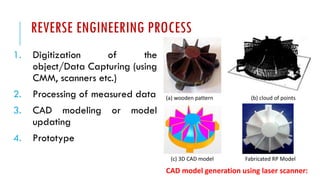
REVERSE ENGINEERING PROCESS
1. Digitization of the
object/Data Capturing (using
CMM, scanners etc.)
2. Processing of measured data
3. CAD modeling or model
updating
4. Prototype
(a) wooden pattern (b) cloud of points
(c) 3D CAD model Fabricated RP Model
CAD model generation using laser scanner:
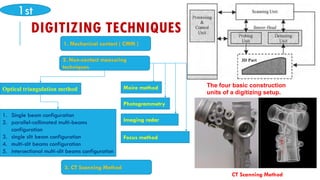
DIGITIZING TECHNIQUES
The four basic construction
units of a digitizing setup.
1. Mechanical contact ( CMM )
2. Non-contact measuring
techniques
Optical triangulation method
1. Single beam configuration
2. parallel-collimated multi-beams
configuration
3. single slit beam configuration
4. multi-slit beams configuration
5. intersectional multi-slit beams configuration
Moire method
Photogrammetry
Imaging radar
Focus method
3. CT Scanning Method
1st
CT Scanning Method
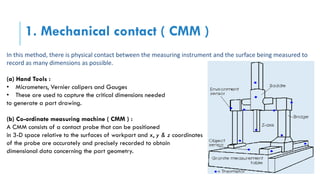
1. Mechanical contact ( CMM )
In this method, there is physical contact between the measuring instrument and the surface being measured to
record as many dimensions as possible.
(a) Hand Tools :
• Micrometers, Vernier calipers and Gauges
• These are used to capture the critical dimensions needed
to generate a part drawing.
(b) Co-ordinate measuring machine ( CMM ) :
A CMM consists of a contact probe that can be positioned
in 3-D space relative to the surfaces of workpart and x, y & z coordinates
of the probe are accurately and precisely recorded to obtain
dimensional data concerning the part geometry.
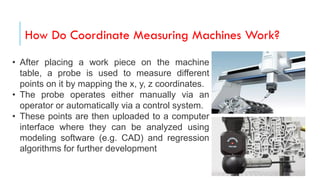
How Do Coordinate Measuring Machines Work?
• After placing a work piece on the machine
table, a probe is used to measure different
points on it by mapping the x, y, z coordinates.
• The probe operates either manually via an
operator or automatically via a control system.
• These points are then uploaded to a computer
interface where they can be analyzed using
modeling software (e.g. CAD) and regression
algorithms for further development.
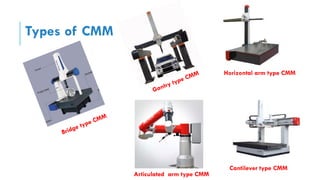
Types of CMM
Horizontal arm type CMM
Articulated arm type CMM
Cantilever type CMM
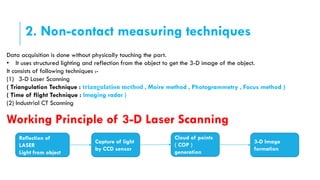
2. Non-contact measuring techniques
Data acquisition is done without physically touching the part.
• It uses structured lighting and reflection from the object to get the 3-D image of the object.
It consists of following techniques :-
(1) 3-D Laser Scanning
( Triangulation Technique : triangulation method , Moire method , Photogrammetry , Focus method )
( Time of flight Technique : Imaging radar )
(2) Industrial CT Scanning
Reflection of
LASER
Light from object
Capture of light
by CCD sensor
Cloud of points
( COP )
generation
3-D Image
formation
Working Principle of 3-D Laser Scanning
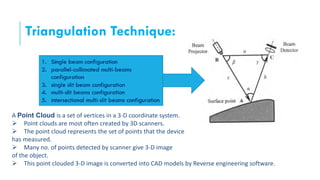
Triangulation Technique:
A Point Cloud is a set of vertices in a 3-D coordinate system.
 Point clouds are most often created by 3D scanners.
 The point cloud represents the set of points that the device
has measured.
 Many no. of points detected by scanner give 3-D image
of the object.
 This point clouded 3-D image is converted into CAD models by Reverse engineering software.
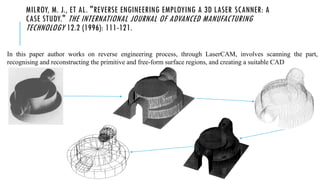
MILROY, M. J., ET AL. "REVERSE ENGINEERING EMPLOYING A 3D LASER SCANNER: A
CASE STUDY." THE INTERNATIONAL JOURNAL OF ADVANCED MANUFACTURING
TECHNOLOGY 12.2 (1996): 111-121.
In this paper author works on reverse engineering process, through LaserCAM, involves scanning the part,
recognising and reconstructing the primitive and free-form surface regions, and creating a suitable CAD
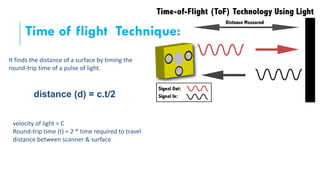
Time of flight Technique:
It finds the distance of a surface by timing the
round-trip time of a pulse of light.
velocity of light = C
Round-trip time (t) = 2 * time required to travel
distance between scanner & surface
distance (d) = c.t/2
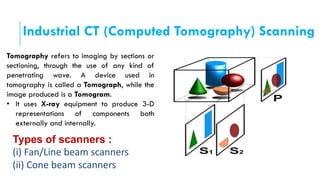
Industrial CT (Computed Tomography) Scanning
Tomography refers to imaging by sections or
sectioning, through the use of any kind of
penetrating wave. A device used in
tomography is called a Tomograph, while the
image produced is a Tomogram.
• It uses X-ray equipment to produce 3-D
representations of components both
externally and internally.
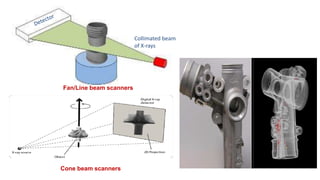
Types of scanners :
(i) Fan/Line beam scanners
(ii) Cone beam scanners
Collimated beam
of X-rays
Fan/Line beam scanners
Cone beam scanners
ADVANTAGES OF USING CT SCANNING OVER
OTHER TECHNIQUES SUCH AS CMM OR 3D
LASER SCANNERS
Design requirements for both internal and external components are validated
quickly and accurately
• Product quality is improved.
• Internal complex features can be precisely measured without destructive testing
• Parts are scanned in a free-state environment without applying stresses which
could damage delicate parts.
• For the first time, rapid prototyping of the internal components can be
completed without the daunting task of creating the CAD file from scratch.
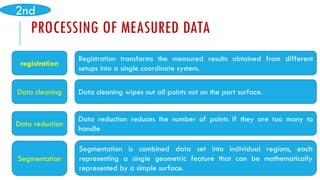
PROCESSING OF MEASURED DATA
registration
Registration transforms the measured results obtained from different
setups into a single coordinate system.
Data cleaning Data cleaning wipes out all points not on the part surface.
Data reduction reduces the number of points if they are too many to
handle
Data reduction
Segmentation is combined data set into individual regions, each
representing a single geometric feature that can be mathematically
represented by a simple surface.
Segmentation
2nd
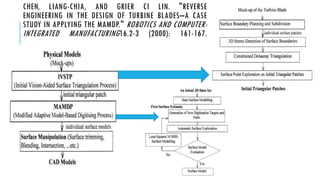
CHEN, LIANG-CHIA, AND GRIER CI LIN. "REVERSE
ENGINEERING IN THE DESIGN OF TURBINE BLADES–A CASE
STUDY IN APPLYING THE MAMDP." ROBOTICS AND COMPUTER-
INTEGRATED MANUFACTURING16.2-3 (2000): 161-167.
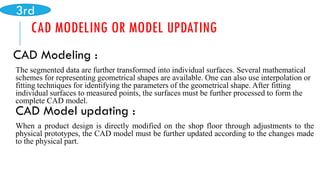
CAD MODELING OR MODEL UPDATING
CAD Modeling :
The segmented data are further transformed into individual surfaces. Several mathematical
schemes for representing geometrical shapes are available. One can also use interpolation or
fitting techniques for identifying the parameters of the geometrical shape. After fitting
individual surfaces to measured points, the surfaces must be further processed to form the
complete CAD model.
CAD Model updating :
When a product design is directly modified on the shop floor through adjustments to the
physical prototypes, the CAD model must be further updated according to the changes made
to the physical part.
3rd
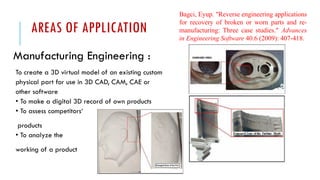
AREAS OF APPLICATION
Manufacturing Engineering :
To create a 3D virtual model of an existing custom
physical part for use in 3D CAD, CAM, CAE or
other software
• To make a digital 3D record of own products
• To assess competitors‘
products
• To analyze the
working of a product
Bagci, Eyup. "Reverse engineering applications
for recovery of broken or worn parts and re-
manufacturing: Three case studies." Advances
in Engineering Software 40.6 (2009): 407-418.
AREAS OF APPLICATION
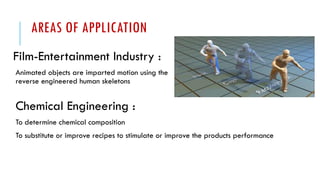
Film-Entertainment Industry :
Animated objects are imparted motion using the
reverse engineered human skeletons
Chemical Engineering :
To determine chemical composition
To substitute or improve recipes to stimulate or improve the products performance
AREAS OF APPLICATION
Medical Field :
1. Applications in orthopedic, dental & reconstructive surgery
2. Imaging, modeling and replication (as a physical model) of a patient's bone structure
3. Models can be viewed & physically handled before surgery, benefiting in evaluation of
the procedure & implant fit in difficult cases
4. Less risk to the patient and reduced cost through saving in theatre time
Software Engineering :
1. To extract design & implementation information (Byrne, Eric J-1991)
2. To detect and neutralize viruses and malware
REFERENCES
1. Venuvinod, Patri K., and Weiyin Ma. Rapid prototyping: laser-based and other technologies.
Springer Science & Business Media, 2013.
2. Kamrani, Ali K., and Emad Abouel Nasr, eds. Rapid prototyping: theory and practice. Vol. 6.
Springer Science & Business Media, 2006.
3. Byrne, Eric J. "Software reverse engineering: a case study." Software: Practice and
Experience 21.12 (1991): 1349-1364.
4. Milroy, M. J., et al. "Reverse engineering employing a 3D laser scanner: a case study." The
International Journal of Advanced Manufacturing Technology 12.2 (1996): 111-121.
5. Chen, Liang-Chia, and Grier CI Lin. "Reverse engineering in the design of turbine blades–a case
study in applying the MAMDP." Robotics and Computer-Integrated Manufacturing16.2-3 (2000):
161-167.
6. Bagci, Eyup. "Reverse engineering applications for recovery of broken or worn parts and re-
manufacturing: Three case studies." Advances in Engineering Software 40.6 (2009): 407-418.
THANK YOU!
Do you have any questions?

Reverse engineering

  • 1.
    REVERSE ENGINEERING Submitted to Dr.Komal G Dave Associate Professor L D College Of Engineering- Ahmedabad
  • 2.
    WHAT IS REVERSEENGINEERING? A systematic methodology for analyzing the design of an existing device or system, either as an approach to study the design or for re-design. It involves creating a CAD model from a physical model, it is the inverse of the normal process of producing a part from a CAD model.
  • 3.
    APPLICATION OF REVERSEENGINEERING 1. New product design 2. Existing product redesign 3. Custom product design 4. Physical model-based shape modification
  • 4.
    IMPORTANCE OF REVERSEENGINEERING 1. We cannot start from the very beginning to develop a new product every time. 2. We need to optimize the resources available in our hands and reduce the production time keeping in view the customers’ requirements. For such cases, RE is an efficient approach to significantly reduce the product development cycle.
  • 5.
    REVERSE ENGINEERING PROCESS 1.Digitization of the object/Data Capturing (using CMM, scanners etc.) 2. Processing of measured data 3. CAD modeling or model updating 4. Prototype (a) wooden pattern (b) cloud of points (c) 3D CAD model Fabricated RP Model CAD model generation using laser scanner:
  • 6.
    DIGITIZING TECHNIQUES The fourbasic construction units of a digitizing setup. 1. Mechanical contact ( CMM ) 2. Non-contact measuring techniques Optical triangulation method 1. Single beam configuration 2. parallel-collimated multi-beams configuration 3. single slit beam configuration 4. multi-slit beams configuration 5. intersectional multi-slit beams configuration Moire method Photogrammetry Imaging radar Focus method 3. CT Scanning Method 1st CT Scanning Method
  • 7.
    1. Mechanical contact( CMM ) In this method, there is physical contact between the measuring instrument and the surface being measured to record as many dimensions as possible. (a) Hand Tools : • Micrometers, Vernier calipers and Gauges • These are used to capture the critical dimensions needed to generate a part drawing. (b) Co-ordinate measuring machine ( CMM ) : A CMM consists of a contact probe that can be positioned in 3-D space relative to the surfaces of workpart and x, y & z coordinates of the probe are accurately and precisely recorded to obtain dimensional data concerning the part geometry.
  • 8.
    How Do CoordinateMeasuring Machines Work? • After placing a work piece on the machine table, a probe is used to measure different points on it by mapping the x, y, z coordinates. • The probe operates either manually via an operator or automatically via a control system. • These points are then uploaded to a computer interface where they can be analyzed using modeling software (e.g. CAD) and regression algorithms for further development.
  • 9.
    Types of CMM Horizontalarm type CMM Articulated arm type CMM Cantilever type CMM
  • 10.
    2. Non-contact measuringtechniques Data acquisition is done without physically touching the part. • It uses structured lighting and reflection from the object to get the 3-D image of the object. It consists of following techniques :- (1) 3-D Laser Scanning ( Triangulation Technique : triangulation method , Moire method , Photogrammetry , Focus method ) ( Time of flight Technique : Imaging radar ) (2) Industrial CT Scanning Reflection of LASER Light from object Capture of light by CCD sensor Cloud of points ( COP ) generation 3-D Image formation Working Principle of 3-D Laser Scanning
  • 11.
    Triangulation Technique: A PointCloud is a set of vertices in a 3-D coordinate system.  Point clouds are most often created by 3D scanners.  The point cloud represents the set of points that the device has measured.  Many no. of points detected by scanner give 3-D image of the object.  This point clouded 3-D image is converted into CAD models by Reverse engineering software.
  • 12.
    MILROY, M. J.,ET AL. "REVERSE ENGINEERING EMPLOYING A 3D LASER SCANNER: A CASE STUDY." THE INTERNATIONAL JOURNAL OF ADVANCED MANUFACTURING TECHNOLOGY 12.2 (1996): 111-121. In this paper author works on reverse engineering process, through LaserCAM, involves scanning the part, recognising and reconstructing the primitive and free-form surface regions, and creating a suitable CAD
  • 13.
    Time of flightTechnique: It finds the distance of a surface by timing the round-trip time of a pulse of light. velocity of light = C Round-trip time (t) = 2 * time required to travel distance between scanner & surface distance (d) = c.t/2
  • 14.
    Industrial CT (ComputedTomography) Scanning Tomography refers to imaging by sections or sectioning, through the use of any kind of penetrating wave. A device used in tomography is called a Tomograph, while the image produced is a Tomogram. • It uses X-ray equipment to produce 3-D representations of components both externally and internally. Types of scanners : (i) Fan/Line beam scanners (ii) Cone beam scanners
  • 15.
    Collimated beam of X-rays Fan/Linebeam scanners Cone beam scanners
  • 16.
    ADVANTAGES OF USINGCT SCANNING OVER OTHER TECHNIQUES SUCH AS CMM OR 3D LASER SCANNERS Design requirements for both internal and external components are validated quickly and accurately • Product quality is improved. • Internal complex features can be precisely measured without destructive testing • Parts are scanned in a free-state environment without applying stresses which could damage delicate parts. • For the first time, rapid prototyping of the internal components can be completed without the daunting task of creating the CAD file from scratch.
  • 17.
    PROCESSING OF MEASUREDDATA registration Registration transforms the measured results obtained from different setups into a single coordinate system. Data cleaning Data cleaning wipes out all points not on the part surface. Data reduction reduces the number of points if they are too many to handle Data reduction Segmentation is combined data set into individual regions, each representing a single geometric feature that can be mathematically represented by a simple surface. Segmentation 2nd
  • 18.
    CHEN, LIANG-CHIA, ANDGRIER CI LIN. "REVERSE ENGINEERING IN THE DESIGN OF TURBINE BLADES–A CASE STUDY IN APPLYING THE MAMDP." ROBOTICS AND COMPUTER- INTEGRATED MANUFACTURING16.2-3 (2000): 161-167.
  • 19.
    CAD MODELING ORMODEL UPDATING CAD Modeling : The segmented data are further transformed into individual surfaces. Several mathematical schemes for representing geometrical shapes are available. One can also use interpolation or fitting techniques for identifying the parameters of the geometrical shape. After fitting individual surfaces to measured points, the surfaces must be further processed to form the complete CAD model. CAD Model updating : When a product design is directly modified on the shop floor through adjustments to the physical prototypes, the CAD model must be further updated according to the changes made to the physical part. 3rd
  • 20.
    AREAS OF APPLICATION ManufacturingEngineering : To create a 3D virtual model of an existing custom physical part for use in 3D CAD, CAM, CAE or other software • To make a digital 3D record of own products • To assess competitors‘ products • To analyze the working of a product Bagci, Eyup. "Reverse engineering applications for recovery of broken or worn parts and re- manufacturing: Three case studies." Advances in Engineering Software 40.6 (2009): 407-418.
  • 21.
    AREAS OF APPLICATION Film-EntertainmentIndustry : Animated objects are imparted motion using the reverse engineered human skeletons Chemical Engineering : To determine chemical composition To substitute or improve recipes to stimulate or improve the products performance
  • 22.
    AREAS OF APPLICATION MedicalField : 1. Applications in orthopedic, dental & reconstructive surgery 2. Imaging, modeling and replication (as a physical model) of a patient's bone structure 3. Models can be viewed & physically handled before surgery, benefiting in evaluation of the procedure & implant fit in difficult cases 4. Less risk to the patient and reduced cost through saving in theatre time Software Engineering : 1. To extract design & implementation information (Byrne, Eric J-1991) 2. To detect and neutralize viruses and malware
  • 23.
    REFERENCES 1. Venuvinod, PatriK., and Weiyin Ma. Rapid prototyping: laser-based and other technologies. Springer Science & Business Media, 2013. 2. Kamrani, Ali K., and Emad Abouel Nasr, eds. Rapid prototyping: theory and practice. Vol. 6. Springer Science & Business Media, 2006. 3. Byrne, Eric J. "Software reverse engineering: a case study." Software: Practice and Experience 21.12 (1991): 1349-1364. 4. Milroy, M. J., et al. "Reverse engineering employing a 3D laser scanner: a case study." The International Journal of Advanced Manufacturing Technology 12.2 (1996): 111-121. 5. Chen, Liang-Chia, and Grier CI Lin. "Reverse engineering in the design of turbine blades–a case study in applying the MAMDP." Robotics and Computer-Integrated Manufacturing16.2-3 (2000): 161-167. 6. Bagci, Eyup. "Reverse engineering applications for recovery of broken or worn parts and re- manufacturing: Three case studies." Advances in Engineering Software 40.6 (2009): 407-418.
  • 24.
    THANK YOU! Do youhave any questions?