BY
p.vishnu
contents
 Introduction
 Compassion between forward engineering and reverse
engineering
 Importance
 Methodology
 Digitizing
 Discretization method
 Manipulation of data
 Generation of functional part
 Advantages and Applications of reverse engineering
Introduction
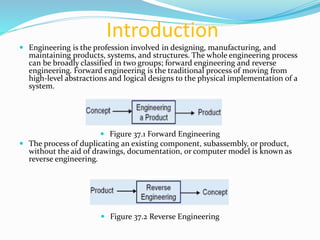
 Engineering is the profession involved in designing, manufacturing, and
maintaining products, systems, and structures. The whole engineering process
can be broadly classified in two groups; forward engineering and reverse
engineering. Forward engineering is the traditional process of moving from
high-level abstractions and logical designs to the physical implementation of a
system.
 Figure 37.1 Forward Engineering
 The process of duplicating an existing component, subassembly, or product,
without the aid of drawings, documentation, or computer model is known as
reverse engineering.
 .
 Figure 37.2 Reverse Engineering
engineering can be mainly viewed as the process of analyzing a system
to identify its components and their interrelationships, to create
representations of it in another form or a higher level of abstraction. An
important reason for application of reverse engineering is reduction of
product development times. In the intensely competitive global market,
manufacturers are constantly seeking new ways to shorten lead-times to
market a new product. For example, injection-molding companies must
drastically reduce the tool and die development times. By using reverse
engineering, a three-dimensional product or model can be quickly
captured in digital form, re-modeled, and exported for rapid
prototyping/tooling or rapid manufacturing.
Reverse engineering
 • Reverse Engineering is a process of redesigning an
existing product to improve and broaden its functions,
add quality and to increase its useful life.
 • The main aim of reverse engineering is to reduce
manufacturing costs of the new product, making it
competitive in market.
 • The duplication is done without the aid of drawings,
documentation or computer model.
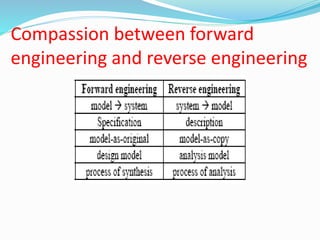
Compassion between forward
engineering and reverse engineering
Importance
 We cannot start from the very beginning to develop a
new product every time.
 We need to optimize the resources available in our
hands and reduce the production time keeping in view
the customers’ requirements.
 For such cases, RE is an efficient approach to
significantly reduce the product development cycle.
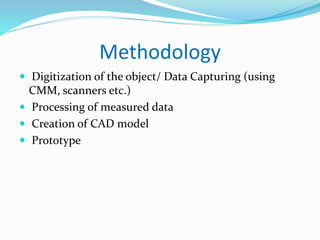
Methodology
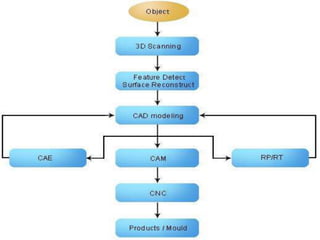
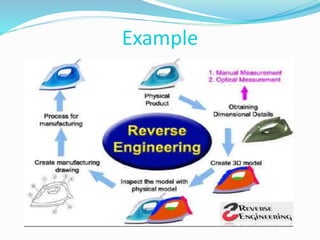
 Digitization of the object/ Data Capturing (using
CMM, scanners etc.)
 Processing of measured data
 Creation of CAD model
 Prototype
Example
Digitizing
 • Collecting data from physical part.
 • Used when drawing of object is not available.
 • Aim is to generate a 3D mapping of the product in
the form of CAD file.
 • This requires acquisition of surface data, which is
large number of points on the product surface.
 • For this two types of processes are used: contact and
non contact method.
Discretization method
Contact method Non Contact method
• Requires contact between the
component surface & a
measuring tool.
• Uses Coordinate Measuring
Machine (CMM),
electromagnetic digitizer or
sonic digitizers to get desired
coordinates.
• Uses light as the main tool
• Uses white light or laser
scanners to scan 3D objects to
generate CAD design.
Manipulation of data
 Basically, after completion of this a CAD model of
product is obtained.
 Used to fit a geometry to the large number of points
obtained from digitizing.
 The surface can be mathematically defined as
algebraic or parametric surface.
 Surface fitting techniques can be of two types:
interpolation and approximation techniques.
Surface fitting techniques
Interpolation technique
 Surface to be fitted
passes through all the
data points.
 Used when the data
points are accurately
measured without any
errors.
Approximation technique
 Surface represents a
generalized or best fit to
the data points.
 Used when large number
of data points are to be
fitted.
Generation of functional part
 The geometric model obtained, can be used as the
basis for variety of operations.
 Operations such as automated process planning,
automated manufacturing, automated dimensional
inspection and automated tolerance analysis.
Advantages of reverse engineering
 RE typically starts with
measuring an existing object,
so that a solid model can be
deduced in order to make use
of the advantages of
CAD/CAM/CAE
technologies.
 CAD models are used for
manufacturing or rapid
prototyping applications.
 Hence we can work on a
product without having prior
knowledge of the technology
involved.
 Cost saving for developing
new products.
 Lesser maintenance costs
 Quality improvement
 Competitive advantages
Applications
 Manufacturing Field: To create a 3D virtual model of
an existing physical part for use in 3D CAD, CAM, CAE
or other software and to analyze the working of a
product.
 Medical Field: Imaging, modeling and replication (as
a physical model) of a patient's bone structure
 Software engineering: To detect and neutralize viruses
and malware.
Reverse engineering for mechanical

Reverse engineering for mechanical

  • 1.
  • 2.
    contents  Introduction  Compassionbetween forward engineering and reverse engineering  Importance  Methodology  Digitizing  Discretization method  Manipulation of data  Generation of functional part  Advantages and Applications of reverse engineering
  • 3.
    Introduction  Engineering isthe profession involved in designing, manufacturing, and maintaining products, systems, and structures. The whole engineering process can be broadly classified in two groups; forward engineering and reverse engineering. Forward engineering is the traditional process of moving from high-level abstractions and logical designs to the physical implementation of a system.  Figure 37.1 Forward Engineering  The process of duplicating an existing component, subassembly, or product, without the aid of drawings, documentation, or computer model is known as reverse engineering.  .  Figure 37.2 Reverse Engineering
  • 4.
    engineering can bemainly viewed as the process of analyzing a system to identify its components and their interrelationships, to create representations of it in another form or a higher level of abstraction. An important reason for application of reverse engineering is reduction of product development times. In the intensely competitive global market, manufacturers are constantly seeking new ways to shorten lead-times to market a new product. For example, injection-molding companies must drastically reduce the tool and die development times. By using reverse engineering, a three-dimensional product or model can be quickly captured in digital form, re-modeled, and exported for rapid prototyping/tooling or rapid manufacturing.
  • 5.
    Reverse engineering  •Reverse Engineering is a process of redesigning an existing product to improve and broaden its functions, add quality and to increase its useful life.  • The main aim of reverse engineering is to reduce manufacturing costs of the new product, making it competitive in market.  • The duplication is done without the aid of drawings, documentation or computer model.
  • 6.
  • 7.
    Importance  We cannotstart from the very beginning to develop a new product every time.  We need to optimize the resources available in our hands and reduce the production time keeping in view the customers’ requirements.  For such cases, RE is an efficient approach to significantly reduce the product development cycle.
  • 8.
    Methodology  Digitization ofthe object/ Data Capturing (using CMM, scanners etc.)  Processing of measured data  Creation of CAD model  Prototype
  • 10.
  • 11.
    Digitizing  • Collectingdata from physical part.  • Used when drawing of object is not available.  • Aim is to generate a 3D mapping of the product in the form of CAD file.  • This requires acquisition of surface data, which is large number of points on the product surface.  • For this two types of processes are used: contact and non contact method.
  • 12.
    Discretization method Contact methodNon Contact method • Requires contact between the component surface & a measuring tool. • Uses Coordinate Measuring Machine (CMM), electromagnetic digitizer or sonic digitizers to get desired coordinates. • Uses light as the main tool • Uses white light or laser scanners to scan 3D objects to generate CAD design.
  • 13.
    Manipulation of data Basically, after completion of this a CAD model of product is obtained.  Used to fit a geometry to the large number of points obtained from digitizing.  The surface can be mathematically defined as algebraic or parametric surface.  Surface fitting techniques can be of two types: interpolation and approximation techniques.
  • 14.
    Surface fitting techniques Interpolationtechnique  Surface to be fitted passes through all the data points.  Used when the data points are accurately measured without any errors. Approximation technique  Surface represents a generalized or best fit to the data points.  Used when large number of data points are to be fitted.
  • 15.
    Generation of functionalpart  The geometric model obtained, can be used as the basis for variety of operations.  Operations such as automated process planning, automated manufacturing, automated dimensional inspection and automated tolerance analysis.
  • 16.
    Advantages of reverseengineering  RE typically starts with measuring an existing object, so that a solid model can be deduced in order to make use of the advantages of CAD/CAM/CAE technologies.  CAD models are used for manufacturing or rapid prototyping applications.  Hence we can work on a product without having prior knowledge of the technology involved.  Cost saving for developing new products.  Lesser maintenance costs  Quality improvement  Competitive advantages
  • 17.
    Applications  Manufacturing Field:To create a 3D virtual model of an existing physical part for use in 3D CAD, CAM, CAE or other software and to analyze the working of a product.  Medical Field: Imaging, modeling and replication (as a physical model) of a patient's bone structure  Software engineering: To detect and neutralize viruses and malware.