1
A Seminar Presentation on
ABHISHEK THOTE
M.Tech, CAD-CAM
VNIT, NAGPUR
2
What is Reverse Engineering ?
 Reverse Engineering is an activity which consists of creation
of a CAD model & manufacturing of a mechanical part
by scanning it and obtaining it’s geometrical details.
Need of Reverse Engineering :
 To provide spares for replacing broken or worn out parts
for which no technical data is available. This can be the
case if the part was originally imported (without drawings)
or the drawings being misplaced or lost.
 Creation of unlicensed/unapproved duplicates.
 Competitive technical intelligence (understand what your
competitor is actually doing, versus what they say they are
doing).
3
STEP[1]
• OBTAINING THE PART GEOMETRY
STEP[2]
• MATERIAL IDENTIFICATION
STEP[3]
• 3-D CAD MODEL GENERATION
STEP[4]
• MANUFACTURING OF A PART
STEPS IN REVERSE ENGINEERING :
STEP [1] OBTAINING THE PART GEOMETRY :-
 It involves ‘automatic digitizing’ of the
surface of a physically existing object i.e.
3-D image of the object is obtained by
scanning the entire object.
 There are two ways of digitizing:
[1] Contact type digitizing.
[2] Non-contact type digitizing.
4
5
[1]Contact Type digitizing:
In this method, there is physical contact
between the measuring instrument and the surface
being measured to record as many dimensions as
possible.
It includes following instruments.
(a) Hand Tools :
 Micrometers, Vernier calipers and Gauges
 These are used to capture the critical
dimensions needed to generate a part drawing.
4
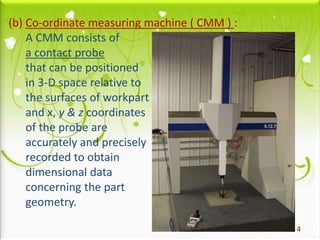
(b) Co-ordinate measuring machine ( CMM ) :
A CMM consists of
a contact probe
that can be positioned
in 3-D space relative to
the surfaces of workpart
and x, y & z coordinates
of the probe are
accurately and precisely
recorded to obtain
dimensional data
concerning the part
geometry.
7
[2] Non-Contact Type digitizing:
 Data acquisition is done without physically
touching the part.
 It uses structured lighting and reflection
from the object to get the 3-D image
of the object.
It consists of following techniques :-
(1) 3-D Laser Scanning
(2) Industrial CT Scanning
8
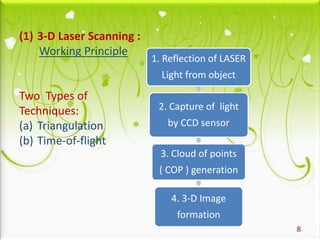
1. Reflection of LASER
Light from object
2. Capture of light
by CCD sensor
3. Cloud of points
( COP ) generation
4. 3-D Image
formation
(1) 3-D Laser Scanning :
Working Principle
Two Types of
Techniques:
(a) Triangulation
(b) Time-of-flight
9
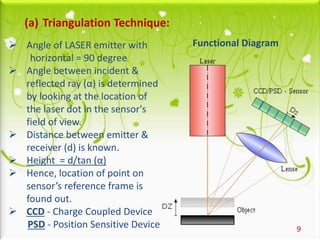
Functional Diagram
(a) Triangulation Technique:
 Angle of LASER emitter with
horizontal = 90 degree
 Angle between incident &
reflected ray (α) is determined
by looking at the location of
the laser dot in the sensor's
field of view.
 Distance between emitter &
receiver (d) is known.
 Height = d/tan (α)
 Hence, location of point on
sensor’s reference frame is
found out.
 CCD - Charge Coupled Device
PSD - Position Sensitive Device
10
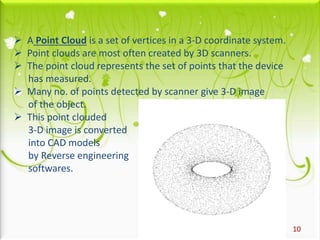
 A Point Cloud is a set of vertices in a 3-D coordinate system.
 Point clouds are most often created by 3D scanners.
 The point cloud represents the set of points that the device
has measured.
 Many no. of points detected by scanner give 3-D image
of the object.
 This point clouded
3-D image is converted
into CAD models
by Reverse engineering
softwares.
11
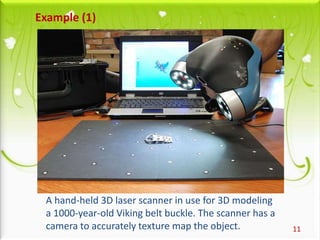
A hand-held 3D laser scanner in use for 3D modeling
a 1000-year-old Viking belt buckle. The scanner has a
camera to accurately texture map the object.
Example (1)
12
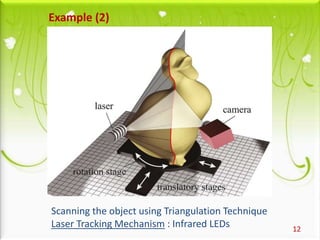
Scanning the object using Triangulation Technique
Laser Tracking Mechanism : Infrared LEDs
Example (2)
13
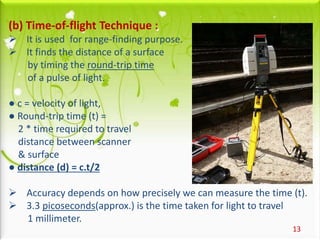
(b) Time-of-flight Technique :
 It is used for range-finding purpose.
 It finds the distance of a surface
by timing the round-trip time
of a pulse of light.
● c = velocity of light,
● Round-trip time (t) =
2 * time required to travel
distance between scanner
& surface
● distance (d) = c.t/2
 Accuracy depends on how precisely we can measure the time (t).
 3.3 picoseconds(approx.) is the time taken for light to travel
1 millimeter.
14
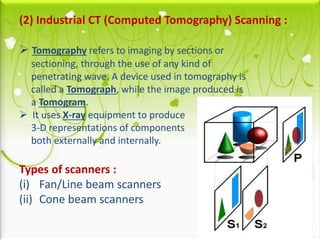
(2) Industrial CT (Computed Tomography) Scanning :
 Tomography refers to imaging by sections or
sectioning, through the use of any kind of
penetrating wave. A device used in tomography is
called a Tomograph, while the image produced is
a Tomogram.
 It uses X-ray equipment to produce
3-D representations of components
both externally and internally.
Types of scanners :
(i) Fan/Line beam scanners
(ii) Cone beam scanners
15
(i) Fan/Line beam scanners-[Translate] :
 These are Line scanners.
 It is the first generation of industrial CT Scanners.
 X-rays are produced and the beam is collimated to create a line.
 The X-ray line beam is then translated across the part and data
is collected by the detector in the form of 2-D image slices.
 The data is then reconstructed to create a 3-D Volume rendering
of the part.
Detector
Collimated beam
of X-rays
16
(ii) Cone beam scanners-[Rotate] :
 During the CT scan, part is
placed on a rotary table.
 As the part rotates the cone
of X-rays produce about
1300 2D images which are
collected by the detector.
 The 2D images are then
processed to create a 3D
Volume rendering of the
external and internal
geometries of the part.
17
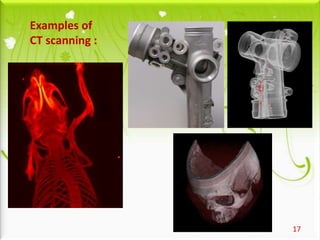
Examples of
CT scanning :
18
Advantages of using CT scanning over other
techniques such as CMM or 3D laser scanners :
• A non-destructive test for inspection and metrology
• Inspection and analysis costs from first article to production are
significantly reduced
• Design requirements for both internal and external components
are validated quickly and accurately
• Product quality is improved.
• Internal complex features can be precisely measured without
destructive testing
• Parts are scanned in a free-state environment without applying
stresses which could damage delicate parts.
• For the first time, rapid prototyping of the internal components
can be completed without the daunting task of creating the CAD
file from scratch.
19
STEP[2] MATERIAL IDENTIFICATION :-
 Identifying the material composition of the
existing part is the second most important task.
 There are several well-established non-destructive
and destructive techniques to find the composition
of part material.
(1) Mass Spectrometry
(2) Scanning Electron Microscope (SEM)
20
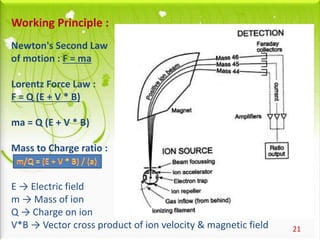
(1) Mass Spectrometry :
 A sample loaded on to the mass spectrometer
undergoes vaporization. Hence,
it is also called as Vapour Phase Chemistry.
We get spectral lines of various masses of components.
Hence, it is called Mass Spectrometry.
 It measures the mass-to-charge ratio[m/Q]of
charged particles(ions) created in the process.
 It is used for determining masses of particles,
for determining the elemental composition
of a sample or molecule.
21
Working Principle :
Newton's Second Law
of motion : F = ma
Lorentz Force Law :
F = Q (E + V * B)
ma = Q (E + V * B)
Mass to Charge ratio :
E → Electric field
m → Mass of ion
Q → Charge on ion
V*B → Vector cross product of ion velocity & magnetic field
22
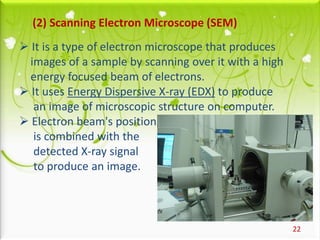
(2) Scanning Electron Microscope (SEM)
 It is a type of electron microscope that produces
images of a sample by scanning over it with a high
energy focused beam of electrons.
 It uses Energy Dispersive X-ray (EDX) to produce
an image of microscopic structure on computer.
 Electron beam's position
is combined with the
detected X-ray signal
to produce an image.
23
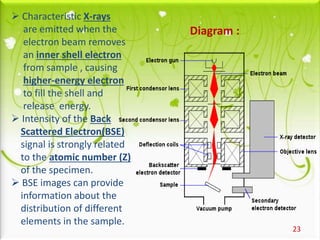
 Characteristic X-rays
are emitted when the
electron beam removes
an inner shell electron
from sample , causing
higher-energy electron
to fill the shell and
release energy.
 Intensity of the Back
Scattered Electron(BSE)
signal is strongly related
to the atomic number (Z)
of the specimen.
 BSE images can provide
information about the
distribution of different
elements in the sample.
Diagram :
24
STEP [3] 3-D CAD MODEL GENERATION :-
 After scanning, we get 3-D image of a part.
 It is converted into 3-D CAD model by Reverse engineering
software such as Geomagics ,Imageware Surfacer,
Magics, Pro/Scan Tools ,Rapidform and STRIM
which are specially developed for this purpose.
STEP [4] MANUFACTURING OF A PART :-
 Once the 3-D CAD model is generated, it is manufactured
by using various manufacturing techniques.
 Mainly, Rapid Prototyping is used for this purpose.
25
References :
(1) Defence Science Journal, DESSIDOC,
DRDO, New Delhi, in print, 2005
“Computer-Aided Reverse Engineering
for Rapid Replacement Parts” : A Case Study
(2) “KBRE: A Knowledge Based Reverse Engineering
for Mechanical Components”
Troyes, University of Technology
(3) “Reverse Engineering of Automotive Parts”
Masters of Science Degree
The University of Tennessee, Knoxville
26
27
28

Rev engg

  • 1.
    1 A Seminar Presentationon ABHISHEK THOTE M.Tech, CAD-CAM VNIT, NAGPUR
  • 2.
    2 What is ReverseEngineering ?  Reverse Engineering is an activity which consists of creation of a CAD model & manufacturing of a mechanical part by scanning it and obtaining it’s geometrical details. Need of Reverse Engineering :  To provide spares for replacing broken or worn out parts for which no technical data is available. This can be the case if the part was originally imported (without drawings) or the drawings being misplaced or lost.  Creation of unlicensed/unapproved duplicates.  Competitive technical intelligence (understand what your competitor is actually doing, versus what they say they are doing).
  • 3.
    3 STEP[1] • OBTAINING THEPART GEOMETRY STEP[2] • MATERIAL IDENTIFICATION STEP[3] • 3-D CAD MODEL GENERATION STEP[4] • MANUFACTURING OF A PART STEPS IN REVERSE ENGINEERING :
  • 4.
    STEP [1] OBTAININGTHE PART GEOMETRY :-  It involves ‘automatic digitizing’ of the surface of a physically existing object i.e. 3-D image of the object is obtained by scanning the entire object.  There are two ways of digitizing: [1] Contact type digitizing. [2] Non-contact type digitizing. 4
  • 5.
    5 [1]Contact Type digitizing: Inthis method, there is physical contact between the measuring instrument and the surface being measured to record as many dimensions as possible. It includes following instruments. (a) Hand Tools :  Micrometers, Vernier calipers and Gauges  These are used to capture the critical dimensions needed to generate a part drawing.
  • 6.
    4 (b) Co-ordinate measuringmachine ( CMM ) : A CMM consists of a contact probe that can be positioned in 3-D space relative to the surfaces of workpart and x, y & z coordinates of the probe are accurately and precisely recorded to obtain dimensional data concerning the part geometry.
  • 7.
    7 [2] Non-Contact Typedigitizing:  Data acquisition is done without physically touching the part.  It uses structured lighting and reflection from the object to get the 3-D image of the object. It consists of following techniques :- (1) 3-D Laser Scanning (2) Industrial CT Scanning
  • 8.
    8 1. Reflection ofLASER Light from object 2. Capture of light by CCD sensor 3. Cloud of points ( COP ) generation 4. 3-D Image formation (1) 3-D Laser Scanning : Working Principle Two Types of Techniques: (a) Triangulation (b) Time-of-flight
  • 9.
    9 Functional Diagram (a) TriangulationTechnique:  Angle of LASER emitter with horizontal = 90 degree  Angle between incident & reflected ray (α) is determined by looking at the location of the laser dot in the sensor's field of view.  Distance between emitter & receiver (d) is known.  Height = d/tan (α)  Hence, location of point on sensor’s reference frame is found out.  CCD - Charge Coupled Device PSD - Position Sensitive Device
  • 10.
    10  A PointCloud is a set of vertices in a 3-D coordinate system.  Point clouds are most often created by 3D scanners.  The point cloud represents the set of points that the device has measured.  Many no. of points detected by scanner give 3-D image of the object.  This point clouded 3-D image is converted into CAD models by Reverse engineering softwares.
  • 11.
    11 A hand-held 3Dlaser scanner in use for 3D modeling a 1000-year-old Viking belt buckle. The scanner has a camera to accurately texture map the object. Example (1)
  • 12.
    12 Scanning the objectusing Triangulation Technique Laser Tracking Mechanism : Infrared LEDs Example (2)
  • 13.
    13 (b) Time-of-flight Technique:  It is used for range-finding purpose.  It finds the distance of a surface by timing the round-trip time of a pulse of light. ● c = velocity of light, ● Round-trip time (t) = 2 * time required to travel distance between scanner & surface ● distance (d) = c.t/2  Accuracy depends on how precisely we can measure the time (t).  3.3 picoseconds(approx.) is the time taken for light to travel 1 millimeter.
  • 14.
    14 (2) Industrial CT(Computed Tomography) Scanning :  Tomography refers to imaging by sections or sectioning, through the use of any kind of penetrating wave. A device used in tomography is called a Tomograph, while the image produced is a Tomogram.  It uses X-ray equipment to produce 3-D representations of components both externally and internally. Types of scanners : (i) Fan/Line beam scanners (ii) Cone beam scanners
  • 15.
    15 (i) Fan/Line beamscanners-[Translate] :  These are Line scanners.  It is the first generation of industrial CT Scanners.  X-rays are produced and the beam is collimated to create a line.  The X-ray line beam is then translated across the part and data is collected by the detector in the form of 2-D image slices.  The data is then reconstructed to create a 3-D Volume rendering of the part. Detector Collimated beam of X-rays
  • 16.
    16 (ii) Cone beamscanners-[Rotate] :  During the CT scan, part is placed on a rotary table.  As the part rotates the cone of X-rays produce about 1300 2D images which are collected by the detector.  The 2D images are then processed to create a 3D Volume rendering of the external and internal geometries of the part.
  • 17.
  • 18.
    18 Advantages of usingCT scanning over other techniques such as CMM or 3D laser scanners : • A non-destructive test for inspection and metrology • Inspection and analysis costs from first article to production are significantly reduced • Design requirements for both internal and external components are validated quickly and accurately • Product quality is improved. • Internal complex features can be precisely measured without destructive testing • Parts are scanned in a free-state environment without applying stresses which could damage delicate parts. • For the first time, rapid prototyping of the internal components can be completed without the daunting task of creating the CAD file from scratch.
  • 19.
    19 STEP[2] MATERIAL IDENTIFICATION:-  Identifying the material composition of the existing part is the second most important task.  There are several well-established non-destructive and destructive techniques to find the composition of part material. (1) Mass Spectrometry (2) Scanning Electron Microscope (SEM)
  • 20.
    20 (1) Mass Spectrometry:  A sample loaded on to the mass spectrometer undergoes vaporization. Hence, it is also called as Vapour Phase Chemistry. We get spectral lines of various masses of components. Hence, it is called Mass Spectrometry.  It measures the mass-to-charge ratio[m/Q]of charged particles(ions) created in the process.  It is used for determining masses of particles, for determining the elemental composition of a sample or molecule.
  • 21.
    21 Working Principle : Newton'sSecond Law of motion : F = ma Lorentz Force Law : F = Q (E + V * B) ma = Q (E + V * B) Mass to Charge ratio : E → Electric field m → Mass of ion Q → Charge on ion V*B → Vector cross product of ion velocity & magnetic field
  • 22.
    22 (2) Scanning ElectronMicroscope (SEM)  It is a type of electron microscope that produces images of a sample by scanning over it with a high energy focused beam of electrons.  It uses Energy Dispersive X-ray (EDX) to produce an image of microscopic structure on computer.  Electron beam's position is combined with the detected X-ray signal to produce an image.
  • 23.
    23  Characteristic X-rays areemitted when the electron beam removes an inner shell electron from sample , causing higher-energy electron to fill the shell and release energy.  Intensity of the Back Scattered Electron(BSE) signal is strongly related to the atomic number (Z) of the specimen.  BSE images can provide information about the distribution of different elements in the sample. Diagram :
  • 24.
    24 STEP [3] 3-DCAD MODEL GENERATION :-  After scanning, we get 3-D image of a part.  It is converted into 3-D CAD model by Reverse engineering software such as Geomagics ,Imageware Surfacer, Magics, Pro/Scan Tools ,Rapidform and STRIM which are specially developed for this purpose. STEP [4] MANUFACTURING OF A PART :-  Once the 3-D CAD model is generated, it is manufactured by using various manufacturing techniques.  Mainly, Rapid Prototyping is used for this purpose.
  • 25.
    25 References : (1) DefenceScience Journal, DESSIDOC, DRDO, New Delhi, in print, 2005 “Computer-Aided Reverse Engineering for Rapid Replacement Parts” : A Case Study (2) “KBRE: A Knowledge Based Reverse Engineering for Mechanical Components” Troyes, University of Technology (3) “Reverse Engineering of Automotive Parts” Masters of Science Degree The University of Tennessee, Knoxville
  • 26.
  • 27.
  • 28.