ASME OLD GUARD ORAL TECHNICAL PRESENTATION COMPETITION  STUDENT LEADERSHIP SEMINAR – 2010 ASME UET Lahore Student Section - Pakistan By: Malik Muhammad Usman Awan Communication In-charge  ASME SDOB Asia-Pacific  ( Pakistan ) Student Chair ASME  NWFP University of Engineering & Technology Peshawar Pakistan 1 st  March, 2010 “ Rapid Prototyping & its  Applications  in 21st Century ”
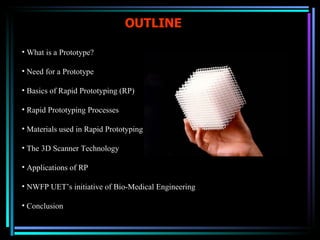
OUTLINE What is a Prototype? Need for a Prototype  Basics of Rapid Prototyping (RP)  Rapid Prototyping Processes Materials used in Rapid Prototyping The 3D Scanner Technology  Applications of RP NWFP UET’s initiative of Bio-Medical Engineering Conclusion
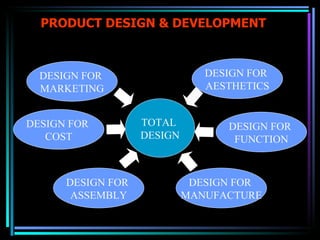
PRODUCT DESIGN & DEVELOPMENT DESIGN FOR  AESTHETICS DESIGN FOR  FUNCTION DESIGN FOR  MANUFACTURE DESIGN FOR  MARKETING DESIGN FOR  ASSEMBLY DESIGN FOR  COST TOTAL  DESIGN
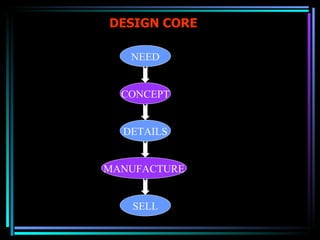
DESIGN CORE NEED CONCEPT DETAILS MANUFACTURE SELL
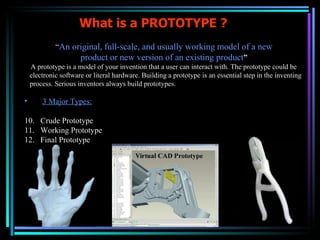
What is a PROTOTYPE ? “ An original, full-scale, and usually working model of a new product or new version of an existing product ” A prototype is a model of your invention that a user can interact with. The prototype could be electronic software or literal hardware. Building a prototype is an essential step in the inventing process. Serious inventors always build prototypes.  3 Major Types: Crude Prototype Working Prototype Final Prototype
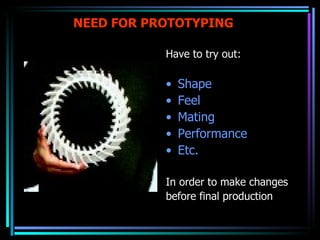
NEED FOR PROTOTYPING Have to try out: Shape Feel Mating Performance Etc. In order to make changes before final production
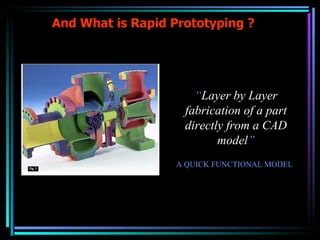
And What is Rapid Prototyping ? “ Layer by Layer fabrication of a part directly from a CAD model ” A QUICK FUNCTIONAL MODEL
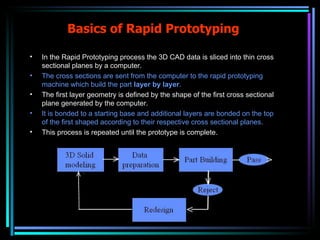
Basics of Rapid Prototyping In the Rapid Prototyping process the 3D CAD data is sliced into thin cross sectional planes by a computer. The cross sections are sent from the computer to the rapid prototyping machine which build the part  layer by layer . The first layer geometry is defined by the shape of the first cross sectional plane generated by the computer. It is bonded to a starting base and additional layers are bonded on the top of the first shaped according to their respective cross sectional planes.  This process is repeated until the prototype is complete.
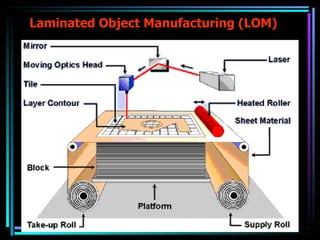
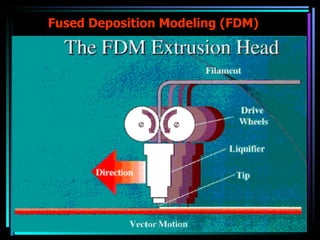
Rapid Prototyping Processes SLA  --- Stereolithography  SLS  --- Selective Laser Sintering LOM   --- Laminated Object Manufacturing FDM   --- Fused Deposition Modeling Others
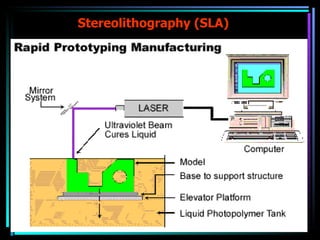
Stereolithography (SLA)
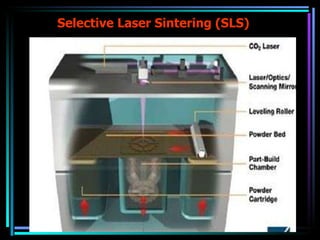
Selective Laser Sintering (SLS)
Laminated Object Manufacturing (LOM)
Fused Deposition Modeling (FDM)
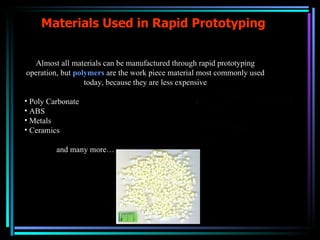
Materials Used in Rapid Prototyping Almost all materials can be manufactured through rapid prototyping operation, but  polymers  are the work piece material most commonly used today, because they are less expensive Poly Carbonate ABS Metals Ceramics and many more…
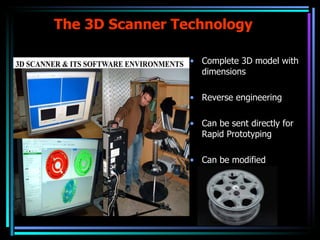
The 3D Scanner Technology Complete 3D model with dimensions Reverse engineering Can be sent directly for Rapid Prototyping Can be modified
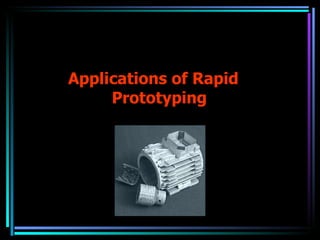
Applications of Rapid Prototyping
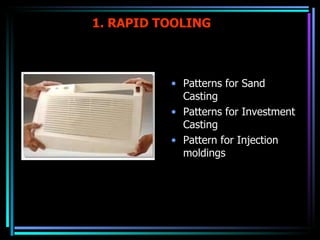
1. RAPID TOOLING  Patterns for Sand Casting Patterns for Investment Casting Pattern for Injection moldings
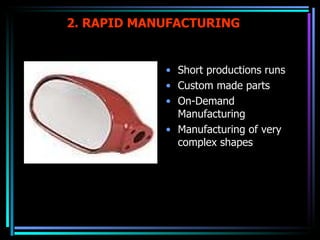
2. RAPID MANUFACTURING Short productions runs Custom made parts On-Demand Manufacturing Manufacturing of very complex shapes
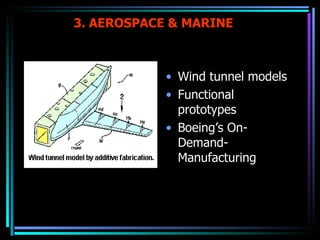
3. AEROSPACE & MARINE Wind tunnel models Functional prototypes Boeing’s On-Demand-Manufacturing
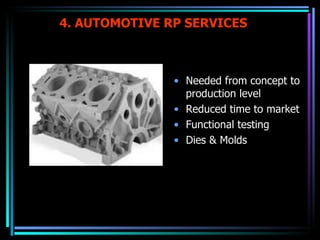
4. AUTOMOTIVE RP SERVICES Needed from concept to production level Reduced time to market Functional testing Dies & Molds
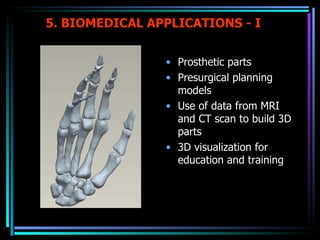
5. BIOMEDICAL APPLICATIONS - I Prosthetic parts Presurgical planning models Use of data from MRI and CT scan to build 3D parts 3D visualization for education and training
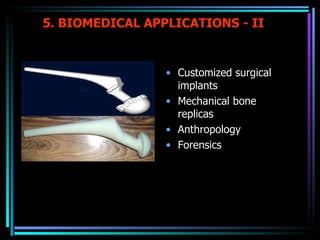
5. BIOMEDICAL APPLICATIONS - II Customized surgical implants Mechanical bone replicas Anthropology Forensics
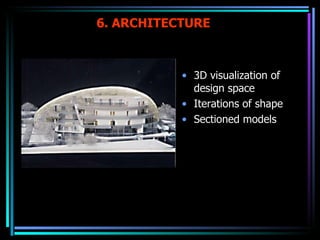
6. ARCHITECTURE 3D visualization of design space Iterations of shape Sectioned models
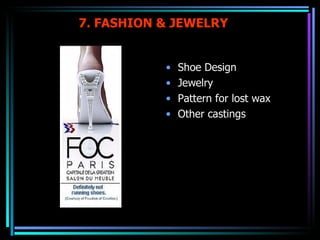
7. FASHION & JEWELRY Shoe Design Jewelry Pattern for lost wax Other castings
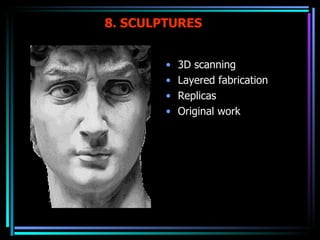
8. SCULPTURES 3D scanning Layered fabrication  Replicas Original work
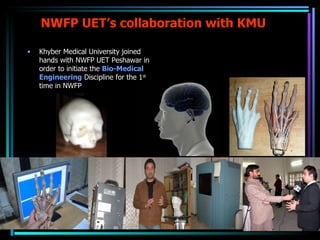
NWFP UET’s collaboration with KMU Khyber Medical University joined hands with NWFP UET Peshawar in order to initiate the  Bio-Medical Engineering  Discipline for the 1 st  time in NWFP
Tooling (no Tooling):  Less tools is better One shot operations:  No assembly of parts, ..etc. Reduced Lead Time:  The less time the better it is The closeness to serve the purpose of the prototype:  Accurate representation of the design Flexible:  Modifications, addition of parameters, scaling Equipment : size, weight, maintenance..etc Economical:  Equipment and operating costs   Clean, safe operation  User friendly  CONCLUSION
QUESTIONS

Rapid Prototyping and its Applications

  • 1.
    ASME OLD GUARDORAL TECHNICAL PRESENTATION COMPETITION STUDENT LEADERSHIP SEMINAR – 2010 ASME UET Lahore Student Section - Pakistan By: Malik Muhammad Usman Awan Communication In-charge ASME SDOB Asia-Pacific ( Pakistan ) Student Chair ASME NWFP University of Engineering & Technology Peshawar Pakistan 1 st March, 2010 “ Rapid Prototyping & its Applications in 21st Century ”
  • 2.
    OUTLINE What isa Prototype? Need for a Prototype Basics of Rapid Prototyping (RP) Rapid Prototyping Processes Materials used in Rapid Prototyping The 3D Scanner Technology Applications of RP NWFP UET’s initiative of Bio-Medical Engineering Conclusion
  • 3.
    PRODUCT DESIGN &DEVELOPMENT DESIGN FOR AESTHETICS DESIGN FOR FUNCTION DESIGN FOR MANUFACTURE DESIGN FOR MARKETING DESIGN FOR ASSEMBLY DESIGN FOR COST TOTAL DESIGN
  • 4.
    DESIGN CORE NEEDCONCEPT DETAILS MANUFACTURE SELL
  • 5.
    What is aPROTOTYPE ? “ An original, full-scale, and usually working model of a new product or new version of an existing product ” A prototype is a model of your invention that a user can interact with. The prototype could be electronic software or literal hardware. Building a prototype is an essential step in the inventing process. Serious inventors always build prototypes. 3 Major Types: Crude Prototype Working Prototype Final Prototype
  • 6.
    NEED FOR PROTOTYPINGHave to try out: Shape Feel Mating Performance Etc. In order to make changes before final production
  • 7.
    And What isRapid Prototyping ? “ Layer by Layer fabrication of a part directly from a CAD model ” A QUICK FUNCTIONAL MODEL
  • 8.
    Basics of RapidPrototyping In the Rapid Prototyping process the 3D CAD data is sliced into thin cross sectional planes by a computer. The cross sections are sent from the computer to the rapid prototyping machine which build the part layer by layer . The first layer geometry is defined by the shape of the first cross sectional plane generated by the computer. It is bonded to a starting base and additional layers are bonded on the top of the first shaped according to their respective cross sectional planes. This process is repeated until the prototype is complete.
  • 9.
    Rapid Prototyping ProcessesSLA --- Stereolithography SLS --- Selective Laser Sintering LOM --- Laminated Object Manufacturing FDM --- Fused Deposition Modeling Others
  • 10.
  • 11.
  • 12.
  • 13.
  • 14.
    Materials Used inRapid Prototyping Almost all materials can be manufactured through rapid prototyping operation, but polymers are the work piece material most commonly used today, because they are less expensive Poly Carbonate ABS Metals Ceramics and many more…
  • 15.
    The 3D ScannerTechnology Complete 3D model with dimensions Reverse engineering Can be sent directly for Rapid Prototyping Can be modified
  • 16.
  • 17.
    1. RAPID TOOLING Patterns for Sand Casting Patterns for Investment Casting Pattern for Injection moldings
  • 18.
    2. RAPID MANUFACTURINGShort productions runs Custom made parts On-Demand Manufacturing Manufacturing of very complex shapes
  • 19.
    3. AEROSPACE &MARINE Wind tunnel models Functional prototypes Boeing’s On-Demand-Manufacturing
  • 20.
    4. AUTOMOTIVE RPSERVICES Needed from concept to production level Reduced time to market Functional testing Dies & Molds
  • 21.
    5. BIOMEDICAL APPLICATIONS- I Prosthetic parts Presurgical planning models Use of data from MRI and CT scan to build 3D parts 3D visualization for education and training
  • 22.
    5. BIOMEDICAL APPLICATIONS- II Customized surgical implants Mechanical bone replicas Anthropology Forensics
  • 23.
    6. ARCHITECTURE 3Dvisualization of design space Iterations of shape Sectioned models
  • 24.
    7. FASHION &JEWELRY Shoe Design Jewelry Pattern for lost wax Other castings
  • 25.
    8. SCULPTURES 3Dscanning Layered fabrication Replicas Original work
  • 26.
    NWFP UET’s collaborationwith KMU Khyber Medical University joined hands with NWFP UET Peshawar in order to initiate the Bio-Medical Engineering Discipline for the 1 st time in NWFP
  • 27.
    Tooling (no Tooling): Less tools is better One shot operations: No assembly of parts, ..etc. Reduced Lead Time: The less time the better it is The closeness to serve the purpose of the prototype: Accurate representation of the design Flexible: Modifications, addition of parameters, scaling Equipment : size, weight, maintenance..etc Economical: Equipment and operating costs Clean, safe operation User friendly CONCLUSION
  • 28.

Editor's Notes

  • #6 The crude prototype is a model that enables you to get a better feel for the basic premise of your invention. A working prototype is something that allows users to try out some or all of the features of the invention. A final prototype is a model that looks and functions almost like a manufactured product.
  • #7 Creating a prototype is an integral step in design