PRODUCT DEVELOPMENT
& DESIGN FOR AM
in the Dawn of Digital Transformation
Empire Group is a full-service product development company that enables
product developers, designers, engineers, and entrepreneurs to move with
speed, flexibility, and confidence through ALL stages of product
development, from virtually any starting point.
ABOUT EMPIRE GROUP
CREATE. ITERATE. ACCELERATE.
TMt
INTRODUCTION
“An industry once considered a gimmick is proving itself
to be a formidable giant. Make no mistake: 3-D printing
will be a force that upends nearly every industry over the
coming decade.” – Forbes Technology Council
“We are going to live in a world where anyone can
create and customize, and iterate with blinding speed.”
– Financial Expert @ Forbes
“It’s going to usher in a new era of localized, distributed
manufacturing that is actually based on digital
fabrication.” – Avi Reichental (CEO of 3D Systems)
THE IMPACTS OF ADDITIVE MANUFACTURING
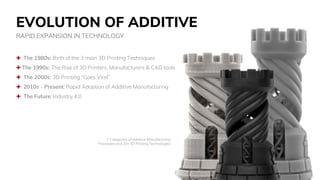
EVOLUTION OF ADDITIVE
 The 1980s: Birth of the 3 main 3D Printing Techniques
 The 1990s: The Rise of 3D Printers, Manufacturers & CAD tools
 The 2000s: 3D Printing “Goes Viral”
 2010s - Present: Rapid Adoption of Additive Manufacturing
 The Future: Industry 4.0
RAPID EXPANSION IN TECHNOLOGY
7 Categories of Additive Manufacturing
Processes and 20+ 3D Printing Technologies
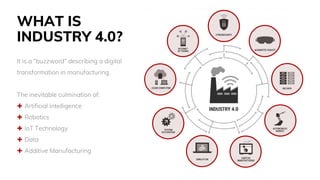
WHAT IS
INDUSTRY 4.0?
It is a “buzzword” describing a digital
transformation in manufacturing.
The inevitable culmination of:
 Artificial Intelligence
 Robotics
 IoT Technology
 Data
 Additive Manufacturing
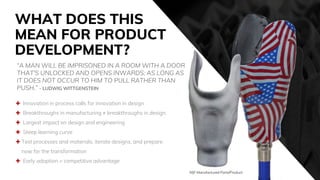
WHAT DOES THIS
MEAN FOR PRODUCT
DEVELOPMENT?
 Innovation in process calls for innovation in design
 Breakthroughs in manufacturing ≠ breakthroughs in design
 Largest impact on design and engineering
 Steep learning curve
 Test processes and materials, iterate designs, and prepare
now for the transformation
 Early adoption = competitive advantage
“A MAN WILL BE IMPRISONED IN A ROOM WITH A DOOR
THAT'S UNLOCKED AND OPENS INWARDS; AS LONG AS
IT DOES NOT OCCUR TO HIM TO PULL RATHER THAN
PUSH.” - LUDWIG WITTGENSTEIN
MJF Manufactured Parts/Product
DESIGN FOR ADDITIVE
MANUFACTURING
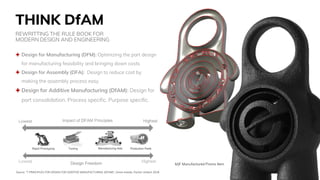
REWRITTING THE RULE BOOK FOR
MODERN DESIGN AND ENGINEERING
THINK DfAM
 Design for Manufacturing (DFM): Optimizing the part design
for manufacturing feasibility and bringing down costs
 Design for Assembly (DFA): Design to reduce cost by
making the assembly process easy
 Design for Additive Manufacturing (DfAM): Design for
part consolidation. Process specific. Purpose specific.
MJF Manufactured Promo Item
Source: “7 PRINCIPLES FOR DESIGN FOR ADDITIVE MANUFACTURING (DFAM)”, Simon Indrele, Fischer Unitech 2018
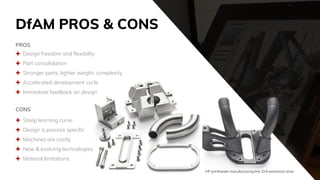
DfAM PROS & CONS
 Design freedom and flexibility
 Part consolidation
 Stronger parts, lighter weight, complexity
 Accelerated development cycle
 Immediate feedback on design
PROS
 Steep learning curve
 Design is process specific
 Machines are costly
 New & evolving technologies
 Material limitations
CONS
HP printheads manufacturing line: Drill extraction shoe
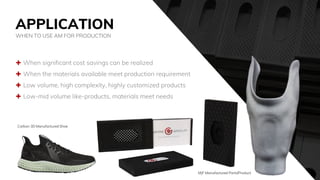
APPLICATION
 When significant cost savings can be realized
 When the materials available meet production requirement
 Low volume, high complexity, highly customized products
 Low-mid volume like-products, materials meet needs
WHEN TO USE AM FOR PRODUCTION
Carbon 3D Manufactured Shoe
MJF Manufactured Parts/Product
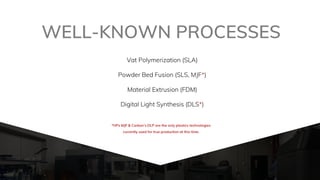
Vat Polymerization (SLA)
Powder Bed Fusion (SLS, MJF*)
Material Extrusion (FDM)
Digital Light Synthesis (DLS*)
WELL-KNOWN PROCESSES
*HPs MJF & Carbon’s DLP are the only plastics technologies
currently used for true production at this time.
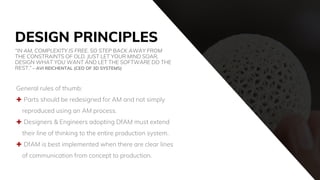
DESIGN PRINCIPLES
General rules of thumb:
 Parts should be redesigned for AM and not simply
reproduced using an AM process.
 Designers & Engineers adopting DfAM must extend
their line of thinking to the entire production system.
 DfAM is best implemented when there are clear lines
of communication from concept to production.
“IN AM, COMPLEXITY IS FREE. SO STEP BACK AWAY FROM
THE CONSTRAINTS OF OLD. JUST LET YOUR MIND SOAR,
DESIGN WHAT YOU WANT AND LET THE SOFTWARE DO THE
REST.” – AVI REICHENTAL (CEO OF 3D SYSTEMS)
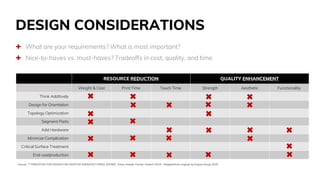
DESIGN CONSIDERATIONS
 What are your requirements? What is most important?
 Nice-to-haves vs. must-haves? Tradeoffs in cost, quality, and time.
RESOURCE REDUCTION QUALITY ENHANCEMENT
Weight & Cost Print Time Touch Time Strength Aesthetic Functionality
Think Additively
Design for Orientation
Topology Optimization
Segment Parts
Add Hardware
Minimize Complication
Critical Surface Treatment
End-use/production
Source: “7 PRINCIPLES FOR DESIGN FOR ADDITIVE MANUFACTURING (DFAM)”, Simon Indrele, Fischer Unitech 2018 - Adapted from original by Empire Group 2019
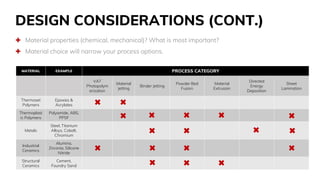
DESIGN CONSIDERATIONS (CONT.)
 Material properties (chemical, mechanical)? What is most important?
 Material choice will narrow your process options.
MATERIAL EXAMPLE PROCESS CATEGORY
VAT
Photopolym
erization
Material
Jetting
Binder Jetting
Powder Bed
Fusion
Material
Extrusion
Directed
Energy
Deposition
Sheet
Lamination
Thermoset
Polymers
Epoxies &
Acrylates
X X
Thermoplast
ic Polymers
Polyamide, ABS,
PPSF
X X X X X
Metals
Steel, Titanium
Alloys, Cobalt,
Chromium
X X X X
Industrial
Ceramics
Alumina,
Zirconia, Silicone
Nitride
X X X X
Structural
Ceramics
Cement,
Foundry Sand
X X X
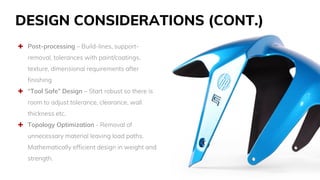
DESIGN CONSIDERATIONS (CONT.)
 Post-processing – Build-lines, support-
removal, tolerances with paint/coatings,
texture, dimensional requirements after
finishing
 “Tool Safe” Design – Start robust so there is
room to adjust tolerance, clearance, wall
thickness etc.
 Topology Optimization - Removal of
unnecessary material leaving load paths.
Mathematically efficient design in weight and
strength.
DESIGN CONSIDERATIONS (CONT.)
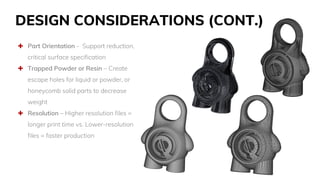
 Part Orientation - Support reduction,
critical surface specification
 Trapped Powder or Resin – Create
escape holes for liquid or powder, or
honeycomb solid parts to decrease
weight
 Resolution – Higher resolution files =
longer print time vs. Lower-resolution
files = faster production
KEY TAKEAWAYS
 A digital transformation in manufacturing is in motion,
stay at the forefront of technology
 Designers & Engineers need DfAM knowledge
 Design has yet to catch up to technology
 Best implemented when there are clear lines of
communication from concept to production
 DfAM is not “one-size-fits-all”
 Design without traditional constraints
 Current production is limited to low-mid volume, end-use.
But not for long.
HOW EMPIRE GROUP
TACKLES DfAM
360° PRODUCT
DEVELOPMENT
SUPPORT
With Empire Group, Customers Have Access to
and gain a trusted partner that provides design, development,
and manufacturing solutions that push the boundaries of
technological advancement.
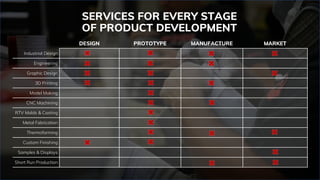
DESIGN PROTOTYPE MANUFACTURE MARKET
Industrial Design
Engineering
Graphic Design
3D Printing
Model Making
CNC Machining
RTV Molds & Casting
Metal Fabrication
Thermoforming
Custom Finishing
Samples & Displays
Short Run Production
SERVICES FOR EVERY STAGE
OF PRODUCT DEVELOPMENT
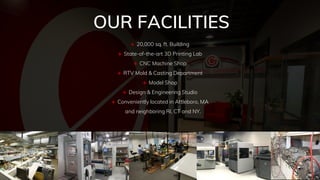
OUR FACILITIES
 20,000 sq. ft. Building
 State-of-the-art 3D Printing Lab
 CNC Machine Shop
 RTV Mold & Casting Department
 Model Shop
 Design & Engineering Studio
 Conveniently located in Attleboro, MA
and neighboring RI, CT and NY.
QUESTIONS?

Product Development & Design for Additive Manufacturing (DfAM)

  • 1.
    PRODUCT DEVELOPMENT & DESIGNFOR AM in the Dawn of Digital Transformation
  • 2.
    Empire Group isa full-service product development company that enables product developers, designers, engineers, and entrepreneurs to move with speed, flexibility, and confidence through ALL stages of product development, from virtually any starting point. ABOUT EMPIRE GROUP CREATE. ITERATE. ACCELERATE. TMt
  • 3.
    INTRODUCTION “An industry onceconsidered a gimmick is proving itself to be a formidable giant. Make no mistake: 3-D printing will be a force that upends nearly every industry over the coming decade.” – Forbes Technology Council “We are going to live in a world where anyone can create and customize, and iterate with blinding speed.” – Financial Expert @ Forbes “It’s going to usher in a new era of localized, distributed manufacturing that is actually based on digital fabrication.” – Avi Reichental (CEO of 3D Systems) THE IMPACTS OF ADDITIVE MANUFACTURING
  • 4.
    EVOLUTION OF ADDITIVE The 1980s: Birth of the 3 main 3D Printing Techniques  The 1990s: The Rise of 3D Printers, Manufacturers & CAD tools  The 2000s: 3D Printing “Goes Viral”  2010s - Present: Rapid Adoption of Additive Manufacturing  The Future: Industry 4.0 RAPID EXPANSION IN TECHNOLOGY 7 Categories of Additive Manufacturing Processes and 20+ 3D Printing Technologies
  • 5.
    WHAT IS INDUSTRY 4.0? Itis a “buzzword” describing a digital transformation in manufacturing. The inevitable culmination of:  Artificial Intelligence  Robotics  IoT Technology  Data  Additive Manufacturing
  • 6.
    WHAT DOES THIS MEANFOR PRODUCT DEVELOPMENT?  Innovation in process calls for innovation in design  Breakthroughs in manufacturing ≠ breakthroughs in design  Largest impact on design and engineering  Steep learning curve  Test processes and materials, iterate designs, and prepare now for the transformation  Early adoption = competitive advantage “A MAN WILL BE IMPRISONED IN A ROOM WITH A DOOR THAT'S UNLOCKED AND OPENS INWARDS; AS LONG AS IT DOES NOT OCCUR TO HIM TO PULL RATHER THAN PUSH.” - LUDWIG WITTGENSTEIN MJF Manufactured Parts/Product
  • 7.
  • 8.
    REWRITTING THE RULEBOOK FOR MODERN DESIGN AND ENGINEERING THINK DfAM  Design for Manufacturing (DFM): Optimizing the part design for manufacturing feasibility and bringing down costs  Design for Assembly (DFA): Design to reduce cost by making the assembly process easy  Design for Additive Manufacturing (DfAM): Design for part consolidation. Process specific. Purpose specific. MJF Manufactured Promo Item Source: “7 PRINCIPLES FOR DESIGN FOR ADDITIVE MANUFACTURING (DFAM)”, Simon Indrele, Fischer Unitech 2018
  • 9.
    DfAM PROS &CONS  Design freedom and flexibility  Part consolidation  Stronger parts, lighter weight, complexity  Accelerated development cycle  Immediate feedback on design PROS  Steep learning curve  Design is process specific  Machines are costly  New & evolving technologies  Material limitations CONS HP printheads manufacturing line: Drill extraction shoe
  • 10.
    APPLICATION  When significantcost savings can be realized  When the materials available meet production requirement  Low volume, high complexity, highly customized products  Low-mid volume like-products, materials meet needs WHEN TO USE AM FOR PRODUCTION Carbon 3D Manufactured Shoe MJF Manufactured Parts/Product
  • 11.
    Vat Polymerization (SLA) PowderBed Fusion (SLS, MJF*) Material Extrusion (FDM) Digital Light Synthesis (DLS*) WELL-KNOWN PROCESSES *HPs MJF & Carbon’s DLP are the only plastics technologies currently used for true production at this time.
  • 12.
    DESIGN PRINCIPLES General rulesof thumb:  Parts should be redesigned for AM and not simply reproduced using an AM process.  Designers & Engineers adopting DfAM must extend their line of thinking to the entire production system.  DfAM is best implemented when there are clear lines of communication from concept to production. “IN AM, COMPLEXITY IS FREE. SO STEP BACK AWAY FROM THE CONSTRAINTS OF OLD. JUST LET YOUR MIND SOAR, DESIGN WHAT YOU WANT AND LET THE SOFTWARE DO THE REST.” – AVI REICHENTAL (CEO OF 3D SYSTEMS)
  • 13.
    DESIGN CONSIDERATIONS  Whatare your requirements? What is most important?  Nice-to-haves vs. must-haves? Tradeoffs in cost, quality, and time. RESOURCE REDUCTION QUALITY ENHANCEMENT Weight & Cost Print Time Touch Time Strength Aesthetic Functionality Think Additively Design for Orientation Topology Optimization Segment Parts Add Hardware Minimize Complication Critical Surface Treatment End-use/production Source: “7 PRINCIPLES FOR DESIGN FOR ADDITIVE MANUFACTURING (DFAM)”, Simon Indrele, Fischer Unitech 2018 - Adapted from original by Empire Group 2019
  • 14.
    DESIGN CONSIDERATIONS (CONT.) Material properties (chemical, mechanical)? What is most important?  Material choice will narrow your process options. MATERIAL EXAMPLE PROCESS CATEGORY VAT Photopolym erization Material Jetting Binder Jetting Powder Bed Fusion Material Extrusion Directed Energy Deposition Sheet Lamination Thermoset Polymers Epoxies & Acrylates X X Thermoplast ic Polymers Polyamide, ABS, PPSF X X X X X Metals Steel, Titanium Alloys, Cobalt, Chromium X X X X Industrial Ceramics Alumina, Zirconia, Silicone Nitride X X X X Structural Ceramics Cement, Foundry Sand X X X
  • 15.
    DESIGN CONSIDERATIONS (CONT.) Post-processing – Build-lines, support- removal, tolerances with paint/coatings, texture, dimensional requirements after finishing  “Tool Safe” Design – Start robust so there is room to adjust tolerance, clearance, wall thickness etc.  Topology Optimization - Removal of unnecessary material leaving load paths. Mathematically efficient design in weight and strength.
  • 16.
    DESIGN CONSIDERATIONS (CONT.) Part Orientation - Support reduction, critical surface specification  Trapped Powder or Resin – Create escape holes for liquid or powder, or honeycomb solid parts to decrease weight  Resolution – Higher resolution files = longer print time vs. Lower-resolution files = faster production
  • 17.
    KEY TAKEAWAYS  Adigital transformation in manufacturing is in motion, stay at the forefront of technology  Designers & Engineers need DfAM knowledge  Design has yet to catch up to technology  Best implemented when there are clear lines of communication from concept to production  DfAM is not “one-size-fits-all”  Design without traditional constraints  Current production is limited to low-mid volume, end-use. But not for long.
  • 18.
  • 19.
    360° PRODUCT DEVELOPMENT SUPPORT With EmpireGroup, Customers Have Access to and gain a trusted partner that provides design, development, and manufacturing solutions that push the boundaries of technological advancement.
  • 20.
    DESIGN PROTOTYPE MANUFACTUREMARKET Industrial Design Engineering Graphic Design 3D Printing Model Making CNC Machining RTV Molds & Casting Metal Fabrication Thermoforming Custom Finishing Samples & Displays Short Run Production SERVICES FOR EVERY STAGE OF PRODUCT DEVELOPMENT
  • 21.
    OUR FACILITIES  20,000sq. ft. Building  State-of-the-art 3D Printing Lab  CNC Machine Shop  RTV Mold & Casting Department  Model Shop  Design & Engineering Studio  Conveniently located in Attleboro, MA and neighboring RI, CT and NY.
  • 22.