1
Seminar Report 2015 Rapid Prototyping
CHAPTER 1
INTRODUCTION
The past decade has witnessed the emergence of new manufacturing technologies that
build parts on a layer-by-layer basis. Using these technologies, manufacturing time for parts of
virtually any complexity is reduced considerably. In other words, it is rapid. Rapid Prototyping
Technologies and Rapid Manufacturing offer great potential for producing models and unique
parts for manufacturing industry. Thus, the reliability of products can be increased; investment of
time and money is less risky. Not everything that is thinkable today is already workable or
available at a reasonable price, but this technology is fast evolving and the better the challenges,
the better for this developing process.
Rapid prototyping is a group of techniques used to quickly fabricate a scale model of a
physical part or assembly using three-dimensional computer aided design (CAD)
data. Construction of the part or assembly is usually done using 3D printing or "additive layer
manufacturing" technology.
The first methods for rapid prototyping became available in the late 1980s and were used
to produce models and prototype parts. Today, they are used for a wide range of applications and
are used to manufacture production-quality parts in relatively small numbers if desired without
the typical unfavorable short-run economics. This economy has encouraged online service
bureaus. Historical surveys of RP technology start with discussions of simulacra production
techniques used by 19th-century sculptors. Some modern sculptors use the progeny technology
to produce exhibitions. The ability to reproduce designs from a dataset has given rise to issues of
rights, as it is now possible to interpolate volumetric data from one-dimensional images.
However, there is much research work being undertaken to improve the RP processes to
enable them to be used as manufacturing alternatives. Three areas have been highlighted by the
Rapid Manufacturing Research Group (RMRG) at Loughborough University that requires
research attention before Rapid Manufacturing will truly become a reality. These include:
1. Processes and Materials
Dept. of Mechanical Engg. AXIS CET
2
Seminar Report 2015 Rapid Prototyping
2. Design for Rapid Manufacture
3. Organization and Implementation
UK funded research projects in all these areas have commenced within the RMRG and this
paper discusses some results of work into the design optimization and customization aspects that
are enabled by RM. The results are derived from the ‘Design for Rapid Manufacture’ and
‘Management, Organizational and Implementation of Rapid Manufacturing’ (Man RM) projects.
It should be noted that although the Man RM project is principally concerned with the
management implications of RM, much work has also been carried out into what is becoming a
significantly important area for business – the area of customization and personalization of
products. It should be noted that an assumption on the projects has been made that the viable
Rapid Manufacturing process have been developed that additively produce end-use parts in
suitable materials and with acceptable surface finish, accuracy and speed.
As with CNC subtractive methods, the CAD-CAM workflow in the traditional Rapid
Prototyping process starts with the creation of geometric data, either as a 3D solid using
a CAD workstation, or 2D slices using a scanning device. For RP this data must represent a valid
geometric model; namely, one whose boundary surfaces enclose a finite volume, contains no
holes exposing the interior, and do not fold back on themselves. In other words, the object must
have an inside. The model is valid if for each point in 3D space the computer can determine
uniquely whether that point lies inside, on, or outside the boundary surface of the
model. CAD post-processors will approximate the application vendors’ internal CAD geometric
forms (e.g., B-spines) with a simplified mathematical form, which in turn is expressed in a
specified data format which is a common feature in Additive Manufacturing: STL
(stereolithography) a de facto standard for transferring solid geometric models to SFF machines.
To obtain the necessary motion control trajectories to drive the actual SFF, Rapid
Prototyping, 3D Printing or Additive Manufacturing mechanism, the prepared geometric model
is typically sliced into layers, and the slices are scanned into lines [producing a "2D drawing"
used to generate trajectory as in CNC`s tool path], mimicking in reverse the layer-to-layer
physical building process.
1.1 HISTORY
Dept. of Mechanical Engg. AXIS CET
3
Seminar Report 2015 Rapid Prototyping
In the 1980s U.S. policy makers and industrial managers were forced to take note that
America's dominance in the field of machine tool manufacturing evaporated, in what was named
the machine tool crisis. Numerous projects sought to counter these trends in the
traditional CNC CAM area, which had begun in the US. Later when Rapid Prototyping Systems
moved out of labs to be commercialized it was recognized that developments were already
international and U.S. rapid prototyping companies would not have the luxury of letting a lead
slip away. The National Science Foundation was an umbrella for the National Aeronautics and
Space Administration (NASA), the US Department of Energy, the US Department of
Commerce NIST, the US Department of Defense, Defense Advanced Research Projects
Agency (DARPA), and the Office of Naval Research coordinated studies to inform strategic
planners in their deliberations. One such report was the 1997 Rapid Prototyping in Europe and
Japan Panel Report in which Joseph J. Beaman founder of DTM Corporation DTM RapidTool
pictured] provides a historical perspective: The roots of rapid prototyping technology can be
traced to practices in topography and photo sculpture. Within TOPOGRAPHY Blanther (1892)
suggested a layered method for making a mold for raised relief paper topographical maps .The
process involved cutting the contour lines on a series of plates which were then stacked.
Matsubara (1974) of Mitsubishi proposed a topographical process with a photo-
hardening photopolymer resin to form thin layers stacked to make a casting mold.
PHOTOSCULPTURE was a 19th-century technique to create exact three-dimensional replicas of
objects. Most famously Francois Willeme (1860) placed 24 cameras in a circular array and
simultaneously photographed an object. The silhouette of each photograph was then used to
carve a replica. Morioka (1935, 1944) developed a hybrid photo sculpture and topographic
process using structured light to photographically create contour lines of an object. The lines
could then be developed into sheets and cut and stacked, or projected onto stock material for
carving. The Munz (1956) Process reproduced a three-dimensional image of an object by
selectively exposing, layer by layer, a photo emulsion on a lowering piston. After fixing, a solid
transparent cylinder contains an image of the object.
The technologies referred to as Solid Freeform Fabrication are what we recognize today as
Rapid Prototyping, 3D Printing or Additive Manufacturing: Swainson (1977), Schwerzel (1984)
Dept. of Mechanical Engg. AXIS CET
4
Seminar Report 2015 Rapid Prototyping
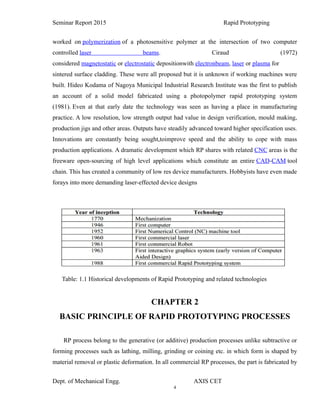
worked on polymerization of a photosensitive polymer at the intersection of two computer
controlled laser beams. Ciraud (1972)
considered magnetostatic or electrostatic depositionwith electronbeam, laser or plasma for
sintered surface cladding. These were all proposed but it is unknown if working machines were
built. Hideo Kodama of Nagoya Municipal Industrial Research Institute was the first to publish
an account of a solid model fabricated using a photopolymer rapid prototyping system
(1981). Even at that early date the technology was seen as having a place in manufacturing
practice. A low resolution, low strength output had value in design verification, mould making,
production jigs and other areas. Outputs have steadily advanced toward higher specification uses.
Innovations are constantly being sought,toimprove speed and the ability to cope with mass
production applications. A dramatic development which RP shares with related CNC areas is the
freeware open-sourcing of high level applications which constitute an entire CAD-CAM tool
chain. This has created a community of low res device manufacturers. Hobbyists have even made
forays into more demanding laser-effected device designs
Table: 1.1 Historical developments of Rapid Prototyping and related technologies
CHAPTER 2
BASIC PRINCIPLE OF RAPID PROTOTYPING PROCESSES
RP process belong to the generative (or additive) production processes unlike subtractive or
forming processes such as lathing, milling, grinding or coining etc. in which form is shaped by
material removal or plastic deformation. In all commercial RP processes, the part is fabricated by
Dept. of Mechanical Engg. AXIS CET
5
Seminar Report 2015 Rapid Prototyping
deposition of layers contoured in a (x-y) plane two dimensionally. The third dimension (z)
results from single layers being stacked up on top of each other, but not as a continuous z-
coordinate. Therefore, the prototypes are very exact on the x-y plane but have stair-stepping
effect in z-direction. If model is deposited with very fine layers, i.e., smaller z-stepping, model
looks like original. RP can be classified into two fundamental process steps namely generation of
mathematical layer information and generation of physical layer model. Typical process chain of
various RP systems is shown in figure.
The concept of Rapid Manufacturing (RM) – the production of end-use parts from
additive manufacturing systems – is evolving from Rapid Prototyping (RP). Though some well-
documented ‘Rapid Manufacturing’ is being undertaken today, these examples are being
undertaken with existing RP systems. However, no current RP method can be considered as a
true manufacturing process as there are many problems with surface finish, resolution, accuracy
and repeatability that need to be overcome. There is much work to be undertaken to convert the
principles of additive manufacturing into viable manufacturing techniques that can be exploited
more universally. However, it is anticipated that true RM manufacturing systems will become
available within a 5 to 10 year period and their introduction will truly amount to a new industrial
revolution.
Dept. of Mechanical Engg. AXIS CET
6
Seminar Report 2015 Rapid Prototyping
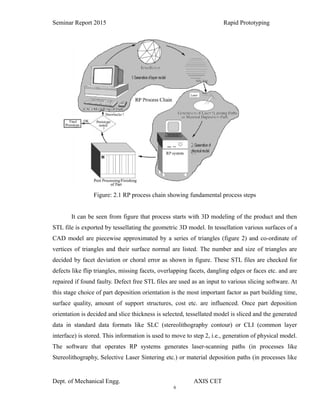
Figure: 2.1 RP process chain showing fundamental process steps
It can be seen from figure that process starts with 3D modeling of the product and then
STL file is exported by tessellating the geometric 3D model. In tessellation various surfaces of a
CAD model are piecewise approximated by a series of triangles (figure 2) and co-ordinate of
vertices of triangles and their surface normal are listed. The number and size of triangles are
decided by facet deviation or choral error as shown in figure. These STL files are checked for
defects like flip triangles, missing facets, overlapping facets, dangling edges or faces etc. and are
repaired if found faulty. Defect free STL files are used as an input to various slicing software. At
this stage choice of part deposition orientation is the most important factor as part building time,
surface quality, amount of support structures, cost etc. are influenced. Once part deposition
orientation is decided and slice thickness is selected, tessellated model is sliced and the generated
data in standard data formats like SLC (stereolithography contour) or CLI (common layer
interface) is stored. This information is used to move to step 2, i.e., generation of physical model.
The software that operates RP systems generates laser-scanning paths (in processes like
Stereolithography, Selective Laser Sintering etc.) or material deposition paths (in processes like
Dept. of Mechanical Engg. AXIS CET
7
Seminar Report 2015 Rapid Prototyping
Fused Deposition Modeling). This step is different for different processes and depends on the
basic deposition principle used in RP machine. Information computed here is used to deposit the
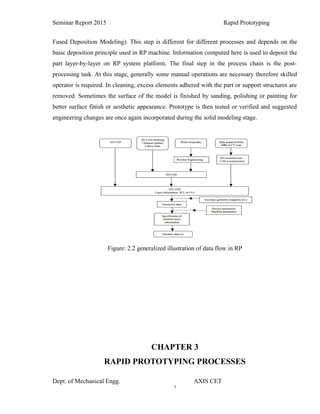
part layer-by-layer on RP system platform. The final step in the process chain is the post-
processing task. At this stage, generally some manual operations are necessary therefore skilled
operator is required. In cleaning, excess elements adhered with the part or support structures are
removed. Sometimes the surface of the model is finished by sanding, polishing or painting for
better surface finish or aesthetic appearance. Prototype is then tested or verified and suggested
engineering changes are once again incorporated during the solid modeling stage.
Figure: 2.2 generalized illustration of data flow in RP
CHAPTER 3
RAPID PROTOTYPING PROCESSES
Dept. of Mechanical Engg. AXIS CET
8
Seminar Report 2015 Rapid Prototyping
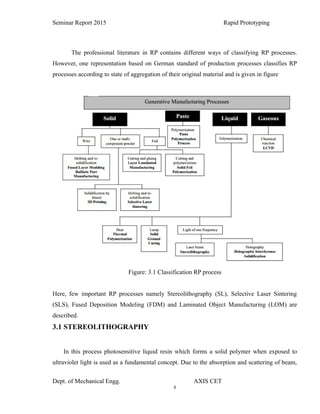
The professional literature in RP contains different ways of classifying RP processes.
However, one representation based on German standard of production processes classifies RP
processes according to state of aggregation of their original material and is given in figure
Figure: 3.1 Classification RP process
Here, few important RP processes namely Stereolithography (SL), Selective Laser Sintering
(SLS), Fused Deposition Modeling (FDM) and Laminated Object Manufacturing (LOM) are
described.
3.1 STEREOLITHOGRAPHY
In this process photosensitive liquid resin which forms a solid polymer when exposed to
ultraviolet light is used as a fundamental concept. Due to the absorption and scattering of beam,
Dept. of Mechanical Engg. AXIS CET
9
Seminar Report 2015 Rapid Prototyping
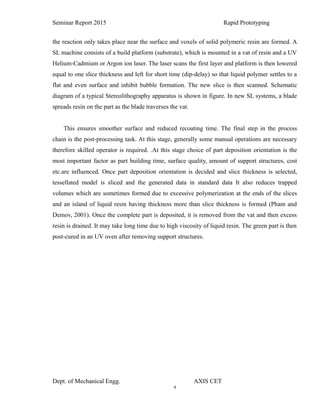
the reaction only takes place near the surface and voxels of solid polymeric resin are formed. A
SL machine consists of a build platform (substrate), which is mounted in a vat of resin and a UV
Helium-Cadmium or Argon ion laser. The laser scans the first layer and platform is then lowered
equal to one slice thickness and left for short time (dip-delay) so that liquid polymer settles to a
flat and even surface and inhibit bubble formation. The new slice is then scanned. Schematic
diagram of a typical Stereolithography apparatus is shown in figure. In new SL systems, a blade
spreads resin on the part as the blade traverses the vat.
This ensures smoother surface and reduced recoating time. The final step in the process
chain is the post-processing task. At this stage, generally some manual operations are necessary
therefore skilled operator is required. .At this stage choice of part deposition orientation is the
most important factor as part building time, surface quality, amount of support structures, cost
etc.are influenced. Once part deposition orientation is decided and slice thickness is selected,
tessellated model is sliced and the generated data in standard data It also reduces trapped
volumes which are sometimes formed due to excessive polymerization at the ends of the slices
and an island of liquid resin having thickness more than slice thickness is formed (Pham and
Demov, 2001). Once the complete part is deposited, it is removed from the vat and then excess
resin is drained. It may take long time due to high viscosity of liquid resin. The green part is then
post-cured in an UV oven after removing support structures.
Dept. of Mechanical Engg. AXIS CET
10
Seminar Report 2015 Rapid Prototyping
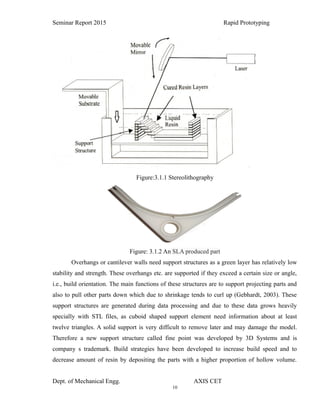
Figure:3.1.1 Stereolithography
Figure: 3.1.2 An SLA produced part
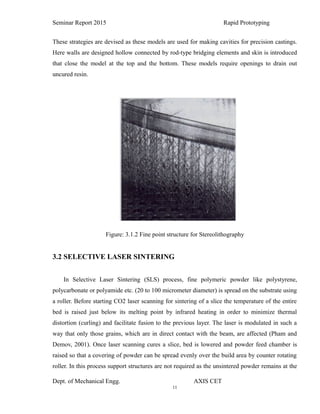
Overhangs or cantilever walls need support structures as a green layer has relatively low
stability and strength. These overhangs etc. are supported if they exceed a certain size or angle,
i.e., build orientation. The main functions of these structures are to support projecting parts and
also to pull other parts down which due to shrinkage tends to curl up (Gebhardt, 2003). These
support structures are generated during data processing and due to these data grows heavily
specially with STL files, as cuboid shaped support element need information about at least
twelve triangles. A solid support is very difficult to remove later and may damage the model.
Therefore a new support structure called fine point was developed by 3D Systems and is
company s trademark. Build strategies have been developed to increase build speed and to
decrease amount of resin by depositing the parts with a higher proportion of hollow volume.
Dept. of Mechanical Engg. AXIS CET
11
Seminar Report 2015 Rapid Prototyping
These strategies are devised as these models are used for making cavities for precision castings.
Here walls are designed hollow connected by rod-type bridging elements and skin is introduced
that close the model at the top and the bottom. These models require openings to drain out
uncured resin.
Figure: 3.1.2 Fine point structure for Stereolithography
3.2 SELECTIVE LASER SINTERING
In Selective Laser Sintering (SLS) process, fine polymeric powder like polystyrene,
polycarbonate or polyamide etc. (20 to 100 micrometer diameter) is spread on the substrate using
a roller. Before starting CO2 laser scanning for sintering of a slice the temperature of the entire
bed is raised just below its melting point by infrared heating in order to minimize thermal
distortion (curling) and facilitate fusion to the previous layer. The laser is modulated in such a
way that only those grains, which are in direct contact with the beam, are affected (Pham and
Demov, 2001). Once laser scanning cures a slice, bed is lowered and powder feed chamber is
raised so that a covering of powder can be spread evenly over the build area by counter rotating
roller. In this process support structures are not required as the unsintered powder remains at the
Dept. of Mechanical Engg. AXIS CET
12
Seminar Report 2015 Rapid Prototyping
places of support structure. It is cleaned away and can be recycled once the model is complete.
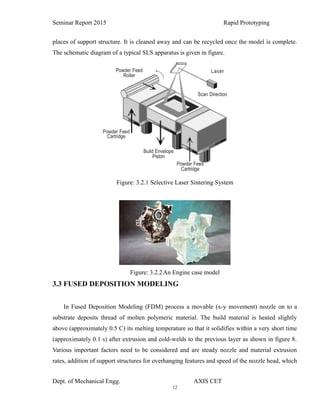
The schematic diagram of a typical SLS apparatus is given in figure.
Figure: 3.2.1 Selective Laser Sintering System
Figure: 3.2.2An Engine case model
3.3 FUSED DEPOSITION MODELING
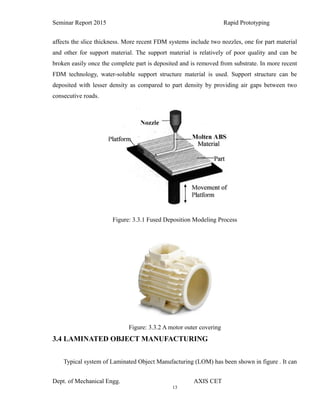
In Fused Deposition Modeling (FDM) process a movable (x-y movement) nozzle on to a
substrate deposits thread of molten polymeric material. The build material is heated slightly
above (approximately 0.5 C) its melting temperature so that it solidifies within a very short time
(approximately 0.1 s) after extrusion and cold-welds to the previous layer as shown in figure 8.
Various important factors need to be considered and are steady nozzle and material extrusion
rates, addition of support structures for overhanging features and speed of the nozzle head, which
Dept. of Mechanical Engg. AXIS CET
13
Seminar Report 2015 Rapid Prototyping
affects the slice thickness. More recent FDM systems include two nozzles, one for part material
and other for support material. The support material is relatively of poor quality and can be
broken easily once the complete part is deposited and is removed from substrate. In more recent
FDM technology, water-soluble support structure material is used. Support structure can be
deposited with lesser density as compared to part density by providing air gaps between two
consecutive roads.
Figure: 3.3.1 Fused Deposition Modeling Process
Figure: 3.3.2 A motor outer covering
3.4 LAMINATED OBJECT MANUFACTURING
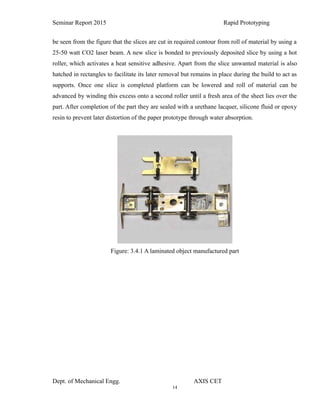
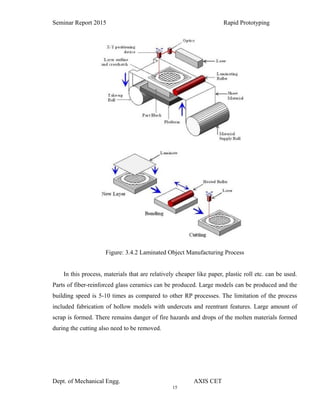
Typical system of Laminated Object Manufacturing (LOM) has been shown in figure . It can
Dept. of Mechanical Engg. AXIS CET
14
Seminar Report 2015 Rapid Prototyping
be seen from the figure that the slices are cut in required contour from roll of material by using a
25-50 watt CO2 laser beam. A new slice is bonded to previously deposited slice by using a hot
roller, which activates a heat sensitive adhesive. Apart from the slice unwanted material is also
hatched in rectangles to facilitate its later removal but remains in place during the build to act as
supports. Once one slice is completed platform can be lowered and roll of material can be
advanced by winding this excess onto a second roller until a fresh area of the sheet lies over the
part. After completion of the part they are sealed with a urethane lacquer, silicone fluid or epoxy
resin to prevent later distortion of the paper prototype through water absorption.
Figure: 3.4.1 A laminated object manufactured part
Dept. of Mechanical Engg. AXIS CET
15
Seminar Report 2015 Rapid Prototyping
Figure: 3.4.2 Laminated Object Manufacturing Process
In this process, materials that are relatively cheaper like paper, plastic roll etc. can be used.
Parts of fiber-reinforced glass ceramics can be produced. Large models can be produced and the
building speed is 5-10 times as compared to other RP processes. The limitation of the process
included fabrication of hollow models with undercuts and reentrant features. Large amount of
scrap is formed. There remains danger of fire hazards and drops of the molten materials formed
during the cutting also need to be removed.
Dept. of Mechanical Engg. AXIS CET
16
Seminar Report 2015 Rapid Prototyping
CHAPTER 4
DESIGN FACTORS
4.1 DESIGNS FOR RAPID MANUFACTURE
A research project that has researched the design aspects is the ‘Design for Rapid
Manufacturing’ project at Loughborough University, UK.The aim of this project was to
investigate how the advent of RM affected the design and manufacturing phases of complex
plastic components and was funded by the Engineering Physical Sciences Research Council
(EPSRC), as part of the Innovative Manufacturing Research Centre (IMRC) at Loughborough.
The project’s industrial partners included: 3D Systems, Custom Design Technologies Ltd
(formerly Bafbox), Delphi Automotive Systems, Jaguar & Land Rover Research, MG Rover
Group and Huntsman (formerly Vantico). They represent a mixture of SMEs, leading world RP
machine and materials suppliers and a cross-section of the UK’s car manufacturers and suppliers.
The main aim of this foundation project was to investigate the design opportunities afforded with
Rapid Manufacturing (RM) and determine a range of material properties for state of the art RM
materials to enable designers to use this information in their designs. The project broadly covers
the following areas:
4.1.1 DESIGN FREEDOM
Freedom of design is one of the most important features of RM and extremely significant
for producing parts of complex geometry, which could result in reducing the lead-time and
ultimately the overall manufacturing costs for such items. RM will affect manufacturers and
customers alike. For manufacturers, costs will be dramatically reduced as no tooling is required
and for customers, complex, individualised products will be cost effectively made that can be
configured to personal use, thus giving the potential for much greater product satisfaction.
Each of the industrial partners was requested to nominate a part for redesign for RM. A total of
four case studies were conducted during the two years and the ability of RM technologies to
Dept. of Mechanical Engg. AXIS CET
17
Seminar Report 2015 Rapid Prototyping
introduce features that are not possible to be manufactured by conventional means was
determined. A set of guidelines for design and assembly of additive manufacturing processes was
established to enable designers to use when they are designing for RM.
4.1.2 MATERIALS PROPERTIES:
In order for designers to have confidence in selecting a mmaterial for a part to be designed
for RM, they have to have extensive information regarding the properties of these materials. For
automotive application, designers typically need material properties ranging from –40o
C to
+140o
C. Within the Design for Rapid Manufacturing project, three state of the art RP/RM
materials (SL7560, Accura SI40, and Duraform PA) were selected, with the principal work being
conducted on SL7560 with preliminary results obtained for the other two materials. The project
conducted extensive material testing for the SL7560 material over the temperature range of 40o
C
to +140o
C, with three different humidities (dry, 50% relative humidity and soaked) and also over
an extended time period (1, 4, 6, 13 and 52 weeks) to consider the ageing of the material.
A comprehensive range of mechanical properties, including tensile properties (namely
ultimate tensile stress, Young’s Modulus and % elongation at break), flexural properties (namely
stress and modulus) and impact strength (Izod test) were conducted. Some preliminary
investigations, such as isotropy/anisotropy tests, effect of thermal post curing, samples of
different wall thickness and different methods of introducing the notch into Izod impact samples
on the mechanical properties of Stereolithography resins, were conducted.
4.1.3 DESIGN OPTIMISATION
One of the design investigations undertaken during the Design for Rapid Manufacture
project was carried out in conjunction with MG Rover Group. The investigation was based on
the use of design optimisation techniques (principally Finite Element Analysis (FEA)) to remove
unnecessary material from a product in order to minimize its weight. This approach is common
in the construction industry where optimal structures for bridges and buildings are derived using
Dept. of Mechanical Engg. AXIS CET
18
Seminar Report 2015 Rapid Prototyping
optimisation techniques and then subsequently fabricated. However, this impossible to make due
to DFM criteria – this is one of the main stumbling blocks for so-called Knowledge Based
Engineering (KBE) systems that often have FEA as the kernel. The design optimisation is
followed by the application of industrial design to the FEA optimised product in order to produce
a hybrid design that encompasses both engineering and aesthetic aspects. This approach follows
the conclusions of a previous investigation for Custom Design Technologies (formerly Bafbox)
that was undertaken during the Design for RM research project [7]. During this work, it was
speculated that as DFM criteria are no longer valid with the advent of RM, then a hybrid design
methodology will emerge where the industrial designer would be able to manufacture any design
that they desire without the need to consider DFM. Thus, there would be an overriding need for
them to incorporate some engineering aspects in their product design. This investigation extends
this principle by incorporating design optimisation and aesthetic design in a single product
design methodology.
MG Rover is currently looking into ways to modularise their product range by modularizing the
components that go to make up different vehicle variants, thus reducing the costs of production
for those vehicles. One part of considerable interest to MG Rover was the development of a
modular handbrake. Currently an expensive metal stamped device is used and these components
are individual to each vehicle variant. In order to provide a more cost effective solution MG
Rover are investigating the use of an injection molded handbrake lever – with a metal ratchet
mechanism, that could be common across the vehicle range. As such, a handbrake lever from the
Rover 75 has been redesigned with injection moulding criteria in mind. As part of their
involvement in the Design for Rapid Manufacture project, MG Rover agreed to perform a
concurrent study to investigate how the design of the handbrake lever would change with the
advent of Rapid Manufacturing with an emphasis on material minimisation. It was a requirement
of the RM designed lever to fit to the ratchet mechanism that had previously been developed for
the injection-molded handbrake.
4.1.4 DESIGN CUSTOMISATION
One area where Rapid Manufacturing could have a significant impact on both customers and
Dept. of Mechanical Engg. AXIS CET
19
Seminar Report 2015 Rapid Prototyping
manufacturers alike is the area of customisation. This will occur for many products in both
consumer and industrial markets. The ability of RM to make products without the need for
tooling is a driver for cost effective customisation / individualisation. An area suitable for
customisation has been identified with one of the project partners, Martin Baker Aircraft Ltd.
Levels of fatigue and discomfort for aircrew have become major issues in the development
of aircraft seating and survival systems - this is especially so when the increased flight times of
modern aircraft are considered. For example, the flight times for some aircraft are thought to be
increasing up to around 14 hours on some missions. It is quite clear that this duration will lead to
levels of discomfort that could affect the endurance and lethality of the aircrew.
It has been established by Martin Baker that the level of “comfort” offered by current seating
systems, which were not designed with such long missions in mind, are adding to the reduction
in endurance of the aircrew. Secondly, as pilots are individuals, their size, stature and weight vary
enormously and hence, what may be comfortable for one may not be comfortable for all. For
these reasons, research is now being undertaken to increase levels of comfort for aircrew
personnel by providing a more comfortable seat base – initially this work has been undertaken on
the MVC-014F seat.
CHAPTER 5
PART DEPOSITION PLANNING
A defect less STL file is used as an input to RP software like Quicksilver or RP Tools for
further processing. At this stage, designer has to take an important decision about the part
deposition orientation. The part deposition orientation is important because part accuracy, surface
quality, building time, amount of support structures and hence cost of the part is highly
influenced .In this section various factors influencing accuracy of RP parts and part deposition
orientation are discussed.
5.1 FACTORS INFLUENCING ACCURACY
Dept. of Mechanical Engg. AXIS CET
20
Seminar Report 2015 Rapid Prototyping
Accuracy of a model is influenced by the errors caused during tessellation and slicing at
data preparation stage. Decision of the designer about part deposition orientation also affects
accuracy of the model.
5.2 ERRORS DUE TO TESSELLATION
In tessellation surfaces of a CAD model are approximated piecewise by using triangles. It
is true that by reducing the size of the triangles, the deviation between the actual surfaces and
approximated triangles can be reduced. In practice, resolution of the STL file is controlled by a
parameter namely chordal error or facet deviation as shown. It has also been suggested that a
curve with small radius (r) should be tessellated if its radius is below a threshold radius (or)
which can be considered as one tenth of the part size, to achieve a maximum chordal error of
(r/ro). Value of can be set equal to 0 for no improvement and 1 for maximum improvement. Here
part size is defined as the diagonal of an imaginary box drawn around the part and is angle
control value.
5.3 ERRORS DUE TO SLICING
Real error on slice plane is much more than that is felt, as shown. For a spherical model
Pham and Demov (2001) proposed that error due to the replacement of a circular arc with stair-
steps can be defined as radius of the arc minus length up to the corresponding corner of the
staircase, i.e., cusp height. Thus maximum error (cusp height) results along z direction and is
equal to slice thickness. Therefore, cusp height approaches to maximum for surfaces, which are
almost parallel with the x-y plane. Maximum value of cusp height is equal to slice thickness and
can be reduced by reducing it; however this results in drastic improvement in part building time.
Therefore, by using slices of variable thicknesses (popularly known as adaptive slicing, , cusp
height can be controlled below a certain value. Except this, mismatching of height and missing
features are two other problems resulting from the slicing. Although most of the RP systems have
facility of slicing with uniform thickness only, adaptive slicing scheme, which can slice a model
Dept. of Mechanical Engg. AXIS CET
21
Seminar Report 2015 Rapid Prototyping
with better accuracy and surface finish without losing important features must be selected.
Review of various slicing schemes for RP has been done by Pandey et al.
5.4 PART BUILDING
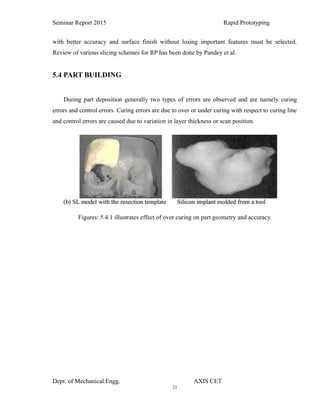
During part deposition generally two types of errors are observed and are namely curing
errors and control errors. Curing errors are due to over or under curing with respect to curing line
and control errors are caused due to variation in layer thickness or scan position.
Figures: 5.4.1 illustrates effect of over curing on part geometry and accuracy.
Dept. of Mechanical Engg. AXIS CET
22
Seminar Report 2015 Rapid Prototyping
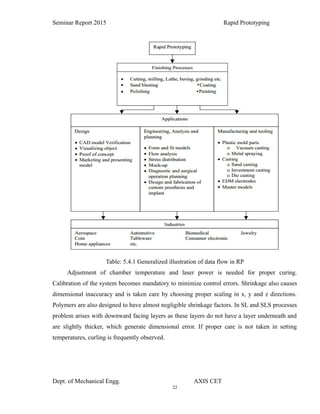
Table: 5.4.1 Generalized illustration of data flow in RP
Adjustment of chamber temperature and laser power is needed for proper curing.
Calibration of the system becomes mandatory to minimize control errors. Shrinkage also causes
dimensional inaccuracy and is taken care by choosing proper scaling in x, y and z directions.
Polymers are also designed to have almost negligible shrinkage factors. In SL and SLS processes
problem arises with downward facing layers as these layers do not have a layer underneath and
are slightly thicker, which generate dimensional error. If proper care is not taken in setting
temperatures, curling is frequently observed.
Dept. of Mechanical Engg. AXIS CET
23
Seminar Report 2015 Rapid Prototyping
CHAPTER 6
ADVANTAGES
1. Speed in production.
2. Strength, Elasticity and Temperature Resistance.
3. Typical quantities.
4. Standard accuracy.
Dept. of Mechanical Engg. AXIS CET
24
Seminar Report 2015 Rapid Prototyping
5. Time Savings.
6. Surface structure.
7. Cost saving/reduction.
8. Use any type of model.
CHAPTER 7
APPLICATIONS
RP technology has potential to reduce time required from conception to market up to 10-
50 percent. It has abilities of enhancing and improving product development while at the same
Dept. of Mechanical Engg. AXIS CET
25
Seminar Report 2015 Rapid Prototyping
time reducing costs due to major breakthrough in manufacturing (Chua and Leong, 2000).
Although poor surface finish, limited strength and accuracy are the limitations of RP models, it
can deposit a part of any degree of complexity theoretically. Therefore, RP technologies are
successfully used by various industries like aerospace, automotive, jewelry, coin making,
tableware, saddletrees, biomedical etc. It is used to fabricate concept models, functional models,
patterns for investment and vacuum casting, medical models and models for engineering
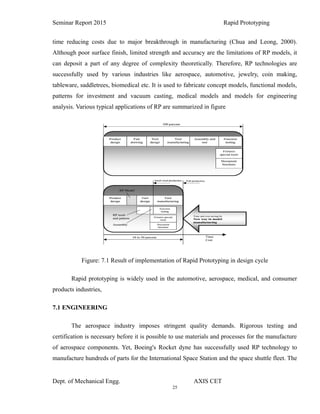
analysis. Various typical applications of RP are summarized in figure
Figure: 7.1 Result of implementation of Rapid Prototyping in design cycle
Rapid prototyping is widely used in the automotive, aerospace, medical, and consumer
products industries,
7.1 ENGINEERING
The aerospace industry imposes stringent quality demands. Rigorous testing and
certification is necessary before it is possible to use materials and processes for the manufacture
of aerospace components. Yet, Boeing's Rocket dyne has successfully used RP technology to
manufacture hundreds of parts for the International Space Station and the space shuttle fleet. The
Dept. of Mechanical Engg. AXIS CET
26
Seminar Report 2015 Rapid Prototyping
company also uses RP to manufacture parts for the military's F-18 fighter jet in glass-filled nylon
.Another not yet mature idea is to have a RP machine on board of the International Space Station
(ISS) to produce spare parts for repair jobs. Models are widely used in automotive industry for
design studies, physical experiments etc. Functional parts have been used for titanium casting
have been made by RP techniques for parts in F1 racing cars
7.2 ARCHITECTURE
The Department of Architecture at the University of Hong Kong is applying Rapid
Prototyping Technology for teaching students about the new possibilities in testing there draft,
e.g. for lighting conditions, mechanical details. One example is the Sidney Opera House.
7.3 MEDICALAPPLICATIONS
RPT has created a new market in the world of orthodontics. Appearance conscious adults
can now have straighter teeth without the embarrassment of a mouth full of metal. Using stereo
lithography technology custom-fit, clear plastic aligners can be produced in a customized mass
process. The RP world has made its entry into the hearing instrument world too. The result is
instrument shells that are stronger, fit better and are biocompatible to a very high degree. The ear
impression is scanned and digitized with an extremely accurate 3-D scanner. Software specially
developed for this converts the digital image into a virtual hearing instrument shell .Thanks to
the accuracy of the process, instrument shells are produced with high precision and
reproducibility. This means the hearing instruments fit better and the need for remakes is
reduced. In the case of repairs, damage to or loss of the ITE instrument, an absolutely identical
shell can be manufactured quickly, since the digital data are stored in the system.
7.4 ARTS AND ARCHEOLOGY
Selective Laser Sintering with marble powders can help to restore or duplicate ancient
statues and ornaments, which suffer from environmental influences. The originals are scanned to
derive the 3D data, damages can be corrected within the software and the duplicates can be
Dept. of Mechanical Engg. AXIS CET
27
Seminar Report 2015 Rapid Prototyping
created easily. One application is duplicating a statue. The original statue was digitized and a
smaller model was produced to serve a base for a bronze casting process.
7.5 RAPID TOOLING
A much-anticipated application of rapid prototyping is rapid tooling, the automatic
fabrication of production quality machine tools. Tooling is one of the slowest and most expensive
steps in the manufacturing process, because of the extremely high quality required. Tools often
have complex geometries, yet must be dimensionally accurate to within a hundredth of a
millimeter. In addition, tools must be hard, wear-resistant, and have very low surface roughness
(about 0.5 micrometers root mean square). To meet these requirements, molds and dies are
traditionally made by CNC-machining, electro-discharge machining, or by hand. All are
expensive and time consuming, so manufacturers would like to incorporate rapid prototyping
techniques to speed the process.
CHAPTER 8
FUTURE DEVELOPMENTS
• Rapid prototyping is starting to change the way companies design and build products. On
the horizon, though, are several developments that will help to revolutionize
manufacturing as we know it.
• One such improvement is increased speed. "Rapid" prototyping machines are still slow
by some standards. By using faster computers, more complex control systems, and
improved materials, RP manufacturers are dramatically reducing build time.
• Another future development is improved accuracy and surface finish. Today’s
commercially available machines are accurate to ~0.08 millimeters in the x-y plane, but
less in the z (vertical) direction. Improvements in laser optics and motor control should
increase accuracy in all three directions. In addition, RP companies are developing new
Dept. of Mechanical Engg. AXIS CET
28
Seminar Report 2015 Rapid Prototyping
polymers that will be less prone to curing and temperature-induced war page.
• The introduction of non-polymeric materials, including metals, ceramics, and composites,
represents another much anticipated development. These materials would allow RP users
to produce functional parts.
• Another important development is increased size capacity. Currently most RP machines
are limited to objects 0.125 cubic meters or less. Larger parts must be built in sections
and joined by hand. To remedy this situation, several "large prototype" techniques are in
the works.
• One future application is Distance Manufacturing on Demand, a combination of RP and
the Internet that will allow designers to remotely submit designs for immediate
manufacture.
CHAPTER 9
CONCLUSION
Finally, the rise of rapid prototyping has spurred progress in traditional subtractive
methods as well. Advances in computerized path planning, numeric control, and machine
dynamics are increasing the speed and accuracy of machining. Modern CNC machining centers
can have spindle speeds of up to 100,000 RPM, with correspondingly fast feed rates. 34
Such high
material removal rates translate into short build times. For certain applications, particularly
metals, machining will continue to be a useful manufacturing process. Rapid prototyping will not
make machining obsolete, but rather complement it. RP technology in brief and emphasizes on
their ability to shorten the product design and development process. Classification of RP
processes and details of few important processes is given. The description of various stages of
Dept. of Mechanical Engg. AXIS CET
29
Seminar Report 2015 Rapid Prototyping
data preparation and model building has been presented. An attempt has been made to include
some important factors to be considered before starting part deposition for proper utilization of
potentials of RP processes.
CHAPTER 10
REFERENCE
1. Chua, C.K., Leong, K.F. (2000) Rapid Prototyping: Principles and Applications in
Manufacturing, World Scientific.
2. Gebhardt, A., (2003) Rapid Prototyping, Hanser Gardner Publications, Inc., Cincinnati.
Pandey, P.M., Reddy N.V., Dhande, S.G. (2003a) Slicing Procedures in Layered Manufacturing:
A Review, Rapid Prototyping Journal, 9(5), pp. 274-288.
3. Pandey, P.M., Reddy, N.V., Dhande, S.G. (2004a) Part Deposition Orientation Studies in
Layered Manufacturing, Proceeding of International Conference on Advanced Manufacturing
Technology, pp. 907-912.
4. Pandey, P.M., Thrimurthullu, K., Reddy, N.V. (2004b) Optimal Part Deposition Orientation in
Dept. of Mechanical Engg. AXIS CET
30
Seminar Report 2015 Rapid Prototyping
FDM using Multi-Criteria GA, International Journal of Production Research, 42(19), pp. 4069-
4089.
5. Pham, D.T., Dimov, S.S. (2001) Rapid Manufacturing, Springer-Verlag London Limited.
6. Singhal, S.K., Pandey, A.P., Pandey, P.M., Nagpal, A.K. (2005) Optimum Part Deposition
Orientation in Stereolithography, Computer Aided Design and Applications, 2 (1-4).
7. Thrimurthullu, K., Pandey, P.M., Reddy, N.V. (2004) Part Deposition Orientation in Fused
Deposition Modeling, International Journal of Machine Tools and Manufacture, 2004, 44, pp.
585-594.
Dept. of Mechanical Engg. AXIS CET

Rapid prototyping

  • 1.
    1 Seminar Report 2015Rapid Prototyping CHAPTER 1 INTRODUCTION The past decade has witnessed the emergence of new manufacturing technologies that build parts on a layer-by-layer basis. Using these technologies, manufacturing time for parts of virtually any complexity is reduced considerably. In other words, it is rapid. Rapid Prototyping Technologies and Rapid Manufacturing offer great potential for producing models and unique parts for manufacturing industry. Thus, the reliability of products can be increased; investment of time and money is less risky. Not everything that is thinkable today is already workable or available at a reasonable price, but this technology is fast evolving and the better the challenges, the better for this developing process. Rapid prototyping is a group of techniques used to quickly fabricate a scale model of a physical part or assembly using three-dimensional computer aided design (CAD) data. Construction of the part or assembly is usually done using 3D printing or "additive layer manufacturing" technology. The first methods for rapid prototyping became available in the late 1980s and were used to produce models and prototype parts. Today, they are used for a wide range of applications and are used to manufacture production-quality parts in relatively small numbers if desired without the typical unfavorable short-run economics. This economy has encouraged online service bureaus. Historical surveys of RP technology start with discussions of simulacra production techniques used by 19th-century sculptors. Some modern sculptors use the progeny technology to produce exhibitions. The ability to reproduce designs from a dataset has given rise to issues of rights, as it is now possible to interpolate volumetric data from one-dimensional images. However, there is much research work being undertaken to improve the RP processes to enable them to be used as manufacturing alternatives. Three areas have been highlighted by the Rapid Manufacturing Research Group (RMRG) at Loughborough University that requires research attention before Rapid Manufacturing will truly become a reality. These include: 1. Processes and Materials Dept. of Mechanical Engg. AXIS CET
  • 2.
    2 Seminar Report 2015Rapid Prototyping 2. Design for Rapid Manufacture 3. Organization and Implementation UK funded research projects in all these areas have commenced within the RMRG and this paper discusses some results of work into the design optimization and customization aspects that are enabled by RM. The results are derived from the ‘Design for Rapid Manufacture’ and ‘Management, Organizational and Implementation of Rapid Manufacturing’ (Man RM) projects. It should be noted that although the Man RM project is principally concerned with the management implications of RM, much work has also been carried out into what is becoming a significantly important area for business – the area of customization and personalization of products. It should be noted that an assumption on the projects has been made that the viable Rapid Manufacturing process have been developed that additively produce end-use parts in suitable materials and with acceptable surface finish, accuracy and speed. As with CNC subtractive methods, the CAD-CAM workflow in the traditional Rapid Prototyping process starts with the creation of geometric data, either as a 3D solid using a CAD workstation, or 2D slices using a scanning device. For RP this data must represent a valid geometric model; namely, one whose boundary surfaces enclose a finite volume, contains no holes exposing the interior, and do not fold back on themselves. In other words, the object must have an inside. The model is valid if for each point in 3D space the computer can determine uniquely whether that point lies inside, on, or outside the boundary surface of the model. CAD post-processors will approximate the application vendors’ internal CAD geometric forms (e.g., B-spines) with a simplified mathematical form, which in turn is expressed in a specified data format which is a common feature in Additive Manufacturing: STL (stereolithography) a de facto standard for transferring solid geometric models to SFF machines. To obtain the necessary motion control trajectories to drive the actual SFF, Rapid Prototyping, 3D Printing or Additive Manufacturing mechanism, the prepared geometric model is typically sliced into layers, and the slices are scanned into lines [producing a "2D drawing" used to generate trajectory as in CNC`s tool path], mimicking in reverse the layer-to-layer physical building process. 1.1 HISTORY Dept. of Mechanical Engg. AXIS CET
  • 3.
    3 Seminar Report 2015Rapid Prototyping In the 1980s U.S. policy makers and industrial managers were forced to take note that America's dominance in the field of machine tool manufacturing evaporated, in what was named the machine tool crisis. Numerous projects sought to counter these trends in the traditional CNC CAM area, which had begun in the US. Later when Rapid Prototyping Systems moved out of labs to be commercialized it was recognized that developments were already international and U.S. rapid prototyping companies would not have the luxury of letting a lead slip away. The National Science Foundation was an umbrella for the National Aeronautics and Space Administration (NASA), the US Department of Energy, the US Department of Commerce NIST, the US Department of Defense, Defense Advanced Research Projects Agency (DARPA), and the Office of Naval Research coordinated studies to inform strategic planners in their deliberations. One such report was the 1997 Rapid Prototyping in Europe and Japan Panel Report in which Joseph J. Beaman founder of DTM Corporation DTM RapidTool pictured] provides a historical perspective: The roots of rapid prototyping technology can be traced to practices in topography and photo sculpture. Within TOPOGRAPHY Blanther (1892) suggested a layered method for making a mold for raised relief paper topographical maps .The process involved cutting the contour lines on a series of plates which were then stacked. Matsubara (1974) of Mitsubishi proposed a topographical process with a photo- hardening photopolymer resin to form thin layers stacked to make a casting mold. PHOTOSCULPTURE was a 19th-century technique to create exact three-dimensional replicas of objects. Most famously Francois Willeme (1860) placed 24 cameras in a circular array and simultaneously photographed an object. The silhouette of each photograph was then used to carve a replica. Morioka (1935, 1944) developed a hybrid photo sculpture and topographic process using structured light to photographically create contour lines of an object. The lines could then be developed into sheets and cut and stacked, or projected onto stock material for carving. The Munz (1956) Process reproduced a three-dimensional image of an object by selectively exposing, layer by layer, a photo emulsion on a lowering piston. After fixing, a solid transparent cylinder contains an image of the object. The technologies referred to as Solid Freeform Fabrication are what we recognize today as Rapid Prototyping, 3D Printing or Additive Manufacturing: Swainson (1977), Schwerzel (1984) Dept. of Mechanical Engg. AXIS CET
  • 4.
    4 Seminar Report 2015Rapid Prototyping worked on polymerization of a photosensitive polymer at the intersection of two computer controlled laser beams. Ciraud (1972) considered magnetostatic or electrostatic depositionwith electronbeam, laser or plasma for sintered surface cladding. These were all proposed but it is unknown if working machines were built. Hideo Kodama of Nagoya Municipal Industrial Research Institute was the first to publish an account of a solid model fabricated using a photopolymer rapid prototyping system (1981). Even at that early date the technology was seen as having a place in manufacturing practice. A low resolution, low strength output had value in design verification, mould making, production jigs and other areas. Outputs have steadily advanced toward higher specification uses. Innovations are constantly being sought,toimprove speed and the ability to cope with mass production applications. A dramatic development which RP shares with related CNC areas is the freeware open-sourcing of high level applications which constitute an entire CAD-CAM tool chain. This has created a community of low res device manufacturers. Hobbyists have even made forays into more demanding laser-effected device designs Table: 1.1 Historical developments of Rapid Prototyping and related technologies CHAPTER 2 BASIC PRINCIPLE OF RAPID PROTOTYPING PROCESSES RP process belong to the generative (or additive) production processes unlike subtractive or forming processes such as lathing, milling, grinding or coining etc. in which form is shaped by material removal or plastic deformation. In all commercial RP processes, the part is fabricated by Dept. of Mechanical Engg. AXIS CET
  • 5.
    5 Seminar Report 2015Rapid Prototyping deposition of layers contoured in a (x-y) plane two dimensionally. The third dimension (z) results from single layers being stacked up on top of each other, but not as a continuous z- coordinate. Therefore, the prototypes are very exact on the x-y plane but have stair-stepping effect in z-direction. If model is deposited with very fine layers, i.e., smaller z-stepping, model looks like original. RP can be classified into two fundamental process steps namely generation of mathematical layer information and generation of physical layer model. Typical process chain of various RP systems is shown in figure. The concept of Rapid Manufacturing (RM) – the production of end-use parts from additive manufacturing systems – is evolving from Rapid Prototyping (RP). Though some well- documented ‘Rapid Manufacturing’ is being undertaken today, these examples are being undertaken with existing RP systems. However, no current RP method can be considered as a true manufacturing process as there are many problems with surface finish, resolution, accuracy and repeatability that need to be overcome. There is much work to be undertaken to convert the principles of additive manufacturing into viable manufacturing techniques that can be exploited more universally. However, it is anticipated that true RM manufacturing systems will become available within a 5 to 10 year period and their introduction will truly amount to a new industrial revolution. Dept. of Mechanical Engg. AXIS CET
  • 6.
    6 Seminar Report 2015Rapid Prototyping Figure: 2.1 RP process chain showing fundamental process steps It can be seen from figure that process starts with 3D modeling of the product and then STL file is exported by tessellating the geometric 3D model. In tessellation various surfaces of a CAD model are piecewise approximated by a series of triangles (figure 2) and co-ordinate of vertices of triangles and their surface normal are listed. The number and size of triangles are decided by facet deviation or choral error as shown in figure. These STL files are checked for defects like flip triangles, missing facets, overlapping facets, dangling edges or faces etc. and are repaired if found faulty. Defect free STL files are used as an input to various slicing software. At this stage choice of part deposition orientation is the most important factor as part building time, surface quality, amount of support structures, cost etc. are influenced. Once part deposition orientation is decided and slice thickness is selected, tessellated model is sliced and the generated data in standard data formats like SLC (stereolithography contour) or CLI (common layer interface) is stored. This information is used to move to step 2, i.e., generation of physical model. The software that operates RP systems generates laser-scanning paths (in processes like Stereolithography, Selective Laser Sintering etc.) or material deposition paths (in processes like Dept. of Mechanical Engg. AXIS CET
  • 7.
    7 Seminar Report 2015Rapid Prototyping Fused Deposition Modeling). This step is different for different processes and depends on the basic deposition principle used in RP machine. Information computed here is used to deposit the part layer-by-layer on RP system platform. The final step in the process chain is the post- processing task. At this stage, generally some manual operations are necessary therefore skilled operator is required. In cleaning, excess elements adhered with the part or support structures are removed. Sometimes the surface of the model is finished by sanding, polishing or painting for better surface finish or aesthetic appearance. Prototype is then tested or verified and suggested engineering changes are once again incorporated during the solid modeling stage. Figure: 2.2 generalized illustration of data flow in RP CHAPTER 3 RAPID PROTOTYPING PROCESSES Dept. of Mechanical Engg. AXIS CET
  • 8.
    8 Seminar Report 2015Rapid Prototyping The professional literature in RP contains different ways of classifying RP processes. However, one representation based on German standard of production processes classifies RP processes according to state of aggregation of their original material and is given in figure Figure: 3.1 Classification RP process Here, few important RP processes namely Stereolithography (SL), Selective Laser Sintering (SLS), Fused Deposition Modeling (FDM) and Laminated Object Manufacturing (LOM) are described. 3.1 STEREOLITHOGRAPHY In this process photosensitive liquid resin which forms a solid polymer when exposed to ultraviolet light is used as a fundamental concept. Due to the absorption and scattering of beam, Dept. of Mechanical Engg. AXIS CET
  • 9.
    9 Seminar Report 2015Rapid Prototyping the reaction only takes place near the surface and voxels of solid polymeric resin are formed. A SL machine consists of a build platform (substrate), which is mounted in a vat of resin and a UV Helium-Cadmium or Argon ion laser. The laser scans the first layer and platform is then lowered equal to one slice thickness and left for short time (dip-delay) so that liquid polymer settles to a flat and even surface and inhibit bubble formation. The new slice is then scanned. Schematic diagram of a typical Stereolithography apparatus is shown in figure. In new SL systems, a blade spreads resin on the part as the blade traverses the vat. This ensures smoother surface and reduced recoating time. The final step in the process chain is the post-processing task. At this stage, generally some manual operations are necessary therefore skilled operator is required. .At this stage choice of part deposition orientation is the most important factor as part building time, surface quality, amount of support structures, cost etc.are influenced. Once part deposition orientation is decided and slice thickness is selected, tessellated model is sliced and the generated data in standard data It also reduces trapped volumes which are sometimes formed due to excessive polymerization at the ends of the slices and an island of liquid resin having thickness more than slice thickness is formed (Pham and Demov, 2001). Once the complete part is deposited, it is removed from the vat and then excess resin is drained. It may take long time due to high viscosity of liquid resin. The green part is then post-cured in an UV oven after removing support structures. Dept. of Mechanical Engg. AXIS CET
  • 10.
    10 Seminar Report 2015Rapid Prototyping Figure:3.1.1 Stereolithography Figure: 3.1.2 An SLA produced part Overhangs or cantilever walls need support structures as a green layer has relatively low stability and strength. These overhangs etc. are supported if they exceed a certain size or angle, i.e., build orientation. The main functions of these structures are to support projecting parts and also to pull other parts down which due to shrinkage tends to curl up (Gebhardt, 2003). These support structures are generated during data processing and due to these data grows heavily specially with STL files, as cuboid shaped support element need information about at least twelve triangles. A solid support is very difficult to remove later and may damage the model. Therefore a new support structure called fine point was developed by 3D Systems and is company s trademark. Build strategies have been developed to increase build speed and to decrease amount of resin by depositing the parts with a higher proportion of hollow volume. Dept. of Mechanical Engg. AXIS CET
  • 11.
    11 Seminar Report 2015Rapid Prototyping These strategies are devised as these models are used for making cavities for precision castings. Here walls are designed hollow connected by rod-type bridging elements and skin is introduced that close the model at the top and the bottom. These models require openings to drain out uncured resin. Figure: 3.1.2 Fine point structure for Stereolithography 3.2 SELECTIVE LASER SINTERING In Selective Laser Sintering (SLS) process, fine polymeric powder like polystyrene, polycarbonate or polyamide etc. (20 to 100 micrometer diameter) is spread on the substrate using a roller. Before starting CO2 laser scanning for sintering of a slice the temperature of the entire bed is raised just below its melting point by infrared heating in order to minimize thermal distortion (curling) and facilitate fusion to the previous layer. The laser is modulated in such a way that only those grains, which are in direct contact with the beam, are affected (Pham and Demov, 2001). Once laser scanning cures a slice, bed is lowered and powder feed chamber is raised so that a covering of powder can be spread evenly over the build area by counter rotating roller. In this process support structures are not required as the unsintered powder remains at the Dept. of Mechanical Engg. AXIS CET
  • 12.
    12 Seminar Report 2015Rapid Prototyping places of support structure. It is cleaned away and can be recycled once the model is complete. The schematic diagram of a typical SLS apparatus is given in figure. Figure: 3.2.1 Selective Laser Sintering System Figure: 3.2.2An Engine case model 3.3 FUSED DEPOSITION MODELING In Fused Deposition Modeling (FDM) process a movable (x-y movement) nozzle on to a substrate deposits thread of molten polymeric material. The build material is heated slightly above (approximately 0.5 C) its melting temperature so that it solidifies within a very short time (approximately 0.1 s) after extrusion and cold-welds to the previous layer as shown in figure 8. Various important factors need to be considered and are steady nozzle and material extrusion rates, addition of support structures for overhanging features and speed of the nozzle head, which Dept. of Mechanical Engg. AXIS CET
  • 13.
    13 Seminar Report 2015Rapid Prototyping affects the slice thickness. More recent FDM systems include two nozzles, one for part material and other for support material. The support material is relatively of poor quality and can be broken easily once the complete part is deposited and is removed from substrate. In more recent FDM technology, water-soluble support structure material is used. Support structure can be deposited with lesser density as compared to part density by providing air gaps between two consecutive roads. Figure: 3.3.1 Fused Deposition Modeling Process Figure: 3.3.2 A motor outer covering 3.4 LAMINATED OBJECT MANUFACTURING Typical system of Laminated Object Manufacturing (LOM) has been shown in figure . It can Dept. of Mechanical Engg. AXIS CET
  • 14.
    14 Seminar Report 2015Rapid Prototyping be seen from the figure that the slices are cut in required contour from roll of material by using a 25-50 watt CO2 laser beam. A new slice is bonded to previously deposited slice by using a hot roller, which activates a heat sensitive adhesive. Apart from the slice unwanted material is also hatched in rectangles to facilitate its later removal but remains in place during the build to act as supports. Once one slice is completed platform can be lowered and roll of material can be advanced by winding this excess onto a second roller until a fresh area of the sheet lies over the part. After completion of the part they are sealed with a urethane lacquer, silicone fluid or epoxy resin to prevent later distortion of the paper prototype through water absorption. Figure: 3.4.1 A laminated object manufactured part Dept. of Mechanical Engg. AXIS CET
  • 15.
    15 Seminar Report 2015Rapid Prototyping Figure: 3.4.2 Laminated Object Manufacturing Process In this process, materials that are relatively cheaper like paper, plastic roll etc. can be used. Parts of fiber-reinforced glass ceramics can be produced. Large models can be produced and the building speed is 5-10 times as compared to other RP processes. The limitation of the process included fabrication of hollow models with undercuts and reentrant features. Large amount of scrap is formed. There remains danger of fire hazards and drops of the molten materials formed during the cutting also need to be removed. Dept. of Mechanical Engg. AXIS CET
  • 16.
    16 Seminar Report 2015Rapid Prototyping CHAPTER 4 DESIGN FACTORS 4.1 DESIGNS FOR RAPID MANUFACTURE A research project that has researched the design aspects is the ‘Design for Rapid Manufacturing’ project at Loughborough University, UK.The aim of this project was to investigate how the advent of RM affected the design and manufacturing phases of complex plastic components and was funded by the Engineering Physical Sciences Research Council (EPSRC), as part of the Innovative Manufacturing Research Centre (IMRC) at Loughborough. The project’s industrial partners included: 3D Systems, Custom Design Technologies Ltd (formerly Bafbox), Delphi Automotive Systems, Jaguar & Land Rover Research, MG Rover Group and Huntsman (formerly Vantico). They represent a mixture of SMEs, leading world RP machine and materials suppliers and a cross-section of the UK’s car manufacturers and suppliers. The main aim of this foundation project was to investigate the design opportunities afforded with Rapid Manufacturing (RM) and determine a range of material properties for state of the art RM materials to enable designers to use this information in their designs. The project broadly covers the following areas: 4.1.1 DESIGN FREEDOM Freedom of design is one of the most important features of RM and extremely significant for producing parts of complex geometry, which could result in reducing the lead-time and ultimately the overall manufacturing costs for such items. RM will affect manufacturers and customers alike. For manufacturers, costs will be dramatically reduced as no tooling is required and for customers, complex, individualised products will be cost effectively made that can be configured to personal use, thus giving the potential for much greater product satisfaction. Each of the industrial partners was requested to nominate a part for redesign for RM. A total of four case studies were conducted during the two years and the ability of RM technologies to Dept. of Mechanical Engg. AXIS CET
  • 17.
    17 Seminar Report 2015Rapid Prototyping introduce features that are not possible to be manufactured by conventional means was determined. A set of guidelines for design and assembly of additive manufacturing processes was established to enable designers to use when they are designing for RM. 4.1.2 MATERIALS PROPERTIES: In order for designers to have confidence in selecting a mmaterial for a part to be designed for RM, they have to have extensive information regarding the properties of these materials. For automotive application, designers typically need material properties ranging from –40o C to +140o C. Within the Design for Rapid Manufacturing project, three state of the art RP/RM materials (SL7560, Accura SI40, and Duraform PA) were selected, with the principal work being conducted on SL7560 with preliminary results obtained for the other two materials. The project conducted extensive material testing for the SL7560 material over the temperature range of 40o C to +140o C, with three different humidities (dry, 50% relative humidity and soaked) and also over an extended time period (1, 4, 6, 13 and 52 weeks) to consider the ageing of the material. A comprehensive range of mechanical properties, including tensile properties (namely ultimate tensile stress, Young’s Modulus and % elongation at break), flexural properties (namely stress and modulus) and impact strength (Izod test) were conducted. Some preliminary investigations, such as isotropy/anisotropy tests, effect of thermal post curing, samples of different wall thickness and different methods of introducing the notch into Izod impact samples on the mechanical properties of Stereolithography resins, were conducted. 4.1.3 DESIGN OPTIMISATION One of the design investigations undertaken during the Design for Rapid Manufacture project was carried out in conjunction with MG Rover Group. The investigation was based on the use of design optimisation techniques (principally Finite Element Analysis (FEA)) to remove unnecessary material from a product in order to minimize its weight. This approach is common in the construction industry where optimal structures for bridges and buildings are derived using Dept. of Mechanical Engg. AXIS CET
  • 18.
    18 Seminar Report 2015Rapid Prototyping optimisation techniques and then subsequently fabricated. However, this impossible to make due to DFM criteria – this is one of the main stumbling blocks for so-called Knowledge Based Engineering (KBE) systems that often have FEA as the kernel. The design optimisation is followed by the application of industrial design to the FEA optimised product in order to produce a hybrid design that encompasses both engineering and aesthetic aspects. This approach follows the conclusions of a previous investigation for Custom Design Technologies (formerly Bafbox) that was undertaken during the Design for RM research project [7]. During this work, it was speculated that as DFM criteria are no longer valid with the advent of RM, then a hybrid design methodology will emerge where the industrial designer would be able to manufacture any design that they desire without the need to consider DFM. Thus, there would be an overriding need for them to incorporate some engineering aspects in their product design. This investigation extends this principle by incorporating design optimisation and aesthetic design in a single product design methodology. MG Rover is currently looking into ways to modularise their product range by modularizing the components that go to make up different vehicle variants, thus reducing the costs of production for those vehicles. One part of considerable interest to MG Rover was the development of a modular handbrake. Currently an expensive metal stamped device is used and these components are individual to each vehicle variant. In order to provide a more cost effective solution MG Rover are investigating the use of an injection molded handbrake lever – with a metal ratchet mechanism, that could be common across the vehicle range. As such, a handbrake lever from the Rover 75 has been redesigned with injection moulding criteria in mind. As part of their involvement in the Design for Rapid Manufacture project, MG Rover agreed to perform a concurrent study to investigate how the design of the handbrake lever would change with the advent of Rapid Manufacturing with an emphasis on material minimisation. It was a requirement of the RM designed lever to fit to the ratchet mechanism that had previously been developed for the injection-molded handbrake. 4.1.4 DESIGN CUSTOMISATION One area where Rapid Manufacturing could have a significant impact on both customers and Dept. of Mechanical Engg. AXIS CET
  • 19.
    19 Seminar Report 2015Rapid Prototyping manufacturers alike is the area of customisation. This will occur for many products in both consumer and industrial markets. The ability of RM to make products without the need for tooling is a driver for cost effective customisation / individualisation. An area suitable for customisation has been identified with one of the project partners, Martin Baker Aircraft Ltd. Levels of fatigue and discomfort for aircrew have become major issues in the development of aircraft seating and survival systems - this is especially so when the increased flight times of modern aircraft are considered. For example, the flight times for some aircraft are thought to be increasing up to around 14 hours on some missions. It is quite clear that this duration will lead to levels of discomfort that could affect the endurance and lethality of the aircrew. It has been established by Martin Baker that the level of “comfort” offered by current seating systems, which were not designed with such long missions in mind, are adding to the reduction in endurance of the aircrew. Secondly, as pilots are individuals, their size, stature and weight vary enormously and hence, what may be comfortable for one may not be comfortable for all. For these reasons, research is now being undertaken to increase levels of comfort for aircrew personnel by providing a more comfortable seat base – initially this work has been undertaken on the MVC-014F seat. CHAPTER 5 PART DEPOSITION PLANNING A defect less STL file is used as an input to RP software like Quicksilver or RP Tools for further processing. At this stage, designer has to take an important decision about the part deposition orientation. The part deposition orientation is important because part accuracy, surface quality, building time, amount of support structures and hence cost of the part is highly influenced .In this section various factors influencing accuracy of RP parts and part deposition orientation are discussed. 5.1 FACTORS INFLUENCING ACCURACY Dept. of Mechanical Engg. AXIS CET
  • 20.
    20 Seminar Report 2015Rapid Prototyping Accuracy of a model is influenced by the errors caused during tessellation and slicing at data preparation stage. Decision of the designer about part deposition orientation also affects accuracy of the model. 5.2 ERRORS DUE TO TESSELLATION In tessellation surfaces of a CAD model are approximated piecewise by using triangles. It is true that by reducing the size of the triangles, the deviation between the actual surfaces and approximated triangles can be reduced. In practice, resolution of the STL file is controlled by a parameter namely chordal error or facet deviation as shown. It has also been suggested that a curve with small radius (r) should be tessellated if its radius is below a threshold radius (or) which can be considered as one tenth of the part size, to achieve a maximum chordal error of (r/ro). Value of can be set equal to 0 for no improvement and 1 for maximum improvement. Here part size is defined as the diagonal of an imaginary box drawn around the part and is angle control value. 5.3 ERRORS DUE TO SLICING Real error on slice plane is much more than that is felt, as shown. For a spherical model Pham and Demov (2001) proposed that error due to the replacement of a circular arc with stair- steps can be defined as radius of the arc minus length up to the corresponding corner of the staircase, i.e., cusp height. Thus maximum error (cusp height) results along z direction and is equal to slice thickness. Therefore, cusp height approaches to maximum for surfaces, which are almost parallel with the x-y plane. Maximum value of cusp height is equal to slice thickness and can be reduced by reducing it; however this results in drastic improvement in part building time. Therefore, by using slices of variable thicknesses (popularly known as adaptive slicing, , cusp height can be controlled below a certain value. Except this, mismatching of height and missing features are two other problems resulting from the slicing. Although most of the RP systems have facility of slicing with uniform thickness only, adaptive slicing scheme, which can slice a model Dept. of Mechanical Engg. AXIS CET
  • 21.
    21 Seminar Report 2015Rapid Prototyping with better accuracy and surface finish without losing important features must be selected. Review of various slicing schemes for RP has been done by Pandey et al. 5.4 PART BUILDING During part deposition generally two types of errors are observed and are namely curing errors and control errors. Curing errors are due to over or under curing with respect to curing line and control errors are caused due to variation in layer thickness or scan position. Figures: 5.4.1 illustrates effect of over curing on part geometry and accuracy. Dept. of Mechanical Engg. AXIS CET
  • 22.
    22 Seminar Report 2015Rapid Prototyping Table: 5.4.1 Generalized illustration of data flow in RP Adjustment of chamber temperature and laser power is needed for proper curing. Calibration of the system becomes mandatory to minimize control errors. Shrinkage also causes dimensional inaccuracy and is taken care by choosing proper scaling in x, y and z directions. Polymers are also designed to have almost negligible shrinkage factors. In SL and SLS processes problem arises with downward facing layers as these layers do not have a layer underneath and are slightly thicker, which generate dimensional error. If proper care is not taken in setting temperatures, curling is frequently observed. Dept. of Mechanical Engg. AXIS CET
  • 23.
    23 Seminar Report 2015Rapid Prototyping CHAPTER 6 ADVANTAGES 1. Speed in production. 2. Strength, Elasticity and Temperature Resistance. 3. Typical quantities. 4. Standard accuracy. Dept. of Mechanical Engg. AXIS CET
  • 24.
    24 Seminar Report 2015Rapid Prototyping 5. Time Savings. 6. Surface structure. 7. Cost saving/reduction. 8. Use any type of model. CHAPTER 7 APPLICATIONS RP technology has potential to reduce time required from conception to market up to 10- 50 percent. It has abilities of enhancing and improving product development while at the same Dept. of Mechanical Engg. AXIS CET
  • 25.
    25 Seminar Report 2015Rapid Prototyping time reducing costs due to major breakthrough in manufacturing (Chua and Leong, 2000). Although poor surface finish, limited strength and accuracy are the limitations of RP models, it can deposit a part of any degree of complexity theoretically. Therefore, RP technologies are successfully used by various industries like aerospace, automotive, jewelry, coin making, tableware, saddletrees, biomedical etc. It is used to fabricate concept models, functional models, patterns for investment and vacuum casting, medical models and models for engineering analysis. Various typical applications of RP are summarized in figure Figure: 7.1 Result of implementation of Rapid Prototyping in design cycle Rapid prototyping is widely used in the automotive, aerospace, medical, and consumer products industries, 7.1 ENGINEERING The aerospace industry imposes stringent quality demands. Rigorous testing and certification is necessary before it is possible to use materials and processes for the manufacture of aerospace components. Yet, Boeing's Rocket dyne has successfully used RP technology to manufacture hundreds of parts for the International Space Station and the space shuttle fleet. The Dept. of Mechanical Engg. AXIS CET
  • 26.
    26 Seminar Report 2015Rapid Prototyping company also uses RP to manufacture parts for the military's F-18 fighter jet in glass-filled nylon .Another not yet mature idea is to have a RP machine on board of the International Space Station (ISS) to produce spare parts for repair jobs. Models are widely used in automotive industry for design studies, physical experiments etc. Functional parts have been used for titanium casting have been made by RP techniques for parts in F1 racing cars 7.2 ARCHITECTURE The Department of Architecture at the University of Hong Kong is applying Rapid Prototyping Technology for teaching students about the new possibilities in testing there draft, e.g. for lighting conditions, mechanical details. One example is the Sidney Opera House. 7.3 MEDICALAPPLICATIONS RPT has created a new market in the world of orthodontics. Appearance conscious adults can now have straighter teeth without the embarrassment of a mouth full of metal. Using stereo lithography technology custom-fit, clear plastic aligners can be produced in a customized mass process. The RP world has made its entry into the hearing instrument world too. The result is instrument shells that are stronger, fit better and are biocompatible to a very high degree. The ear impression is scanned and digitized with an extremely accurate 3-D scanner. Software specially developed for this converts the digital image into a virtual hearing instrument shell .Thanks to the accuracy of the process, instrument shells are produced with high precision and reproducibility. This means the hearing instruments fit better and the need for remakes is reduced. In the case of repairs, damage to or loss of the ITE instrument, an absolutely identical shell can be manufactured quickly, since the digital data are stored in the system. 7.4 ARTS AND ARCHEOLOGY Selective Laser Sintering with marble powders can help to restore or duplicate ancient statues and ornaments, which suffer from environmental influences. The originals are scanned to derive the 3D data, damages can be corrected within the software and the duplicates can be Dept. of Mechanical Engg. AXIS CET
  • 27.
    27 Seminar Report 2015Rapid Prototyping created easily. One application is duplicating a statue. The original statue was digitized and a smaller model was produced to serve a base for a bronze casting process. 7.5 RAPID TOOLING A much-anticipated application of rapid prototyping is rapid tooling, the automatic fabrication of production quality machine tools. Tooling is one of the slowest and most expensive steps in the manufacturing process, because of the extremely high quality required. Tools often have complex geometries, yet must be dimensionally accurate to within a hundredth of a millimeter. In addition, tools must be hard, wear-resistant, and have very low surface roughness (about 0.5 micrometers root mean square). To meet these requirements, molds and dies are traditionally made by CNC-machining, electro-discharge machining, or by hand. All are expensive and time consuming, so manufacturers would like to incorporate rapid prototyping techniques to speed the process. CHAPTER 8 FUTURE DEVELOPMENTS • Rapid prototyping is starting to change the way companies design and build products. On the horizon, though, are several developments that will help to revolutionize manufacturing as we know it. • One such improvement is increased speed. "Rapid" prototyping machines are still slow by some standards. By using faster computers, more complex control systems, and improved materials, RP manufacturers are dramatically reducing build time. • Another future development is improved accuracy and surface finish. Today’s commercially available machines are accurate to ~0.08 millimeters in the x-y plane, but less in the z (vertical) direction. Improvements in laser optics and motor control should increase accuracy in all three directions. In addition, RP companies are developing new Dept. of Mechanical Engg. AXIS CET
  • 28.
    28 Seminar Report 2015Rapid Prototyping polymers that will be less prone to curing and temperature-induced war page. • The introduction of non-polymeric materials, including metals, ceramics, and composites, represents another much anticipated development. These materials would allow RP users to produce functional parts. • Another important development is increased size capacity. Currently most RP machines are limited to objects 0.125 cubic meters or less. Larger parts must be built in sections and joined by hand. To remedy this situation, several "large prototype" techniques are in the works. • One future application is Distance Manufacturing on Demand, a combination of RP and the Internet that will allow designers to remotely submit designs for immediate manufacture. CHAPTER 9 CONCLUSION Finally, the rise of rapid prototyping has spurred progress in traditional subtractive methods as well. Advances in computerized path planning, numeric control, and machine dynamics are increasing the speed and accuracy of machining. Modern CNC machining centers can have spindle speeds of up to 100,000 RPM, with correspondingly fast feed rates. 34 Such high material removal rates translate into short build times. For certain applications, particularly metals, machining will continue to be a useful manufacturing process. Rapid prototyping will not make machining obsolete, but rather complement it. RP technology in brief and emphasizes on their ability to shorten the product design and development process. Classification of RP processes and details of few important processes is given. The description of various stages of Dept. of Mechanical Engg. AXIS CET
  • 29.
    29 Seminar Report 2015Rapid Prototyping data preparation and model building has been presented. An attempt has been made to include some important factors to be considered before starting part deposition for proper utilization of potentials of RP processes. CHAPTER 10 REFERENCE 1. Chua, C.K., Leong, K.F. (2000) Rapid Prototyping: Principles and Applications in Manufacturing, World Scientific. 2. Gebhardt, A., (2003) Rapid Prototyping, Hanser Gardner Publications, Inc., Cincinnati. Pandey, P.M., Reddy N.V., Dhande, S.G. (2003a) Slicing Procedures in Layered Manufacturing: A Review, Rapid Prototyping Journal, 9(5), pp. 274-288. 3. Pandey, P.M., Reddy, N.V., Dhande, S.G. (2004a) Part Deposition Orientation Studies in Layered Manufacturing, Proceeding of International Conference on Advanced Manufacturing Technology, pp. 907-912. 4. Pandey, P.M., Thrimurthullu, K., Reddy, N.V. (2004b) Optimal Part Deposition Orientation in Dept. of Mechanical Engg. AXIS CET
  • 30.
    30 Seminar Report 2015Rapid Prototyping FDM using Multi-Criteria GA, International Journal of Production Research, 42(19), pp. 4069- 4089. 5. Pham, D.T., Dimov, S.S. (2001) Rapid Manufacturing, Springer-Verlag London Limited. 6. Singhal, S.K., Pandey, A.P., Pandey, P.M., Nagpal, A.K. (2005) Optimum Part Deposition Orientation in Stereolithography, Computer Aided Design and Applications, 2 (1-4). 7. Thrimurthullu, K., Pandey, P.M., Reddy, N.V. (2004) Part Deposition Orientation in Fused Deposition Modeling, International Journal of Machine Tools and Manufacture, 2004, 44, pp. 585-594. Dept. of Mechanical Engg. AXIS CET