CHAPTER 9
Basic Design
Evaluation Tools
LEARNING OBJECTIVES
 Theory of virtual engineering
 Principles and advantages of virtual
prototyping
 Basic rapid prototyping techniques
INTRODUCTION
 A conventional product development process
employs a design–build–test philosophy.
 Virtual prototyping makes use of virtual reality
which employs an image similar to a real physical
object, enabling operators to feel the similarity with
a real prototype from a digital mock-up.
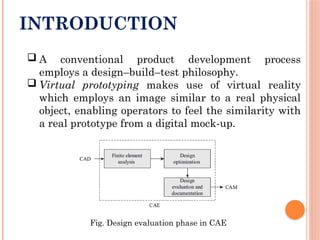
Fig. Design evaluation phase in CAE
VIRTUAL ENGINEERING
 Virtual engineering is a simulation-based
methodology that helps engineers take decisions and
establishes controls.
The following stages show how virtual
engineering is used in various areas.
 Simulation of machining the part and assembly
 Testing the assembled prototype (virtual) and
redesign through simulation
 Modelling of a production system and operating it
virtually
 Prediction of production cost and time
COMPONENTS OF VR
SYSTEMS
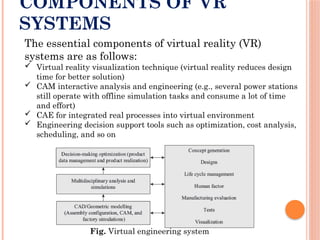
The essential components of virtual reality (VR)
systems are as follows:
 Virtual reality visualization technique (virtual reality reduces design
time for better solution)
 CAM interactive analysis and engineering (e.g., several power stations
still operate with offline simulation tasks and consume a lot of time
and effort)
 CAE for integrated real processes into virtual environment
 Engineering decision support tools such as optimization, cost analysis,
scheduling, and so on
Fig. Virtual engineering system
VIRTUAL PROTOTYPING
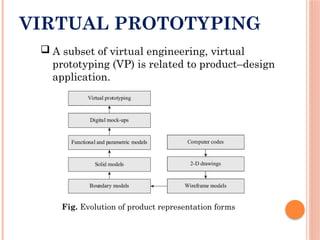
 A subset of virtual engineering, virtual
prototyping (VP) is related to product–design
application.
Fig. Evolution of product representation forms
VIRTUAL PROTOTYPING
SYSTEMS
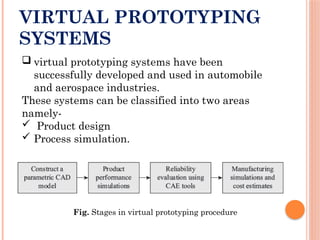
 virtual prototyping systems have been
successfully developed and used in automobile
and aerospace industries.
These systems can be classified into two areas
namely-
 Product design
 Process simulation.
Fig. Stages in virtual prototyping procedure
APPLICATIONS OF VIRTUAL
PROTOTYPING SYSTEM
The main applications of virtual prototyping are as
follows:
 Kinematic and dynamic simulation of the
prototype can be performed.
 Design optimization can be achieved through the
iterative refinement of the virtual prototype.
 Virtual prototyping can be a successful alternative
to know the object performance since the CAD
systems are used for the design process.
 Dedicated virtual prototyping technology has been
extensively and successfully applied to automobile
and aerospace fields.
CONTINUES…
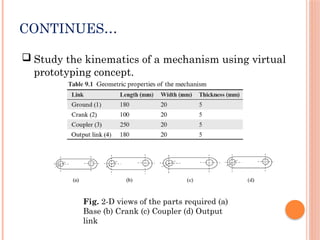
 Study the kinematics of a mechanism using virtual
prototyping concept.
Fig. 2-D views of the parts required (a)
Base (b) Crank (c) Coupler (d) Output
link
CONTINUES…
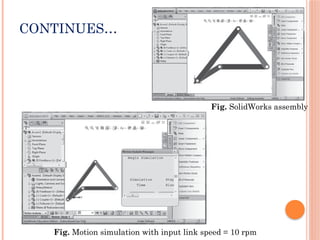
Fig. Motion simulation with input link speed = 10 rpm
Fig. SolidWorks assembly
RAPID PROTOTYPING
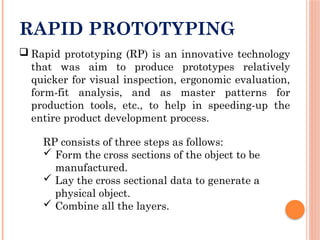
 Rapid prototyping (RP) is an innovative technology
that was aim to produce prototypes relatively
quicker for visual inspection, ergonomic evaluation,
form-fit analysis, and as master patterns for
production tools, etc., to help in speeding-up the
entire product development process.
RP consists of three steps as follows:
 Form the cross sections of the object to be
manufactured.
 Lay the cross sectional data to generate a
physical object.
 Combine all the layers.
CONTINUES…
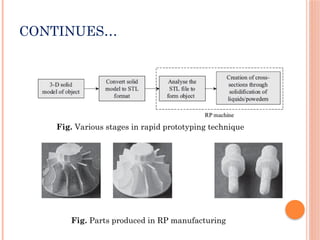
Fig. Various stages in rapid prototyping technique
Fig. Parts produced in RP manufacturing
ADVANTAGES OF RAPID
PROTOTYPING
RP has the following advantages compared to
regular manufacturing work:
 Feature-based geometric model is not required,
because the process plan does not depend on
features.
 A 3-D surface or a solid model of the part is
sufficient.
 No material handling equipment is required, as a
part is produced in one operation.
 Clamps, jigs, and fixtures are not necessary.
 No mould or die is required.
 Development time and cost are relatively less.
RAPID PROTOTYPING
TECHNIQUES
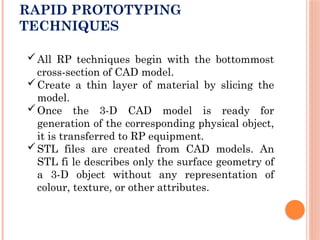
All RP techniques begin with the bottommost
cross-section of CAD model.
Create a thin layer of material by slicing the
model.
Once the 3-D CAD model is ready for
generation of the corresponding physical object,
it is transferred to RP equipment.
STL files are created from CAD models. An
STL fi le describes only the surface geometry of
a 3-D object without any representation of
colour, texture, or other attributes.
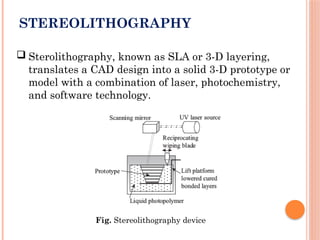
STEREOLITHOGRAPHY
 Sterolithography, known as SLA or 3-D layering,
translates a CAD design into a solid 3-D prototype or
model with a combination of laser, photochemistry,
and software technology.
Fig. Stereolithography device
SELECTIVE LASER SINTERING
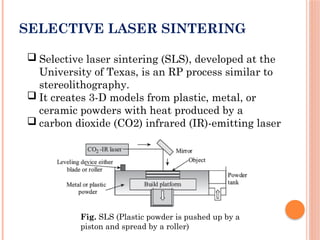
 Selective laser sintering (SLS), developed at the
University of Texas, is an RP process similar to
stereolithography.
 It creates 3-D models from plastic, metal, or
ceramic powders with heat produced by a
 carbon dioxide (CO2) infrared (IR)-emitting laser
Fig. SLS (Plastic powder is pushed up by a
piston and spread by a roller)
FUSED DEPOSITION MODELLING
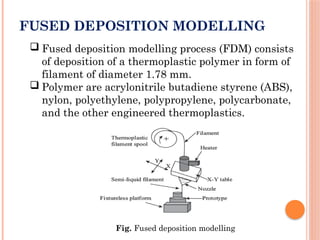
 Fused deposition modelling process (FDM) consists
of deposition of a thermoplastic polymer in form of
filament of diameter 1.78 mm.
 Polymer are acrylonitrile butadiene styrene (ABS),
nylon, polyethylene, polypropylene, polycarbonate,
and the other engineered thermoplastics.
Fig. Fused deposition modelling
THREE-DIMENSIONAL PRINTING
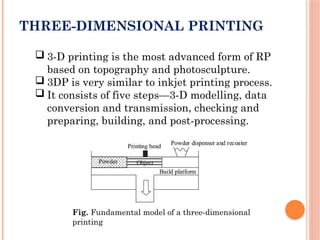
 3-D printing is the most advanced form of RP
based on topography and photosculpture.
 3DP is very similar to inkjet printing process.
 It consists of five steps—3-D modelling, data
conversion and transmission, checking and
preparing, building, and post-processing.
Fig. Fundamental model of a three-dimensional
printing
ADVANTAGES AND
APPLICATIONS OF 3-D PRINTING
 The main advantages of 3-D printing are as follows:
 It is faster, affordable, and easier than other methods.
 It can print full colour prototypes.
 Advanced 3-D printing technologies yield models having
good looks and functionality.
 Various applications, such as manufacturing, the food
industry, education, and art.
APPLICATIONS OF RAPID
PROTOTYPING
There are three essential applications of this
technology:
 Design evaluation
 Function verification
 Model for further manufacturing processes
SUMMARY
 Virtual engineering is a simulation-based
methodology used to help engineers for making
decisions and establish the control.
 Virtual prototyping includes animation, motion
study, mechanism kinematics, and dynamics.
 Rapid prototyping is another evaluation tool for
CAD geometrical models by generating physical
(but not functional) prototypes.
 Some examples of RP techniques are
stereolithography (SLA), selective laser sintering
(SLS), fused deposition modeling (FDM), and 3-D
printing (3DP).

chapter-9Basic Design Evaluation Tools.pptx

  • 1.
  • 2.
    LEARNING OBJECTIVES  Theoryof virtual engineering  Principles and advantages of virtual prototyping  Basic rapid prototyping techniques
  • 3.
    INTRODUCTION  A conventionalproduct development process employs a design–build–test philosophy.  Virtual prototyping makes use of virtual reality which employs an image similar to a real physical object, enabling operators to feel the similarity with a real prototype from a digital mock-up. Fig. Design evaluation phase in CAE
  • 4.
    VIRTUAL ENGINEERING  Virtualengineering is a simulation-based methodology that helps engineers take decisions and establishes controls. The following stages show how virtual engineering is used in various areas.  Simulation of machining the part and assembly  Testing the assembled prototype (virtual) and redesign through simulation  Modelling of a production system and operating it virtually  Prediction of production cost and time
  • 5.
    COMPONENTS OF VR SYSTEMS Theessential components of virtual reality (VR) systems are as follows:  Virtual reality visualization technique (virtual reality reduces design time for better solution)  CAM interactive analysis and engineering (e.g., several power stations still operate with offline simulation tasks and consume a lot of time and effort)  CAE for integrated real processes into virtual environment  Engineering decision support tools such as optimization, cost analysis, scheduling, and so on Fig. Virtual engineering system
  • 6.
    VIRTUAL PROTOTYPING  Asubset of virtual engineering, virtual prototyping (VP) is related to product–design application. Fig. Evolution of product representation forms
  • 7.
    VIRTUAL PROTOTYPING SYSTEMS  virtualprototyping systems have been successfully developed and used in automobile and aerospace industries. These systems can be classified into two areas namely-  Product design  Process simulation. Fig. Stages in virtual prototyping procedure
  • 8.
    APPLICATIONS OF VIRTUAL PROTOTYPINGSYSTEM The main applications of virtual prototyping are as follows:  Kinematic and dynamic simulation of the prototype can be performed.  Design optimization can be achieved through the iterative refinement of the virtual prototype.  Virtual prototyping can be a successful alternative to know the object performance since the CAD systems are used for the design process.  Dedicated virtual prototyping technology has been extensively and successfully applied to automobile and aerospace fields.
  • 9.
    CONTINUES…  Study thekinematics of a mechanism using virtual prototyping concept. Fig. 2-D views of the parts required (a) Base (b) Crank (c) Coupler (d) Output link
  • 10.
    CONTINUES… Fig. Motion simulationwith input link speed = 10 rpm Fig. SolidWorks assembly
  • 11.
    RAPID PROTOTYPING  Rapidprototyping (RP) is an innovative technology that was aim to produce prototypes relatively quicker for visual inspection, ergonomic evaluation, form-fit analysis, and as master patterns for production tools, etc., to help in speeding-up the entire product development process. RP consists of three steps as follows:  Form the cross sections of the object to be manufactured.  Lay the cross sectional data to generate a physical object.  Combine all the layers.
  • 12.
    CONTINUES… Fig. Various stagesin rapid prototyping technique Fig. Parts produced in RP manufacturing
  • 13.
    ADVANTAGES OF RAPID PROTOTYPING RPhas the following advantages compared to regular manufacturing work:  Feature-based geometric model is not required, because the process plan does not depend on features.  A 3-D surface or a solid model of the part is sufficient.  No material handling equipment is required, as a part is produced in one operation.  Clamps, jigs, and fixtures are not necessary.  No mould or die is required.  Development time and cost are relatively less.
  • 14.
    RAPID PROTOTYPING TECHNIQUES All RPtechniques begin with the bottommost cross-section of CAD model. Create a thin layer of material by slicing the model. Once the 3-D CAD model is ready for generation of the corresponding physical object, it is transferred to RP equipment. STL files are created from CAD models. An STL fi le describes only the surface geometry of a 3-D object without any representation of colour, texture, or other attributes.
  • 15.
    STEREOLITHOGRAPHY  Sterolithography, knownas SLA or 3-D layering, translates a CAD design into a solid 3-D prototype or model with a combination of laser, photochemistry, and software technology. Fig. Stereolithography device
  • 16.
    SELECTIVE LASER SINTERING Selective laser sintering (SLS), developed at the University of Texas, is an RP process similar to stereolithography.  It creates 3-D models from plastic, metal, or ceramic powders with heat produced by a  carbon dioxide (CO2) infrared (IR)-emitting laser Fig. SLS (Plastic powder is pushed up by a piston and spread by a roller)
  • 17.
    FUSED DEPOSITION MODELLING Fused deposition modelling process (FDM) consists of deposition of a thermoplastic polymer in form of filament of diameter 1.78 mm.  Polymer are acrylonitrile butadiene styrene (ABS), nylon, polyethylene, polypropylene, polycarbonate, and the other engineered thermoplastics. Fig. Fused deposition modelling
  • 18.
    THREE-DIMENSIONAL PRINTING  3-Dprinting is the most advanced form of RP based on topography and photosculpture.  3DP is very similar to inkjet printing process.  It consists of five steps—3-D modelling, data conversion and transmission, checking and preparing, building, and post-processing. Fig. Fundamental model of a three-dimensional printing
  • 19.
    ADVANTAGES AND APPLICATIONS OF3-D PRINTING  The main advantages of 3-D printing are as follows:  It is faster, affordable, and easier than other methods.  It can print full colour prototypes.  Advanced 3-D printing technologies yield models having good looks and functionality.  Various applications, such as manufacturing, the food industry, education, and art.
  • 20.
    APPLICATIONS OF RAPID PROTOTYPING Thereare three essential applications of this technology:  Design evaluation  Function verification  Model for further manufacturing processes
  • 21.
    SUMMARY  Virtual engineeringis a simulation-based methodology used to help engineers for making decisions and establish the control.  Virtual prototyping includes animation, motion study, mechanism kinematics, and dynamics.  Rapid prototyping is another evaluation tool for CAD geometrical models by generating physical (but not functional) prototypes.  Some examples of RP techniques are stereolithography (SLA), selective laser sintering (SLS), fused deposition modeling (FDM), and 3-D printing (3DP).