Reverse Engineering
Presented by-
Dattaprasad Pokale
What is Reverse Engineering?
• A systematic methodology for analyzing the design of an
existing device or system, either as an approach to study
the design or as a prerequisite for re-design.
• In this, existing product is redesigned to improve and
broaden its functions, add quality functions and to increase
its useful life.
2
Why reverse engineering ?
• The original producer no longer produces the product, but the
customers still requires the product or old product needed to
be repaired.
• There is inadequate documentation of the product.
• Problems of the existing product are needed to be solved
• To replace the time consuming or defective or costly process of
manufacturing.
• This means reverse engineering is efficient approach to
significantly reduce the product development cycle.
3
Reasons for Reverse Engineering
•Military or commercial espionage
•Creation of unlicensed/unapproved duplicates
•Improve documentation shortcomings
•Obsolescence
•Software modernization
•Product security analysis
•Bug fixing
•Academic/learning purposes
•Competitive technical intelligence
•Saving money
•Repurposing
4
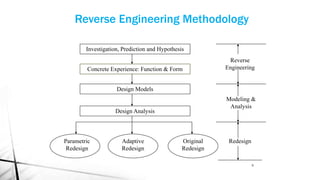
Reverse Engineering Methodology
Investigation, Prediction and Hypothesis
Concrete Experience: Function & Form
Design Models
Design Analysis
Parametric
Redesign
Adaptive
Redesign
Original
Redesign
Reverse
Engineering
Modeling &
Analysis
Redesign
5
Parametric Redesign
•Optimize design parameters
•Perform sensitivity analysis and tolerance design
•Build and test prototype
Adaptive Redesign
•Recommend new subsystems
•Search for inventive solutions
•Analyze force flows and component combinations
•Build and test prototype
Original Redesign
•Develop new functional structure
•Choose alternatives
•Verify design concepts
•Build and test prototype
6
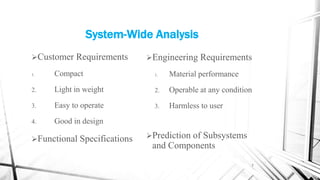
System-Wide Analysis
Customer Requirements
1. Compact
2. Light in weight
3. Easy to operate
4. Good in design
Functional Specifications
Engineering Requirements
1. Material performance
2. Operable at any condition
3. Harmless to user
Prediction of Subsystems
and Components
7
Digitizing
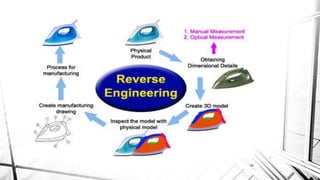
• Collecting data from physical part.
• Used when drawing of object is not available.
• Aim is to generate a 3D mapping of the product in the form of
CAD file.
• This requires acquisition of surface data, which is large
number of points on the product surface.
• For this two types of processes are used: contact and non
contact method.
8
Discretization method
1. Contact method
• Requires contact between the
component surface & a
measuring tool.
• Uses Coordinate Measuring
Machine (CMM),
electromagnetic digitizer or
sonic digitizers to get desired
coordinates.
2. Non contact method
• Uses light as the main tool
• Uses white light or laser
scanners to scan 3D objects to
generate CAD design.
9
Manipulation of data
• Basically, after completion of this a CAD model of product is
obtained.
• Used to fit a geometry to the large number of points obtained
from digitizing.
• The surface can be mathematically defined as algebraic or
parametric surface.
• Surface fitting techniques can be of two types: interpolation
and approximation techniques.
10
Surface fitting techniques
1.Interpolation technique
• Surface to be fitted passes
through all the data points.
• Used when the data points
are accurately measured
without any errors.
2.Approximation technique
• Surface represents a
generalized or best fit to the
data points.
• Used when large number of
data points are to be fitted.
11
Generation of functional part
• The geometric model obtained, can be used as the basis for
variety of operations.
• Operations such as automated process planning, automated
manufacturing, automated dimensional inspection and
automated tolerance analysis.
12
Advantages of reverse engineering
• RE typically starts with measuring an existing object, so that a solid
model can be deduced in order to make use of the advantages of
CAD/CAM/CAE technologies.
• CAD models are used for manufacturing or rapid prototyping
applications.
• Hence we can work on a product without having prior knowledge of
the technology involved.
13
Advantages of reverse engineering
 Cost saving for developing new products.
 Lesser maintenance costs
 Quality improvement
 Competitive advantages
14
Applications
• Manufacturing Field: To create a 3D virtual model of an
existing physical part for use in 3D CAD, CAM, CAE or other
software and to analyze the working of a product.
• Medical Field: Imaging, modeling and replication (as a physical
model) of a patient's bone structure
• Software engineering: To detect and neutralize viruses and
malware.
15
16
References
[1] Durupt A., Remy S. and Ducellier G (2010), Knowledge Based Reverse
Engineering- An Approach for Reverse Engineering of a Mechanical Part, ASME
Journal of Computing and Information Science in Engineering, 10, pp.044501-1.
[2] Lefever D. D. and Wood K. L. (1996), Design for Assembly Technique in Reverse
Engineering and Redesign, ASME Design Theory and Methodology Conference, pp.
78712-1063.
[3] Shooter Steven (2008), Reverse Engineering to Design Forward, American Society
for Engineering Education, pp.2008- 1170.
17
ANY QUERIES ?
THANK YOU

Reverse engineering

  • 1.
  • 2.
    What is ReverseEngineering? • A systematic methodology for analyzing the design of an existing device or system, either as an approach to study the design or as a prerequisite for re-design. • In this, existing product is redesigned to improve and broaden its functions, add quality functions and to increase its useful life. 2
  • 3.
    Why reverse engineering? • The original producer no longer produces the product, but the customers still requires the product or old product needed to be repaired. • There is inadequate documentation of the product. • Problems of the existing product are needed to be solved • To replace the time consuming or defective or costly process of manufacturing. • This means reverse engineering is efficient approach to significantly reduce the product development cycle. 3
  • 4.
    Reasons for ReverseEngineering •Military or commercial espionage •Creation of unlicensed/unapproved duplicates •Improve documentation shortcomings •Obsolescence •Software modernization •Product security analysis •Bug fixing •Academic/learning purposes •Competitive technical intelligence •Saving money •Repurposing 4
  • 5.
    Reverse Engineering Methodology Investigation,Prediction and Hypothesis Concrete Experience: Function & Form Design Models Design Analysis Parametric Redesign Adaptive Redesign Original Redesign Reverse Engineering Modeling & Analysis Redesign 5
  • 6.
    Parametric Redesign •Optimize designparameters •Perform sensitivity analysis and tolerance design •Build and test prototype Adaptive Redesign •Recommend new subsystems •Search for inventive solutions •Analyze force flows and component combinations •Build and test prototype Original Redesign •Develop new functional structure •Choose alternatives •Verify design concepts •Build and test prototype 6
  • 7.
    System-Wide Analysis Customer Requirements 1.Compact 2. Light in weight 3. Easy to operate 4. Good in design Functional Specifications Engineering Requirements 1. Material performance 2. Operable at any condition 3. Harmless to user Prediction of Subsystems and Components 7
  • 8.
    Digitizing • Collecting datafrom physical part. • Used when drawing of object is not available. • Aim is to generate a 3D mapping of the product in the form of CAD file. • This requires acquisition of surface data, which is large number of points on the product surface. • For this two types of processes are used: contact and non contact method. 8
  • 9.
    Discretization method 1. Contactmethod • Requires contact between the component surface & a measuring tool. • Uses Coordinate Measuring Machine (CMM), electromagnetic digitizer or sonic digitizers to get desired coordinates. 2. Non contact method • Uses light as the main tool • Uses white light or laser scanners to scan 3D objects to generate CAD design. 9
  • 10.
    Manipulation of data •Basically, after completion of this a CAD model of product is obtained. • Used to fit a geometry to the large number of points obtained from digitizing. • The surface can be mathematically defined as algebraic or parametric surface. • Surface fitting techniques can be of two types: interpolation and approximation techniques. 10
  • 11.
    Surface fitting techniques 1.Interpolationtechnique • Surface to be fitted passes through all the data points. • Used when the data points are accurately measured without any errors. 2.Approximation technique • Surface represents a generalized or best fit to the data points. • Used when large number of data points are to be fitted. 11
  • 12.
    Generation of functionalpart • The geometric model obtained, can be used as the basis for variety of operations. • Operations such as automated process planning, automated manufacturing, automated dimensional inspection and automated tolerance analysis. 12
  • 13.
    Advantages of reverseengineering • RE typically starts with measuring an existing object, so that a solid model can be deduced in order to make use of the advantages of CAD/CAM/CAE technologies. • CAD models are used for manufacturing or rapid prototyping applications. • Hence we can work on a product without having prior knowledge of the technology involved. 13
  • 14.
    Advantages of reverseengineering  Cost saving for developing new products.  Lesser maintenance costs  Quality improvement  Competitive advantages 14
  • 15.
    Applications • Manufacturing Field:To create a 3D virtual model of an existing physical part for use in 3D CAD, CAM, CAE or other software and to analyze the working of a product. • Medical Field: Imaging, modeling and replication (as a physical model) of a patient's bone structure • Software engineering: To detect and neutralize viruses and malware. 15
  • 16.
  • 17.
    References [1] Durupt A.,Remy S. and Ducellier G (2010), Knowledge Based Reverse Engineering- An Approach for Reverse Engineering of a Mechanical Part, ASME Journal of Computing and Information Science in Engineering, 10, pp.044501-1. [2] Lefever D. D. and Wood K. L. (1996), Design for Assembly Technique in Reverse Engineering and Redesign, ASME Design Theory and Methodology Conference, pp. 78712-1063. [3] Shooter Steven (2008), Reverse Engineering to Design Forward, American Society for Engineering Education, pp.2008- 1170. 17
  • 18.
  • 19.

Editor's Notes

  • #10 The choice of discretization method is based on speed & performance during digitization and avoidance of damage to the product.
  • #11 Algebraic function is one which is defined as f(x,y,z)=0 and is for infinite surface whereas parametric function is one which is defined as a finite surface for example: bezier surface, NURBS surface.