What is Reverse Engineering ?
 You have an unexpected case:
• You finished one project using Java
• Your program runs fine
• But, by accident, you delete the java file
• How to handle this in your project?
Reverse Engineering
What is Reverse Engineering ?
 Reverse Engineering is the process of
discovering the technological principles of a
device, object, or system through analysis of
its structure, function, and operation.
What is Reverse Engineering ?
 It often involves taking something (e.g.,
a mechanical device, electronic
component, software program, or biological,
chemical, or organic matter) apart and
analyzing its workings.
In Terms of Software
 To retrieve the source code of a program
 To study how the program performs certain
operations
 To improve the performance of a program
 To fix a bug
 To identify malicious content in a program
Reverse Engineering
Applications:
 Security Related
• Reversing has been employed in encryption
research
• With malicious software, on both ends of the
fence
• Crackers
Reverse Engineering
Applications:
 Software Development Related
• Evaluating software quality and robustness
• Achieving interoperability with propriety
software
• Developing competing software
Why do we need RE ?
 Reasons
• Product Analysis
To examine how a product works, what
components it consists of, estimate costs, and
identify potential patent infringement.
• Lost Documentation
Reverse engineering often is done because
the documentation of a particular device has been
lost (or was never written), and the person who built
it is no longer available
Why do we need RE ?
 Reasons
• Software Modernization
In order to understand the 'as is' state of
existing or legacy software in order to properly
estimate the effort required to migrate system
knowledge into a 'to be' state.
• Learning
Learn from others' mistakes. Do not make
the same mistakes that others have already made
and subsequently corrected.
Why do we need RE ?
 Reasons
• The original manufacturer of a product no
longer produces a product
• The original manufacturer no longer exists,
but a customer needs the product
• To analyze the good and bad features of
competitors' product
• Strengthen the good features of a product
based on long-term usage of the product
Why do we need RE ?
 Benefits
• Understand existing design
• Quality improvements
• Competitive advantages
• Software reuse facilitation
• No need to start from scratch
Two Levels of Reversing
 System Level Reversing
• Running various tools on the program and
utilizing various operating system services
• To obtain information, inspect program
executables, track program input and output,
and so forth
 Code Level Reversing
• Extracting design concepts and algorithms
from a program
• Observes the code from a very low-level
• Many of these details are generated
automatically by the compiler
Two Levels of Reversing
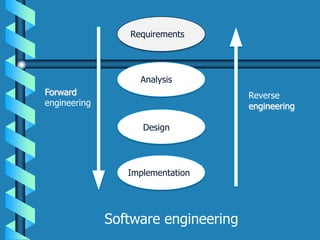
Requirements
Analysis
Design
Implementation
Forward
engineering
Reverse
engineering
Software engineering
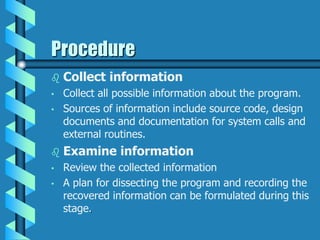
Procedure
 Collect information
• Collect all possible information about the program.
• Sources of information include source code, design
documents and documentation for system calls and
external routines.
 Examine information
• Review the collected information
• A plan for dissecting the program and recording the
recovered information can be formulated during this
stage.
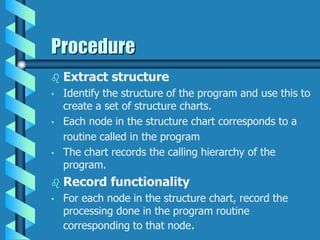
Procedure
 Extract structure
• Identify the structure of the program and use this to
create a set of structure charts.
• Each node in the structure chart corresponds to a
routine called in the program
• The chart records the calling hierarchy of the
program.
 Record functionality
• For each node in the structure chart, record the
processing done in the program routine
corresponding to that node.
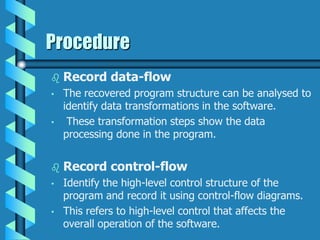
Procedure
 Record data-flow
• The recovered program structure can be analysed to
identify data transformations in the software.
• These transformation steps show the data
processing done in the program.
 Record control-flow
• Identify the high-level control structure of the
program and record it using control-flow diagrams.
• This refers to high-level control that affects the
overall operation of the software.
Procedure
 Review recovered design
• Review the design to verify that it correctly
• represents the program.
• Identify any missing items of information and
attempt to locate them.
 Generate documentation
• The final step is to generate design documentation.
• Information explaining the purpose of the program,
program-overview, history, etc will need to be
recorded.
 System Monitoring Tools
• System-level reversing requires a variety of tools
that sniff, monitor, explore, and otherwise
expose the program being reversed
• Display information gathered by the operating
system about the application and its
environment
Reverse Engineering Tools
 Disassembler
• Converts exe to assembly - as best it can
• Relatively simple process
• Sometimes are difficult to understand
Reverse Engineering Tools
 Debugger
• Reversers use debuggers in disassembly
mode
• Reversers can install breakpoints in locations
of interest in the disassembled code and
then examine the state of the program
Reverse Engineering Tools
 Decompiler
• Decompile a binary programs into high level
source language
• Replace all binary code that could not be
decompiled with assembly code
Reverse Engineering Tools
Unethical ???
 The legal debate around reverse engineering
has been going on for years
 The reverse engineering of software in the
US is generally a breach of contract as
most EULAs specifically prohibit it
 EU allows reverse engineering for the
purposes of interoperability.
Reverse  engineering

Reverse engineering

  • 2.
    What is ReverseEngineering ?  You have an unexpected case: • You finished one project using Java • Your program runs fine • But, by accident, you delete the java file • How to handle this in your project? Reverse Engineering
  • 3.
    What is ReverseEngineering ?  Reverse Engineering is the process of discovering the technological principles of a device, object, or system through analysis of its structure, function, and operation.
  • 4.
    What is ReverseEngineering ?  It often involves taking something (e.g., a mechanical device, electronic component, software program, or biological, chemical, or organic matter) apart and analyzing its workings.
  • 5.
    In Terms ofSoftware  To retrieve the source code of a program  To study how the program performs certain operations  To improve the performance of a program  To fix a bug  To identify malicious content in a program
  • 6.
    Reverse Engineering Applications:  SecurityRelated • Reversing has been employed in encryption research • With malicious software, on both ends of the fence • Crackers
  • 7.
    Reverse Engineering Applications:  SoftwareDevelopment Related • Evaluating software quality and robustness • Achieving interoperability with propriety software • Developing competing software
  • 8.
    Why do weneed RE ?  Reasons • Product Analysis To examine how a product works, what components it consists of, estimate costs, and identify potential patent infringement. • Lost Documentation Reverse engineering often is done because the documentation of a particular device has been lost (or was never written), and the person who built it is no longer available
  • 9.
    Why do weneed RE ?  Reasons • Software Modernization In order to understand the 'as is' state of existing or legacy software in order to properly estimate the effort required to migrate system knowledge into a 'to be' state. • Learning Learn from others' mistakes. Do not make the same mistakes that others have already made and subsequently corrected.
  • 10.
    Why do weneed RE ?  Reasons • The original manufacturer of a product no longer produces a product • The original manufacturer no longer exists, but a customer needs the product • To analyze the good and bad features of competitors' product • Strengthen the good features of a product based on long-term usage of the product
  • 11.
    Why do weneed RE ?  Benefits • Understand existing design • Quality improvements • Competitive advantages • Software reuse facilitation • No need to start from scratch
  • 12.
    Two Levels ofReversing  System Level Reversing • Running various tools on the program and utilizing various operating system services • To obtain information, inspect program executables, track program input and output, and so forth
  • 13.
     Code LevelReversing • Extracting design concepts and algorithms from a program • Observes the code from a very low-level • Many of these details are generated automatically by the compiler Two Levels of Reversing
  • 14.
  • 15.
    Procedure  Collect information •Collect all possible information about the program. • Sources of information include source code, design documents and documentation for system calls and external routines.  Examine information • Review the collected information • A plan for dissecting the program and recording the recovered information can be formulated during this stage.
  • 16.
    Procedure  Extract structure •Identify the structure of the program and use this to create a set of structure charts. • Each node in the structure chart corresponds to a routine called in the program • The chart records the calling hierarchy of the program.  Record functionality • For each node in the structure chart, record the processing done in the program routine corresponding to that node.
  • 17.
    Procedure  Record data-flow •The recovered program structure can be analysed to identify data transformations in the software. • These transformation steps show the data processing done in the program.  Record control-flow • Identify the high-level control structure of the program and record it using control-flow diagrams. • This refers to high-level control that affects the overall operation of the software.
  • 18.
    Procedure  Review recovereddesign • Review the design to verify that it correctly • represents the program. • Identify any missing items of information and attempt to locate them.  Generate documentation • The final step is to generate design documentation. • Information explaining the purpose of the program, program-overview, history, etc will need to be recorded.
  • 19.
     System MonitoringTools • System-level reversing requires a variety of tools that sniff, monitor, explore, and otherwise expose the program being reversed • Display information gathered by the operating system about the application and its environment Reverse Engineering Tools
  • 20.
     Disassembler • Convertsexe to assembly - as best it can • Relatively simple process • Sometimes are difficult to understand Reverse Engineering Tools
  • 21.
     Debugger • Reversersuse debuggers in disassembly mode • Reversers can install breakpoints in locations of interest in the disassembled code and then examine the state of the program Reverse Engineering Tools
  • 22.
     Decompiler • Decompilea binary programs into high level source language • Replace all binary code that could not be decompiled with assembly code Reverse Engineering Tools
  • 23.
    Unethical ???  Thelegal debate around reverse engineering has been going on for years  The reverse engineering of software in the US is generally a breach of contract as most EULAs specifically prohibit it  EU allows reverse engineering for the purposes of interoperability.