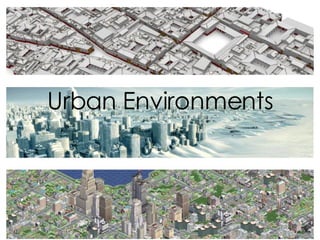
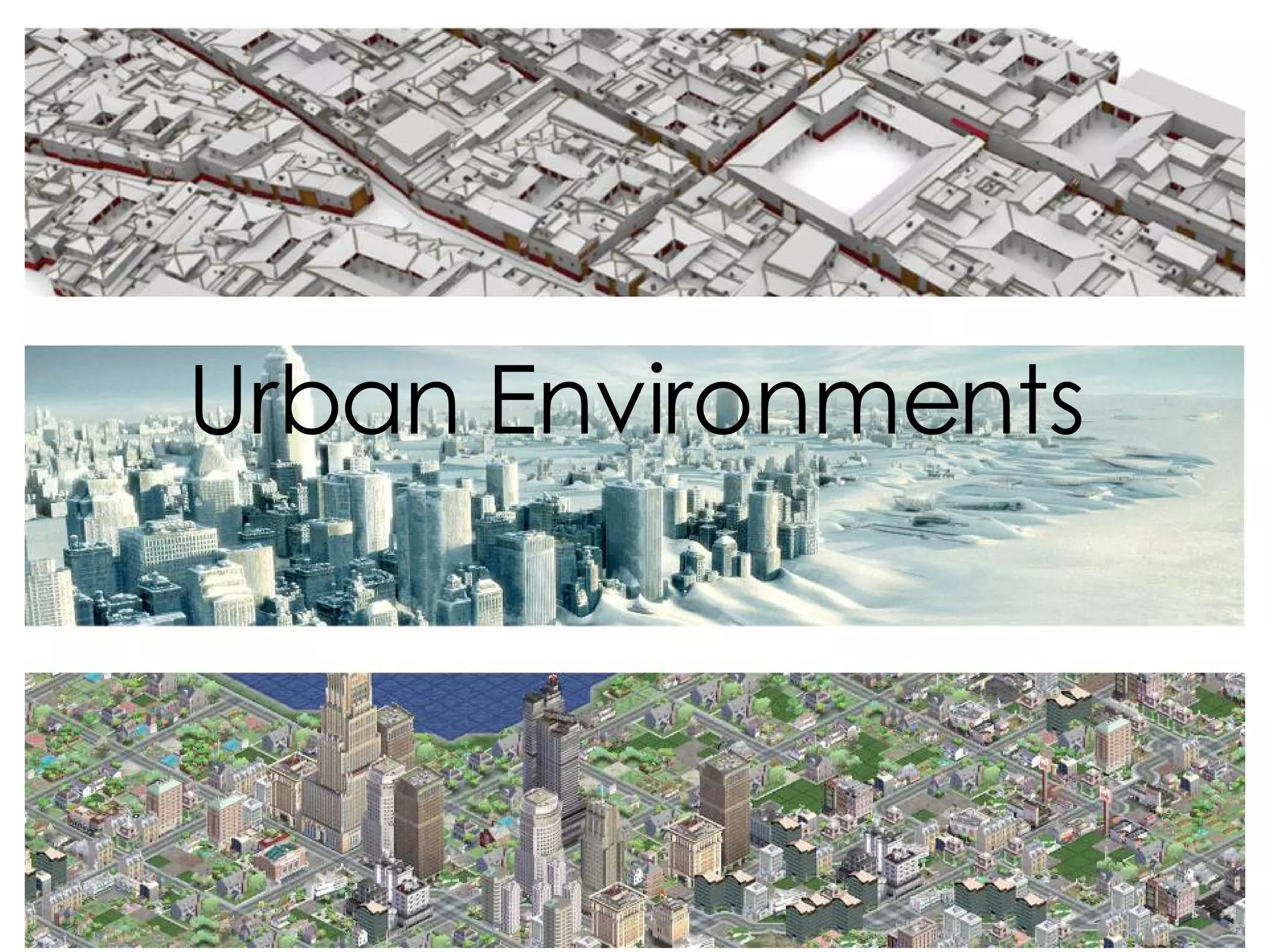
Urban Environments
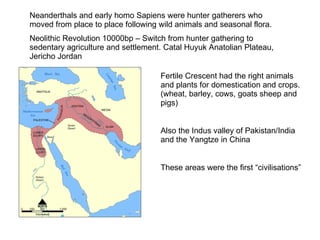
Neanderthals and early homo Sapiens were hunter gatherers who moved from place to place following wild animals and seasonal flora. Neolithic Revolution 10000bp – Switch from hunter gathering to sedentary agriculture and settlement. Catal Huyuk Anatolian Plateau, Jericho Jordan  Fertile Crescent had the right animals and plants for domestication and crops. (wheat, barley, cows, goats sheep and pigs) Also the Indus valley of Pakistan/India and the Yangtze in China These areas were the first “civilisations”
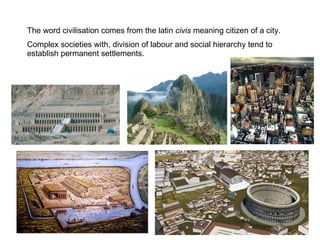
The word civilisation comes from the latin  civis  meaning citizen of a city.  Complex societies with, division of labour and social hierarchy tend to establish permanent settlements.
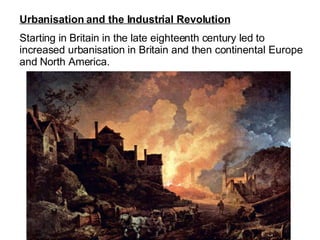
Urbanisation and the Industrial Revolution Starting in Britain in the late eighteenth century led to increased urbanisation in Britain and then continental Europe and North America.
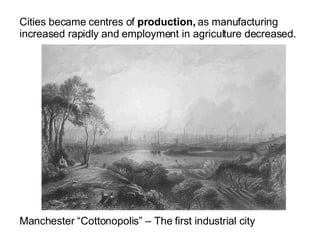
Cities became centres of  production,  as manufacturing increased rapidly and employment in agriculture decreased. Manchester “Cottonopolis” – The first industrial city
Urbanisation and the Population Explosion Now we can see global levels of urbanisation. NICs and LEDCs are urbanising at a very fast rate. Rural to Urban migration Natural increase
Settlements are places where people live. They are created by us.  They reflect our culture, our beliefs, our values. They range in size from small farmsteads to a metropolis with millions of inhabitants  We could create perfect urban environments But urban environments develop through a combination of many factors, planned / unplanned, sometimes conflicting, always changing. The tyranny of small decisions.
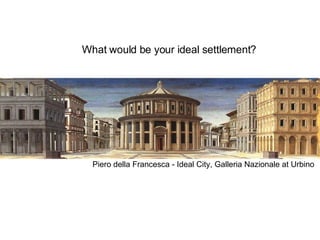
What would be your ideal settlement? Piero della Francesca - Ideal City, Galleria Nazionale at Urbino
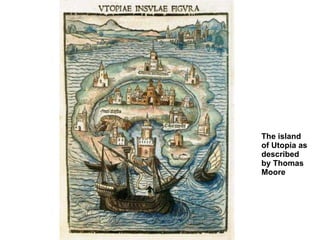
The island of Utopia as described by Thomas Moore
 
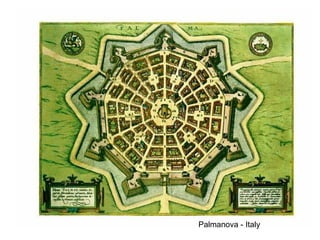
Palmanova - Italy
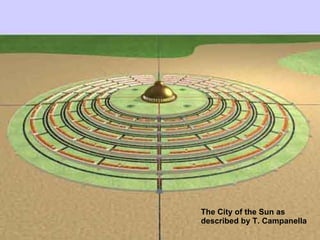
The City of the Sun as described by T. Campanella
For the first time in human history the majority of the world’s population now live in cities. http://news.bbc.co.uk/1/hi/in_depth/world/2006/urbanisation/default.stm We are modifying huge areas of land, not just for cities, but also for the agricultural land, quarrying for building materials, energy resources which supply these cities. The ecological footprint of cities is far bigger than their land area. We are truly in the Anthropocene Age.
What is the environmental impact of increased urbanisation? Can cities be sustainable? (live in a way which satisfies our needs but does not compromise future generations ability to meet their needs) Do cities satisfy peoples needs and wants? Are people happier living in cities or the countryside? Is there an optimum size for a city? What is the impact of primate mega cities? Can urban processes be controlled or managed? What is the future for the urban poor?
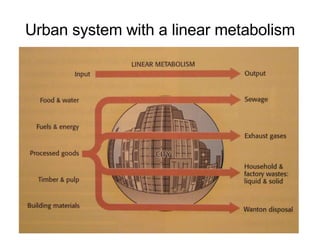
Urban system with a linear metabolism
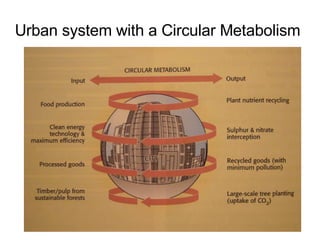
Urban system with a Circular Metabolism
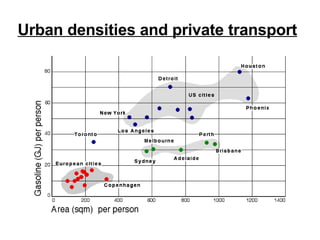
Urban densities and private transport
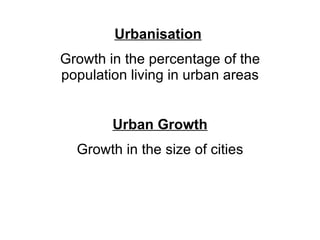
Urbanisation   Growth in the percentage of the population living in urban areas Urban Growth Growth in the size of cities
World Urbanisation http://news.bbc.co.uk/1/hi/in_depth/world/2006/urbanisation/default.stm Landmark 188/189 Hart 212/213 Nagle 268 289 Pop, Res, Dev 62 (Zelinsky) Atlas data Use the information to describe and explain the trends in world urbanisation.  Remember Zelinsky’s Model of Mobility Transition?
World Urbanisation Key trends Evidence  Explanations Implications Research possibilities

1 Intro To Urban Geography

  • 1.
  • 2.
    Neanderthals and earlyhomo Sapiens were hunter gatherers who moved from place to place following wild animals and seasonal flora. Neolithic Revolution 10000bp – Switch from hunter gathering to sedentary agriculture and settlement. Catal Huyuk Anatolian Plateau, Jericho Jordan Fertile Crescent had the right animals and plants for domestication and crops. (wheat, barley, cows, goats sheep and pigs) Also the Indus valley of Pakistan/India and the Yangtze in China These areas were the first “civilisations”
  • 3.
    The word civilisationcomes from the latin civis meaning citizen of a city. Complex societies with, division of labour and social hierarchy tend to establish permanent settlements.
  • 4.
    Urbanisation and theIndustrial Revolution Starting in Britain in the late eighteenth century led to increased urbanisation in Britain and then continental Europe and North America.
  • 5.
    Cities became centresof production, as manufacturing increased rapidly and employment in agriculture decreased. Manchester “Cottonopolis” – The first industrial city
  • 6.
    Urbanisation and thePopulation Explosion Now we can see global levels of urbanisation. NICs and LEDCs are urbanising at a very fast rate. Rural to Urban migration Natural increase
  • 7.
    Settlements are placeswhere people live. They are created by us. They reflect our culture, our beliefs, our values. They range in size from small farmsteads to a metropolis with millions of inhabitants We could create perfect urban environments But urban environments develop through a combination of many factors, planned / unplanned, sometimes conflicting, always changing. The tyranny of small decisions.
  • 8.
    What would beyour ideal settlement? Piero della Francesca - Ideal City, Galleria Nazionale at Urbino
  • 9.
    The island ofUtopia as described by Thomas Moore
  • 10.
  • 11.
  • 12.
    The City ofthe Sun as described by T. Campanella
  • 13.
    For the firsttime in human history the majority of the world’s population now live in cities. http://news.bbc.co.uk/1/hi/in_depth/world/2006/urbanisation/default.stm We are modifying huge areas of land, not just for cities, but also for the agricultural land, quarrying for building materials, energy resources which supply these cities. The ecological footprint of cities is far bigger than their land area. We are truly in the Anthropocene Age.
  • 14.
    What is theenvironmental impact of increased urbanisation? Can cities be sustainable? (live in a way which satisfies our needs but does not compromise future generations ability to meet their needs) Do cities satisfy peoples needs and wants? Are people happier living in cities or the countryside? Is there an optimum size for a city? What is the impact of primate mega cities? Can urban processes be controlled or managed? What is the future for the urban poor?
  • 15.
    Urban system witha linear metabolism
  • 16.
    Urban system witha Circular Metabolism
  • 17.
    Urban densities andprivate transport
  • 18.
    Urbanisation Growth in the percentage of the population living in urban areas Urban Growth Growth in the size of cities
  • 19.
    World Urbanisation http://news.bbc.co.uk/1/hi/in_depth/world/2006/urbanisation/default.stmLandmark 188/189 Hart 212/213 Nagle 268 289 Pop, Res, Dev 62 (Zelinsky) Atlas data Use the information to describe and explain the trends in world urbanisation. Remember Zelinsky’s Model of Mobility Transition?
  • 20.
    World Urbanisation Keytrends Evidence Explanations Implications Research possibilities