Lecture 13Lecture 13
Urbanization & Urban GrowthUrbanization & Urban Growth
HRhHRh
Urbanization & Urban GrowthUrbanization & Urban Growth
Urban area is that area usually having a population of overUrban area is that area usually having a population of over
2,500, but Britain’s smallest city St David’s has a population2,500, but Britain’s smallest city St David’s has a population
of only 1’797of only 1’797
 UrbanizationUrbanization——transformation of rural areas into urban areatransformation of rural areas into urban area
 Urban growthUrban growth——rate of increase of urban populationrate of increase of urban population
CausesCauses
1. Natural increase (more births than deaths)1. Natural increase (more births than deaths)
2. Immigration, mostly from rural areas2. Immigration, mostly from rural areas
 Migration is influenced byMigration is influenced by ‘‘push factorpush factor’ (’ (poverty, lack ofpoverty, lack of
land, declining agricultural jobs, famineland, declining agricultural jobs, famine))
 ‘‘pull factorpull factor’ (in search of jobs, housing, health care, better’ (in search of jobs, housing, health care, better
life, entertainmentlife, entertainment))
Trends important in understanding the problems &Trends important in understanding the problems &
challenges of Urban Growthchallenges of Urban Growth
1.The global proportion of urban population rose dramatically1.The global proportion of urban population rose dramatically
from13% (220 million) in 1900, to 29% (732 million) in1950, tofrom13% (220 million) in 1900, to 29% (732 million) in1950, to
49% (3.2 billion) in 200549% (3.2 billion) in 2005
According to UN, currently 25% people live in urban area ofAccording to UN, currently 25% people live in urban area of
Bangladesh, 50% of the urban people live in 4 large citiesBangladesh, 50% of the urban people live in 4 large cities
According to UN projections,According to UN projections, by 2050by 2050 over 6 billion people, twoover 6 billion people, two
thirds of the humanity, will be living in towns and cities, withthirds of the humanity, will be living in towns and cities, with 93%93%
of this urban growth occurring in developing countriesof this urban growth occurring in developing countries
2 .The number of large cities mushrooming2 .The number of large cities mushrooming
 In 1900, only 19 cities had a million or more people andIn 1900, only 19 cities had a million or more people and
more than 95% of humanity lived in rural communitiesmore than 95% of humanity lived in rural communities
 In 2003 more than 400 cities had a million or more peopleIn 2003 more than 400 cities had a million or more people
and projected to 564 by 2015and projected to 564 by 2015
 As they grow and sprawl outward separate urban areasAs they grow and sprawl outward separate urban areas
merge to formmerge to form megalopolismegalopolis
Trends important in understanding the problems &Trends important in understanding the problems &
challenges of Urban Growthchallenges of Urban Growth
33. Urbanization and urban population increasing rapidly in. Urbanization and urban population increasing rapidly in
developing countriesdeveloping countries
 Currently about 40% of the people in developingCurrently about 40% of the people in developing
countries live in urban areascountries live in urban areas
4. Urban growth is slower in developed countries4. Urban growth is slower in developed countries
 Still developed countries are projected to reach 84%Still developed countries are projected to reach 84%
urbanization by 2025urbanization by 2025
 PovertyPoverty is becoming increasingly urbanized as more peopleis becoming increasingly urbanized as more people
migrate from rural to urban areasmigrate from rural to urban areas
 According to UN at leastAccording to UN at least 1 billion1 billion people live in crowdedpeople live in crowded
slums of central citiesslums of central cities
Centre of Sao Paulo, one of the largest metropolis in the
world
Major Environmental Pros & ConsMajor Environmental Pros & Cons
 Most cities are not self-sustaining systems because of theirMost cities are not self-sustaining systems because of their
high resource input and high waste outputhigh resource input and high waste output
 Urban dwellers occupy onlyUrban dwellers occupy only 2%2% of Earth’s land area but theyof Earth’s land area but they
consume aboutconsume about 75%75% of Earth’s resourcesof Earth’s resources
 To provide urban dwellers with food, water, energy, minerals,To provide urban dwellers with food, water, energy, minerals,
& other resources large areas are& other resources large areas are disturbeddisturbed andand degradeddegraded,,
hencehence decreases biodiversitydecreases biodiversity
 As cities expand theyAs cities expand they destroydestroy rural croplands, fertile soil,rural croplands, fertile soil,
forests, wetlands, and wildlife habitatsforests, wetlands, and wildlife habitats
Major Environmental Pros & ConsMajor Environmental Pros & Cons
 Water resource problemsWater resource problems
 Increased demand is met through heavy extraction of groundwaterIncreased demand is met through heavy extraction of groundwater
depletingdepleting this resourcethis resource faster than is replenishedfaster than is replenished
 City pavement increases the chances of local flooding within theCity pavement increases the chances of local flooding within the
city by overloading the storm drainscity by overloading the storm drains
 Increased runoff from the city can increase the chances ofIncreased runoff from the city can increase the chances of
flooding downstream as wellflooding downstream as well
 High population densities and high resource consumption in citiesHigh population densities and high resource consumption in cities
produce most of the world’s air pollution, water pollution, solid andproduce most of the world’s air pollution, water pollution, solid and
hazardous wasteshazardous wastes
 Spread of infectiousSpread of infectious diseases & physical injuries causingdiseases & physical injuries causing
hundreds and thousands of premature deaths each yearhundreds and thousands of premature deaths each year
 Life in a city is riskierLife in a city is riskier because of pollution and pollution andbecause of pollution and pollution and
pollutant-related diseasespollutant-related diseases
 High unemploymentHigh unemployment,, deafening noisedeafening noise, and, and soaring rate ofsoaring rate of crimecrime
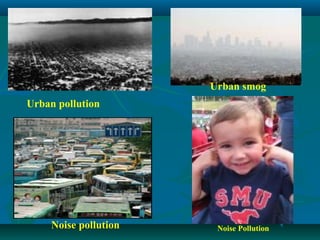
Noise pollution
Urban pollution
Urban smog
Noise Pollution
Urban slums, Dhaka CO2 emission
Human wasteSlum, Waste, water pollution
Massive urbanization in Dhaka resulted in tremendous strain on the
city’s infrastructure
Major Environmental Pros & ConsMajor Environmental Pros & Cons
 Less windyLess windy because tall buildings and otherbecause tall buildings and other structures obstructstructures obstruct
thethe flow of airflow of air
 Keeps polluted area from being diluted and cleansedKeeps polluted area from being diluted and cleansed
 Enormous amounts ofEnormous amounts of heat generatedheat generated by vehicles, factories,by vehicles, factories,
furnaces, lights, air conditioners, and heat absorbing darkfurnaces, lights, air conditioners, and heat absorbing dark
surfaces, and lack of vegetation in citiessurfaces, and lack of vegetation in cities create an urban heatcreate an urban heat
islandisland surrounded by cooler suburban and rural areassurrounded by cooler suburban and rural areas
 This effect causes the city to become 1 to 6This effect causes the city to become 1 to 6 ºº C warmer thanC warmer than
surrounding landscapessurrounding landscapes
 Reduces soil moisture and intensifies COReduces soil moisture and intensifies CO22 emissionsemissions
 Traffic congestion, increased pollution, limited real estate, andTraffic congestion, increased pollution, limited real estate, and
decreasing resources are all possible side effects of urbanizationdecreasing resources are all possible side effects of urbanization
 Can intensify poverty and social problems which can increaseCan intensify poverty and social problems which can increase
civil unrest and undermine governmentcivil unrest and undermine government
City PlanningCity Planning
InIn city planningcity planning environmental factors, city’s site and situationenvironmental factors, city’s site and situation
should be taken into considerationshould be taken into consideration
 It is important to combine the physical and aesthetic needs of aIt is important to combine the physical and aesthetic needs of a
citycity
 Although it is impossible to eliminate exposure to pollutants inAlthough it is impossible to eliminate exposure to pollutants in
urban areas it is possible to reduce the exposure by carefulurban areas it is possible to reduce the exposure by careful
planning, design, and developmentplanning, design, and development
 A practical solution to the problems associated withA practical solution to the problems associated with
urbanization can be achieved by involving several specializedurbanization can be achieved by involving several specialized
professions including urban forestry, landscape architecture,professions including urban forestry, landscape architecture,
city planning, and city engineerscity planning, and city engineers
 Trees and plants adapted to local climate and soil should beTrees and plants adapted to local climate and soil should be
planted to provide shade and beauty, supply wildlife habitats,planted to provide shade and beauty, supply wildlife habitats,
reduce pollution, noise, and soil erosionreduce pollution, noise, and soil erosion
 Stream and marsh habitats should be maintained or created soStream and marsh habitats should be maintained or created so
that they can become habitats for fish and mammalsthat they can become habitats for fish and mammals
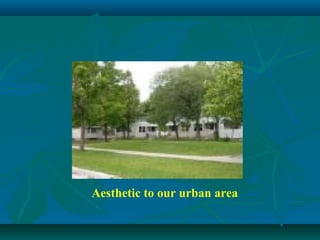
Aesthetic to our urban area
End of SlidesEnd of Slides
Thank YouThank You

L 13 urban environment

  • 1.
    Lecture 13Lecture 13 Urbanization& Urban GrowthUrbanization & Urban Growth HRhHRh
  • 2.
    Urbanization & UrbanGrowthUrbanization & Urban Growth Urban area is that area usually having a population of overUrban area is that area usually having a population of over 2,500, but Britain’s smallest city St David’s has a population2,500, but Britain’s smallest city St David’s has a population of only 1’797of only 1’797  UrbanizationUrbanization——transformation of rural areas into urban areatransformation of rural areas into urban area  Urban growthUrban growth——rate of increase of urban populationrate of increase of urban population CausesCauses 1. Natural increase (more births than deaths)1. Natural increase (more births than deaths) 2. Immigration, mostly from rural areas2. Immigration, mostly from rural areas  Migration is influenced byMigration is influenced by ‘‘push factorpush factor’ (’ (poverty, lack ofpoverty, lack of land, declining agricultural jobs, famineland, declining agricultural jobs, famine))  ‘‘pull factorpull factor’ (in search of jobs, housing, health care, better’ (in search of jobs, housing, health care, better life, entertainmentlife, entertainment))
  • 3.
    Trends important inunderstanding the problems &Trends important in understanding the problems & challenges of Urban Growthchallenges of Urban Growth 1.The global proportion of urban population rose dramatically1.The global proportion of urban population rose dramatically from13% (220 million) in 1900, to 29% (732 million) in1950, tofrom13% (220 million) in 1900, to 29% (732 million) in1950, to 49% (3.2 billion) in 200549% (3.2 billion) in 2005 According to UN, currently 25% people live in urban area ofAccording to UN, currently 25% people live in urban area of Bangladesh, 50% of the urban people live in 4 large citiesBangladesh, 50% of the urban people live in 4 large cities According to UN projections,According to UN projections, by 2050by 2050 over 6 billion people, twoover 6 billion people, two thirds of the humanity, will be living in towns and cities, withthirds of the humanity, will be living in towns and cities, with 93%93% of this urban growth occurring in developing countriesof this urban growth occurring in developing countries 2 .The number of large cities mushrooming2 .The number of large cities mushrooming  In 1900, only 19 cities had a million or more people andIn 1900, only 19 cities had a million or more people and more than 95% of humanity lived in rural communitiesmore than 95% of humanity lived in rural communities  In 2003 more than 400 cities had a million or more peopleIn 2003 more than 400 cities had a million or more people and projected to 564 by 2015and projected to 564 by 2015  As they grow and sprawl outward separate urban areasAs they grow and sprawl outward separate urban areas merge to formmerge to form megalopolismegalopolis
  • 4.
    Trends important inunderstanding the problems &Trends important in understanding the problems & challenges of Urban Growthchallenges of Urban Growth 33. Urbanization and urban population increasing rapidly in. Urbanization and urban population increasing rapidly in developing countriesdeveloping countries  Currently about 40% of the people in developingCurrently about 40% of the people in developing countries live in urban areascountries live in urban areas 4. Urban growth is slower in developed countries4. Urban growth is slower in developed countries  Still developed countries are projected to reach 84%Still developed countries are projected to reach 84% urbanization by 2025urbanization by 2025  PovertyPoverty is becoming increasingly urbanized as more peopleis becoming increasingly urbanized as more people migrate from rural to urban areasmigrate from rural to urban areas  According to UN at leastAccording to UN at least 1 billion1 billion people live in crowdedpeople live in crowded slums of central citiesslums of central cities
  • 5.
    Centre of SaoPaulo, one of the largest metropolis in the world
  • 6.
    Major Environmental Pros& ConsMajor Environmental Pros & Cons  Most cities are not self-sustaining systems because of theirMost cities are not self-sustaining systems because of their high resource input and high waste outputhigh resource input and high waste output  Urban dwellers occupy onlyUrban dwellers occupy only 2%2% of Earth’s land area but theyof Earth’s land area but they consume aboutconsume about 75%75% of Earth’s resourcesof Earth’s resources  To provide urban dwellers with food, water, energy, minerals,To provide urban dwellers with food, water, energy, minerals, & other resources large areas are& other resources large areas are disturbeddisturbed andand degradeddegraded,, hencehence decreases biodiversitydecreases biodiversity  As cities expand theyAs cities expand they destroydestroy rural croplands, fertile soil,rural croplands, fertile soil, forests, wetlands, and wildlife habitatsforests, wetlands, and wildlife habitats
  • 7.
    Major Environmental Pros& ConsMajor Environmental Pros & Cons  Water resource problemsWater resource problems  Increased demand is met through heavy extraction of groundwaterIncreased demand is met through heavy extraction of groundwater depletingdepleting this resourcethis resource faster than is replenishedfaster than is replenished  City pavement increases the chances of local flooding within theCity pavement increases the chances of local flooding within the city by overloading the storm drainscity by overloading the storm drains  Increased runoff from the city can increase the chances ofIncreased runoff from the city can increase the chances of flooding downstream as wellflooding downstream as well  High population densities and high resource consumption in citiesHigh population densities and high resource consumption in cities produce most of the world’s air pollution, water pollution, solid andproduce most of the world’s air pollution, water pollution, solid and hazardous wasteshazardous wastes  Spread of infectiousSpread of infectious diseases & physical injuries causingdiseases & physical injuries causing hundreds and thousands of premature deaths each yearhundreds and thousands of premature deaths each year  Life in a city is riskierLife in a city is riskier because of pollution and pollution andbecause of pollution and pollution and pollutant-related diseasespollutant-related diseases  High unemploymentHigh unemployment,, deafening noisedeafening noise, and, and soaring rate ofsoaring rate of crimecrime
  • 8.
  • 9.
    Urban slums, DhakaCO2 emission Human wasteSlum, Waste, water pollution
  • 10.
    Massive urbanization inDhaka resulted in tremendous strain on the city’s infrastructure
  • 11.
    Major Environmental Pros& ConsMajor Environmental Pros & Cons  Less windyLess windy because tall buildings and otherbecause tall buildings and other structures obstructstructures obstruct thethe flow of airflow of air  Keeps polluted area from being diluted and cleansedKeeps polluted area from being diluted and cleansed  Enormous amounts ofEnormous amounts of heat generatedheat generated by vehicles, factories,by vehicles, factories, furnaces, lights, air conditioners, and heat absorbing darkfurnaces, lights, air conditioners, and heat absorbing dark surfaces, and lack of vegetation in citiessurfaces, and lack of vegetation in cities create an urban heatcreate an urban heat islandisland surrounded by cooler suburban and rural areassurrounded by cooler suburban and rural areas  This effect causes the city to become 1 to 6This effect causes the city to become 1 to 6 ºº C warmer thanC warmer than surrounding landscapessurrounding landscapes  Reduces soil moisture and intensifies COReduces soil moisture and intensifies CO22 emissionsemissions  Traffic congestion, increased pollution, limited real estate, andTraffic congestion, increased pollution, limited real estate, and decreasing resources are all possible side effects of urbanizationdecreasing resources are all possible side effects of urbanization  Can intensify poverty and social problems which can increaseCan intensify poverty and social problems which can increase civil unrest and undermine governmentcivil unrest and undermine government
  • 12.
    City PlanningCity Planning InIncity planningcity planning environmental factors, city’s site and situationenvironmental factors, city’s site and situation should be taken into considerationshould be taken into consideration  It is important to combine the physical and aesthetic needs of aIt is important to combine the physical and aesthetic needs of a citycity  Although it is impossible to eliminate exposure to pollutants inAlthough it is impossible to eliminate exposure to pollutants in urban areas it is possible to reduce the exposure by carefulurban areas it is possible to reduce the exposure by careful planning, design, and developmentplanning, design, and development  A practical solution to the problems associated withA practical solution to the problems associated with urbanization can be achieved by involving several specializedurbanization can be achieved by involving several specialized professions including urban forestry, landscape architecture,professions including urban forestry, landscape architecture, city planning, and city engineerscity planning, and city engineers  Trees and plants adapted to local climate and soil should beTrees and plants adapted to local climate and soil should be planted to provide shade and beauty, supply wildlife habitats,planted to provide shade and beauty, supply wildlife habitats, reduce pollution, noise, and soil erosionreduce pollution, noise, and soil erosion  Stream and marsh habitats should be maintained or created soStream and marsh habitats should be maintained or created so that they can become habitats for fish and mammalsthat they can become habitats for fish and mammals
  • 13.
    Aesthetic to oururban area
  • 14.
    End of SlidesEndof Slides Thank YouThank You