Frontiers
Prepared By: Jedgule Revnnath
M.A Geography II
University Of Pune
Dept - Geography
Introduction
Frontiers and boundaries are topics of special
interest for the political geographers. Perhaps
no other aspect of political geography has
attracted more interest than the studies
regarding frontier, the critical interface
between states and special elements of the
territorial question; while boundaries have been
specially studied as they are frequently a source
of friction between states, and the areas
through which they lie are profoundly affected
by their presence.
Frontiers
Definition
‘The frontier can thus be described as a zonal politico -
geographical area that lies at the margin of the settled
territory of a political unit and into which expansion can
take place.’ (k. Siddhartha.)
Classification criteria frontier
1.In relation to the sovereign of the state ,
Political, settlement
1) Primary
2) Secondary
3) Hollow
2. In relation to the indigenous population of the frontier
zone,
Inclusion,
Exclusion
3. In relation to the pace of frontier advance,
Dynamic,
Static
4. In relation to the degree of Trans – frontier contact,
Contact
Separation
Classification criteria frontier
1.In relation to the sovereign of the state ,
Political, settlement
1) Primary
2) Secondary
3) Hollow
2. In relation to the indigenous population of the frontier
zone,
Inclusion,
Exclusion
3. In relation to the pace of frontier advance,
Dynamic,
Static
4. In relation to the degree of Trans – frontier contact,
Contact
Separation
1. Political frontiers :-
In a political frontier the de facto limits of the state advance
with the advance of its frontiers but its demure boundaries
lag behind. Political frontiers should not be confused with
boundaries because international boundaries have
frequently been drawn in frontier zones. As the sovereign
state replaced the earlier forms of political region, it became
necessary that the exact extent of sovereignty should be
known; the very necessity for a boundary implies that the
frontier is under pressure from both sides and may not be
claimed as legitimate territory of the states in contact with
it. The expansion of the Russian state into Kazakhstan and
soviet central Asia was associates with political frontiers.
In relation to the sovereign of the
state
Settlement frontiers mark the stages in the
expansion of the state ecumene within pre –
expansion of Homo sapiens into nearly every
corner of the earth where the human beings
can survive. These areas of relatively sparse
population but abundant resources capable of
supporting larger population but abundant
resources , in the more extreme climatic
environments of the world.
2. Settlement frontiers
Settlement frontiers are of three types.
Primary settlement frontiers :-
Primary settlement frontiers exist when a
state is taking possession of its territory for
the first time and disappear when the legal
limits of the states are reached , e.g., the
western expansion of the united states
sovereignty through its territory in North
America
Secondary settlement frontiers :-
As the primary settlement frontier advances into certain
areas having adverse physical environment or with
inadequate techniques, it hinder settlement and are thus
bypassed. When these enclaves of unsettled and
neglected territory that are left behind are subsequently
colonized, they form secondary settlement frontiers.
Hollow settlement frontiers :-
In case of a hollow settlement frontier, the
consolidation of settlement does not always occur in
the wake of frontier advance. Rather, the crude and
speculative exploitation of frontier resources leads to
the exhaustion of soils and mineral, causing the
retreat of Settlement from colonized areas to new
frontiers or longer established areas of development
(Prescott, 1987).
frontiers of inclusion :-
Frontiers of inclusion are associated with the
assimilation of indigenous population in areas
over which the frontier passes. Examples include,
to some degree, the roman, the Arab and the
Spanish American frontiers.
2. In relation to the indigenous population of the frontier zone,
frontiers of exclusion
The most important characteristic of the frontiers of exclusion
is the segregation of indigenous population. Examines include
the North American, the Australian and the Boer frontiers the
American frontier was advancing and in Australia the native
Australians resisted the frontier advance. In the erstwhile
Soviet Union, the Siberian natives showed a greater readiness
to mix with great Russian colonists than did the Muslims of
soviet central Asia whose religion opposed mixing with infidels
.
Dynamic and static frontiers
Dynamic frontiers are in motion and involve continues
colonization of the new territory. they may become static
when advance is checked by environmental barriers,
resistance by indigenous people or by lack of colonists.
The Appalachian mountains in north America and the great
dividing range in Australia checked the early colonization of
these countries.
3.In relation to the pace of frontier advance,
Contact and separation frontiers
Contact frontiers facilitate peaceful intercourse
between states while separation frontiers are zones of
difficult terrain and scarce population which minimize
the risk of war by separating potential enemies.
4. In relation to the degree of Trans – frontier contact,
Frontiers – A frontier is a politico
geographical area, lying beyond defined
borders of a political unit into which
expansion could take place. It is a physical
and moral concept which implied looking
outwards and moving outwards. Frontiers
can be differentiated from boundaries as
follows -:
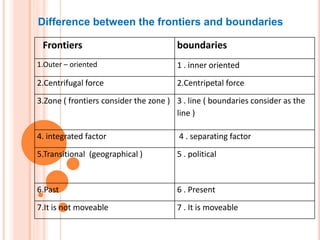
Difference between frontiers and boundaries
Frontiers boundaries
1.Outer – oriented 1 . inner oriented
2.Centrifugal force 2.Centripetal force
3.Zone ( frontiers consider the zone ) 3 . line ( boundaries consider as the
line )
4. integrated factor 4 . separating factor
5.Transitional (geographical ) 5 . political
6.Past 6 . Present
7.It is not moveable 7 . It is moveable
Difference between the frontiers and boundaries
Reference – K .Siddhartha
books Nation – state, territory and
geopolitics
frontiers and boundaries

frontiers and boundaries

  • 1.
    Frontiers Prepared By: JedguleRevnnath M.A Geography II University Of Pune Dept - Geography
  • 2.
    Introduction Frontiers and boundariesare topics of special interest for the political geographers. Perhaps no other aspect of political geography has attracted more interest than the studies regarding frontier, the critical interface between states and special elements of the territorial question; while boundaries have been specially studied as they are frequently a source of friction between states, and the areas through which they lie are profoundly affected by their presence.
  • 3.
    Frontiers Definition ‘The frontier canthus be described as a zonal politico - geographical area that lies at the margin of the settled territory of a political unit and into which expansion can take place.’ (k. Siddhartha.)
  • 4.
    Classification criteria frontier 1.Inrelation to the sovereign of the state , Political, settlement 1) Primary 2) Secondary 3) Hollow 2. In relation to the indigenous population of the frontier zone, Inclusion, Exclusion 3. In relation to the pace of frontier advance, Dynamic, Static 4. In relation to the degree of Trans – frontier contact, Contact Separation Classification criteria frontier 1.In relation to the sovereign of the state , Political, settlement 1) Primary 2) Secondary 3) Hollow 2. In relation to the indigenous population of the frontier zone, Inclusion, Exclusion 3. In relation to the pace of frontier advance, Dynamic, Static 4. In relation to the degree of Trans – frontier contact, Contact Separation
  • 5.
    1. Political frontiers:- In a political frontier the de facto limits of the state advance with the advance of its frontiers but its demure boundaries lag behind. Political frontiers should not be confused with boundaries because international boundaries have frequently been drawn in frontier zones. As the sovereign state replaced the earlier forms of political region, it became necessary that the exact extent of sovereignty should be known; the very necessity for a boundary implies that the frontier is under pressure from both sides and may not be claimed as legitimate territory of the states in contact with it. The expansion of the Russian state into Kazakhstan and soviet central Asia was associates with political frontiers. In relation to the sovereign of the state
  • 7.
    Settlement frontiers markthe stages in the expansion of the state ecumene within pre – expansion of Homo sapiens into nearly every corner of the earth where the human beings can survive. These areas of relatively sparse population but abundant resources capable of supporting larger population but abundant resources , in the more extreme climatic environments of the world. 2. Settlement frontiers
  • 8.
    Settlement frontiers areof three types. Primary settlement frontiers :- Primary settlement frontiers exist when a state is taking possession of its territory for the first time and disappear when the legal limits of the states are reached , e.g., the western expansion of the united states sovereignty through its territory in North America
  • 9.
    Secondary settlement frontiers:- As the primary settlement frontier advances into certain areas having adverse physical environment or with inadequate techniques, it hinder settlement and are thus bypassed. When these enclaves of unsettled and neglected territory that are left behind are subsequently colonized, they form secondary settlement frontiers.
  • 10.
    Hollow settlement frontiers:- In case of a hollow settlement frontier, the consolidation of settlement does not always occur in the wake of frontier advance. Rather, the crude and speculative exploitation of frontier resources leads to the exhaustion of soils and mineral, causing the retreat of Settlement from colonized areas to new frontiers or longer established areas of development (Prescott, 1987).
  • 11.
    frontiers of inclusion:- Frontiers of inclusion are associated with the assimilation of indigenous population in areas over which the frontier passes. Examples include, to some degree, the roman, the Arab and the Spanish American frontiers. 2. In relation to the indigenous population of the frontier zone,
  • 12.
    frontiers of exclusion Themost important characteristic of the frontiers of exclusion is the segregation of indigenous population. Examines include the North American, the Australian and the Boer frontiers the American frontier was advancing and in Australia the native Australians resisted the frontier advance. In the erstwhile Soviet Union, the Siberian natives showed a greater readiness to mix with great Russian colonists than did the Muslims of soviet central Asia whose religion opposed mixing with infidels .
  • 13.
    Dynamic and staticfrontiers Dynamic frontiers are in motion and involve continues colonization of the new territory. they may become static when advance is checked by environmental barriers, resistance by indigenous people or by lack of colonists. The Appalachian mountains in north America and the great dividing range in Australia checked the early colonization of these countries. 3.In relation to the pace of frontier advance,
  • 14.
    Contact and separationfrontiers Contact frontiers facilitate peaceful intercourse between states while separation frontiers are zones of difficult terrain and scarce population which minimize the risk of war by separating potential enemies. 4. In relation to the degree of Trans – frontier contact,
  • 15.
    Frontiers – Afrontier is a politico geographical area, lying beyond defined borders of a political unit into which expansion could take place. It is a physical and moral concept which implied looking outwards and moving outwards. Frontiers can be differentiated from boundaries as follows -: Difference between frontiers and boundaries
  • 16.
    Frontiers boundaries 1.Outer –oriented 1 . inner oriented 2.Centrifugal force 2.Centripetal force 3.Zone ( frontiers consider the zone ) 3 . line ( boundaries consider as the line ) 4. integrated factor 4 . separating factor 5.Transitional (geographical ) 5 . political 6.Past 6 . Present 7.It is not moveable 7 . It is moveable Difference between the frontiers and boundaries
  • 18.
    Reference – K.Siddhartha books Nation – state, territory and geopolitics