Fundamental of Human
Geography
Class xii
Ch.1- Nature and scope of Human geography
NATURE AND SCOPE OF HUMAN
GEOGRAPHY
• Geography is a field of study is integrative,
empirical and practical
• It studies each and every event on the earth over
the space and time
• Human geography studies the relationship
between man and nature
• Geo. can be studied through law making or
descriptive
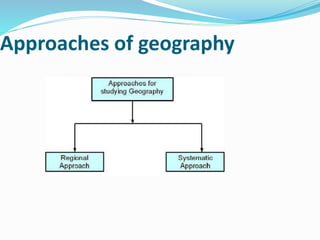
Approaches of geography
Human Geography
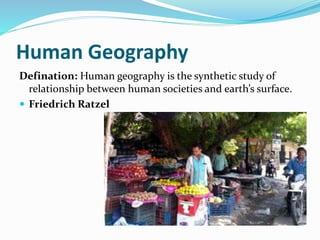
Defination: Human geography is the synthetic study of
relationship between human societies and earth’s surface.
 Friedrich Ratzel
Nature of Human
Geography
(a) Human geography studies the inter-relationship
between the physical environment and socio-cultural
environment created by man.
(b) Elements of physical are land, water, soil, climate,
vegetation, fauna
(c) Elements of cultural are transport and
communication, settlements, crops
Naturalization of Humans
(a) Man interact with nature with the help of technology
(b) It is not important that what he creates but with what tools he
used to create
(c) Technology indicates the level of cultural development of society
(d) Understanding the nature helps to create technology:
1. Understanding of friction and heat helped to discover fire
2. Understanding DNA helped to eradicate diseases
3. Laws of thermodynamics helped to develop fast planes
4. The interaction between primitive society and nature is
called Environmental Determinism.(Humboldt, Carl Ritter,
Ratzel, E.C. Sample)
Humanizations of Nature
1. With the development of technology people
understood the nature well
2. They move from state of necessity to state of
possibilities
3. Human activities created cultural landscape
4. The imprints of human activities are health resorts,
huge urbanisation, agriculture in plain, plantation in
rolling hills, ports on the coasts and satellites in the
space.
So it is called as possibilism ( Lucian Febvre, Paul Vidal-de-La
Blache, Jean Brunhes)
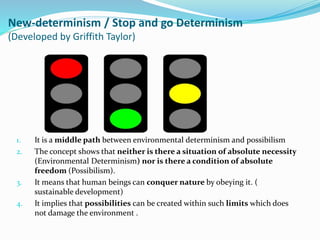
New-determinism / Stop and go Determinism
(Developed by Griffith Taylor)
1. It is a middle path between environmental determinism and possibilism
2. The concept shows that neither is there a situation of absolute necessity
(Environmental Determinism) nor is there a condition of absolute
freedom (Possibilism).
3. It means that human beings can conquer nature by obeying it. (
sustainable development)
4. It implies that possibilities can be created within such limits which does
not damage the environment .
Human Geography Through the
Corridors of Time
Schools of human geography
1. Welfare School
Concerned with social well-being of the people:
Housing, Health, Education
2. Radical School: Concerned with causes of poverty,
deprivation and social Inequality
3. Behavioural School: Given importance to lived
experience, perception of space by Social
categories
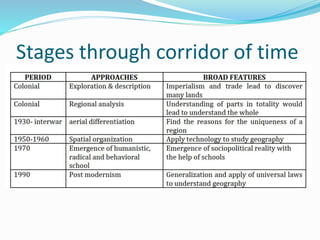
Stages through corridor of time
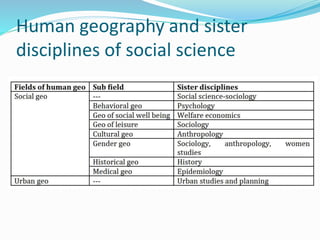
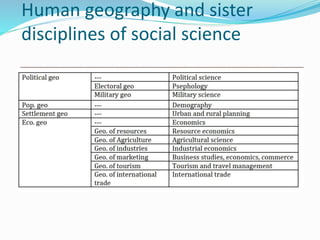
Human geography and sister
disciplines of social science
Human geography and sister
disciplines of social science
Thank you…..
See you soon with next chapter...
Sudip

Human Geography Nature and scope

  • 1.
    Fundamental of Human Geography Classxii Ch.1- Nature and scope of Human geography
  • 2.
    NATURE AND SCOPEOF HUMAN GEOGRAPHY • Geography is a field of study is integrative, empirical and practical • It studies each and every event on the earth over the space and time • Human geography studies the relationship between man and nature • Geo. can be studied through law making or descriptive
  • 3.
  • 4.
    Human Geography Defination: Humangeography is the synthetic study of relationship between human societies and earth’s surface.  Friedrich Ratzel
  • 5.
    Nature of Human Geography (a)Human geography studies the inter-relationship between the physical environment and socio-cultural environment created by man. (b) Elements of physical are land, water, soil, climate, vegetation, fauna (c) Elements of cultural are transport and communication, settlements, crops
  • 6.
    Naturalization of Humans (a)Man interact with nature with the help of technology (b) It is not important that what he creates but with what tools he used to create (c) Technology indicates the level of cultural development of society (d) Understanding the nature helps to create technology: 1. Understanding of friction and heat helped to discover fire 2. Understanding DNA helped to eradicate diseases 3. Laws of thermodynamics helped to develop fast planes 4. The interaction between primitive society and nature is called Environmental Determinism.(Humboldt, Carl Ritter, Ratzel, E.C. Sample)
  • 7.
    Humanizations of Nature 1.With the development of technology people understood the nature well 2. They move from state of necessity to state of possibilities 3. Human activities created cultural landscape 4. The imprints of human activities are health resorts, huge urbanisation, agriculture in plain, plantation in rolling hills, ports on the coasts and satellites in the space. So it is called as possibilism ( Lucian Febvre, Paul Vidal-de-La Blache, Jean Brunhes)
  • 8.
    New-determinism / Stopand go Determinism (Developed by Griffith Taylor) 1. It is a middle path between environmental determinism and possibilism 2. The concept shows that neither is there a situation of absolute necessity (Environmental Determinism) nor is there a condition of absolute freedom (Possibilism). 3. It means that human beings can conquer nature by obeying it. ( sustainable development) 4. It implies that possibilities can be created within such limits which does not damage the environment .
  • 9.
    Human Geography Throughthe Corridors of Time Schools of human geography 1. Welfare School Concerned with social well-being of the people: Housing, Health, Education 2. Radical School: Concerned with causes of poverty, deprivation and social Inequality 3. Behavioural School: Given importance to lived experience, perception of space by Social categories
  • 10.
  • 11.
    Human geography andsister disciplines of social science
  • 12.
    Human geography andsister disciplines of social science
  • 13.
    Thank you….. See yousoon with next chapter... Sudip

Editor's Notes