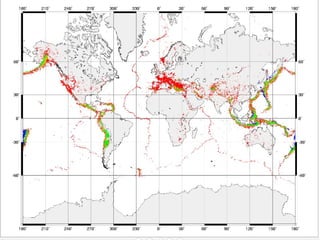
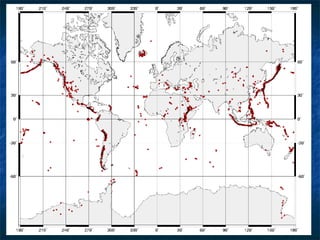
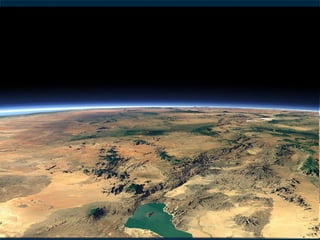
What do these maps show?
 
 
Task Produce an annotated world map to show the location and distribution of earthquakes, volcanoes and  fold mountains Use pages 8+9 from the Atlas   You have 15 minutes
Structure  You should be able to Describe the general distribution of fold mountains, volcanoes and earthquakes  Explain how this distribution is related to movements at plate boundaries.  Understand the processes leading to the formation of rift valleys and block mountains. Show a basic understanding of plate tectonics, describing the global pattern of plates, their structure, and be aware of plate movements - plates moving away from each other (sea floor spreading), plates moving towards each other (subduction) and plates sliding past each other.
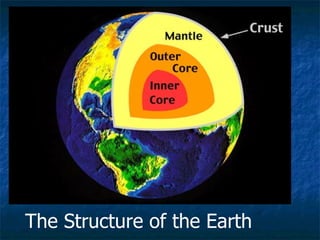
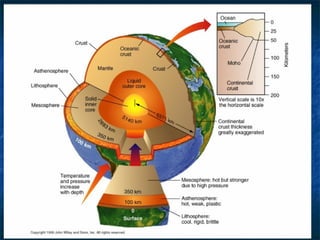
The Structure of the Earth
 
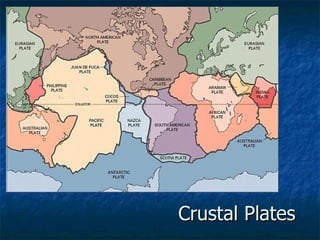
Crustal Plates
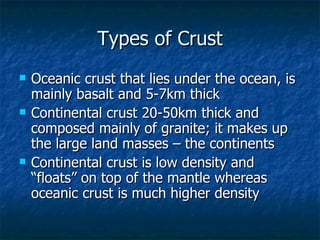
Types of Crust Oceanic crust that lies under the ocean, is mainly basalt and 5-7km thick Continental crust 20-50km thick and composed mainly of granite; it makes up the large land masses – the continents Continental crust is low density and “floats” on top of the mantle whereas oceanic crust is much higher density
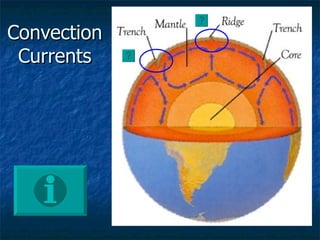
Convection Currents
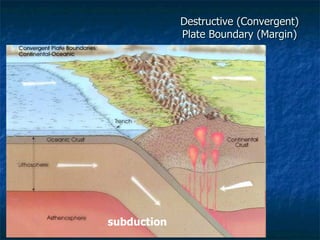
Destructive (Convergent) Plate Boundary (Margin) subduction
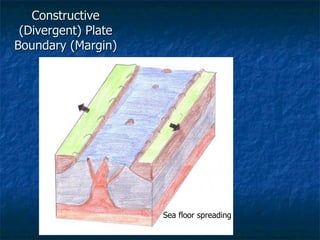
Constructive (Divergent) Plate Boundary (Margin) Sea floor spreading
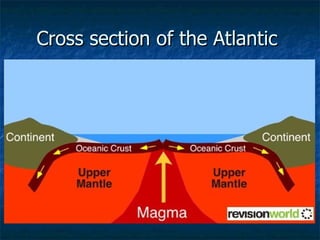
Cross section of the Atlantic
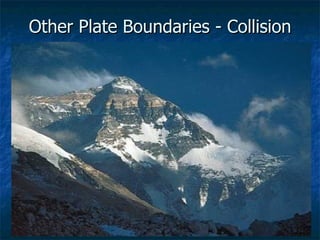
Other Plate Boundaries - Collision India colliding with Asian subcontinent
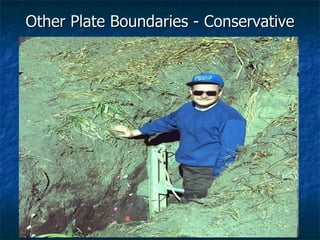
Other Plate Boundaries - Conservative San Andreas fault California
Rift Valley and Block Mountains
 
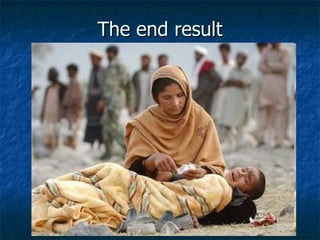
The end result
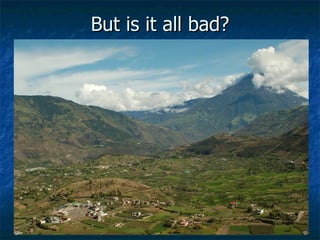
But is it all bad?
Task Produce an A3 summary sheet to show the 4 plate boundaries (destructive, constructive, collision and conservative) You need a cross-sectional diagram of each For each boundary you should;   describe what is happening,  give a real example of a place in the world where this boundary can be found, outline the type of tectonic (volcanic and earthquake) activity linked with each boundary.

13 - Plate Tectonic Theory

  • 1.
    What do thesemaps show?
  • 2.
  • 3.
  • 4.
    Task Produce anannotated world map to show the location and distribution of earthquakes, volcanoes and fold mountains Use pages 8+9 from the Atlas You have 15 minutes
  • 5.
    Structure Youshould be able to Describe the general distribution of fold mountains, volcanoes and earthquakes Explain how this distribution is related to movements at plate boundaries. Understand the processes leading to the formation of rift valleys and block mountains. Show a basic understanding of plate tectonics, describing the global pattern of plates, their structure, and be aware of plate movements - plates moving away from each other (sea floor spreading), plates moving towards each other (subduction) and plates sliding past each other.
  • 6.
  • 7.
  • 8.
  • 9.
    Types of CrustOceanic crust that lies under the ocean, is mainly basalt and 5-7km thick Continental crust 20-50km thick and composed mainly of granite; it makes up the large land masses – the continents Continental crust is low density and “floats” on top of the mantle whereas oceanic crust is much higher density
  • 10.
  • 11.
    Destructive (Convergent) PlateBoundary (Margin) subduction
  • 12.
    Constructive (Divergent) PlateBoundary (Margin) Sea floor spreading
  • 13.
    Cross section ofthe Atlantic
  • 14.
    Other Plate Boundaries- Collision India colliding with Asian subcontinent
  • 15.
    Other Plate Boundaries- Conservative San Andreas fault California
  • 16.
    Rift Valley andBlock Mountains
  • 17.
  • 18.
  • 19.
    But is itall bad?
  • 20.
    Task Produce anA3 summary sheet to show the 4 plate boundaries (destructive, constructive, collision and conservative) You need a cross-sectional diagram of each For each boundary you should; describe what is happening, give a real example of a place in the world where this boundary can be found, outline the type of tectonic (volcanic and earthquake) activity linked with each boundary.