Learning Objectives Understand the causes of suburbanisation in relation to MEDCs Be able to describe the consequences of suburbanisation on different areas of the urban area
Suburbanisation The increased movement of people / services and industries from the centres of inner urban areas outwards, towards and onto the edges of the built-up area.
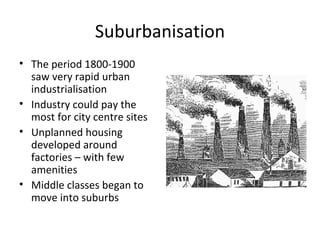
Suburbanisation The period 1800-1900 saw very rapid urban industrialisation Industry could pay the most for city centre sites Unplanned housing developed around factories – with few amenities Middle classes began to move into suburbs
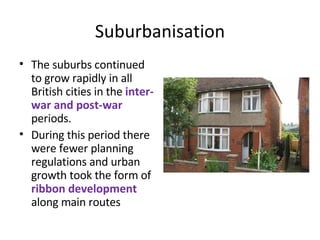
Suburbanisation The suburbs continued to grow rapidly in all British cities in the  inter-war and post-war  periods. During this period there were fewer planning regulations and urban growth took the form of  ribbon development  along main routes
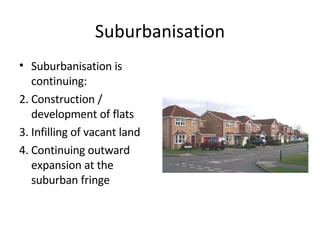
Suburbanisation Suburbanisation is continuing: Construction / development of flats Infilling of vacant land Continuing outward expansion at the suburban fringe
Causes of suburbanisation De-centralisation Shift of jobs into service sector Often tend to be in non-centralised locations to make use of cheaper land prices De-industrialisation Loss of manufacturing jobs in inner cities Workers often lacked skills for jobs in service sectors Inner cities experienced spiral of problems
Causes of suburbanisation Attractions of edge of city location Access – motorways etc Room to expand Green space Pleasant environment Technology Advances in transport meant people could commute longer distances ICT and communications developments mean more people can work from home
Consequences of suburbanisation These can relate to periphery and inner city/CBD Consequences can be economic, environmental or social Positive or negative
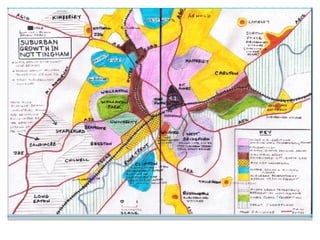
Suburbanisation of Nottingham
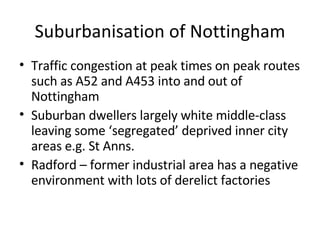
Suburbanisation of Nottingham Traffic congestion at peak times on peak routes such as A52 and A453 into and out of Nottingham Suburban dwellers largely white middle-class leaving some ‘segregated’ deprived inner city areas e.g. St Anns. Radford – former industrial area has a negative environment with lots of derelict factories
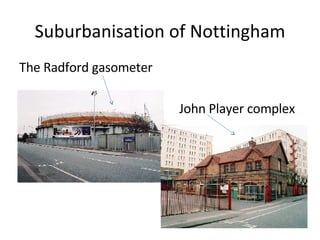
Suburbanisation of Nottingham The Radford gasometer John Player complex
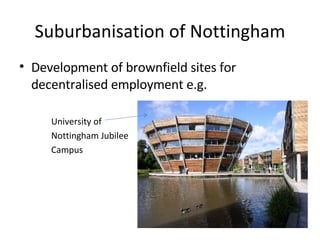
Suburbanisation of Nottingham Development of brownfield sites for decentralised employment e.g. University of  Nottingham Jubilee  Campus
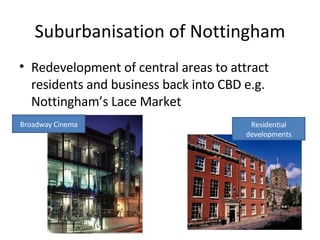
Suburbanisation of Nottingham Redevelopment of central areas to attract residents and business back into CBD e.g. Nottingham’s Lace Market Broadway Cinema Residential developments
Read Geo Factsheet ‘Suburbanisation’ 1. What factors encouraged early development of the suburbs? 2. In the last 30 years:   What problems did ‘ de-industrialisation’  cause in the inner cities? How did these problems encourage growth of the suburbs? 3. Outline the push factors and pull factors that caused the suburbanisation of industry and jobs. 4. Outline how changes in transport encouraged suburbanisation  5. Why are suburbs ‘ not  all the same’? 6. Copy or summarise Table 4 for revision for the exam  7. How does Table 3 show that the inner city has more problems than the suburbs?  8. List the ‘three major developments’ in the suburbs in the last 15 years.

Suburbanisation

  • 1.
    Learning Objectives Understandthe causes of suburbanisation in relation to MEDCs Be able to describe the consequences of suburbanisation on different areas of the urban area
  • 2.
    Suburbanisation The increasedmovement of people / services and industries from the centres of inner urban areas outwards, towards and onto the edges of the built-up area.
  • 3.
    Suburbanisation The period1800-1900 saw very rapid urban industrialisation Industry could pay the most for city centre sites Unplanned housing developed around factories – with few amenities Middle classes began to move into suburbs
  • 4.
    Suburbanisation The suburbscontinued to grow rapidly in all British cities in the inter-war and post-war periods. During this period there were fewer planning regulations and urban growth took the form of ribbon development along main routes
  • 5.
    Suburbanisation Suburbanisation iscontinuing: Construction / development of flats Infilling of vacant land Continuing outward expansion at the suburban fringe
  • 6.
    Causes of suburbanisationDe-centralisation Shift of jobs into service sector Often tend to be in non-centralised locations to make use of cheaper land prices De-industrialisation Loss of manufacturing jobs in inner cities Workers often lacked skills for jobs in service sectors Inner cities experienced spiral of problems
  • 7.
    Causes of suburbanisationAttractions of edge of city location Access – motorways etc Room to expand Green space Pleasant environment Technology Advances in transport meant people could commute longer distances ICT and communications developments mean more people can work from home
  • 8.
    Consequences of suburbanisationThese can relate to periphery and inner city/CBD Consequences can be economic, environmental or social Positive or negative
  • 9.
  • 10.
    Suburbanisation of NottinghamTraffic congestion at peak times on peak routes such as A52 and A453 into and out of Nottingham Suburban dwellers largely white middle-class leaving some ‘segregated’ deprived inner city areas e.g. St Anns. Radford – former industrial area has a negative environment with lots of derelict factories
  • 11.
    Suburbanisation of NottinghamThe Radford gasometer John Player complex
  • 12.
    Suburbanisation of NottinghamDevelopment of brownfield sites for decentralised employment e.g. University of Nottingham Jubilee Campus
  • 13.
    Suburbanisation of NottinghamRedevelopment of central areas to attract residents and business back into CBD e.g. Nottingham’s Lace Market Broadway Cinema Residential developments
  • 14.
    Read Geo Factsheet‘Suburbanisation’ 1. What factors encouraged early development of the suburbs? 2. In the last 30 years:   What problems did ‘ de-industrialisation’ cause in the inner cities? How did these problems encourage growth of the suburbs? 3. Outline the push factors and pull factors that caused the suburbanisation of industry and jobs. 4. Outline how changes in transport encouraged suburbanisation  5. Why are suburbs ‘ not all the same’? 6. Copy or summarise Table 4 for revision for the exam  7. How does Table 3 show that the inner city has more problems than the suburbs? 8. List the ‘three major developments’ in the suburbs in the last 15 years.