BASICS OF
FIBRE SPLICING
MOHAMED NIJAS V
S.9 ISP
CUSAT
FIBRE SPLICING
A permanent joint formed between two individual optical fibers .
Fiber splicing is frequently used to establish long-haul optical fiber links where
smaller fiber lengths need to be joined, and there is no requirement for
repeated connection and disconnection.
 Splices may be divided into two broad categories depending upon the splicing
technique utilized.
These are fusion splicing or welding and mechanical splicing.
 All these techniques seek to optimize the splice performance through both
fiber end preparation and alignment of the two joint fibers.
Typical average splice insertion losses for multimode fibers are in the range 0.1
to 0.2 dB
OPTICAL FIBER END PREPARATION
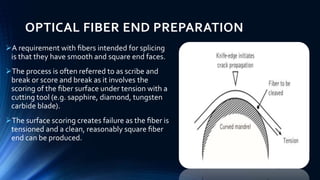
A requirement with fibers intended for splicing
is that they have smooth and square end faces.
The process is often referred to as scribe and
break or score and break as it involves the
scoring of the fiber surface under tension with a
cutting tool (e.g. sapphire, diamond, tungsten
carbide blade).
The surface scoring creates failure as the fiber is
tensioned and a clean, reasonably square fiber
end can be produced.
CONTINUED…
However, straight pull, scribe and break tools are also utilized, which arguably
give better results .
An alternative technique involves circumferential scoring which provides a
controlled method of lightly scoring around the fiber circumference .
In this case the score can be made smooth and uniform and large-diameter fibers
may be prepared by a simple straight pull with end angles less than 1°.
FUSION SPLICING
• The fusion splicing of single fibers involves the heating of the two
prepared fiber ends to their fusing point with the application of
sufficient axial pressure between the two optical fibers.
• It is therefore essential that the stripped (of cabling and buffer
coating) fiber ends are adequately positioned and aligned in order to
achieve good continuity of the transmission medium at the junction
point.
• Hence the fibers are usually positioned and clamped with the aid of
an inspection microscope.
CONTINUED…
Flame heating sources such as microplasma torches (argon and hydrogen) and
oxhydric microburners (oxygen, hydrogen and alcohol vapour) have been
utilized with some success .
However, the most widely used heating source is an electric arc.This technique
offers advantages of consistent, easily controlled heat with adaptability for use
under field conditions.
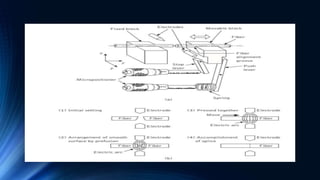
The two fibers are welded together by development of the basic arc fusion
process which involves the rounding of the fiber ends with a low-energy
discharge before pressing the fibers together and fusing with a stronger arc.
This technique, known as prefusion, removes the requirement for fiber end
preparation which has a distinct advantage in the field environment. It has
been utilized with multimode fibers giving average splice losses of 0.09 dB
CONTINUED…
• Fusion splicing of single-mode fibers with typical core diameters between 5
and 10 μm presents problems of more critical fiber alignment (i.e. lateral
offsets of less than 1 μm are required for low-loss joints).
• However, splice insertion losses below 0.3 dB may be achieved due to a self-
alignment phenomenon which partially compensates for any lateral offset.
• A possible drawback with fusion splicing is that the heat necessary to fuse the
fibers may weaken the fiber in the vicinity of the splice.
• It has been found that even with careful handling, the tensile strength of the
fused fiber may be as low as 30% of that of the uncoated fiber before fusion.
MECHANICAL SPLICING
Fbers are held in alignment by some mechanical means.
Using tubes around the fiber ends (tube splices, glass or ceramic
capillary)
Using v-grooves into which the butted fibers are placed (groove
splices).
SNUG TUBE SPLICE
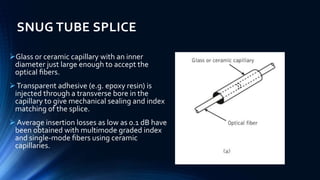
Glass or ceramic capillary with an inner
diameter just large enough to accept the
optical fibers.
Transparent adhesive (e.g. epoxy resin) is
injected through a transverse bore in the
capillary to give mechanical sealing and index
matching of the splice.
 Average insertion losses as low as 0.1 dB have
been obtained with multimode graded index
and single-mode fibers using ceramic
capillaries.
LOOSE TUBE SPLICE UTILIZING
SQUARE CROSS-SECTION CAPILLARY
• A mechanical splicing technique which avoids the
critical tolerance requirements of the snug tube
splice .
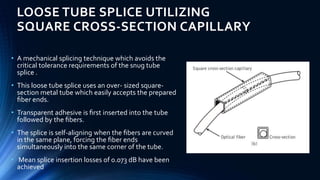
• This loose tube splice uses an over- sized square-
section metal tube which easily accepts the prepared
fiber ends.
• Transparent adhesive is first inserted into the tube
followed by the fibers.
• The splice is self-aligning when the fibers are curved
in the same plane, forcing the fiber ends
simultaneously into the same corner of the tube.
• Mean splice insertion losses of 0.073 dB have been
achieved
V-GROOVE SPLICE
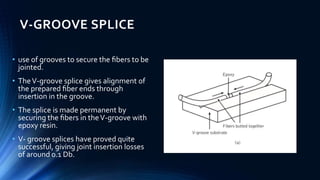
• use of grooves to secure the fibers to be
jointed.
• TheV-groove splice gives alignment of
the prepared fiber ends through
insertion in the groove.
• The splice is made permanent by
securing the fibers in theV-groove with
epoxy resin.
• V- groove splices have proved quite
successful, giving joint insertion losses
of around 0.1 Db.
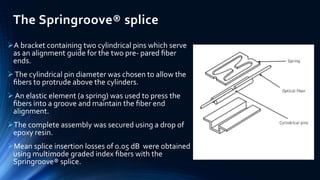
The Springroove® splice
A bracket containing two cylindrical pins which serve
as an alignment guide for the two pre- pared fiber
ends.
The cylindrical pin diameter was chosen to allow the
fibers to protrude above the cylinders.
 An elastic element (a spring) was used to press the
fibers into a groove and maintain the fiber end
alignment.
The complete assembly was secured using a drop of
epoxy resin.
Mean splice insertion losses of 0.05 dB were obtained
using multimode graded index fibers with the
Springroove® splice.
ARRAY SPLICING
• Multiple simultaneous fusion splicing of an array of fibers in a ribbon cable
has been demonstrated for both multimode and single-mode fibers.
• In both cases a 12-fiber ribbon was prepared by scoring and breaking prior
to pressing the fiber ends onto a contact plate to avoid difficulties with
varying gaps between the fibers to be fused.
• An electric arc fusing device was then employed to provide simultaneous
fusion.
• Such a device is now commercially available to allow the splicing of 12
fibers simultaneously in a time of around 6 minutes, which requires only 30
seconds per splice.
• Splice losses using this device with multimode graded index fiber range
from an average of 0.04 dB to a maximum of 0.12 dB, whereas for single-
mode fiber the average loss is 0.04 dB with a 0.4 dB maximum.
CONTINUED…
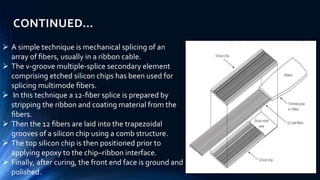
 A simple technique is mechanical splicing of an
array of fibers, usually in a ribbon cable.
 The v-groove multiple-splice secondary element
comprising etched silicon chips has been used for
splicing multimode fibers.
 In this technique a 12-fiber splice is prepared by
stripping the ribbon and coating material from the
fibers.
 Then the 12 fibers are laid into the trapezoidal
grooves of a silicon chip using a comb structure.
 The top silicon chip is then positioned prior to
applying epoxy to the chip–ribbon interface.
 Finally, after curing, the front end face is ground and
polished.
REFERENCES
Optical Fibre Communications ------- Gerd Keiser
Optical Fibre Communications ------- John M Senior
Fibre splicing

Fibre splicing

  • 1.
    BASICS OF FIBRE SPLICING MOHAMEDNIJAS V S.9 ISP CUSAT
  • 2.
    FIBRE SPLICING A permanentjoint formed between two individual optical fibers . Fiber splicing is frequently used to establish long-haul optical fiber links where smaller fiber lengths need to be joined, and there is no requirement for repeated connection and disconnection.  Splices may be divided into two broad categories depending upon the splicing technique utilized. These are fusion splicing or welding and mechanical splicing.  All these techniques seek to optimize the splice performance through both fiber end preparation and alignment of the two joint fibers. Typical average splice insertion losses for multimode fibers are in the range 0.1 to 0.2 dB
  • 3.
    OPTICAL FIBER ENDPREPARATION A requirement with fibers intended for splicing is that they have smooth and square end faces. The process is often referred to as scribe and break or score and break as it involves the scoring of the fiber surface under tension with a cutting tool (e.g. sapphire, diamond, tungsten carbide blade). The surface scoring creates failure as the fiber is tensioned and a clean, reasonably square fiber end can be produced.
  • 4.
    CONTINUED… However, straight pull,scribe and break tools are also utilized, which arguably give better results . An alternative technique involves circumferential scoring which provides a controlled method of lightly scoring around the fiber circumference . In this case the score can be made smooth and uniform and large-diameter fibers may be prepared by a simple straight pull with end angles less than 1°.
  • 5.
    FUSION SPLICING • Thefusion splicing of single fibers involves the heating of the two prepared fiber ends to their fusing point with the application of sufficient axial pressure between the two optical fibers. • It is therefore essential that the stripped (of cabling and buffer coating) fiber ends are adequately positioned and aligned in order to achieve good continuity of the transmission medium at the junction point. • Hence the fibers are usually positioned and clamped with the aid of an inspection microscope.
  • 6.
    CONTINUED… Flame heating sourcessuch as microplasma torches (argon and hydrogen) and oxhydric microburners (oxygen, hydrogen and alcohol vapour) have been utilized with some success . However, the most widely used heating source is an electric arc.This technique offers advantages of consistent, easily controlled heat with adaptability for use under field conditions. The two fibers are welded together by development of the basic arc fusion process which involves the rounding of the fiber ends with a low-energy discharge before pressing the fibers together and fusing with a stronger arc. This technique, known as prefusion, removes the requirement for fiber end preparation which has a distinct advantage in the field environment. It has been utilized with multimode fibers giving average splice losses of 0.09 dB
  • 8.
    CONTINUED… • Fusion splicingof single-mode fibers with typical core diameters between 5 and 10 μm presents problems of more critical fiber alignment (i.e. lateral offsets of less than 1 μm are required for low-loss joints). • However, splice insertion losses below 0.3 dB may be achieved due to a self- alignment phenomenon which partially compensates for any lateral offset. • A possible drawback with fusion splicing is that the heat necessary to fuse the fibers may weaken the fiber in the vicinity of the splice. • It has been found that even with careful handling, the tensile strength of the fused fiber may be as low as 30% of that of the uncoated fiber before fusion.
  • 9.
    MECHANICAL SPLICING Fbers areheld in alignment by some mechanical means. Using tubes around the fiber ends (tube splices, glass or ceramic capillary) Using v-grooves into which the butted fibers are placed (groove splices).
  • 10.
    SNUG TUBE SPLICE Glassor ceramic capillary with an inner diameter just large enough to accept the optical fibers. Transparent adhesive (e.g. epoxy resin) is injected through a transverse bore in the capillary to give mechanical sealing and index matching of the splice.  Average insertion losses as low as 0.1 dB have been obtained with multimode graded index and single-mode fibers using ceramic capillaries.
  • 11.
    LOOSE TUBE SPLICEUTILIZING SQUARE CROSS-SECTION CAPILLARY • A mechanical splicing technique which avoids the critical tolerance requirements of the snug tube splice . • This loose tube splice uses an over- sized square- section metal tube which easily accepts the prepared fiber ends. • Transparent adhesive is first inserted into the tube followed by the fibers. • The splice is self-aligning when the fibers are curved in the same plane, forcing the fiber ends simultaneously into the same corner of the tube. • Mean splice insertion losses of 0.073 dB have been achieved
  • 12.
    V-GROOVE SPLICE • useof grooves to secure the fibers to be jointed. • TheV-groove splice gives alignment of the prepared fiber ends through insertion in the groove. • The splice is made permanent by securing the fibers in theV-groove with epoxy resin. • V- groove splices have proved quite successful, giving joint insertion losses of around 0.1 Db.
  • 13.
    The Springroove® splice Abracket containing two cylindrical pins which serve as an alignment guide for the two pre- pared fiber ends. The cylindrical pin diameter was chosen to allow the fibers to protrude above the cylinders.  An elastic element (a spring) was used to press the fibers into a groove and maintain the fiber end alignment. The complete assembly was secured using a drop of epoxy resin. Mean splice insertion losses of 0.05 dB were obtained using multimode graded index fibers with the Springroove® splice.
  • 14.
    ARRAY SPLICING • Multiplesimultaneous fusion splicing of an array of fibers in a ribbon cable has been demonstrated for both multimode and single-mode fibers. • In both cases a 12-fiber ribbon was prepared by scoring and breaking prior to pressing the fiber ends onto a contact plate to avoid difficulties with varying gaps between the fibers to be fused. • An electric arc fusing device was then employed to provide simultaneous fusion. • Such a device is now commercially available to allow the splicing of 12 fibers simultaneously in a time of around 6 minutes, which requires only 30 seconds per splice. • Splice losses using this device with multimode graded index fiber range from an average of 0.04 dB to a maximum of 0.12 dB, whereas for single- mode fiber the average loss is 0.04 dB with a 0.4 dB maximum.
  • 15.
    CONTINUED…  A simpletechnique is mechanical splicing of an array of fibers, usually in a ribbon cable.  The v-groove multiple-splice secondary element comprising etched silicon chips has been used for splicing multimode fibers.  In this technique a 12-fiber splice is prepared by stripping the ribbon and coating material from the fibers.  Then the 12 fibers are laid into the trapezoidal grooves of a silicon chip using a comb structure.  The top silicon chip is then positioned prior to applying epoxy to the chip–ribbon interface.  Finally, after curing, the front end face is ground and polished.
  • 16.
    REFERENCES Optical Fibre Communications------- Gerd Keiser Optical Fibre Communications ------- John M Senior