Optical Fibre Communication
           Systems

       Lecture 5 – Optical Amplifier

           Professor Z Ghassemlooy

       Optical Communications Research Group
  Northumbria Communications Research Laboratory
        School of Computing, Engineering and
                 Information Sciences
            The University of Northumbria
                          U.K.
                http://soe.unn.ac.uk/ocr

              Prof. Z Ghassemlooy             1
Contents

   Why the need for optical amplifier?
   Spectra
   Noise
   Types
   Principle of Operation
   Main Parameters
   Applications


                         Prof. Z Ghassemlooy   2
Signal Reshaping and Amplification

  In long distance communications, whether going
  through wire, fibre or wave, the signal carrying the
  information experience:
  - Power loss
  - Pulse broadening
  which requires amplification and signal reshaping.

m In fibre optics communications, these can be done in
  two ways:
   – Opto-electronic conversion
   – All optical

                         Prof. Z Ghassemlooy             3
Signal Reshaping and Amplification

Depending on its nature, a signal can also be regenerated.

  A digital signal is made of 1's and 0's: it is possible to
  reconstruct the signal and amplify it at the same time.

s An analog signal however, cannot be reconstructed
  because nobody knows what the original signal looked
  like.


                         Prof. Z Ghassemlooy                   4
Why the Need for Optical Amplification?

  Semiconductor devices can convert an optical signal into an
  electrical signal, amplify it and reconvert the signal back to
  an optical signal. However, this procedure has several
  disadvantages:
   – Costly
   – Require a large number over long distances
   – Noise is introduced after each conversion in analog signals
     (which cannot be reconstructed)
   – Restriction on bandwidth, wavelengths and type of optical
     signals being used, due to the electronics
e By amplifying signal in the optical domain many of these
  disadvantages would disappear!
                           Prof. Z Ghassemlooy                     5
Optical Amplification

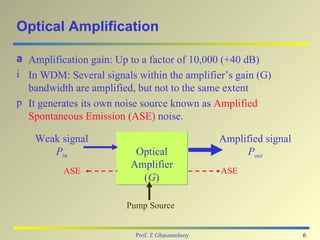
a Amplification gain: Up to a factor of 10,000 (+40 dB)
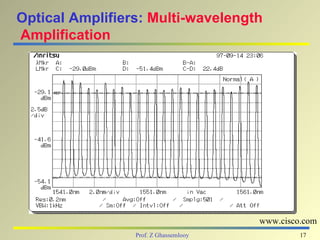
i In WDM: Several signals within the amplifier’s gain (G)
  bandwidth are amplified, but not to the same extent
p It generates its own noise source known as Amplified
  Spontaneous Emission (ASE) noise.

    Weak signal                                 Amplified signal
       Pin                Optical                    Pout
                         Amplifier
          ASE                                   ASE
                           (G)

                        Pump Source


                          Prof. Z Ghassemlooy                      6
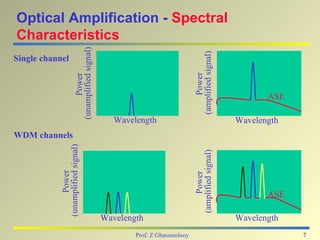
Optical Amplification - Spectral
Characteristics


                         (unamplified signal)


                                                                              (amplified signal)
Single channel


                                                                                  Power
                              Power
                                                                                                          ASE

                                                   Wavelength                                      Wavelength
WDM channels
           (unamplified signal)


                                                                              (amplified signal)
                Power


                                                                                  Power
                                                                                                          ASE

                                                Wavelength                                         Wavelength
                                                        Prof. Z Ghassemlooy                                     7
Optical Amplification - Noise Figure

a Required figure of merit to compare amplifier noise
  performance
o Defined when the input signal is coherent

                           Input signal − to− noise ratio ( SNRi )
      Noise Figure (NF) =
                          Output signal − to− noise ratio ( SNRo )


  NF is a positive number, nearly always > 2 (I.e. 3 dB)
  Good performance: when NF ~ 3 dB
: NF is one of a number of factors that determine the
  overall BER of a network.
                               Prof. Z Ghassemlooy                   8
Optical Amplifiers - Types

There are mainly two types:

  Semiconductor Laser (optical) Amplifier (SLA) (SOA)
s Active-Fibre or Doped-Fibre
  – Erbium Doped Fibre Amplifier (EDFA)
  – Fibre Raman Amplifier (FRA)
  – Thulium Doped Fibre Amplifier (TDFA)


                      Prof. Z Ghassemlooy               9
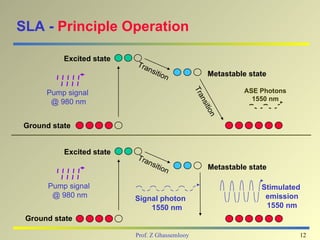
SLA - Principle Operation
i Remember diode lasers?
Suppose that the diode laser has no mirrors:
   - we get the diode to a population inversion condition
   - we inject photons at one end of the diode
o By stimulated emission, the incident signal will be amplified!
   – By stimulated emission, one photon gives rise to another photon: the total
     is two photons. Each of these two photons can give rise to another
     photon: the total is then four photons. And it goes on and on...
Problems:
) Poor noise performance: they add a lot of noise to the signal!
r Matching with the fibre is also a problem!
e However, they are small and cheap!
                                Prof. Z Ghassemlooy                           10
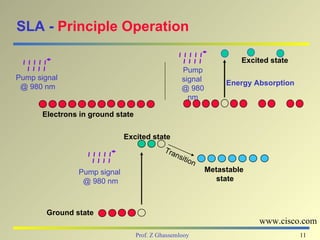
SLA - Principle Operation

                                                                         Excited state
                                                     Pump
Pump signal                                          signal          Energy Absorption
 @ 980 nm                                            @ 980
                                                       nm

       Electrons in ground state

                              Excited state
                                             Tra
                                                   nsi
                                                         tion
                Pump signal                                     Metastable
                 @ 980 nm                                          state


        Ground state
                                                                             www.cisco.com
                                   Prof. Z Ghassemlooy                                   11
SLA - Principle Operation

           Excited state
                           Tra
                              nsi
                                    tion               Metastable state

                                                                ASE Photons


                                                 Tra
      Pump signal
       @ 980 nm                                                   1550 nm


                                                  ns
                                                    itio
                                                       n
 Ground state


           Excited state
                           Tra
                                 nsi
                                       tion            Metastable state

       Pump signal                                                   Stimulated
        @ 980 nm           Signal photon                              emission
                               1550 nm                                1550 nm
 Ground state

                           Prof. Z Ghassemlooy                                12
Erbium Doped Fibre Amplifier (EDFA)

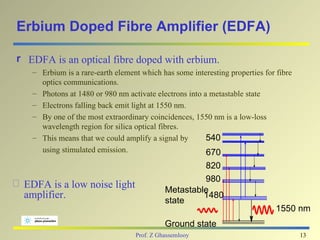
r EDFA is an optical fibre doped with erbium.
   – Erbium is a rare-earth element which has some interesting properties for fibre
     optics communications.
   – Photons at 1480 or 980 nm activate electrons into a metastable state
   – Electrons falling back emit light at 1550 nm.
   – By one of the most extraordinary coincidences, 1550 nm is a low-loss
     wavelength region for silica optical fibres.
   – This means that we could amplify a signal by       540
     using stimulated emission.                         670
                                                     820
                                                     980
 EDFA is a low noise light                  Metastable
 amplifier.                                          1480
                                            state
                                                                              1550 nm
                                            Ground state
                                  Prof. Z Ghassemlooy                                 13
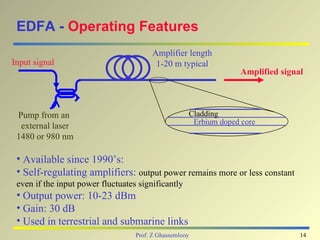
EDFA - Operating Features
                                        Amplifier length
Input signal                             1-20 m typical
                                                                   Amplified signal


 Pump from an                                        Cladding
                                                      Erbium doped core
  external laser
 1480 or 980 nm

 • Available since 1990’s:
 • Self-regulating amplifiers: output power remains more or less constant
 even if the input power fluctuates significantly
 • Output power: 10-23 dBm
 • Gain: 30 dB
 • Used in terrestrial and submarine links
                                   Prof. Z Ghassemlooy                            14
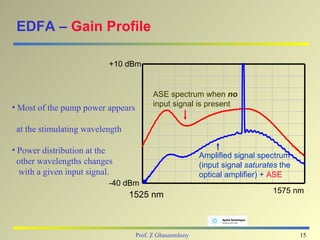
EDFA – Gain Profile

                           +10 dBm


                                         ASE spectrum when no
• Most of the pump power appears         input signal is present


 at the stimulating wavelength

• Power distribution at the
                                                         Amplified signal spectrum
  other wavelengths changes                              (input signal saturates the
  with a given input signal.                             optical amplifier) + ASE
                           -40 dBm
                                                                              1575 nm
                                 1525 nm


                                   Prof. Z Ghassemlooy                                 15
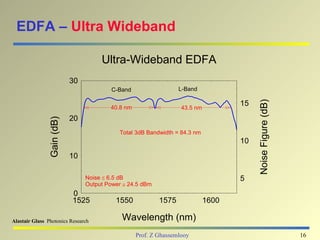
EDFA – Ultra Wideband

                                     Ultra-Wideband EDFA
                           30
                                         C-Band                  L-Band

                                                                                   15


                                                                                        Noise Figure (dB)
                                        40.8 nm                   43.5 nm
                           20
               Gain (dB)


                                           Total 3dB Bandwidth = 84.3 nm
                                                                                   10
                           10

                                Noise ≤ 6.5 dB                                     5
                                Output Power ≅ 24.5 dBm
                           0
                           1525           1550            1575              1600

Alastair Glass Photonics Research           Wavelength (nm)
                                                  Prof. Z Ghassemlooy                                       16
Optical Amplifiers: Multi-wavelength
Amplification


                                       www.cisco.com
                 Prof. Z Ghassemlooy            17
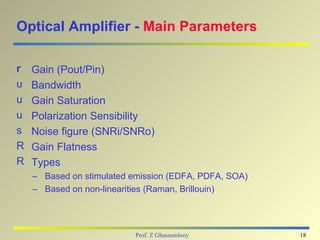
Optical Amplifier - Main Parameters

r   Gain (Pout/Pin)
u   Bandwidth
u   Gain Saturation
u   Polarization Sensibility
s   Noise figure (SNRi/SNRo)
R   Gain Flatness
R   Types
    – Based on stimulated emission (EDFA, PDFA, SOA)
    – Based on non-linearities (Raman, Brillouin)


                          Prof. Z Ghassemlooy          18
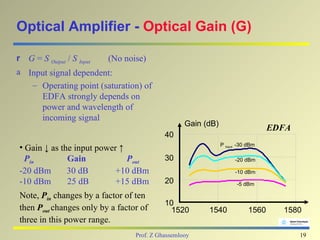
Optical Amplifier - Optical Gain (G)

r G = S Output / S Input   (No noise)
a Input signal dependent:
   – Operating point (saturation) of
     EDFA strongly depends on
     power and wavelength of
     incoming signal
                                                   Gain (dB)
                                                                                  EDFA
                                            40
                                                               P Input: -30 dBm
• Gain ↓ as the input power ↑
  Pin         Gain            Pout          30                       -20 dBm

-20 dBm       30 dB        +10 dBm                                   -10 dBm
-10 dBm       25 dB        +15 dBm          20                        -5 dBm

Note, Pin changes by a factor of ten
                                            10
then Pout changes only by a factor of        1520        1540              1560     1580
three in this power range.
                                  Prof. Z Ghassemlooy                                    19
Optical Amplifier - Optical Gain (G)
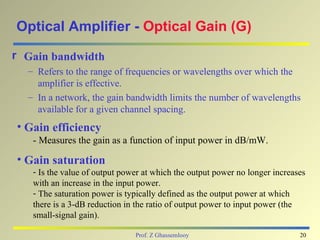
r Gain bandwidth
  – Refers to the range of frequencies or wavelengths over which the
    amplifier is effective.
  – In a network, the gain bandwidth limits the number of wavelengths
    available for a given channel spacing.
• Gain efficiency
   - Measures the gain as a function of input power in dB/mW.

• Gain saturation
   - Is the value of output power at which the output power no longer increases
   with an increase in the input power.
   - The saturation power is typically defined as the output power at which
   there is a 3-dB reduction in the ratio of output power to input power (the
   small-signal gain).

                               Prof. Z Ghassemlooy                           20
Optical SNR

 For BER < 10-13 the following OSNRs are required:
    ~ 13 dB for STM-16 / OC-48 (2.5 Gbps)
    ~ 18 dB for STM-64 / OC-192 (10 Gbps)
 Optical power at the receiver needs to bigger than receiver
  sensitivity
 Optical Amplifiers give rise to OSNR degradation (due to
  the ASE generation and amplification)
   – Noise Figure = OSNRin/OSNRout
 Therefore for a given OSNR there is only a finite number
  of amplifiers (that is to say a finite number of spans)
 Thus the need for multi-stage OA design

                             Prof. Z Ghassemlooy                21
Optical Amplifiers: Multi-Stage
                                     Er3+
                                  Doped Fiber
Input Signal                                                       Output Signal

    Optical
    Isolator

                Pump                                    Pump

  1st Active stage co-pumped:                      2nd stage counter-pumped:
 optimized for low noise figure                  optimized for high output power

NF 1st/2nd stage = Pin - SNRo [dB] - 10 Log (hc2∆λ / λ3)

NFtotal = NF1+NF2/G1
                                  Prof. Z Ghassemlooy                          22
System Performance: OSNR Limitation

 5 Spans x 25 dB
 32 Chs. @ 2.5Gb/s with 13 dB OSNR
 BER < 10-13

Channel Count / Span Loss Trade-Off:
 5 spans x 22 dB
 64 chs @ 2.5Gb/s with 13 dB OSNR
 BER < 10-13


                     Prof. Z Ghassemlooy   23
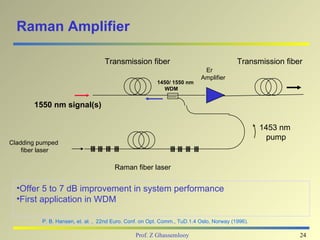
Raman Amplifier

                                   Transmission fiber                                    Transmission fiber
                                                                           Er
                                                                          Amplifier
                                                        1450/ 1550 nm
                                                           WDM


       1550 nm signal(s)

                                                                                                 1453 nm
                                                                                                   pump
Cladding pumped
    fiber laser

                                       Raman fiber laser


  •Offer 5 to 7 dB improvement in system performance
  •First application in WDM

          P. B. Hansen, et. al. , 22nd Euro. Conf. on Opt. Comm., TuD.1.4 Oslo, Norway (1996).

                                                Prof. Z Ghassemlooy                                        24
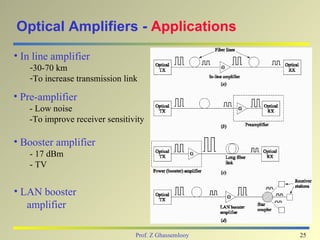
Optical Amplifiers - Applications
• In line amplifier
    -30-70 km
    -To increase transmission link

• Pre-amplifier
   - Low noise
   -To improve receiver sensitivity

• Booster amplifier
   - 17 dBm
   - TV


• LAN booster
   amplifier

                                 Prof. Z Ghassemlooy   25

Opticalamp

  • 1.
    Optical Fibre Communication Systems Lecture 5 – Optical Amplifier Professor Z Ghassemlooy Optical Communications Research Group Northumbria Communications Research Laboratory School of Computing, Engineering and Information Sciences The University of Northumbria U.K. http://soe.unn.ac.uk/ocr Prof. Z Ghassemlooy 1
  • 2.
    Contents  Why the need for optical amplifier?  Spectra  Noise  Types  Principle of Operation  Main Parameters  Applications Prof. Z Ghassemlooy 2
  • 3.
    Signal Reshaping andAmplification In long distance communications, whether going through wire, fibre or wave, the signal carrying the information experience: - Power loss - Pulse broadening which requires amplification and signal reshaping. m In fibre optics communications, these can be done in two ways: – Opto-electronic conversion – All optical Prof. Z Ghassemlooy 3
  • 4.
    Signal Reshaping andAmplification Depending on its nature, a signal can also be regenerated. A digital signal is made of 1's and 0's: it is possible to reconstruct the signal and amplify it at the same time. s An analog signal however, cannot be reconstructed because nobody knows what the original signal looked like. Prof. Z Ghassemlooy 4
  • 5.
    Why the Needfor Optical Amplification? Semiconductor devices can convert an optical signal into an electrical signal, amplify it and reconvert the signal back to an optical signal. However, this procedure has several disadvantages: – Costly – Require a large number over long distances – Noise is introduced after each conversion in analog signals (which cannot be reconstructed) – Restriction on bandwidth, wavelengths and type of optical signals being used, due to the electronics e By amplifying signal in the optical domain many of these disadvantages would disappear! Prof. Z Ghassemlooy 5
  • 6.
    Optical Amplification a Amplificationgain: Up to a factor of 10,000 (+40 dB) i In WDM: Several signals within the amplifier’s gain (G) bandwidth are amplified, but not to the same extent p It generates its own noise source known as Amplified Spontaneous Emission (ASE) noise. Weak signal Amplified signal Pin Optical Pout Amplifier ASE ASE (G) Pump Source Prof. Z Ghassemlooy 6
  • 7.
    Optical Amplification -Spectral Characteristics (unamplified signal) (amplified signal) Single channel Power Power ASE Wavelength Wavelength WDM channels (unamplified signal) (amplified signal) Power Power ASE Wavelength Wavelength Prof. Z Ghassemlooy 7
  • 8.
    Optical Amplification -Noise Figure a Required figure of merit to compare amplifier noise performance o Defined when the input signal is coherent Input signal − to− noise ratio ( SNRi ) Noise Figure (NF) = Output signal − to− noise ratio ( SNRo ) NF is a positive number, nearly always > 2 (I.e. 3 dB) Good performance: when NF ~ 3 dB : NF is one of a number of factors that determine the overall BER of a network. Prof. Z Ghassemlooy 8
  • 9.
    Optical Amplifiers -Types There are mainly two types: Semiconductor Laser (optical) Amplifier (SLA) (SOA) s Active-Fibre or Doped-Fibre – Erbium Doped Fibre Amplifier (EDFA) – Fibre Raman Amplifier (FRA) – Thulium Doped Fibre Amplifier (TDFA) Prof. Z Ghassemlooy 9
  • 10.
    SLA - PrincipleOperation i Remember diode lasers? Suppose that the diode laser has no mirrors: - we get the diode to a population inversion condition - we inject photons at one end of the diode o By stimulated emission, the incident signal will be amplified! – By stimulated emission, one photon gives rise to another photon: the total is two photons. Each of these two photons can give rise to another photon: the total is then four photons. And it goes on and on... Problems: ) Poor noise performance: they add a lot of noise to the signal! r Matching with the fibre is also a problem! e However, they are small and cheap! Prof. Z Ghassemlooy 10
  • 11.
    SLA - PrincipleOperation Excited state Pump Pump signal signal Energy Absorption @ 980 nm @ 980 nm Electrons in ground state Excited state Tra nsi tion Pump signal Metastable @ 980 nm state Ground state www.cisco.com Prof. Z Ghassemlooy 11
  • 12.
    SLA - PrincipleOperation Excited state Tra nsi tion Metastable state ASE Photons Tra Pump signal @ 980 nm 1550 nm ns itio n Ground state Excited state Tra nsi tion Metastable state Pump signal Stimulated @ 980 nm Signal photon emission 1550 nm 1550 nm Ground state Prof. Z Ghassemlooy 12
  • 13.
    Erbium Doped FibreAmplifier (EDFA) r EDFA is an optical fibre doped with erbium. – Erbium is a rare-earth element which has some interesting properties for fibre optics communications. – Photons at 1480 or 980 nm activate electrons into a metastable state – Electrons falling back emit light at 1550 nm. – By one of the most extraordinary coincidences, 1550 nm is a low-loss wavelength region for silica optical fibres. – This means that we could amplify a signal by 540 using stimulated emission. 670 820 980 EDFA is a low noise light Metastable amplifier. 1480 state 1550 nm Ground state Prof. Z Ghassemlooy 13
  • 14.
    EDFA - OperatingFeatures Amplifier length Input signal 1-20 m typical Amplified signal Pump from an Cladding Erbium doped core external laser 1480 or 980 nm • Available since 1990’s: • Self-regulating amplifiers: output power remains more or less constant even if the input power fluctuates significantly • Output power: 10-23 dBm • Gain: 30 dB • Used in terrestrial and submarine links Prof. Z Ghassemlooy 14
  • 15.
    EDFA – GainProfile +10 dBm ASE spectrum when no • Most of the pump power appears input signal is present at the stimulating wavelength • Power distribution at the Amplified signal spectrum other wavelengths changes (input signal saturates the with a given input signal. optical amplifier) + ASE -40 dBm 1575 nm 1525 nm Prof. Z Ghassemlooy 15
  • 16.
    EDFA – UltraWideband Ultra-Wideband EDFA 30 C-Band L-Band 15 Noise Figure (dB) 40.8 nm 43.5 nm 20 Gain (dB) Total 3dB Bandwidth = 84.3 nm 10 10 Noise ≤ 6.5 dB 5 Output Power ≅ 24.5 dBm 0 1525 1550 1575 1600 Alastair Glass Photonics Research Wavelength (nm) Prof. Z Ghassemlooy 16
  • 17.
    Optical Amplifiers: Multi-wavelength Amplification www.cisco.com Prof. Z Ghassemlooy 17
  • 18.
    Optical Amplifier -Main Parameters r Gain (Pout/Pin) u Bandwidth u Gain Saturation u Polarization Sensibility s Noise figure (SNRi/SNRo) R Gain Flatness R Types – Based on stimulated emission (EDFA, PDFA, SOA) – Based on non-linearities (Raman, Brillouin) Prof. Z Ghassemlooy 18
  • 19.
    Optical Amplifier -Optical Gain (G) r G = S Output / S Input (No noise) a Input signal dependent: – Operating point (saturation) of EDFA strongly depends on power and wavelength of incoming signal Gain (dB) EDFA 40 P Input: -30 dBm • Gain ↓ as the input power ↑ Pin Gain Pout 30 -20 dBm -20 dBm 30 dB +10 dBm -10 dBm -10 dBm 25 dB +15 dBm 20 -5 dBm Note, Pin changes by a factor of ten 10 then Pout changes only by a factor of 1520 1540 1560 1580 three in this power range. Prof. Z Ghassemlooy 19
  • 20.
    Optical Amplifier -Optical Gain (G) r Gain bandwidth – Refers to the range of frequencies or wavelengths over which the amplifier is effective. – In a network, the gain bandwidth limits the number of wavelengths available for a given channel spacing. • Gain efficiency - Measures the gain as a function of input power in dB/mW. • Gain saturation - Is the value of output power at which the output power no longer increases with an increase in the input power. - The saturation power is typically defined as the output power at which there is a 3-dB reduction in the ratio of output power to input power (the small-signal gain). Prof. Z Ghassemlooy 20
  • 21.
    Optical SNR  ForBER < 10-13 the following OSNRs are required:  ~ 13 dB for STM-16 / OC-48 (2.5 Gbps)  ~ 18 dB for STM-64 / OC-192 (10 Gbps)  Optical power at the receiver needs to bigger than receiver sensitivity  Optical Amplifiers give rise to OSNR degradation (due to the ASE generation and amplification) – Noise Figure = OSNRin/OSNRout  Therefore for a given OSNR there is only a finite number of amplifiers (that is to say a finite number of spans)  Thus the need for multi-stage OA design Prof. Z Ghassemlooy 21
  • 22.
    Optical Amplifiers: Multi-Stage Er3+ Doped Fiber Input Signal Output Signal Optical Isolator Pump Pump 1st Active stage co-pumped: 2nd stage counter-pumped: optimized for low noise figure optimized for high output power NF 1st/2nd stage = Pin - SNRo [dB] - 10 Log (hc2∆λ / λ3) NFtotal = NF1+NF2/G1 Prof. Z Ghassemlooy 22
  • 23.
    System Performance: OSNRLimitation  5 Spans x 25 dB  32 Chs. @ 2.5Gb/s with 13 dB OSNR  BER < 10-13 Channel Count / Span Loss Trade-Off:  5 spans x 22 dB  64 chs @ 2.5Gb/s with 13 dB OSNR  BER < 10-13 Prof. Z Ghassemlooy 23
  • 24.
    Raman Amplifier Transmission fiber Transmission fiber Er Amplifier 1450/ 1550 nm WDM 1550 nm signal(s) 1453 nm pump Cladding pumped fiber laser Raman fiber laser •Offer 5 to 7 dB improvement in system performance •First application in WDM P. B. Hansen, et. al. , 22nd Euro. Conf. on Opt. Comm., TuD.1.4 Oslo, Norway (1996). Prof. Z Ghassemlooy 24
  • 25.
    Optical Amplifiers -Applications • In line amplifier -30-70 km -To increase transmission link • Pre-amplifier - Low noise -To improve receiver sensitivity • Booster amplifier - 17 dBm - TV • LAN booster amplifier Prof. Z Ghassemlooy 25