OPTICAL FIBER
COMMUNICATION
FIBER-OPTIC COMMUNICATION


is a method of transmitting information from one
place to another by sending light through an
optical fiber.



The light forms an electromagnetic carrier wave
that is modulated to carry information.
FIBER-OPTIC COMMUNICATION
The process of communicating using fiber-optics
involves the following basic steps:
 Creating the optical signal using a transmitter,
 relaying the signal along the fiber, ensuring that
the signal does not become too distorted or weak,
 and receiving the optical signal and converting it
into an electrical signal.
OPTICAL FIBER


An optical fiber (or fibre) is a glass or plastic
fiber that carries light along its length.



Light is kept in the "core" of the optical fiber by
total internal reflection.
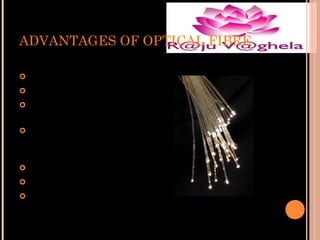
ADVANTAGES OF OPTICAL FIBRE
Thinner
 Less Expensive
 Higher Carrying
Capacity
 Less Signal
Degradation& Digital
Signals
 Light Signals
 Non-Flammable
 Light Weight

ADVANTAGES OF FIBER
OPTICS








Much Higher Bandwidth (Gbps) - Thousands of
channels can be multiplexed together over one
strand of fiber
Immunity to Noise - Immune to electromagnetic
interference (EMI).
Safety - Doesn’t transmit electrical signals,
making it safe in environments like a gas
pipeline.
High Security - Impossible to “tap into.”
ADVANTAGES OF FIBER
OPTICS







Less Loss - Repeaters can be spaced 75 miles
apart (fibers can be made to have only 0.2 dB/km
of attenuation)
Reliability - More resilient than copper in
extreme environmental conditions.
Size - Lighter and more compact than copper.
Flexibility - Unlike impure, brittle glass, fiber is
physically very flexible.
FIBER OPTIC ADVANTAGES


greater capacity (bandwidth
up to 2 Gbps, or more)



smaller

size

and

lighter

weight


lower attenuation



immunity to environmental
interference



highly secure due to tap
difficulty and lack of signal
radiation

8
DISADVANTAGES OF FIBER
OPTICS
 Disadvantages

include the cost of
interfacing
equipment necessary
to convert electrical
signals to optical
signals.
(optical
transmitters,
receivers)
Splicing
fiber optic cable is
also more difficult.
FIBER OPTIC DISADVANTAGES


expensive over short distance



requires highly skilled installers



adding additional nodes is difficult

10
AREAS OF APPLICATION
Telecommunications
 Local Area Networks
 Cable TV
 CCTV
 Optical Fiber Sensors

FIBER OPTIC CABLE


relatively new transmission medium used by
telephone companies in place of long-distance
trunk lines



also used by private companies in implementing
local data networks



require a light source with injection laser diode
(ILD) or light-emitting diodes (LED)



fiber to the desktop in the future

12
FIBER OPTIC CABLE
OPTICAL FIBER


Optical fiber consists of a core, cladding, and a
protective outer coating, which guides light along
the core by total internal reflection.
OPTICAL FIBER
CONSTRUCTION
Core – thin glass center of the
fiber where light travels.
Cladding – outer optical
material surrounding the core
Buffer Coating – plastic
coating that protects
the fiber.
OPTICAL FIBER


The core, and the lower-refractive-index cladding,
are typically made of high-quality silica glass,
though they can both be made of plastic as well.
FIBER OPTIC LAYERS


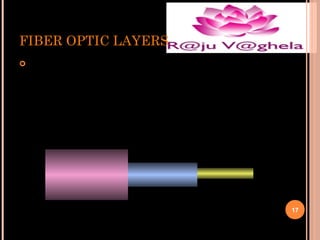
consists of three concentric sections

plastic jacket

glass or plastic
cladding

fiber core

17
FIBER OPTIC CABLE

18
FIBER-OPTIC CABLE
 Contains

one
or
several
glass fibers at
its core
 Surrounding

the fibers is a
layer of glass
called

cladding
FIBER-OPTIC CABLE
3 TYPES OF OPTICAL
FIBERS
1.

Plastic

core

and

cladding
2.

Glass core with plastic
cladding ( called PCS
fiber- Plastic Clad Silica
)

3.

Glass core and glass
cladding ( called SCS Silica Clad Silica )
PHYSICS OF LIGHT


Photons (light “particles”)
light represented by tiny bundles of energy (or
quanta), following straight line paths along the
rays.
PHYSICS OF LIGHT
PLANCK’S LAW

Ep =hf
Where,
Ep – energy of the photon (joules)
h = Planck’s constant = 6.625 x 10 -34 J-s
f – frequency o f light (photon) emitted (hertz)
INDEX OF REFRACTION
SNELL’S LAW
SNELL’S LAW
EXAMPLE:


Let medium 1 be glass ( n1 = 1.5 ) and medium 2
by ethyl alcohol (n2 = 1.36 ). For an angle of
incidence

of

refraction.



Answer: 33.47°

30°,

determine

the

angle

of
SNELL’S LAW
TOTAL INTERNAL REFLECTION IN
FIBER
CRITICAL ANGLE, ΘC


The minimum angle of incidence at which a light
ray ay strike the interface of two media and
result in an angle of refraction of 90° or greater.
ACCEPTANCE ANGLE /CONE HALFANGLE


The maximum angle in which external light rays
may strike the air/glass interface and still
propagate down the fiber.
ACCEPTANCE ANGLE /CONE HALFANGLE



θin (max) = sin-1

Where,
 θin (max) – acceptance angle (degrees)
 n1 – refractive index of glass fiber core (1.5)
 n2 – refractive index of quartz fiber cladding
( 1.46 )

ACCEPTANCE ANGLE /CONE HALFANGLE
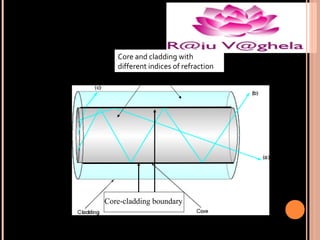
Core and cladding with
different indices of refraction

Core-cladding boundary
NUMERICAL APERTURE (NA)


Used to describe the light-gathering or lightcollecting ability of an optical fiber.



In optics, the numerical aperture (NA) of an
optical system is a dimensionless number that
characterizes the range of angles over which the
system can accept or emit light
NUMERICAL APERTURE (NA)

The numerical aperture in
respect to a point P depends
on the half-angle θ of the
maximum cone of light that
can enter or exit the lens.
NUMERICAL APERTURE (NA)
MODE OF PROPAGATION


Two main categories
of optical fiber used in
fiber
communications

optic
are

multi-mode optical fiber
and
single-mode optical fiber
.
SINGLE-MODE FIBERS


Single-mode fibers – used to transmit one signal per
fiber (used in telephone and cable TV). They have small
cores(9 microns in diameter) and transmit infra-red
light from laser.
SINGLE-MODE FIBERS


Single-mode

fiber’s

smaller

micrometres)

necessitates

more

core

(<10

expensive

components and interconnection methods, but
allows much longer, higher-performance links.
MULTI-MODE FIBERS


Multi-mode fibers – used to transmit many
signals per fiber (used in computer networks).
They have larger cores(62.5 microns in diameter)
and transmit infra-red light from LED.
MULTI-MODE FIBERS


Multimode fiber has a
larger

core

(≥

50

micrometres), allowing
less precise, cheaper
transmitters

and

receivers to connect to
it as well as cheaper
connectors.
MULTI-MODE FIBERS


However,

multi-mode

fiber

introduces

multimode distortion which often limits the
bandwidth and length of the link. Furthermore,
because of its higher dopant content, multimode
fiber is usually more expensive and exhibits
higher attenuation.
INDEX PROFILE


The index profile of an optical fiber is a graphical
representation of the magnitude of the refractive
index across the fiber.



The refractive index is plotted on the horizontal
axis, and the radial distance from the core axis is
plotted on the vertical axis.
INDEX PROFILE


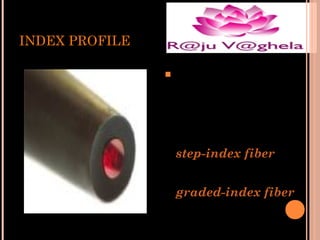
The

boundary

between

the

core

and cladding may
either be abrupt, in
step-index fiber, or
gradual,

in

graded-index fiber
.
STEP-INDEX


A step-index fiber has a central core with a
uniform refractive index. An outside cladding
that

also

has

a

uniform

refractive

index

surrounds the core;


however, the refractive index of the cladding is
less than that of the central core.
GRADED-INDEX


In graded-index fiber, the index of refraction in
the core decreases continuously between the axis
and the cladding. This causes light rays to bend
smoothly as they approach the cladding, rather
than reflecting abruptly from the core-cladding
boundary.
FIBER OPTIC TYPES
 multimode

step-index fiber

 the

reflective walls of the fiber move the light
pulses to the receiver

 multimode

graded-index fiber

 acts

to refract the light toward the center of the
fiber by variations in the density

 single

mode fiber

 the

light is guided down the center of an
extremely narrow core

51
FIBER-OPTIC CABLE


Single-mode
fiber




Carries light
pulses along
single path

Multimode
fiber


Many pulses of
light generated
by LED travel
at different
angles
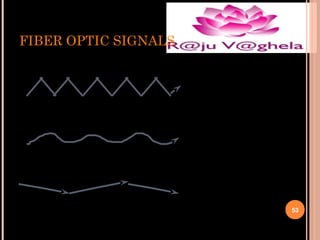
FIBER OPTIC SIGNALS
fiber optic multimode
step-index

fiber optic multimode
graded-index

fiber optic single mode
53
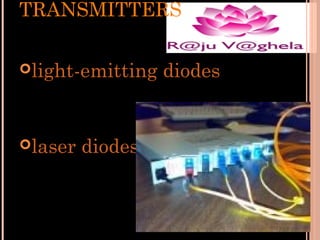
TRANSMITTERS
light-emitting

(LEDs)
laser

diodes

diodes
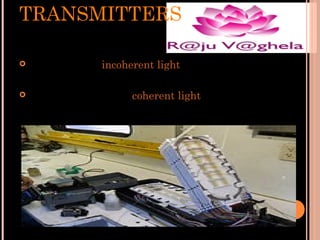
TRANSMITTERS


LEDs produce incoherent light



laser diodes produce coherent light.


LED is a forward-biased p-n junction, emitting
light

through

spontaneous emission,

a

phenomenon referred to as electroluminescence.


The emitted light is incoherent with a relatively
wide spectral width of 30-60 nm.
 LED

light transmission is also inefficient,

with only about 1 % of input power, or
about

100

microwatts,

eventually

converted into «launched power» which
has been coupled into the optical fiber.
 However,

due to their relatively simple

design, LEDs are very useful for low-cost
applications.
 Communications

LEDs

are

most

commonly made from gallium arsenide
phosphide (GaAsP) or gallium arsenide
(GaAs)
 Because

GaAsP LEDs operate at a longer

wavelength

than

GaAs

LEDs

(1.3

micrometers vs. 0.81-0.87 micrometers),
their output spectrum is wider by a factor
LED


LEDs are suitable primarily for localarea-network applications with bit rates
of

10-100

Mbit/s

and

transmission

distances of a few kilometers.


LEDs have also been developed that use
several quantum wells to emit light at
different

wavelengths

over

a

broad

spectrum, and are currently in use for
LASER


A semiconductor laser emits light through
stimulated emission rather than spontaneous
emission, which results in high output power
(~100 mW) as well as other benefits related to
the nature of coherent light.
LASER
 The

output

directional,

of

a

laser

allowing

is

relatively

high

coupling

efficiency (~50 %) into single-mode fiber.
The narrow spectral width also allows for
high bit rates since it reduces the effect of
chromatic

dispersion.

Furthermore,

semiconductor lasers can be modulated
directly at high frequencies because of
LASER


Laser diodes are often directly modulated, that is
the light output is controlled by a current applied
directly to the device.
RECEIVERS


The main component of an optical receiver is a
photodetector that converts light into electricity
through the photoelectric effect.
RECEIVERS


The photodetector is typically a semiconductorbased photodiode, such as a p-n photodiode, a p-in photodiode, or an avalanche photodiode.
RECEIVERS


Metal-semiconductor-metal

(MSM)

photodetectors are also used due to their
suitability for circuit integration in regenerators
and wavelength-division multiplexers.
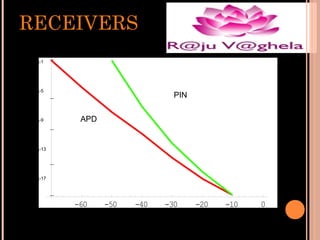
RECEIVERS
10-1

Bit Error Rate

10-5

10-9

PIN
APD

10-13

10-17

-60

-50

-40

-30

-20

-10

Average Received Optical Power (dBm)

0
FIBER TRANSMISSION
TRANSMISSION WINDOWS
Band

Description

Wavelength Range

O band

original

1260 to 1360 nm

E band

extended

1360 to 1460 nm

S band

short wavelengths

1460 to 1530 nm

C band

conventional
("erbium window")

1530 to 1565 nm

L band

long wavelengths

1565 to 1625 nm

U band

Ultra-long wavelengths

1625 to 1675 nm
FIBER-OPTIC CABLE


Two popular connectors used with fiber-optic
cable:



ST connectors
SC connectors
Long Haul Fiber System Overview
Types of Systems
Pulse quality
Bit Error Rate
Noise

71

Metro

OPT 471A © Russell A. Chipman

•
•
•
•

CATV

Long Haul
Metro

Access
Metro
Submarine networks
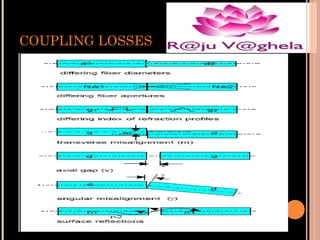
COUPLING LOSSES

Optical fiber communications