Brief flow of
presentation
1. Introduction
2. What are Optical Fibers?
3. Evolution of optical fiber
4. Structure of optical fiber
5. Workings principle of optical fiber
6. Classification of optical fiber
7. Optical fiber communication system
What is optical
Fiber?
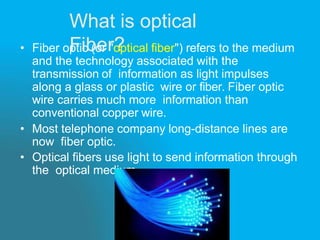
• Fiber optic (or "optical fiber") refers to the medium
and the technology associated with the
transmission of information as light impulses
along a glass or plastic wire or fiber. Fiber optic
wire carries much more information than
conventional copper wire.
• Most telephone company long-distance lines are
now fiber optic.
• Optical fibers use light to send information through
the optical medium.
Evolution of optical fiber
• 1880 – Alexander Graham Bell
• 1930 – Patents on tubing
• 1950 – Patent for two-layer glass wave-guide
• 1960 – Laser first used as light source
• 1965 – High loss of light discovered
• 1970s – Refining of manufacturing
process(John Tyndall demonstration in
1870)
• 1980s – OF technology becomes backbone of
long distance telephone networks in NA.
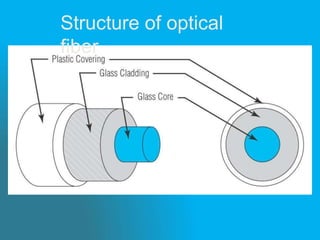
Structure of optical
fiber
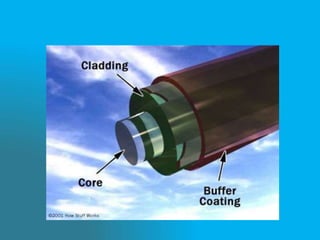
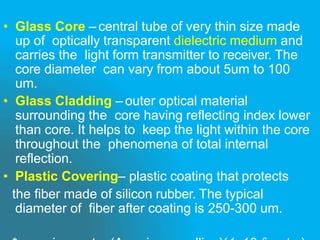
• Glass Core – central tube of very thin size made
up of optically transparent dielectric medium and
carries the light form transmitter to receiver. The
core diameter can vary from about 5um to 100
um.
• Glass Cladding – outer optical material
surrounding the core having reflecting index lower
than core. It helps to keep the light within the core
throughout the phenomena of total internal
reflection.
• Plastic Covering– plastic coating that protects
the fiber made of silicon rubber. The typical
diameter of fiber after coating is 250-300 um.
Working principle
Total Internal Reflection
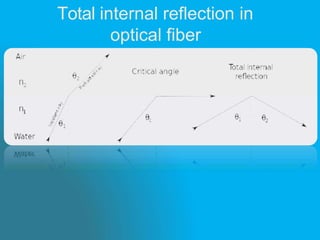
• When a ray of light travels from a denser to
a rarer medium such that the angle of
incidence is greater than the critical angle,
the ray reflects back into the same medium
this phenomena is called total internal
reflection.
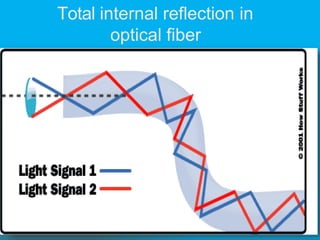
• In the optical fiberthe rays undergo repeated
total number of reflections until it emerges out
of the other end of the fiber, even if the fiber
is bent.
Total internal reflection in
optical fiber
Total internal reflection in
optical fiber
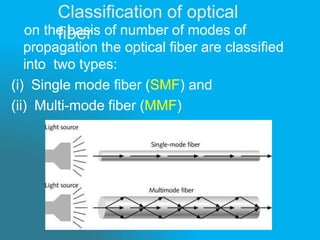
Classification of optical
fiber
on the basis of number of modes of
propagation the optical fiber are classified
into two types:
(i) Single mode fiber (SMF) and
(ii) Multi-mode fiber (MMF)
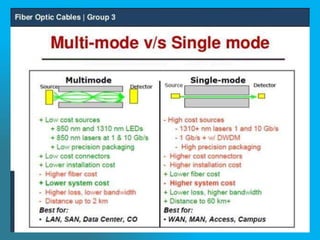
• Single-mode fiber
– Carries light pulses along single path
– Uses Laser Light Source
– has a very small core and carry only one beam of
light. It can support (Gbps) data rates over > 100
Km without using repeaters.
– data rates up to 10 Gbps with a bandwidth of
20Ghz.
• Multimode fiber
– Many pulses of light generated by LED travel at
different angles
– can support less bandwidth than Single-mode
Fiber.
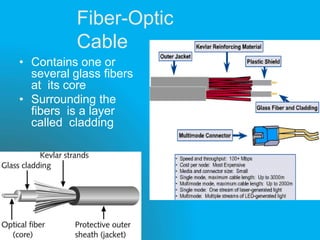
Fiber-Optic
Cable
• Contains one or
several glass fibers
at its core
• Surrounding the
fibers is a layer
called cladding
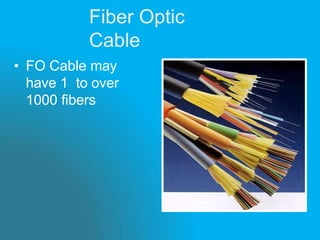
Fiber Optic
Cable
• FO Cable may
have 1 to over
1000 fibers
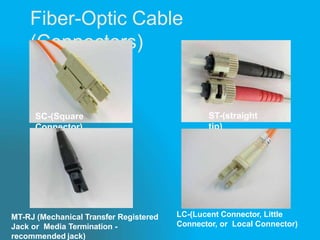
Fiber-Optic Cable
(Connectors)
SC-(Square
Connector)
ST-(straight
tip)
MT-RJ (Mechanical Transfer Registered
Jack or Media Termination -
recommended jack)
LC-(Lucent Connector, Little
Connector, or Local Connector)
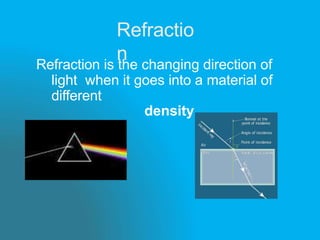
Refractio
n
Refraction is the changing direction of
light when it goes into a material of
different
density
How Optical Fiber’s are
made??
• Three Steps are Involved in the
manufacturing of the optical fiber which
are given below:-
-Making a Preform Glass Cylinder
-Drawing the Fiber’s from thepreform
-Testing the Fiber.
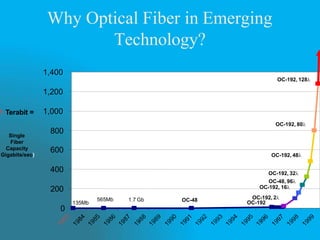
Why Optical Fiber in Emerging
Technology?
0
200
400
600
800
1,000
1,200
1,400
OC-48 OC-192
OC-192, 2
OC-192, 32
OC-48, 96
OC-192, 16
OC-192, 48
OC-192, 80
OC-192, 128
1.7 Gb
565Mb
135Mb
Single
Fiber
Capacity
Gigabits/sec)
1 Terabit =
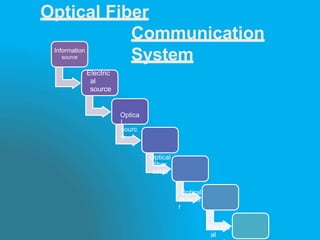
Optical Fiber
Communication
System
Information
source
Electric
al
source
Optica
l
sourc
e
Optical
fiber
cable
Optical
detecto
r
Electric
al
• Information source- it provides an
electrical signal to a transmitter
comprising an electrical stage.
• Electrical transmitter- It drives an optical
source to give an modulation of the light
wave carrier.
• Optical source- It provides the electrical-
optical conversion .It may be a
semiconductor laser or an LED.
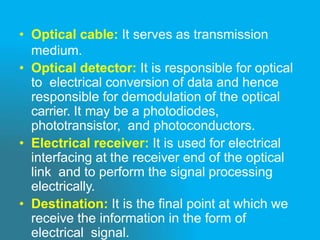
• Optical cable: It serves as transmission
medium.
• Optical detector: It is responsible for optical
to electrical conversion of data and hence
responsible for demodulation of the optical
carrier. It may be a photodiodes,
phototransistor, and photoconductors.
• Electrical receiver: It is used for electrical
interfacing at the receiver end of the optical
link and to perform the signal processing
electrically.
• Destination: It is the final point at which we
receive the information in the form of
electrical signal.
Source:
http://www.amazon.com/gp/product/B005NWYQN2/ref=pd_lpo_sbs_dp_ss_2?pf
_ rd_p=1944687622&pf_rd_s=lpo-top-stripe-
1&pf_rd_t=201&pf_rd_i=B0000C8Y58&pf_rd_m=ATVPDKIKX0DER&pf_rd_r=1
CJPB SZYDXC3GC100YDW
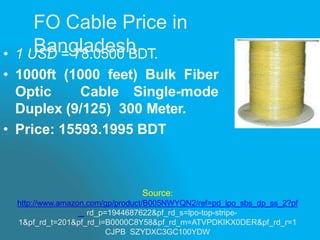
• 1 USD = 78.0500 BDT.
• 1000ft (1000 feet) Bulk Fiber
Optic Cable Single-mode
Duplex (9/125) 300 Meter.
• Price: 15593.1995 BDT
FO Cable Price in
Bangladesh
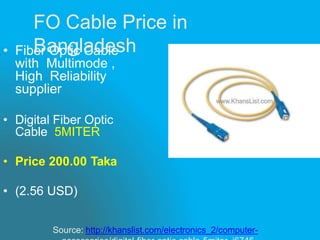
• Fiber Optic Cable
with Multimode ,
High Reliability
supplier
• Digital Fiber Optic
Cable 5MITER
• Price 200.00 Taka
• (2.56 USD)
Source: http://khanslist.com/electronics_2/computer-
FO Cable Price in
Bangladesh
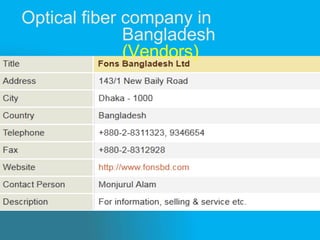
Optical fiber company in
Bangladesh
(Vendors)
Optical fiber company in
Bangladesh
(Vendors)
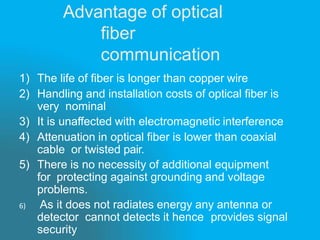
Advantage of optical
fiber
communication
1) The life of fiber is longer than copper wire
2) Handling and installation costs of optical fiber is
very nominal
3) It is unaffected with electromagnetic interference
4) Attenuation in optical fiber is lower than coaxial
cable or twisted pair.
5) There is no necessity of additional equipment
for protecting against grounding and voltage
problems.
6) As it does not radiates energy any antenna or
detector cannot detects it hence provides signal
security
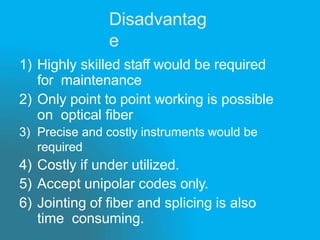
Disadvantag
e
1) Highly skilled staff would be required
for maintenance
2) Only point to point working is possible
on optical fiber
3) Precise and costly instruments would be
required
4) Costly if under utilized.
5) Accept unipolar codes only.
6) Jointing of fiber and splicing is also
time consuming.
Most helpful positive reviews
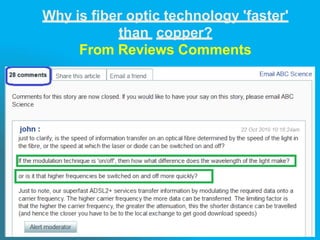
Why is fiber optic technology 'faster'
than copper?
From Reviews Comments
Applications
• Optical fiber have wider range of application in
almost all field, some are been specified below
• In telecommunication field
• In space applications
• Broadband applications
• Computer applications industrial applications
• Mining applications
• In medical applications
• In military applications etc.
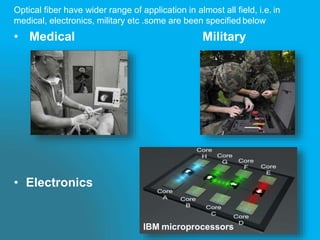
Optical fiber have wider range of application in almost all field, i.e. in
medical, electronics, military etc .some are been specified below
• Medical Military
• Electronics
IBM microprocessors
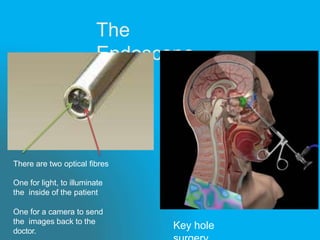
The
Endoscope
There are two optical fibres
One for light, to illuminate
the inside of the patient
One for a camera to send
the images back to the
doctor.
Key hole
Conclusio
n
This conclusion our study of optical fiber
communications have looked at how they work and
how they are made, properties of fibers, Application...
Although this presentation does not cover all
the aspects of optical fiber work it will have equipped
you knowledge and skills essential to the fiber optic
industry.
References:
• https://en.wikipedia.org/wiki/Optical_fiber
• http://electronics.howstuffworks.com/fibe
r- optic7.htm
• http://www.commspecial.com/fiberguide.ht
m
• http://www.thefoa.org/
• http://www.fiber-optics.info/fiber-history.htm
• http://www.timbercon.com/history-of-
fiber- optics/
THANK
YO
U

Opticalfiber 13015411-151122111147-lva1-app6891-converted

  • 1.
    Brief flow of presentation 1.Introduction 2. What are Optical Fibers? 3. Evolution of optical fiber 4. Structure of optical fiber 5. Workings principle of optical fiber 6. Classification of optical fiber 7. Optical fiber communication system
  • 2.
    What is optical Fiber? •Fiber optic (or "optical fiber") refers to the medium and the technology associated with the transmission of information as light impulses along a glass or plastic wire or fiber. Fiber optic wire carries much more information than conventional copper wire. • Most telephone company long-distance lines are now fiber optic. • Optical fibers use light to send information through the optical medium.
  • 3.
    Evolution of opticalfiber • 1880 – Alexander Graham Bell • 1930 – Patents on tubing • 1950 – Patent for two-layer glass wave-guide • 1960 – Laser first used as light source • 1965 – High loss of light discovered • 1970s – Refining of manufacturing process(John Tyndall demonstration in 1870) • 1980s – OF technology becomes backbone of long distance telephone networks in NA.
  • 5.
  • 6.
    • Glass Core– central tube of very thin size made up of optically transparent dielectric medium and carries the light form transmitter to receiver. The core diameter can vary from about 5um to 100 um. • Glass Cladding – outer optical material surrounding the core having reflecting index lower than core. It helps to keep the light within the core throughout the phenomena of total internal reflection. • Plastic Covering– plastic coating that protects the fiber made of silicon rubber. The typical diameter of fiber after coating is 250-300 um.
  • 7.
    Working principle Total InternalReflection • When a ray of light travels from a denser to a rarer medium such that the angle of incidence is greater than the critical angle, the ray reflects back into the same medium this phenomena is called total internal reflection. • In the optical fiberthe rays undergo repeated total number of reflections until it emerges out of the other end of the fiber, even if the fiber is bent.
  • 8.
    Total internal reflectionin optical fiber
  • 9.
    Total internal reflectionin optical fiber
  • 10.
    Classification of optical fiber onthe basis of number of modes of propagation the optical fiber are classified into two types: (i) Single mode fiber (SMF) and (ii) Multi-mode fiber (MMF)
  • 11.
    • Single-mode fiber –Carries light pulses along single path – Uses Laser Light Source – has a very small core and carry only one beam of light. It can support (Gbps) data rates over > 100 Km without using repeaters. – data rates up to 10 Gbps with a bandwidth of 20Ghz. • Multimode fiber – Many pulses of light generated by LED travel at different angles – can support less bandwidth than Single-mode Fiber.
  • 13.
    Fiber-Optic Cable • Contains oneor several glass fibers at its core • Surrounding the fibers is a layer called cladding
  • 14.
    Fiber Optic Cable • FOCable may have 1 to over 1000 fibers
  • 15.
    Fiber-Optic Cable (Connectors) SC-(Square Connector) ST-(straight tip) MT-RJ (MechanicalTransfer Registered Jack or Media Termination - recommended jack) LC-(Lucent Connector, Little Connector, or Local Connector)
  • 16.
    Refractio n Refraction is thechanging direction of light when it goes into a material of different density
  • 17.
    How Optical Fiber’sare made?? • Three Steps are Involved in the manufacturing of the optical fiber which are given below:- -Making a Preform Glass Cylinder -Drawing the Fiber’s from thepreform -Testing the Fiber.
  • 18.
    Why Optical Fiberin Emerging Technology? 0 200 400 600 800 1,000 1,200 1,400 OC-48 OC-192 OC-192, 2 OC-192, 32 OC-48, 96 OC-192, 16 OC-192, 48 OC-192, 80 OC-192, 128 1.7 Gb 565Mb 135Mb Single Fiber Capacity Gigabits/sec) 1 Terabit =
  • 19.
  • 20.
    • Information source-it provides an electrical signal to a transmitter comprising an electrical stage. • Electrical transmitter- It drives an optical source to give an modulation of the light wave carrier. • Optical source- It provides the electrical- optical conversion .It may be a semiconductor laser or an LED.
  • 21.
    • Optical cable:It serves as transmission medium. • Optical detector: It is responsible for optical to electrical conversion of data and hence responsible for demodulation of the optical carrier. It may be a photodiodes, phototransistor, and photoconductors. • Electrical receiver: It is used for electrical interfacing at the receiver end of the optical link and to perform the signal processing electrically. • Destination: It is the final point at which we receive the information in the form of electrical signal.
  • 22.
    Source: http://www.amazon.com/gp/product/B005NWYQN2/ref=pd_lpo_sbs_dp_ss_2?pf _ rd_p=1944687622&pf_rd_s=lpo-top-stripe- 1&pf_rd_t=201&pf_rd_i=B0000C8Y58&pf_rd_m=ATVPDKIKX0DER&pf_rd_r=1 CJPB SZYDXC3GC100YDW •1 USD = 78.0500 BDT. • 1000ft (1000 feet) Bulk Fiber Optic Cable Single-mode Duplex (9/125) 300 Meter. • Price: 15593.1995 BDT FO Cable Price in Bangladesh
  • 23.
    • Fiber OpticCable with Multimode , High Reliability supplier • Digital Fiber Optic Cable 5MITER • Price 200.00 Taka • (2.56 USD) Source: http://khanslist.com/electronics_2/computer- FO Cable Price in Bangladesh
  • 24.
    Optical fiber companyin Bangladesh (Vendors)
  • 25.
    Optical fiber companyin Bangladesh (Vendors)
  • 26.
    Advantage of optical fiber communication 1)The life of fiber is longer than copper wire 2) Handling and installation costs of optical fiber is very nominal 3) It is unaffected with electromagnetic interference 4) Attenuation in optical fiber is lower than coaxial cable or twisted pair. 5) There is no necessity of additional equipment for protecting against grounding and voltage problems. 6) As it does not radiates energy any antenna or detector cannot detects it hence provides signal security
  • 27.
    Disadvantag e 1) Highly skilledstaff would be required for maintenance 2) Only point to point working is possible on optical fiber 3) Precise and costly instruments would be required 4) Costly if under utilized. 5) Accept unipolar codes only. 6) Jointing of fiber and splicing is also time consuming.
  • 28.
  • 29.
    Why is fiberoptic technology 'faster' than copper? From Reviews Comments
  • 30.
    Applications • Optical fiberhave wider range of application in almost all field, some are been specified below • In telecommunication field • In space applications • Broadband applications • Computer applications industrial applications • Mining applications • In medical applications • In military applications etc.
  • 31.
    Optical fiber havewider range of application in almost all field, i.e. in medical, electronics, military etc .some are been specified below • Medical Military • Electronics IBM microprocessors
  • 32.
    The Endoscope There are twooptical fibres One for light, to illuminate the inside of the patient One for a camera to send the images back to the doctor. Key hole
  • 33.
    Conclusio n This conclusion ourstudy of optical fiber communications have looked at how they work and how they are made, properties of fibers, Application... Although this presentation does not cover all the aspects of optical fiber work it will have equipped you knowledge and skills essential to the fiber optic industry.
  • 34.
    References: • https://en.wikipedia.org/wiki/Optical_fiber • http://electronics.howstuffworks.com/fibe r-optic7.htm • http://www.commspecial.com/fiberguide.ht m • http://www.thefoa.org/ • http://www.fiber-optics.info/fiber-history.htm • http://www.timbercon.com/history-of- fiber- optics/
  • 35.