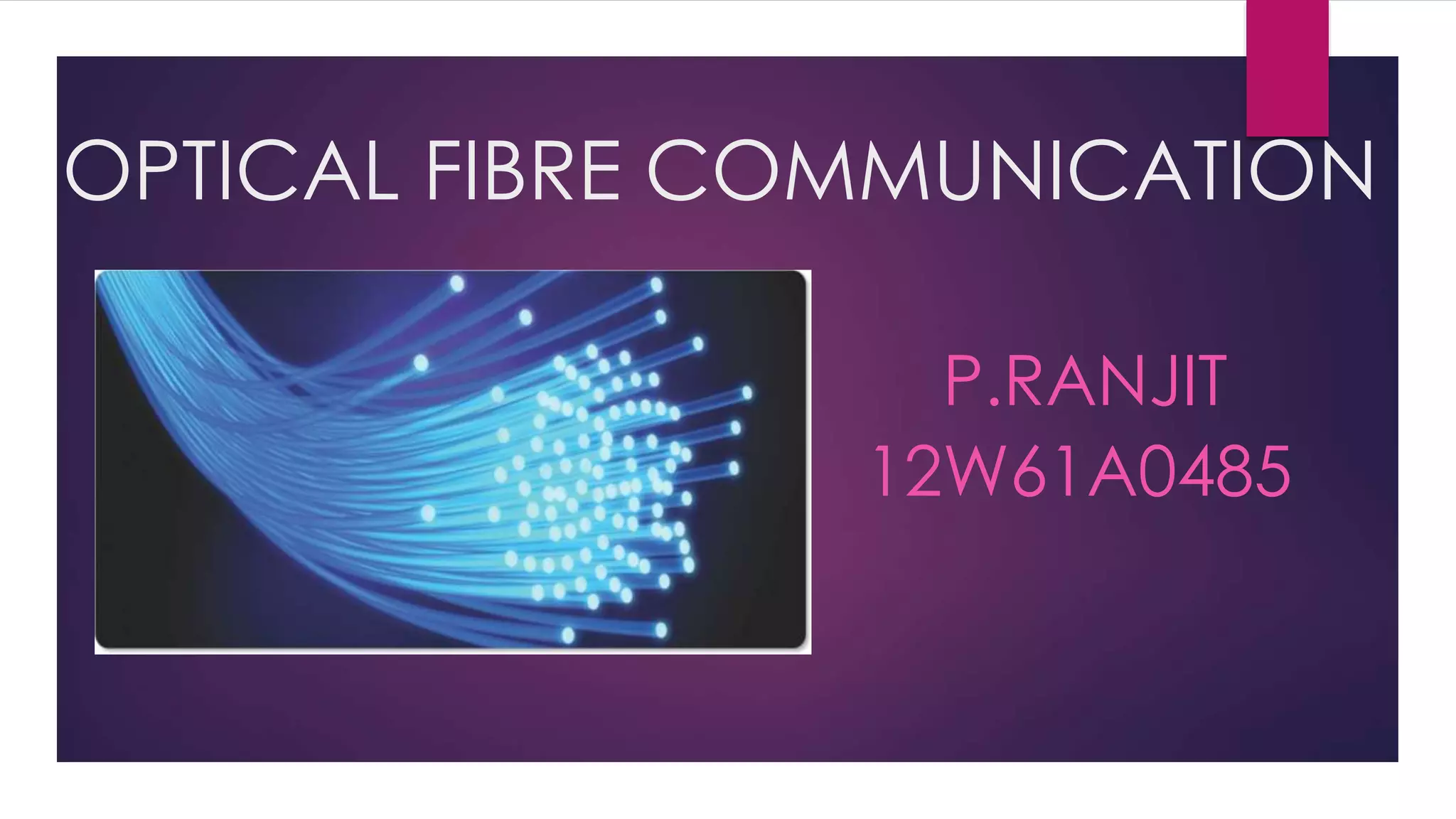
OPTICAL FIBRE COMMUNICATION
P.RANJIT
12W61A0485
CONTENTS
 INTRODUCTION
 Cross section area of optical fibre
 Materials used for optical fibre
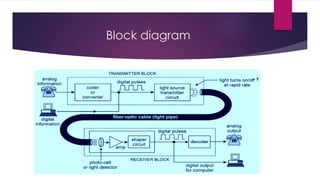
 Block diagram of optical fibre with transmitter and receiver blocks
 Working principle
 Advantages
 Disadvantages
 Applications in various fields
INTRODUCTION
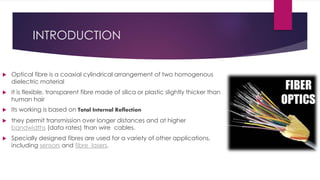
 Optical fibre is a coaxial cylindrical arrangement of two homogenous
dielectric material
 It is flexible, transparent fibre made of silica or plastic slightly thicker than
human hair
 Its working is based on Total Internal Reflection
 they permit transmission over longer distances and at higher
bandwidths (data rates) than wire cables.
 Specially designed fibres are used for a variety of other applications,
including sensors and fibre lasers.
Cross section area of optical fibre
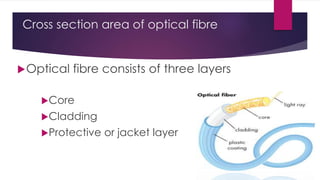
Optical fibre consists of three layers
Core
Cladding
Protective or jacket layer
MATERIALS USED FOR OPTICAL FIBER
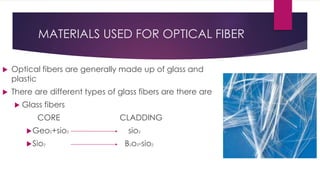
 Optical fibers are generally made up of glass and
plastic
 There are different types of glass fibers are there are
 Glass fibers
CORE CLADDING
Geo2+sio2 sio2
Sio2 B2o3-sio2
MATERIALS USED FOR OPTICAL FIBER
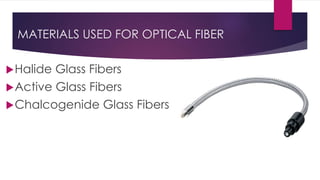
Halide Glass Fibers
Active Glass Fibers
Chalcogenide Glass Fibers
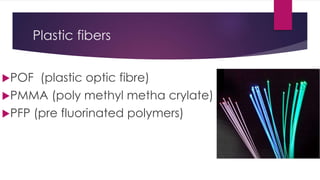
Plastic fibers
POF (plastic optic fibre)
PMMA (poly methyl metha crylate)
PFP (pre fluorinated polymers)
Block diagram
Working Principle
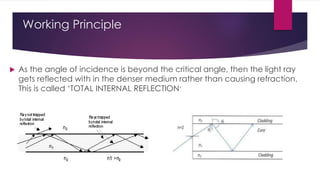
 As the angle of incidence is beyond the critical angle, then the light ray
gets reflected with in the denser medium rather than causing refraction.
This is called ‘TOTAL INTERNAL REFLECTION’
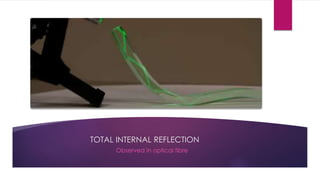
TOTAL INTERNAL REFLECTION
Observed in optical fibre
Advantages
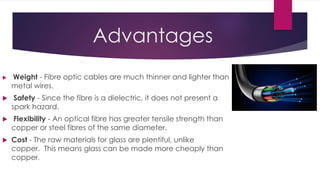
 Weight - Fibre optic cables are much thinner and lighter than
metal wires.
 Safety - Since the fibre is a dielectric, it does not present a
spark hazard.
 Flexibility - An optical fibre has greater tensile strength than
copper or steel fibres of the same diameter.
 Cost - The raw materials for glass are plentiful, unlike
copper. This means glass can be made more cheaply than
copper.
Disadvantages
 Cost - Cables are expensive to install but last longer than copper
cables.
 Transmission - transmission on optical fibre requires repeating at
distance intervals.
 Protection - Optical fibres require more protection around the cable
compared to copper.
 Affected by chemicals - The glass can be affected by various
chemicals including hydrogen gas (a problem in underwater cables.)
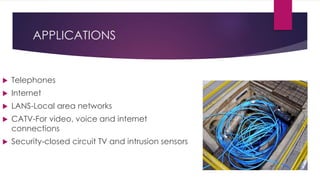
APPLICATIONS
 Telephones
 Internet
 LANS-Local area networks
 CATV-For video, voice and internet
connections
 Security-closed circuit TV and intrusion sensors
APPLICATIONS
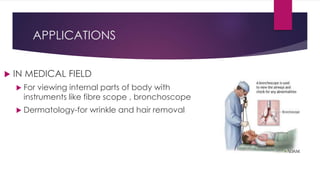
 IN MEDICAL FIELD
 For viewing internal parts of body with
instruments like fibre scope , bronchoscope
 Dermatology-for wrinkle and hair removal
OPTIAL FIBRE COMMUNICATION

OPTIAL FIBRE COMMUNICATION

  • 1.
  • 2.
    CONTENTS  INTRODUCTION  Crosssection area of optical fibre  Materials used for optical fibre  Block diagram of optical fibre with transmitter and receiver blocks  Working principle  Advantages  Disadvantages  Applications in various fields
  • 3.
    INTRODUCTION  Optical fibreis a coaxial cylindrical arrangement of two homogenous dielectric material  It is flexible, transparent fibre made of silica or plastic slightly thicker than human hair  Its working is based on Total Internal Reflection  they permit transmission over longer distances and at higher bandwidths (data rates) than wire cables.  Specially designed fibres are used for a variety of other applications, including sensors and fibre lasers.
  • 4.
    Cross section areaof optical fibre Optical fibre consists of three layers Core Cladding Protective or jacket layer
  • 5.
    MATERIALS USED FOROPTICAL FIBER  Optical fibers are generally made up of glass and plastic  There are different types of glass fibers are there are  Glass fibers CORE CLADDING Geo2+sio2 sio2 Sio2 B2o3-sio2
  • 6.
    MATERIALS USED FOROPTICAL FIBER Halide Glass Fibers Active Glass Fibers Chalcogenide Glass Fibers
  • 7.
    Plastic fibers POF (plasticoptic fibre) PMMA (poly methyl metha crylate) PFP (pre fluorinated polymers)
  • 8.
  • 9.
    Working Principle  Asthe angle of incidence is beyond the critical angle, then the light ray gets reflected with in the denser medium rather than causing refraction. This is called ‘TOTAL INTERNAL REFLECTION’
  • 10.
  • 11.
    Advantages  Weight -Fibre optic cables are much thinner and lighter than metal wires.  Safety - Since the fibre is a dielectric, it does not present a spark hazard.  Flexibility - An optical fibre has greater tensile strength than copper or steel fibres of the same diameter.  Cost - The raw materials for glass are plentiful, unlike copper. This means glass can be made more cheaply than copper.
  • 12.
    Disadvantages  Cost -Cables are expensive to install but last longer than copper cables.  Transmission - transmission on optical fibre requires repeating at distance intervals.  Protection - Optical fibres require more protection around the cable compared to copper.  Affected by chemicals - The glass can be affected by various chemicals including hydrogen gas (a problem in underwater cables.)
  • 13.
    APPLICATIONS  Telephones  Internet LANS-Local area networks  CATV-For video, voice and internet connections  Security-closed circuit TV and intrusion sensors
  • 14.
    APPLICATIONS  IN MEDICALFIELD  For viewing internal parts of body with instruments like fibre scope , bronchoscope  Dermatology-for wrinkle and hair removal