Optical Fiber
Rushit Patel
B.E.Electrical
Optical fiber
 Optical fiber (or "fiber optic") refers to the
medium and the technology associated with
the transmission of information as light pulses
along a glass or plastic strand or fiber.
 Optical fiber carries much more
information than conventional copper
wire and is in general not subject to
electromagnetic interference and the
need to retransmit signals.
Fiber optic system
 Communication system that uses light as the carrier of
the information from a source to a destination through a
guided fiber cable (glass or plastic) are called fiber optic
system.
 The information carrying capacity of a communication
system is directly proportional to it’s bandwidth.
 The wider bandwidth the greater is it’s information
carrying capacity.
 Because of high information carrying capacity and low
attenuation ,now-a-days fiber are finding wide application
in telecommunications ,Local area networks ,sensors,
computer networks ,etc.
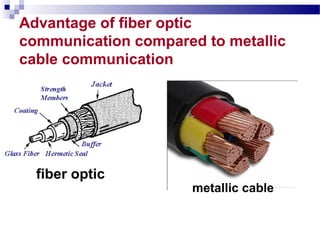
Advantage of fiber optic
communication compared to metallic
cable communication
fiber optic
metallic cable
1.Extremely Wide (Large)
Bandwidth
 The bandwidth available with a single glass fiber is
more than 100 GHz.
 With such a large bandwidth, it is possible to
transmit thousands of video conversations or
dozens of video signals over the same fiber
simultaneously.
 Irrespective of weather the information is voice ,data
or video or a combination of these, it can be
transmitted easily over the optical fibers.
 Whereas ,only a very less number(40-50) of
independent signals alone can be sent through
metallic cables.
2.Immunity to electrostatic
interference
 As optical fibers are being made of
either glass or plastic external
electrical noise and lightning do not
affect the energy in a fiber cable.
 The result is noise free transmission.
 However ,this is not true for metallic
cables made of metals ,as they are
good conductors of electricity.
3. Elimination of cross talk
 Fiber system are immune to cross talk between
cables caused by magnetic induction .
 Whereas ,in a metallic cable cross talk results
from the electromagnetic coupling between two
adjacent wires.
4. Lighter weight and smaller size
 Optic fiber are very small in the size.
 The size reduction make fiber the ideal
transmission medium for ships, aircraft and
high rise buildings where bulky copper
cables occupy too much space.
 Reduction of size is reduction of weight also.
5. Lower cost
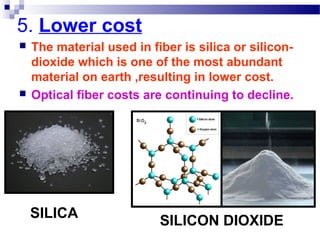
 The material used in fiber is silica or silicon-
dioxide which is one of the most abundant
material on earth ,resulting in lower cost.
 Optical fiber costs are continuing to decline.
SILICA
SILICON DIOXIDE
6. Security
 Fiber cable are more secure than metallic cable.
 Due to it’s immunity to electromagnetic coupling
and radiation ,optical fiber can be used in most
secure environments.
 Although it can be intercepted ,it is very difficult
to do so because at the receiving user’s end an
alarm would be sounded.
7. Greater safety
 In many wired system, the potential hazard of
short circuits requires precautionary
designs.
 Whereas, the dielectric nature of optical
fibers eliminates the spark hazard.
8. Corrosion
 Fiber cables are more resistive to environmental
extremes.
 They operate over large temperature variation
than their metallic counter parts ,and are less
affected by corrosive liquids and gases.
9. Longer life and easy to
maintenance
 A longer life span of 20 to 30 years is predicated
for the fiber optic cable as compared to 12 to 15
years for the conventional cables.
Fiber cable construction
 There are many different cable designs available
today.
 Depending on configuration, the cable may
include a core, a cladding, a protective tube, a
polyurethane compound and one or more
protective jackets.
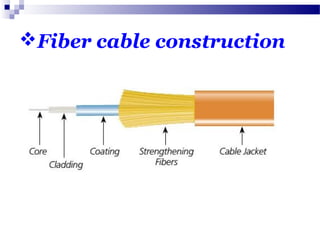
 The fiber cable consist of a core at the center and
a cladding outside the core.
 The buffer jacket provide protection for the fiber
from external mechanical influences that could
cause fiber breakage or excessive optical
attenuation.
 Surrounding the buffer jacket there is a layer of
strength members called Kevlar (a yarn type material)
which increase the tensile strength of cable.
 Again, an outer protective tube is filled with
polyurethane ,which prevents moisture from coming
into contact with fiber.
 The type of cable construction used depends on the
performance requirements of the system and both the
economic and environmental constraints.
Types of optical fibres
1. Based on material
- Plastic core with plastic cladding
- Plastic core with glass cladding
- glass core with glass cladding
2. Based on mode of transmission
- Single mode fiber
- multimode fiber
3. Index profile
- Step-index fiber
- Graded index fiber
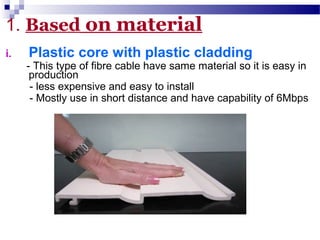
1. Based on material
i. Plastic core with plastic cladding
- This type of fibre cable have same material so it is easy in
production
- less expensive and easy to install
- Mostly use in short distance and have capability of 6Mbps
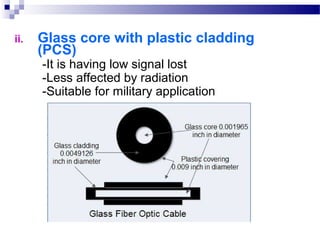
ii. Glass core with plastic cladding
(PCS)
-It is having low signal lost
-Less affected by radiation
-Suitable for military application
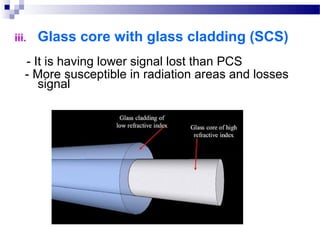
iii. Glass core with glass cladding (SCS)
- It is having lower signal lost than PCS
- More susceptible in radiation areas and losses
signal
2. Based on mode of transmission
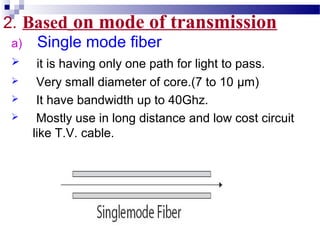
a) Single mode fiber
 it is having only one path for light to pass.
 Very small diameter of core.(7 to 10 μm)
 It have bandwidth up to 40Ghz.
 Mostly use in long distance and low cost circuit
like T.V. cable.
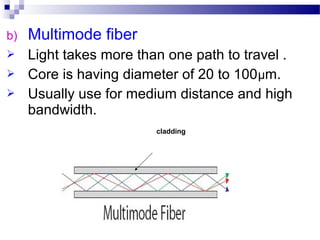
b) Multimode fiber
 Light takes more than one path to travel .
 Core is having diameter of 20 to 100μm.
 Usually use for medium distance and high
bandwidth.
cladding
3. Index profile
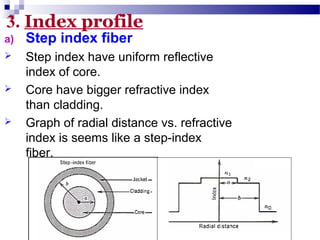
a) Step index fiber
 Step index have uniform reflective
index of core.
 Core have bigger refractive index
than cladding.
 Graph of radial distance vs. refractive
index is seems like a step-index
fiber.
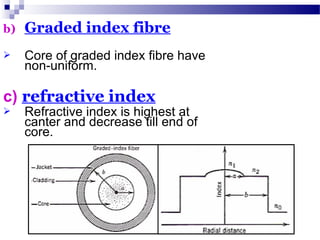
b) Graded index fibre
 Core of graded index fibre have
non-uniform.
c) refractive index
 Refractive index is highest at
canter and decrease till end of
core.
Application of optical fiber
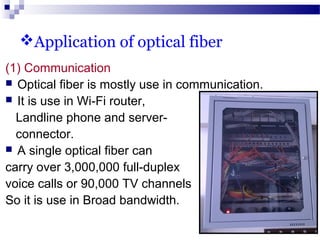
(1) Communication
 Optical fiber is mostly use in communication.
 It is use in Wi-Fi router,
Landline phone and server-
connector.
 A single optical fiber can
carry over 3,000,000 full-duplex
voice calls or 90,000 TV channels
So it is use in Broad bandwidth.
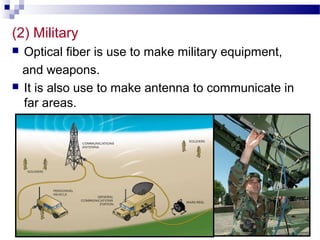
(2) Military
 Optical fiber is use to make military equipment,
and weapons.
 It is also use to make antenna to communicate in
far areas.
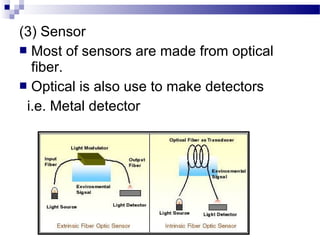
(3) Sensor
 Most of sensors are made from optical
fiber.
 Optical is also use to make detectors
i.e. Metal detector
(4) Other application
 Optical fiber is use to make lamps,
decorative application, art, toys, micro
scope and outer body of devices.
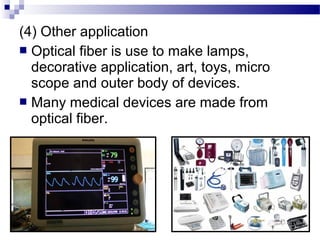
 Many medical devices are made from
optical fiber.
Thank you

optical fiber ppt

  • 1.
  • 2.
    Optical fiber  Opticalfiber (or "fiber optic") refers to the medium and the technology associated with the transmission of information as light pulses along a glass or plastic strand or fiber.  Optical fiber carries much more information than conventional copper wire and is in general not subject to electromagnetic interference and the need to retransmit signals.
  • 3.
    Fiber optic system Communication system that uses light as the carrier of the information from a source to a destination through a guided fiber cable (glass or plastic) are called fiber optic system.  The information carrying capacity of a communication system is directly proportional to it’s bandwidth.  The wider bandwidth the greater is it’s information carrying capacity.  Because of high information carrying capacity and low attenuation ,now-a-days fiber are finding wide application in telecommunications ,Local area networks ,sensors, computer networks ,etc.
  • 4.
    Advantage of fiberoptic communication compared to metallic cable communication fiber optic metallic cable
  • 5.
    1.Extremely Wide (Large) Bandwidth The bandwidth available with a single glass fiber is more than 100 GHz.  With such a large bandwidth, it is possible to transmit thousands of video conversations or dozens of video signals over the same fiber simultaneously.  Irrespective of weather the information is voice ,data or video or a combination of these, it can be transmitted easily over the optical fibers.  Whereas ,only a very less number(40-50) of independent signals alone can be sent through metallic cables.
  • 6.
    2.Immunity to electrostatic interference As optical fibers are being made of either glass or plastic external electrical noise and lightning do not affect the energy in a fiber cable.  The result is noise free transmission.  However ,this is not true for metallic cables made of metals ,as they are good conductors of electricity.
  • 7.
    3. Elimination ofcross talk  Fiber system are immune to cross talk between cables caused by magnetic induction .  Whereas ,in a metallic cable cross talk results from the electromagnetic coupling between two adjacent wires.
  • 8.
    4. Lighter weightand smaller size  Optic fiber are very small in the size.  The size reduction make fiber the ideal transmission medium for ships, aircraft and high rise buildings where bulky copper cables occupy too much space.  Reduction of size is reduction of weight also.
  • 9.
    5. Lower cost The material used in fiber is silica or silicon- dioxide which is one of the most abundant material on earth ,resulting in lower cost.  Optical fiber costs are continuing to decline. SILICA SILICON DIOXIDE
  • 10.
    6. Security  Fibercable are more secure than metallic cable.  Due to it’s immunity to electromagnetic coupling and radiation ,optical fiber can be used in most secure environments.  Although it can be intercepted ,it is very difficult to do so because at the receiving user’s end an alarm would be sounded.
  • 11.
    7. Greater safety In many wired system, the potential hazard of short circuits requires precautionary designs.  Whereas, the dielectric nature of optical fibers eliminates the spark hazard.
  • 12.
    8. Corrosion  Fibercables are more resistive to environmental extremes.  They operate over large temperature variation than their metallic counter parts ,and are less affected by corrosive liquids and gases.
  • 13.
    9. Longer lifeand easy to maintenance  A longer life span of 20 to 30 years is predicated for the fiber optic cable as compared to 12 to 15 years for the conventional cables.
  • 14.
  • 15.
    Fiber cable construction There are many different cable designs available today.  Depending on configuration, the cable may include a core, a cladding, a protective tube, a polyurethane compound and one or more protective jackets.  The fiber cable consist of a core at the center and a cladding outside the core.  The buffer jacket provide protection for the fiber from external mechanical influences that could cause fiber breakage or excessive optical attenuation.
  • 16.
     Surrounding thebuffer jacket there is a layer of strength members called Kevlar (a yarn type material) which increase the tensile strength of cable.  Again, an outer protective tube is filled with polyurethane ,which prevents moisture from coming into contact with fiber.  The type of cable construction used depends on the performance requirements of the system and both the economic and environmental constraints.
  • 17.
    Types of opticalfibres 1. Based on material - Plastic core with plastic cladding - Plastic core with glass cladding - glass core with glass cladding 2. Based on mode of transmission - Single mode fiber - multimode fiber 3. Index profile - Step-index fiber - Graded index fiber
  • 18.
    1. Based onmaterial i. Plastic core with plastic cladding - This type of fibre cable have same material so it is easy in production - less expensive and easy to install - Mostly use in short distance and have capability of 6Mbps
  • 19.
    ii. Glass corewith plastic cladding (PCS) -It is having low signal lost -Less affected by radiation -Suitable for military application
  • 20.
    iii. Glass corewith glass cladding (SCS) - It is having lower signal lost than PCS - More susceptible in radiation areas and losses signal
  • 21.
    2. Based onmode of transmission a) Single mode fiber  it is having only one path for light to pass.  Very small diameter of core.(7 to 10 μm)  It have bandwidth up to 40Ghz.  Mostly use in long distance and low cost circuit like T.V. cable.
  • 22.
    b) Multimode fiber Light takes more than one path to travel .  Core is having diameter of 20 to 100μm.  Usually use for medium distance and high bandwidth. cladding
  • 23.
    3. Index profile a)Step index fiber  Step index have uniform reflective index of core.  Core have bigger refractive index than cladding.  Graph of radial distance vs. refractive index is seems like a step-index fiber.
  • 24.
    b) Graded indexfibre  Core of graded index fibre have non-uniform. c) refractive index  Refractive index is highest at canter and decrease till end of core.
  • 25.
    Application of opticalfiber (1) Communication  Optical fiber is mostly use in communication.  It is use in Wi-Fi router, Landline phone and server- connector.  A single optical fiber can carry over 3,000,000 full-duplex voice calls or 90,000 TV channels So it is use in Broad bandwidth.
  • 26.
    (2) Military  Opticalfiber is use to make military equipment, and weapons.  It is also use to make antenna to communicate in far areas.
  • 27.
    (3) Sensor  Mostof sensors are made from optical fiber.  Optical is also use to make detectors i.e. Metal detector
  • 28.
    (4) Other application Optical fiber is use to make lamps, decorative application, art, toys, micro scope and outer body of devices.  Many medical devices are made from optical fiber.
  • 29.