Mark D. Harrison
sixsigmadude@gmail.com
Purpose of Presentation
  Provide guidance on proper implementation of SPC
  Provide suggestions on improving process
   performance
  Provide a method to ensure SPC becomes a part of
   company culture
  Provide suggestions for new methods to improve SPC
   effectiveness
  Be used a checklist/reference for new SPC system or
   improvement of current SPC system


4/10/2012      Author: Mark D. Harrison                  2
What is SPC ?
  SPC stands for Statistical Process Control
  SPC is a fundamental approach to quality control and
     improvement that is based on objective data and
     analysis
        Measure the Process
        Eliminate Variances in the Process
        Monitor the Process
        Improve the Process


4/10/2012           Author: Mark D. Harrison              3
Why use SPC ?
  Provides indications of how healthy the process is
  Allows objective numerical analysis of a process
  Make the Most with the Least Possible
     Maximize Process Yields
     Minimize Scrap and Rework incidents
     Increases Efficiency
  Provides a “Voice of the Process”


4/10/2012       Author: Mark D. Harrison                4
Where can SPC be used ?
  SPC can be used anywhere measurements and
   performance specifications are utilized
  SPC is mostly associated with Manufacturing
  But… SPC can also be used in:

        Marketing
        Medical/Healthcare
        Service Industries
        And many other fields


4/10/2012            Author: Mark D. Harrison    5
Elements of a Successful SPC Program
  Management Leadership
  A Team Approach
  Education of employees at all levels
  Emphasis on reducing variability
  Measuring success in quantitative (economic) terms
  Communicate successful results throughout
     organization


4/10/2012           Author: Mark D. Harrison            6
Management Leadership
  Need “Top Down” buy-in
  Communicate Business Justification to Employees
  Drive Cultural Change
  Prevent Internal “Sabotage”
  Put SPC metrics in “Performance Plans”


4/10/2012      Author: Mark D. Harrison              7
A Team Approach
  Include all Stakeholders
  Break down “Silos”
  Define “What’s in it for me” for each Stakeholder
  Utilize the Strengths of all your Resources


4/10/2012       Author: Mark D. Harrison               8
Education of Employees at all Levels
  Everyone should understand SPC and why it is being
     used
    New Employee Orientation
    Manufacturing should get additional training on RCA
    Manufacturing and Design Engineering should get
     additional training on DOE, RCA and Gage R&R
    Management should get additional training on high
     level metrics (Cp/Cpk, 1st Pass Yield, ROI etc..)


4/10/2012        Author: Mark D. Harrison                  9
Emphasis on Reducing Variability
  Reduce Scrap
  Reduce Rework
  Improve Process Capabilities
  Reduced Costs = Higher Profits


4/10/2012      Author: Mark D. Harrison   10
Measure Success in Quantitative Terms
  Develop Performance Metrics to report regularly
  How Workers Benefit (Less Work/Time for same
   output)
  How Company Benefits (Higher Profits/More
   Customers/Competitive)


4/10/2012      Author: Mark D. Harrison              11
Communicate Successful Results
  Report Chosen Performance Metrics on a Regular
   Basis
  Post Communications in places where easily viewable
        Bulletin Boards
        Video Monitors
        Internal Company Websites
  Report who, what, when, where to build pride and
   ownership in people’s work
  Include people who did the work to present to higher
   level management and even write papers


4/10/2012          Author: Mark D. Harrison               12
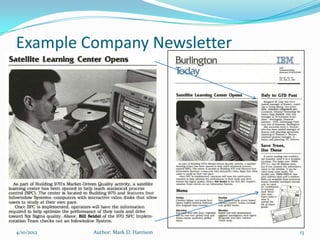
Example Company Newsletter


4/10/2012   Author: Mark D. Harrison   13
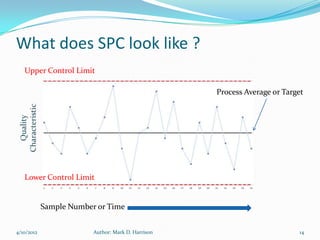
What does SPC look like ?
   Upper Control Limit

                                                    Process Average or Target


   Lower Control Limit


            Sample Number or Time


4/10/2012                Author: Mark D. Harrison                          14
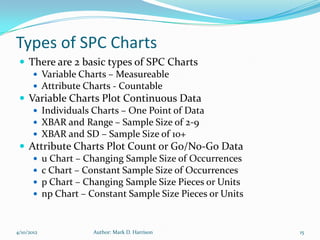
Types of SPC Charts
  There are 2 basic types of SPC Charts
     Variable Charts – Measureable
     Attribute Charts - Countable
  Variable Charts Plot Continuous Data
     Individuals Charts – One Point of Data
     XBAR and Range – Sample Size of 2-9
     XBAR and SD – Sample Size of 10+
  Attribute Charts Plot Count or Go/No-Go Data
     u Chart – Changing Sample Size of Occurrences
     c Chart – Constant Sample Size of Occurrences
     p Chart – Changing Sample Size Pieces or Units
     np Chart – Constant Sample Size Pieces or Units


4/10/2012         Author: Mark D. Harrison              15
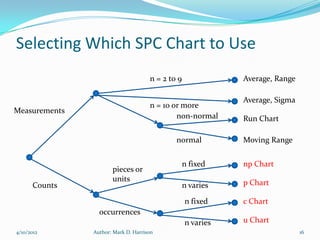
Selecting Which SPC Chart to Use
                                     n = 2 to 9              Average, Range

                                                             Average, Sigma
                                     n = 10 or more
Measurements
                                             non-normal      Run Chart

                                             normal          Moving Range


                                                  n fixed    np Chart
                      pieces or
                      units                                  p Chart
      Counts                                      n varies

                                                  n fixed    c Chart
                 occurrences
                                                  n varies   u Chart
4/10/2012      Author: Mark D. Harrison                                       16
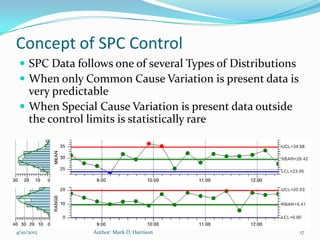
Concept of SPC Control
  SPC Data follows one of several Types of Distributions
  When only Common Cause Variation is present data is
   very predictable
  When Special Cause Variation is present data outside
   the control limits is statistically rare


4/10/2012      Author: Mark D. Harrison                     17
Sources of Process Variability
  People – Every Person is different
  Material – Every piece of material/item/tool is unique
  Methods – No one does something exactly the same
   way
  Measurements – Individual instruments perform
   differently
  Environment - the weather changes!


  Sound familiar ? (Think Fishbone Diagram)


4/10/2012       Author: Mark D. Harrison                    18
Process Variability
  Two types of Variability Exist in a Process
     Common Cause Variability
     Special Cause Variability


4/10/2012       Author: Mark D. Harrison         19
Common Cause Variability
  Is characterized as
     Inherent or Natural Variability
     Background Noise
     Cumulative effect of many small, unavoidable causes
     Stable System of Chance Causes


  If a Process is operating with only chance cause of
     variation present it is said to be in Statistical Control


4/10/2012          Author: Mark D. Harrison                      20
Common Cause Variability Examples
  Repeatability of Manually Set Controls
  Change in Temperature from Ventilation System
  Barometric Pressure and Humidity
  Repeatability of Computer Set Controls


4/10/2012      Author: Mark D. Harrison            21
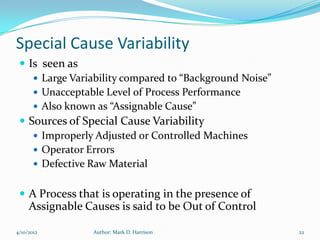
Special Cause Variability
  Is seen as
     Large Variability compared to “Background Noise”
     Unacceptable Level of Process Performance
     Also known as “Assignable Cause”
  Sources of Special Cause Variability
     Improperly Adjusted or Controlled Machines
     Operator Errors
     Defective Raw Material


  A Process that is operating in the presence of
     Assignable Causes is said to be Out of Control

4/10/2012         Author: Mark D. Harrison               22
Special Cause Variability Examples
  Broken Regulator provides too high Air Pressure
  Shorting Transformer provides too low Voltage
  Metal being welded in Contaminated
  Chemicals used for Processing are Expired
  Operator Loading a Tool Incorrectly


4/10/2012      Author: Mark D. Harrison              23
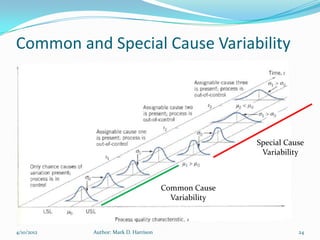
Common and Special Cause Variability


                                                       Special Cause
                                                        Variability


                                       Common Cause
                                         Variability


4/10/2012   Author: Mark D. Harrison                              24
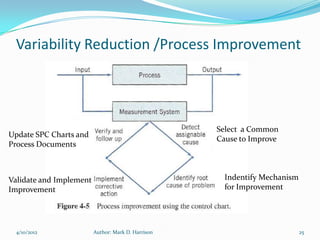
Variability Reduction /Process Improvement


                                                    Select a Common
Update SPC Charts and
                                                    Cause to Improve
Process Documents


Validate and Implement                                Indentify Mechanism
Improvement                                           for Improvement


 4/10/2012               Author: Mark D. Harrison                           25
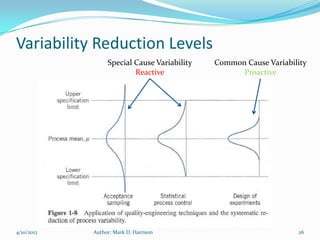
Variability Reduction Levels
                 Special Cause Variability   Common Cause Variability
                         Reactive                  Proactive


4/10/2012   Author: Mark D. Harrison                              26
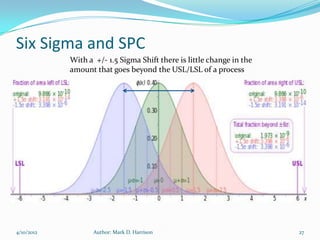
Six Sigma and SPC
            With a +/- 1.5 Sigma Shift there is little change in the
            amount that goes beyond the USL/LSL of a process


4/10/2012          Author: Mark D. Harrison                            27
How SPC Chart Hierarchy is Structured
  SPC Charts should be organized in this hierarchy
     Process Tool – 145V, Welder # 2, etc..
     Part – Bolt, Nitride Deposition, Cable Type Y, etc..
     Characteristic – Length, Thickness, Resistance, etc..
  This is done to ensure SPC control integrity
  Data from different process tools is never mixed with other
     process tools (Part is top of Hierarchy)
        This combines Special and Common Cause Variability from
         several sources
        Root Cause Analysis requires you to fragment and reassemble
         the data to get a true picture
        SPC Limits and Run Rules will not function properly


4/10/2012           Author: Mark D. Harrison                           28
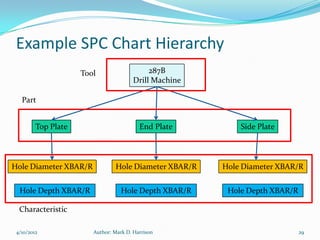
Example SPC Chart Hierarchy
                     Tool                    287B
                                        Drill Machine

   Part


         Top Plate                        End Plate         Side Plate


Hole Diameter XBAR/R            Hole Diameter XBAR/R    Hole Diameter XBAR/R


  Hole Depth XBAR/R                Hole Depth XBAR/R     Hole Depth XBAR/R

  Characteristic

 4/10/2012              Author: Mark D. Harrison                             29
Where to put SPC / What to Chart ?
  Key Process Indicators
     Engineering Specifications
     Customer Requirements
  Usually Chart the Output of an Individual Process
  Can Chart Tool / Process beyond KPIs for even better
   Process Performance
  Use a SIPOC and FishBone Diagram to determine if
   any other Variables need to be Charted


4/10/2012      Author: Mark D. Harrison                   30
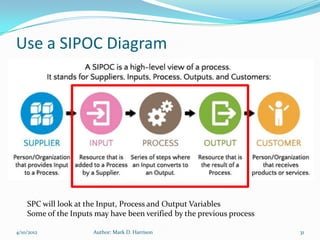
Use a SIPOC Diagram


    SPC will look at the Input, Process and Output Variables
    Some of the Inputs may have been verified by the previous process

4/10/2012             Author: Mark D. Harrison                          31
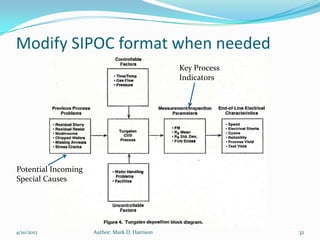
Modify SIPOC format when needed
                                                Key Process
                                                Indicators


Potential Incoming
Special Causes


4/10/2012            Author: Mark D. Harrison                 32
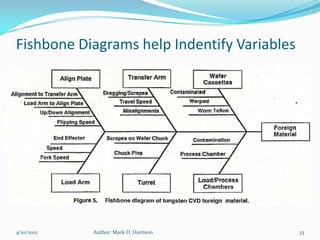
Fishbone Diagrams help Indentify Variables


4/10/2012   Author: Mark D. Harrison         33
Process Specifications
  Process specifications need to be reviewed to ensure
     They have been generated through Design and
      Engineering work
     The process is capable of meeting the specifications
     They are optimized for desired characteristics
     There are no conflicts with other specifications
  Ask
     Where did they come from?
     How were they derived?


4/10/2012       Author: Mark D. Harrison                     34
Design of Experiments (DoE)
  Should have been used to define Process
   Specifications
  Current Specs need to be researched to ensure how
   they were developed and validated
  Look for objective evidence on how the specs were
   developed
        Engineering Process Documents
        Engineering/Design Reports
        Industry Process Practices
  There should be an information trail leading to the
     how and why the specs were developed

4/10/2012           Author: Mark D. Harrison             35
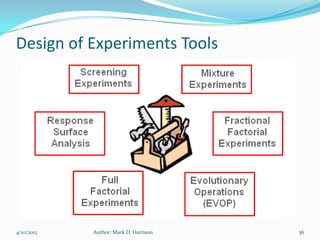
Design of Experiments Tools


4/10/2012   Author: Mark D. Harrison   36
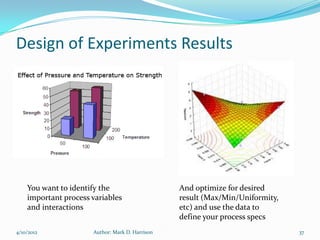
Design of Experiments Results


    You want to identify the                     And optimize for desired
    important process variables                  result (Max/Min/Uniformity,
    and interactions                             etc) and use the data to
                                                 define your process specs
4/10/2012             Author: Mark D. Harrison                                 37
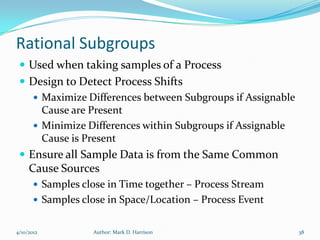
Rational Subgroups
  Used when taking samples of a Process
  Design to Detect Process Shifts
     Maximize Differences between Subgroups if Assignable
      Cause are Present
     Minimize Differences within Subgroups if Assignable
      Cause is Present
  Ensure all Sample Data is from the Same Common
     Cause Sources
        Samples close in Time together – Process Stream
        Samples close in Space/Location – Process Event


4/10/2012          Author: Mark D. Harrison                  38
Rational Subgroups Examples
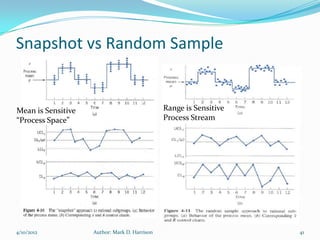
  Snapshot - Process Space
     Sampling 5 chip features on a wafer
     Sampling 5 drill holes on a cover plate
  Random - Process Stream
     Sampling the last 5 parts from a punch tool
     Sampling every 10th Hesrey’s Kiss for weight


4/10/2012        Author: Mark D. Harrison            39
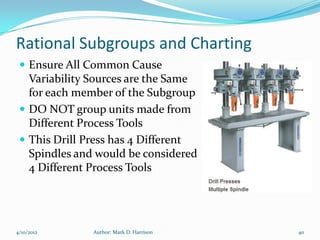
Rational Subgroups and Charting
  Ensure All Common Cause
   Variability Sources are the Same
   for each member of the Subgroup
  DO NOT group units made from
   Different Process Tools
  This Drill Press has 4 Different
   Spindles and would be considered
   4 Different Process Tools


4/10/2012      Author: Mark D. Harrison   40
Snapshot vs Random Sample


Mean is Sensitive                              Range is Sensitive
“Process Space”                                Process Stream


4/10/2012           Author: Mark D. Harrison                        41
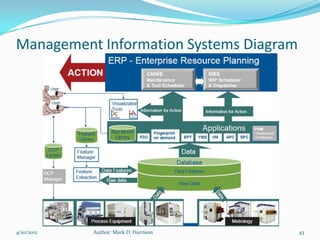
Integrated Information Systems
  Management Information Systems (MIS) have become
   increasingly integrated
  Data can come from multiple sources and reside in a
   single database
  What used to be shuffled with paper is now
   instantaneous through network connected devices
  Communications to the outside world
   (operators/engineering/management) takes place
   through applications/software algorithms first


4/10/2012      Author: Mark D. Harrison                  42
Management Information Systems Diagram


4/10/2012   Author: Mark D. Harrison     43
Integrate SPC Data into Operations
  Make the “Voice of the Process” visible to Stakeholders
  Create procedures that uses SPC data on a regular
   basis
  Create a process that ensures problems are solved and
   improvements are made


4/10/2012       Author: Mark D. Harrison                   44
Example “Voice of the Process” Data
  % Exceptions works well as Indicator
    No need to recalculate Process Capabilities weekly
    SQL Query updated with process additions/deletions as
     needed
  Weekly SQL Database Query run against SPC Data
    Data is formatted by Department and % Exceptions
    Each Dept works on the Highest % SPC Exception
     Charts and reports to their Management
    Top 5 overall performers are reviewed at the weekly
     Controls Steering Committee meeting


4/10/2012       Author: Mark D. Harrison                     45
Controls Steering Committee
  CSC ensure involvement of Management at higher levels
  Team usually consists of:
     Management
     Engineering
     Manufacturing Engineering
     Six Sigma/SPC
  Top Problem SPC charts are reviewed for
     Capture of Product
     Root Cause Analysis
     Solution
     Implementation and Results
  Offer additional suggestions / improvements

4/10/2012       Author: Mark D. Harrison                   46
How to Improve your Processes
  Improve Process Metrology
  Improve Processing Technologies
  Make Charts more Sensitive
  Utilize Modified Control Limits/Reject Limits
  Utilize Feed-back/Feed-forward Algorithms
  Utilize Tool Control
  Utilize Delta from Expected Charting
  Utilize Delta from Target Charting


4/10/2012       Author: Mark D. Harrison           47
Improve Metrology
  Improve Gauge working environment
  Fixturing for Measurements
  New Gauges or Instruments
  Network / SPC Connections


4/10/2012     Author: Mark D. Harrison   48
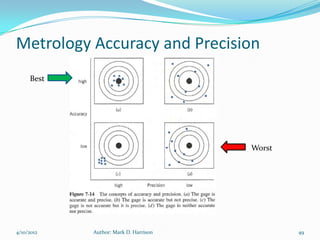
Metrology Accuracy and Precision
     Best


                                       Worst


4/10/2012   Author: Mark D. Harrison           49
Gage R&R Variability
  Gage R&R Variability is included when you calculate
   SPC Limits for a Process
  Gage R&R Variability Reduces your Process Capability
  Reducing Gage R&R Variability will provide a more
   accurate picture of your Process


4/10/2012      Author: Mark D. Harrison                   50
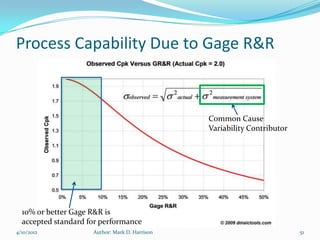
Process Capability Due to Gage R&R


                                                Common Cause
                                                Variability Contributor


  10% or better Gage R&R is
  accepted standard for performance
4/10/2012            Author: Mark D. Harrison                             51
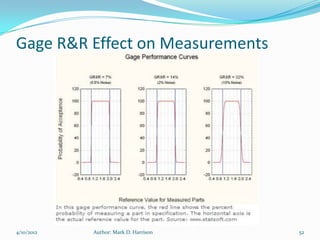
Gage R&R Effect on Measurements


4/10/2012   Author: Mark D. Harrison   52
Improve Metrology Working Environment
  Ensure Temperature and Humidity of workspace is
   held as constant as possible
  Improve stability of inputs required by the Gage
        Electrical – power conditioning
        Pneumatic – improve flow/pressure regulation
        Hydraulic – improve flow/pressure regulation
        Optical – reduce dust/particles


4/10/2012           Author: Mark D. Harrison            53
Improve / Create Fixturing
  This ensures more consistent Measurements
  Reduced Person-to-Person Variation
  Measurements are always taken at the same Locations
   using the same Techniques
  Perform a Gage R&R Study and closely observe how
   things are done and integrate this information into the
   Fixture Design and Use Instructions


4/10/2012       Author: Mark D. Harrison                 54
Review Measurement Patterns and Analysis
  Ensure Data generated makes Statistical sense
  Ensure Data is not Biased
  Ensure Data Correctly represents what you are trying
   to measure
  Examine Alternative Strategies
        Example – Break up and Chart as two measurements
        Main area or surface – process performance
        Edge of area – alignment or processing issues


4/10/2012           Author: Mark D. Harrison                55
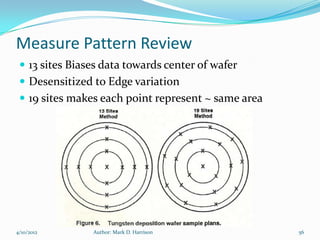
Measure Pattern Review
  13 sites Biases data towards center of wafer
  Desensitized to Edge variation
  19 sites makes each point represent ~ same area


4/10/2012       Author: Mark D. Harrison             56
Metrology Network/SPC Connections
  Most modern metrology systems come equipped with
     network connection capability or can easily be adapted
     for connection
        Micrometers
        Volt Meters
        Analyzers
        Etc..
  Most need a computer to support network operation
  Once connected data can be sent to databases and
     applications of your choosing

4/10/2012            Author: Mark D. Harrison             57
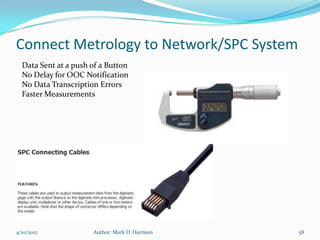
Connect Metrology to Network/SPC System
  Data Sent at a push of a Button
  No Delay for OOC Notification
  No Data Transcription Errors
  Faster Measurements


4/10/2012             Author: Mark D. Harrison   58
Automated Metrology
  Place Item, Start, and Walk Away
  Automatic, Pre-Programmed Measurements
  Connected to SPC/Network Systems
  Instant Indications of Go/No-Go
  Parts Measurement
  Defect Detection/Classification
  Some Vendors can Custom Build


4/10/2012      Author: Mark D. Harrison     59
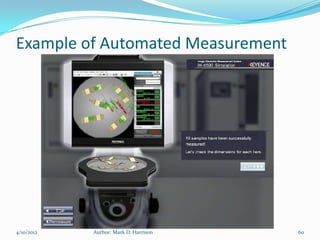
Example of Automated Measurement


4/10/2012   Author: Mark D. Harrison   60
Improve Process Technology
  Modify Process / Part to take advantage of New
   Technologies (Redesign/DOE)
  Upgrade Current Equipment
  Purchase Newest Technology Equipment


4/10/2012      Author: Mark D. Harrison             61
Make Charts more Sensitive
  Add +/- 2 Sigma, +/- 1 Sigma and/or +/- Target Limits
  Start with +/- 2 Sigma Limits
  Work up to +/- Target Limits
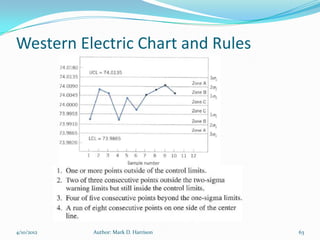
  Apply Western Electric Rules (Standard in Current
   SPC Packages)
  Remember! As you make charts more sensitive you
   may be uncovering low lying Special Cause Variation
  Be prepared for additional Root Cause Analysis
   activities!


4/10/2012       Author: Mark D. Harrison                   62
Western Electric Chart and Rules


4/10/2012   Author: Mark D. Harrison   63
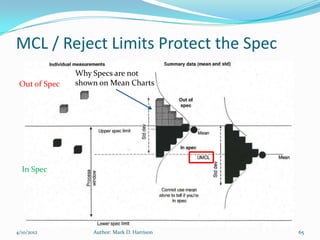
Modified Control / Reject Limits
  Modified Control Limits or Reject Limits Protect the
     Specification Limits when using an XBAR/R or
     XBAR/SD set of SPC Charts
    Indicate when the Spec is being Violated
    Used Alone or in conjunction with Regular Control
     Limits
    Used in Critical Process Applications
    Used in Metrology Systems with Manufacturer
     Defined Specs


4/10/2012        Author: Mark D. Harrison                 64
MCL / Reject Limits Protect the Spec
               Why Specs are not
 Out of Spec   shown on Mean Charts


  In Spec


4/10/2012          Author: Mark D. Harrison   65
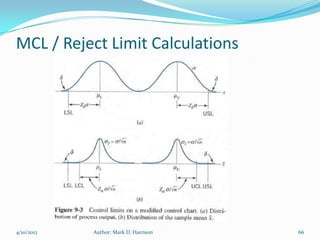
MCL / Reject Limit Calculations


4/10/2012   Author: Mark D. Harrison   66
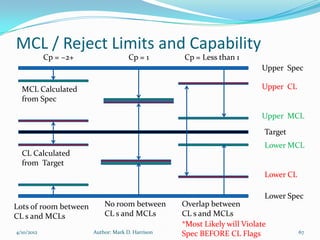
MCL / Reject Limits and Capability
            Cp = ~2+                 Cp = 1       Cp = Less than 1
                                                                         Upper Spec

  MCL Calculated                                                         Upper CL
  from Spec

                                                                         Upper MCL

                                                                          Target
                                                                          Lower MCL
  CL Calculated
  from Target
                                                                          Lower CL

                                                                          Lower Spec
Lots of room between       No room between        Overlap between
CL s and MCLs              CL s and MCLs          CL s and MCLs
                                                  *Most Likely will Violate
4/10/2012              Author: Mark D. Harrison   Spec BEFORE CL Flags               67
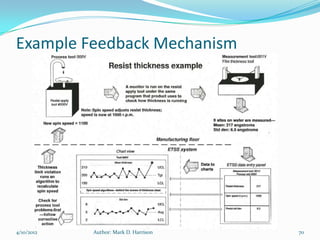
Feedback and Feed-forward Mechanisms
  Feedback provides information about the process
   outcome that is used to modify the that particular
   process for the next unit or event
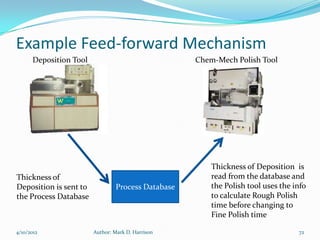
  Feed-forward provides information about the current
   process that is used by the next process for settings or
   initial conditions


4/10/2012       Author: Mark D. Harrison                      68
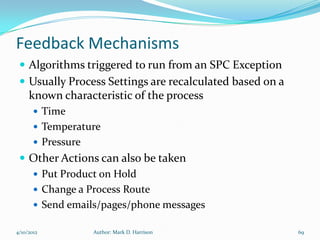
Feedback Mechanisms
  Algorithms triggered to run from an SPC Exception
  Usually Process Settings are recalculated based on a
     known characteristic of the process
        Time
        Temperature
        Pressure
  Other Actions can also be taken
    Put Product on Hold
    Change a Process Route
    Send emails/pages/phone messages

4/10/2012           Author: Mark D. Harrison              69
Example Feedback Mechanism


4/10/2012   Author: Mark D. Harrison   70
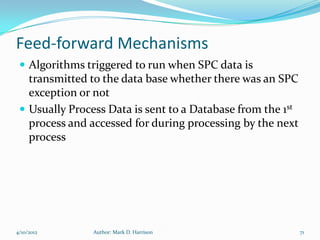
Feed-forward Mechanisms
  Algorithms triggered to run when SPC data is
   transmitted to the data base whether there was an SPC
   exception or not
  Usually Process Data is sent to a Database from the 1st
   process and accessed for during processing by the next
   process


4/10/2012       Author: Mark D. Harrison                     71
Example Feed-forward Mechanism
      Deposition Tool                               Chem-Mech Polish Tool


                                                        Thickness of Deposition is
Thickness of                                            read from the database and
Deposition is sent to            Process Database       the Polish tool uses the info
the Process Database                                    to calculate Rough Polish
                                                        time before changing to
                                                        Fine Polish time

4/10/2012               Author: Mark D. Harrison                                  72
Tool Control
  Many more process variables can be charted
  Usually found on expensive high use equipment
  Simple Type – Older Equipment
     Data is sent to SPC through a network/computer
      connection and provides a summary or data file that can
      be used for SPC control
  Complex Type – Newer Equipment
     SPC is imbedded in the process tool software
     Monitors and flags SPC exceptions at end of process
  Not the same as the derided APC or Automated
     Process Control

4/10/2012        Author: Mark D. Harrison                       73
Delta from Expected - Simple
  A Process may change with a known characteristic and
     may not be controllable using normal SPC charts
        Oxide Standard gaining Native Oxide thickness
        Deposition Rate changes due to number of runs
  If the process is repeatable and consistent it might be
     characterized by a formula
        Least Squares Fit Line
        Polynomial
        Other Line Fitting Formulas
  This formula can be used to predict where the next
     point should be and calculate a Delta from Expected

4/10/2012           Author: Mark D. Harrison                 74
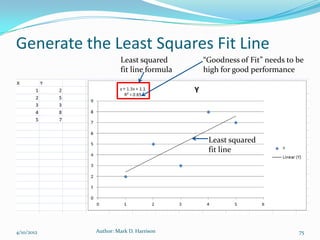
Generate the Least Squares Fit Line
                     Least squared      “Goodness of Fit” needs to be
                     fit line formula   high for good performance


                                         Least squared
                                         fit line


4/10/2012   Author: Mark D. Harrison                               75
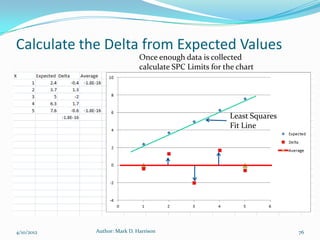
Calculate the Delta from Expected Values
                             Once enough data is collected
                             calculate SPC Limits for the chart


                                                       Least Squares
                                                       Fit Line


4/10/2012   Author: Mark D. Harrison                                   76
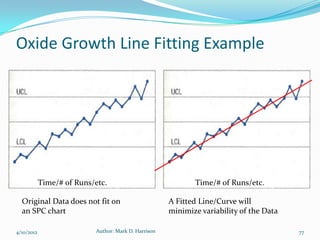
Oxide Growth Line Fitting Example


            Time/# of Runs/etc.                              Time/# of Runs/etc.

  Original Data does not fit on                       A Fitted Line/Curve will
  an SPC chart                                        minimize variability of the Data

4/10/2012                  Author: Mark D. Harrison                                      77
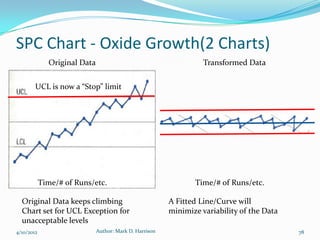
SPC Chart - Oxide Growth(2 Charts)
              Original Data                                        Transformed Data


        UCL is now a “Stop” limit


            Time/# of Runs/etc.                                 Time/# of Runs/etc.

  Original Data keeps climbing                           A Fitted Line/Curve will
  Chart set for UCL Exception for                        minimize variability of the Data
  unacceptable levels
4/10/2012                     Author: Mark D. Harrison                                      78
Delta from Expected – Complex Example
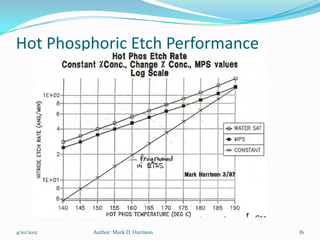
  Hot Phosphoric Wet Bench
  Had scrap issues with Residual Nitride from process
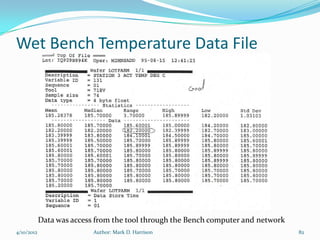
  Wet bench computer generated Bath Temperature files
  Able to characterize Etch Rate by Temperature
  Developed Algorithm to estimate Etch Amount for each Time
   Interval
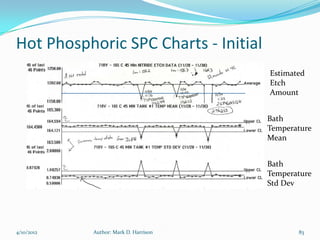
  Summed Total Estimated Etch Amount and sent to SPC chart
  SPC Exception generated if Estimated Etch Amount is Too Low


4/10/2012        Author: Mark D. Harrison                        79
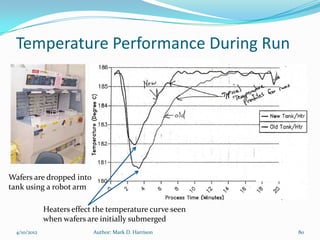
Temperature Performance During Run


Wafers are dropped into
tank using a robot arm

              Heaters effect the temperature curve seen
              when wafers are initially submerged
  4/10/2012                 Author: Mark D. Harrison      80
Hot Phosphoric Etch Performance


4/10/2012   Author: Mark D. Harrison   81
Wet Bench Temperature Data File


            Data was access from the tool through the Bench computer and network
4/10/2012                  Author: Mark D. Harrison                                82
Hot Phosphoric SPC Charts - Initial
                                       Estimated
                                       Etch
                                       Amount


                                       Bath
                                       Temperature
                                       Mean


                                       Bath
                                       Temperature
                                       Std Dev


4/10/2012   Author: Mark D. Harrison          83
Delta from Target
  Used to combine many SPC charts with data entered in
     irregular intervals with few points
    Reduces number of SPC Charts required to control all
     processes on a particular tool (seen 10X in practice)
    Combines SPC data into longer unbroken strings for better
     process control
    Processes are combined that have the same spec limits and
     general performance levels
    Real Data is stored in a database for queries and
     traceability


4/10/2012         Author: Mark D. Harrison                   84
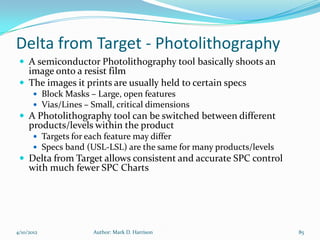
Delta from Target - Photolithography
  A semiconductor Photolithography tool basically shoots an
   image onto a resist film
  The images it prints are usually held to certain specs
        Block Masks – Large, open features
        Vias/Lines – Small, critical dimensions
  A Photolithography tool can be switched between different
     products/levels within the product
        Targets for each feature may differ
        Specs band (USL-LSL) are the same for many products/levels
  Delta from Target allows consistent and accurate SPC control
     with much fewer SPC Charts


4/10/2012             Author: Mark D. Harrison                        85
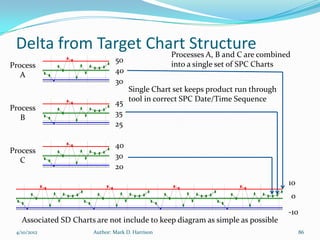
Delta from Target Chart Structurecombined
                      Processes A, B and C are
                               50
Process                                           into a single set of SPC Charts
                               40
   A
                               30
                                  Single Chart set keeps product run through
                               45 tool in correct SPC Date/Time Sequence
Process
                               35
   B
                               25

                               40
Process
                               30
   C
                               20

                                                                                    10
                                                                                    0

                                                                                    -10
   Associated SD Charts are not include to keep diagram as simple as possible
 4/10/2012             Author: Mark D. Harrison                                           86
In Conclusion
  Ensure you have Company/Management Support
  Ensure your are Charting the Important/Correct Variables
  Chart/Sample properly
  Ensure your metrology is capable
  Use the correct limits for your situation
  Utilize any Information Systems available
  Use advanced control techniques where applicable
  Ensure all areas that use SPC do so on a regular basis and it
   becomes a part of company culture
  When Special Cause is down reduce Common Cause Variability


4/10/2012        Author: Mark D. Harrison                          87
References
Introduction to Statistical Process Control           Douglas C. Montgomery
The Six Sigma Handbook                                 Thomas Pyzdek
Lean Six Sigma DeMystified                              Jay Arthur

Basic Statistical Process Control                      Jack Hunt - IBM

Intermediate Statistical Process Control              Lenny Dubuque - IBM

Advanced Statistical Process Control                  Gary Snyder - IBM

A Large Scale SPC Implementation using the IBM Multimedia SPC Program
                                                   Mark Harrison

http://www.keyence.com/products/measure/image/im6500/simulation/simulation.php
      http://elonen.iki.fi/articles/centrallimit/index.en.html#demo
    http://en.wikipedia.org/wiki/Illustration_of_the_central_limit_theorem
4/10/2012              Author: Mark D. Harrison                               88

Mark Harrison SPC Implementation

  • 1.
  • 2.
    Purpose of Presentation  Provide guidance on proper implementation of SPC  Provide suggestions on improving process performance  Provide a method to ensure SPC becomes a part of company culture  Provide suggestions for new methods to improve SPC effectiveness  Be used a checklist/reference for new SPC system or improvement of current SPC system 4/10/2012 Author: Mark D. Harrison 2
  • 3.
    What is SPC?  SPC stands for Statistical Process Control  SPC is a fundamental approach to quality control and improvement that is based on objective data and analysis  Measure the Process  Eliminate Variances in the Process  Monitor the Process  Improve the Process 4/10/2012 Author: Mark D. Harrison 3
  • 4.
    Why use SPC?  Provides indications of how healthy the process is  Allows objective numerical analysis of a process  Make the Most with the Least Possible  Maximize Process Yields  Minimize Scrap and Rework incidents  Increases Efficiency  Provides a “Voice of the Process” 4/10/2012 Author: Mark D. Harrison 4
  • 5.
    Where can SPCbe used ?  SPC can be used anywhere measurements and performance specifications are utilized  SPC is mostly associated with Manufacturing  But… SPC can also be used in:  Marketing  Medical/Healthcare  Service Industries  And many other fields 4/10/2012 Author: Mark D. Harrison 5
  • 6.
    Elements of aSuccessful SPC Program  Management Leadership  A Team Approach  Education of employees at all levels  Emphasis on reducing variability  Measuring success in quantitative (economic) terms  Communicate successful results throughout organization 4/10/2012 Author: Mark D. Harrison 6
  • 7.
    Management Leadership Need “Top Down” buy-in  Communicate Business Justification to Employees  Drive Cultural Change  Prevent Internal “Sabotage”  Put SPC metrics in “Performance Plans” 4/10/2012 Author: Mark D. Harrison 7
  • 8.
    A Team Approach  Include all Stakeholders  Break down “Silos”  Define “What’s in it for me” for each Stakeholder  Utilize the Strengths of all your Resources 4/10/2012 Author: Mark D. Harrison 8
  • 9.
    Education of Employeesat all Levels  Everyone should understand SPC and why it is being used  New Employee Orientation  Manufacturing should get additional training on RCA  Manufacturing and Design Engineering should get additional training on DOE, RCA and Gage R&R  Management should get additional training on high level metrics (Cp/Cpk, 1st Pass Yield, ROI etc..) 4/10/2012 Author: Mark D. Harrison 9
  • 10.
    Emphasis on ReducingVariability  Reduce Scrap  Reduce Rework  Improve Process Capabilities  Reduced Costs = Higher Profits 4/10/2012 Author: Mark D. Harrison 10
  • 11.
    Measure Success inQuantitative Terms  Develop Performance Metrics to report regularly  How Workers Benefit (Less Work/Time for same output)  How Company Benefits (Higher Profits/More Customers/Competitive) 4/10/2012 Author: Mark D. Harrison 11
  • 12.
    Communicate Successful Results  Report Chosen Performance Metrics on a Regular Basis  Post Communications in places where easily viewable  Bulletin Boards  Video Monitors  Internal Company Websites  Report who, what, when, where to build pride and ownership in people’s work  Include people who did the work to present to higher level management and even write papers 4/10/2012 Author: Mark D. Harrison 12
  • 13.
    Example Company Newsletter 4/10/2012 Author: Mark D. Harrison 13
  • 14.
    What does SPClook like ? Upper Control Limit Process Average or Target Lower Control Limit Sample Number or Time 4/10/2012 Author: Mark D. Harrison 14
  • 15.
    Types of SPCCharts  There are 2 basic types of SPC Charts  Variable Charts – Measureable  Attribute Charts - Countable  Variable Charts Plot Continuous Data  Individuals Charts – One Point of Data  XBAR and Range – Sample Size of 2-9  XBAR and SD – Sample Size of 10+  Attribute Charts Plot Count or Go/No-Go Data  u Chart – Changing Sample Size of Occurrences  c Chart – Constant Sample Size of Occurrences  p Chart – Changing Sample Size Pieces or Units  np Chart – Constant Sample Size Pieces or Units 4/10/2012 Author: Mark D. Harrison 15
  • 16.
    Selecting Which SPCChart to Use n = 2 to 9 Average, Range Average, Sigma n = 10 or more Measurements non-normal Run Chart normal Moving Range n fixed np Chart pieces or units p Chart Counts n varies n fixed c Chart occurrences n varies u Chart 4/10/2012 Author: Mark D. Harrison 16
  • 17.
    Concept of SPCControl  SPC Data follows one of several Types of Distributions  When only Common Cause Variation is present data is very predictable  When Special Cause Variation is present data outside the control limits is statistically rare 4/10/2012 Author: Mark D. Harrison 17
  • 18.
    Sources of ProcessVariability  People – Every Person is different  Material – Every piece of material/item/tool is unique  Methods – No one does something exactly the same way  Measurements – Individual instruments perform differently  Environment - the weather changes!  Sound familiar ? (Think Fishbone Diagram) 4/10/2012 Author: Mark D. Harrison 18
  • 19.
    Process Variability Two types of Variability Exist in a Process  Common Cause Variability  Special Cause Variability 4/10/2012 Author: Mark D. Harrison 19
  • 20.
    Common Cause Variability  Is characterized as  Inherent or Natural Variability  Background Noise  Cumulative effect of many small, unavoidable causes  Stable System of Chance Causes  If a Process is operating with only chance cause of variation present it is said to be in Statistical Control 4/10/2012 Author: Mark D. Harrison 20
  • 21.
    Common Cause VariabilityExamples  Repeatability of Manually Set Controls  Change in Temperature from Ventilation System  Barometric Pressure and Humidity  Repeatability of Computer Set Controls 4/10/2012 Author: Mark D. Harrison 21
  • 22.
    Special Cause Variability  Is seen as  Large Variability compared to “Background Noise”  Unacceptable Level of Process Performance  Also known as “Assignable Cause”  Sources of Special Cause Variability  Improperly Adjusted or Controlled Machines  Operator Errors  Defective Raw Material  A Process that is operating in the presence of Assignable Causes is said to be Out of Control 4/10/2012 Author: Mark D. Harrison 22
  • 23.
    Special Cause VariabilityExamples  Broken Regulator provides too high Air Pressure  Shorting Transformer provides too low Voltage  Metal being welded in Contaminated  Chemicals used for Processing are Expired  Operator Loading a Tool Incorrectly 4/10/2012 Author: Mark D. Harrison 23
  • 24.
    Common and SpecialCause Variability Special Cause Variability Common Cause Variability 4/10/2012 Author: Mark D. Harrison 24
  • 25.
    Variability Reduction /ProcessImprovement Select a Common Update SPC Charts and Cause to Improve Process Documents Validate and Implement Indentify Mechanism Improvement for Improvement 4/10/2012 Author: Mark D. Harrison 25
  • 26.
    Variability Reduction Levels Special Cause Variability Common Cause Variability Reactive Proactive 4/10/2012 Author: Mark D. Harrison 26
  • 27.
    Six Sigma andSPC With a +/- 1.5 Sigma Shift there is little change in the amount that goes beyond the USL/LSL of a process 4/10/2012 Author: Mark D. Harrison 27
  • 28.
    How SPC ChartHierarchy is Structured  SPC Charts should be organized in this hierarchy  Process Tool – 145V, Welder # 2, etc..  Part – Bolt, Nitride Deposition, Cable Type Y, etc..  Characteristic – Length, Thickness, Resistance, etc..  This is done to ensure SPC control integrity  Data from different process tools is never mixed with other process tools (Part is top of Hierarchy)  This combines Special and Common Cause Variability from several sources  Root Cause Analysis requires you to fragment and reassemble the data to get a true picture  SPC Limits and Run Rules will not function properly 4/10/2012 Author: Mark D. Harrison 28
  • 29.
    Example SPC ChartHierarchy Tool 287B Drill Machine Part Top Plate End Plate Side Plate Hole Diameter XBAR/R Hole Diameter XBAR/R Hole Diameter XBAR/R Hole Depth XBAR/R Hole Depth XBAR/R Hole Depth XBAR/R Characteristic 4/10/2012 Author: Mark D. Harrison 29
  • 30.
    Where to putSPC / What to Chart ?  Key Process Indicators  Engineering Specifications  Customer Requirements  Usually Chart the Output of an Individual Process  Can Chart Tool / Process beyond KPIs for even better Process Performance  Use a SIPOC and FishBone Diagram to determine if any other Variables need to be Charted 4/10/2012 Author: Mark D. Harrison 30
  • 31.
    Use a SIPOCDiagram SPC will look at the Input, Process and Output Variables Some of the Inputs may have been verified by the previous process 4/10/2012 Author: Mark D. Harrison 31
  • 32.
    Modify SIPOC formatwhen needed Key Process Indicators Potential Incoming Special Causes 4/10/2012 Author: Mark D. Harrison 32
  • 33.
    Fishbone Diagrams helpIndentify Variables 4/10/2012 Author: Mark D. Harrison 33
  • 34.
    Process Specifications Process specifications need to be reviewed to ensure  They have been generated through Design and Engineering work  The process is capable of meeting the specifications  They are optimized for desired characteristics  There are no conflicts with other specifications  Ask  Where did they come from?  How were they derived? 4/10/2012 Author: Mark D. Harrison 34
  • 35.
    Design of Experiments(DoE)  Should have been used to define Process Specifications  Current Specs need to be researched to ensure how they were developed and validated  Look for objective evidence on how the specs were developed  Engineering Process Documents  Engineering/Design Reports  Industry Process Practices  There should be an information trail leading to the how and why the specs were developed 4/10/2012 Author: Mark D. Harrison 35
  • 36.
    Design of ExperimentsTools 4/10/2012 Author: Mark D. Harrison 36
  • 37.
    Design of ExperimentsResults You want to identify the And optimize for desired important process variables result (Max/Min/Uniformity, and interactions etc) and use the data to define your process specs 4/10/2012 Author: Mark D. Harrison 37
  • 38.
    Rational Subgroups Used when taking samples of a Process  Design to Detect Process Shifts  Maximize Differences between Subgroups if Assignable Cause are Present  Minimize Differences within Subgroups if Assignable Cause is Present  Ensure all Sample Data is from the Same Common Cause Sources  Samples close in Time together – Process Stream  Samples close in Space/Location – Process Event 4/10/2012 Author: Mark D. Harrison 38
  • 39.
    Rational Subgroups Examples  Snapshot - Process Space  Sampling 5 chip features on a wafer  Sampling 5 drill holes on a cover plate  Random - Process Stream  Sampling the last 5 parts from a punch tool  Sampling every 10th Hesrey’s Kiss for weight 4/10/2012 Author: Mark D. Harrison 39
  • 40.
    Rational Subgroups andCharting  Ensure All Common Cause Variability Sources are the Same for each member of the Subgroup  DO NOT group units made from Different Process Tools  This Drill Press has 4 Different Spindles and would be considered 4 Different Process Tools 4/10/2012 Author: Mark D. Harrison 40
  • 41.
    Snapshot vs RandomSample Mean is Sensitive Range is Sensitive “Process Space” Process Stream 4/10/2012 Author: Mark D. Harrison 41
  • 42.
    Integrated Information Systems  Management Information Systems (MIS) have become increasingly integrated  Data can come from multiple sources and reside in a single database  What used to be shuffled with paper is now instantaneous through network connected devices  Communications to the outside world (operators/engineering/management) takes place through applications/software algorithms first 4/10/2012 Author: Mark D. Harrison 42
  • 43.
    Management Information SystemsDiagram 4/10/2012 Author: Mark D. Harrison 43
  • 44.
    Integrate SPC Datainto Operations  Make the “Voice of the Process” visible to Stakeholders  Create procedures that uses SPC data on a regular basis  Create a process that ensures problems are solved and improvements are made 4/10/2012 Author: Mark D. Harrison 44
  • 45.
    Example “Voice ofthe Process” Data  % Exceptions works well as Indicator  No need to recalculate Process Capabilities weekly  SQL Query updated with process additions/deletions as needed  Weekly SQL Database Query run against SPC Data  Data is formatted by Department and % Exceptions  Each Dept works on the Highest % SPC Exception Charts and reports to their Management  Top 5 overall performers are reviewed at the weekly Controls Steering Committee meeting 4/10/2012 Author: Mark D. Harrison 45
  • 46.
    Controls Steering Committee  CSC ensure involvement of Management at higher levels  Team usually consists of:  Management  Engineering  Manufacturing Engineering  Six Sigma/SPC  Top Problem SPC charts are reviewed for  Capture of Product  Root Cause Analysis  Solution  Implementation and Results  Offer additional suggestions / improvements 4/10/2012 Author: Mark D. Harrison 46
  • 47.
    How to Improveyour Processes  Improve Process Metrology  Improve Processing Technologies  Make Charts more Sensitive  Utilize Modified Control Limits/Reject Limits  Utilize Feed-back/Feed-forward Algorithms  Utilize Tool Control  Utilize Delta from Expected Charting  Utilize Delta from Target Charting 4/10/2012 Author: Mark D. Harrison 47
  • 48.
    Improve Metrology Improve Gauge working environment  Fixturing for Measurements  New Gauges or Instruments  Network / SPC Connections 4/10/2012 Author: Mark D. Harrison 48
  • 49.
    Metrology Accuracy andPrecision Best Worst 4/10/2012 Author: Mark D. Harrison 49
  • 50.
    Gage R&R Variability  Gage R&R Variability is included when you calculate SPC Limits for a Process  Gage R&R Variability Reduces your Process Capability  Reducing Gage R&R Variability will provide a more accurate picture of your Process 4/10/2012 Author: Mark D. Harrison 50
  • 51.
    Process Capability Dueto Gage R&R Common Cause Variability Contributor 10% or better Gage R&R is accepted standard for performance 4/10/2012 Author: Mark D. Harrison 51
  • 52.
    Gage R&R Effecton Measurements 4/10/2012 Author: Mark D. Harrison 52
  • 53.
    Improve Metrology WorkingEnvironment  Ensure Temperature and Humidity of workspace is held as constant as possible  Improve stability of inputs required by the Gage  Electrical – power conditioning  Pneumatic – improve flow/pressure regulation  Hydraulic – improve flow/pressure regulation  Optical – reduce dust/particles 4/10/2012 Author: Mark D. Harrison 53
  • 54.
    Improve / CreateFixturing  This ensures more consistent Measurements  Reduced Person-to-Person Variation  Measurements are always taken at the same Locations using the same Techniques  Perform a Gage R&R Study and closely observe how things are done and integrate this information into the Fixture Design and Use Instructions 4/10/2012 Author: Mark D. Harrison 54
  • 55.
    Review Measurement Patternsand Analysis  Ensure Data generated makes Statistical sense  Ensure Data is not Biased  Ensure Data Correctly represents what you are trying to measure  Examine Alternative Strategies  Example – Break up and Chart as two measurements  Main area or surface – process performance  Edge of area – alignment or processing issues 4/10/2012 Author: Mark D. Harrison 55
  • 56.
    Measure Pattern Review  13 sites Biases data towards center of wafer  Desensitized to Edge variation  19 sites makes each point represent ~ same area 4/10/2012 Author: Mark D. Harrison 56
  • 57.
    Metrology Network/SPC Connections  Most modern metrology systems come equipped with network connection capability or can easily be adapted for connection  Micrometers  Volt Meters  Analyzers  Etc..  Most need a computer to support network operation  Once connected data can be sent to databases and applications of your choosing 4/10/2012 Author: Mark D. Harrison 57
  • 58.
    Connect Metrology toNetwork/SPC System Data Sent at a push of a Button No Delay for OOC Notification No Data Transcription Errors Faster Measurements 4/10/2012 Author: Mark D. Harrison 58
  • 59.
    Automated Metrology Place Item, Start, and Walk Away  Automatic, Pre-Programmed Measurements  Connected to SPC/Network Systems  Instant Indications of Go/No-Go  Parts Measurement  Defect Detection/Classification  Some Vendors can Custom Build 4/10/2012 Author: Mark D. Harrison 59
  • 60.
    Example of AutomatedMeasurement 4/10/2012 Author: Mark D. Harrison 60
  • 61.
    Improve Process Technology  Modify Process / Part to take advantage of New Technologies (Redesign/DOE)  Upgrade Current Equipment  Purchase Newest Technology Equipment 4/10/2012 Author: Mark D. Harrison 61
  • 62.
    Make Charts moreSensitive  Add +/- 2 Sigma, +/- 1 Sigma and/or +/- Target Limits  Start with +/- 2 Sigma Limits  Work up to +/- Target Limits  Apply Western Electric Rules (Standard in Current SPC Packages)  Remember! As you make charts more sensitive you may be uncovering low lying Special Cause Variation  Be prepared for additional Root Cause Analysis activities! 4/10/2012 Author: Mark D. Harrison 62
  • 63.
    Western Electric Chartand Rules 4/10/2012 Author: Mark D. Harrison 63
  • 64.
    Modified Control /Reject Limits  Modified Control Limits or Reject Limits Protect the Specification Limits when using an XBAR/R or XBAR/SD set of SPC Charts  Indicate when the Spec is being Violated  Used Alone or in conjunction with Regular Control Limits  Used in Critical Process Applications  Used in Metrology Systems with Manufacturer Defined Specs 4/10/2012 Author: Mark D. Harrison 64
  • 65.
    MCL / RejectLimits Protect the Spec Why Specs are not Out of Spec shown on Mean Charts In Spec 4/10/2012 Author: Mark D. Harrison 65
  • 66.
    MCL / RejectLimit Calculations 4/10/2012 Author: Mark D. Harrison 66
  • 67.
    MCL / RejectLimits and Capability Cp = ~2+ Cp = 1 Cp = Less than 1 Upper Spec MCL Calculated Upper CL from Spec Upper MCL Target Lower MCL CL Calculated from Target Lower CL Lower Spec Lots of room between No room between Overlap between CL s and MCLs CL s and MCLs CL s and MCLs *Most Likely will Violate 4/10/2012 Author: Mark D. Harrison Spec BEFORE CL Flags 67
  • 68.
    Feedback and Feed-forwardMechanisms  Feedback provides information about the process outcome that is used to modify the that particular process for the next unit or event  Feed-forward provides information about the current process that is used by the next process for settings or initial conditions 4/10/2012 Author: Mark D. Harrison 68
  • 69.
    Feedback Mechanisms Algorithms triggered to run from an SPC Exception  Usually Process Settings are recalculated based on a known characteristic of the process  Time  Temperature  Pressure  Other Actions can also be taken  Put Product on Hold  Change a Process Route  Send emails/pages/phone messages 4/10/2012 Author: Mark D. Harrison 69
  • 70.
    Example Feedback Mechanism 4/10/2012 Author: Mark D. Harrison 70
  • 71.
    Feed-forward Mechanisms Algorithms triggered to run when SPC data is transmitted to the data base whether there was an SPC exception or not  Usually Process Data is sent to a Database from the 1st process and accessed for during processing by the next process 4/10/2012 Author: Mark D. Harrison 71
  • 72.
    Example Feed-forward Mechanism Deposition Tool Chem-Mech Polish Tool Thickness of Deposition is Thickness of read from the database and Deposition is sent to Process Database the Polish tool uses the info the Process Database to calculate Rough Polish time before changing to Fine Polish time 4/10/2012 Author: Mark D. Harrison 72
  • 73.
    Tool Control Many more process variables can be charted  Usually found on expensive high use equipment  Simple Type – Older Equipment  Data is sent to SPC through a network/computer connection and provides a summary or data file that can be used for SPC control  Complex Type – Newer Equipment  SPC is imbedded in the process tool software  Monitors and flags SPC exceptions at end of process  Not the same as the derided APC or Automated Process Control 4/10/2012 Author: Mark D. Harrison 73
  • 74.
    Delta from Expected- Simple  A Process may change with a known characteristic and may not be controllable using normal SPC charts  Oxide Standard gaining Native Oxide thickness  Deposition Rate changes due to number of runs  If the process is repeatable and consistent it might be characterized by a formula  Least Squares Fit Line  Polynomial  Other Line Fitting Formulas  This formula can be used to predict where the next point should be and calculate a Delta from Expected 4/10/2012 Author: Mark D. Harrison 74
  • 75.
    Generate the LeastSquares Fit Line Least squared “Goodness of Fit” needs to be fit line formula high for good performance Least squared fit line 4/10/2012 Author: Mark D. Harrison 75
  • 76.
    Calculate the Deltafrom Expected Values Once enough data is collected calculate SPC Limits for the chart Least Squares Fit Line 4/10/2012 Author: Mark D. Harrison 76
  • 77.
    Oxide Growth LineFitting Example Time/# of Runs/etc. Time/# of Runs/etc. Original Data does not fit on A Fitted Line/Curve will an SPC chart minimize variability of the Data 4/10/2012 Author: Mark D. Harrison 77
  • 78.
    SPC Chart -Oxide Growth(2 Charts) Original Data Transformed Data UCL is now a “Stop” limit Time/# of Runs/etc. Time/# of Runs/etc. Original Data keeps climbing A Fitted Line/Curve will Chart set for UCL Exception for minimize variability of the Data unacceptable levels 4/10/2012 Author: Mark D. Harrison 78
  • 79.
    Delta from Expected– Complex Example  Hot Phosphoric Wet Bench  Had scrap issues with Residual Nitride from process  Wet bench computer generated Bath Temperature files  Able to characterize Etch Rate by Temperature  Developed Algorithm to estimate Etch Amount for each Time Interval  Summed Total Estimated Etch Amount and sent to SPC chart  SPC Exception generated if Estimated Etch Amount is Too Low 4/10/2012 Author: Mark D. Harrison 79
  • 80.
    Temperature Performance DuringRun Wafers are dropped into tank using a robot arm Heaters effect the temperature curve seen when wafers are initially submerged 4/10/2012 Author: Mark D. Harrison 80
  • 81.
    Hot Phosphoric EtchPerformance 4/10/2012 Author: Mark D. Harrison 81
  • 82.
    Wet Bench TemperatureData File Data was access from the tool through the Bench computer and network 4/10/2012 Author: Mark D. Harrison 82
  • 83.
    Hot Phosphoric SPCCharts - Initial Estimated Etch Amount Bath Temperature Mean Bath Temperature Std Dev 4/10/2012 Author: Mark D. Harrison 83
  • 84.
    Delta from Target  Used to combine many SPC charts with data entered in irregular intervals with few points  Reduces number of SPC Charts required to control all processes on a particular tool (seen 10X in practice)  Combines SPC data into longer unbroken strings for better process control  Processes are combined that have the same spec limits and general performance levels  Real Data is stored in a database for queries and traceability 4/10/2012 Author: Mark D. Harrison 84
  • 85.
    Delta from Target- Photolithography  A semiconductor Photolithography tool basically shoots an image onto a resist film  The images it prints are usually held to certain specs  Block Masks – Large, open features  Vias/Lines – Small, critical dimensions  A Photolithography tool can be switched between different products/levels within the product  Targets for each feature may differ  Specs band (USL-LSL) are the same for many products/levels  Delta from Target allows consistent and accurate SPC control with much fewer SPC Charts 4/10/2012 Author: Mark D. Harrison 85
  • 86.
    Delta from TargetChart Structurecombined Processes A, B and C are 50 Process into a single set of SPC Charts 40 A 30 Single Chart set keeps product run through 45 tool in correct SPC Date/Time Sequence Process 35 B 25 40 Process 30 C 20 10 0 -10 Associated SD Charts are not include to keep diagram as simple as possible 4/10/2012 Author: Mark D. Harrison 86
  • 87.
    In Conclusion Ensure you have Company/Management Support  Ensure your are Charting the Important/Correct Variables  Chart/Sample properly  Ensure your metrology is capable  Use the correct limits for your situation  Utilize any Information Systems available  Use advanced control techniques where applicable  Ensure all areas that use SPC do so on a regular basis and it becomes a part of company culture  When Special Cause is down reduce Common Cause Variability 4/10/2012 Author: Mark D. Harrison 87
  • 88.
    References Introduction to StatisticalProcess Control Douglas C. Montgomery The Six Sigma Handbook Thomas Pyzdek Lean Six Sigma DeMystified Jay Arthur Basic Statistical Process Control Jack Hunt - IBM Intermediate Statistical Process Control Lenny Dubuque - IBM Advanced Statistical Process Control Gary Snyder - IBM A Large Scale SPC Implementation using the IBM Multimedia SPC Program Mark Harrison http://www.keyence.com/products/measure/image/im6500/simulation/simulation.php http://elonen.iki.fi/articles/centrallimit/index.en.html#demo http://en.wikipedia.org/wiki/Illustration_of_the_central_limit_theorem 4/10/2012 Author: Mark D. Harrison 88