DR. SHERIF ELBADRAWY
ICU ADVANCED TRAINEE
WESTMEAD HOSPITAL
Introduction ...
When a patient experiences a cardiac
arrest you need to ACT
swiftly and correctly starting with
BASIC LIFE SUPPORT skills.
• vital intervention before arrival of
emergency services - double or triple
survival from sudden cardiac arrest (SCA).
• Early resuscitation and prompt defibrillation
(within 1-2 minutes) can result in >60% survival
DEFINITIONS
• CARDIAC ARREST: Abrupt cessation of cardiac
pump function which may be reversible by a rapid
intervention but will lead to
in its absence.
DEATH: Irreversible cessation of all biologic functions
Providing CPR/AED for Adults
 Cardiopulmonary resuscitation circulates blood
that contains
oxygen
 to the vital organs of a patient in cardiac arrest
when the heart and breathing have stopped.
 It includes chest compressions and
ventilations as well as the use of an automated
external defibrillator.
BASIC LIFE SUPPORT
Chest compressions and pulmonary
ventilation performed by
anyone
who knows how to do it
anywhere,
immediately,
without any other equipment
CHAIN OF SURVIVAL
Cardiopulmonary Resuscitation (CPR).
Combines rescue breathing and chest
compressions
Revives heart (cardio) and lung (pulmonary)
functioning
Use when there is no breathing and no pulse
 Provides O2 to the brain until ACLS arrives
How CPR Works
Effective CPR provides 1/4
to 1/3 normal blood flow
Rescue breaths contain
16% oxygen (exhaled).
Start CPR Immediately
Better chance of survival Brain
damage starts in 4-6 minutes
Brain damage is certain after 10
minutes without CPR
Levine sign
Do Not Move the Victim
Until CPR is Given and Qualified Help
Arrives ...
unless the scene dictates otherwise
CHECK RESPONSE
- Shake shoulders gently
- Ask "Are you all right?"
- If he responds
• Leave as you find him.
• Find out what is wrong.
• Reassess regularly.
Open the airway
with the head tilt chin lift
CHEST COMPRESSIONS
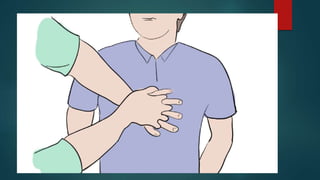
• Place the heel of one hand in the center of the
chest
• Place other hand on top
• Interlock fingers
• Compress the chest
- Rate 100 min
- Depth 5 cm
- Equal compression : relaxation
When possible change CPR operator every 2 minutes
AED operation steps
AED step 1
Power on
AED step 2
attach AED pads to bare chest
AED step 3
Clear and analyze
AED step 4
Shock if advised (clear victim)
AED step 5
resume CPR starting with chest compressions
Don’ts
 Do not use alcohol to wipe the patient’s chest dry. Alcohol is
flammable.
 Do not touch the patient while the AED is analyzing. Touching or
moving the patient may affect analysis.
 Do not touch the patient while the AED is defibrillating. You or
someone else could be shocked.
 Do not defibrillate someone when around flammable or combustible
materials, such as gasoline or free-flowing oxygen.
Basic Life Support
Basic Life Support
Basic Life Support
Basic Life Support
Basic Life Support
Basic Life Support
Basic Life Support
Basic Life Support
Basic Life Support
Basic Life Support
Basic Life Support
Basic Life Support
Basic Life Support
Basic Life Support
Basic Life Support
Basic Life Support
Basic Life Support

Basic Life Support

  • 1.
    DR. SHERIF ELBADRAWY ICUADVANCED TRAINEE WESTMEAD HOSPITAL
  • 2.
    Introduction ... When apatient experiences a cardiac arrest you need to ACT swiftly and correctly starting with BASIC LIFE SUPPORT skills.
  • 3.
    • vital interventionbefore arrival of emergency services - double or triple survival from sudden cardiac arrest (SCA). • Early resuscitation and prompt defibrillation (within 1-2 minutes) can result in >60% survival
  • 4.
    DEFINITIONS • CARDIAC ARREST:Abrupt cessation of cardiac pump function which may be reversible by a rapid intervention but will lead to in its absence. DEATH: Irreversible cessation of all biologic functions
  • 5.
    Providing CPR/AED forAdults  Cardiopulmonary resuscitation circulates blood that contains oxygen  to the vital organs of a patient in cardiac arrest when the heart and breathing have stopped.  It includes chest compressions and ventilations as well as the use of an automated external defibrillator.
  • 6.
    BASIC LIFE SUPPORT Chestcompressions and pulmonary ventilation performed by anyone who knows how to do it anywhere, immediately, without any other equipment
  • 7.
  • 8.
    Cardiopulmonary Resuscitation (CPR). Combinesrescue breathing and chest compressions Revives heart (cardio) and lung (pulmonary) functioning Use when there is no breathing and no pulse  Provides O2 to the brain until ACLS arrives
  • 9.
    How CPR Works EffectiveCPR provides 1/4 to 1/3 normal blood flow Rescue breaths contain 16% oxygen (exhaled).
  • 10.
    Start CPR Immediately Betterchance of survival Brain damage starts in 4-6 minutes Brain damage is certain after 10 minutes without CPR
  • 12.
  • 15.
    Do Not Movethe Victim Until CPR is Given and Qualified Help Arrives ... unless the scene dictates otherwise
  • 17.
    CHECK RESPONSE - Shakeshoulders gently - Ask "Are you all right?" - If he responds • Leave as you find him. • Find out what is wrong. • Reassess regularly.
  • 21.
    Open the airway withthe head tilt chin lift
  • 30.
    CHEST COMPRESSIONS • Placethe heel of one hand in the center of the chest • Place other hand on top • Interlock fingers • Compress the chest - Rate 100 min - Depth 5 cm - Equal compression : relaxation
  • 36.
    When possible changeCPR operator every 2 minutes
  • 40.
    AED operation steps AEDstep 1 Power on AED step 2 attach AED pads to bare chest AED step 3 Clear and analyze AED step 4 Shock if advised (clear victim) AED step 5 resume CPR starting with chest compressions
  • 48.
    Don’ts  Do notuse alcohol to wipe the patient’s chest dry. Alcohol is flammable.  Do not touch the patient while the AED is analyzing. Touching or moving the patient may affect analysis.  Do not touch the patient while the AED is defibrillating. You or someone else could be shocked.  Do not defibrillate someone when around flammable or combustible materials, such as gasoline or free-flowing oxygen.