BASIC LIFE SUPPORT
JOEY J. MARCO
OIC, CDRRMO
Alexander M. Wong
Chief Admin & Training, CDRRMO
Learning Objectives
At the end of this session, participants shall be able to:
1. Perform proper Heimlich maneuver techniques
2. Perform correct cardiopulmonary resuscitation techniques
to an adult, child and infant who are in cardiac arrest
3. Discuss other alternative forms of CPR
4. How to Place an unconscious breathing victim in the
recovery position
5. Enumerate the criteria for when to start and when to stop
CPR.
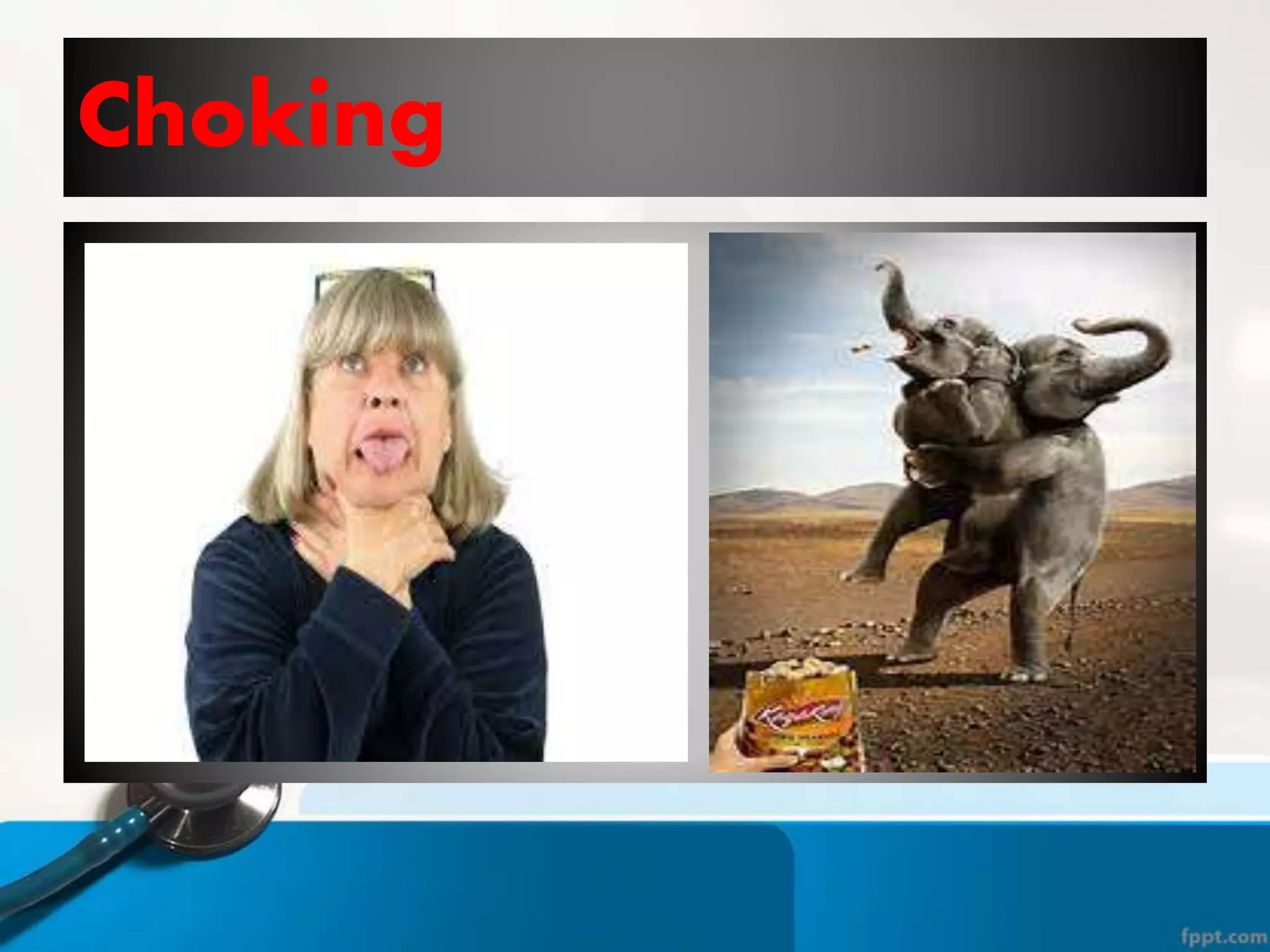
Choking
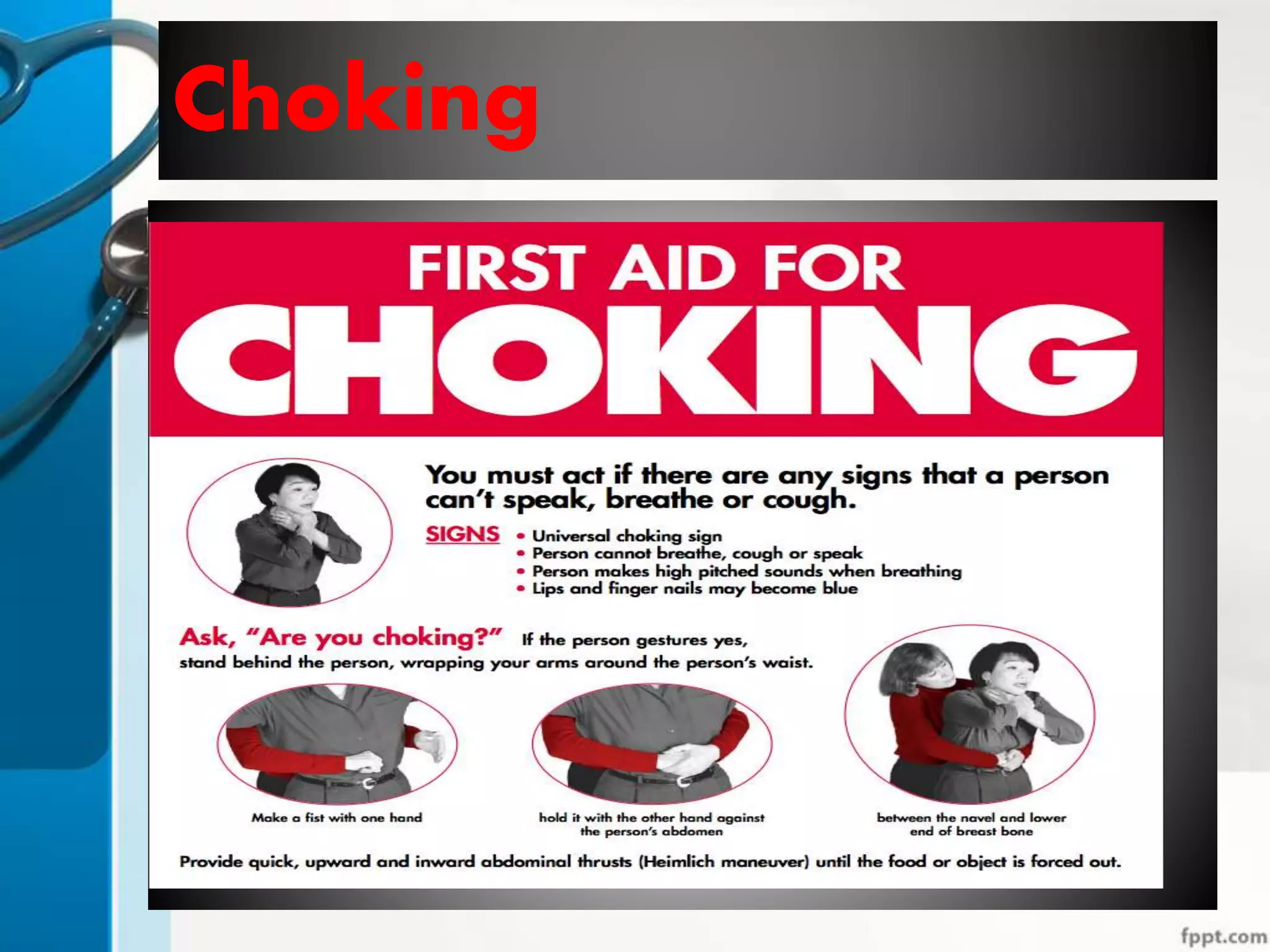
Choking
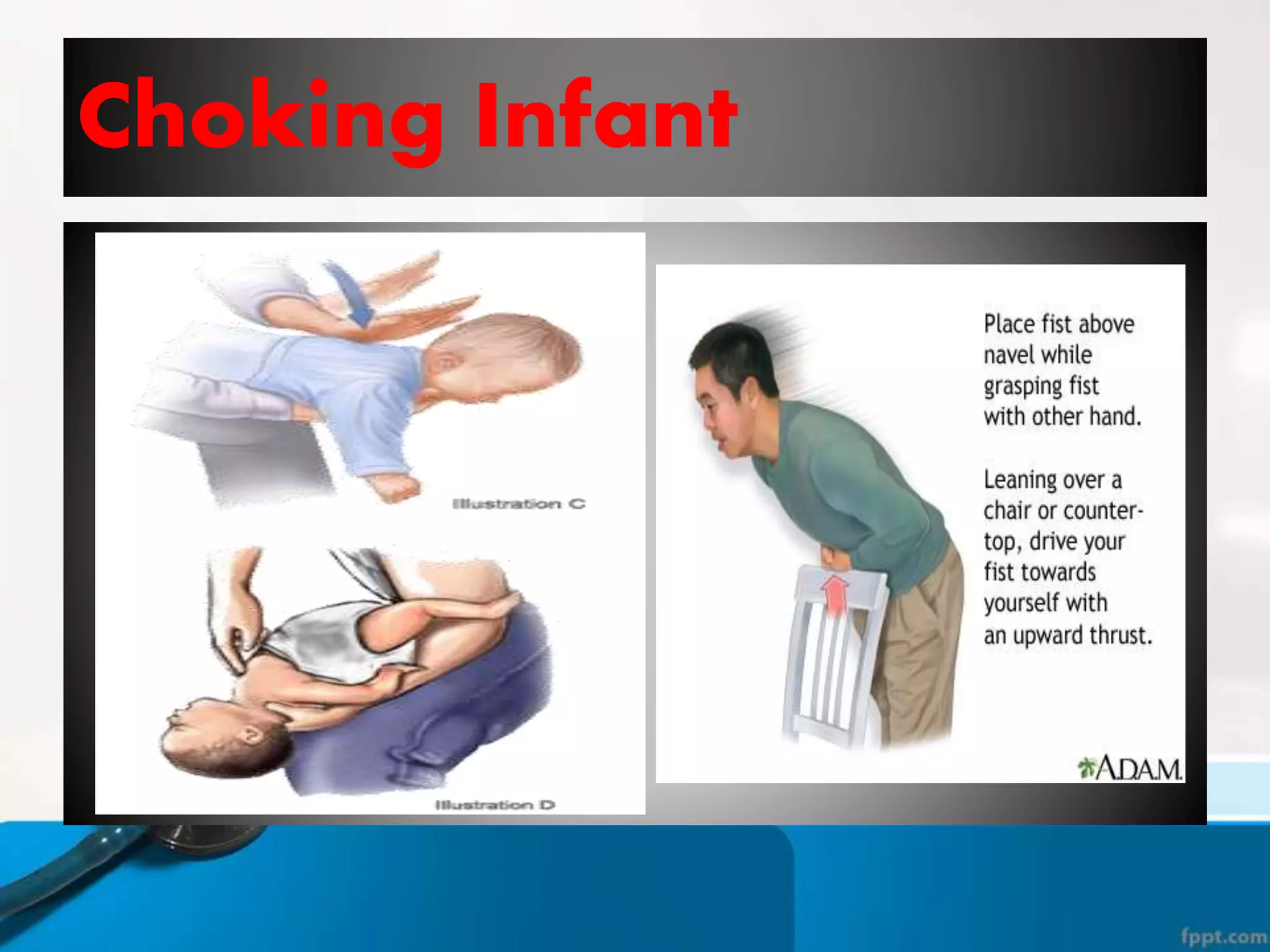
Choking Infant
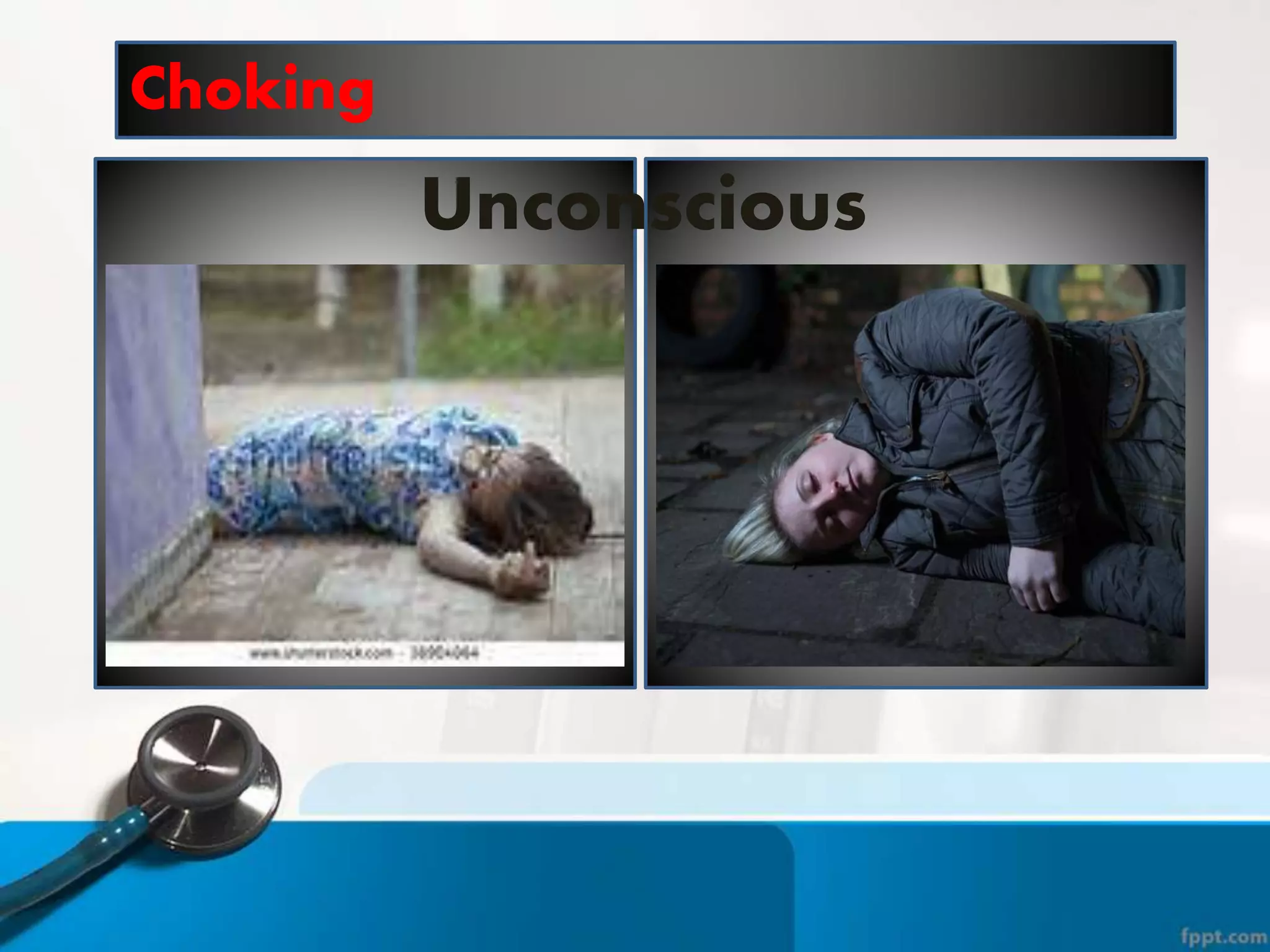
Choking
Unconscious
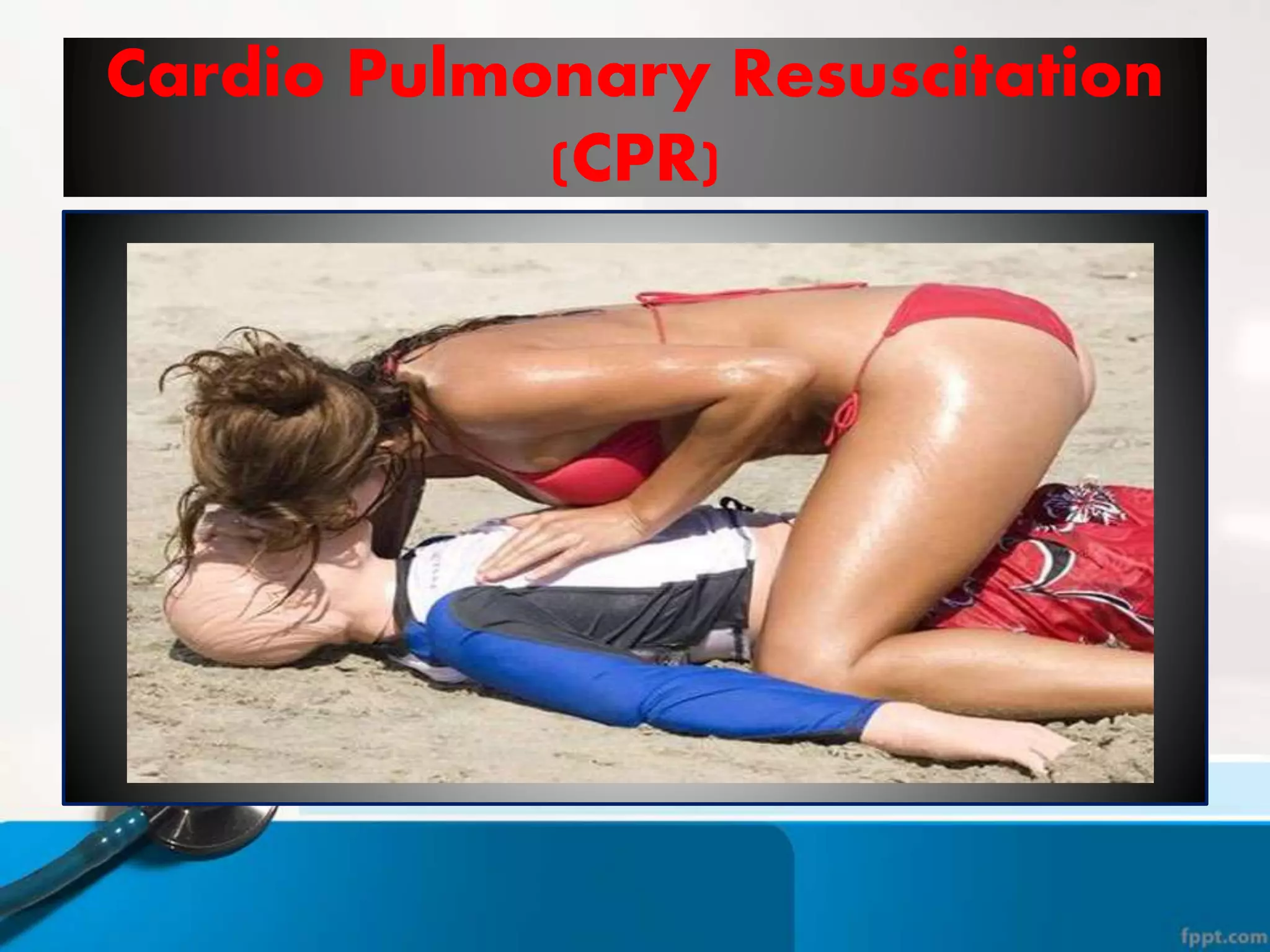
Cardio Pulmonary Resuscitation
(CPR)
Cardio Pulmonary Resuscitation
(CPR)
series of assessments and interventions
using techniques and maneuvers made to
bring victims of cardiac and respiratory
arrest back to life.
Definition:
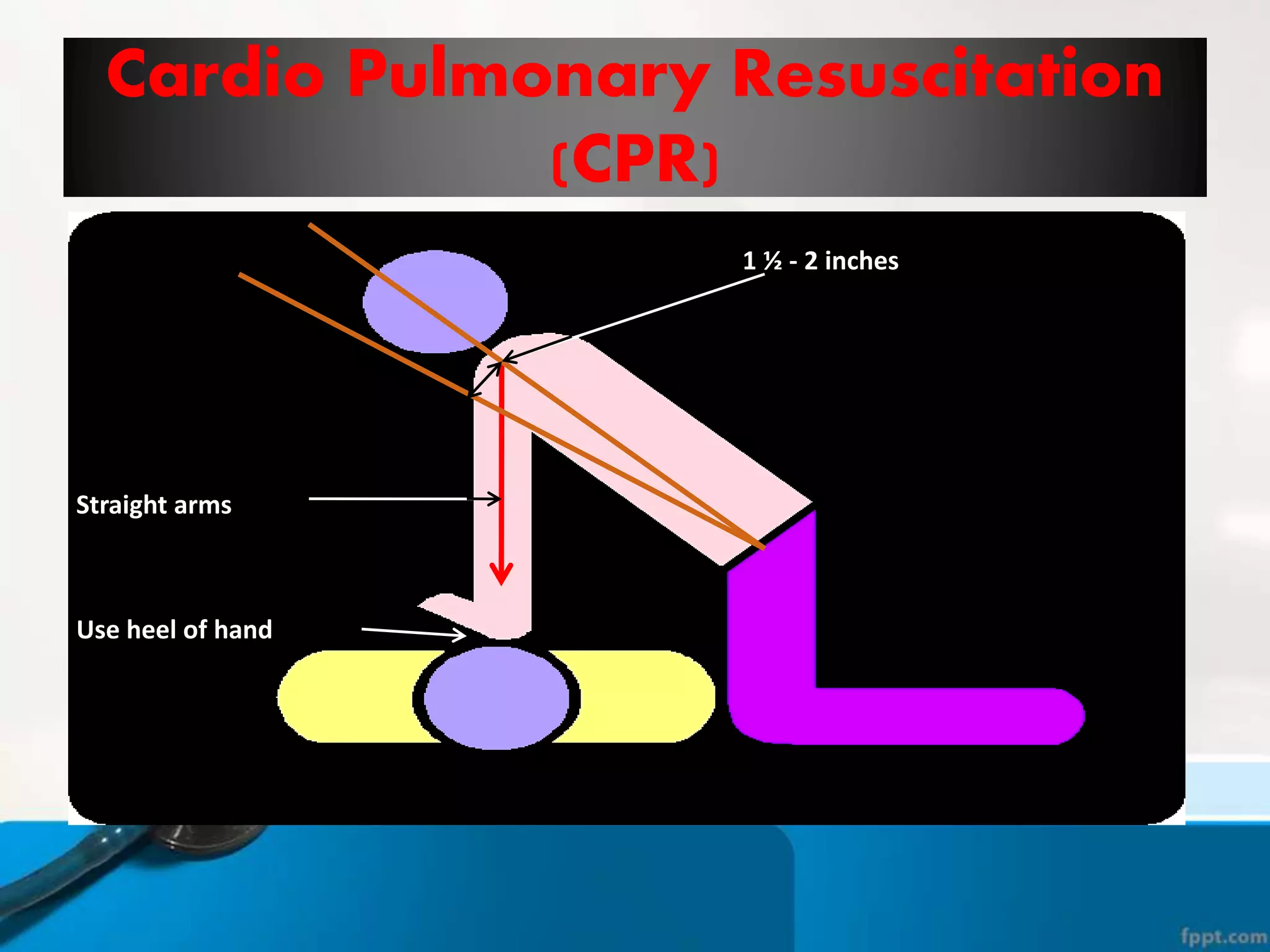
Cardio Pulmonary Resuscitation
(CPR)
Use heel of hand
Straight arms
1 ½ - 2 inches
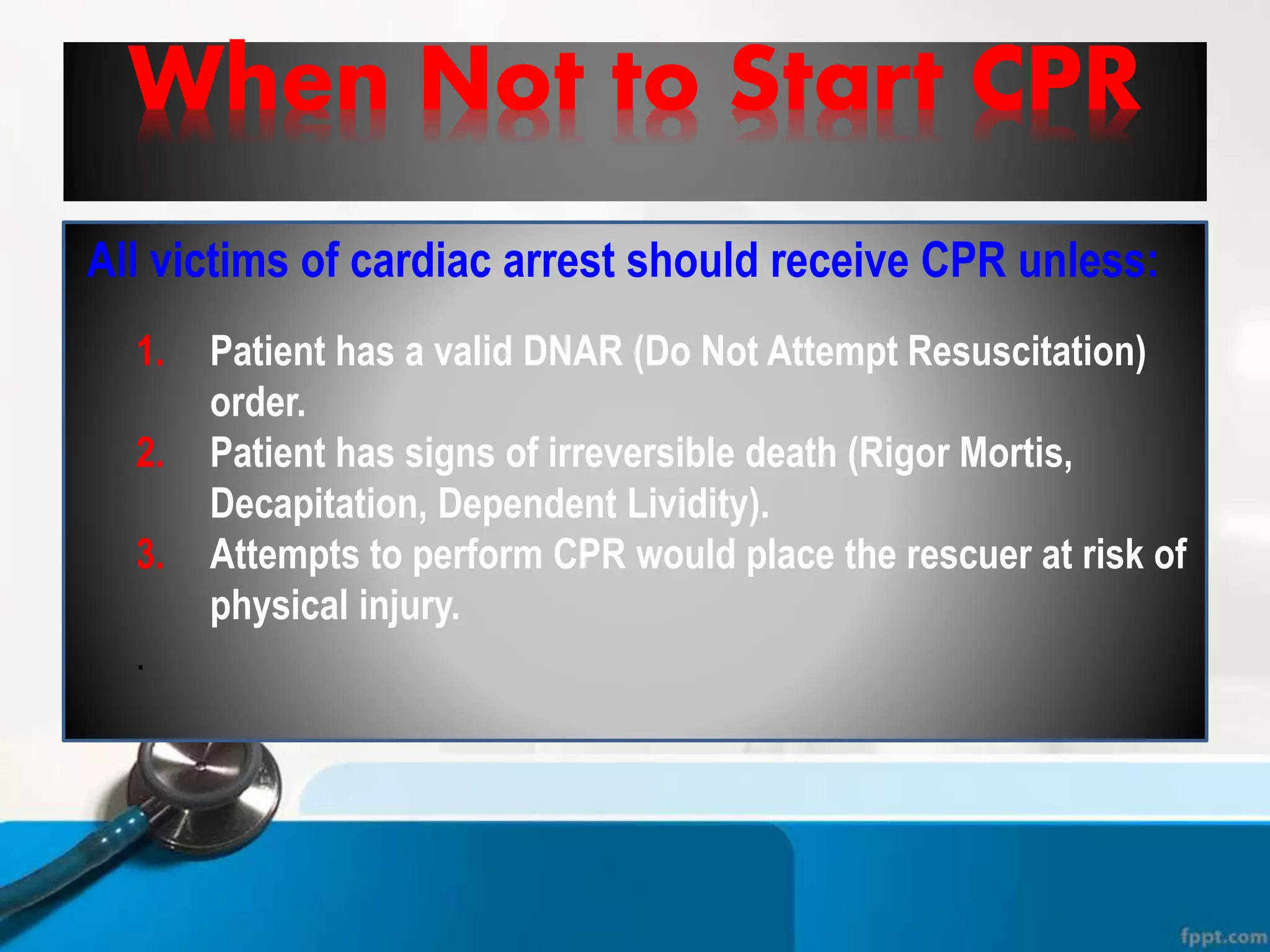
When Not to Start CPR
All victims of cardiac arrest should receive CPR unless:
1. Patient has a valid DNAR (Do Not Attempt Resuscitation)
order.
2. Patient has signs of irreversible death (Rigor Mortis,
Decapitation, Dependent Lividity).
3. Attempts to perform CPR would place the rescuer at risk of
physical injury.
.
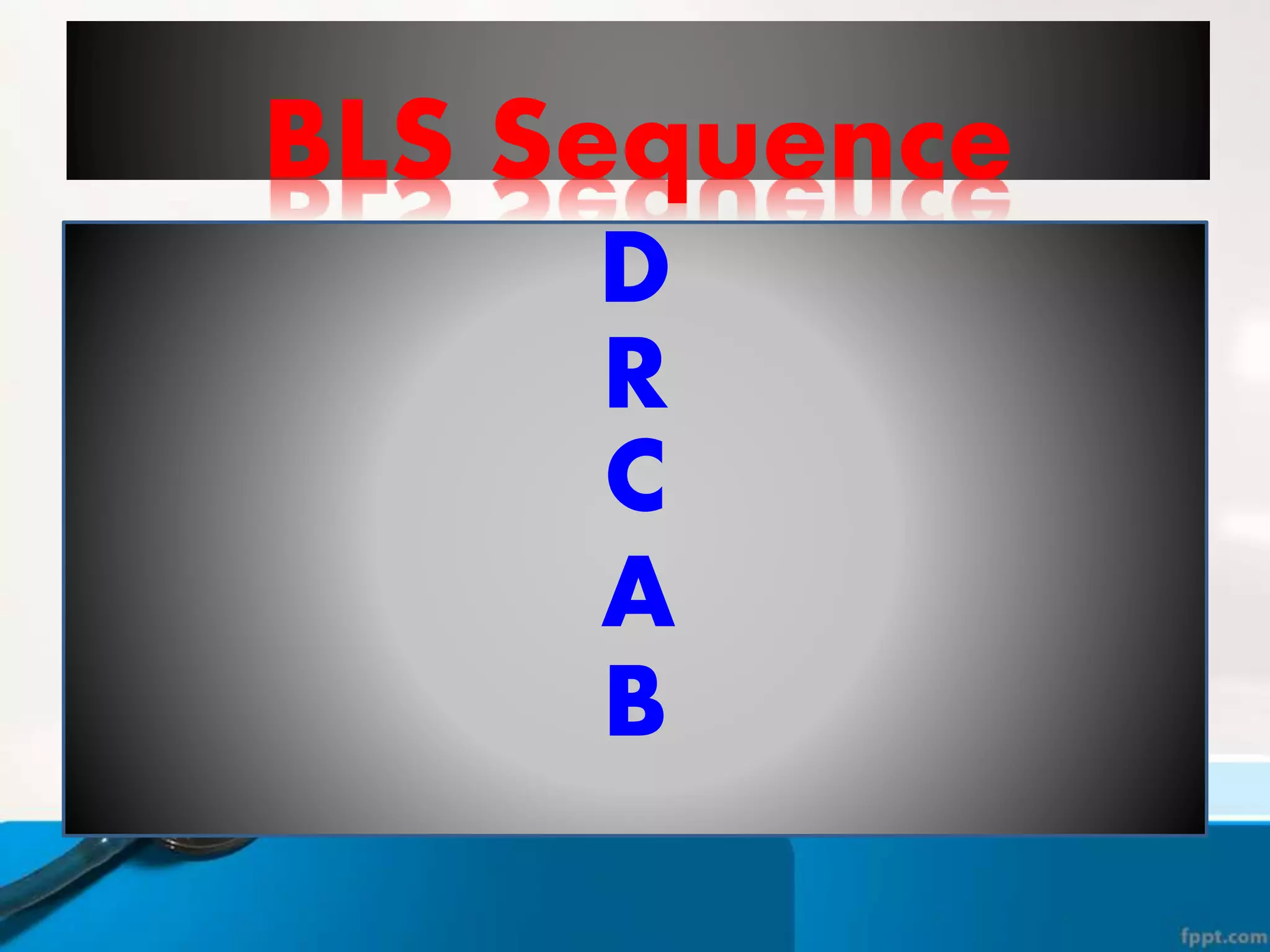
BLS Sequence
D
R
C
A
B
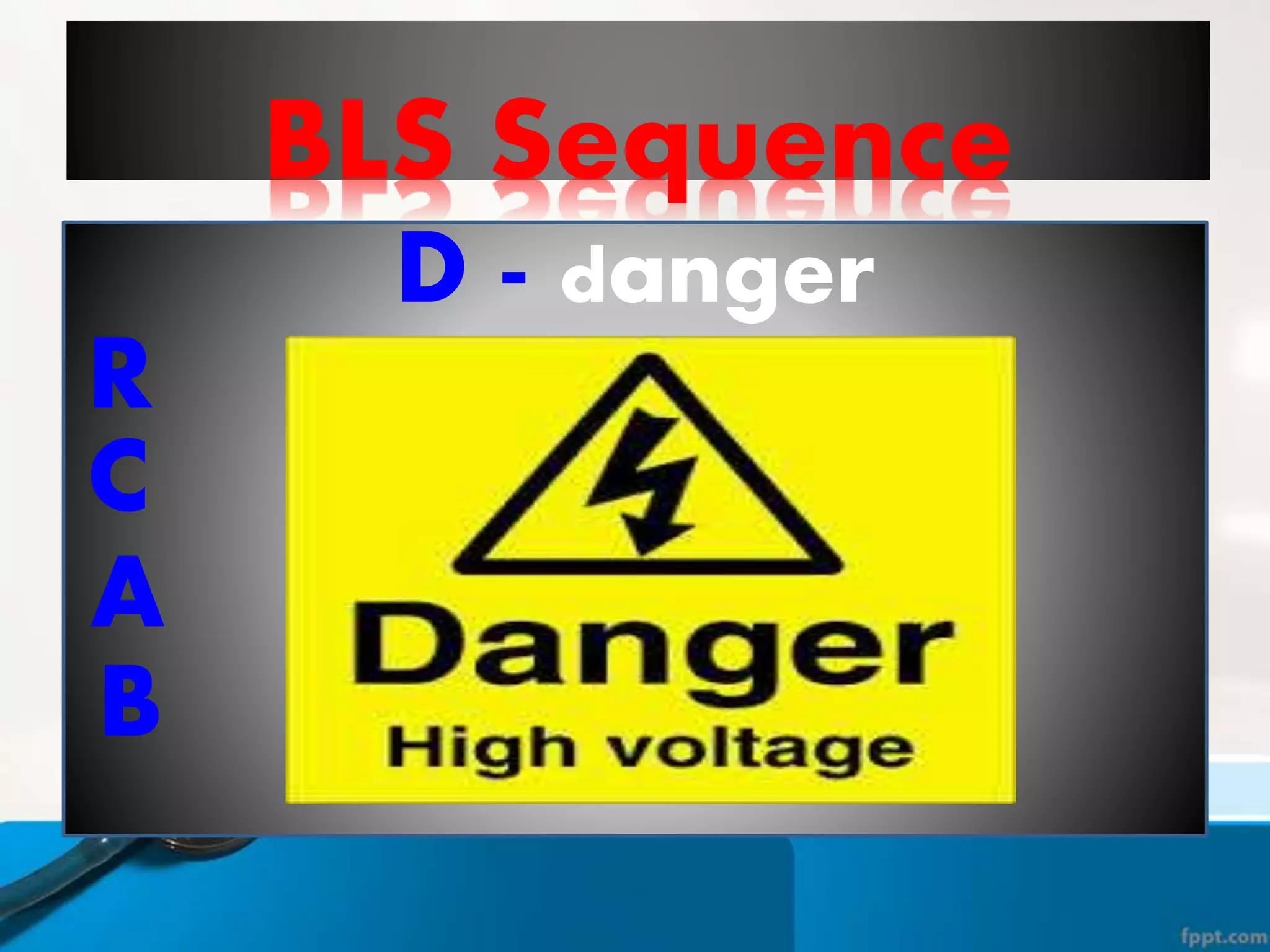
BLS Sequence
D - danger
R
C
A
B
BLS Sequence
R - responsiveness
C
A
B
•Adult and Child
BLS
– Tap the shoulders
to check for
responsiveness
•Infant BLS
– Tap the sole of the
feet to check for
responsiveness
BLS Sequence
C - circulation
A
B
• Pulse Check
– Check pulse no
more than 10
seconds
– If there is no
pulse start CPR
BLS Sequence
Chest Compressions
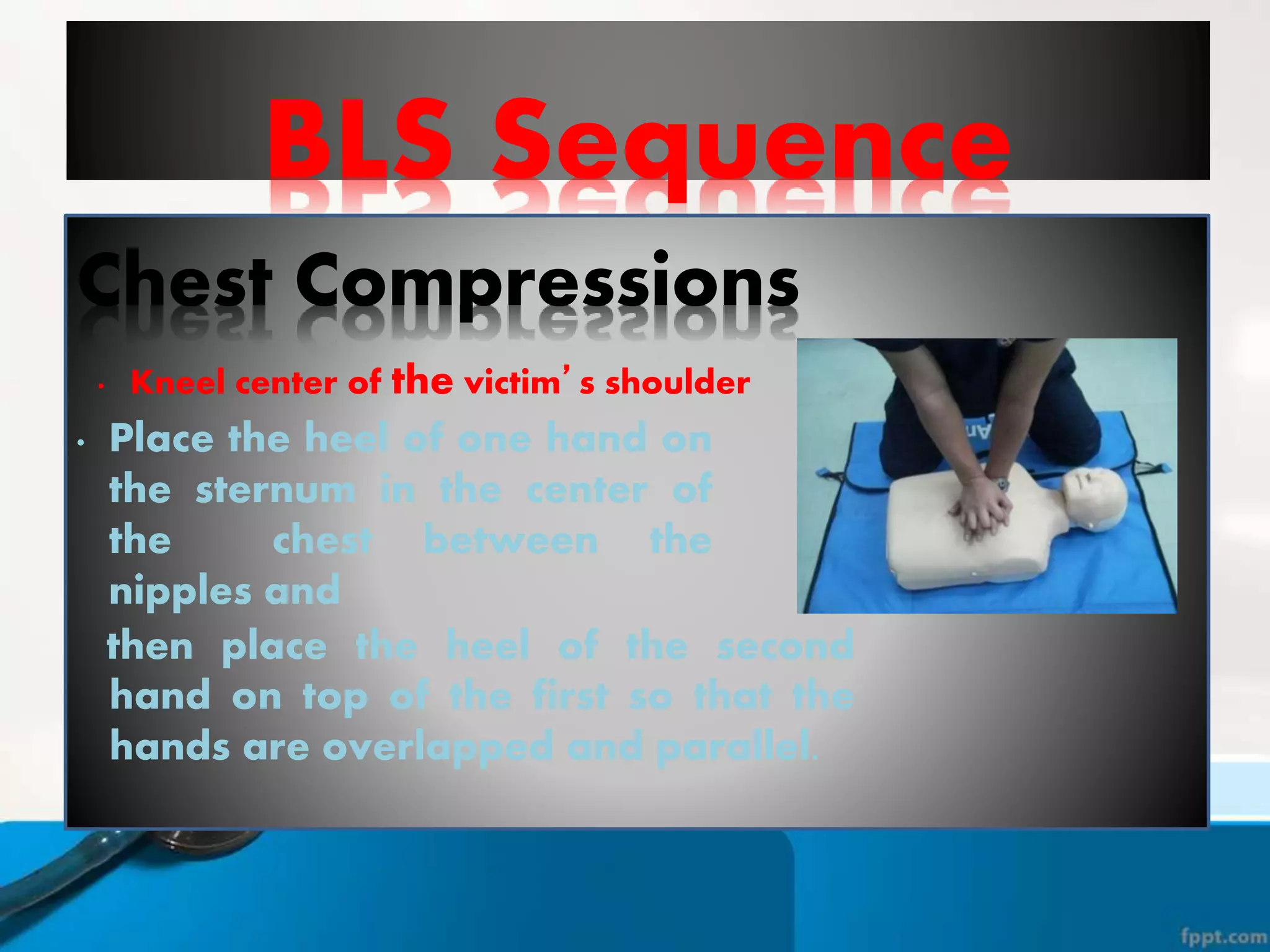
• Kneel center of the victim’s shoulder
• Place the heel of one hand on
the sternum in the center of
the chest between the
nipples and
then place the heel of the second
hand on top of the first so that the
hands are overlapped and parallel.
BLS Sequence
Chest Compressions
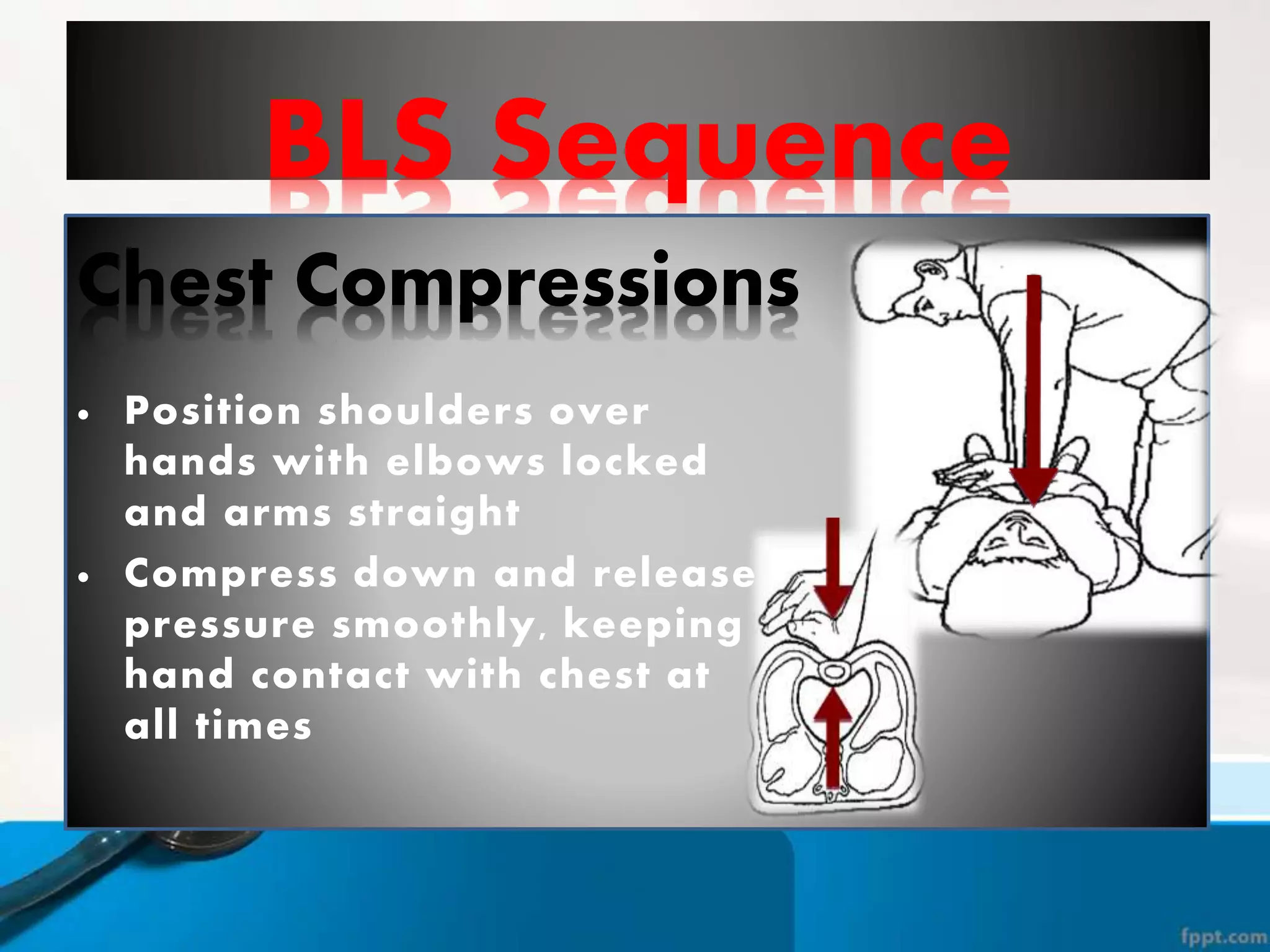
 Position shoulders over
hands with elbows locked
and arms straight
 Compress down and release
pressure smoothly, keeping
hand contact with chest at
all times
BLS Sequence
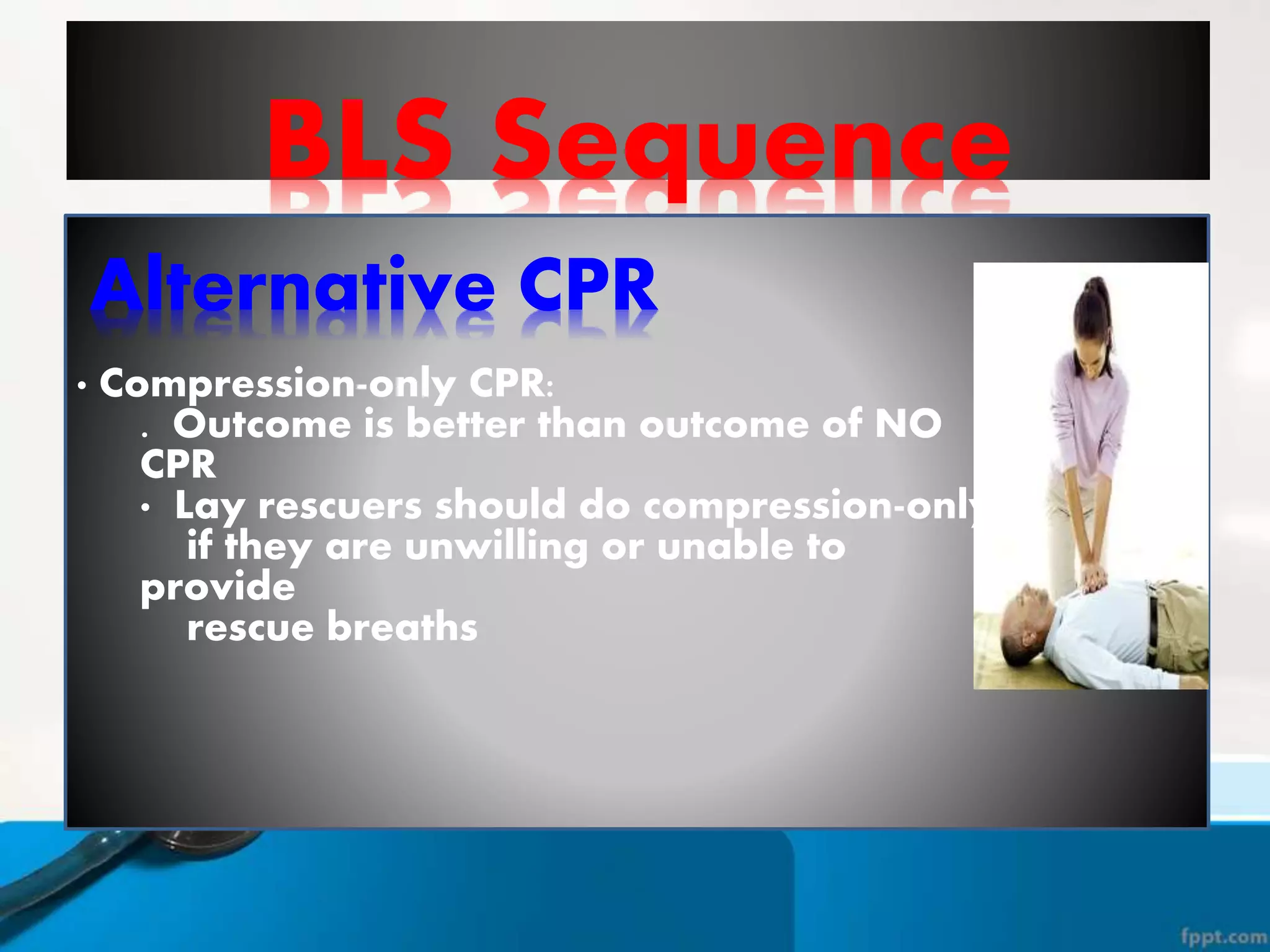
Alternative CPR
• Compression-only CPR:
. Outcome is better than outcome of NO
CPR
• Lay rescuers should do compression-only
if they are unwilling or unable to
provide
rescue breaths
BLS Sequence
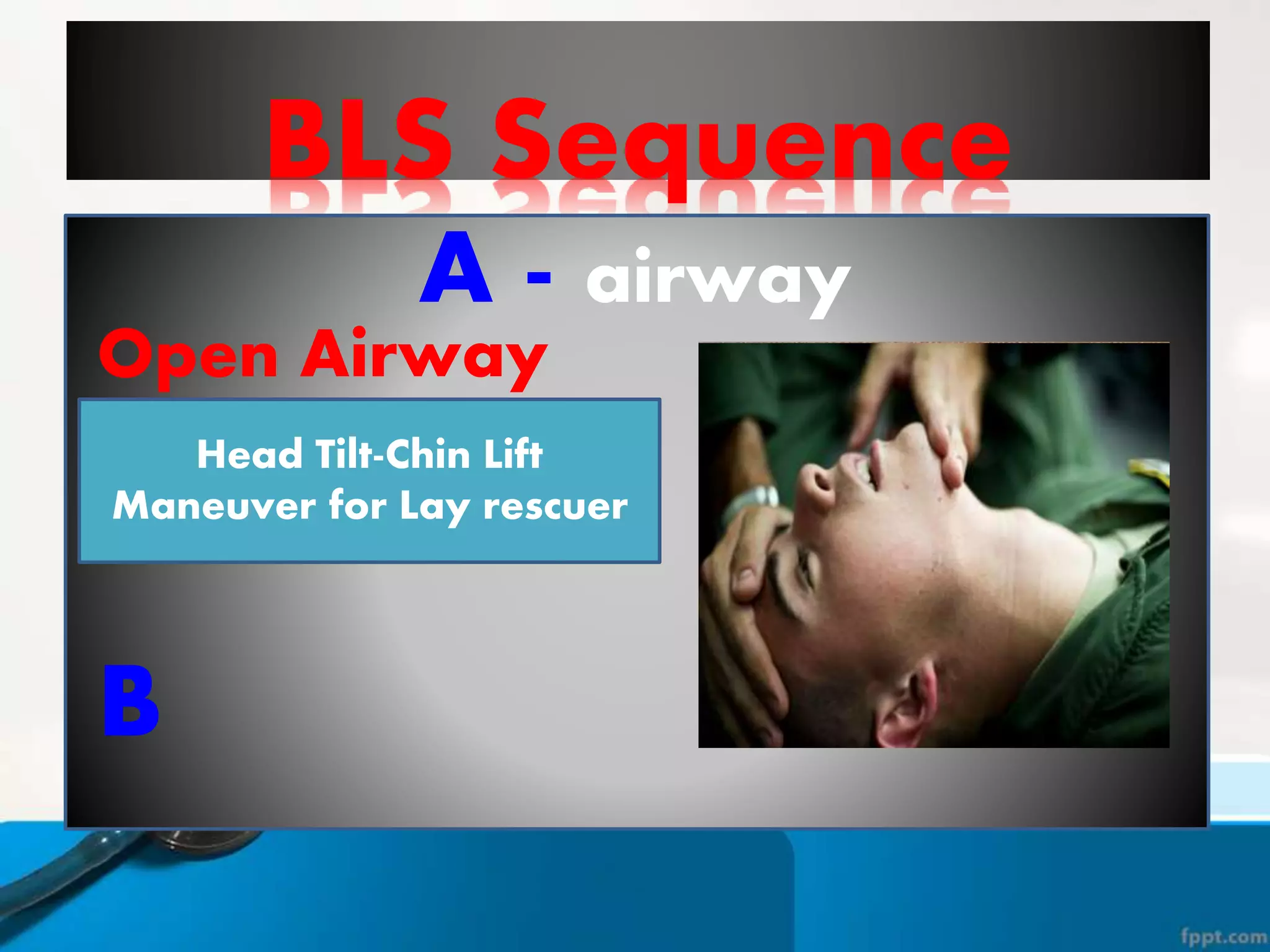
A - airway
B
Open Airway
 Jaw-Thrust Maneuver is
strictly a Healthcare
Provider technique
Head Tilt-Chin Lift
Maneuver for Lay rescuer
BLS Sequence
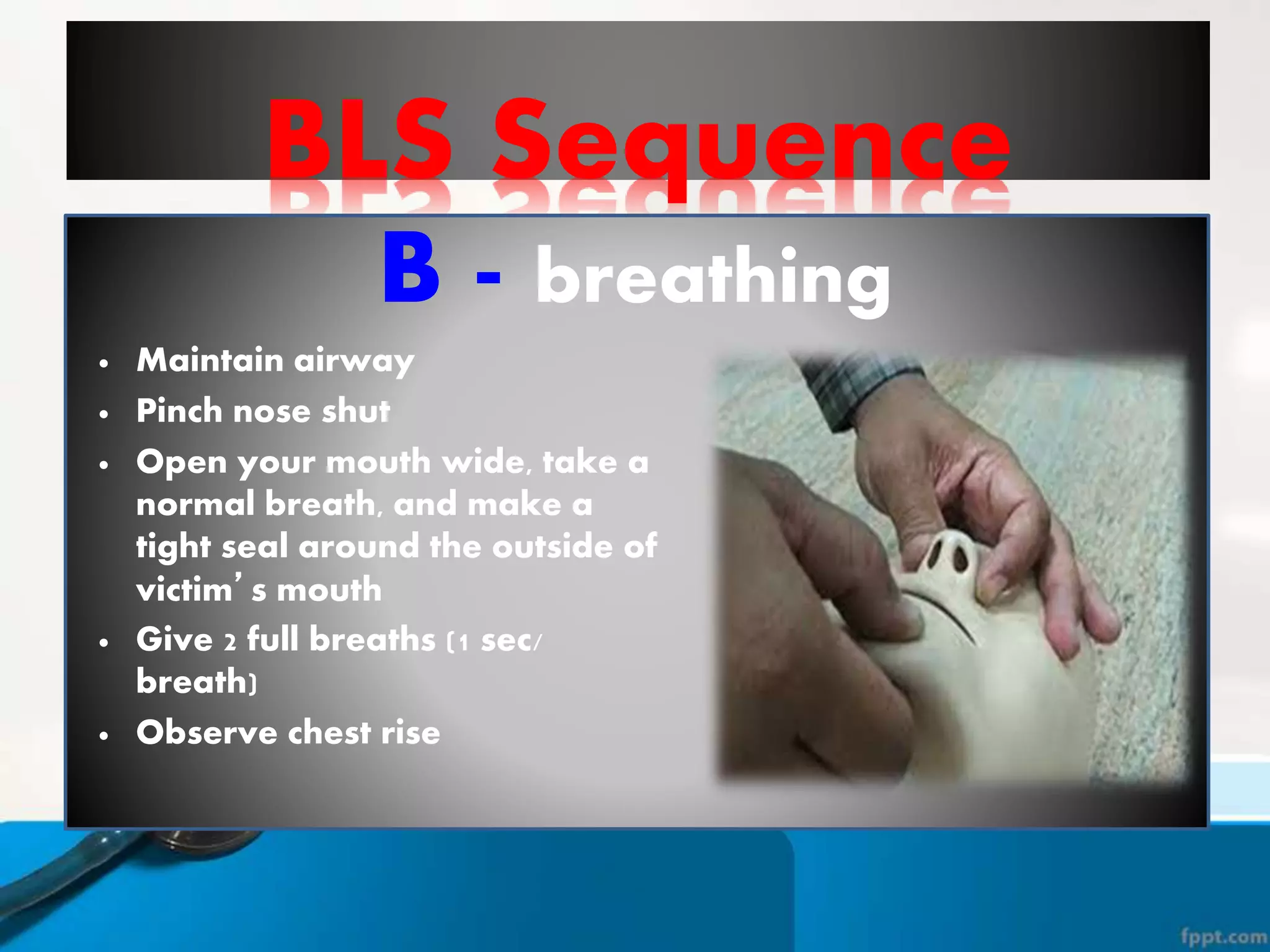
B - breathing
 Maintain airway
 Pinch nose shut
 Open your mouth wide, take a
normal breath, and make a
tight seal around the outside of
victim’s mouth
 Give 2 full breaths (1 sec/
breath)
 Observe chest rise
BLS Sequence
Important Points to Remember
 Ratio - 30 compressions:2 breaths
 Rate - Approx. 100 compressions per
minute
 Depth - 1.5-2 inches
 Cycles
•1 cycle = 30 compressions and 2 breaths
• Five cycles should take no more than 2
minutes
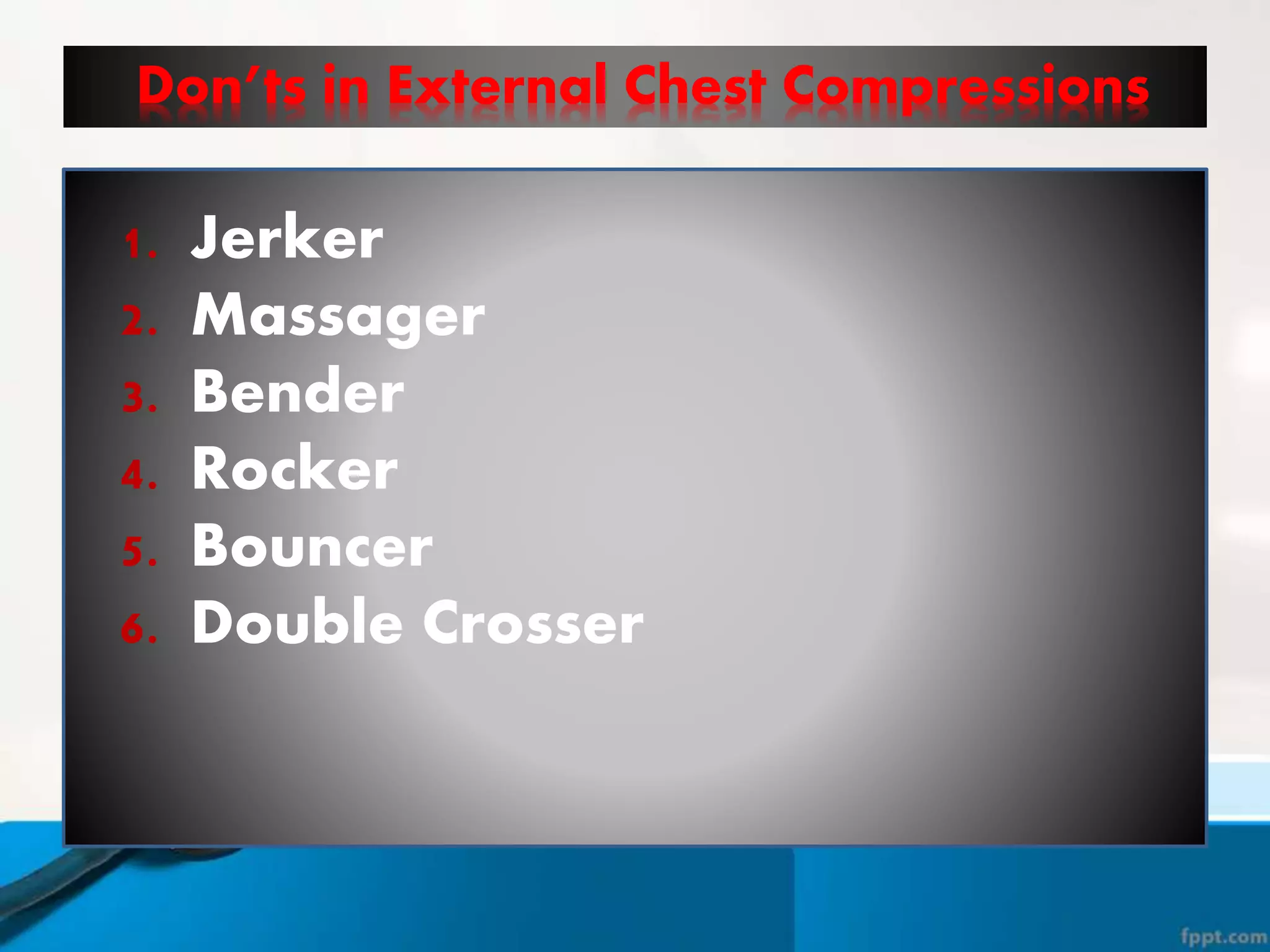
Don’ts in External Chest Compressions
1. Jerker
2. Massager
3. Bender
4. Rocker
5. Bouncer
6. Double Crosser
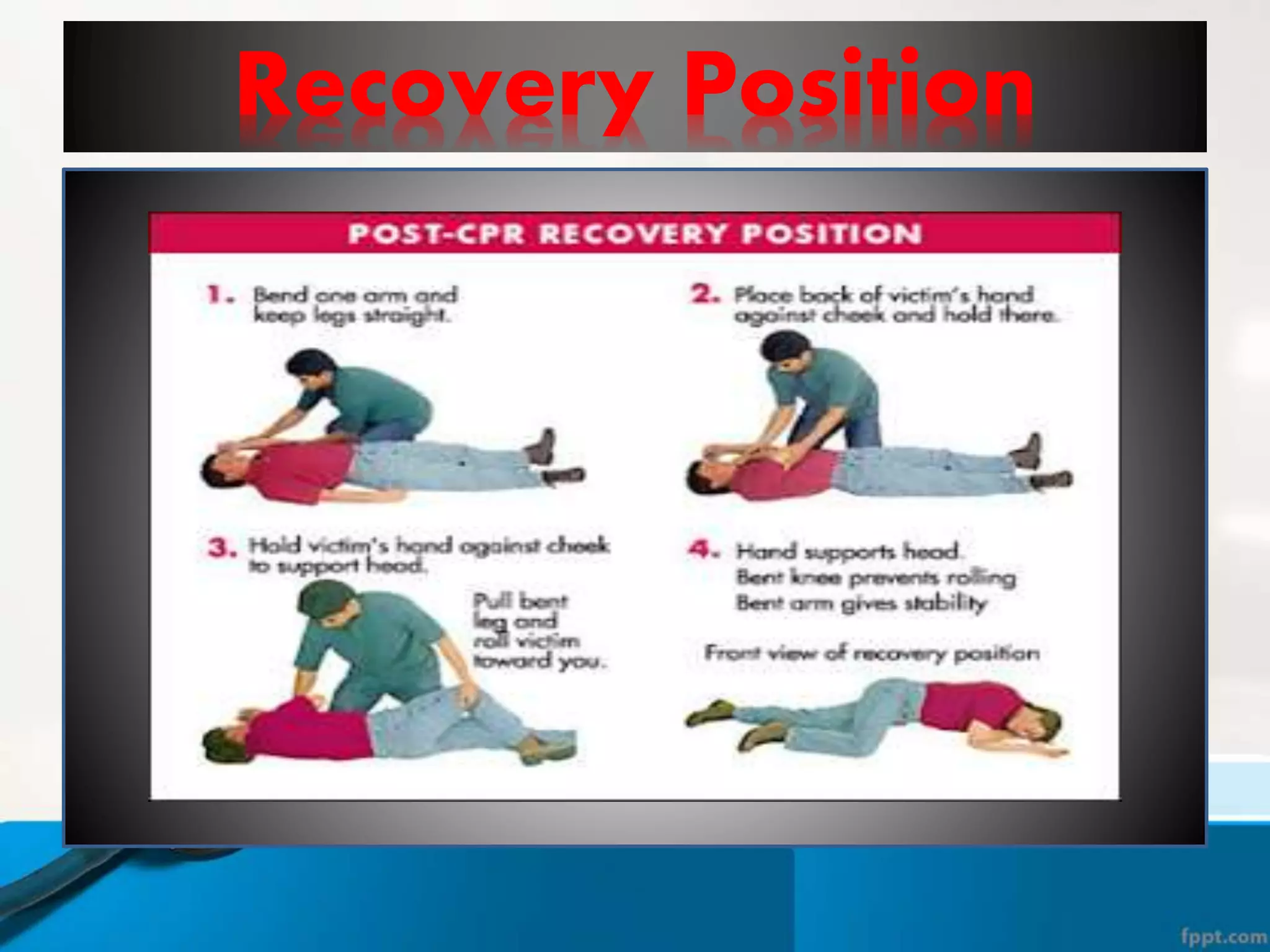
Recovery Position
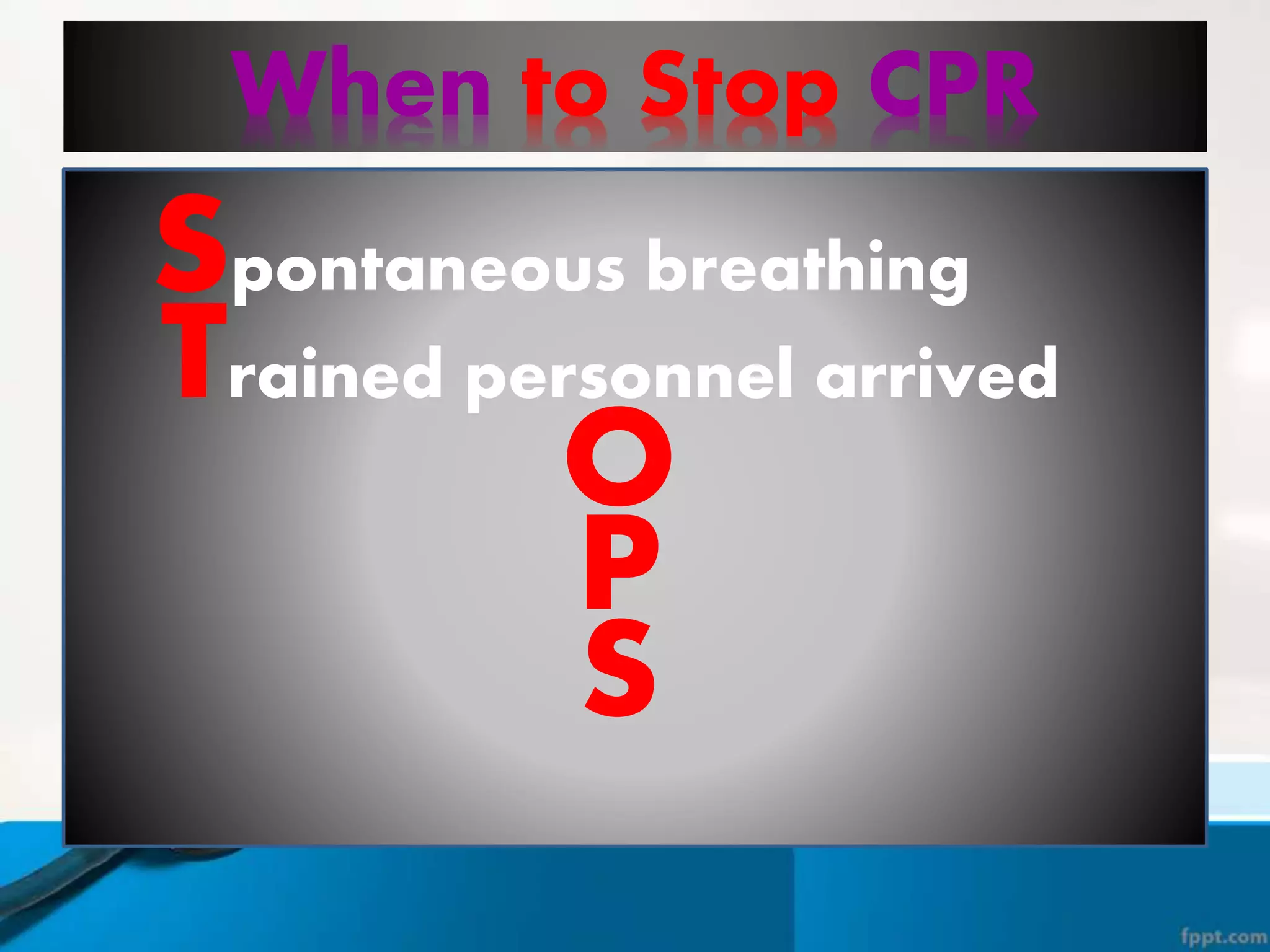
When to Stop CPR
T
S
O
P
S
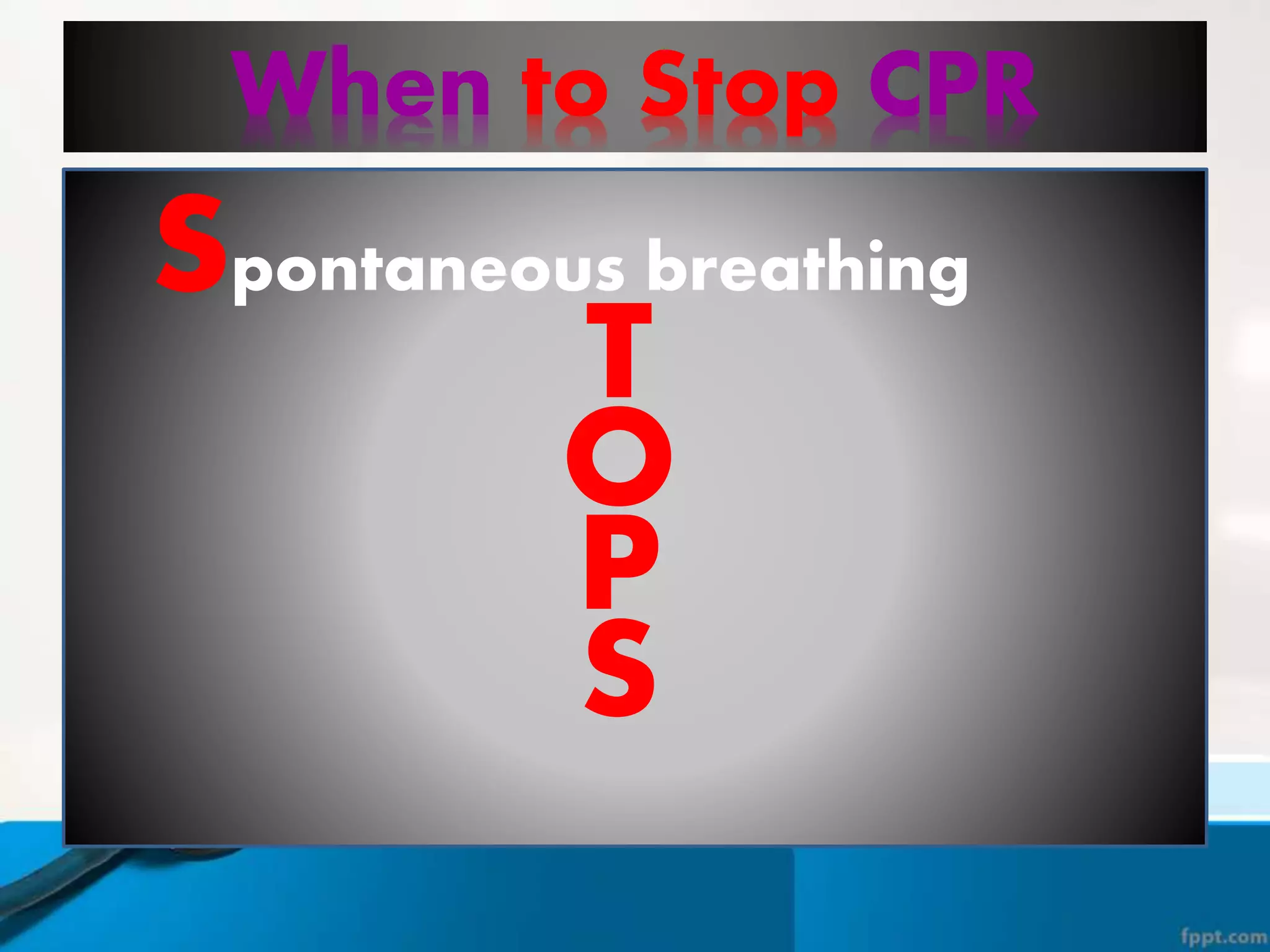
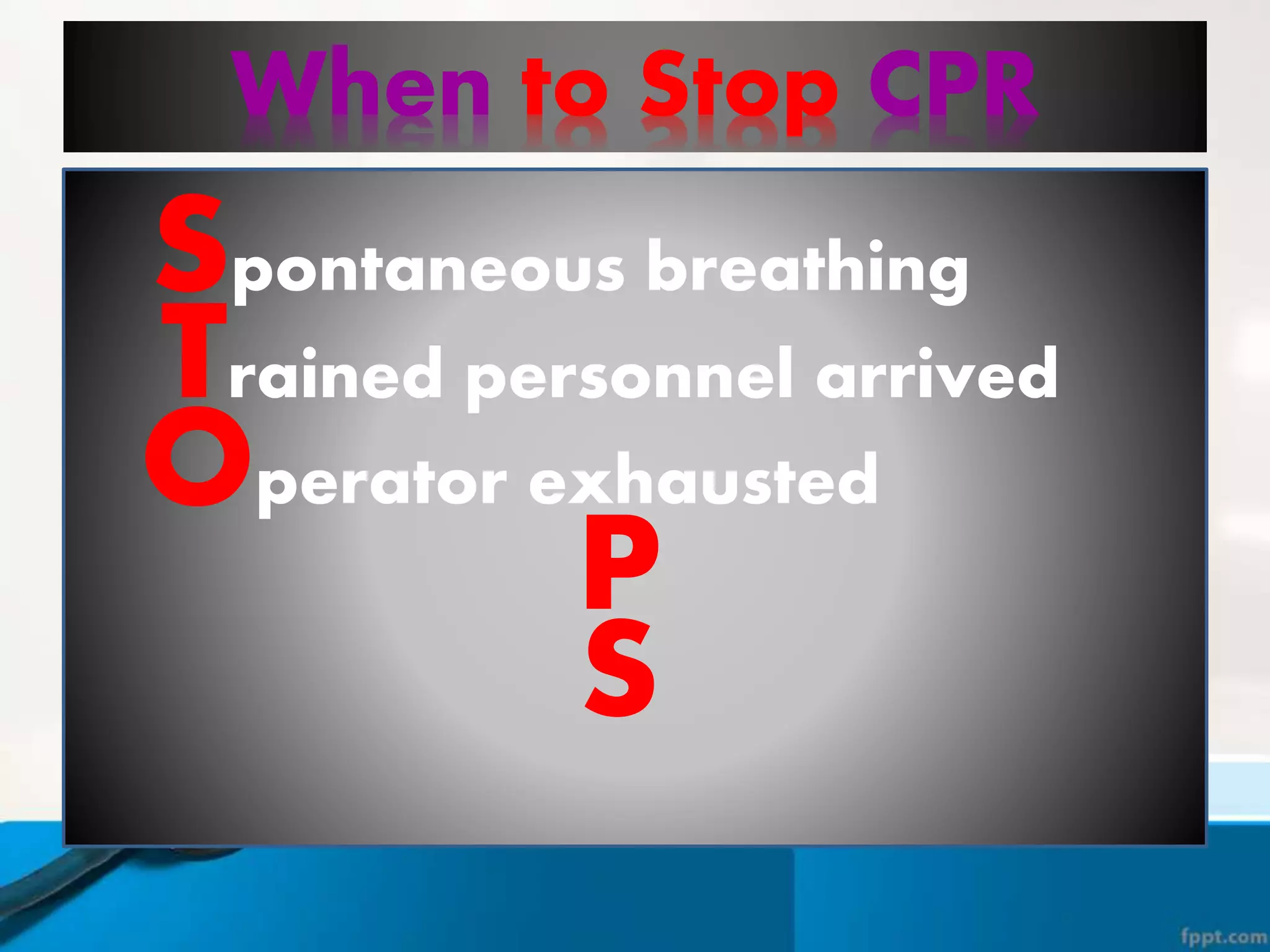
When to Stop CPR
T
O
P
S
Spontaneous breathing
When to Stop CPR
Trained personnel arrived
Spontaneous breathing
O
P
S
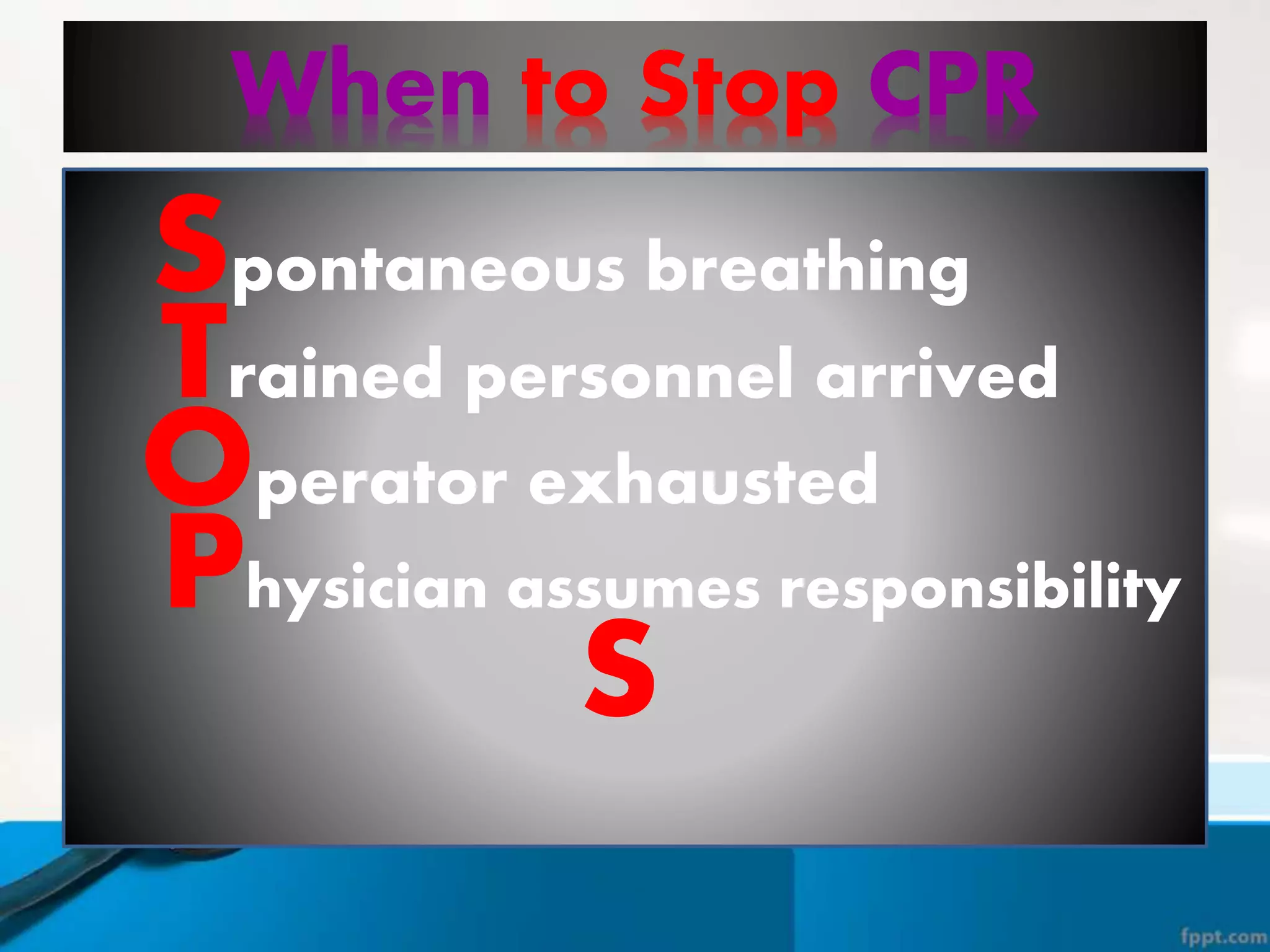
When to Stop CPR
Trained personnel arrived
Spontaneous breathing
Operator exhausted
P
S
When to Stop CPR
Trained personnel arrived
Spontaneous breathing
Operator exhausted
Physician assumes responsibility
S
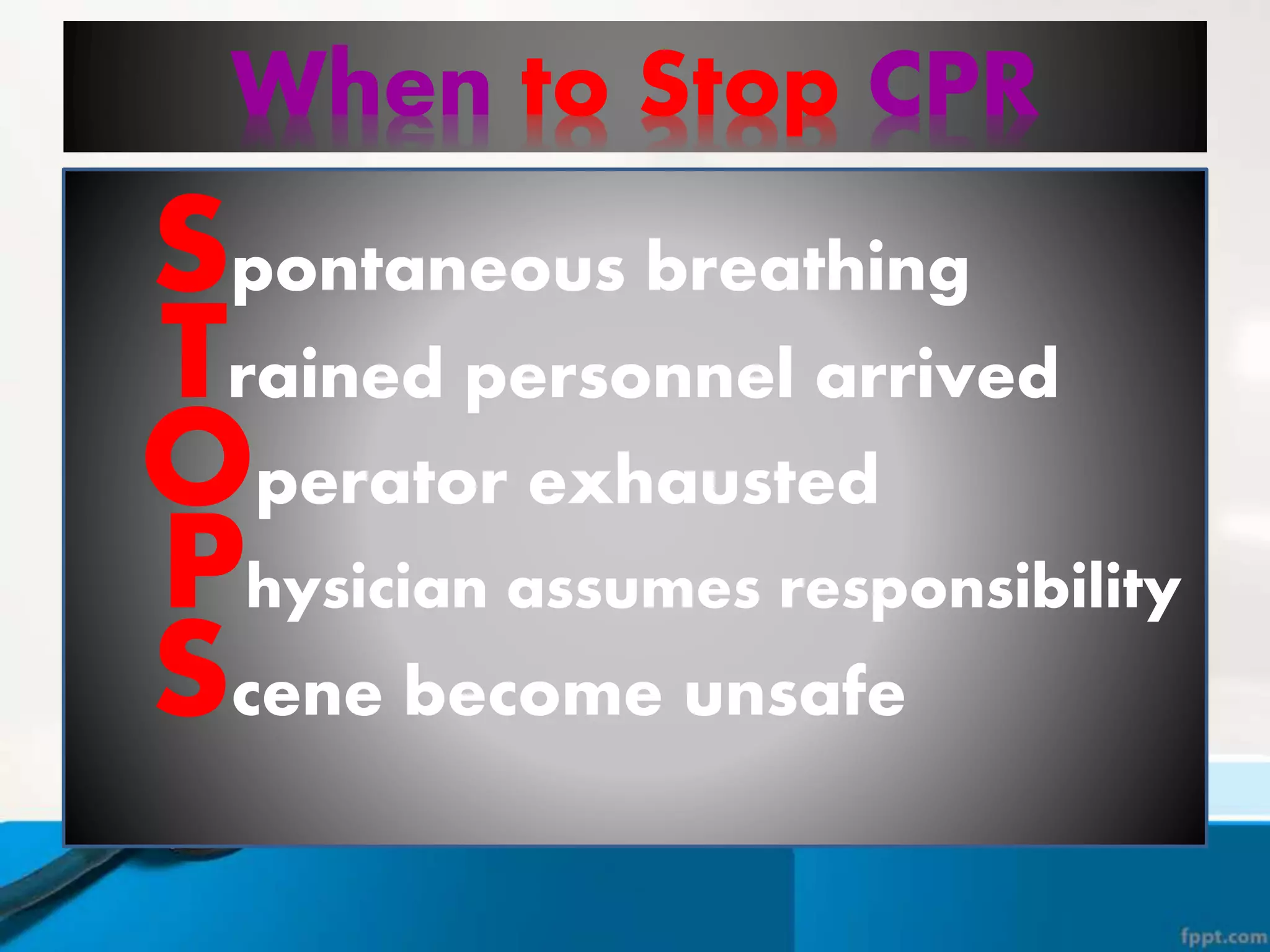
When to Stop CPR
Trained personnel arrived
Spontaneous breathing
Operator exhausted
Physician assumes responsibility
Scene become unsafe
Updated bls training

Updated bls training

  • 1.
    BASIC LIFE SUPPORT JOEYJ. MARCO OIC, CDRRMO Alexander M. Wong Chief Admin & Training, CDRRMO
  • 2.
    Learning Objectives At theend of this session, participants shall be able to: 1. Perform proper Heimlich maneuver techniques 2. Perform correct cardiopulmonary resuscitation techniques to an adult, child and infant who are in cardiac arrest 3. Discuss other alternative forms of CPR 4. How to Place an unconscious breathing victim in the recovery position 5. Enumerate the criteria for when to start and when to stop CPR.
  • 3.
  • 4.
  • 5.
  • 6.
  • 7.
  • 8.
    Cardio Pulmonary Resuscitation (CPR) seriesof assessments and interventions using techniques and maneuvers made to bring victims of cardiac and respiratory arrest back to life. Definition:
  • 9.
    Cardio Pulmonary Resuscitation (CPR) Useheel of hand Straight arms 1 ½ - 2 inches
  • 10.
    When Not toStart CPR All victims of cardiac arrest should receive CPR unless: 1. Patient has a valid DNAR (Do Not Attempt Resuscitation) order. 2. Patient has signs of irreversible death (Rigor Mortis, Decapitation, Dependent Lividity). 3. Attempts to perform CPR would place the rescuer at risk of physical injury. .
  • 11.
  • 12.
    BLS Sequence D -danger R C A B
  • 13.
    BLS Sequence R -responsiveness C A B •Adult and Child BLS – Tap the shoulders to check for responsiveness •Infant BLS – Tap the sole of the feet to check for responsiveness
  • 14.
    BLS Sequence C -circulation A B • Pulse Check – Check pulse no more than 10 seconds – If there is no pulse start CPR
  • 15.
    BLS Sequence Chest Compressions •Kneel center of the victim’s shoulder • Place the heel of one hand on the sternum in the center of the chest between the nipples and then place the heel of the second hand on top of the first so that the hands are overlapped and parallel.
  • 16.
    BLS Sequence Chest Compressions Position shoulders over hands with elbows locked and arms straight  Compress down and release pressure smoothly, keeping hand contact with chest at all times
  • 17.
    BLS Sequence Alternative CPR •Compression-only CPR: . Outcome is better than outcome of NO CPR • Lay rescuers should do compression-only if they are unwilling or unable to provide rescue breaths
  • 18.
    BLS Sequence A -airway B Open Airway  Jaw-Thrust Maneuver is strictly a Healthcare Provider technique Head Tilt-Chin Lift Maneuver for Lay rescuer
  • 19.
    BLS Sequence B -breathing  Maintain airway  Pinch nose shut  Open your mouth wide, take a normal breath, and make a tight seal around the outside of victim’s mouth  Give 2 full breaths (1 sec/ breath)  Observe chest rise
  • 20.
    BLS Sequence Important Pointsto Remember  Ratio - 30 compressions:2 breaths  Rate - Approx. 100 compressions per minute  Depth - 1.5-2 inches  Cycles •1 cycle = 30 compressions and 2 breaths • Five cycles should take no more than 2 minutes
  • 21.
    Don’ts in ExternalChest Compressions 1. Jerker 2. Massager 3. Bender 4. Rocker 5. Bouncer 6. Double Crosser
  • 22.
  • 23.
    When to StopCPR T S O P S
  • 24.
    When to StopCPR T O P S Spontaneous breathing
  • 25.
    When to StopCPR Trained personnel arrived Spontaneous breathing O P S
  • 26.
    When to StopCPR Trained personnel arrived Spontaneous breathing Operator exhausted P S
  • 27.
    When to StopCPR Trained personnel arrived Spontaneous breathing Operator exhausted Physician assumes responsibility S
  • 28.
    When to StopCPR Trained personnel arrived Spontaneous breathing Operator exhausted Physician assumes responsibility Scene become unsafe