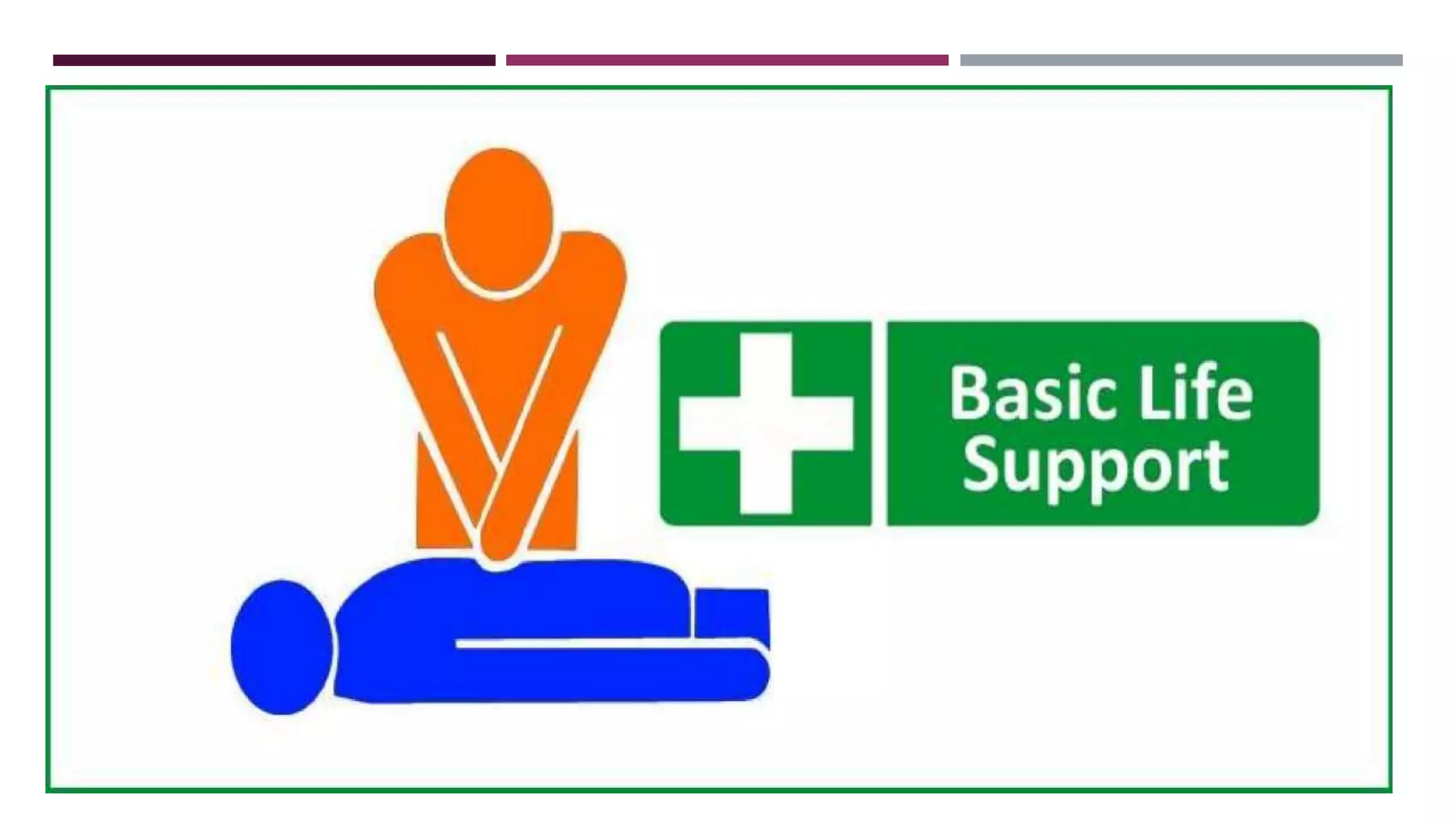
By-
Dr. ASHWINI KUMAR
(MS Surgery)
NMCH, PATNA
After an accident, immediately move the
victim to a comfortable position.
An AED (Automated External Defibrillator) should be
used before performing CPR
We should use a head tilt-chin lift to open the airway
in an adult victim when you do not suspect a cervical
spine injury
Check for a carotid pulse in an infant when
beginning the steps of CPR
Prequiz:
True or False?
OBJECTIVES
◾Define BLS
◾Explain steps & components of
BLS
WHAT IS BLS ?
◾Basic life support refers to sequences of
procedures performed to restore the circulation
of oxygenated blood after a sudden pulmonary
and/or cardiac arrest by chest compressions
and pulmonary ventilation performed by anyone
who knows how to do it, anywhere, immediately,
without any other equipment.
COMPONENTS
◾Ensure safety
◾Check for response
◾Activate EMS(102)
◾Chest compressions
◾Check airway and ventilate
◾Defibrillate
STEPS OF BLS
1. ENSURE SAFETY
◾Safety of SELF
◾Safety of PATIENT
◾Movement of TRAUMA
victim only when
absolutely necessary.
[unstable cervical spine,
injured spinal cord]
2. ASSESS RESPONSE (AVPU)
◾Ask the person “Are you ok ?”
◾Tap and shout
◾Look the chest for movement and
breathing.
◾If the victim responds-
leave the client and call for help .
Return as quick as possible and reassess
the condition of the person.
Are you ok ?
If the victim is unresponsive- HELP ,HELP,
HELP !!!
3. ACTIVATE EMS
◾Call 102
◾ Describe the emergency to the operator:
-includes where you are (address and
location)
-condition of patient
CHANGE FROM A-B-C TO C-A-B
 The ABC regime is used now exclusively for
victims of TRAUMA.
 The vast majority of cardiac arrests occur in
adults. In these patients, the critical initial
elements of BLS are chest compressions
and early defibrillation.
 In the A-B-C sequence, chest compressions
are often delayed while the responder opens
the airway to give mouth-to-mouth breaths ,
retrieves a barrier device, or gathers and
assembles ventilation equipment.
C. CIRCULATION
◾Position of victim :
• Must be supine on a firm flat surface for
CPR to be effective
Check the patient for a carotid pulse for 5-10 seconds. (Do not check
for more than 10 seconds.)
1. If the patient has a pulse:
• Move to the airway and rescue Breathing portion of the algorithm.
• Provide 10 rescue breaths per minute (1 breath every 6 seconds).
• Recheck pulse every 2 minutes.
2. If the patient doesn’t have a pulse:
• Begin CPR (lasts approx. 2 minutes).
4. CHEST COMPRESSIONS
◾POSTION OF THE RESCUER
1. Kneel beside victim’s chest or stand beside bed
line.
parallel
2. Heel of one hand on inter-mammary line( lower half of the sternum) in mid
3. Heel of other hand on top of the first so that the hands are overlapped and
4. Lock elbows
1,2,3,4,5,6,……
.29,30
GOOD COMPRESSIONS
“Push hard push fast”. Push at a rate of 100-120/min.
Compression depth- at least 2 inches(5cm)(not more than2.5
inches)
Release completely to allow the chest to fully recoil.
 A compression-ventilation ratio of 30:2 .
◾Do not bounce your hands up and down on the victim’s chest.
◾Never use the palm of your hand, use the heel of your hand.
◾If two rescuers are present: switch rolls between compressor and
rescue breather every 5 cycles.
A. AIRWAY
OPEN AIRWAY
 In the event of an unwitnessed collapse,
drowning or trauma:
Use the “Jaw Thrust maneuver”. (This maneuver
is used when a cervical spine injury cannot be
ruled out.)
a. Place your fingers on the lower rami of the
jaw behind the angles.
b. Provide anterior pressure to advance the
jaw forward using your thumb.
 In the event of a witnessed collapse with no
reason to assume a C-spine injury:
Use the “Head Tilt-Chin Lift maneuver” :
a. place your palm on the patient’s forehead
and apply pressure to tilt the head
backward.
b. place the fingers of your other hand under
the mental protuberance of the chin and
pull the chin forward and cephalic.
B. BREATHING
◾Scan the patients chest and torso for
possible movement during the “assess
unresponsiveness” portion of the
algorithm. Watch for abnormal
breathing or gasping.
◾Breathing check should take no longer
than10 seconds. If no breath is
detected, CPR should not be delayed.
 Maintain airway and place your ear over casualty’s mouth and
nose, looking toward their abdomen.
1. If the patient is breathing adequately: Continue to assess and maintain
a patent airway and place the patient in the “recovery position”. (Only
use the recovery position if its unlikely to worsen patient injury.)
2. If the patient is not breathing or is breathing INADEQUATELY:
• If the patient has a pulse
i. Commence rescue breaths immediately.
ii. Provide 10 rescue breaths per minute (1 breath every 6 seconds).
iii. Recheck pulse every 2 minutes.
• If the patient has NO pulse
Begin CPR. (move to the “Circulation” portion of the algorithm) along
with rescue breaths.
 An advanced airway (supraglottic airway, laryngeal mask airway,
or endotracheal tube) provides a more stable way of providing
breaths and should, therefore, be inserted as early as possible in a
resuscitation effort.
 During normal CPR without an advanced airway:
approximately 6-8 rescue breaths per minute
 During normal CPR with an advanced airway:
10 rescue breaths per minute
(don’t pause chest compressions for breaths).
RESCUE BREATHS
◾ Use a barrier device if available.
◾ Pinch the patient’s nose closed.
◾ Make a seal using your mouth over the
mouth of the patient or use a pocket mask
or bag mask.
◾ Each rescue breath should last
approximately 1 second.
◾ Watch for chest rise.
◾ Allow time for the air to expel from the
patient.
HOW TO APPLY A SEAL USING A MASK
Pediatric BLS modifications
• Compress the chest by about AT LEAST 1/3 of its depth.
• For a baby under 1 year, use two fingers
• For a child over 1 year use one hand to achieve an
adequate depth
Pediatric BLS modifications
Approach safely
Check response
Shout for help
Open airway
Check breathing
Call (102)
30 chest compressions
2 rescue breaths
APPROACH SAFELY!
Scene
Rescuer
Victim
Bystanders
Approach safely
Check response
Shout for help
Open airway
Check breathing
Call (102)
30 chest compressions
2 rescue breaths
CHECK RESPONSE
Approach safely
Check response
Shout for help
Open airway
Check breathing
Call (102)
30 chest compressions
2 rescue breaths
Shake shoulders gently
Ask “Are you all right?”
If he responds
 Find out what is wrong.
 Reassess regularly.
If he does not respond
CHECK RESPONSE
SHOUT FOR HELP
Approach safely
Check response
Shout for help
Open airway
Check breathing
Call (102)
30 chest compressions
2 rescue breaths
OPEN AIRWAY
Approach safely
Check response
Shout for help
Open airway
Check breathing
Call (102)
30 chest compressions
2 rescue breaths
OPEN AIRWAY
Head tilt, chin lift + jaw thrust
- For healthcare professionals
CHECK BREATHING
Approach safely
Check response
Shout for help
Open airway
Check breathing
Call (102)
30 chest compressions
2 rescue breaths
CHECK BREATHING
 Look, listen and feel
for NORMAL
breathing
 Do not confuse
AGONAL breathing
with normal breathing
AGONAL BREATHING
 Occurs shortly after the heart stops
in up to 40% of cardiac arrests
 Described as barely, heavy, noisy or
gasping breathing
 Recognise as a sign of cardiac arrest
Erroneous information can result in withholding CPR
from cardiac arrest victim
Approach safely
Check response
Shout for help
Open airway
Check breathing
Call (102)
30 chest compressions
2 rescue breaths
30 CHEST COMPRESSIONS
Approach safely
Check response
Shout for help
Open airway
Check breathing
Call (102)
30 chest compressions
2 rescue breaths
 Place the heel of one hand in
the centre of the chest
 Place other hand on top
 Interlock fingers
 Compress the chest
Rate 100 min-1
Depth 4-5 cm
Equal compression : relaxation
 When possible change CPR
operator every 2 min
CHEST COMPRESSIONS
RESCUE BREATHS
 Pinch the nose
 Take a normal breath
 Place lips over mouth
 Blow until the chest
rises
 Take about 1 second
 Allow chest to fall
 Repeat
CONTINUE CPR
30 2
D. DEFIBRILLATE
◾AED – Automatic external Defibrillator
• A battery operated device which on applying to
victim detects and assesses cardiac rhythm and
prompts the user for further action.
Components:
• On/Off switch
• Plug with flashing light near it
• Shock delivery button(orange)
• Speaker & volume control for voice prompt.
• Two self sticking pads with cables & connectors
 POWER: Turn AED On NOW! (early
defibrillation is the single most
important therapy for survival of
cardiac arrest and should be done
as soon as it arrives).Follow verbal
AED prompts.
 ATTACHMENT : Firmly place
appropriate pads (adult/pediatric)
to patient’s skin to the indicated
locations (pad image).
 ANALYSE: A short pause in CPR is
required to allow the AED to
analyze the rhythm.
 If the rhythm is not shockable : Initiate 5 cycles of CPR 30:2 .Recheck the rhythm at
the end of the 5 cycles of CPR.
 If the shock is indicated: Assure no one is touching the patient or is in mutual contact
of a good conductor of electricity by yelling “Clear, I’m Clear, you’re Clear!” prior to
delivering a shock . Press the shock button when the providers are clear of the
patient.
Resume 5 cycles of CPR. Clear, I’m Clear,
you’re Clear!
RECOVERY POSITION
(LATERAL RECUMBENT OR 3/4 PRONE POSITION)
in.
 If the victim responds, position him in the recovery position and monitor
breathing until help arrives.
◾ This position is used to maintain a patent airway in the unconscious
person. Place the patient close to a true lateral position with the head
dependent to allow fluid to dra
 Avoid pressure of the chest
that could impairs
breathing.
 Position patient in such a
way that it allows turning
them onto their back easily.
IF VICTIM STARTS TO BREATHE NORMALLY PLACE
IN RECOVERY POSITION
CONTINUE RESUSCITATION UNTIL
Qualified help arrives and takes over
 Victim starts breathing normally
 Rescuer becomes exhausted
THANK YOU

BLS .pptx

  • 1.
    By- Dr. ASHWINI KUMAR (MSSurgery) NMCH, PATNA
  • 2.
    After an accident,immediately move the victim to a comfortable position. An AED (Automated External Defibrillator) should be used before performing CPR We should use a head tilt-chin lift to open the airway in an adult victim when you do not suspect a cervical spine injury Check for a carotid pulse in an infant when beginning the steps of CPR Prequiz: True or False?
  • 3.
  • 4.
    WHAT IS BLS? ◾Basic life support refers to sequences of procedures performed to restore the circulation of oxygenated blood after a sudden pulmonary and/or cardiac arrest by chest compressions and pulmonary ventilation performed by anyone who knows how to do it, anywhere, immediately, without any other equipment.
  • 5.
    COMPONENTS ◾Ensure safety ◾Check forresponse ◾Activate EMS(102) ◾Chest compressions ◾Check airway and ventilate ◾Defibrillate
  • 6.
  • 7.
    1. ENSURE SAFETY ◾Safetyof SELF ◾Safety of PATIENT ◾Movement of TRAUMA victim only when absolutely necessary. [unstable cervical spine, injured spinal cord]
  • 8.
    2. ASSESS RESPONSE(AVPU) ◾Ask the person “Are you ok ?” ◾Tap and shout ◾Look the chest for movement and breathing. ◾If the victim responds- leave the client and call for help . Return as quick as possible and reassess the condition of the person. Are you ok ?
  • 9.
    If the victimis unresponsive- HELP ,HELP, HELP !!!
  • 10.
    3. ACTIVATE EMS ◾Call102 ◾ Describe the emergency to the operator: -includes where you are (address and location) -condition of patient
  • 11.
    CHANGE FROM A-B-CTO C-A-B  The ABC regime is used now exclusively for victims of TRAUMA.  The vast majority of cardiac arrests occur in adults. In these patients, the critical initial elements of BLS are chest compressions and early defibrillation.  In the A-B-C sequence, chest compressions are often delayed while the responder opens the airway to give mouth-to-mouth breaths , retrieves a barrier device, or gathers and assembles ventilation equipment.
  • 12.
    C. CIRCULATION ◾Position ofvictim : • Must be supine on a firm flat surface for CPR to be effective
  • 13.
    Check the patientfor a carotid pulse for 5-10 seconds. (Do not check for more than 10 seconds.) 1. If the patient has a pulse: • Move to the airway and rescue Breathing portion of the algorithm. • Provide 10 rescue breaths per minute (1 breath every 6 seconds). • Recheck pulse every 2 minutes. 2. If the patient doesn’t have a pulse: • Begin CPR (lasts approx. 2 minutes).
  • 14.
    4. CHEST COMPRESSIONS ◾POSTIONOF THE RESCUER 1. Kneel beside victim’s chest or stand beside bed line. parallel 2. Heel of one hand on inter-mammary line( lower half of the sternum) in mid 3. Heel of other hand on top of the first so that the hands are overlapped and 4. Lock elbows 1,2,3,4,5,6,…… .29,30
  • 15.
    GOOD COMPRESSIONS “Push hardpush fast”. Push at a rate of 100-120/min. Compression depth- at least 2 inches(5cm)(not more than2.5 inches) Release completely to allow the chest to fully recoil.  A compression-ventilation ratio of 30:2 . ◾Do not bounce your hands up and down on the victim’s chest. ◾Never use the palm of your hand, use the heel of your hand. ◾If two rescuers are present: switch rolls between compressor and rescue breather every 5 cycles.
  • 16.
    A. AIRWAY OPEN AIRWAY In the event of an unwitnessed collapse, drowning or trauma: Use the “Jaw Thrust maneuver”. (This maneuver is used when a cervical spine injury cannot be ruled out.) a. Place your fingers on the lower rami of the jaw behind the angles. b. Provide anterior pressure to advance the jaw forward using your thumb.
  • 17.
     In theevent of a witnessed collapse with no reason to assume a C-spine injury: Use the “Head Tilt-Chin Lift maneuver” : a. place your palm on the patient’s forehead and apply pressure to tilt the head backward. b. place the fingers of your other hand under the mental protuberance of the chin and pull the chin forward and cephalic.
  • 18.
    B. BREATHING ◾Scan thepatients chest and torso for possible movement during the “assess unresponsiveness” portion of the algorithm. Watch for abnormal breathing or gasping. ◾Breathing check should take no longer than10 seconds. If no breath is detected, CPR should not be delayed.
  • 19.
     Maintain airwayand place your ear over casualty’s mouth and nose, looking toward their abdomen.
  • 20.
    1. If thepatient is breathing adequately: Continue to assess and maintain a patent airway and place the patient in the “recovery position”. (Only use the recovery position if its unlikely to worsen patient injury.) 2. If the patient is not breathing or is breathing INADEQUATELY: • If the patient has a pulse i. Commence rescue breaths immediately. ii. Provide 10 rescue breaths per minute (1 breath every 6 seconds). iii. Recheck pulse every 2 minutes. • If the patient has NO pulse Begin CPR. (move to the “Circulation” portion of the algorithm) along with rescue breaths.
  • 21.
     An advancedairway (supraglottic airway, laryngeal mask airway, or endotracheal tube) provides a more stable way of providing breaths and should, therefore, be inserted as early as possible in a resuscitation effort.  During normal CPR without an advanced airway: approximately 6-8 rescue breaths per minute  During normal CPR with an advanced airway: 10 rescue breaths per minute (don’t pause chest compressions for breaths).
  • 22.
    RESCUE BREATHS ◾ Usea barrier device if available. ◾ Pinch the patient’s nose closed. ◾ Make a seal using your mouth over the mouth of the patient or use a pocket mask or bag mask. ◾ Each rescue breath should last approximately 1 second. ◾ Watch for chest rise. ◾ Allow time for the air to expel from the patient.
  • 24.
    HOW TO APPLYA SEAL USING A MASK
  • 25.
  • 26.
    • Compress thechest by about AT LEAST 1/3 of its depth. • For a baby under 1 year, use two fingers • For a child over 1 year use one hand to achieve an adequate depth Pediatric BLS modifications
  • 27.
    Approach safely Check response Shoutfor help Open airway Check breathing Call (102) 30 chest compressions 2 rescue breaths
  • 28.
    APPROACH SAFELY! Scene Rescuer Victim Bystanders Approach safely Checkresponse Shout for help Open airway Check breathing Call (102) 30 chest compressions 2 rescue breaths
  • 29.
    CHECK RESPONSE Approach safely Checkresponse Shout for help Open airway Check breathing Call (102) 30 chest compressions 2 rescue breaths
  • 30.
    Shake shoulders gently Ask“Are you all right?” If he responds  Find out what is wrong.  Reassess regularly. If he does not respond CHECK RESPONSE
  • 31.
    SHOUT FOR HELP Approachsafely Check response Shout for help Open airway Check breathing Call (102) 30 chest compressions 2 rescue breaths
  • 32.
    OPEN AIRWAY Approach safely Checkresponse Shout for help Open airway Check breathing Call (102) 30 chest compressions 2 rescue breaths
  • 33.
    OPEN AIRWAY Head tilt,chin lift + jaw thrust - For healthcare professionals
  • 34.
    CHECK BREATHING Approach safely Checkresponse Shout for help Open airway Check breathing Call (102) 30 chest compressions 2 rescue breaths
  • 35.
    CHECK BREATHING  Look,listen and feel for NORMAL breathing  Do not confuse AGONAL breathing with normal breathing
  • 36.
    AGONAL BREATHING  Occursshortly after the heart stops in up to 40% of cardiac arrests  Described as barely, heavy, noisy or gasping breathing  Recognise as a sign of cardiac arrest Erroneous information can result in withholding CPR from cardiac arrest victim
  • 37.
    Approach safely Check response Shoutfor help Open airway Check breathing Call (102) 30 chest compressions 2 rescue breaths
  • 38.
    30 CHEST COMPRESSIONS Approachsafely Check response Shout for help Open airway Check breathing Call (102) 30 chest compressions 2 rescue breaths
  • 39.
     Place theheel of one hand in the centre of the chest  Place other hand on top  Interlock fingers  Compress the chest Rate 100 min-1 Depth 4-5 cm Equal compression : relaxation  When possible change CPR operator every 2 min CHEST COMPRESSIONS
  • 40.
    RESCUE BREATHS  Pinchthe nose  Take a normal breath  Place lips over mouth  Blow until the chest rises  Take about 1 second  Allow chest to fall  Repeat
  • 41.
  • 42.
    D. DEFIBRILLATE ◾AED –Automatic external Defibrillator • A battery operated device which on applying to victim detects and assesses cardiac rhythm and prompts the user for further action. Components: • On/Off switch • Plug with flashing light near it • Shock delivery button(orange) • Speaker & volume control for voice prompt. • Two self sticking pads with cables & connectors
  • 43.
     POWER: TurnAED On NOW! (early defibrillation is the single most important therapy for survival of cardiac arrest and should be done as soon as it arrives).Follow verbal AED prompts.  ATTACHMENT : Firmly place appropriate pads (adult/pediatric) to patient’s skin to the indicated locations (pad image).  ANALYSE: A short pause in CPR is required to allow the AED to analyze the rhythm.
  • 44.
     If therhythm is not shockable : Initiate 5 cycles of CPR 30:2 .Recheck the rhythm at the end of the 5 cycles of CPR.  If the shock is indicated: Assure no one is touching the patient or is in mutual contact of a good conductor of electricity by yelling “Clear, I’m Clear, you’re Clear!” prior to delivering a shock . Press the shock button when the providers are clear of the patient. Resume 5 cycles of CPR. Clear, I’m Clear, you’re Clear!
  • 46.
    RECOVERY POSITION (LATERAL RECUMBENTOR 3/4 PRONE POSITION) in.  If the victim responds, position him in the recovery position and monitor breathing until help arrives. ◾ This position is used to maintain a patent airway in the unconscious person. Place the patient close to a true lateral position with the head dependent to allow fluid to dra  Avoid pressure of the chest that could impairs breathing.  Position patient in such a way that it allows turning them onto their back easily.
  • 47.
    IF VICTIM STARTSTO BREATHE NORMALLY PLACE IN RECOVERY POSITION
  • 49.
    CONTINUE RESUSCITATION UNTIL Qualifiedhelp arrives and takes over  Victim starts breathing normally  Rescuer becomes exhausted
  • 50.