ASP Medical Clinic/ sept 2012ASP Medical Clinic/ sept 2012
1
BASIC LIFE SUPPORTBASIC LIFE SUPPORT
ASP Medical Clinic/ sept 2012ASP Medical Clinic/ sept 2012 2
OBJECTIVES:OBJECTIVES:
 Define theDefine the basic conceptsbasic concepts of CPRof CPR
 Identify theIdentify the basic mnemonicbasic mnemonic of Basic Lifeof Basic Life
SupportSupport
 Identify theIdentify the chain of survivalchain of survival for adultfor adult
 Explain the adultExplain the adult managementmanagement of airway,of airway,
breathing and circulationbreathing and circulation
ASP Medical Clinic/ sept 2012ASP Medical Clinic/ sept 2012 3
ASP Medical Clinic/ sept 2012ASP Medical Clinic/ sept 2012 4
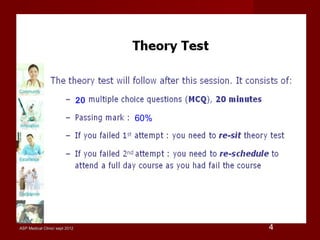
20
60%
ASP Medical Clinic/ sept 2012ASP Medical Clinic/ sept 2012 5
ASP Medical Clinic/ sept 2012ASP Medical Clinic/ sept 2012 6
Content
 Adult One rescuer CPR technique
 Adult Two rescuer CPR technique
 Airway Obstruction – Conscious (Heimlich
Manoeuvre)
 Airway Obstruction – become Unconscious
 Airway Obstruction – Found Unconscious
 Care of unconscious victim ( Recovery position)
ASP Medical Clinic/ sept 2012ASP Medical Clinic/ sept 2012 7
Chain of Survival
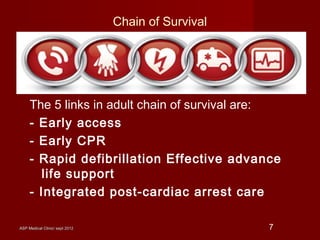
The 5 links in adult chain of survival are:
- Early access
- Early CPR
- Rapid defibrillation Effective advance
life support
- Integrated post-cardiac arrest care
ASP Medical Clinic/ sept 2012ASP Medical Clinic/ sept 2012 8
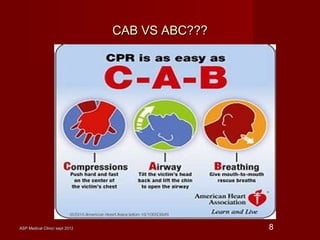
CAB VS ABC???CAB VS ABC???
ASP Medical Clinic/ sept 2012ASP Medical Clinic/ sept 2012 9
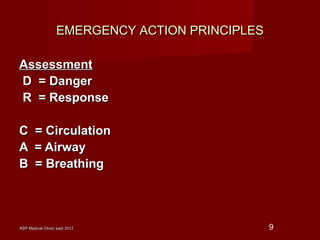
EMERGENCY ACTION PRINCIPLESEMERGENCY ACTION PRINCIPLES
AssessmentAssessment
D = DangerD = Danger
R = ResponseR = Response
C = CirculationC = Circulation
A = AirwayA = Airway
B = BreathingB = Breathing
ASP Medical Clinic/ sept 2012ASP Medical Clinic/ sept 2012 10
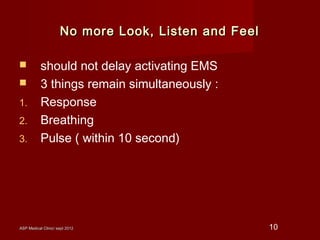
No more Look, Listen and FeelNo more Look, Listen and Feel
 should not delay activating EMS
 3 things remain simultaneously :
1. Response
2. Breathing
3. Pulse ( within 10 second)
ASP Medical Clinic/ sept 2012ASP Medical Clinic/ sept 2012 11
ASP Medical Clinic/ sept 2012ASP Medical Clinic/ sept 2012 12
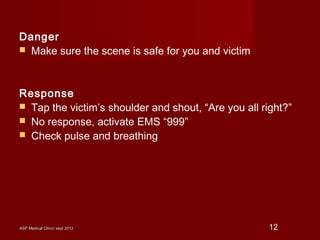
Danger
 Make sure the scene is safe for you and victim
Response
 Tap the victim’s shoulder and shout, “Are you all right?”
 No response, activate EMS “999”
 Check pulse and breathing
ASP Medical Clinic/ sept 2012ASP Medical Clinic/ sept 2012 13
Chest Compression
 Compress the center of victims' chest
 Start compression within 10 seconds of
recognition of cardiac arrest
 Allow complete chest recoil after each compression
 Minimize interruption in compressions (limit lest than
10 sec)
 Push hard, push fast:
- compress at a rate of at least 100/min
- Compress depth at least 2 inches (5cm)
ASP Medical Clinic/ sept 2012ASP Medical Clinic/ sept 2012 14
Chest Compression
 Give effective breaths that make chest raise
 Avoid excessive ventilation
 Ratio 30:2
 Recheck after 5 cycles
ASP Medical Clinic/ sept 2012ASP Medical Clinic/ sept 2012 15
Breathing
 Breathing devices
1-way valve face mask
- Deliver air over 1 second to make the victim’s chest
raise
Bag-Mask
- Use the E-C clamp technique to hold mask in place
while you lift up the jaw to open airway
- Squeeze the bag to give breath (1 second each) while
watching for chest rise
ASP Medical Clinic/ sept 2012ASP Medical Clinic/ sept 2012 16
Rescue Breathing
 To perform when victim has pulse but no breathing
 Give 1 breath every 5 to 6 seconds (about 10 to 12
breaths per minute)
 Rescuer’s exhaled air contain approximately 17%
oxygen and 4% carbon dioxide
 Give each breath 1 second
 Each breath should result in visible chest rise
 Check pulse every 2 minutes
ASP Medical Clinic/ sept 2012ASP Medical Clinic/ sept 2012 17
Rescue Breathing
 Avoid giving breaths too rapidly, too forcefully and with
too much volume as it will cause gastric inflation.
 Gastric inflation can resulting victim vomit, aspiration or
pneumonia
 To reduce risk of gastric inflation:
1. Take 1 second to deliver each breath
2. Deliver air until you make victim’s chest rise
ASP Medical Clinic/ sept 2012ASP Medical Clinic/ sept 2012 18
RECOVERYRECOVERY
POSITIONPOSITION
If there is pulse and casualty is breathing.If there is pulse and casualty is breathing.
September 16, 2013September 16, 2013
18
NURSING - KDU COLLEGENURSING - KDU COLLEGE
ASP Medical Clinic/ sept 2012ASP Medical Clinic/ sept 2012
19
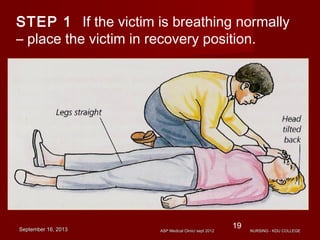
STEP 1 If the victim is breathing normally
– place the victim in recovery position.
September 16, 2013September 16, 2013
19
NURSING - KDU COLLEGENURSING - KDU COLLEGE
ASP Medical Clinic/ sept 2012ASP Medical Clinic/ sept 2012
20
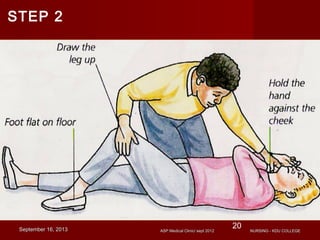
STEP 2
September 16, 2013September 16, 2013
20
NURSING - KDU COLLEGENURSING - KDU COLLEGE
ASP Medical Clinic/ sept 2012ASP Medical Clinic/ sept 2012
21
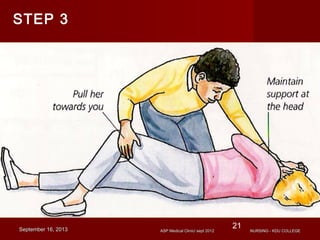
STEP 3
September 16, 2013September 16, 2013
21
NURSING - KDU COLLEGENURSING - KDU COLLEGE
ASP Medical Clinic/ sept 2012ASP Medical Clinic/ sept 2012
22
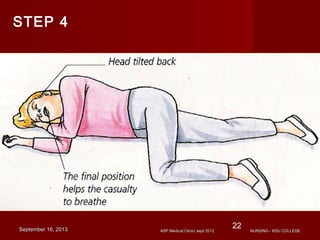
STEP 4
September 16, 2013September 16, 2013
22
NURSING - KDU COLLEGENURSING - KDU COLLEGE
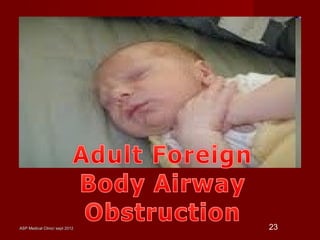
ASP Medical Clinic/ sept 2012ASP Medical Clinic/ sept 2012 23
ASP Medical Clinic/ sept 2012ASP Medical Clinic/ sept 2012 24
ASP Medical Clinic/ sept 2012ASP Medical Clinic/ sept 2012 25
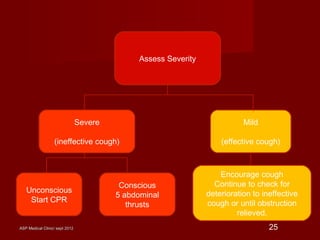
Assess Severity
Severe
(ineffective cough)
Mild
(effective cough)
Unconscious
Start CPR
Conscious
5 abdominal
thrusts
Encourage cough
Continue to check for
deterioration to ineffective
cough or until obstruction
relieved.
ASP Medical Clinic/ sept 2012ASP Medical Clinic/ sept 2012 26
ADULT – FOREIGN BODYADULT – FOREIGN BODY
AIRWAY OBSTRUCTIONAIRWAY OBSTRUCTION
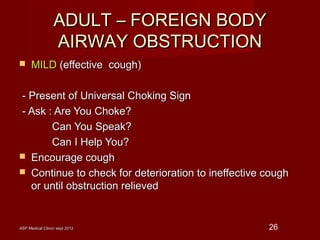
 MILDMILD (effective cough)(effective cough)
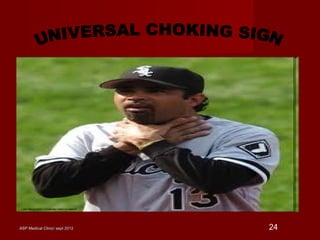
- Present of Universal Choking Sign- Present of Universal Choking Sign
- Ask : Are You Choke?- Ask : Are You Choke?
Can You Speak?Can You Speak?
Can I Help You?Can I Help You?
 Encourage coughEncourage cough
 Continue to check for deterioration to ineffective coughContinue to check for deterioration to ineffective cough
or until obstruction relievedor until obstruction relieved
ASP Medical Clinic/ sept 2012ASP Medical Clinic/ sept 2012 27
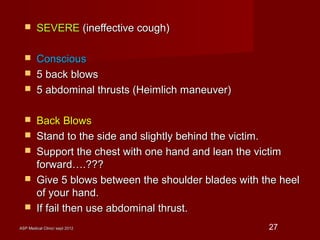
 SEVERESEVERE (ineffective cough)(ineffective cough)
 ConsciousConscious
 5 back blows5 back blows
 5 abdominal thrusts (Heimlich maneuver)5 abdominal thrusts (Heimlich maneuver)
 Back BlowsBack Blows
 Stand to the side and slightly behind the victim.Stand to the side and slightly behind the victim.
 Support the chest with one hand and lean the victimSupport the chest with one hand and lean the victim
forward….???forward….???
 Give 5 blows between the shoulder blades with the heelGive 5 blows between the shoulder blades with the heel
of your hand.of your hand.
 If fail then use abdominal thrust.If fail then use abdominal thrust.
ASP Medical Clinic/ sept 2012ASP Medical Clinic/ sept 2012 28
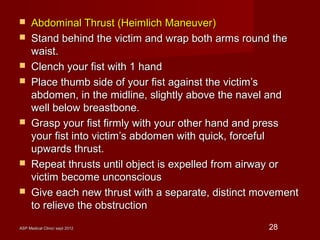
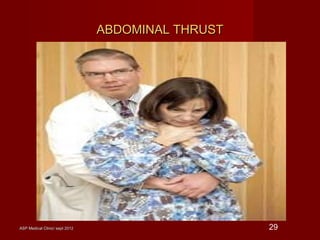
 Abdominal Thrust (Heimlich Maneuver)Abdominal Thrust (Heimlich Maneuver)
 Stand behind the victim and wrap both arms round theStand behind the victim and wrap both arms round the
waist.waist.
 Clench your fist with 1 handClench your fist with 1 hand
 Place thumb side of your fist against the victim’sPlace thumb side of your fist against the victim’s
abdomen, in the midline, slightly above the navel andabdomen, in the midline, slightly above the navel and
well below breastbone.well below breastbone.
 Grasp your fist firmly with your other hand and pressGrasp your fist firmly with your other hand and press
your fist into victim’s abdomen with quick, forcefulyour fist into victim’s abdomen with quick, forceful
upwards thrust.upwards thrust.
 Repeat thrusts until object is expelled from airway orRepeat thrusts until object is expelled from airway or
victim become unconsciousvictim become unconscious
 Give each new thrust with a separate, distinct movementGive each new thrust with a separate, distinct movement
to relieve the obstructionto relieve the obstruction
ASP Medical Clinic/ sept 2012ASP Medical Clinic/ sept 2012 29
ABDOMINAL THRUSTABDOMINAL THRUST
ASP Medical Clinic/ sept 2012ASP Medical Clinic/ sept 2012 30
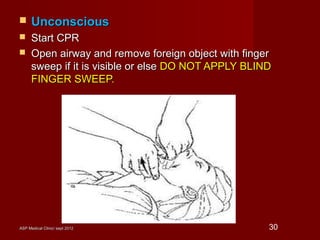
 UnconsciousUnconscious
 Start CPRStart CPR
 Open airway and remove foreign object with fingerOpen airway and remove foreign object with finger
sweep if it is visible or elsesweep if it is visible or else DO NOT APPLY BLINDDO NOT APPLY BLIND
FINGER SWEEP.FINGER SWEEP.
ASP Medical Clinic/ sept 2012ASP Medical Clinic/ sept 2012 31
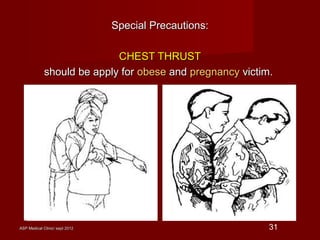
Special Precautions:Special Precautions:
CHEST THRUSTCHEST THRUST
should be apply forshould be apply for obeseobese andand pregnancypregnancy victim.victim.

basic life support 2013

  • 1.
    ASP Medical Clinic/sept 2012ASP Medical Clinic/ sept 2012 1 BASIC LIFE SUPPORTBASIC LIFE SUPPORT
  • 2.
    ASP Medical Clinic/sept 2012ASP Medical Clinic/ sept 2012 2 OBJECTIVES:OBJECTIVES:  Define theDefine the basic conceptsbasic concepts of CPRof CPR  Identify theIdentify the basic mnemonicbasic mnemonic of Basic Lifeof Basic Life SupportSupport  Identify theIdentify the chain of survivalchain of survival for adultfor adult  Explain the adultExplain the adult managementmanagement of airway,of airway, breathing and circulationbreathing and circulation
  • 3.
    ASP Medical Clinic/sept 2012ASP Medical Clinic/ sept 2012 3
  • 4.
    ASP Medical Clinic/sept 2012ASP Medical Clinic/ sept 2012 4 20 60%
  • 5.
    ASP Medical Clinic/sept 2012ASP Medical Clinic/ sept 2012 5
  • 6.
    ASP Medical Clinic/sept 2012ASP Medical Clinic/ sept 2012 6 Content  Adult One rescuer CPR technique  Adult Two rescuer CPR technique  Airway Obstruction – Conscious (Heimlich Manoeuvre)  Airway Obstruction – become Unconscious  Airway Obstruction – Found Unconscious  Care of unconscious victim ( Recovery position)
  • 7.
    ASP Medical Clinic/sept 2012ASP Medical Clinic/ sept 2012 7 Chain of Survival The 5 links in adult chain of survival are: - Early access - Early CPR - Rapid defibrillation Effective advance life support - Integrated post-cardiac arrest care
  • 8.
    ASP Medical Clinic/sept 2012ASP Medical Clinic/ sept 2012 8 CAB VS ABC???CAB VS ABC???
  • 9.
    ASP Medical Clinic/sept 2012ASP Medical Clinic/ sept 2012 9 EMERGENCY ACTION PRINCIPLESEMERGENCY ACTION PRINCIPLES AssessmentAssessment D = DangerD = Danger R = ResponseR = Response C = CirculationC = Circulation A = AirwayA = Airway B = BreathingB = Breathing
  • 10.
    ASP Medical Clinic/sept 2012ASP Medical Clinic/ sept 2012 10 No more Look, Listen and FeelNo more Look, Listen and Feel  should not delay activating EMS  3 things remain simultaneously : 1. Response 2. Breathing 3. Pulse ( within 10 second)
  • 11.
    ASP Medical Clinic/sept 2012ASP Medical Clinic/ sept 2012 11
  • 12.
    ASP Medical Clinic/sept 2012ASP Medical Clinic/ sept 2012 12 Danger  Make sure the scene is safe for you and victim Response  Tap the victim’s shoulder and shout, “Are you all right?”  No response, activate EMS “999”  Check pulse and breathing
  • 13.
    ASP Medical Clinic/sept 2012ASP Medical Clinic/ sept 2012 13 Chest Compression  Compress the center of victims' chest  Start compression within 10 seconds of recognition of cardiac arrest  Allow complete chest recoil after each compression  Minimize interruption in compressions (limit lest than 10 sec)  Push hard, push fast: - compress at a rate of at least 100/min - Compress depth at least 2 inches (5cm)
  • 14.
    ASP Medical Clinic/sept 2012ASP Medical Clinic/ sept 2012 14 Chest Compression  Give effective breaths that make chest raise  Avoid excessive ventilation  Ratio 30:2  Recheck after 5 cycles
  • 15.
    ASP Medical Clinic/sept 2012ASP Medical Clinic/ sept 2012 15 Breathing  Breathing devices 1-way valve face mask - Deliver air over 1 second to make the victim’s chest raise Bag-Mask - Use the E-C clamp technique to hold mask in place while you lift up the jaw to open airway - Squeeze the bag to give breath (1 second each) while watching for chest rise
  • 16.
    ASP Medical Clinic/sept 2012ASP Medical Clinic/ sept 2012 16 Rescue Breathing  To perform when victim has pulse but no breathing  Give 1 breath every 5 to 6 seconds (about 10 to 12 breaths per minute)  Rescuer’s exhaled air contain approximately 17% oxygen and 4% carbon dioxide  Give each breath 1 second  Each breath should result in visible chest rise  Check pulse every 2 minutes
  • 17.
    ASP Medical Clinic/sept 2012ASP Medical Clinic/ sept 2012 17 Rescue Breathing  Avoid giving breaths too rapidly, too forcefully and with too much volume as it will cause gastric inflation.  Gastric inflation can resulting victim vomit, aspiration or pneumonia  To reduce risk of gastric inflation: 1. Take 1 second to deliver each breath 2. Deliver air until you make victim’s chest rise
  • 18.
    ASP Medical Clinic/sept 2012ASP Medical Clinic/ sept 2012 18 RECOVERYRECOVERY POSITIONPOSITION If there is pulse and casualty is breathing.If there is pulse and casualty is breathing. September 16, 2013September 16, 2013 18 NURSING - KDU COLLEGENURSING - KDU COLLEGE
  • 19.
    ASP Medical Clinic/sept 2012ASP Medical Clinic/ sept 2012 19 STEP 1 If the victim is breathing normally – place the victim in recovery position. September 16, 2013September 16, 2013 19 NURSING - KDU COLLEGENURSING - KDU COLLEGE
  • 20.
    ASP Medical Clinic/sept 2012ASP Medical Clinic/ sept 2012 20 STEP 2 September 16, 2013September 16, 2013 20 NURSING - KDU COLLEGENURSING - KDU COLLEGE
  • 21.
    ASP Medical Clinic/sept 2012ASP Medical Clinic/ sept 2012 21 STEP 3 September 16, 2013September 16, 2013 21 NURSING - KDU COLLEGENURSING - KDU COLLEGE
  • 22.
    ASP Medical Clinic/sept 2012ASP Medical Clinic/ sept 2012 22 STEP 4 September 16, 2013September 16, 2013 22 NURSING - KDU COLLEGENURSING - KDU COLLEGE
  • 23.
    ASP Medical Clinic/sept 2012ASP Medical Clinic/ sept 2012 23
  • 24.
    ASP Medical Clinic/sept 2012ASP Medical Clinic/ sept 2012 24
  • 25.
    ASP Medical Clinic/sept 2012ASP Medical Clinic/ sept 2012 25 Assess Severity Severe (ineffective cough) Mild (effective cough) Unconscious Start CPR Conscious 5 abdominal thrusts Encourage cough Continue to check for deterioration to ineffective cough or until obstruction relieved.
  • 26.
    ASP Medical Clinic/sept 2012ASP Medical Clinic/ sept 2012 26 ADULT – FOREIGN BODYADULT – FOREIGN BODY AIRWAY OBSTRUCTIONAIRWAY OBSTRUCTION  MILDMILD (effective cough)(effective cough) - Present of Universal Choking Sign- Present of Universal Choking Sign - Ask : Are You Choke?- Ask : Are You Choke? Can You Speak?Can You Speak? Can I Help You?Can I Help You?  Encourage coughEncourage cough  Continue to check for deterioration to ineffective coughContinue to check for deterioration to ineffective cough or until obstruction relievedor until obstruction relieved
  • 27.
    ASP Medical Clinic/sept 2012ASP Medical Clinic/ sept 2012 27  SEVERESEVERE (ineffective cough)(ineffective cough)  ConsciousConscious  5 back blows5 back blows  5 abdominal thrusts (Heimlich maneuver)5 abdominal thrusts (Heimlich maneuver)  Back BlowsBack Blows  Stand to the side and slightly behind the victim.Stand to the side and slightly behind the victim.  Support the chest with one hand and lean the victimSupport the chest with one hand and lean the victim forward….???forward….???  Give 5 blows between the shoulder blades with the heelGive 5 blows between the shoulder blades with the heel of your hand.of your hand.  If fail then use abdominal thrust.If fail then use abdominal thrust.
  • 28.
    ASP Medical Clinic/sept 2012ASP Medical Clinic/ sept 2012 28  Abdominal Thrust (Heimlich Maneuver)Abdominal Thrust (Heimlich Maneuver)  Stand behind the victim and wrap both arms round theStand behind the victim and wrap both arms round the waist.waist.  Clench your fist with 1 handClench your fist with 1 hand  Place thumb side of your fist against the victim’sPlace thumb side of your fist against the victim’s abdomen, in the midline, slightly above the navel andabdomen, in the midline, slightly above the navel and well below breastbone.well below breastbone.  Grasp your fist firmly with your other hand and pressGrasp your fist firmly with your other hand and press your fist into victim’s abdomen with quick, forcefulyour fist into victim’s abdomen with quick, forceful upwards thrust.upwards thrust.  Repeat thrusts until object is expelled from airway orRepeat thrusts until object is expelled from airway or victim become unconsciousvictim become unconscious  Give each new thrust with a separate, distinct movementGive each new thrust with a separate, distinct movement to relieve the obstructionto relieve the obstruction
  • 29.
    ASP Medical Clinic/sept 2012ASP Medical Clinic/ sept 2012 29 ABDOMINAL THRUSTABDOMINAL THRUST
  • 30.
    ASP Medical Clinic/sept 2012ASP Medical Clinic/ sept 2012 30  UnconsciousUnconscious  Start CPRStart CPR  Open airway and remove foreign object with fingerOpen airway and remove foreign object with finger sweep if it is visible or elsesweep if it is visible or else DO NOT APPLY BLINDDO NOT APPLY BLIND FINGER SWEEP.FINGER SWEEP.
  • 31.
    ASP Medical Clinic/sept 2012ASP Medical Clinic/ sept 2012 31 Special Precautions:Special Precautions: CHEST THRUSTCHEST THRUST should be apply forshould be apply for obeseobese andand pregnancypregnancy victim.victim.

Editor's Notes