 Define BLS
 Explain steps and components of BLS
 Explain Chain of survival
 Explain about Defibrillator
 Orientation and Demonstration
 Sudden cardiac arrest is rapidly becoming the
leading cause of death across age group.
 Once the heart ceases to function, a healthy
human brain may survive without oxygen for
only up to 4 minutes without suffering any
permanent damage.
 Unfortunately a typical EMS response may
take 6, 8 or even 10 minutes.
 Therefore during these critical minutes if CPR
is initiated then the chance of survival
without any neurological injury increases.
 And if properly instructed, almost anyone can
learn and perform CPR.
 Basic Life Support (BLS) refers to the care
healthcare providers and public safety
professionals provide to patients who are
experiencing respiratory arrest , cardiac
arrest or airway obstruction.
 It involves assessing and performing high
quality CPR, using AED and relieving an
obstructed airway.
 Anyone who knows how to do it
 Anywhere
 Immediately
 No Complex Device
 If the patient is not breathing but has a
definitive pulse, then the patient is in
respiratory arrest.
 Main aim is to maintain the patency of the
airway and provide ventilation.
 If there is no breathing, no pulse and the
patient is unresponsive, then the patient is in
cardiac support.
 The aim is to restore the circulation through
mechanical or electrical stimulation and
provide oxygenation.
 Myocardial Infarction
 Heart failure
 Airway obstruction
 Pneumothorax
 Pulmonary embolism
 Electrolyte imbalance
 Drug toxicity
 Series of life saving actions that improve the chance
of survival after a cardiac arrest
 To achieve early and effective CPR is the key.
 Support and Restore Oxygenation, Ventilation and
Circulation to prevent Neurological injury.
Strong chain made of small but strong links
Scene
Rescuer
Victim
 Face the victim
 Tap on shoulder & shout Are you
all right?
 Scan chest for movement look
for Absent or Abnormal
Breathing
 Look or scan chest for 5-10 Sec
If no Response ?
 Shout for Help ask to Activate EMS
 If no help activate EMS (108) Yourself
 Give full details
 Ask for AED
 Don’t hang up till told to
Pulse Check
If no pulse?
Start CPR
Which?
Carotid artery
How?
Maintain head tilt with one hand
Use 2-3 fingers of other hand to locate trachea
Slide fingers into groove b/w trachea & muscles of same side of
neck
How long?
Not > 10 secs
 Victim on firm flat surface
 Rescuer to kneel by side of victim
 Place heel of one hand on middle of victims chest (lower half
of sternum)
 Place heel of other hand on top of 1st hand
 Interlace fingers to keep them off the chest
 Arms straight-shoulder above victim
 Push Hard (at least 2 inches or 5 cm)
 Push Fast (at least 100/ min)
 Minimize interruption
 Allow Chest recoil
 Rotate compressor 2min
 Avoid excess ventilation
 If no advanced airway 30:2
comp-vent ratio
Open Airway
 Head tilt and Chin lift
 Jaw thrust
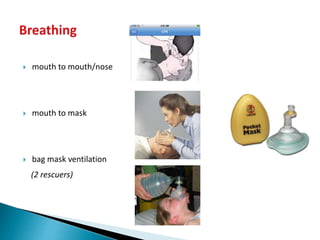
 mouth to mouth/nose
 mouth to mask
 bag mask ventilation
(2 rescuers)
 2 Breaths
 Give breath over 1second
 Allow 1 second for expiration
 See visible chest rise
 If no chest rise reposition and give 2nd breath
 If no chest rise again go back to chest compression
 Compression : Ventilation ratio 30 :2
( for single and two rescuer)
 No cricoid pressure
 Get AED as soon as possible
 Continue CPR till AED arrives
 Immediately after defibrillation start CPR
 Do not check pulse
 Minimize (collapse-defibrillation) interval
 Chance of survival falls 7-10% per min lost if no CPR
 3-4% per min if bystander CPR
 If no pulse
 Check for shockable rhythm with AED/Defibrillator
 Provide shock as indicated
 Follow shock with CPR for 2 min beginning with
chest compression
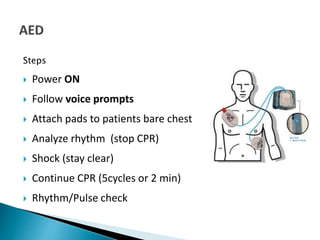
Steps
 Power ON
 Follow voice prompts
 Attach pads to patients bare chest
 Analyze rhythm (stop CPR)
 Shock (stay clear)
 Continue CPR (5cycles or 2 min)
 Rhythm/Pulse check
• Stand clear
• Deliver shock
 Hairy Chest Press firmly
Use jelly
Use razor
Pull and put new pads
 Water
 Implanted pacer
 Transdermal medication
Rescue breaths 10 to 12/min (every 5-6 sec)
 Give breath over 1second
 Visible chest rise
Check pulse every 2 minutes
Recovery
Position
Approach to Patient
 Unconscious
BLS survey for initial assessment
After completing BLS use ACLS survey for advanced
assessment and treatment
 Conscious
ACLS survey for initial assessment
Scene safety
 Step1 Check Response and Breathing
 Step2 Activate EMS and ask for AED
 Step3 Pulse Check if no pulse Start CPR
 Step4 Defibrillation
CAB not ABC
Check rhythm /
shock if indicated
Repeat every 2
minutes
Start
CPR
Activate emergency response
Unresponsive
No breathing or no normal breathing
(Only gasping) Get Defibrillator / AED
PUSH HARD
PUSH FAST
Shock
ADULT BLS ALGORITHM FOR HEALTH CARE PROVIDERS
Resume CPR immediately
For 2 minutes Check rhythm every 2 minutes;
continue until ALS providers take over or victim
starts to move
Give 1 shock Resume
CPR immediately for
2 minutes
Check Pulse:
DEFINITE pulse within 10 seconds?
*Give 1 breath every 5-6 seconds
*Recheck pulse every 2 minutes
Activate emergency response system
Get AED/Defibrillator
or send second rescuer (if available) to do this
Unresponsive
No breathing or No normal breathing
(i.e., only gasping)
Begin cycles of 30 COMPRESSIONS and
2BREATHS
AED defibrillator ARRIVES
Check rhythm
Shockable rhythm?
Definite Pulse
No Pulse
Not Shockable
Shockable
 RESPONSE CHECK- calling and try painful
stimulus
 30: 2 compression ventilation ratio if one
rescuer; 15: 2 for two rescuers for all
paediatric age group.
 Compression depth- 1/3rd of AP diameter of
chest or less than two inches in a small child.
Unwitnessed cardiac arrest- perform CPR and
then activate EMS.
 Witnessed collapse- activate EMS and then
perform CPR.
 PULSE check site- Brachial pulse in a small
child; carotid/ Femoral in a large child.
 Rescue Breath at every 5 seconds.
 HEIMLICH manoeuvre- abdominal thrusts:
stand behind the person and wrap
your arms around the waist.
place your clenched fist just above
the persons navel. Grab your fist with the
other hand encircling the victims and give
abdominal thrusts.
THANK YOU

Basic Life Support( BLS ) Dr.Javith.pptx

  • 2.
     Define BLS Explain steps and components of BLS  Explain Chain of survival  Explain about Defibrillator  Orientation and Demonstration
  • 3.
     Sudden cardiacarrest is rapidly becoming the leading cause of death across age group.  Once the heart ceases to function, a healthy human brain may survive without oxygen for only up to 4 minutes without suffering any permanent damage.  Unfortunately a typical EMS response may take 6, 8 or even 10 minutes.
  • 4.
     Therefore duringthese critical minutes if CPR is initiated then the chance of survival without any neurological injury increases.  And if properly instructed, almost anyone can learn and perform CPR.
  • 5.
     Basic LifeSupport (BLS) refers to the care healthcare providers and public safety professionals provide to patients who are experiencing respiratory arrest , cardiac arrest or airway obstruction.  It involves assessing and performing high quality CPR, using AED and relieving an obstructed airway.
  • 6.
     Anyone whoknows how to do it  Anywhere  Immediately  No Complex Device
  • 7.
     If thepatient is not breathing but has a definitive pulse, then the patient is in respiratory arrest.  Main aim is to maintain the patency of the airway and provide ventilation.
  • 8.
     If thereis no breathing, no pulse and the patient is unresponsive, then the patient is in cardiac support.  The aim is to restore the circulation through mechanical or electrical stimulation and provide oxygenation.
  • 9.
     Myocardial Infarction Heart failure  Airway obstruction  Pneumothorax  Pulmonary embolism  Electrolyte imbalance  Drug toxicity
  • 10.
     Series oflife saving actions that improve the chance of survival after a cardiac arrest  To achieve early and effective CPR is the key.
  • 11.
     Support andRestore Oxygenation, Ventilation and Circulation to prevent Neurological injury.
  • 12.
    Strong chain madeof small but strong links
  • 13.
  • 14.
     Face thevictim  Tap on shoulder & shout Are you all right?  Scan chest for movement look for Absent or Abnormal Breathing  Look or scan chest for 5-10 Sec If no Response ?
  • 15.
     Shout forHelp ask to Activate EMS  If no help activate EMS (108) Yourself  Give full details  Ask for AED  Don’t hang up till told to
  • 16.
    Pulse Check If nopulse? Start CPR
  • 17.
    Which? Carotid artery How? Maintain headtilt with one hand Use 2-3 fingers of other hand to locate trachea Slide fingers into groove b/w trachea & muscles of same side of neck How long? Not > 10 secs
  • 18.
     Victim onfirm flat surface  Rescuer to kneel by side of victim  Place heel of one hand on middle of victims chest (lower half of sternum)  Place heel of other hand on top of 1st hand  Interlace fingers to keep them off the chest  Arms straight-shoulder above victim
  • 19.
     Push Hard(at least 2 inches or 5 cm)  Push Fast (at least 100/ min)  Minimize interruption  Allow Chest recoil  Rotate compressor 2min  Avoid excess ventilation  If no advanced airway 30:2 comp-vent ratio
  • 20.
    Open Airway  Headtilt and Chin lift  Jaw thrust
  • 21.
     mouth tomouth/nose  mouth to mask  bag mask ventilation (2 rescuers)
  • 22.
     2 Breaths Give breath over 1second  Allow 1 second for expiration  See visible chest rise  If no chest rise reposition and give 2nd breath  If no chest rise again go back to chest compression  Compression : Ventilation ratio 30 :2 ( for single and two rescuer)  No cricoid pressure
  • 23.
     Get AEDas soon as possible  Continue CPR till AED arrives  Immediately after defibrillation start CPR  Do not check pulse  Minimize (collapse-defibrillation) interval  Chance of survival falls 7-10% per min lost if no CPR  3-4% per min if bystander CPR
  • 24.
     If nopulse  Check for shockable rhythm with AED/Defibrillator  Provide shock as indicated  Follow shock with CPR for 2 min beginning with chest compression
  • 26.
    Steps  Power ON Follow voice prompts  Attach pads to patients bare chest  Analyze rhythm (stop CPR)  Shock (stay clear)  Continue CPR (5cycles or 2 min)  Rhythm/Pulse check
  • 29.
    • Stand clear •Deliver shock
  • 31.
     Hairy ChestPress firmly Use jelly Use razor Pull and put new pads  Water  Implanted pacer  Transdermal medication
  • 32.
    Rescue breaths 10to 12/min (every 5-6 sec)  Give breath over 1second  Visible chest rise Check pulse every 2 minutes
  • 33.
  • 35.
    Approach to Patient Unconscious BLS survey for initial assessment After completing BLS use ACLS survey for advanced assessment and treatment  Conscious ACLS survey for initial assessment
  • 36.
    Scene safety  Step1Check Response and Breathing  Step2 Activate EMS and ask for AED  Step3 Pulse Check if no pulse Start CPR  Step4 Defibrillation
  • 37.
  • 39.
    Check rhythm / shockif indicated Repeat every 2 minutes Start CPR Activate emergency response Unresponsive No breathing or no normal breathing (Only gasping) Get Defibrillator / AED PUSH HARD PUSH FAST Shock
  • 40.
    ADULT BLS ALGORITHMFOR HEALTH CARE PROVIDERS Resume CPR immediately For 2 minutes Check rhythm every 2 minutes; continue until ALS providers take over or victim starts to move Give 1 shock Resume CPR immediately for 2 minutes Check Pulse: DEFINITE pulse within 10 seconds? *Give 1 breath every 5-6 seconds *Recheck pulse every 2 minutes Activate emergency response system Get AED/Defibrillator or send second rescuer (if available) to do this Unresponsive No breathing or No normal breathing (i.e., only gasping) Begin cycles of 30 COMPRESSIONS and 2BREATHS AED defibrillator ARRIVES Check rhythm Shockable rhythm? Definite Pulse No Pulse Not Shockable Shockable
  • 41.
     RESPONSE CHECK-calling and try painful stimulus  30: 2 compression ventilation ratio if one rescuer; 15: 2 for two rescuers for all paediatric age group.  Compression depth- 1/3rd of AP diameter of chest or less than two inches in a small child.
  • 42.
    Unwitnessed cardiac arrest-perform CPR and then activate EMS.  Witnessed collapse- activate EMS and then perform CPR.  PULSE check site- Brachial pulse in a small child; carotid/ Femoral in a large child.  Rescue Breath at every 5 seconds.
  • 43.
     HEIMLICH manoeuvre-abdominal thrusts: stand behind the person and wrap your arms around the waist. place your clenched fist just above the persons navel. Grab your fist with the other hand encircling the victims and give abdominal thrusts.
  • 44.