SUPPORT (BLS)
By: Dr. Akshita (PT)
M.P.T (Cardiopulmonary), B.P.T (AJIPT, Delhi
University), D.C.P.T
In charge, Department of Physiotherapy, IPHI, New
Delhi
Former PT Yashoda Super Specialty Hospital &
DCCW
Former Intern Sir Ganga Ram Hospital
Certified BLS & ACLS, AHA
WHATISBASICLIFESUPPORT?
Basic Life Support (BLS) defines
Sequences of procedures performed to
restore the circulation of oxygenated blood
after a sudden pulmonary or cardiac arrest
until they can be given full medical care at a
hospital.
BLS does not include the use of drugs or
invasive skills.
GLOBAL BURDEN OF SUDDEN CARDIAC ARREST
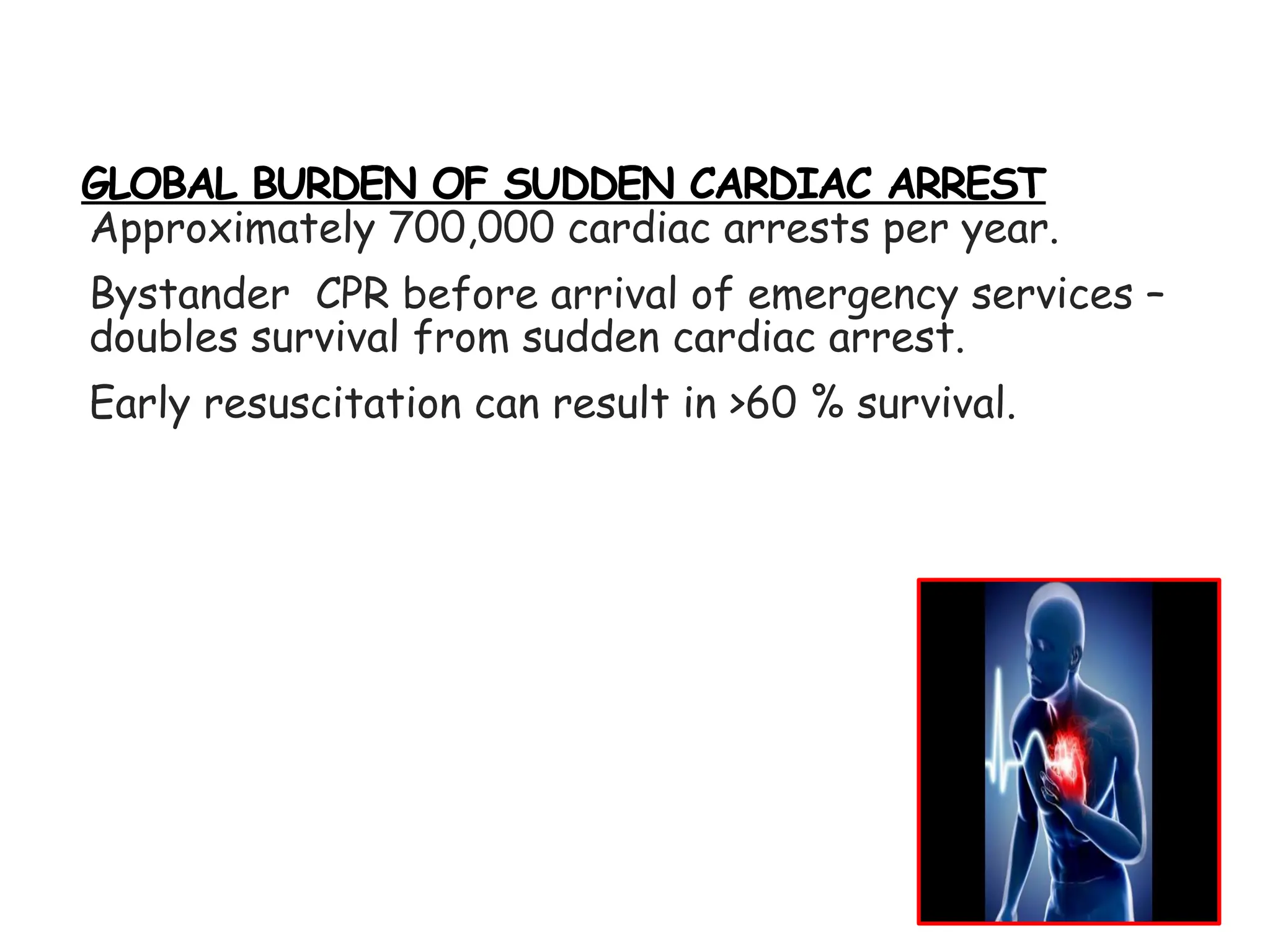
Approximately 700,000 cardiac arrests per year.
Bystander CPR before arrival of emergency services –
doubles survival from sudden cardiac arrest.
Early resuscitation can result in >60 % survival.
BASIC LIFE SUPPORT
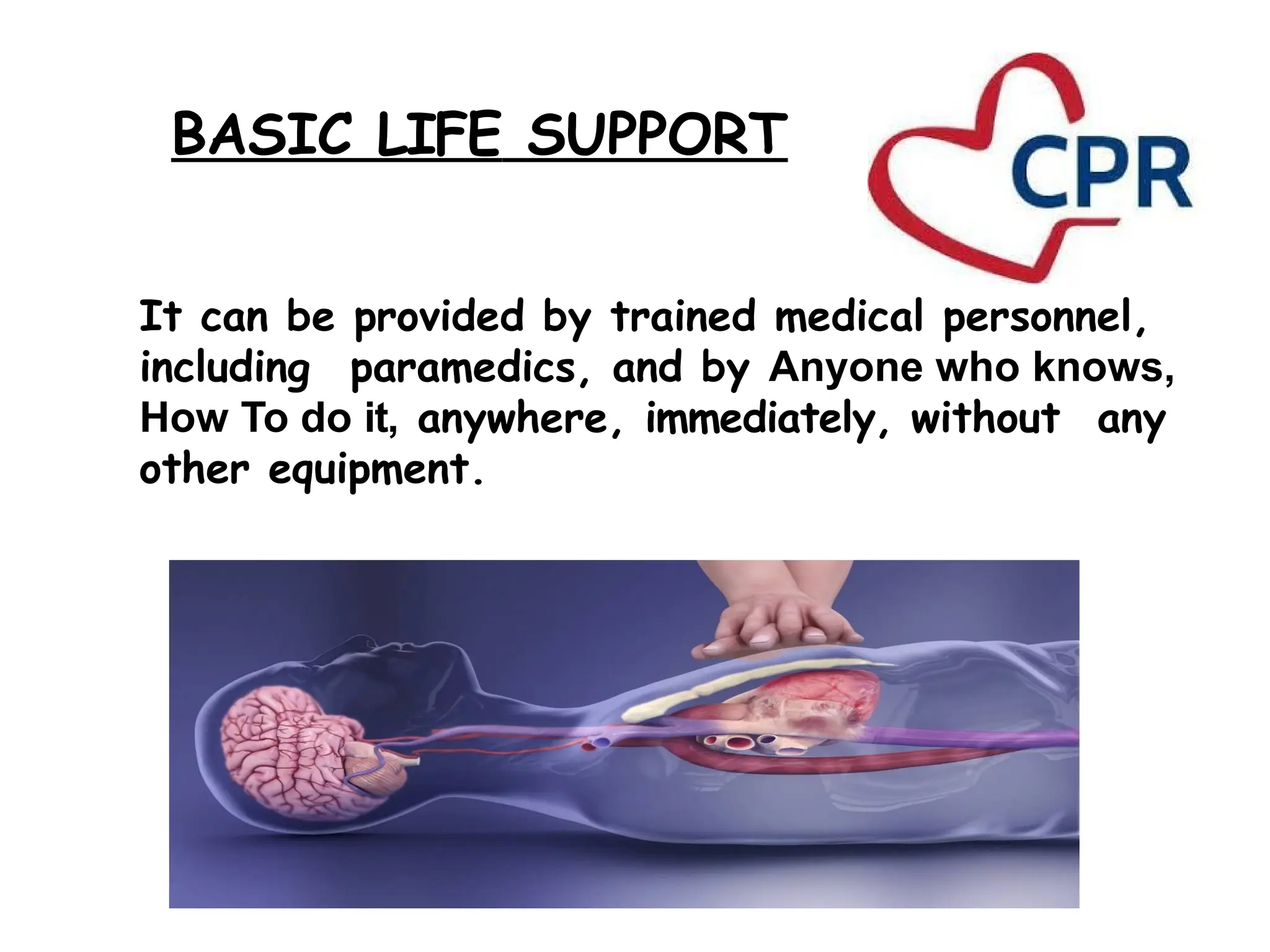
It can be provided by trained medical personnel,
including paramedics, and by Anyone who knows,
How To do it, anywhere, immediately, without any
other equipment.
HODS - November 2006 27
PURPOSES OF CPR
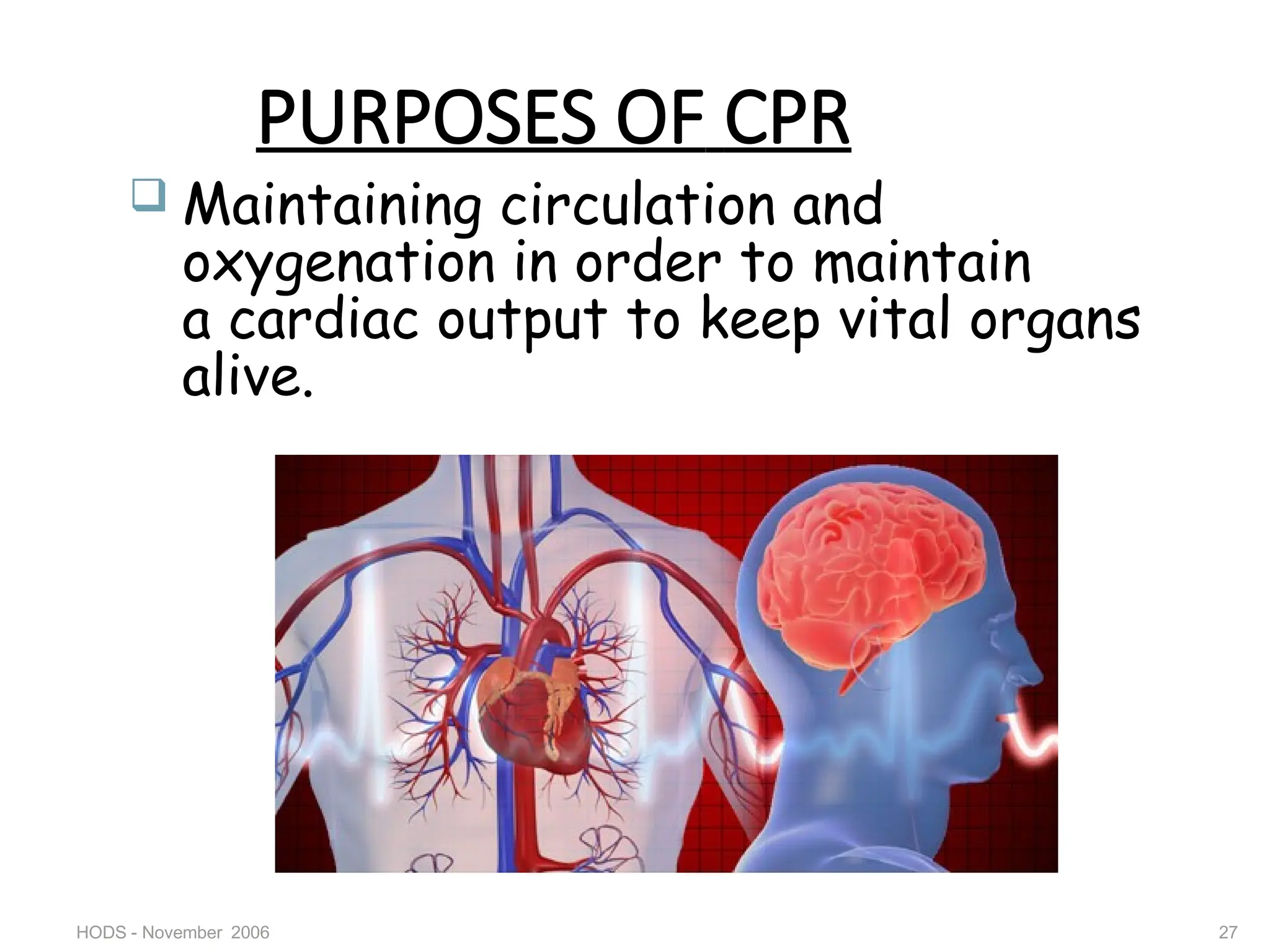
 Maintaining circulation and
oxygenation in order to maintain
a cardiac output to keep vital organs
alive.
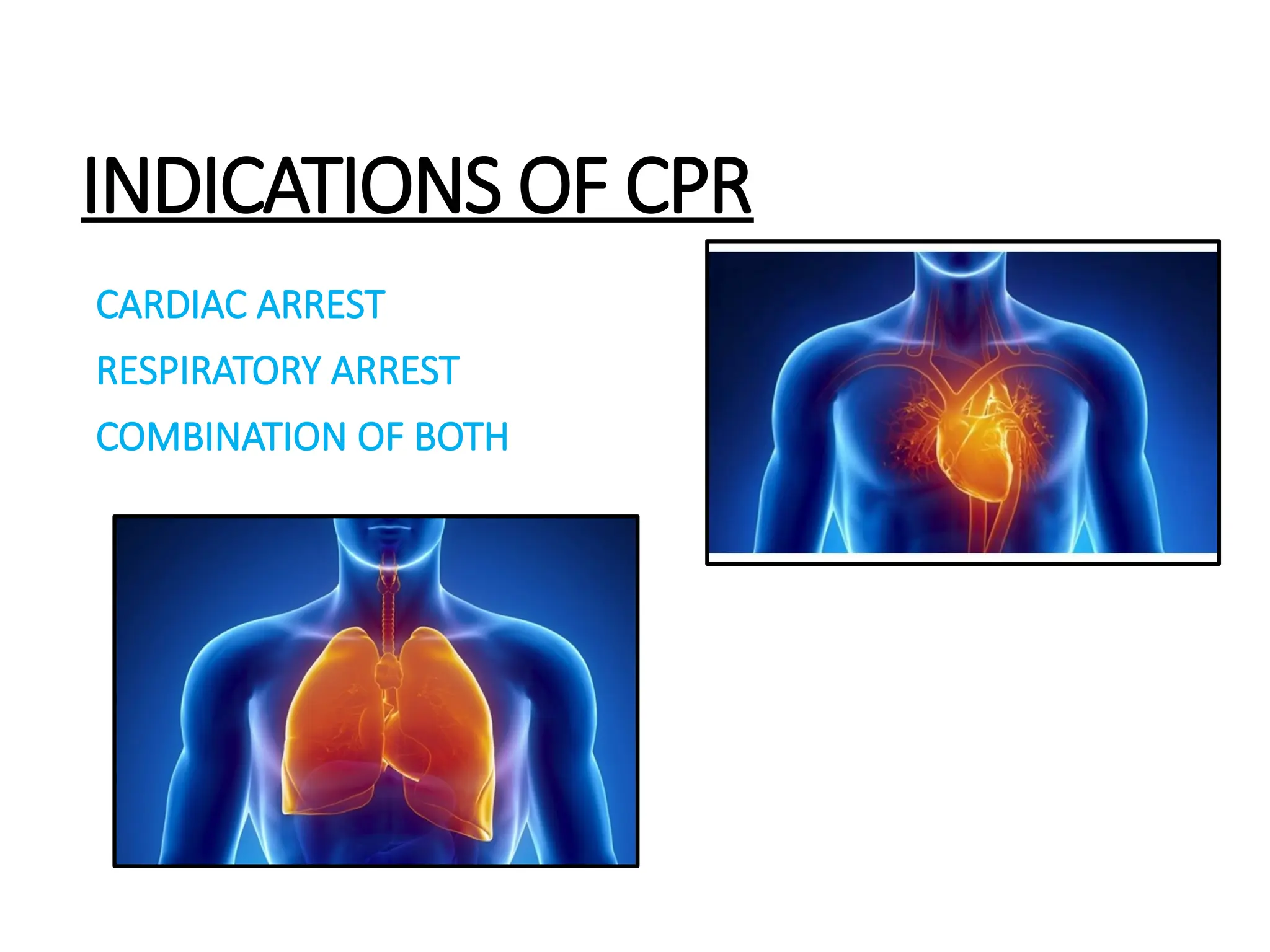
INDICATIONS OF CPR
CARDIAC ARREST
RESPIRATORY ARREST
COMBINATION OF BOTH
WHAT IS CAB APPROACH ?
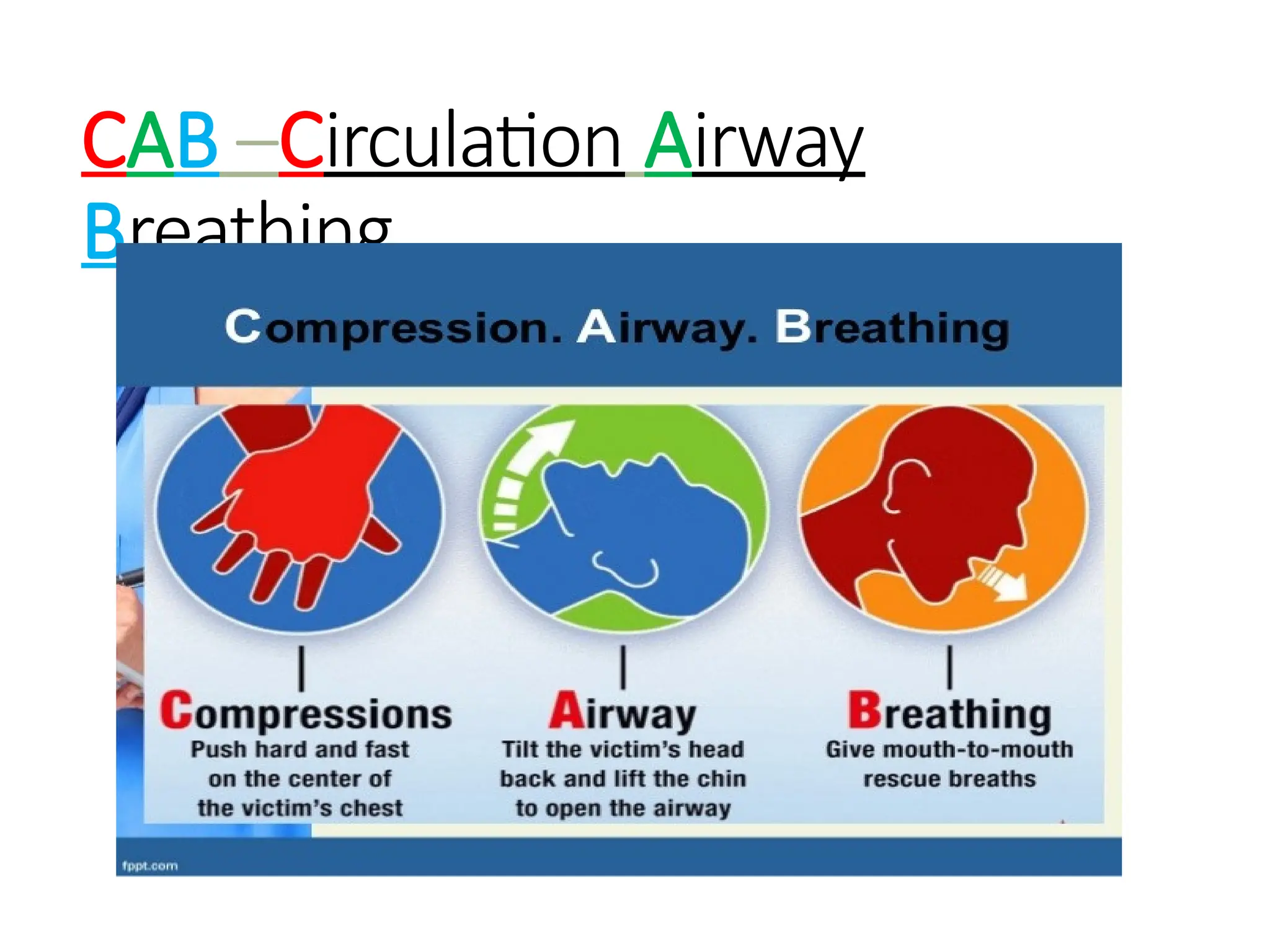
There is a common acronym in BLS
used to guide providers in the
appropriate steps to assess and treat
patients in respiratory and cardiac
distress. This is CAB-D (Circulation,
Airway, Breathing, Defibrillate)
CAB –Circulation Airway
Breathing
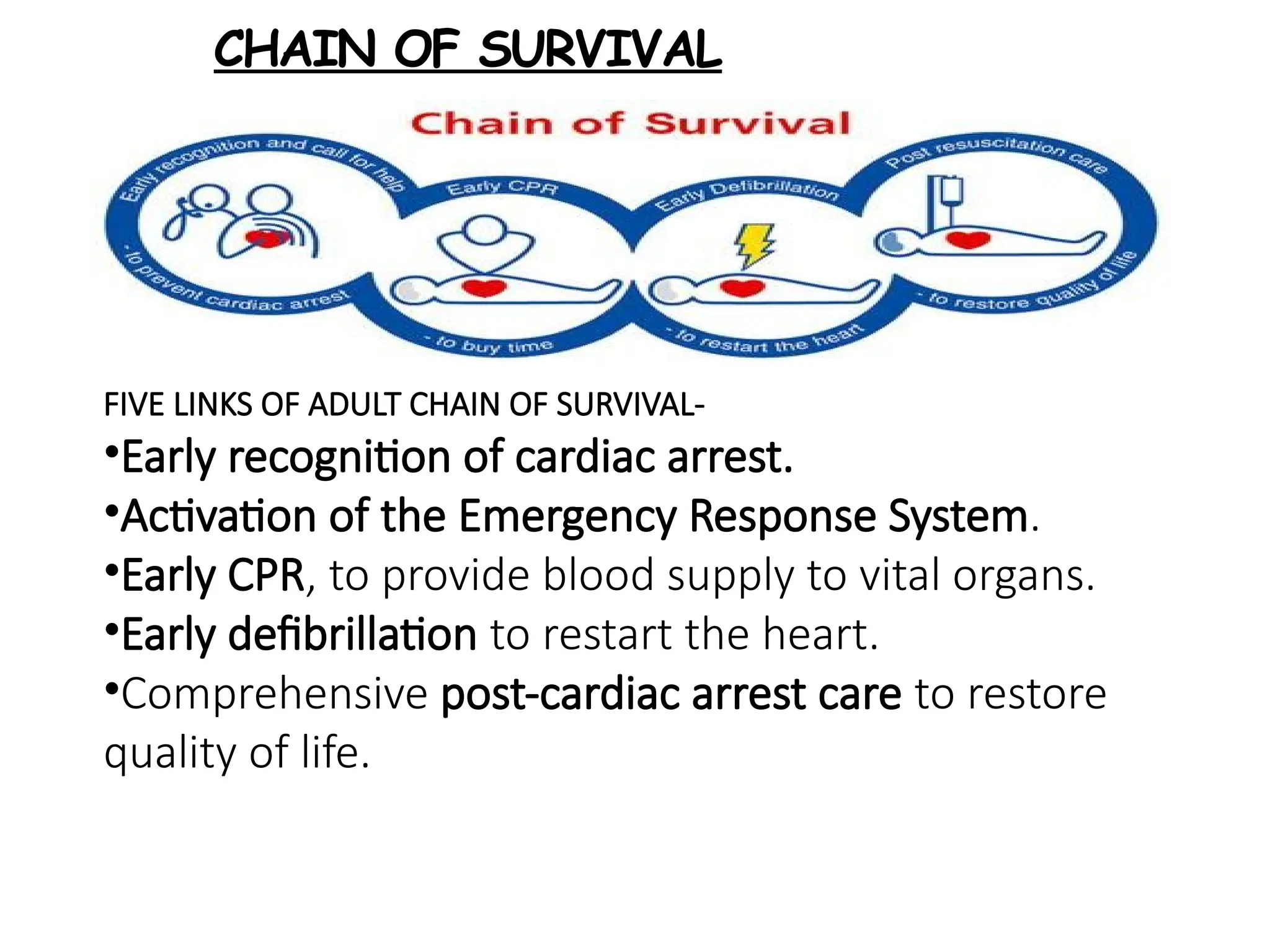
CHAIN OF SURVIVAL
FIVE LINKS OF ADULT CHAIN OF SURVIVAL-
•Early recognition of cardiac arrest.
•Activation of the Emergency Response System.
•Early CPR, to provide blood supply to vital organs.
•Early defibrillation to restart the heart.
•Comprehensive post-cardiac arrest care to restore
quality of life.
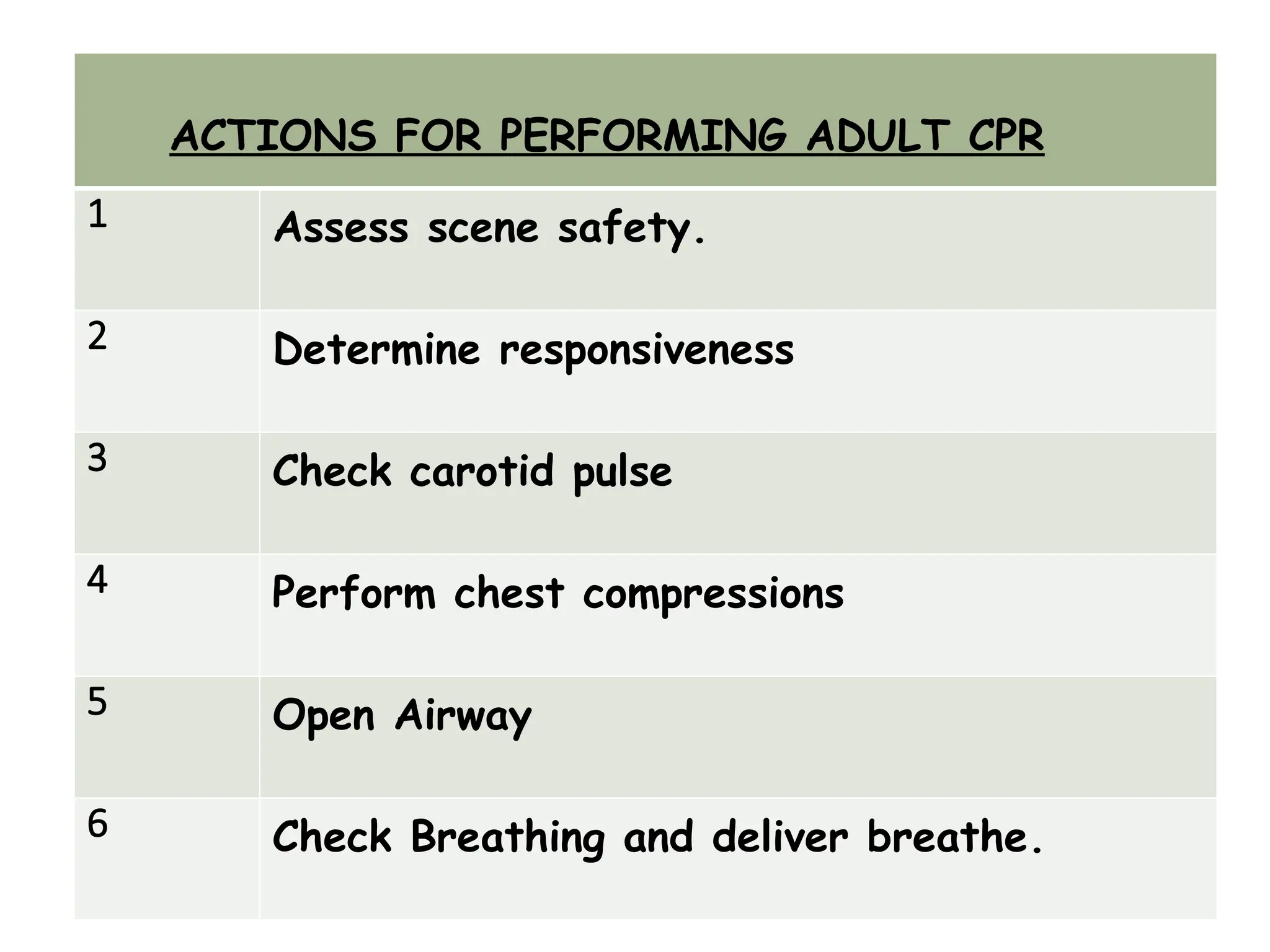
ACTIONS FOR PERFORMING ADULT CPR
1 Assess scene safety.
2 Determine responsiveness
3 Check carotid pulse
4 Perform chest compressions
5 Open Airway
6 Check Breathing and deliver breathe.
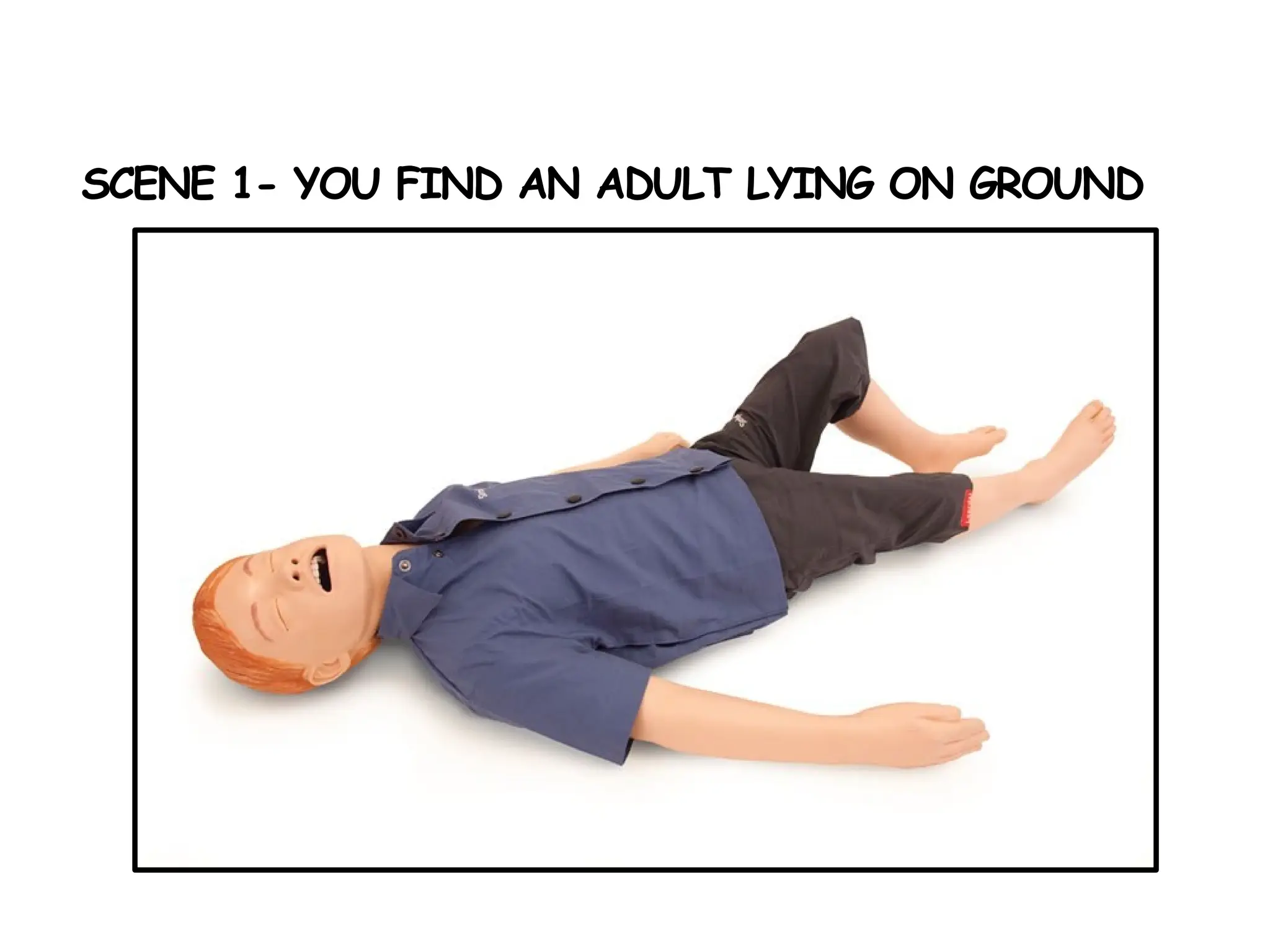
SCENE 1- YOU FIND AN ADULT LYING ON GROUND
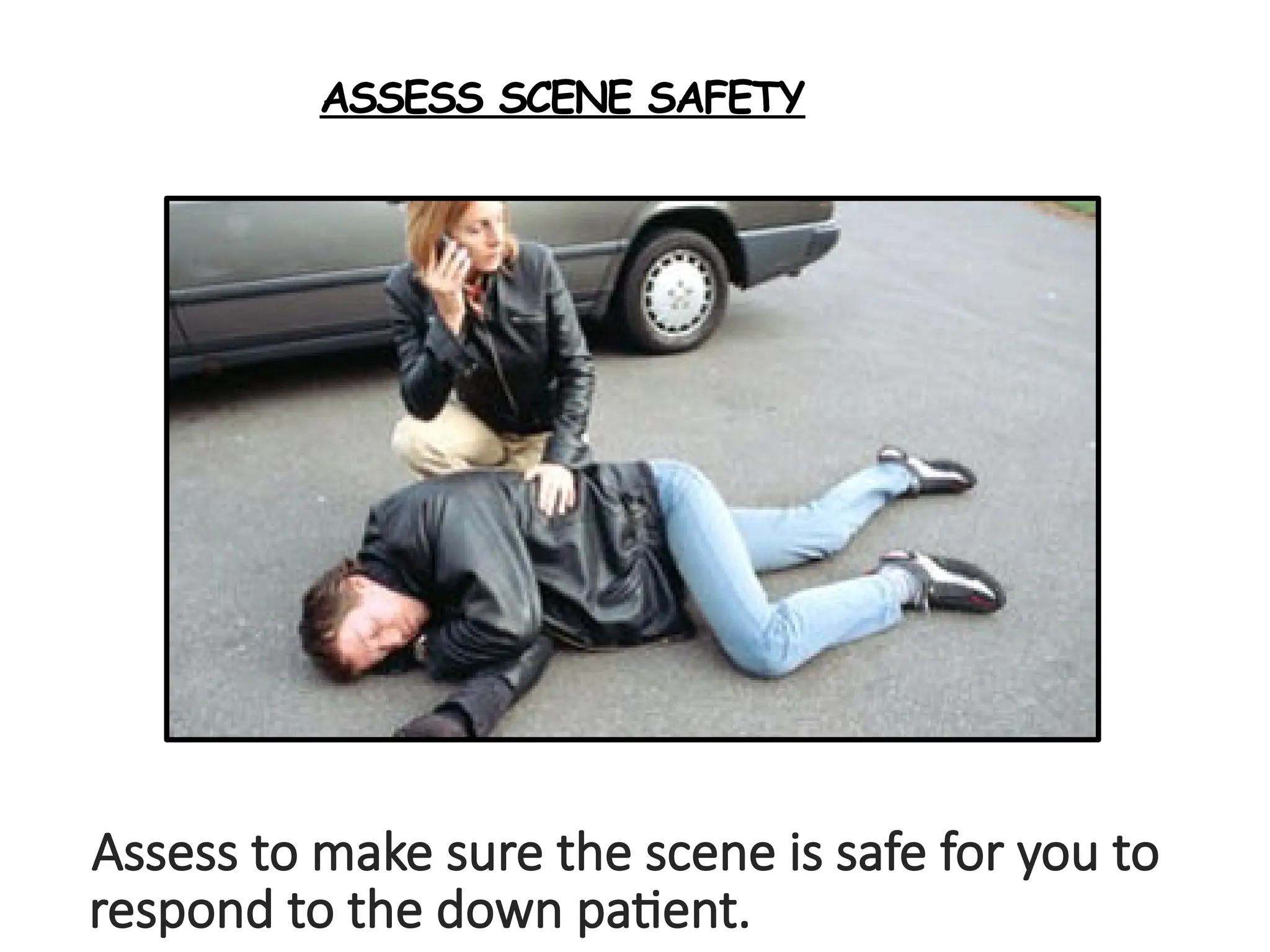
ASSESS SCENE SAFETY
Assess to make sure the scene is safe for you to
respond to the down patient.
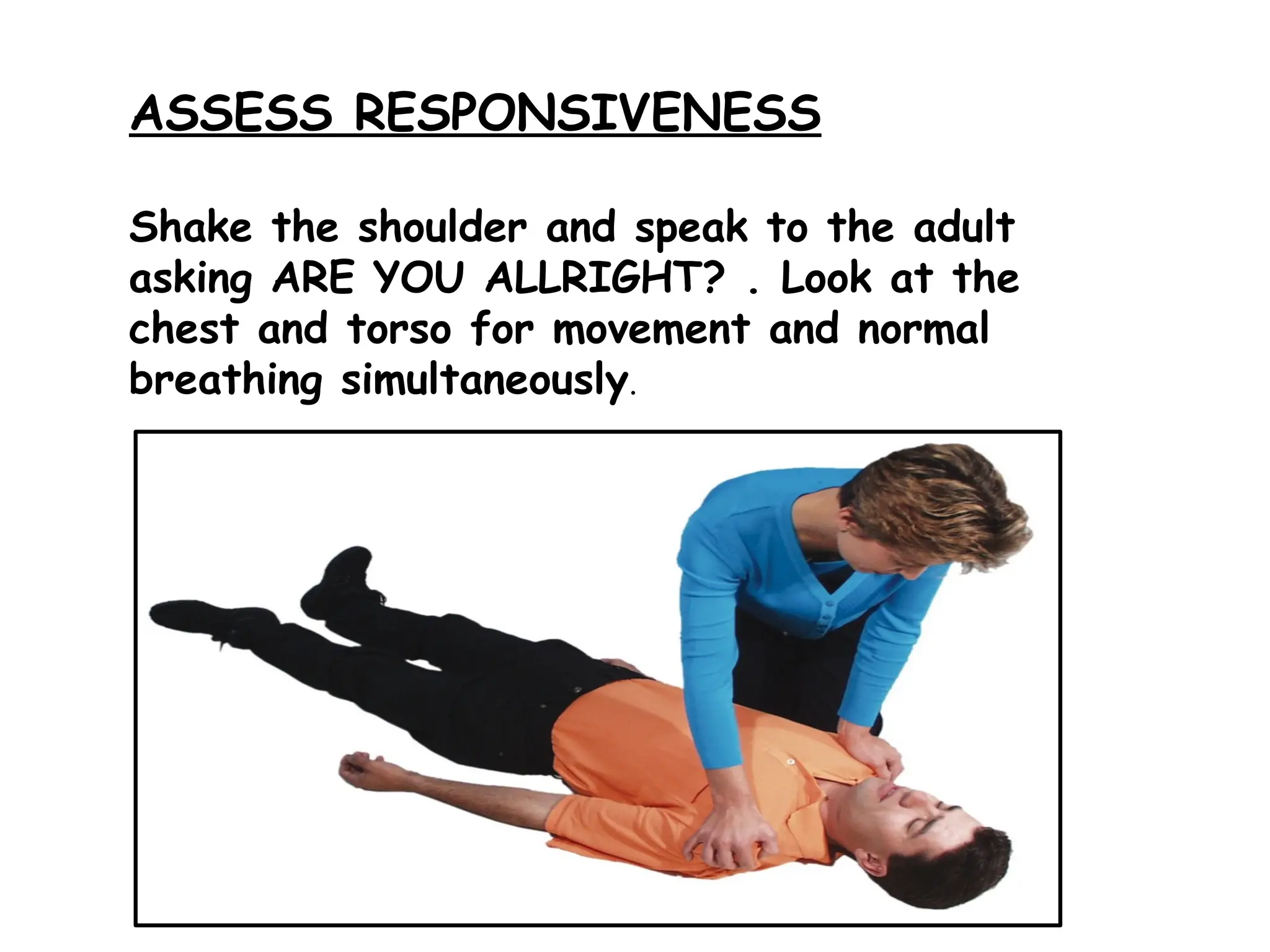
ASSESS RESPONSIVENESS
Shake the shoulder and speak to the adult
asking ARE YOU ALLRIGHT? . Look at the
chest and torso for movement and normal
breathing simultaneously.
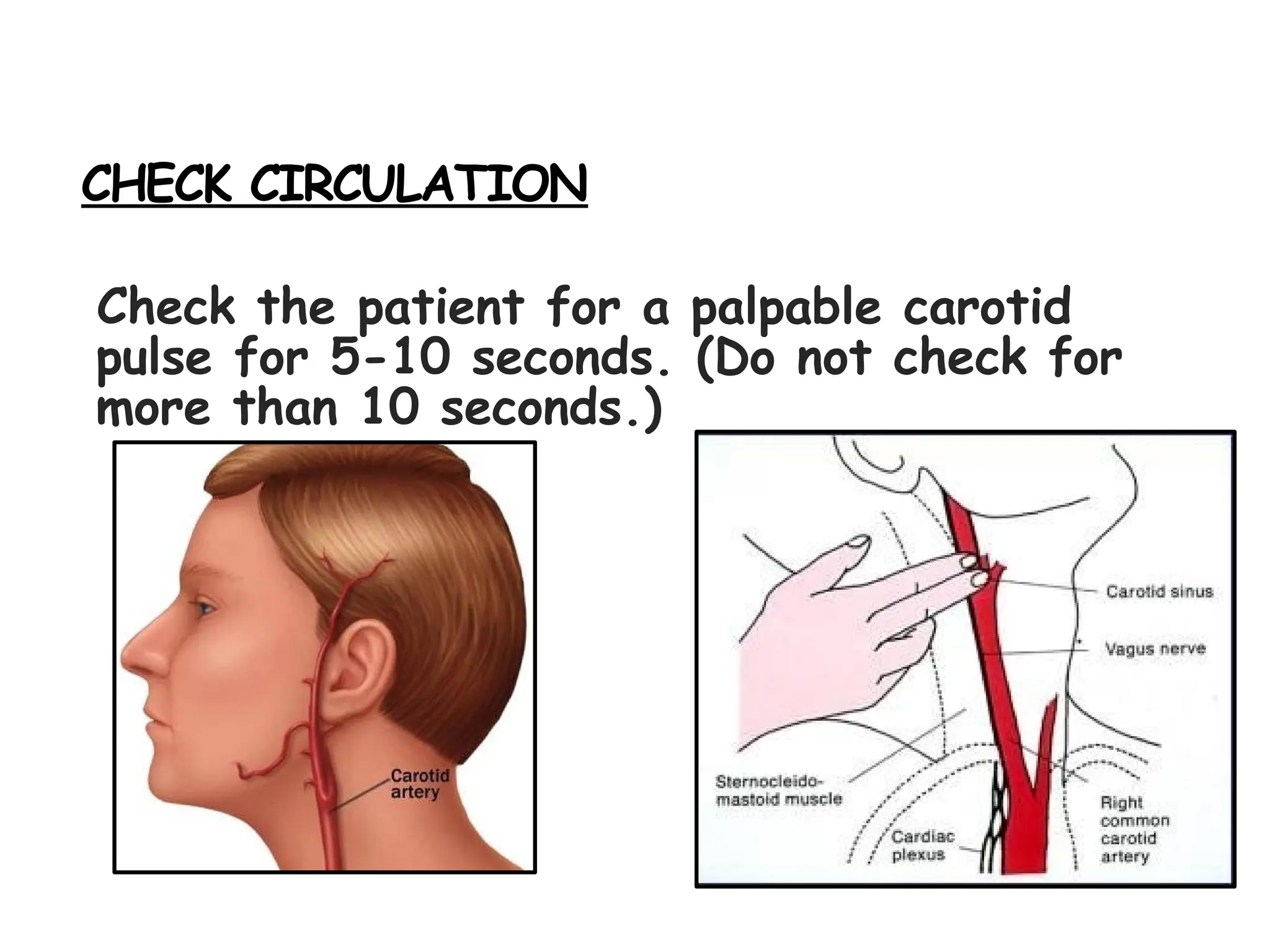
CHECK CIRCULATION
Check the patient for a palpable carotid
pulse for 5-10 seconds. (Do not check for
more than 10 seconds.)
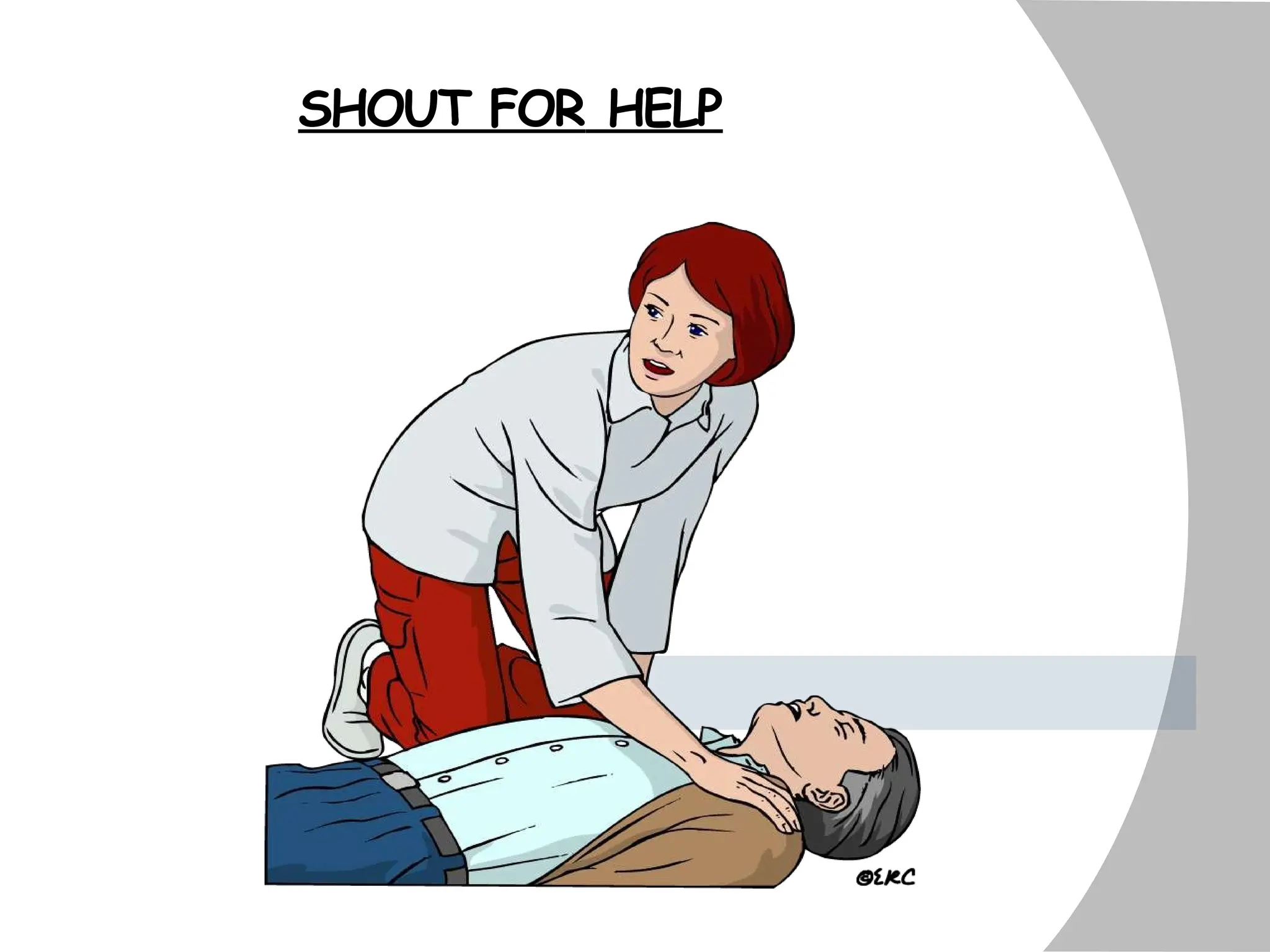
SHOUT FOR HELP
IF THERE IS NO PULSE AND
NO/ABNORMAL BREATHING
START CPR
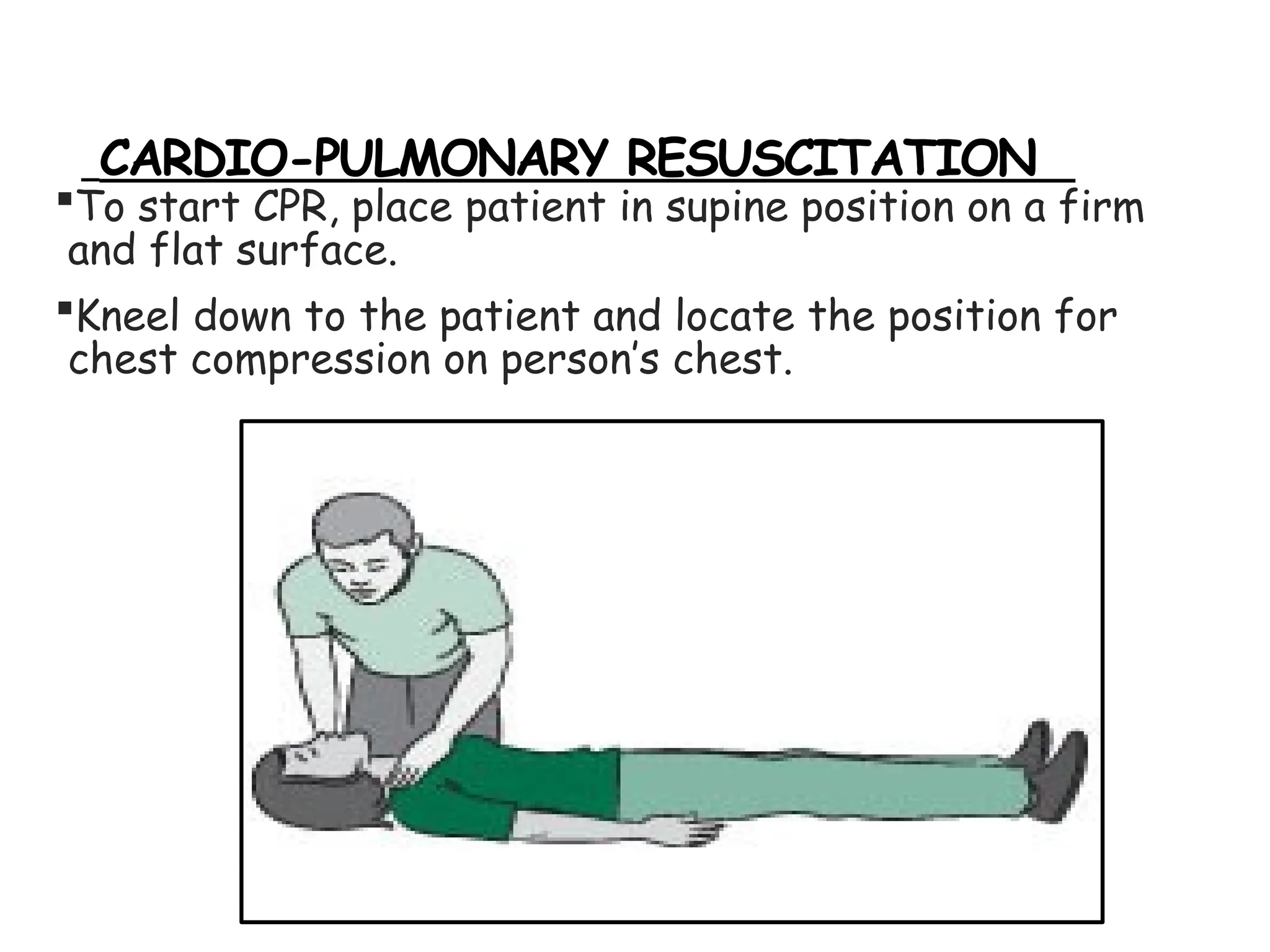
CARDIO-PULMONARY RESUSCITATION
To start CPR, place patient in supine position on a firm
and flat surface.
Kneel down to the patient and locate the position for
chest compression on person’s chest.
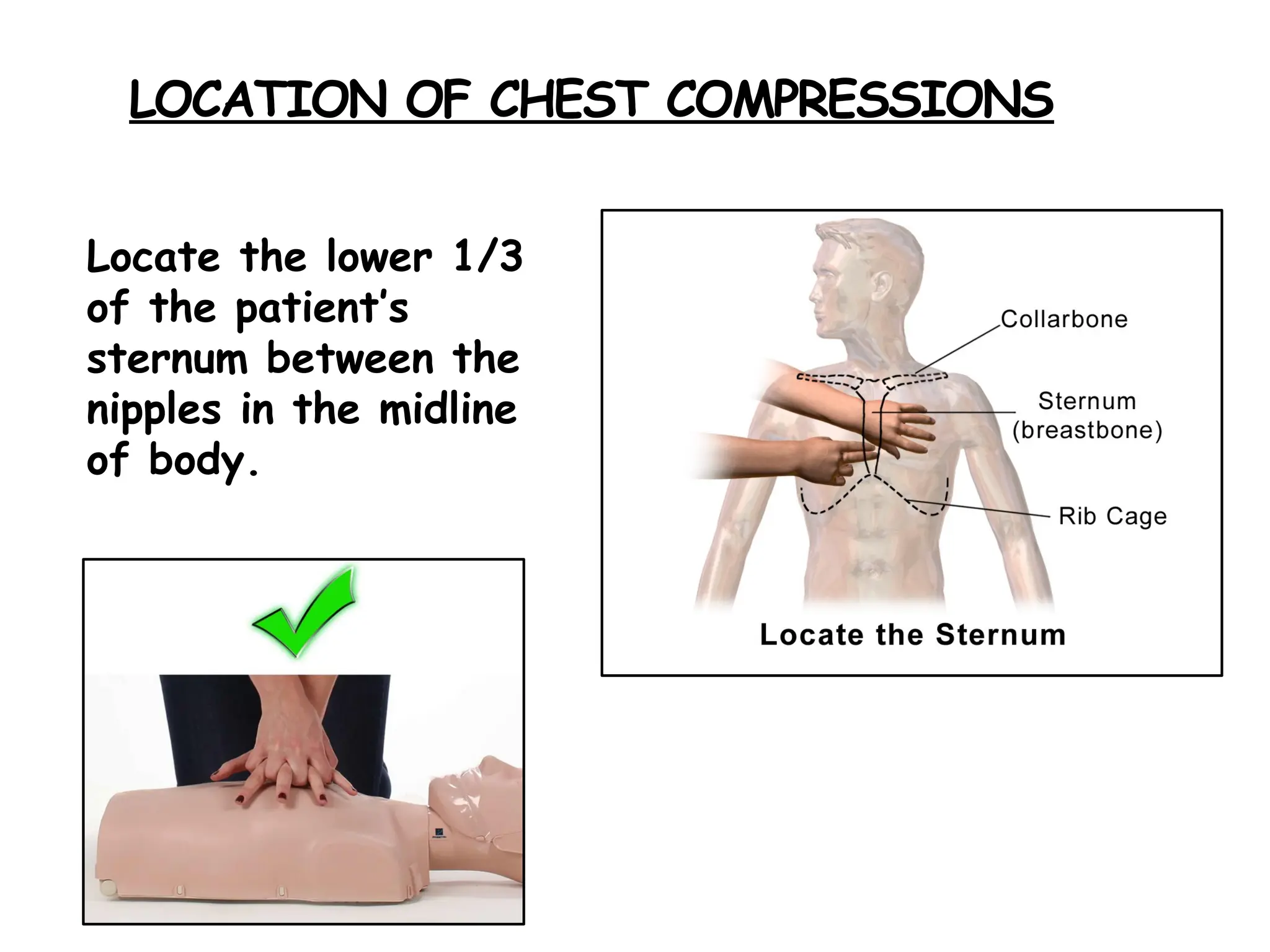
LOCATION OF CHEST COMPRESSIONS
Locate the lower 1/3
of the patient’s
sternum between the
nipples in the midline
of body.
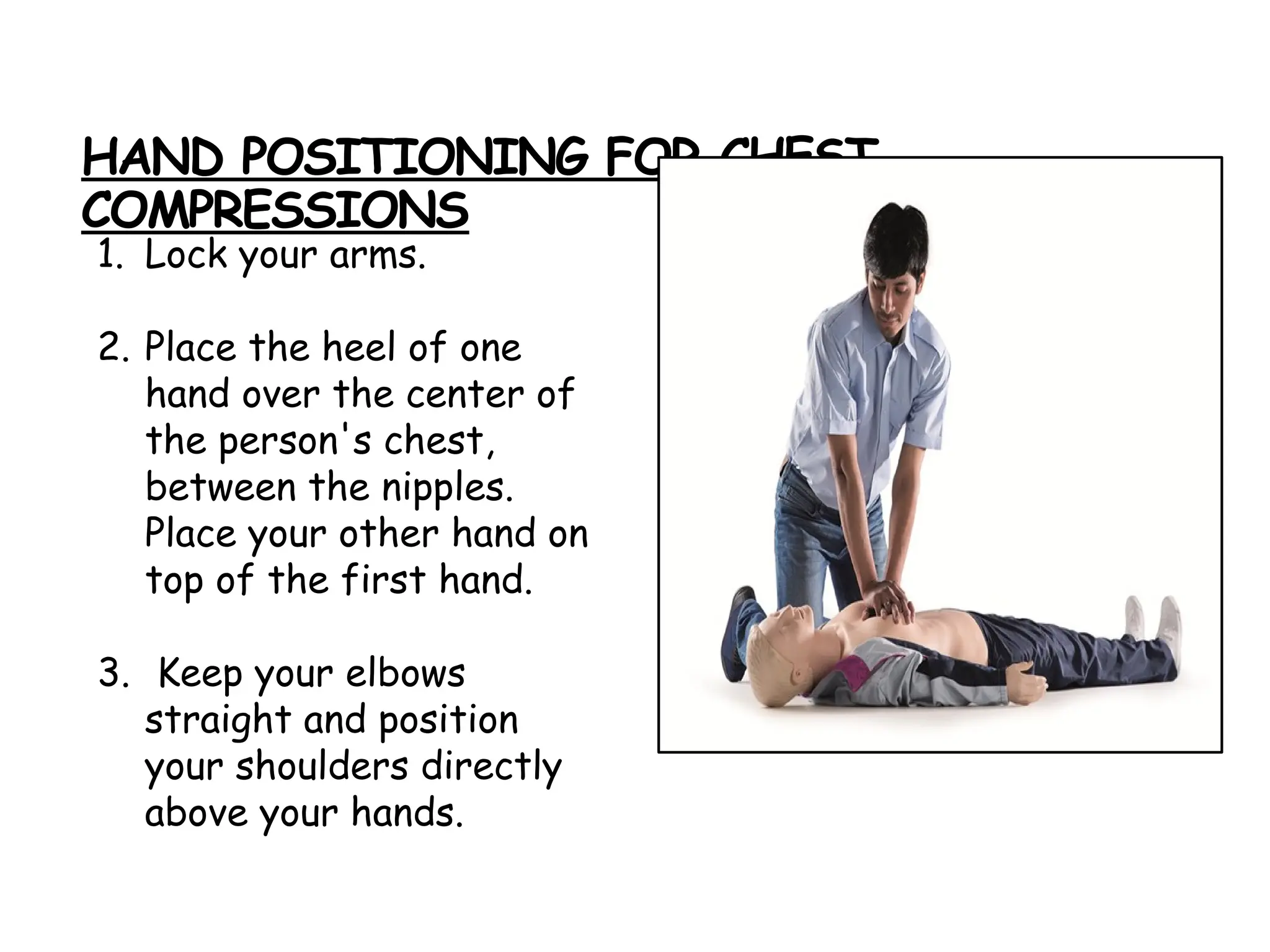
HAND POSITIONING FOR CHEST
COMPRESSIONS
1. Lock your arms.
2. Place the heel of one
hand over the center of
the person's chest,
between the nipples.
Place your other hand on
top of the first hand.
3. Keep your elbows
straight and position
your shoulders directly
above your hands.
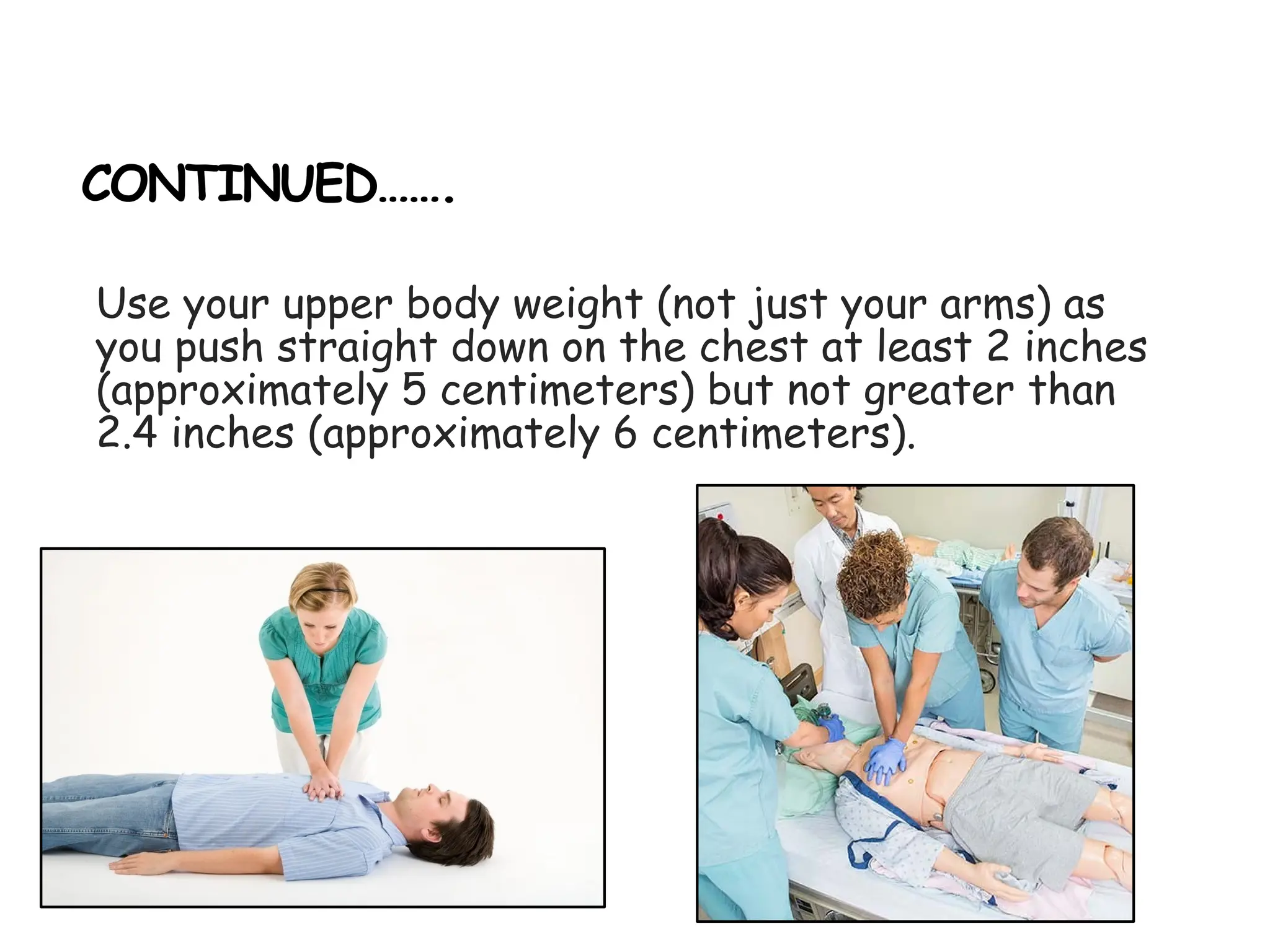
CONTINUED…….
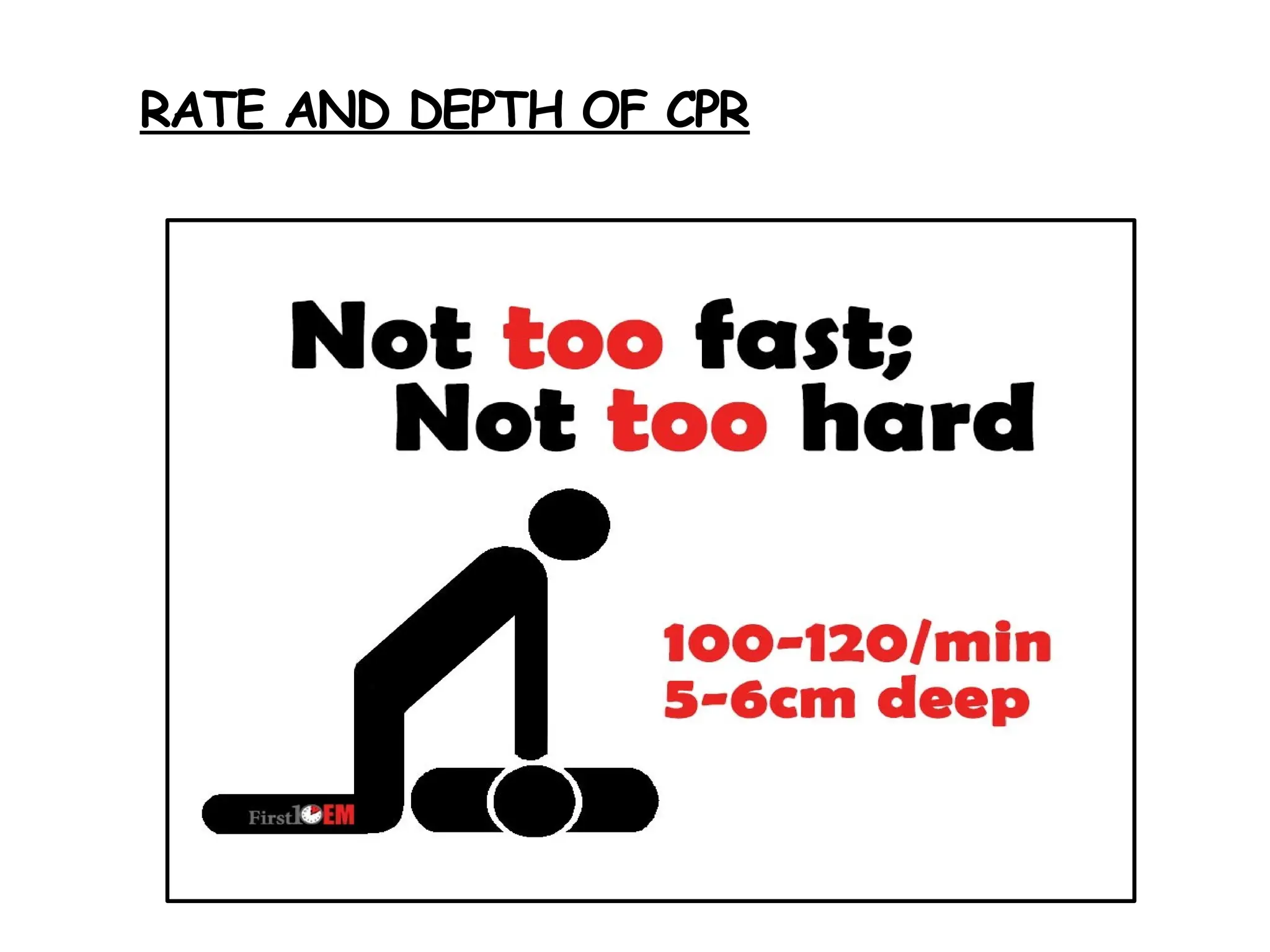
Use your upper body weight (not just your arms) as
you push straight down on the chest at least 2 inches
(approximately 5 centimeters) but not greater than
2.4 inches (approximately 6 centimeters).
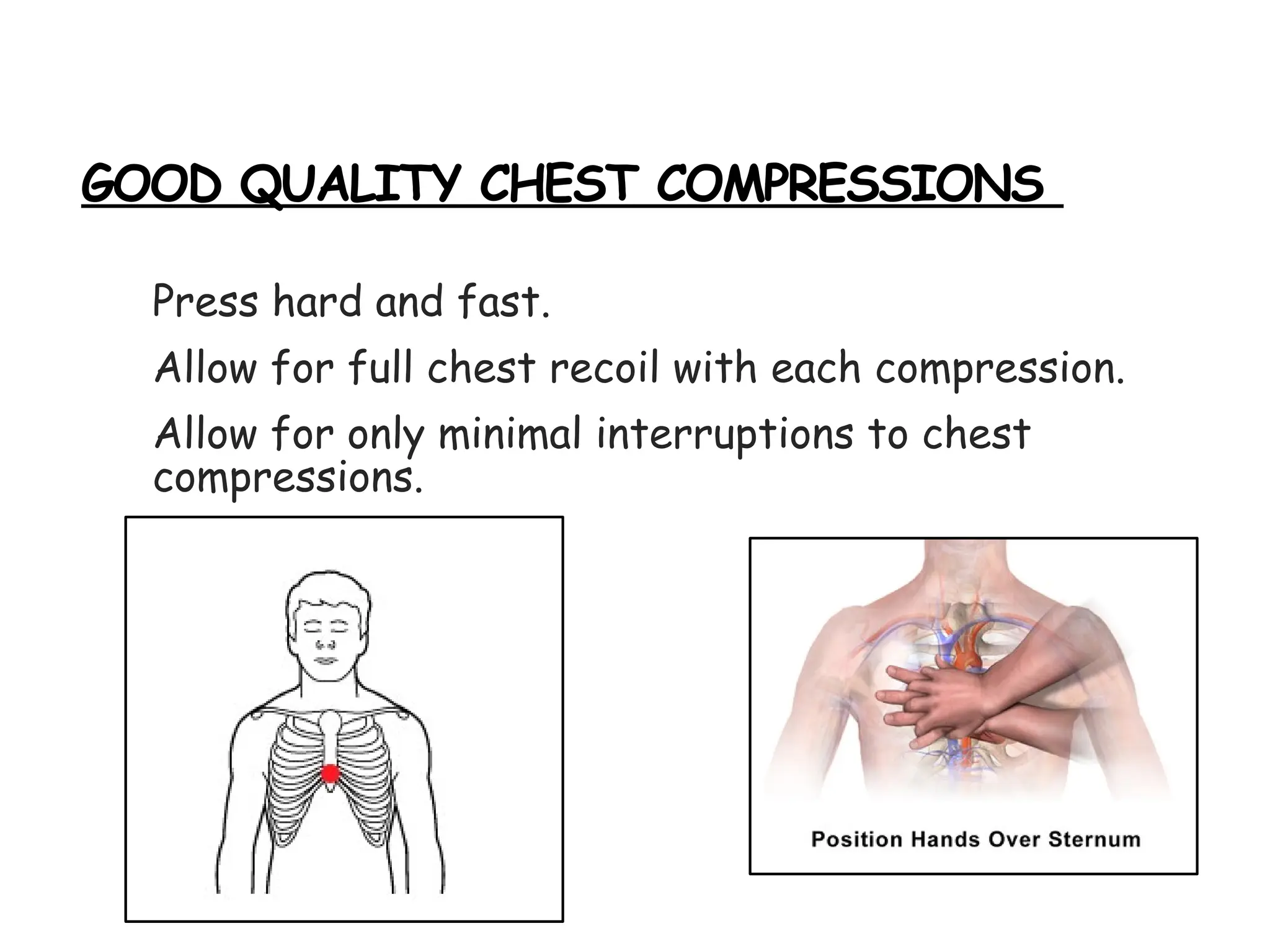
GOOD QUALITY CHEST COMPRESSIONS
Press hard and fast.
Allow for full chest recoil with each compression.
Allow for only minimal interruptions to chest
compressions.
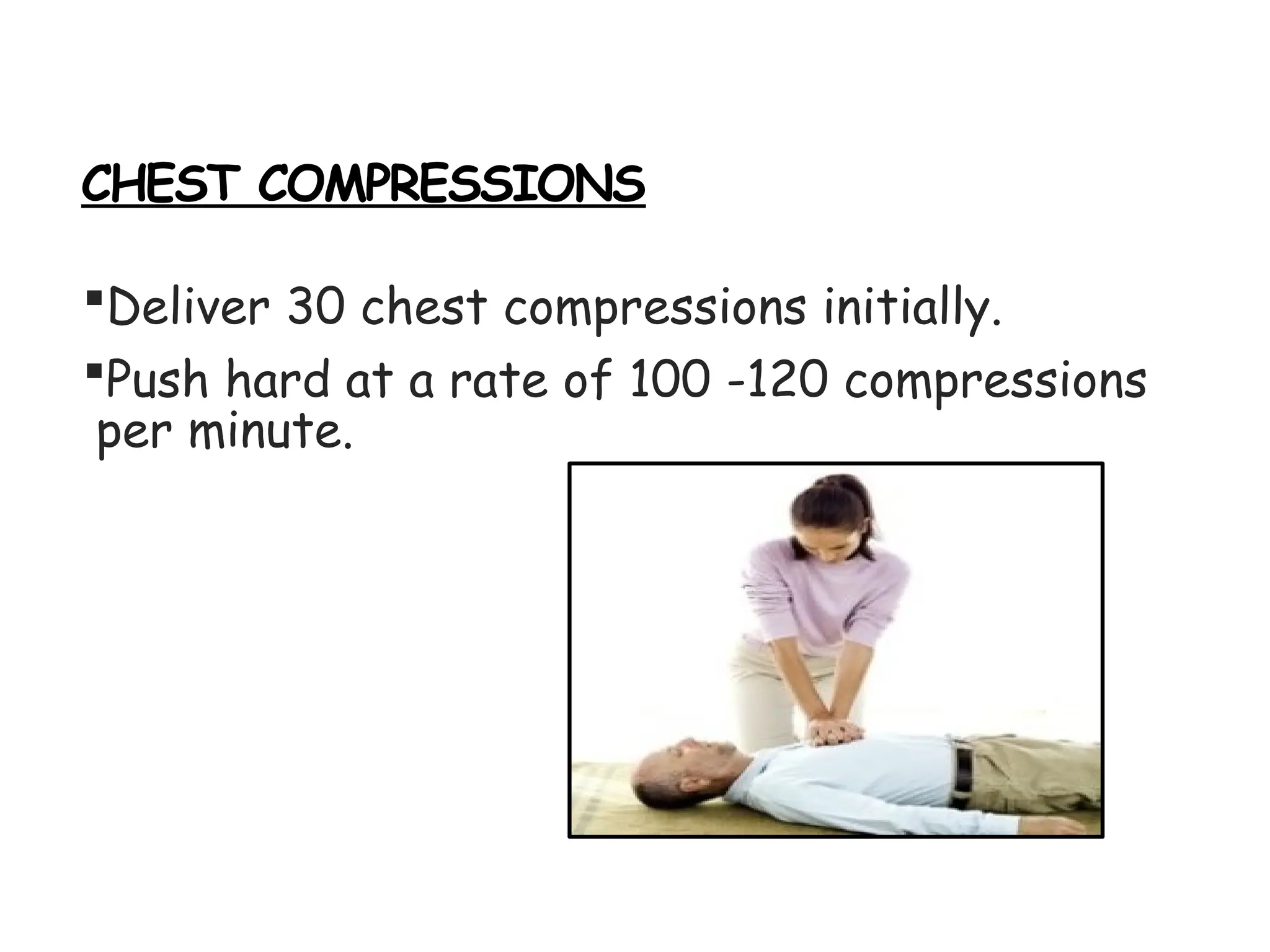
CHEST COMPRESSIONS
Deliver 30 chest compressions initially.
Push hard at a rate of 100 -120 compressions
per minute.
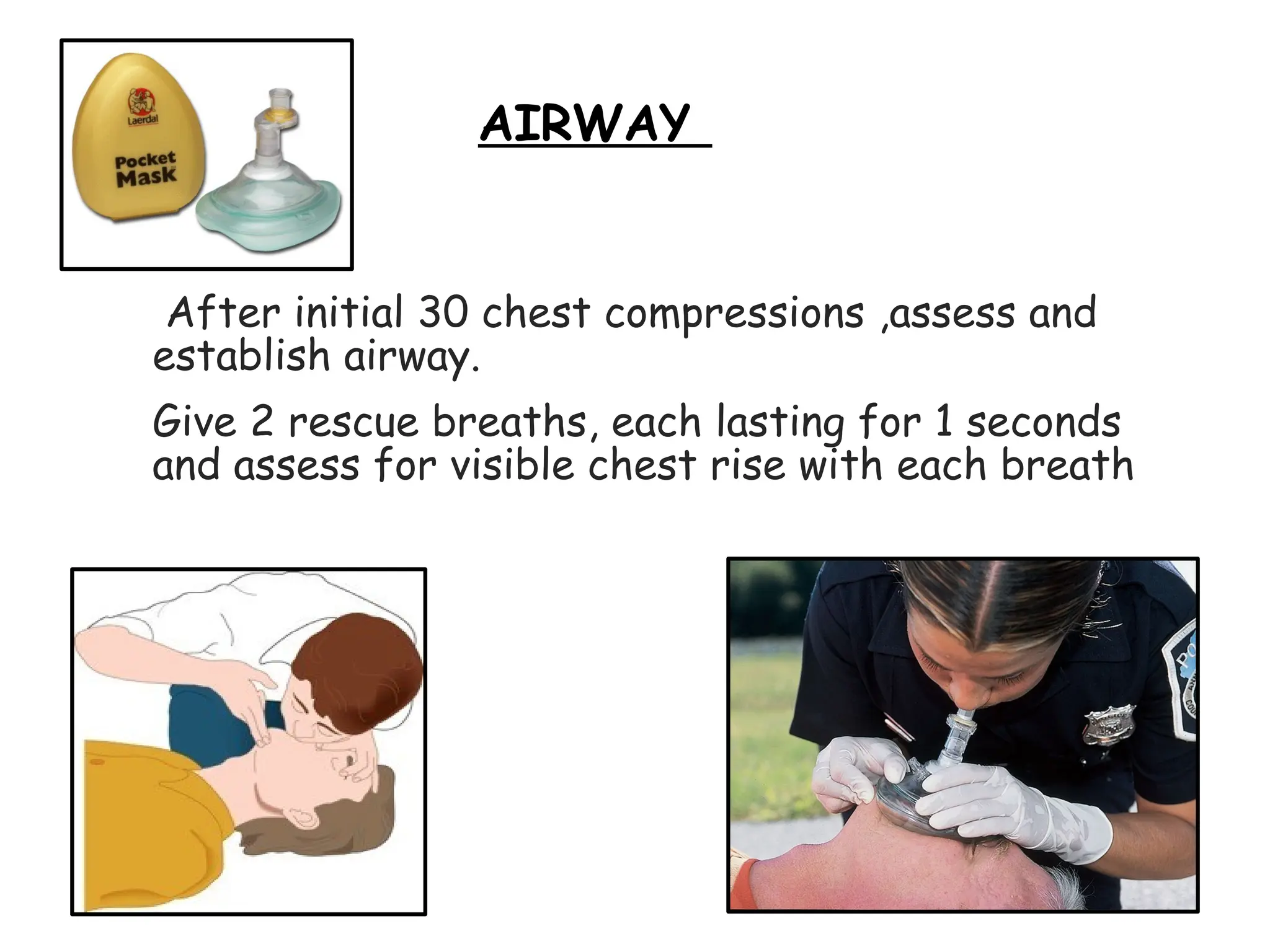
After initial 30 chest compressions ,assess and
establish airway.
Give 2 rescue breaths, each lasting for 1 seconds
and assess for visible chest rise with each breath
AIRWAY
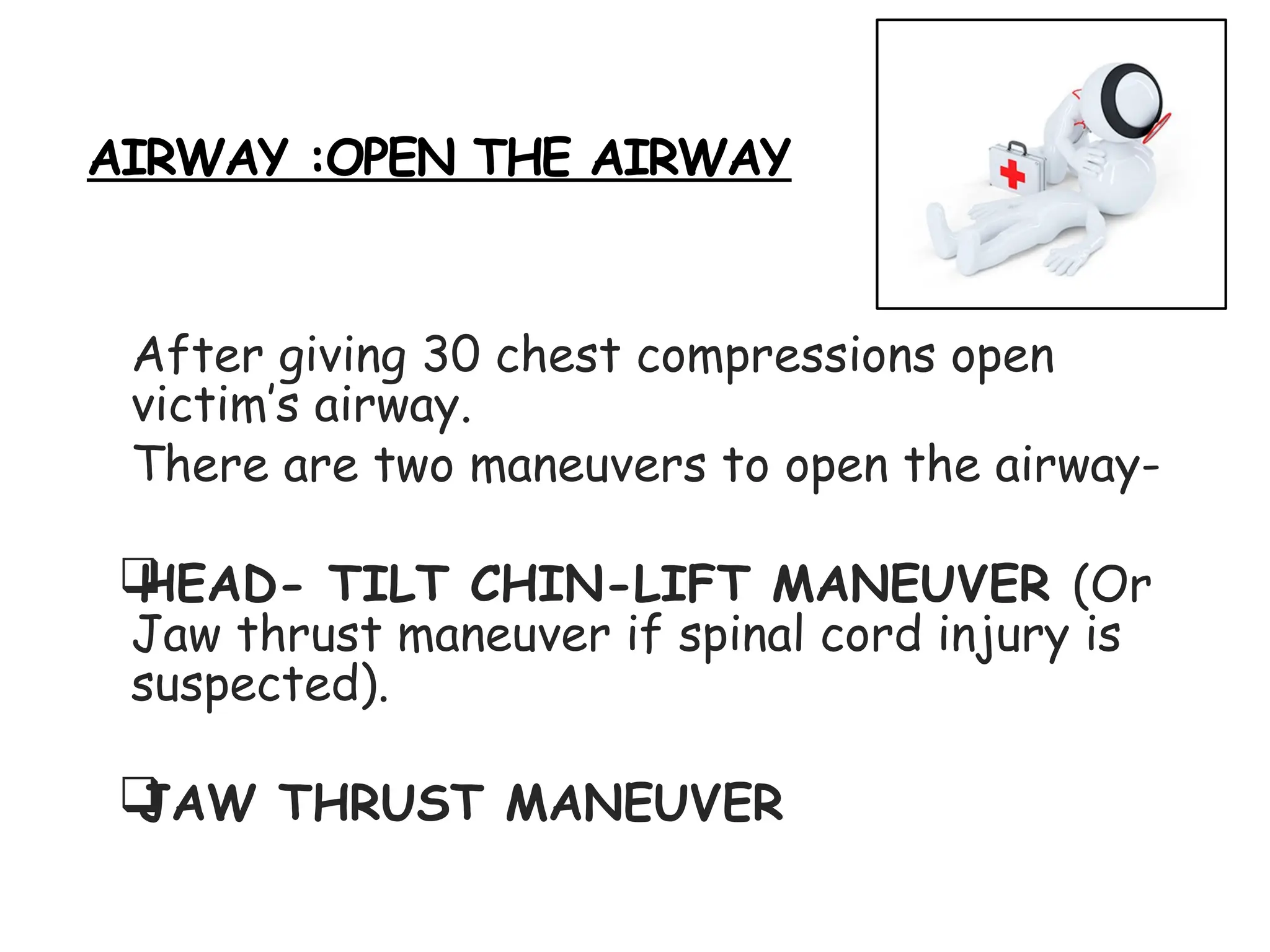
AIRWAY :OPEN THE AIRWAY
After giving 30 chest compressions open
victim’s airway.
There are two maneuvers to open the airway-

HEAD- TILT CHIN-LIFT MANEUVER (Or
Jaw thrust maneuver if spinal cord injury is
suspected).

JAW THRUST MANEUVER
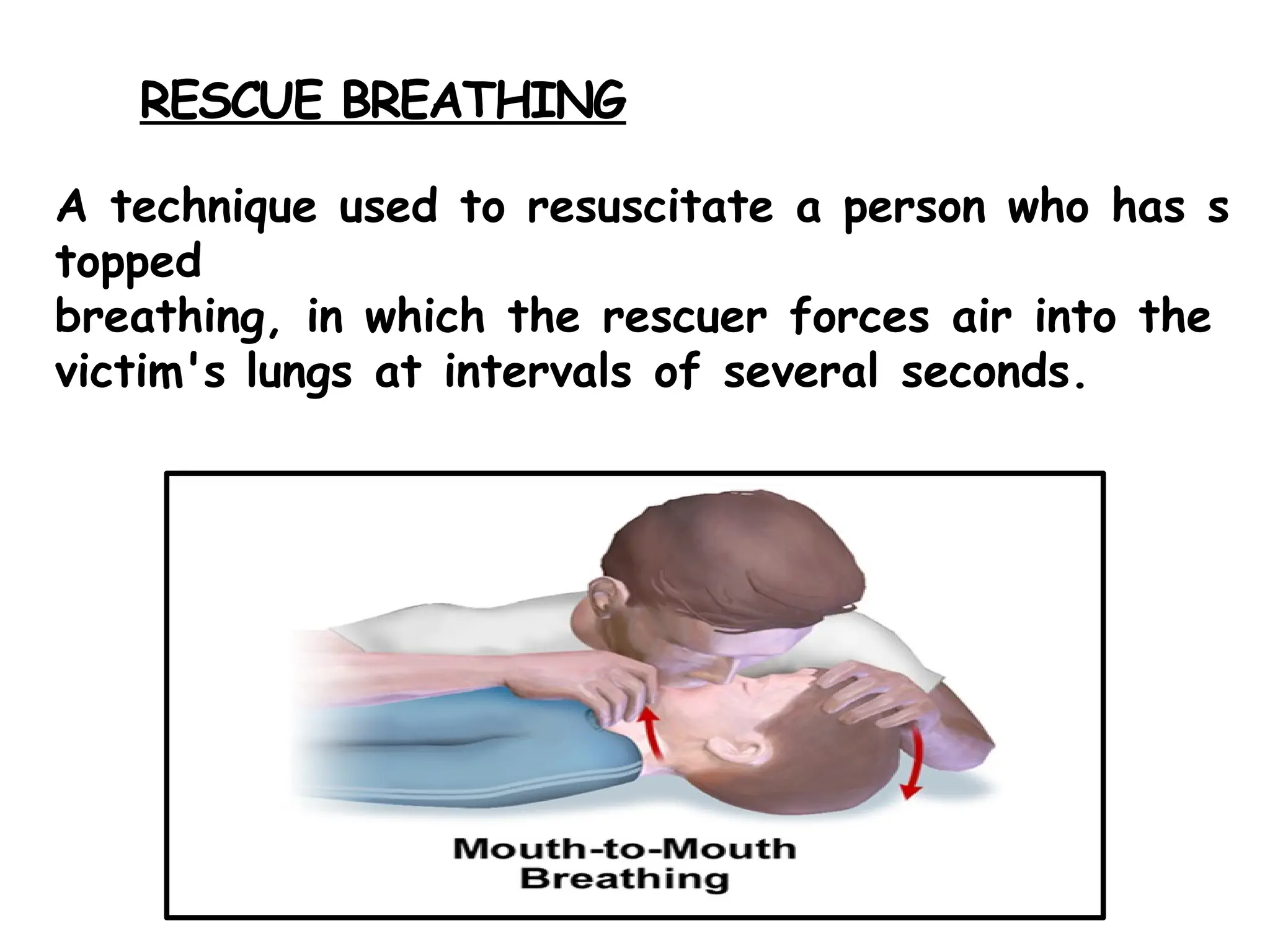
RESCUE BREATHING
A technique used to resuscitate a person who has s
topped
breathing, in which the rescuer forces air into the
victim's lungs at intervals of several seconds.
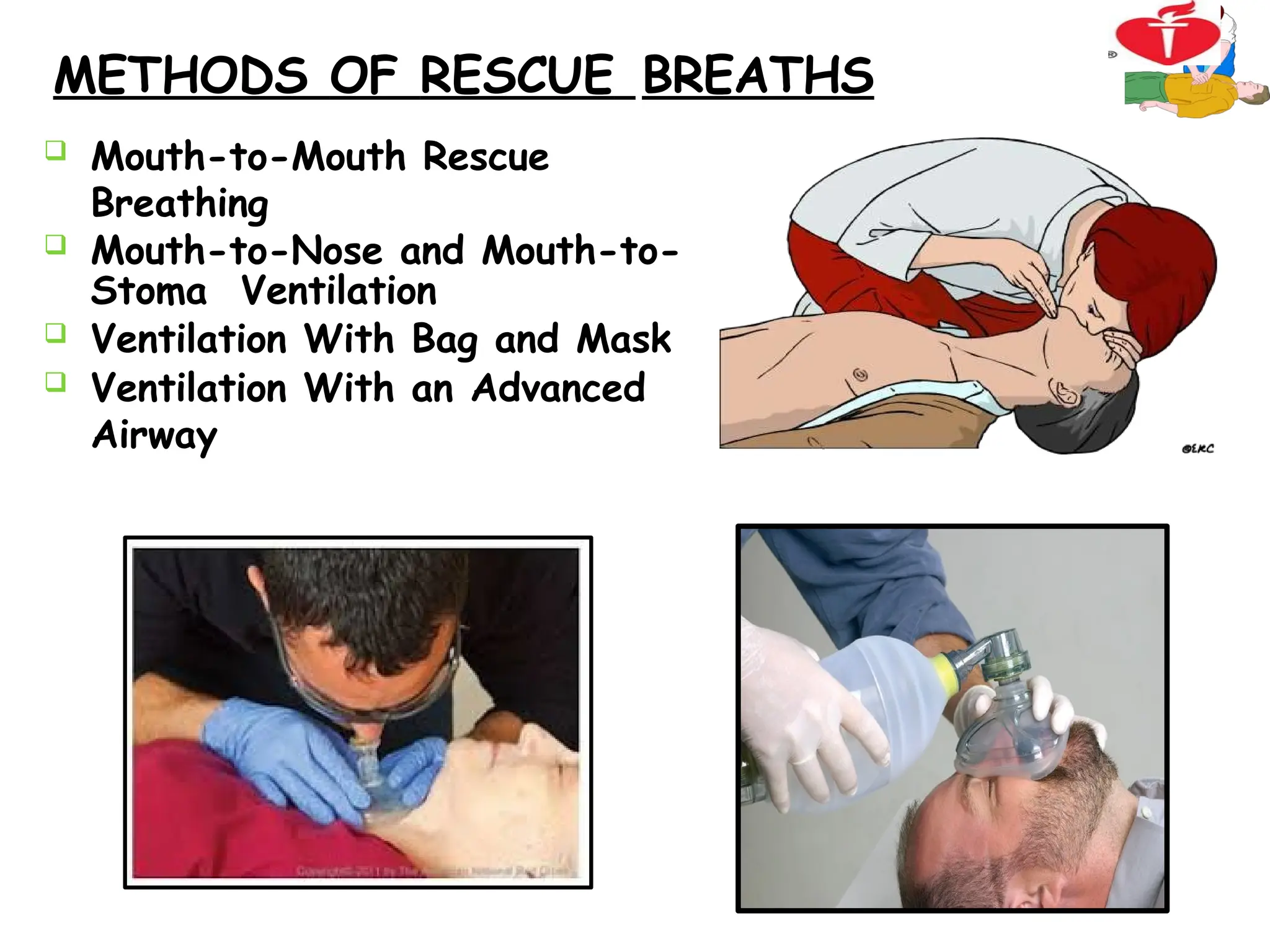
METHODS OF RESCUE BREATHS
 Mouth-to-Mouth Rescue
Breathing
 Mouth-to-Nose and Mouth-to-
Stoma Ventilation
 Ventilation With Bag and Mask
 Ventilation With an Advanced
Airway
32
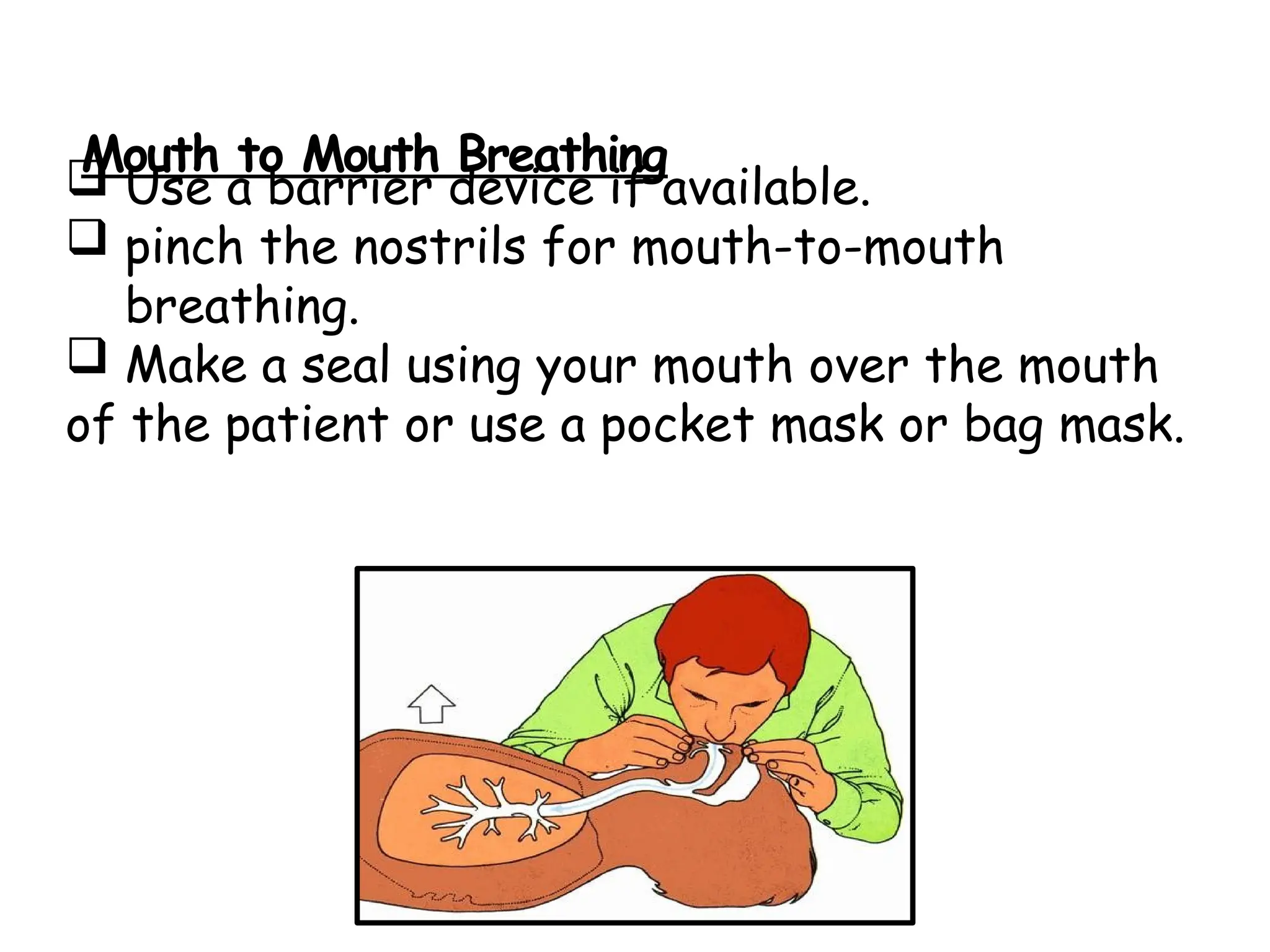
Mouth to Mouth Breathing
 Use a barrier device if available.
 pinch the nostrils for mouth-to-mouth
breathing.
 Make a seal using your mouth over the mouth
of the patient or use a pocket mask or bag mask.
33
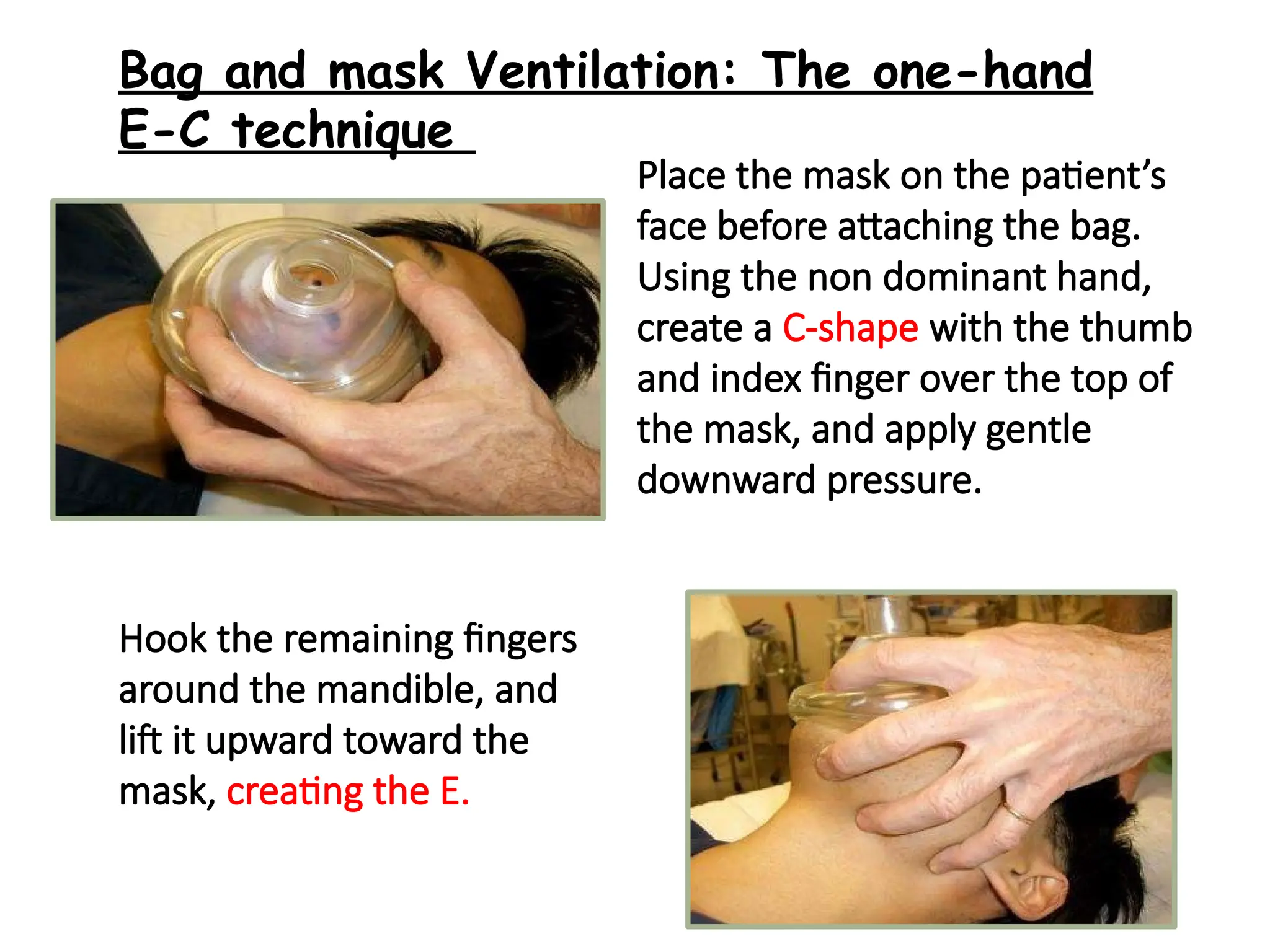
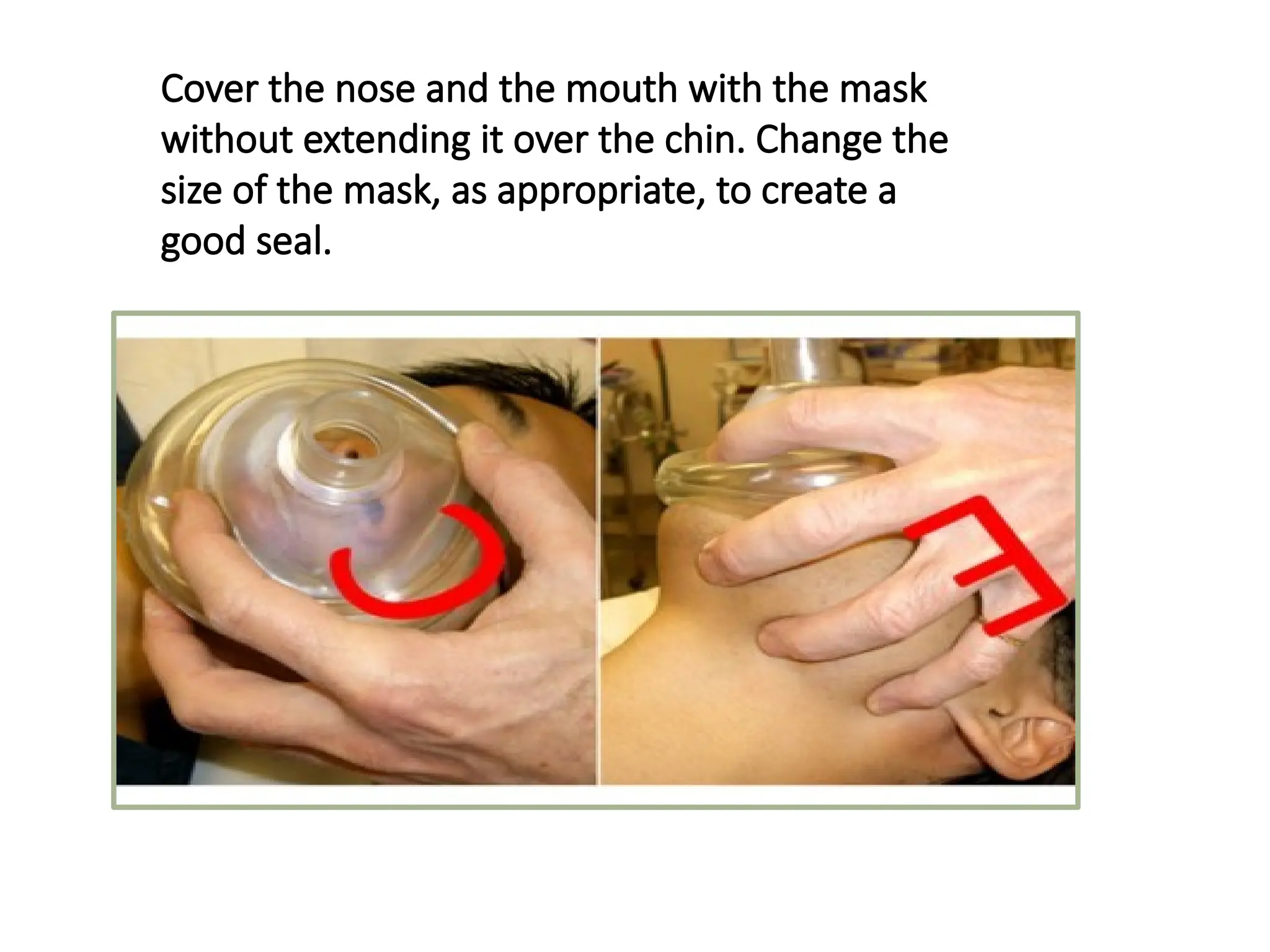
Place the mask on the patient’s
face before attaching the bag.
Using the non dominant hand,
create a C-shape with the thumb
and index finger over the top of
the mask, and apply gentle
downward pressure.
Hook the remaining fingers
around the mandible, and
lift it upward toward the
mask, creating the E.
Bag and mask Ventilation: The one-hand
E-C technique
Cover the nose and the mouth with the mask
without extending it over the chin. Change the
size of the mask, as appropriate, to create a
good seal.
RESCUE BREATHING
Each rescue breath should last approximately 1
second.
Watch for chest rise.
Allow time for the air to expel from the
patient.
Cardio-Pulmonary
Resuscitation
1 cycle of adult CPR is 30 chest compressions
to 2 rescue breaths.
Perform 5 cycles of CPR (lasts approximately
2 minutes).
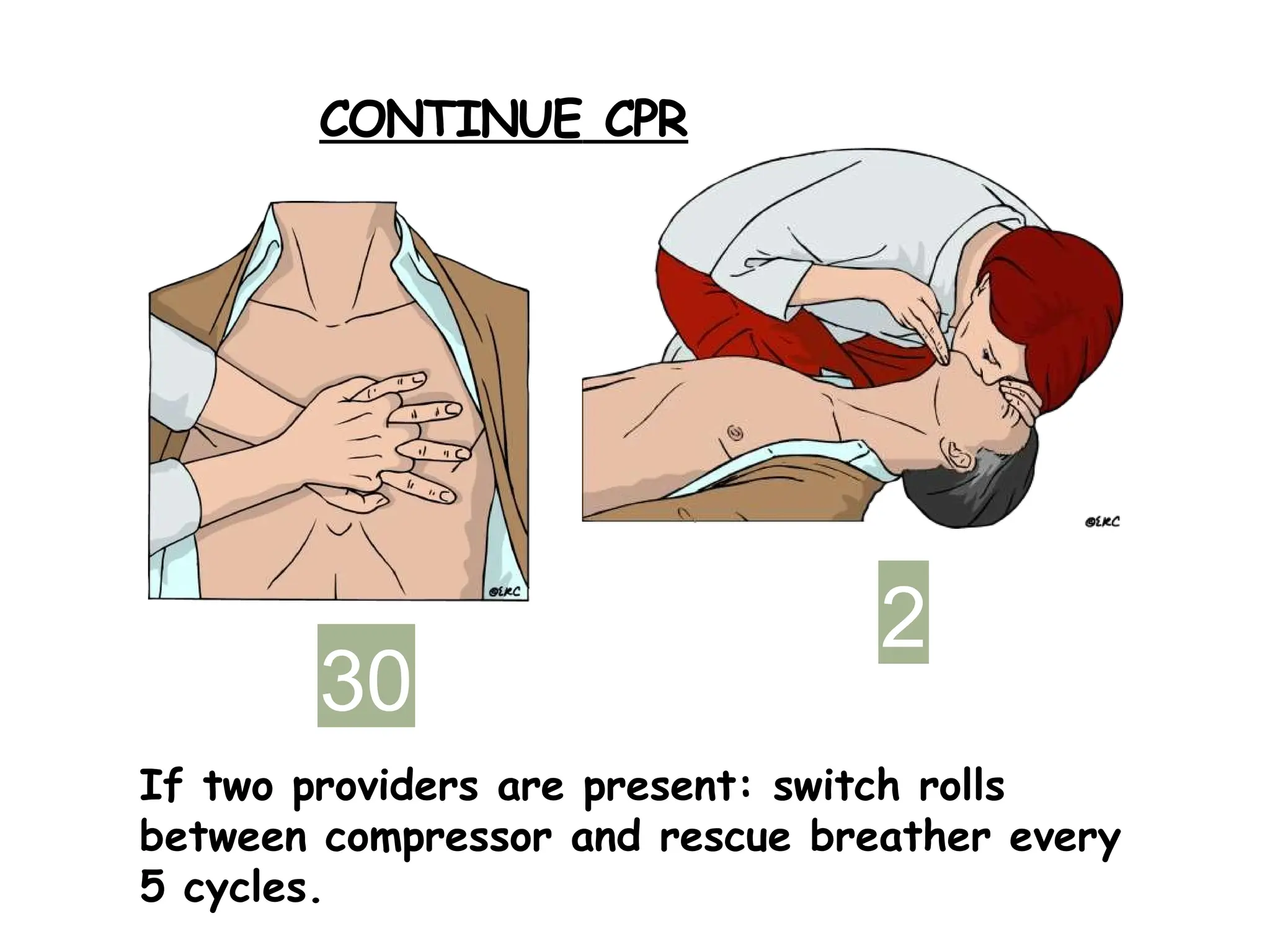
CONTINUE CPR
30
2
If two providers are present: switch rolls
between compressor and rescue breather every
5 cycles.
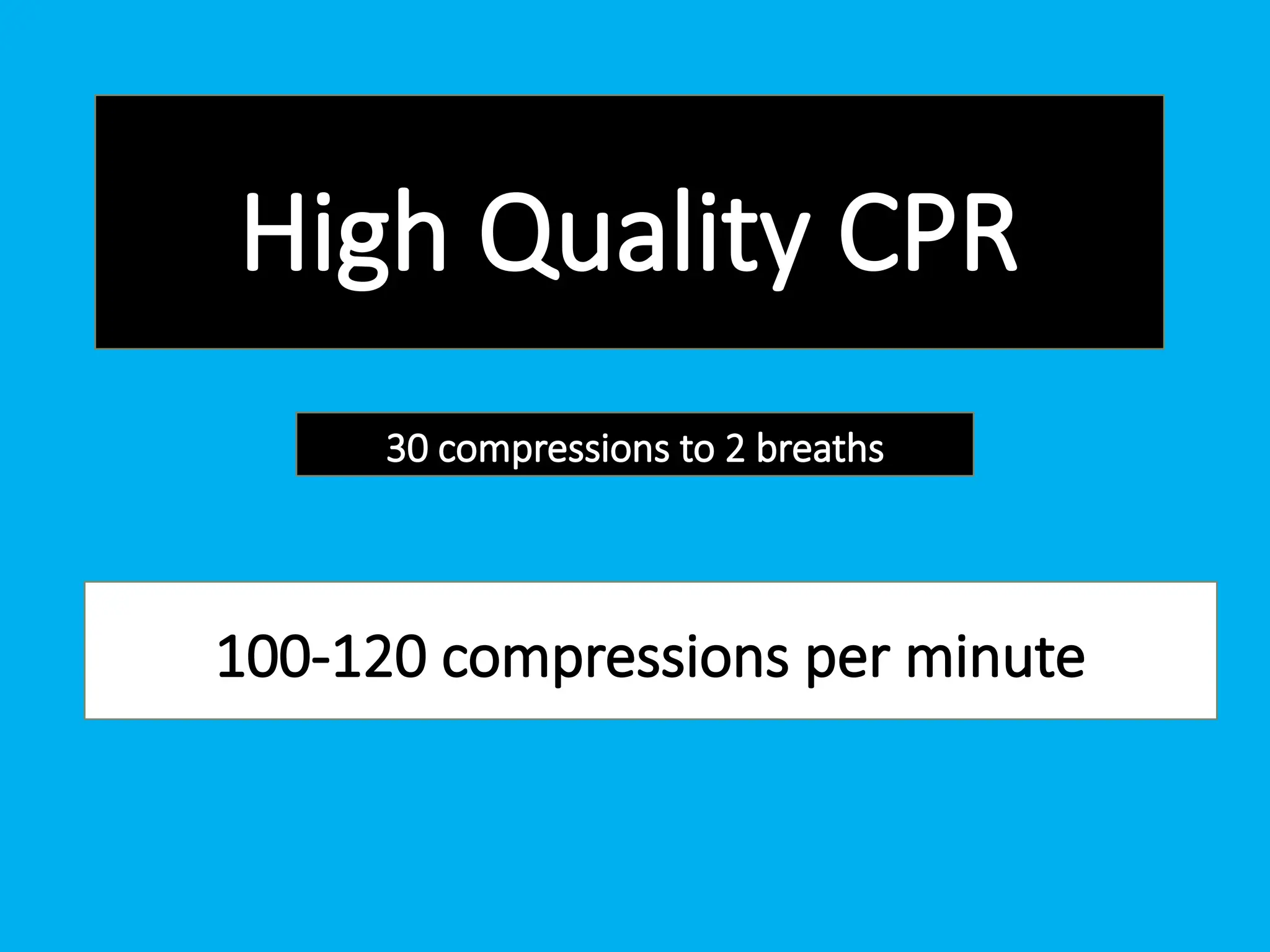
High Quality CPR
30 compressions to 2 breaths
100-120 compressions per minute
RATE AND DEPTH OF CPR
CONTINUE RESUSCITATION UNTIL
 Qualified help arrives and takes over
 The victim starts breathing normally
 Rescuer becomes exhausted
AUTOMATED EXTERNAL
DEFIBRILLATOR
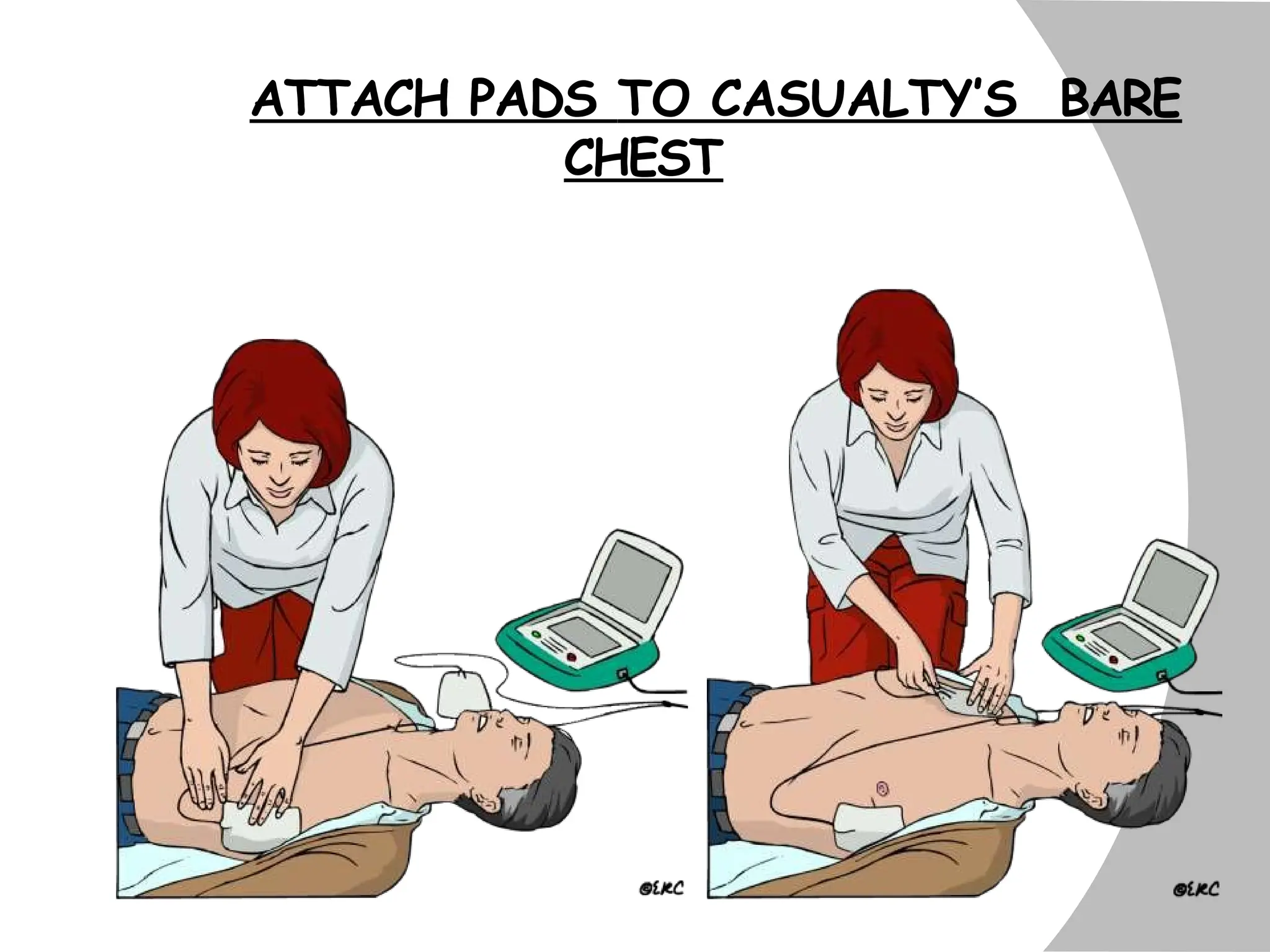
An AED, or automated external
defrillator, is a device that has
the ability to detect irregular
heart rhythm and it automatically
delivers a defibrillation shock to
stop irregular heart beat and allow
a normal rhythm to resume.
AEDs are designed to be used by
any laypersons.
ATTACH PADS TO CASUALTY’S BARE
CHEST
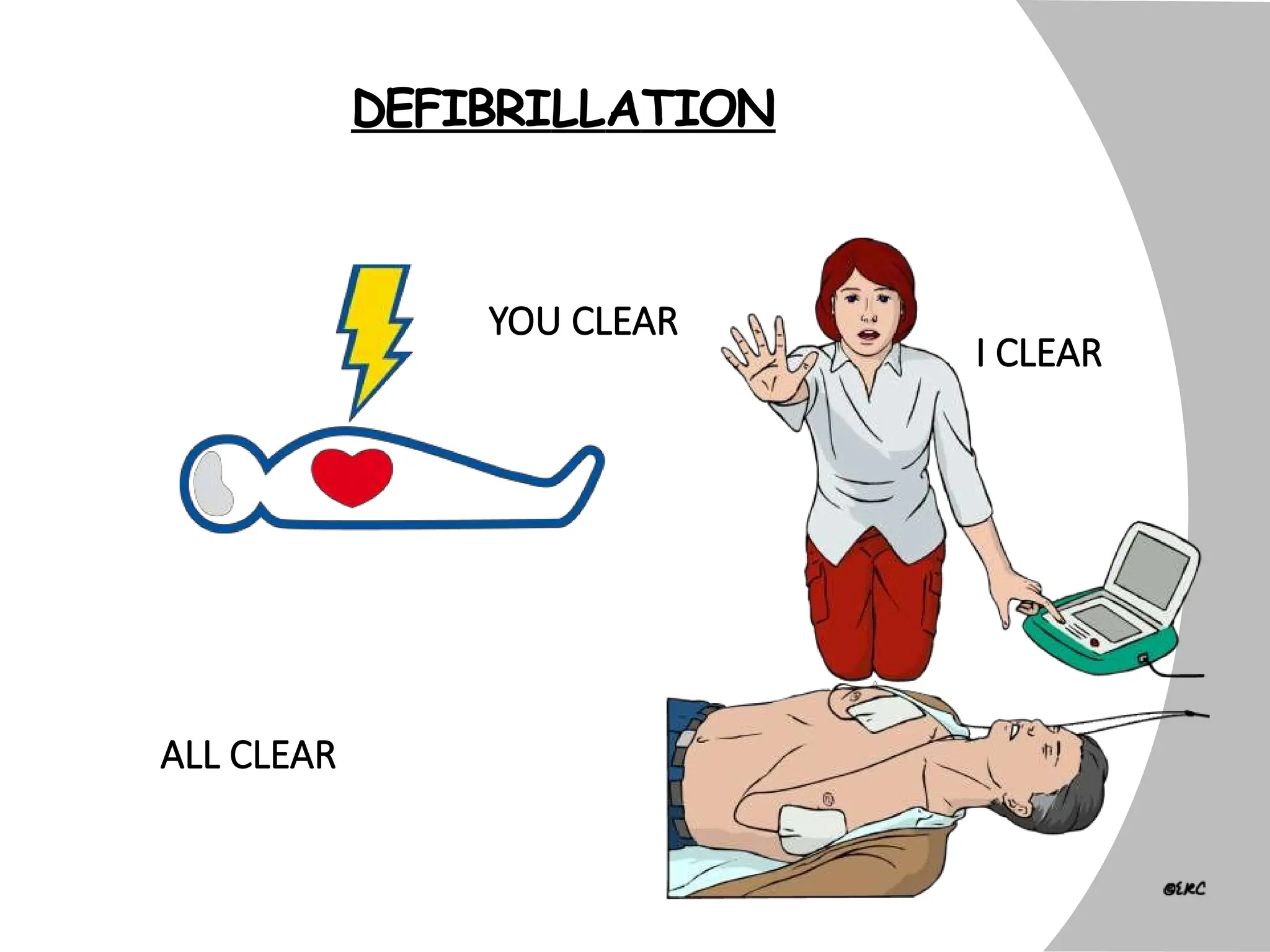
DEFIBRILLATION
I CLEAR
YOU CLEAR
ALL CLEAR
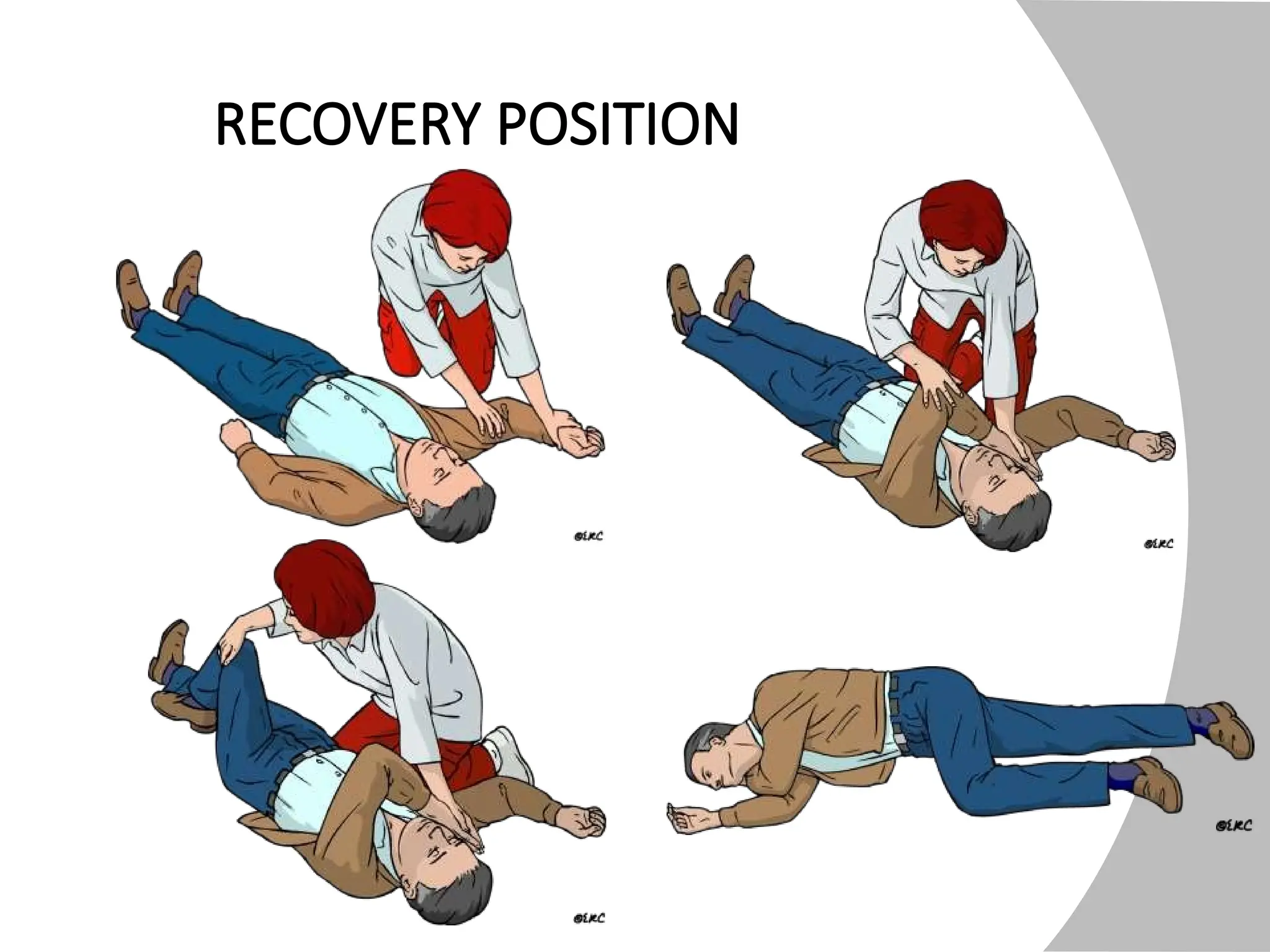
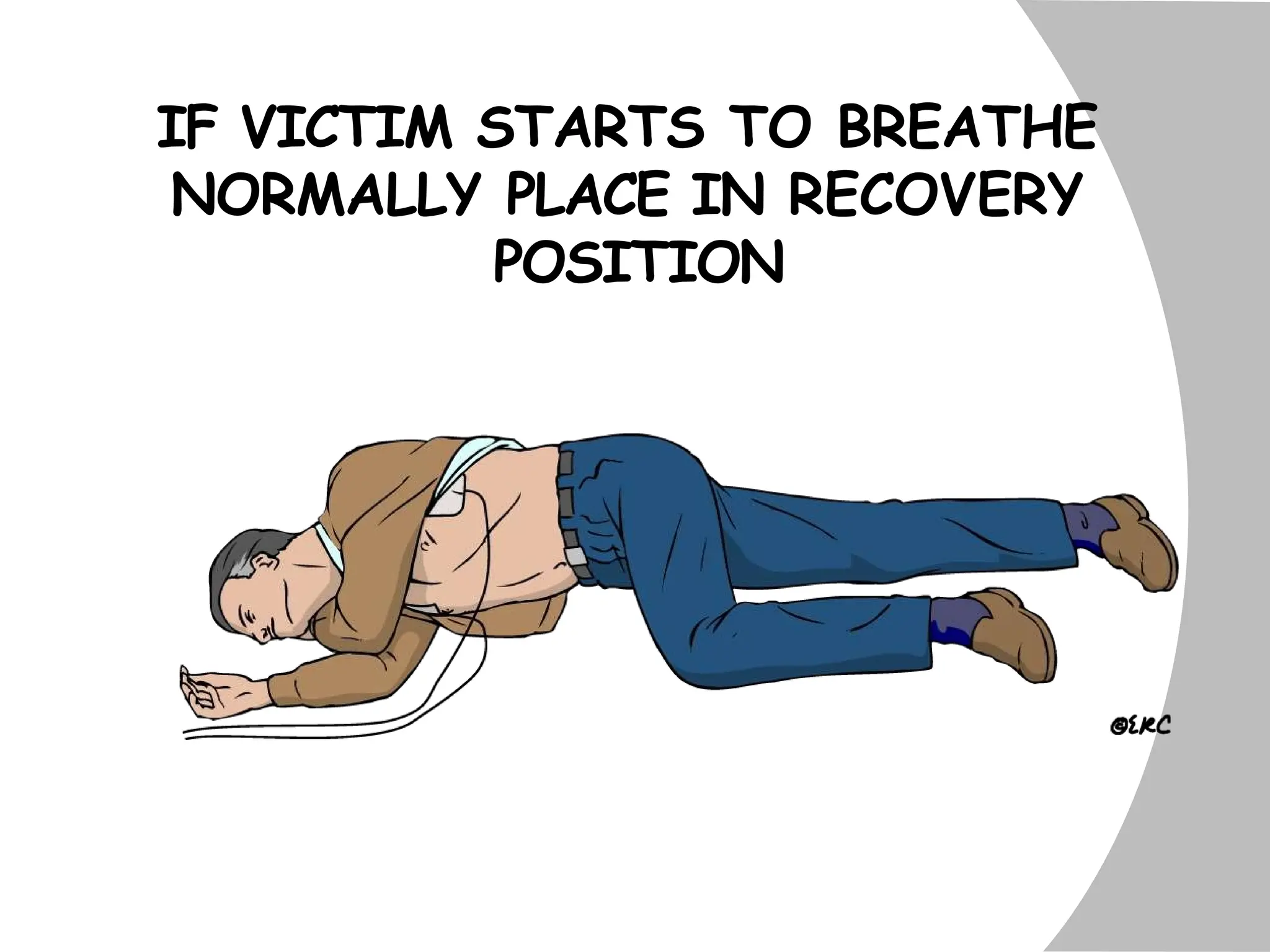
IF VICTIM STARTS TO BREATHE
NORMALLY PLACE IN RECOVERY
POSITION
RECOVERY POSITION
HODS - November 2006 86
COMPLICATIONS OF CPR
1. Rib Fracture
2. Internal injuries to
organs
3. Laceration related to
the tip of the
sternum
4. Vomiting and
aspiration
5. Gastric distension.
TAKE HOME MESSAGE
Taking the right action quickly and confidently can
make the difference between life and death for a
person dealing with cardiac arrest.
CPR Principles and Techniques, Proper patient handing

CPR Principles and Techniques, Proper patient handing

  • 1.
    SUPPORT (BLS) By: Dr.Akshita (PT) M.P.T (Cardiopulmonary), B.P.T (AJIPT, Delhi University), D.C.P.T In charge, Department of Physiotherapy, IPHI, New Delhi Former PT Yashoda Super Specialty Hospital & DCCW Former Intern Sir Ganga Ram Hospital Certified BLS & ACLS, AHA
  • 2.
    WHATISBASICLIFESUPPORT? Basic Life Support(BLS) defines Sequences of procedures performed to restore the circulation of oxygenated blood after a sudden pulmonary or cardiac arrest until they can be given full medical care at a hospital. BLS does not include the use of drugs or invasive skills.
  • 3.
    GLOBAL BURDEN OFSUDDEN CARDIAC ARREST Approximately 700,000 cardiac arrests per year. Bystander CPR before arrival of emergency services – doubles survival from sudden cardiac arrest. Early resuscitation can result in >60 % survival.
  • 4.
    BASIC LIFE SUPPORT Itcan be provided by trained medical personnel, including paramedics, and by Anyone who knows, How To do it, anywhere, immediately, without any other equipment.
  • 5.
    HODS - November2006 27 PURPOSES OF CPR  Maintaining circulation and oxygenation in order to maintain a cardiac output to keep vital organs alive.
  • 6.
    INDICATIONS OF CPR CARDIACARREST RESPIRATORY ARREST COMBINATION OF BOTH
  • 7.
    WHAT IS CABAPPROACH ? There is a common acronym in BLS used to guide providers in the appropriate steps to assess and treat patients in respiratory and cardiac distress. This is CAB-D (Circulation, Airway, Breathing, Defibrillate)
  • 8.
  • 9.
    CHAIN OF SURVIVAL FIVELINKS OF ADULT CHAIN OF SURVIVAL- •Early recognition of cardiac arrest. •Activation of the Emergency Response System. •Early CPR, to provide blood supply to vital organs. •Early defibrillation to restart the heart. •Comprehensive post-cardiac arrest care to restore quality of life.
  • 10.
    ACTIONS FOR PERFORMINGADULT CPR 1 Assess scene safety. 2 Determine responsiveness 3 Check carotid pulse 4 Perform chest compressions 5 Open Airway 6 Check Breathing and deliver breathe.
  • 11.
    SCENE 1- YOUFIND AN ADULT LYING ON GROUND
  • 12.
    ASSESS SCENE SAFETY Assessto make sure the scene is safe for you to respond to the down patient.
  • 13.
    ASSESS RESPONSIVENESS Shake theshoulder and speak to the adult asking ARE YOU ALLRIGHT? . Look at the chest and torso for movement and normal breathing simultaneously.
  • 14.
    CHECK CIRCULATION Check thepatient for a palpable carotid pulse for 5-10 seconds. (Do not check for more than 10 seconds.)
  • 15.
  • 16.
    IF THERE ISNO PULSE AND NO/ABNORMAL BREATHING START CPR
  • 17.
    CARDIO-PULMONARY RESUSCITATION To startCPR, place patient in supine position on a firm and flat surface. Kneel down to the patient and locate the position for chest compression on person’s chest.
  • 18.
    LOCATION OF CHESTCOMPRESSIONS Locate the lower 1/3 of the patient’s sternum between the nipples in the midline of body.
  • 19.
    HAND POSITIONING FORCHEST COMPRESSIONS 1. Lock your arms. 2. Place the heel of one hand over the center of the person's chest, between the nipples. Place your other hand on top of the first hand. 3. Keep your elbows straight and position your shoulders directly above your hands.
  • 20.
    CONTINUED……. Use your upperbody weight (not just your arms) as you push straight down on the chest at least 2 inches (approximately 5 centimeters) but not greater than 2.4 inches (approximately 6 centimeters).
  • 21.
    GOOD QUALITY CHESTCOMPRESSIONS Press hard and fast. Allow for full chest recoil with each compression. Allow for only minimal interruptions to chest compressions.
  • 22.
    CHEST COMPRESSIONS Deliver 30chest compressions initially. Push hard at a rate of 100 -120 compressions per minute.
  • 23.
    After initial 30chest compressions ,assess and establish airway. Give 2 rescue breaths, each lasting for 1 seconds and assess for visible chest rise with each breath AIRWAY
  • 24.
    AIRWAY :OPEN THEAIRWAY After giving 30 chest compressions open victim’s airway. There are two maneuvers to open the airway-  HEAD- TILT CHIN-LIFT MANEUVER (Or Jaw thrust maneuver if spinal cord injury is suspected).  JAW THRUST MANEUVER
  • 25.
    RESCUE BREATHING A techniqueused to resuscitate a person who has s topped breathing, in which the rescuer forces air into the victim's lungs at intervals of several seconds.
  • 26.
    METHODS OF RESCUEBREATHS  Mouth-to-Mouth Rescue Breathing  Mouth-to-Nose and Mouth-to- Stoma Ventilation  Ventilation With Bag and Mask  Ventilation With an Advanced Airway 32
  • 27.
    Mouth to MouthBreathing  Use a barrier device if available.  pinch the nostrils for mouth-to-mouth breathing.  Make a seal using your mouth over the mouth of the patient or use a pocket mask or bag mask.
  • 28.
    33 Place the maskon the patient’s face before attaching the bag. Using the non dominant hand, create a C-shape with the thumb and index finger over the top of the mask, and apply gentle downward pressure. Hook the remaining fingers around the mandible, and lift it upward toward the mask, creating the E. Bag and mask Ventilation: The one-hand E-C technique
  • 29.
    Cover the noseand the mouth with the mask without extending it over the chin. Change the size of the mask, as appropriate, to create a good seal.
  • 30.
    RESCUE BREATHING Each rescuebreath should last approximately 1 second. Watch for chest rise. Allow time for the air to expel from the patient.
  • 31.
    Cardio-Pulmonary Resuscitation 1 cycle ofadult CPR is 30 chest compressions to 2 rescue breaths. Perform 5 cycles of CPR (lasts approximately 2 minutes).
  • 32.
    CONTINUE CPR 30 2 If twoproviders are present: switch rolls between compressor and rescue breather every 5 cycles.
  • 33.
    High Quality CPR 30compressions to 2 breaths 100-120 compressions per minute
  • 34.
  • 35.
    CONTINUE RESUSCITATION UNTIL Qualified help arrives and takes over  The victim starts breathing normally  Rescuer becomes exhausted
  • 36.
    AUTOMATED EXTERNAL DEFIBRILLATOR An AED,or automated external defrillator, is a device that has the ability to detect irregular heart rhythm and it automatically delivers a defibrillation shock to stop irregular heart beat and allow a normal rhythm to resume. AEDs are designed to be used by any laypersons.
  • 37.
    ATTACH PADS TOCASUALTY’S BARE CHEST
  • 38.
  • 39.
    IF VICTIM STARTSTO BREATHE NORMALLY PLACE IN RECOVERY POSITION
  • 40.
  • 41.
    HODS - November2006 86 COMPLICATIONS OF CPR 1. Rib Fracture 2. Internal injuries to organs 3. Laceration related to the tip of the sternum 4. Vomiting and aspiration 5. Gastric distension.
  • 42.
    TAKE HOME MESSAGE Takingthe right action quickly and confidently can make the difference between life and death for a person dealing with cardiac arrest.