BLS (Basic Life Support)
AHA Chains of Survival for adult IHCA and OHCA.
• For any serious patient
Prevent cardiac arrest
Give O (OXYGEN)
Apply M (MONITOR)
Take I (IV Line )
Record V (RECORD VITALS)
and act accordingly
A patient with
 Chest pain
 Shortness of breath
 Low blood pressure
 Decreased level of consciousness
 Clinical shock
is serious.
Why is this so important?
• Ischemic Heart Disease is the leading cause
of death in the world.
• 1 in 3 deaths is cardiovascular.
• Most victims will die without immediate
and appropriate intervention.
CAUSES OF CARDIAC ARREST
5 “T”
• Tablets
• Temponade cardiac
• Tension pneumothorax
• Thrombosis coronary
• Trauma
ALL POSSSIBLE “H
• Hypoxia
• Hypercarbia
• Hypotension
• Hypovolaemia
• Hypoglycaemia
• /Hyper kalemia
• Hypo/ Hypermegnesium
• Hypo/ Hypercalcaemia
• Hypothermia
• High H+ Ion
• If arrest time is < 6 minutes & CPR time is < 30 minutes,
there is 50% chance of good neurological recovery.
SO, BE QUICK & ENERGETIC
• Goal is to start CPR within 5 minutes of arrest.
SO, BYSTANDER CPR IS MUST.
• Looking to the importance of bystander CPR.
TEACH & TRAIN TO EVEN THE PARAMEDICS
• Cardiac Arrest Management is a team work.
SO, CALL FOR HELP IN THE BEGINNING
BUT DON’T WAIT FOR HELP
THINGS TO REMEMBER
• CPR is only a temporary method, identification of
underlying cause & its effective management is the
basis of successful management.
• INTRACARDIAC ADRENALINE IS NOT
RECOMMENDED.
• Keep yourself updated with the latest advances in
the field.
THINGS TO REMEMBER
• Unconsciousness.
• Absence of pulse.
• Gasping/ Respiratory arrest.
Pupillary size has prognostic significance
SIGNS OF CARDIAC ARREST
Lets get ready to be prepared !
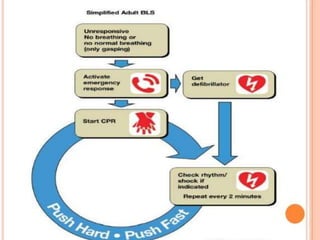
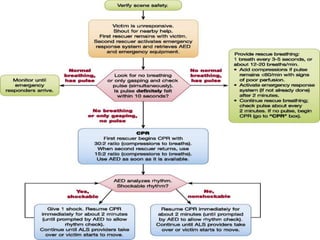
Approach safety
Check response
Shout for help
Call 108
Chest Compression
Rescue Breath
Early Defibrillation
Look around to see if it is
safe to approach(safety)
Tap the victim’s shoulder
and shout “Are you okay?”
Check to see if the victim
is breathing by looking at
their chest. If they are not
breathing, or not breathing
normally (only gasping)
call 108.
.
BLS:Circulation
Check Pulse
carotid
How to check the carotid
• Turn the face laterally to relax sternocledomastoid.
• Place your index and middle fingers on your neck to
the side of your trachea.
• At the level of cricoid cartilage.
• At least 5 s but Not more than 10 s.
 Lower half of sternum
 On the centre of chest
 Hard and fast at least 5 cm depth,
100 to 120/min (30:2)
 Equal compression and relaxation
BLS: Circulation
.
Start quality External cardiac massage
How to give compressions?
• Patient should be supine and on hard surface.
• Position of rescuer should be higher than the
patient so adequate leverage can be generated.
• Chest compressions should be given with the heel
of hand with interlocking both the hands.
• Rate should be 100-120/m.
• Compression and relaxation should be equal.
Basic Life Support
Compression Fraction :
• The amount of time spent providing
compressions
• May also be called “compression ratio”
• Goal: At least 80% !
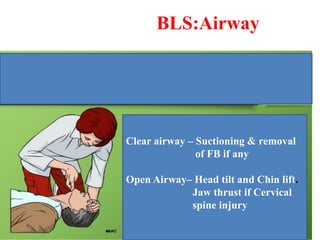
BLS:Airway
Clear airway – Suctioning & removal
of FB if any
Open Airway– Head tilt and Chin lift.
Jaw thrust if Cervical
spine injury
Open airway – Jaw Thrust
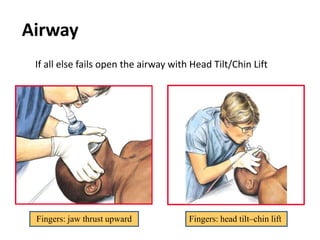
Fingers: jaw thrust upward Fingers: head tilt–chin lift
Airway
If all else fails open the airway with Head Tilt/Chin Lift
BLS:Breathing
Via mouth, barrier device or bag-valve-mask.
Check breathing and start artificial breathing with AMBU bag
if no breathing (30:2) for single rescuer.
 8 to 10 /min – inspiration over 1 sec for two or more rescuers.
Whom would you perform Mouth to
Mouth on?
•Open the airway adequately
•Pinch the nose
•Take a normal breath
•Place lips over mouth
•Blow until the chest rises
•Take about 1 second
•Allow chest to fall
•Provide two breathes
•Then continue CPR 30:2
Barrier Devices
Oral airway: inserts in patient
Pocket-Mask Devices
1-way valve
Port to attach O2 source
Adult CPR Adjuncts
• Airways / OPA / Combi-Tubes / ETT
• Pocket face masks
• Automatic Chest Compressor
DEFIBRILLATION by AED
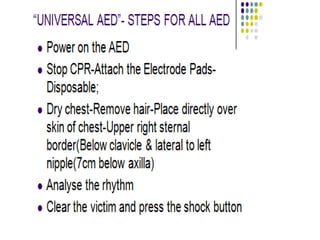
Follow voice prompts from AED
AEDs and
Ventricular Fibrillation
• VF is the most frequent initial rhythm in sudden
cardiac arrest
• VF is a useless quivering of the heart that results
in no blood flow
• Defibrillation is the only
effective treatment for VF
• Successful electrical
defibrillation diminishes
rapidly over time
Electrical Therapies
• Witnessed arrest should receive AED as
quickly as possible.
• Un-witnessed, the rescuer should provide 5
cycles of CPR prior to AED to hyperoxygenate
the heart prior to electrical therapy
ATTACH PADS TO CASUALTY’S BARE
CHEST
ANALYSING RHYTHM
DO NOT TOUCH VICTIM
SHOCK INDICATED
Stand clear
Deliver shock
SHOCK DELIVERED
FOLLOW AED INSTRUCTIONS
30 2
• Check the power supply
• Check that leads are properly connected to
the patients and to the monitor
• Confirm the flat line in at least two leads on
the monitor.
• Increase amplitude / gain
Flat line protocol
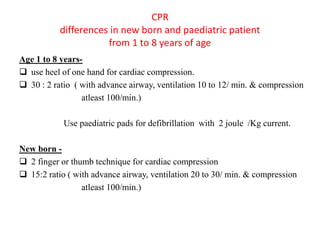
Age 1 to 8 years-
 use heel of one hand for cardiac compression.
 30 : 2 ratio ( with advance airway, ventilation 10 to 12/ min. & compression
atleast 100/min.)
Use paediatric pads for defibrillation with 2 joule /Kg current.
New born -
 2 finger or thumb technique for cardiac compression
 15:2 ratio ( with advance airway, ventilation 20 to 30/ min. & compression
atleast 100/min.)
CPR
differences in new born and paediatric patient
from 1 to 8 years of age
Two Thumb–Encircling Hands Technique Preferred for
Infant 2-Rescuer CPR by HCP
Infant Chest Compressions
Thumb technique
 Pressure must remain on sternum
Comparison of Chest Compression Techniques
 Thumb Technique (Preferred)
– Less tiring
– Better control of compression depth
 Two-Finger Technique
– More convenient with only one rescuer
– Better for small hands
– Provides access to umbilicus for medications
• Before resident doctors in any discipline, you are a
qualified MBBS doctor.
• Providing quality CPR with BLS and ACLS is your
primary responsibility
Thanks
Take home massage

Basic and advanced life support(BLS)-1.pptx

  • 1.
  • 4.
    AHA Chains ofSurvival for adult IHCA and OHCA.
  • 5.
    • For anyserious patient Prevent cardiac arrest Give O (OXYGEN) Apply M (MONITOR) Take I (IV Line ) Record V (RECORD VITALS) and act accordingly A patient with  Chest pain  Shortness of breath  Low blood pressure  Decreased level of consciousness  Clinical shock is serious.
  • 6.
    Why is thisso important? • Ischemic Heart Disease is the leading cause of death in the world. • 1 in 3 deaths is cardiovascular. • Most victims will die without immediate and appropriate intervention.
  • 7.
    CAUSES OF CARDIACARREST 5 “T” • Tablets • Temponade cardiac • Tension pneumothorax • Thrombosis coronary • Trauma ALL POSSSIBLE “H • Hypoxia • Hypercarbia • Hypotension • Hypovolaemia • Hypoglycaemia • /Hyper kalemia • Hypo/ Hypermegnesium • Hypo/ Hypercalcaemia • Hypothermia • High H+ Ion
  • 10.
    • If arresttime is < 6 minutes & CPR time is < 30 minutes, there is 50% chance of good neurological recovery. SO, BE QUICK & ENERGETIC • Goal is to start CPR within 5 minutes of arrest. SO, BYSTANDER CPR IS MUST. • Looking to the importance of bystander CPR. TEACH & TRAIN TO EVEN THE PARAMEDICS • Cardiac Arrest Management is a team work. SO, CALL FOR HELP IN THE BEGINNING BUT DON’T WAIT FOR HELP THINGS TO REMEMBER
  • 11.
    • CPR isonly a temporary method, identification of underlying cause & its effective management is the basis of successful management. • INTRACARDIAC ADRENALINE IS NOT RECOMMENDED. • Keep yourself updated with the latest advances in the field. THINGS TO REMEMBER
  • 12.
    • Unconsciousness. • Absenceof pulse. • Gasping/ Respiratory arrest. Pupillary size has prognostic significance SIGNS OF CARDIAC ARREST
  • 13.
    Lets get readyto be prepared !
  • 14.
    Approach safety Check response Shoutfor help Call 108 Chest Compression Rescue Breath Early Defibrillation
  • 15.
    Look around tosee if it is safe to approach(safety) Tap the victim’s shoulder and shout “Are you okay?” Check to see if the victim is breathing by looking at their chest. If they are not breathing, or not breathing normally (only gasping)
  • 16.
  • 17.
  • 18.
  • 19.
    How to checkthe carotid • Turn the face laterally to relax sternocledomastoid. • Place your index and middle fingers on your neck to the side of your trachea. • At the level of cricoid cartilage. • At least 5 s but Not more than 10 s.
  • 20.
     Lower halfof sternum  On the centre of chest  Hard and fast at least 5 cm depth, 100 to 120/min (30:2)  Equal compression and relaxation BLS: Circulation . Start quality External cardiac massage
  • 21.
    How to givecompressions? • Patient should be supine and on hard surface. • Position of rescuer should be higher than the patient so adequate leverage can be generated. • Chest compressions should be given with the heel of hand with interlocking both the hands. • Rate should be 100-120/m. • Compression and relaxation should be equal.
  • 22.
    Basic Life Support CompressionFraction : • The amount of time spent providing compressions • May also be called “compression ratio” • Goal: At least 80% !
  • 23.
    BLS:Airway Clear airway –Suctioning & removal of FB if any Open Airway– Head tilt and Chin lift. Jaw thrust if Cervical spine injury
  • 24.
    Open airway –Jaw Thrust
  • 25.
    Fingers: jaw thrustupward Fingers: head tilt–chin lift Airway If all else fails open the airway with Head Tilt/Chin Lift
  • 26.
    BLS:Breathing Via mouth, barrierdevice or bag-valve-mask. Check breathing and start artificial breathing with AMBU bag if no breathing (30:2) for single rescuer.  8 to 10 /min – inspiration over 1 sec for two or more rescuers.
  • 27.
    Whom would youperform Mouth to Mouth on?
  • 28.
    •Open the airwayadequately •Pinch the nose •Take a normal breath •Place lips over mouth •Blow until the chest rises •Take about 1 second •Allow chest to fall •Provide two breathes •Then continue CPR 30:2
  • 30.
    Barrier Devices Oral airway:inserts in patient
  • 31.
  • 32.
    Adult CPR Adjuncts •Airways / OPA / Combi-Tubes / ETT • Pocket face masks • Automatic Chest Compressor
  • 33.
    DEFIBRILLATION by AED Followvoice prompts from AED
  • 34.
    AEDs and Ventricular Fibrillation •VF is the most frequent initial rhythm in sudden cardiac arrest • VF is a useless quivering of the heart that results in no blood flow • Defibrillation is the only effective treatment for VF • Successful electrical defibrillation diminishes rapidly over time
  • 35.
    Electrical Therapies • Witnessedarrest should receive AED as quickly as possible. • Un-witnessed, the rescuer should provide 5 cycles of CPR prior to AED to hyperoxygenate the heart prior to electrical therapy
  • 37.
    ATTACH PADS TOCASUALTY’S BARE CHEST
  • 38.
  • 39.
  • 40.
    SHOCK DELIVERED FOLLOW AEDINSTRUCTIONS 30 2
  • 41.
    • Check thepower supply • Check that leads are properly connected to the patients and to the monitor • Confirm the flat line in at least two leads on the monitor. • Increase amplitude / gain Flat line protocol
  • 42.
    Age 1 to8 years-  use heel of one hand for cardiac compression.  30 : 2 ratio ( with advance airway, ventilation 10 to 12/ min. & compression atleast 100/min.) Use paediatric pads for defibrillation with 2 joule /Kg current. New born -  2 finger or thumb technique for cardiac compression  15:2 ratio ( with advance airway, ventilation 20 to 30/ min. & compression atleast 100/min.) CPR differences in new born and paediatric patient from 1 to 8 years of age
  • 43.
    Two Thumb–Encircling HandsTechnique Preferred for Infant 2-Rescuer CPR by HCP
  • 44.
    Infant Chest Compressions Thumbtechnique  Pressure must remain on sternum
  • 45.
    Comparison of ChestCompression Techniques  Thumb Technique (Preferred) – Less tiring – Better control of compression depth  Two-Finger Technique – More convenient with only one rescuer – Better for small hands – Provides access to umbilicus for medications
  • 49.
    • Before residentdoctors in any discipline, you are a qualified MBBS doctor. • Providing quality CPR with BLS and ACLS is your primary responsibility Thanks Take home massage