BASIC LIFE SUPPORT
OBJECTIVES
• At the end of this class you must know
– How to assess the collapsed victim.
– How to perform chest compression and rescue breathing.
– How to operate an automated external defibrillator safely.
– How to place an unconscious breathing victim in the
recovery position.
– How to do Hiemlich maneuver
What is CPR?
• Sequences of procedures performed to
restore the circulation of oxygenated blood
after a sudden pulmonary and/or cardiac
arrest
Who can be a rescuer?
• Anyone!!!!
• Chest compressions and
pulmonary ventilation
performed by anyone
who knows how to do
it, anywhere,
immediately, without
any other equipment
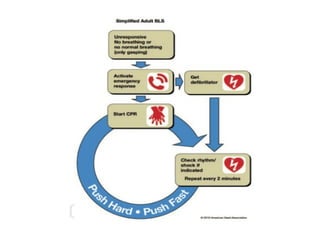
Start CPR Immediately
• Better chance of survival
• Brain damage starts in 4-6 minutes
• Brain damage is certain after 10 minutes without CPR
• Bystander CPR vital intervention before arrival of
emergency services – double or triple survival from
SCA (sudden cardiac arrest)
• Early resuscitation and prompt defibrillation (within
1-2 minutes) can result in >60% survival
Chain of survival
• Core set of actions that provide a universal
strategy for achieving successful resuscitation
• Survival rates approach 50% when
implemented
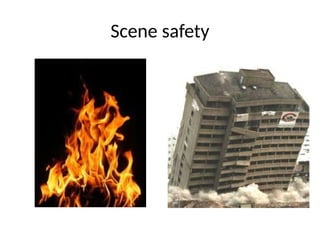
Scene safety
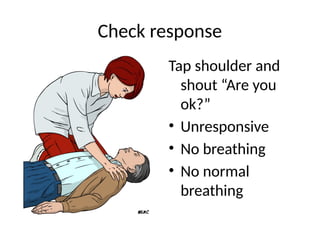
Check response
Tap shoulder and
shout “Are you
ok?”
• Unresponsive
• No breathing
• No normal
breathing
Do not confuse gasping with NORMAL breathing
• Occurs shortly after the heart stops
in up to 40% of cardiac arrests
• Described as barely, heavy, noisy or agonal
breathing
• Recognise as a sign of cardiac arrest
Shout for help
• Activate emergency
response system
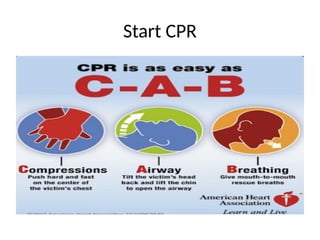
Start CPR
Why the change?
• Majority of SCA- VF or pulseless VT
– Critical elements- compression and defib
• In ABC sequence- compressions delayed
• More willingness among rescuers
• Healthcare providers can tailor sequence
Compression is more important
• Initially- oxygen levels in blood adequate
• Many cardiac arrest victims exhibit gasping
• If airway is open, passive chest recoil allows
gas exchange
Pulse check
• Lay rescuers- NO pulse
check
• Healthcare providers-
take no more than 10
seconds
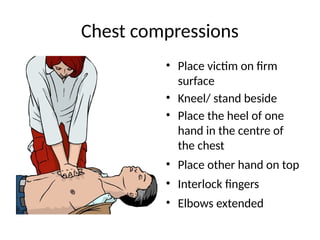
Chest compressions
• Place victim on firm
surface
• Kneel/ stand beside
• Place the heel of one
hand in the centre of
the chest
• Place other hand on top
• Interlock fingers
• Elbows extended
How compression works
• Effective CPR provides 1/4 to 1/3
normal blood flow
High quality CPR
• Rate- At least 100/ min
• Depth- 2 inches
• complete chest recoil
• Minimise interruptions
• Avoid excessive
ventilation
Rescuer fatigue
• Leads to inadequate
rates or depth
• When 2 or more
rescuers present- swith
compressors every 2
mins
Managing airway
• Head- tilt
• Chin lift
• Jaw thrust
Managing airway
Campbell
Managing airway
• C- spine injury suspected- ONLY JAW THRUST
RESCUE BREATHING
• Give 2 rescue breaths
• Pinch the nose
• Take a normal breath
• Place lips over mouth
• Blow until the chest
rises
• Take about 1 second
• Allow chest to fall
• Repeat
Methods
• Mouth- mouth
• Mouth- barrier device
• Mouth- nose
• Bag and mask
• Supraglottic airway
• Advanced airway
Compression ventilation ratio
30 2
Pulse check- Every 2 mins/ After 5 cycles
Definite pulse
• 1 breath every 5 secs
• Recheck pulse every 2 mins
No pulse
• Continue CPR
AED arrives
• Some AEDs will
automatically switch
themselves on when
the lid is opened
Attach pads
Analyse rhythm
When shock indicated
• Stand clear
• Deliver shock
Resume CPR
• DO NOT CHECK PULSE
IMMEDIATELY
• Resume CPR
When to stop CPR?
• Victim revives
• Trained help arrives
• Too exhausted to continue
• Criteria indicating irreversible death
Recovery position
• When unresponsive victims have normal
breathing & effective circulation
FBAO- Recognizing Choking
• Can’t speak, breathe or cough
• Universal distress signal (clutches neck)
• Turning blue
If victim is coughing strongly, do not intervene
Conscious Choking
• Give abdominal thrusts
(Heimlich maneuver)
– Place fist just above the
umbilicus (normal size)
– Give upward and inward
thrusts
– Pregnant or obese- chest
thrusts
– Continue until successful
or victim collapses
REMEMBER
• Everyone is a rescuer
• Every second matters
• Chain of survival
• High quality CPR
• Learn how to operate an AED
Thank you

Basic life support - BLS - explained.pptx

  • 1.
  • 2.
    OBJECTIVES • At theend of this class you must know – How to assess the collapsed victim. – How to perform chest compression and rescue breathing. – How to operate an automated external defibrillator safely. – How to place an unconscious breathing victim in the recovery position. – How to do Hiemlich maneuver
  • 3.
    What is CPR? •Sequences of procedures performed to restore the circulation of oxygenated blood after a sudden pulmonary and/or cardiac arrest
  • 4.
    Who can bea rescuer? • Anyone!!!! • Chest compressions and pulmonary ventilation performed by anyone who knows how to do it, anywhere, immediately, without any other equipment
  • 5.
    Start CPR Immediately •Better chance of survival • Brain damage starts in 4-6 minutes • Brain damage is certain after 10 minutes without CPR • Bystander CPR vital intervention before arrival of emergency services – double or triple survival from SCA (sudden cardiac arrest) • Early resuscitation and prompt defibrillation (within 1-2 minutes) can result in >60% survival
  • 6.
    Chain of survival •Core set of actions that provide a universal strategy for achieving successful resuscitation • Survival rates approach 50% when implemented
  • 8.
  • 9.
    Check response Tap shoulderand shout “Are you ok?” • Unresponsive • No breathing • No normal breathing
  • 10.
    Do not confusegasping with NORMAL breathing • Occurs shortly after the heart stops in up to 40% of cardiac arrests • Described as barely, heavy, noisy or agonal breathing • Recognise as a sign of cardiac arrest
  • 11.
    Shout for help •Activate emergency response system
  • 12.
  • 13.
    Why the change? •Majority of SCA- VF or pulseless VT – Critical elements- compression and defib • In ABC sequence- compressions delayed • More willingness among rescuers • Healthcare providers can tailor sequence
  • 14.
    Compression is moreimportant • Initially- oxygen levels in blood adequate • Many cardiac arrest victims exhibit gasping • If airway is open, passive chest recoil allows gas exchange
  • 15.
    Pulse check • Layrescuers- NO pulse check • Healthcare providers- take no more than 10 seconds
  • 16.
    Chest compressions • Placevictim on firm surface • Kneel/ stand beside • Place the heel of one hand in the centre of the chest • Place other hand on top • Interlock fingers • Elbows extended
  • 17.
    How compression works •Effective CPR provides 1/4 to 1/3 normal blood flow
  • 18.
    High quality CPR •Rate- At least 100/ min • Depth- 2 inches • complete chest recoil • Minimise interruptions • Avoid excessive ventilation
  • 19.
    Rescuer fatigue • Leadsto inadequate rates or depth • When 2 or more rescuers present- swith compressors every 2 mins
  • 20.
    Managing airway • Head-tilt • Chin lift • Jaw thrust
  • 21.
  • 22.
    Managing airway • C-spine injury suspected- ONLY JAW THRUST
  • 23.
    RESCUE BREATHING • Give2 rescue breaths • Pinch the nose • Take a normal breath • Place lips over mouth • Blow until the chest rises • Take about 1 second • Allow chest to fall • Repeat
  • 24.
    Methods • Mouth- mouth •Mouth- barrier device • Mouth- nose • Bag and mask • Supraglottic airway • Advanced airway
  • 25.
  • 26.
    Pulse check- Every2 mins/ After 5 cycles Definite pulse • 1 breath every 5 secs • Recheck pulse every 2 mins No pulse • Continue CPR
  • 27.
    AED arrives • SomeAEDs will automatically switch themselves on when the lid is opened
  • 28.
  • 29.
  • 30.
    When shock indicated •Stand clear • Deliver shock
  • 31.
    Resume CPR • DONOT CHECK PULSE IMMEDIATELY • Resume CPR
  • 32.
    When to stopCPR? • Victim revives • Trained help arrives • Too exhausted to continue • Criteria indicating irreversible death
  • 33.
    Recovery position • Whenunresponsive victims have normal breathing & effective circulation
  • 35.
    FBAO- Recognizing Choking •Can’t speak, breathe or cough • Universal distress signal (clutches neck) • Turning blue If victim is coughing strongly, do not intervene
  • 36.
    Conscious Choking • Giveabdominal thrusts (Heimlich maneuver) – Place fist just above the umbilicus (normal size) – Give upward and inward thrusts – Pregnant or obese- chest thrusts – Continue until successful or victim collapses
  • 38.
    REMEMBER • Everyone isa rescuer • Every second matters • Chain of survival • High quality CPR • Learn how to operate an AED
  • 39.