Professor Dr. Md. Toufiqur Rahman
I. Introduction
II. Causes of Cardiac Arrest
III. Basic Life Support Techniques
IV. Chest Compressions Technique
V. Rescue Breathing Technique
VI. Automated External Defibrillator (AED) Usage
VII. Additional Tips and Reminders
VIII. Conclusion
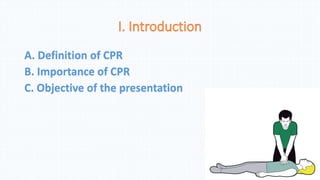
A. Definition of CPR
B. Importance of CPR
C. Objective of the presentation
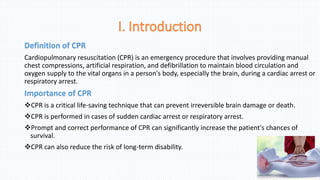
Definition of CPR
Cardiopulmonary resuscitation (CPR) is an emergency procedure that involves providing manual
chest compressions, artificial respiration, and defibrillation to maintain blood circulation and
oxygen supply to the vital organs in a person's body, especially the brain, during a cardiac arrest or
respiratory arrest.
Importance of CPR
īļCPR is a critical life-saving technique that can prevent irreversible brain damage or death.
īļCPR is performed in cases of sudden cardiac arrest or respiratory arrest.
īļPrompt and correct performance of CPR can significantly increase the patient's chances of
survival.
īļCPR can also reduce the risk of long-term disability.
Objective of the Presentation
The primary objective of this presentation is to provide an overview of basic CPR techniques and
guidelines for healthcare professionals and individuals who may need to perform CPR in an emergency
situation. Specifically, the presentation will cover the following topics:
īļThe importance of early recognition of cardiac arrest and the need for prompt initiation of CPR
īļThe steps involved in performing basic CPR, including chest compressions, rescue breaths and
defibrillation
īļGuidelines for determining the correct depth and rate of chest compressions
īļProper positioning and technique for rescue breaths
īļThe use of automated external defibrillators (AEDs) in CPR
īļTips for performing CPR on children and infants
īļLegal and ethical considerations associated with performing CPR
By the end of the presentation, participants will have a basic understanding of CPR techniques and be
better prepared to respond to a cardiac arrest or respiratory arrest emergency.
A. Common causes of cardiac arrest
B. Understanding the signs of cardiac
arrest
C. Quick response and early intervention
Cardiac arrest is a sudden and unexpected loss of heart function. It can occur due to several reasons, such as heart disease, trauma,
drowning, drug overdose, and respiratory failure. Understanding the causes of cardiac arrest is essential in identifying the signs and
providing early intervention.
A. Common Causes of Cardiac Arrest
â€ĸ Coronary Artery Disease: The most common cause of cardiac arrest is coronary artery disease, which leads to the narrowing or
blockage of the arteries that supply blood to the heart muscle.
â€ĸ Heart Attack: A heart attack occurs when there is a complete blockage of one of the coronary arteries, causing damage to the
heart muscle.
â€ĸ Arrhythmia: An abnormal heart rhythm can also cause cardiac arrest. Some of the common arrhythmias are ventricular
fibrillation and ventricular tachycardia.
â€ĸ Drug Overdose: Drug overdose, especially opioids, can cause respiratory failure and lead to cardiac arrest.
â€ĸ Trauma: Trauma to the chest or head can disrupt the heart's normal function and lead to cardiac arrest.
B. Understanding the Signs of Cardiac Arrest
Sudden loss of responsiveness
Absence of breathing or abnormal breathing patterns
Absence of pulse or signs of circulation
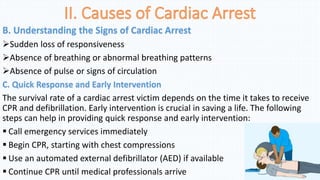
C. Quick Response and Early Intervention
The survival rate of a cardiac arrest victim depends on the time it takes to receive
CPR and defibrillation. Early intervention is crucial in saving a life. The following
steps can help in providing quick response and early intervention:
ī‚§ Call emergency services immediately
ī‚§ Begin CPR, starting with chest compressions
ī‚§ Use an automated external defibrillator (AED) if available
ī‚§ Continue CPR until medical professionals arrive
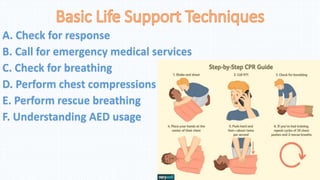
A. Check for response
B. Call for emergency medical services
C. Check for breathing
D. Perform chest compressions
E. Perform rescue breathing
F. Understanding AED usage
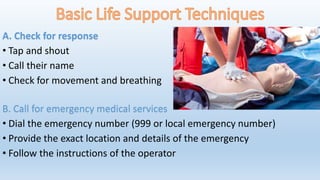
A. Check for response
â€ĸ Tap and shout
â€ĸ Call their name
â€ĸ Check for movement and breathing
B. Call for emergency medical services
â€ĸ Dial the emergency number (999 or local emergency number)
â€ĸ Provide the exact location and details of the emergency
â€ĸ Follow the instructions of the operator
C. Check for breathing
Tilt the head back
Check for breathing for up to 10 seconds
If the person is not breathing, proceed to chest compressions
D. Perform chest compressions
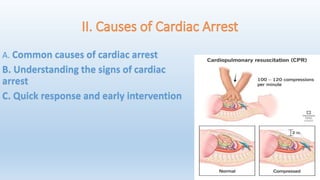
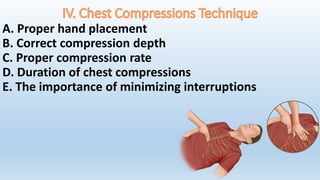
īļPlace the heel of one hand on the center of the chest
īļPlace the other hand on top of the first hand
īļInterlock the fingers and straighten the arms
īļPress down hard and fast on the chest (about 2 inches)
īļPerform compressions at a rate of 100 to 120 per minute
īļAllow the chest to fully recoil between compressions
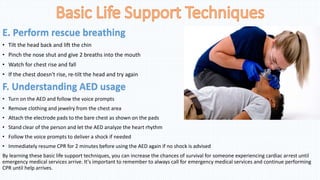
E. Perform rescue breathing
â€ĸ Tilt the head back and lift the chin
â€ĸ Pinch the nose shut and give 2 breaths into the mouth
â€ĸ Watch for chest rise and fall
â€ĸ If the chest doesn't rise, re-tilt the head and try again
F. Understanding AED usage
â€ĸ Turn on the AED and follow the voice prompts
â€ĸ Remove clothing and jewelry from the chest area
â€ĸ Attach the electrode pads to the bare chest as shown on the pads
â€ĸ Stand clear of the person and let the AED analyze the heart rhythm
â€ĸ Follow the voice prompts to deliver a shock if needed
â€ĸ Immediately resume CPR for 2 minutes before using the AED again if no shock is advised
By learning these basic life support techniques, you can increase the chances of survival for someone experiencing cardiac arrest until
emergency medical services arrive. It's important to remember to always call for emergency medical services and continue performing
CPR until help arrives.
A. Proper hand placement
B. Correct compression depth
C. Proper compression rate
D. Duration of chest compressions
E. The importance of minimizing interruptions
â€ĸ Chest compressions are a crucial part of performing CPR and are essential for maintaining
circulation until advanced medical help arrives. Here are the key points to keep in mind
when performing chest compressions:
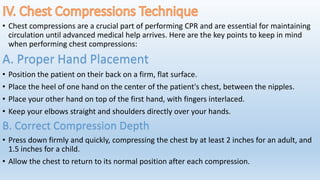
A. Proper Hand Placement
â€ĸ Position the patient on their back on a firm, flat surface.
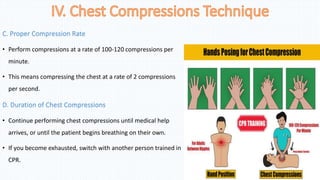
â€ĸ Place the heel of one hand on the center of the patient's chest, between the nipples.
â€ĸ Place your other hand on top of the first hand, with fingers interlaced.
â€ĸ Keep your elbows straight and shoulders directly over your hands.
B. Correct Compression Depth
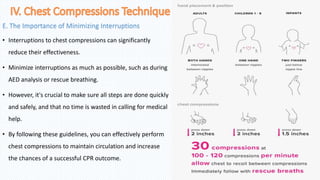
â€ĸ Press down firmly and quickly, compressing the chest by at least 2 inches for an adult, and
1.5 inches for a child.
â€ĸ Allow the chest to return to its normal position after each compression.
C. Proper Compression Rate
â€ĸ Perform compressions at a rate of 100-120 compressions per
minute.
â€ĸ This means compressing the chest at a rate of 2 compressions
per second.
D. Duration of Chest Compressions
â€ĸ Continue performing chest compressions until medical help
arrives, or until the patient begins breathing on their own.
â€ĸ If you become exhausted, switch with another person trained in
CPR.
E. The Importance of Minimizing Interruptions
â€ĸ Interruptions to chest compressions can significantly
reduce their effectiveness.
â€ĸ Minimize interruptions as much as possible, such as during
AED analysis or rescue breathing.
â€ĸ However, it's crucial to make sure all steps are done quickly
and safely, and that no time is wasted in calling for medical
help.
â€ĸ By following these guidelines, you can effectively perform
chest compressions to maintain circulation and increase
the chances of a successful CPR outcome.
A. Proper head tilt and
chin lift
B. Proper breathing
technique
C. The importance of
maintaining an open
airway
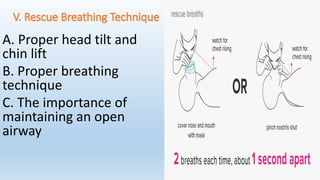
â€ĸ Rescue breathing is an essential part of basic CPR and can help to restore breathing in a
person who is not breathing or is experiencing difficulty in breathing.
â€ĸ A. Proper Head Tilt and Chin Lift
Before rescue breathing, ensure the person's airway is open
Place one hand on the forehead and gently tilt the head back
Use the other hand to lift the chin up
This position helps to open the airway
An open airway prevents any obstruction
Rescue breathing can then be performed safely and effectively
B. Proper Breathing Technique
īļthe rescuer must take a deep breath
īļCreate a seal by placing the rescuer's mouth over the person's mouth
īļExhale steadily and gently into the person's mouth
īļWatch for the chest to rise
īļGive two breaths, each lasting about one second
F. Understanding AED usage
â€ĸ Turn on the AED and follow the voice prompts
â€ĸ Remove clothing and jewelry from the chest area
â€ĸ Attach the electrode pads to the bare chest as shown on the pads
â€ĸ Stand clear of the person and let the AED analyze the heart rhythm
â€ĸ Follow the voice prompts to deliver a shock if needed
â€ĸ Immediately resume CPR for 2 minutes before using the AED again if no shock is
advised
By learning these basic life support techniques, you can increase the chances of
survival for someone experiencing cardiac arrest until emergency medical services
arrive. It's important to remember to always call for emergency medical services
and continue performing CPR until help arrives.
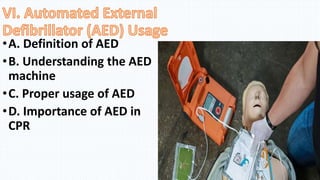
â€ĸA. Definition of AED
â€ĸB. Understanding the AED
machine
â€ĸC. Proper usage of AED
â€ĸD. Importance of AED in
CPR
A. Definition of AED
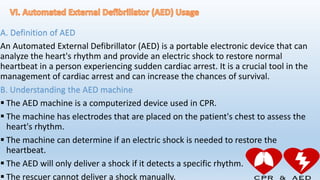
An Automated External Defibrillator (AED) is a portable electronic device that can
analyze the heart's rhythm and provide an electric shock to restore normal
heartbeat in a person experiencing sudden cardiac arrest. It is a crucial tool in the
management of cardiac arrest and can increase the chances of survival.
B. Understanding the AED machine
ī‚§ The AED machine is a computerized device used in CPR.
ī‚§ The machine has electrodes that are placed on the patient's chest to assess the
heart's rhythm.
ī‚§ The machine can determine if an electric shock is needed to restore the
heartbeat.
ī‚§ The AED will only deliver a shock if it detects a specific rhythm.
ī‚§ The rescuer cannot deliver a shock manually.
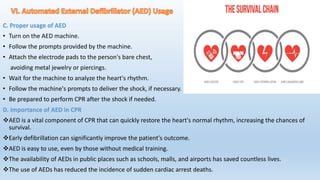
C. Proper usage of AED
â€ĸ Turn on the AED machine.
â€ĸ Follow the prompts provided by the machine.
â€ĸ Attach the electrode pads to the person's bare chest,
avoiding metal jewelry or piercings.
â€ĸ Wait for the machine to analyze the heart's rhythm.
â€ĸ Follow the machine's prompts to deliver the shock, if necessary.
â€ĸ Be prepared to perform CPR after the shock if needed.
D. Importance of AED in CPR
īļAED is a vital component of CPR that can quickly restore the heart's normal rhythm, increasing the chances of
survival.
īļEarly defibrillation can significantly improve the patient's outcome.
īļAED is easy to use, even by those without medical training.
īļThe availability of AEDs in public places such as schools, malls, and airports has saved countless lives.
īļThe use of AEDs has reduced the incidence of sudden cardiac arrest deaths.
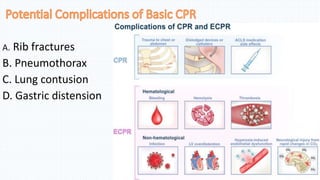
A. Rib fractures
B. Pneumothorax
C. Lung contusion
D. Gastric distension
A. Rib fractures:
â€ĸ Chest compressions during CPR can cause rib fractures
â€ĸ Elderly patients or patients with osteoporosis are at higher risk for rib fractures during CPR
â€ĸ The incidence of rib fractures during CPR is reported to be as high as 30-40%
â€ĸ It can cause discomfort and pain
â€ĸ Rib fractures are generally not life-threatening
â€ĸ It can be managed with pain medications.
B. Pneumothorax:
īļPneumothorax is a potential complication of chest compressions during CPR.
īļIt occurs when air leaks into the space between the lung and chest wall, causing the lung
to collapse.
īļThe risk of pneumothorax is higher in patients with pre-existing lung conditions.
īļIf a pneumothorax occurs during CPR, it may require immediate medical attention.
C. Lung contusion
â€ĸ Chest compressions can also cause lung contusion, which can impair lung
function and oxygenation and may require further medical treatment.
D. Gastric distension
īļRescue breathing during CPR can cause gastric distension, which is the abnormal
accumulation of air in the stomach.
īļGastric distension can cause discomfort, nausea, vomiting, and in severe cases,
aspiration of stomach contents into the lungs, causing respiratory distress.
īļTo avoid gastric distension, proper technique during rescue breathing is
essential.
īļDespite these potential complications, the benefits of CPR outweigh the risks,
and it is crucial to act quickly and efficiently in case of cardiac arrest.
īļCPR is often a high-stress situation and teamwork can help distribute the workload and
reduce the risk of fatigue among rescuers.
īļIn cases where multiple rescuers are available, tasks can be delegated, allowing each
person to focus on specific responsibilities, such as performing chest compressions or
administering rescue breaths.
īļEffective communication is crucial during CPR to ensure that everyone is on the same page
and working together to achieve the same goal.
īļTeamwork can also help improve the quality of CPR, with one rescuer providing feedback
and monitoring the effectiveness of chest compressions while others assist with rescue
breathing or prepare for defibrillation.
īļIn emergency medical situations, such as cardiac arrest, time is of the essence, and
effective teamwork can help ensure that CPR is initiated quickly and efficiently.
īļWorking as a team can also help minimize the risk of injury to both the patient and the
rescuers, as multiple individuals can share the workload and provide support as needed.
Regular CPR training and certification can help individuals maintain their skills and
knowledge of the latest CPR guidelines and techniques
Staying up-to-date with the latest developments in CPR can help individuals feel more
confident in performing CPR when necessary
CPR certification courses may also cover the use of AEDs and other life-saving techniques,
further enhancing an individual's ability to provide effective emergency care
Regular training and certification can also help individuals identify and address potential
risks and complications associated with CPR
By staying current with CPR training and certification, individuals can increase their
chances of performing effective CPR and potentially saving a life in an emergency situation
īļBasic CPR knowledge and skills can be critical in emergency situations and can make the difference
between life and death.
īļIt is highly recommended that individuals take a CPR training course to enhance their skills and
knowledge.
īļCPR is a simple yet effective technique that can save lives, and everyone should be prepared to
perform it if necessary.
īļTaking a CPR course can also provide individuals with the confidence and knowledge to act quickly and
efficiently in an emergency situation.
īļCPR is not just for medical professionals but for anyone who may encounter an emergency situation.
īļKnowing CPR can be especially important for parents, caregivers, and those working in high-risk
environments such as construction sites or swimming pools.

Basic CPR .pptx

  • 1.
    Professor Dr. Md.Toufiqur Rahman
  • 2.
    I. Introduction II. Causesof Cardiac Arrest III. Basic Life Support Techniques IV. Chest Compressions Technique V. Rescue Breathing Technique VI. Automated External Defibrillator (AED) Usage VII. Additional Tips and Reminders VIII. Conclusion
  • 3.
    A. Definition ofCPR B. Importance of CPR C. Objective of the presentation
  • 4.
    Definition of CPR Cardiopulmonaryresuscitation (CPR) is an emergency procedure that involves providing manual chest compressions, artificial respiration, and defibrillation to maintain blood circulation and oxygen supply to the vital organs in a person's body, especially the brain, during a cardiac arrest or respiratory arrest. Importance of CPR īļCPR is a critical life-saving technique that can prevent irreversible brain damage or death. īļCPR is performed in cases of sudden cardiac arrest or respiratory arrest. īļPrompt and correct performance of CPR can significantly increase the patient's chances of survival. īļCPR can also reduce the risk of long-term disability.
  • 5.
    Objective of thePresentation The primary objective of this presentation is to provide an overview of basic CPR techniques and guidelines for healthcare professionals and individuals who may need to perform CPR in an emergency situation. Specifically, the presentation will cover the following topics: īļThe importance of early recognition of cardiac arrest and the need for prompt initiation of CPR īļThe steps involved in performing basic CPR, including chest compressions, rescue breaths and defibrillation īļGuidelines for determining the correct depth and rate of chest compressions īļProper positioning and technique for rescue breaths īļThe use of automated external defibrillators (AEDs) in CPR īļTips for performing CPR on children and infants īļLegal and ethical considerations associated with performing CPR By the end of the presentation, participants will have a basic understanding of CPR techniques and be better prepared to respond to a cardiac arrest or respiratory arrest emergency.
  • 6.
    A. Common causesof cardiac arrest B. Understanding the signs of cardiac arrest C. Quick response and early intervention
  • 7.
    Cardiac arrest isa sudden and unexpected loss of heart function. It can occur due to several reasons, such as heart disease, trauma, drowning, drug overdose, and respiratory failure. Understanding the causes of cardiac arrest is essential in identifying the signs and providing early intervention. A. Common Causes of Cardiac Arrest â€ĸ Coronary Artery Disease: The most common cause of cardiac arrest is coronary artery disease, which leads to the narrowing or blockage of the arteries that supply blood to the heart muscle. â€ĸ Heart Attack: A heart attack occurs when there is a complete blockage of one of the coronary arteries, causing damage to the heart muscle. â€ĸ Arrhythmia: An abnormal heart rhythm can also cause cardiac arrest. Some of the common arrhythmias are ventricular fibrillation and ventricular tachycardia. â€ĸ Drug Overdose: Drug overdose, especially opioids, can cause respiratory failure and lead to cardiac arrest. â€ĸ Trauma: Trauma to the chest or head can disrupt the heart's normal function and lead to cardiac arrest.
  • 8.
    B. Understanding theSigns of Cardiac Arrest Sudden loss of responsiveness Absence of breathing or abnormal breathing patterns Absence of pulse or signs of circulation C. Quick Response and Early Intervention The survival rate of a cardiac arrest victim depends on the time it takes to receive CPR and defibrillation. Early intervention is crucial in saving a life. The following steps can help in providing quick response and early intervention: ī‚§ Call emergency services immediately ī‚§ Begin CPR, starting with chest compressions ī‚§ Use an automated external defibrillator (AED) if available ī‚§ Continue CPR until medical professionals arrive
  • 9.
    A. Check forresponse B. Call for emergency medical services C. Check for breathing D. Perform chest compressions E. Perform rescue breathing F. Understanding AED usage
  • 10.
    A. Check forresponse â€ĸ Tap and shout â€ĸ Call their name â€ĸ Check for movement and breathing B. Call for emergency medical services â€ĸ Dial the emergency number (999 or local emergency number) â€ĸ Provide the exact location and details of the emergency â€ĸ Follow the instructions of the operator
  • 11.
    C. Check forbreathing Tilt the head back Check for breathing for up to 10 seconds If the person is not breathing, proceed to chest compressions D. Perform chest compressions īļPlace the heel of one hand on the center of the chest īļPlace the other hand on top of the first hand īļInterlock the fingers and straighten the arms īļPress down hard and fast on the chest (about 2 inches) īļPerform compressions at a rate of 100 to 120 per minute īļAllow the chest to fully recoil between compressions
  • 12.
    E. Perform rescuebreathing â€ĸ Tilt the head back and lift the chin â€ĸ Pinch the nose shut and give 2 breaths into the mouth â€ĸ Watch for chest rise and fall â€ĸ If the chest doesn't rise, re-tilt the head and try again F. Understanding AED usage â€ĸ Turn on the AED and follow the voice prompts â€ĸ Remove clothing and jewelry from the chest area â€ĸ Attach the electrode pads to the bare chest as shown on the pads â€ĸ Stand clear of the person and let the AED analyze the heart rhythm â€ĸ Follow the voice prompts to deliver a shock if needed â€ĸ Immediately resume CPR for 2 minutes before using the AED again if no shock is advised By learning these basic life support techniques, you can increase the chances of survival for someone experiencing cardiac arrest until emergency medical services arrive. It's important to remember to always call for emergency medical services and continue performing CPR until help arrives.
  • 13.
    A. Proper handplacement B. Correct compression depth C. Proper compression rate D. Duration of chest compressions E. The importance of minimizing interruptions
  • 14.
    â€ĸ Chest compressionsare a crucial part of performing CPR and are essential for maintaining circulation until advanced medical help arrives. Here are the key points to keep in mind when performing chest compressions: A. Proper Hand Placement â€ĸ Position the patient on their back on a firm, flat surface. â€ĸ Place the heel of one hand on the center of the patient's chest, between the nipples. â€ĸ Place your other hand on top of the first hand, with fingers interlaced. â€ĸ Keep your elbows straight and shoulders directly over your hands. B. Correct Compression Depth â€ĸ Press down firmly and quickly, compressing the chest by at least 2 inches for an adult, and 1.5 inches for a child. â€ĸ Allow the chest to return to its normal position after each compression.
  • 15.
    C. Proper CompressionRate â€ĸ Perform compressions at a rate of 100-120 compressions per minute. â€ĸ This means compressing the chest at a rate of 2 compressions per second. D. Duration of Chest Compressions â€ĸ Continue performing chest compressions until medical help arrives, or until the patient begins breathing on their own. â€ĸ If you become exhausted, switch with another person trained in CPR.
  • 16.
    E. The Importanceof Minimizing Interruptions â€ĸ Interruptions to chest compressions can significantly reduce their effectiveness. â€ĸ Minimize interruptions as much as possible, such as during AED analysis or rescue breathing. â€ĸ However, it's crucial to make sure all steps are done quickly and safely, and that no time is wasted in calling for medical help. â€ĸ By following these guidelines, you can effectively perform chest compressions to maintain circulation and increase the chances of a successful CPR outcome.
  • 17.
    A. Proper headtilt and chin lift B. Proper breathing technique C. The importance of maintaining an open airway
  • 18.
    â€ĸ Rescue breathingis an essential part of basic CPR and can help to restore breathing in a person who is not breathing or is experiencing difficulty in breathing. â€ĸ A. Proper Head Tilt and Chin Lift Before rescue breathing, ensure the person's airway is open Place one hand on the forehead and gently tilt the head back Use the other hand to lift the chin up This position helps to open the airway An open airway prevents any obstruction Rescue breathing can then be performed safely and effectively B. Proper Breathing Technique īļthe rescuer must take a deep breath īļCreate a seal by placing the rescuer's mouth over the person's mouth īļExhale steadily and gently into the person's mouth īļWatch for the chest to rise īļGive two breaths, each lasting about one second
  • 19.
    F. Understanding AEDusage â€ĸ Turn on the AED and follow the voice prompts â€ĸ Remove clothing and jewelry from the chest area â€ĸ Attach the electrode pads to the bare chest as shown on the pads â€ĸ Stand clear of the person and let the AED analyze the heart rhythm â€ĸ Follow the voice prompts to deliver a shock if needed â€ĸ Immediately resume CPR for 2 minutes before using the AED again if no shock is advised By learning these basic life support techniques, you can increase the chances of survival for someone experiencing cardiac arrest until emergency medical services arrive. It's important to remember to always call for emergency medical services and continue performing CPR until help arrives.
  • 20.
    â€ĸA. Definition ofAED â€ĸB. Understanding the AED machine â€ĸC. Proper usage of AED â€ĸD. Importance of AED in CPR
  • 21.
    A. Definition ofAED An Automated External Defibrillator (AED) is a portable electronic device that can analyze the heart's rhythm and provide an electric shock to restore normal heartbeat in a person experiencing sudden cardiac arrest. It is a crucial tool in the management of cardiac arrest and can increase the chances of survival. B. Understanding the AED machine ī‚§ The AED machine is a computerized device used in CPR. ī‚§ The machine has electrodes that are placed on the patient's chest to assess the heart's rhythm. ī‚§ The machine can determine if an electric shock is needed to restore the heartbeat. ī‚§ The AED will only deliver a shock if it detects a specific rhythm. ī‚§ The rescuer cannot deliver a shock manually.
  • 22.
    C. Proper usageof AED â€ĸ Turn on the AED machine. â€ĸ Follow the prompts provided by the machine. â€ĸ Attach the electrode pads to the person's bare chest, avoiding metal jewelry or piercings. â€ĸ Wait for the machine to analyze the heart's rhythm. â€ĸ Follow the machine's prompts to deliver the shock, if necessary. â€ĸ Be prepared to perform CPR after the shock if needed. D. Importance of AED in CPR īļAED is a vital component of CPR that can quickly restore the heart's normal rhythm, increasing the chances of survival. īļEarly defibrillation can significantly improve the patient's outcome. īļAED is easy to use, even by those without medical training. īļThe availability of AEDs in public places such as schools, malls, and airports has saved countless lives. īļThe use of AEDs has reduced the incidence of sudden cardiac arrest deaths.
  • 23.
    A. Rib fractures B.Pneumothorax C. Lung contusion D. Gastric distension
  • 24.
    A. Rib fractures: â€ĸChest compressions during CPR can cause rib fractures â€ĸ Elderly patients or patients with osteoporosis are at higher risk for rib fractures during CPR â€ĸ The incidence of rib fractures during CPR is reported to be as high as 30-40% â€ĸ It can cause discomfort and pain â€ĸ Rib fractures are generally not life-threatening â€ĸ It can be managed with pain medications. B. Pneumothorax: īļPneumothorax is a potential complication of chest compressions during CPR. īļIt occurs when air leaks into the space between the lung and chest wall, causing the lung to collapse. īļThe risk of pneumothorax is higher in patients with pre-existing lung conditions. īļIf a pneumothorax occurs during CPR, it may require immediate medical attention.
  • 25.
    C. Lung contusion â€ĸChest compressions can also cause lung contusion, which can impair lung function and oxygenation and may require further medical treatment. D. Gastric distension īļRescue breathing during CPR can cause gastric distension, which is the abnormal accumulation of air in the stomach. īļGastric distension can cause discomfort, nausea, vomiting, and in severe cases, aspiration of stomach contents into the lungs, causing respiratory distress. īļTo avoid gastric distension, proper technique during rescue breathing is essential. īļDespite these potential complications, the benefits of CPR outweigh the risks, and it is crucial to act quickly and efficiently in case of cardiac arrest.
  • 26.
    īļCPR is oftena high-stress situation and teamwork can help distribute the workload and reduce the risk of fatigue among rescuers. īļIn cases where multiple rescuers are available, tasks can be delegated, allowing each person to focus on specific responsibilities, such as performing chest compressions or administering rescue breaths. īļEffective communication is crucial during CPR to ensure that everyone is on the same page and working together to achieve the same goal. īļTeamwork can also help improve the quality of CPR, with one rescuer providing feedback and monitoring the effectiveness of chest compressions while others assist with rescue breathing or prepare for defibrillation. īļIn emergency medical situations, such as cardiac arrest, time is of the essence, and effective teamwork can help ensure that CPR is initiated quickly and efficiently. īļWorking as a team can also help minimize the risk of injury to both the patient and the rescuers, as multiple individuals can share the workload and provide support as needed.
  • 27.
    Regular CPR trainingand certification can help individuals maintain their skills and knowledge of the latest CPR guidelines and techniques Staying up-to-date with the latest developments in CPR can help individuals feel more confident in performing CPR when necessary CPR certification courses may also cover the use of AEDs and other life-saving techniques, further enhancing an individual's ability to provide effective emergency care Regular training and certification can also help individuals identify and address potential risks and complications associated with CPR By staying current with CPR training and certification, individuals can increase their chances of performing effective CPR and potentially saving a life in an emergency situation
  • 29.
    īļBasic CPR knowledgeand skills can be critical in emergency situations and can make the difference between life and death. īļIt is highly recommended that individuals take a CPR training course to enhance their skills and knowledge. īļCPR is a simple yet effective technique that can save lives, and everyone should be prepared to perform it if necessary. īļTaking a CPR course can also provide individuals with the confidence and knowledge to act quickly and efficiently in an emergency situation. īļCPR is not just for medical professionals but for anyone who may encounter an emergency situation. īļKnowing CPR can be especially important for parents, caregivers, and those working in high-risk environments such as construction sites or swimming pools.