
Cardiopulmonary Resuscitation
Basic Life Support
A set of emergency procedures involving the immediate
recognition of signs of sudden cardiac arrest (SCA), heart
attack, stroke, and foreign-body airway obstruction
(FBAO); and the application of external chest
compressions, rescue breathing, abdominal thrusts, as
well as the defibrillation with the use of an AED to
maintain life or until advanced life support is available.
Cardiopulmonary Resuscitation
Series of steps to help you save one’s life by
manually providing blood flow to the heart, brain and
lungs until further medical attention can be obtained
Provided through quality chest compressions that is
uninterrupted as possible and only for the shortest
time needed
NOTE: CPR itself does not completely save a life it
does prolong it for a short period of time
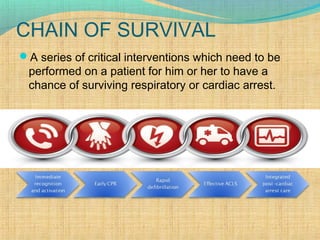
CHAIN OF SURVIVAL
A series of critical interventions which need to be
performed on a patient for him or her to have a
chance of surviving respiratory or cardiac arrest.
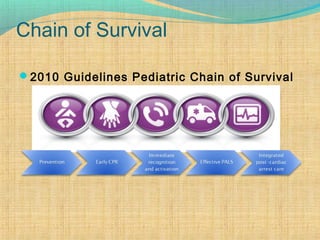
Chain of Survival
2010 Guidelines Pediatric Chain of Survival
CPR Broken down
CARDIO = heart
Muscle that contracts/expands more than 60-100
beats per minute
Pumps oxygen-rich blood from the lungs out to the
rest of the body
CPR Broken down
PULMONARY = lungs
Breathe about 15-25 times per minute
Brings oxygen into our lungs and gets rid of carbon
dioxide
Breathe in 21% oxygen and breathe out 16-18%
oxygen
CPR Broken down
RESUSCITATE = Revive
 Mimics the function of the heart and lungs
 Prevents brain damage
 CPR slows down deterioration of patient’s chance of survival
from 7-10% per minute to 3-4%
Immediate Recognition
Unresponsiveness and absence of breathing
or normal breathing should prompt the rescuer to
call for emergency assistance
Pulse checking is often unreliable even for trained
healthcare professionals. Pulse checking should not
take more than 10 seconds .
When there are more than one rescuer, one should
start CPR immediately while the other calls for help
If alone one should call for help first before providing
CPR except for infants and children
What is CPR?
CARDIOPULMONARY RESUSCITATION = Reviving
the heart and lungs
 Rescue breathing + chest compression
 Effective if commenced within 6 mins after the blood stops
flowing
 When effective can provide only about 30% of the “normal”
heart output
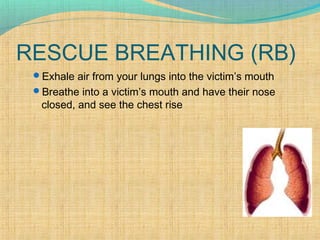
RESCUE BREATHING (RB)
Exhale air from your lungs into the victim’s mouth
Breathe into a victim’s mouth and have their nose
closed, and see the chest rise
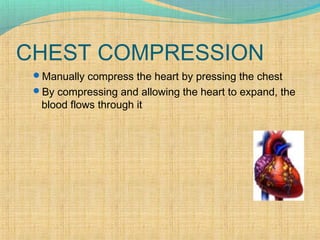
CHEST COMPRESSION
Manually compress the heart by pressing the chest
By compressing and allowing the heart to expand, the
blood flows through it
WHEN TO START CPR
All victims of cardiac arrest should receive CPR
unless:
• Patient has a valid DNAR (Do Not Attempt Resuscitation)
• Patient has signs of irreversible death (Rigor Mortis,
Decapitation, Dependent Lividity)
• No physiological benefit can be expected because
functions have deteriorated (terminally ill)
• Gestation of < 23 weeks or birth weight of <400g,
anencephaly
• Attempts to perform CPR would place the rescuer at
risk of physical injury
RULES IN GIVING
EMERGENCY CARE
WHAT TO DO:
• Do obtain consent when possible
• Do remember to identify yourself to the victim
• Do provide comfort and emotional support
• Be calm and direct as possible
• Keep onlookers away from the injured person
• Do loosen tight clothing
1- SCENE SURVEY
OBTAIN AS MUCH INFORMATION AS
POSSIBLE:
• Is the scene safe?
• What happened?
• How many people are injured?
• Are there any bystanders who can help?
• Identify yourself as a trained CPR provider
• Get consent to give care
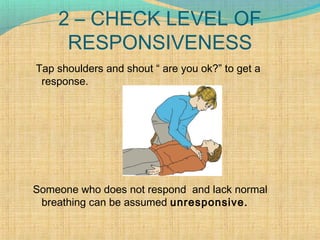
2 – CHECK LEVEL OF
RESPONSIVENESS
Tap shoulders and shout “ are you ok?” to get a
response.
Someone who does not respond and lack normal
breathing can be assumed unresponsive.
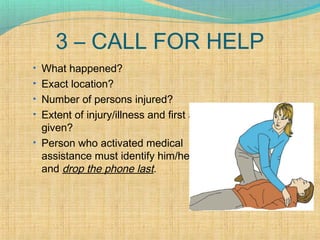
3 – CALL FOR HELP
• What happened?
• Exact location?
• Number of persons injured?
• Extent of injury/illness and first aid
given?
• Person who activated medical
assistance must identify him/herself
and drop the phone last.
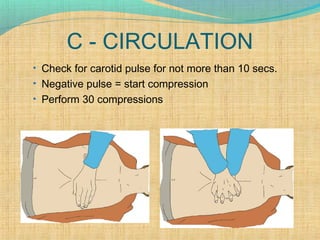
C - CIRCULATION
• Check for carotid pulse for not more than 10 secs.
• Negative pulse = start compression
• Perform 30 compressions
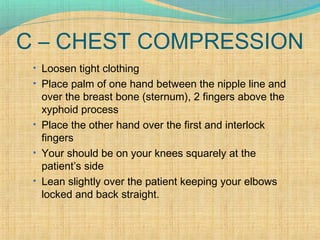
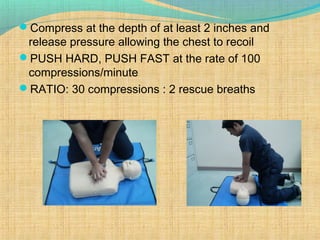
C – CHEST COMPRESSION
• Loosen tight clothing
• Place palm of one hand between the nipple line and
over the breast bone (sternum), 2 fingers above the
xyphoid process
• Place the other hand over the first and interlock
fingers
• Your should be on your knees squarely at the
patient’s side
• Lean slightly over the patient keeping your elbows
locked and back straight.
Compress at the depth of at least 2 inches and
release pressure allowing the chest to recoil
PUSH HARD, PUSH FAST at the rate of 100
compressions/minute
RATIO: 30 compressions : 2 rescue breaths
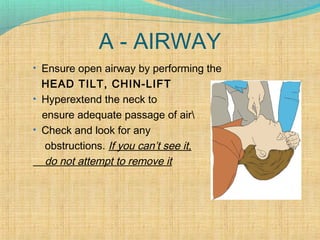
A - AIRWAY
• Ensure open airway by performing the
HEAD TILT, CHIN-LIFT
• Hyperextend the neck to
ensure adequate passage of air
• Check and look for any
obstructions. If you can’t see it,
do not attempt to remove it
WHAT NOW?
REPEAT STEPS C, A, B.
Reassess the patient every 5 cycles
WHEN TO STOP CPR
Spontaneous signs of life are restored (effective or
normal breathing and circulation)
Turnover to medical services or properly trained
personnel (such as EMTs, physicians)
Operator is exhausted
Physicians assumes responsibility
Scene becomes unsafe
WHEN SIGNS OF LIFE
APPEAR
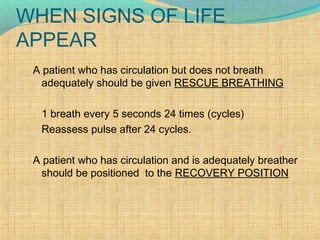
A patient who has circulation but does not breath
adequately should be given RESCUE BREATHING
1 breath every 5 seconds 24 times (cycles)
Reassess pulse after 24 cycles.
A patient who has circulation and is adequately breather
should be positioned to the RECOVERY POSITION
WHEN SIGNS OF LIFE
APPEAR
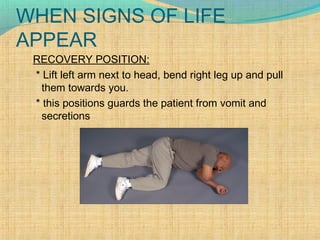
RECOVERY POSITION:
* Lift left arm next to head, bend right leg up and pull
them towards you.
* this positions guards the patient from vomit and
secretions
AUTOMATED EXTERNAL
DEFIBRILLATOR
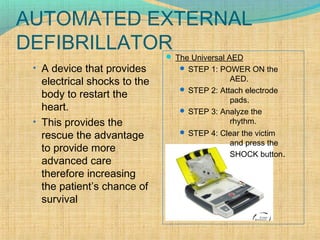
• A device that provides
electrical shocks to the
body to restart the
heart.
• This provides the
rescue the advantage
to provide more
advanced care
therefore increasing
the patient’s chance of
survival
 The Universal AED
 STEP 1: POWER ON the
AED.
 STEP 2: Attach electrode
pads.
 STEP 3: Analyze the
rhythm.
 STEP 4: Clear the victim
and press the
SHOCK button.
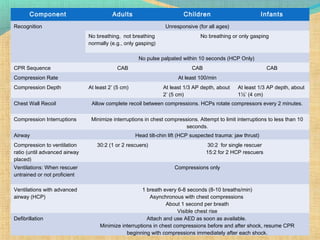
Component Adults Children Infants
Recognition Unresponsive (for all ages)
No breathing, not breathing
normally (e.g., only gasping)
No breathing or only gasping
No pulse palpated within 10 seconds (HCP Only)
CPR Sequence CAB CAB CAB
Compression Rate At least 100/min
Compression Depth At least 2’ (5 cm) At least 1/3 AP depth, about
2’ (5 cm)
At least 1/3 AP depth, about
1½’ (4 cm)
Chest Wall Recoil Allow complete recoil between compressions. HCPs rotate compressors every 2 minutes.
Compression Interruptions Minimize interruptions in chest compressions. Attempt to limit interruptions to less than 10
seconds.
Airway Head tilt-chin lift (HCP suspected trauma: jaw thrust)
Compression to ventilation
ratio (until advanced airway
placed)
30:2 (1 or 2 rescuers) 30:2 for single rescuer
15:2 for 2 HCP rescuers
Ventilations: When rescuer
untrained or not proficient
Compressions only
Ventilations with advanced
airway (HCP)
1 breath every 6-8 seconds (8-10 breaths/min)
Asynchronous with chest compressions
About 1 second per breath
Visible chest rise
Defibrillation Attach and use AED as soon as available.
Minimize interruptions in chest compressions before and after shock, resume CPR
beginning with compressions immediately after each shock.
FOREIGN BODY AIRWAY OBSTRUCTION (FBAO)
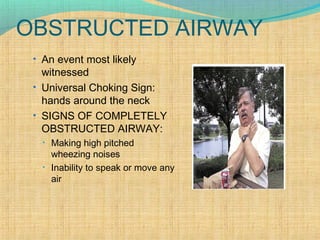
OBSTRUCTED AIRWAY
• An event most likely
witnessed
• Universal Choking Sign:
hands around the neck
• SIGNS OF COMPLETELY
OBSTRUCTED AIRWAY:
• Making high pitched
wheezing noises
• Inability to speak or move any
air
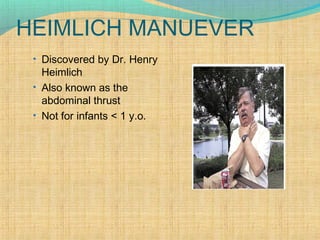
HEIMLICH MANUEVER
• Discovered by Dr. Henry
Heimlich
• Also known as the
abdominal thrust
• Not for infants < 1 y.o.
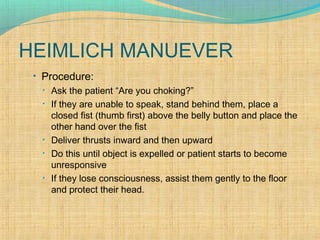
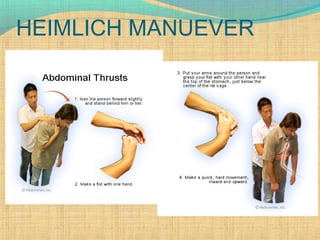
HEIMLICH MANUEVER
• Procedure:
• Ask the patient “Are you choking?”
• If they are unable to speak, stand behind them, place a
closed fist (thumb first) above the belly button and place the
other hand over the fist
• Deliver thrusts inward and then upward
• Do this until object is expelled or patient starts to become
unresponsive
• If they lose consciousness, assist them gently to the floor
and protect their head.
HEIMLICH MANUEVER
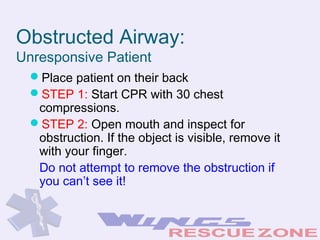
Obstructed Airway:
Unresponsive Patient
Place patient on their back
STEP 1: Start CPR with 30 chest
compressions.
STEP 2: Open mouth and inspect for
obstruction. If the object is visible, remove it
with your finger.
Do not attempt to remove the obstruction if
you can’t see it!
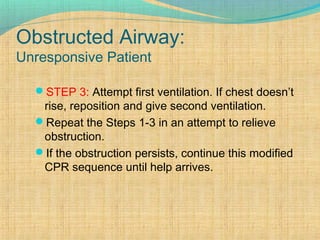
Obstructed Airway:
Unresponsive Patient
STEP 3: Attempt first ventilation. If chest doesn’t
rise, reposition and give second ventilation.
Repeat the Steps 1-3 in an attempt to relieve
obstruction.
If the obstruction persists, continue this modified
CPR sequence until help arrives.
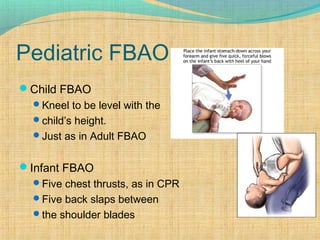
Pediatric FBAO
Child FBAO
Kneel to be level with the
child’s height.
Just as in Adult FBAO
Infant FBAO
Five chest thrusts, as in CPR
Five back slaps between
the shoulder blades
1 - Scene Survey
 Scene Safety
 Identify and Consent
2 - Check Level Of
Consciousness
 Tap Shout and Chest Rub
3 - Call for help (AED if
available)
C - Circulation
 Pulse check (not more than
10 secs) –
negative=compression
A - Airway
 Head-tilt, chin-lift, Check for
obstruction
B - Breathing
 adult = 2 blows: 5secs: 24
cycles
 Infant = 2 blows: 3 secs: 40
cycles
RESCUE BREATHING
ADULT
Blow, 1,1002,1003, 1001
….. 24
INFANT
Blow, 1,1001… 40
THANK YOU!!!
PARAÑAQUE
DRRMO
FACEBOOK PAGE:

Basic life support 2013

  • 1.
  • 2.
    Basic Life Support Aset of emergency procedures involving the immediate recognition of signs of sudden cardiac arrest (SCA), heart attack, stroke, and foreign-body airway obstruction (FBAO); and the application of external chest compressions, rescue breathing, abdominal thrusts, as well as the defibrillation with the use of an AED to maintain life or until advanced life support is available.
  • 3.
    Cardiopulmonary Resuscitation Series ofsteps to help you save one’s life by manually providing blood flow to the heart, brain and lungs until further medical attention can be obtained Provided through quality chest compressions that is uninterrupted as possible and only for the shortest time needed NOTE: CPR itself does not completely save a life it does prolong it for a short period of time
  • 4.
    CHAIN OF SURVIVAL Aseries of critical interventions which need to be performed on a patient for him or her to have a chance of surviving respiratory or cardiac arrest.
  • 5.
    Chain of Survival 2010Guidelines Pediatric Chain of Survival
  • 6.
    CPR Broken down CARDIO= heart Muscle that contracts/expands more than 60-100 beats per minute Pumps oxygen-rich blood from the lungs out to the rest of the body
  • 7.
    CPR Broken down PULMONARY= lungs Breathe about 15-25 times per minute Brings oxygen into our lungs and gets rid of carbon dioxide Breathe in 21% oxygen and breathe out 16-18% oxygen
  • 8.
    CPR Broken down RESUSCITATE= Revive  Mimics the function of the heart and lungs  Prevents brain damage  CPR slows down deterioration of patient’s chance of survival from 7-10% per minute to 3-4%
  • 9.
    Immediate Recognition Unresponsiveness andabsence of breathing or normal breathing should prompt the rescuer to call for emergency assistance Pulse checking is often unreliable even for trained healthcare professionals. Pulse checking should not take more than 10 seconds . When there are more than one rescuer, one should start CPR immediately while the other calls for help If alone one should call for help first before providing CPR except for infants and children
  • 10.
    What is CPR? CARDIOPULMONARYRESUSCITATION = Reviving the heart and lungs  Rescue breathing + chest compression  Effective if commenced within 6 mins after the blood stops flowing  When effective can provide only about 30% of the “normal” heart output
  • 11.
    RESCUE BREATHING (RB) Exhaleair from your lungs into the victim’s mouth Breathe into a victim’s mouth and have their nose closed, and see the chest rise
  • 12.
    CHEST COMPRESSION Manually compressthe heart by pressing the chest By compressing and allowing the heart to expand, the blood flows through it
  • 13.
    WHEN TO STARTCPR All victims of cardiac arrest should receive CPR unless: • Patient has a valid DNAR (Do Not Attempt Resuscitation) • Patient has signs of irreversible death (Rigor Mortis, Decapitation, Dependent Lividity) • No physiological benefit can be expected because functions have deteriorated (terminally ill) • Gestation of < 23 weeks or birth weight of <400g, anencephaly • Attempts to perform CPR would place the rescuer at risk of physical injury
  • 14.
    RULES IN GIVING EMERGENCYCARE WHAT TO DO: • Do obtain consent when possible • Do remember to identify yourself to the victim • Do provide comfort and emotional support • Be calm and direct as possible • Keep onlookers away from the injured person • Do loosen tight clothing
  • 15.
    1- SCENE SURVEY OBTAINAS MUCH INFORMATION AS POSSIBLE: • Is the scene safe? • What happened? • How many people are injured? • Are there any bystanders who can help? • Identify yourself as a trained CPR provider • Get consent to give care
  • 16.
    2 – CHECKLEVEL OF RESPONSIVENESS Tap shoulders and shout “ are you ok?” to get a response. Someone who does not respond and lack normal breathing can be assumed unresponsive.
  • 17.
    3 – CALLFOR HELP • What happened? • Exact location? • Number of persons injured? • Extent of injury/illness and first aid given? • Person who activated medical assistance must identify him/herself and drop the phone last.
  • 18.
    C - CIRCULATION •Check for carotid pulse for not more than 10 secs. • Negative pulse = start compression • Perform 30 compressions
  • 19.
    C – CHESTCOMPRESSION • Loosen tight clothing • Place palm of one hand between the nipple line and over the breast bone (sternum), 2 fingers above the xyphoid process • Place the other hand over the first and interlock fingers • Your should be on your knees squarely at the patient’s side • Lean slightly over the patient keeping your elbows locked and back straight.
  • 20.
    Compress at thedepth of at least 2 inches and release pressure allowing the chest to recoil PUSH HARD, PUSH FAST at the rate of 100 compressions/minute RATIO: 30 compressions : 2 rescue breaths
  • 21.
    A - AIRWAY •Ensure open airway by performing the HEAD TILT, CHIN-LIFT • Hyperextend the neck to ensure adequate passage of air • Check and look for any obstructions. If you can’t see it, do not attempt to remove it
  • 22.
    WHAT NOW? REPEAT STEPSC, A, B. Reassess the patient every 5 cycles
  • 23.
    WHEN TO STOPCPR Spontaneous signs of life are restored (effective or normal breathing and circulation) Turnover to medical services or properly trained personnel (such as EMTs, physicians) Operator is exhausted Physicians assumes responsibility Scene becomes unsafe
  • 24.
    WHEN SIGNS OFLIFE APPEAR A patient who has circulation but does not breath adequately should be given RESCUE BREATHING 1 breath every 5 seconds 24 times (cycles) Reassess pulse after 24 cycles. A patient who has circulation and is adequately breather should be positioned to the RECOVERY POSITION
  • 25.
    WHEN SIGNS OFLIFE APPEAR RECOVERY POSITION: * Lift left arm next to head, bend right leg up and pull them towards you. * this positions guards the patient from vomit and secretions
  • 26.
    AUTOMATED EXTERNAL DEFIBRILLATOR • Adevice that provides electrical shocks to the body to restart the heart. • This provides the rescue the advantage to provide more advanced care therefore increasing the patient’s chance of survival  The Universal AED  STEP 1: POWER ON the AED.  STEP 2: Attach electrode pads.  STEP 3: Analyze the rhythm.  STEP 4: Clear the victim and press the SHOCK button.
  • 27.
    Component Adults ChildrenInfants Recognition Unresponsive (for all ages) No breathing, not breathing normally (e.g., only gasping) No breathing or only gasping No pulse palpated within 10 seconds (HCP Only) CPR Sequence CAB CAB CAB Compression Rate At least 100/min Compression Depth At least 2’ (5 cm) At least 1/3 AP depth, about 2’ (5 cm) At least 1/3 AP depth, about 1½’ (4 cm) Chest Wall Recoil Allow complete recoil between compressions. HCPs rotate compressors every 2 minutes. Compression Interruptions Minimize interruptions in chest compressions. Attempt to limit interruptions to less than 10 seconds. Airway Head tilt-chin lift (HCP suspected trauma: jaw thrust) Compression to ventilation ratio (until advanced airway placed) 30:2 (1 or 2 rescuers) 30:2 for single rescuer 15:2 for 2 HCP rescuers Ventilations: When rescuer untrained or not proficient Compressions only Ventilations with advanced airway (HCP) 1 breath every 6-8 seconds (8-10 breaths/min) Asynchronous with chest compressions About 1 second per breath Visible chest rise Defibrillation Attach and use AED as soon as available. Minimize interruptions in chest compressions before and after shock, resume CPR beginning with compressions immediately after each shock.
  • 28.
    FOREIGN BODY AIRWAYOBSTRUCTION (FBAO)
  • 29.
    OBSTRUCTED AIRWAY • Anevent most likely witnessed • Universal Choking Sign: hands around the neck • SIGNS OF COMPLETELY OBSTRUCTED AIRWAY: • Making high pitched wheezing noises • Inability to speak or move any air
  • 30.
    HEIMLICH MANUEVER • Discoveredby Dr. Henry Heimlich • Also known as the abdominal thrust • Not for infants < 1 y.o.
  • 31.
    HEIMLICH MANUEVER • Procedure: •Ask the patient “Are you choking?” • If they are unable to speak, stand behind them, place a closed fist (thumb first) above the belly button and place the other hand over the fist • Deliver thrusts inward and then upward • Do this until object is expelled or patient starts to become unresponsive • If they lose consciousness, assist them gently to the floor and protect their head.
  • 32.
  • 33.
    Obstructed Airway: Unresponsive Patient Placepatient on their back STEP 1: Start CPR with 30 chest compressions. STEP 2: Open mouth and inspect for obstruction. If the object is visible, remove it with your finger. Do not attempt to remove the obstruction if you can’t see it!
  • 34.
    Obstructed Airway: Unresponsive Patient STEP3: Attempt first ventilation. If chest doesn’t rise, reposition and give second ventilation. Repeat the Steps 1-3 in an attempt to relieve obstruction. If the obstruction persists, continue this modified CPR sequence until help arrives.
  • 35.
    Pediatric FBAO Child FBAO Kneelto be level with the child’s height. Just as in Adult FBAO Infant FBAO Five chest thrusts, as in CPR Five back slaps between the shoulder blades
  • 36.
    1 - SceneSurvey  Scene Safety  Identify and Consent 2 - Check Level Of Consciousness  Tap Shout and Chest Rub 3 - Call for help (AED if available) C - Circulation  Pulse check (not more than 10 secs) – negative=compression A - Airway  Head-tilt, chin-lift, Check for obstruction B - Breathing  adult = 2 blows: 5secs: 24 cycles  Infant = 2 blows: 3 secs: 40 cycles RESCUE BREATHING ADULT Blow, 1,1002,1003, 1001 ….. 24 INFANT Blow, 1,1001… 40
  • 37.