DR. ANKIT
GAJJAR
MD, IDCCM, IFCCM, EDIC
(CONSULTANT
INTENSIVIST)
TOPIC- BLS
WHAT IS CARDIAC
ARREST
 Cessation of normal circulation of blood due to
failure of heart to contract effectively.
 Sudden cessation of mechanical activity of
heart with some or no electricalactivity.
 May be reversible by a rapid intervention
but will lead to death in its absence.
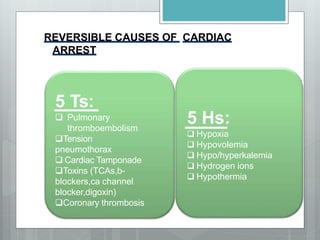
REVERSIBLE CAUSES OF CARDIAC
ARREST
5 Ts:
 Pulmonary
thromboembolism
Tension
pneumothorax
 Cardiac Tamponade
Toxins (TCAs,b-
blockers,ca channel
blocker,digoxin)
Coronary thrombosis
5 Hs:
 Hypoxia
 Hypovolemia
 Hypo/hyperkalemia
 Hydrogen ions
 Hypothermia
 M.I.
 Arrhythmia
 Low C.O.,failure,shock
 Cardiomyopathy
 Myocarditis
 Massive pulmonary
emboli
CARDIAC: OTHERS
 Coronary artery disease  Severe anaphylaxis
 Suffocation
 Electrocution
 Trauma
 Stroke
 Exsanguination
(severe loss of
blood)
 Drowning
CAUSES OF CARDIAC ARREST
BLS
 Its Cardiopulmonary Resuscitation (CPR).
 It Combines rescue breathing and chest
compressions
 It requires knowledge and skill to perform CPR
and how to operate AED / defibrillartor.
 These are Sequences of procedures performed to
restore the circulation of oxygenated blood
after a sudden pulmonary and/or cardiac arrest
ABC to CAB
Basics of BLS
• Chest compressions
• Airway
• Breathing
• Defibrillation
STEPS of BLS
 Assessment and scene safety
1. Scene is safe??
2. Asses the patient
3. Check breathing
Assesse the patient
 Shake shoulders gently
 Ask “Are you all right?”
 If he responds
 Find out what is wrong.
 Reassess regularly.
Check for pulse: no more than 10
sec
Feel the pulse
Feel the pulse at least for 5 seconds
Slide the finger laterally
Into the groove between trachea and muscle
Locate the trachea
Using 2 or3 fingures
SHOUT FOR
HELP
Start CPR
 Ratio: 30:2
 High quality CPR
 Chest compression
is foundation of CPR
 Push hard and push
fast
 100-120/min
 2.5-2-1.5 inch depth
 Allow complete chest
recoil
 Avoid excessive
ventilation
 Minimize interruption
 <10 seconds
 Effective rescue
breaths.
Chest Compressions
 Position yourself at patient’sside
 Victim should be laid on firm, flat surface
 Remove the clothings of the patient.
 Put the heel of one hand on the centre of chest
(sternum) at the level of nipples and put your other
hand on the top of the former hand.
 Strengthen arms and shoulders ditrectly over
hands
 Lockall joints ; movement is allowed only at hip
joint
 Pushhard and fast (100 - 120 times/ min)
 At the end of each compression, chest is allowed
torecoil completely
 Avoid excessiveventilation
 Then give next compression immediately
ChestCompressions
Mechanisms
• CardiacPump–
1. Blood pumping is assured by compression of
heartbetween sternum andspine
2. Between compressions, thoracic cageexpands and
heart gets filled with blood.
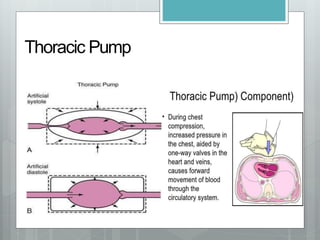
Thoracic Pump
Opening the airway
Caution
 Do not press deeply into the soft tissue
 Don’t use thumb to lift the chin
 Don’t close mouth completely
Jaw thrust
RESCUE BREATHS
26
RECOMMENDATIONS:
- Tidal volume
500 – 600 ml
- Respiratory rate
give each breaths over about 1s with enough
volume to make the victim’s chest rise
Types
 Mouth to mouthbreathing
 Mouth to barrier device breathing
 Mouth to nose and mouth tostoma ventilation
 Ventilation with bagandmask
Mouth-To-Mouth breath
Mouth-To-Nose breath
 Given when mouth cant beopen
 Good seal cant be made
 Severeinjury present over area of mouth
Mouth-To-Barrier device
Bagand Mask ventilation
 Position yourself directly above patient’shead
o Perform headtilt
o Make “C”with thumb and index finger to seal the mask
o And other 3 fingers,forms“E” jawthurst
o Chestrise is checked while squeezing the bagto give
breaths to thepatient.
BagAnd Mask Ventilation
 Defibrillation is used for the treatment of
tachydysrhythmias.
 Defibrillation depolarises the critical mass of
myocardial cell at once. It recaptures the SA
node as its role as the pacemaker .
 Is treatment of choice for pulseless VT/VF.
Prof. Dr. RS Mehta, BPKIHS
Defibrillation
DEFIBRILLATION
Ventricular
tachycardia
35 Prof. Dr. RS Mehta, BPKIHS
Ventricular
fibrillation
36 Prof. Dr. RS Mehta, BPKIHS
Defibrillators can be classified as :
Monophasic(delivers current of
one polarity only)
Biphasic (deliver current of 2
polarity)
Defibrillator
37 Prof. Dr. RS Mehta, BPKIHS
Position of defibrillator paddle:
 1st paddle - on the right
side of the chest just
below the clavicle
 2nd at precordial,
region.
 Paddle should be applied
with pressure equivalent
to 10 kg.
38 Prof. Dr. RS Mehta, BPKIHS
 Adult: 13cm
 Children:8cm
 Infants:4.5cm
Latest Recommendation for shock protocol ;
Previous recommendation of 3 successive shock
(200,300,360J)
Now a days only single shock is recommended .i.e.
360J by monophasic
150-200J by biphasic
Paddle
size
39
 Apply conducting jelly between the
paddle and the skin.
 Place the paddle so that they don't
touch patient’s clothing and bed
linen and aren't near medication and
direct oxygen flow.
 Ensure that defibrillator is not in
synchronized mode.
 Don't charge the device until ready to
shock
 keep the thumbs and fingers off
discharge button until paddle are on
Nurses role while performing
defibrillation
 Before pressing the discharge button call “ all
clear” 3 times
1st clear: Ensures" YOU” aren’t touching
patient,bed, equipment
2nd clear: Ensures “no one" is touching patient, bed ,
equipment
3rd clear: Ensures “you and everyone" else are clear off
the patient and anything touching the patient.
Nurses role in
defibrillation
Nurses role in
defibrillation
 Record the delivered energy and the results (cardiac
rhythm and pulse).
 After the event is complete inspect the skin under
the pads and paddles for burns , and if any
detected consult about the treatment.
42 Prof. Dr. RS Mehta, BPKIHS
First turn it on.
Then simply follow
instructions.
Using an AED
43
AUTOMATED EXTERNAL
DEFIBRILLATOR (AED)
 Some AEDs will
automatically switch
themselves on when
the lid is opened
ATTACH PADS TO
CASUALTY’S BARE CHEST
ANALYSING RHYTHM
DO NOT TOUCH VICTIM
SHOCK INDICATED
 Stand clear
 Deliver shock
SHOCK DELIVERED
FOLLOW AED INSTRUCTIONS
30 2
IF VICTIM STARTS TO BREATHE
NORMALLY PLACE IN RECOVERY
POSITION
1. Adrenaline(all types of cardiac arrest)- 1mg
every 3-5 mins
2. Amidarone(VF,VT)- 1st dose:300mg IV bolus,
2nd dose 150 mg
3. Lidocaine- ( 1 to 1.5 mg/kg)
4. Sodium bicarbonate(only if cardiac arrest is
associated with hyperkalemia ) (2- 5 meq/kg)
5. Calcium gluconate- 10 mg iv slowly
6. Magnesium sulphate – 2 gms iv in 100 ml NS
(refractory VT / VF)
51
DRUGS
THANK YOU
FOR YOUR ATTENTION

AHA BLS

  • 1.
    DR. ANKIT GAJJAR MD, IDCCM,IFCCM, EDIC (CONSULTANT INTENSIVIST) TOPIC- BLS
  • 2.
    WHAT IS CARDIAC ARREST Cessation of normal circulation of blood due to failure of heart to contract effectively.  Sudden cessation of mechanical activity of heart with some or no electricalactivity.  May be reversible by a rapid intervention but will lead to death in its absence.
  • 3.
    REVERSIBLE CAUSES OFCARDIAC ARREST 5 Ts:  Pulmonary thromboembolism Tension pneumothorax  Cardiac Tamponade Toxins (TCAs,b- blockers,ca channel blocker,digoxin) Coronary thrombosis 5 Hs:  Hypoxia  Hypovolemia  Hypo/hyperkalemia  Hydrogen ions  Hypothermia
  • 4.
     M.I.  Arrhythmia Low C.O.,failure,shock  Cardiomyopathy  Myocarditis  Massive pulmonary emboli CARDIAC: OTHERS  Coronary artery disease  Severe anaphylaxis  Suffocation  Electrocution  Trauma  Stroke  Exsanguination (severe loss of blood)  Drowning CAUSES OF CARDIAC ARREST
  • 5.
    BLS  Its CardiopulmonaryResuscitation (CPR).  It Combines rescue breathing and chest compressions  It requires knowledge and skill to perform CPR and how to operate AED / defibrillartor.  These are Sequences of procedures performed to restore the circulation of oxygenated blood after a sudden pulmonary and/or cardiac arrest
  • 6.
  • 7.
    Basics of BLS •Chest compressions • Airway • Breathing • Defibrillation
  • 8.
    STEPS of BLS Assessment and scene safety 1. Scene is safe?? 2. Asses the patient 3. Check breathing
  • 9.
    Assesse the patient Shake shoulders gently  Ask “Are you all right?”  If he responds  Find out what is wrong.  Reassess regularly.
  • 10.
    Check for pulse:no more than 10 sec Feel the pulse Feel the pulse at least for 5 seconds Slide the finger laterally Into the groove between trachea and muscle Locate the trachea Using 2 or3 fingures
  • 11.
  • 12.
    Start CPR  Ratio:30:2  High quality CPR  Chest compression is foundation of CPR  Push hard and push fast  100-120/min  2.5-2-1.5 inch depth  Allow complete chest recoil  Avoid excessive ventilation  Minimize interruption  <10 seconds  Effective rescue breaths.
  • 14.
    Chest Compressions  Positionyourself at patient’sside  Victim should be laid on firm, flat surface  Remove the clothings of the patient.  Put the heel of one hand on the centre of chest (sternum) at the level of nipples and put your other hand on the top of the former hand.
  • 15.
     Strengthen armsand shoulders ditrectly over hands  Lockall joints ; movement is allowed only at hip joint  Pushhard and fast (100 - 120 times/ min)  At the end of each compression, chest is allowed torecoil completely  Avoid excessiveventilation  Then give next compression immediately
  • 16.
  • 17.
    Mechanisms • CardiacPump– 1. Bloodpumping is assured by compression of heartbetween sternum andspine 2. Between compressions, thoracic cageexpands and heart gets filled with blood.
  • 18.
  • 19.
  • 23.
    Caution  Do notpress deeply into the soft tissue  Don’t use thumb to lift the chin  Don’t close mouth completely
  • 24.
  • 26.
    RESCUE BREATHS 26 RECOMMENDATIONS: - Tidalvolume 500 – 600 ml - Respiratory rate give each breaths over about 1s with enough volume to make the victim’s chest rise
  • 27.
    Types  Mouth tomouthbreathing  Mouth to barrier device breathing  Mouth to nose and mouth tostoma ventilation  Ventilation with bagandmask
  • 28.
  • 29.
    Mouth-To-Nose breath  Givenwhen mouth cant beopen  Good seal cant be made  Severeinjury present over area of mouth
  • 30.
  • 31.
    Bagand Mask ventilation Position yourself directly above patient’shead o Perform headtilt o Make “C”with thumb and index finger to seal the mask o And other 3 fingers,forms“E” jawthurst o Chestrise is checked while squeezing the bagto give breaths to thepatient.
  • 32.
  • 33.
     Defibrillation isused for the treatment of tachydysrhythmias.  Defibrillation depolarises the critical mass of myocardial cell at once. It recaptures the SA node as its role as the pacemaker .  Is treatment of choice for pulseless VT/VF. Prof. Dr. RS Mehta, BPKIHS Defibrillation
  • 34.
  • 35.
  • 36.
  • 37.
    Defibrillators can beclassified as : Monophasic(delivers current of one polarity only) Biphasic (deliver current of 2 polarity) Defibrillator 37 Prof. Dr. RS Mehta, BPKIHS
  • 38.
    Position of defibrillatorpaddle:  1st paddle - on the right side of the chest just below the clavicle  2nd at precordial, region.  Paddle should be applied with pressure equivalent to 10 kg. 38 Prof. Dr. RS Mehta, BPKIHS
  • 39.
     Adult: 13cm Children:8cm  Infants:4.5cm Latest Recommendation for shock protocol ; Previous recommendation of 3 successive shock (200,300,360J) Now a days only single shock is recommended .i.e. 360J by monophasic 150-200J by biphasic Paddle size 39
  • 40.
     Apply conductingjelly between the paddle and the skin.  Place the paddle so that they don't touch patient’s clothing and bed linen and aren't near medication and direct oxygen flow.  Ensure that defibrillator is not in synchronized mode.  Don't charge the device until ready to shock  keep the thumbs and fingers off discharge button until paddle are on Nurses role while performing defibrillation
  • 41.
     Before pressingthe discharge button call “ all clear” 3 times 1st clear: Ensures" YOU” aren’t touching patient,bed, equipment 2nd clear: Ensures “no one" is touching patient, bed , equipment 3rd clear: Ensures “you and everyone" else are clear off the patient and anything touching the patient. Nurses role in defibrillation
  • 42.
    Nurses role in defibrillation Record the delivered energy and the results (cardiac rhythm and pulse).  After the event is complete inspect the skin under the pads and paddles for burns , and if any detected consult about the treatment. 42 Prof. Dr. RS Mehta, BPKIHS
  • 43.
    First turn iton. Then simply follow instructions. Using an AED 43
  • 44.
    AUTOMATED EXTERNAL DEFIBRILLATOR (AED) Some AEDs will automatically switch themselves on when the lid is opened
  • 45.
  • 46.
  • 47.
    SHOCK INDICATED  Standclear  Deliver shock
  • 48.
    SHOCK DELIVERED FOLLOW AEDINSTRUCTIONS 30 2
  • 49.
    IF VICTIM STARTSTO BREATHE NORMALLY PLACE IN RECOVERY POSITION
  • 51.
    1. Adrenaline(all typesof cardiac arrest)- 1mg every 3-5 mins 2. Amidarone(VF,VT)- 1st dose:300mg IV bolus, 2nd dose 150 mg 3. Lidocaine- ( 1 to 1.5 mg/kg) 4. Sodium bicarbonate(only if cardiac arrest is associated with hyperkalemia ) (2- 5 meq/kg) 5. Calcium gluconate- 10 mg iv slowly 6. Magnesium sulphate – 2 gms iv in 100 ml NS (refractory VT / VF) 51 DRUGS
  • 52.