ACID BASE BALANCE
INTERPRETATION
Dr.Sherif Badrawy
‫اﻟﺮﺣﯿﻢ‬ ‫اﻟﺮﺣﻤﻦ‬ ‫ﷲ‬ ‫ﺑﺴﻢ‬
♻ This is a summarized presentation about
acid base balance & its practical application
in the ICU.
♻ I hope this will help in simplifying this
important ICU topic.
♻ All comments are welcome & highly
appreciated.
1a
1b
Dr. Sherif
Badrawy
Digitally signed by Dr.
Sherif Badrawy
DN: cn=Dr. Sherif Badrawy,
o=KKUH, ou=Critical Care,
email=sherif_badrawy@ya
hoo.com, c=SA
Date: 2015.08.25 18:40:56
+03'00'
Osmolar Gap
2a
Screening test for detecting abnormal
low MW solutes (e.g. ethanol, methanol
& ethylene glycol [Normal is < 10]
↑Osmolar Gap ➜ >10 ➜ indirect
evidence for the presence of an abnormal
solute in significant amounts
2b
Osmolar gap =
3a
Osmolality - Osmolarity
Osmolality (measured),
Osmolarity (calculated)
3b
Osmolality (measured) ➜
Units:
4a
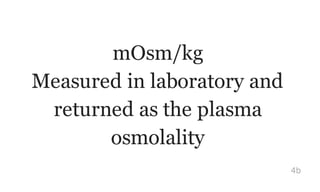
mOsm/kg
Measured in laboratory and
returned as the plasma
osmolality
4b
Osmolarity (calculated) ➜
Units:
5a
mOsm/l
Osmolarity = (1.86 x [Na+]) +
[glucose] + [urea] + 9 (using
values measured in mmol/l)
5b
Compensation rules for
Metabolic Acidosis
6a
Expected PCO2 = 1.5 x HCO3
+ 8 ± 2
6b
Compensation rules for
Metabolic Alkalosis
7a
Expected PCO2 = 0.7 x HCO3
+ 21 ± 2
7b
Compensation rules for
Respiratory Acidosis
8a
8b
Compensation rules for
Respiratory Alkalosis
9a
9b
How to calculate metabolic
compensation in respiratory
acidosis and alkalosis (aka the
1-2-3-4-5 rule)
10a
10b
Adverse effects of metabolic
acidosis
11a
◒ ↓myocardial contractility,
arrhythmias, VC
◒ Pulmonary VC, hyperventilation
◒ ↓Splanchnic and renal blood flow
◒ ↑metabolic rate, catabolism, ↓ATP
synthesis, ↓2,3DPG synthesis
11b
Working out a Metabolic
Acidosis
◒ Calculate AG or AGc, if:
◒ High:
12a
◒ Unmeasured anions likely ➜ measure osmolality.
➜ If there is no obvious cause for an elevated AGc, ➜
specific assays (glucose, renal function,
rhabdomyolysis, L-lactate, D-lactate, β-
hydroxybutyrate, salicylate)
◒ Calculate osmolar gap. If high AG and high OG
then ketones, lactate, ethanol, ethylene glycol,
methanol, mannitol.
12b
Working out a Metabolic
Acidosis
◒ Calculate AG or AGc, if:
◒ Normal:
13a
Do Urinary AG
13b
Working out a Metabolic
Acidosis
◒ Calculate AG or AGc, if:
◒ Low:
14a
- Lab error: ↑Cl, ↓Na
- ↓anions (eg Alb)
- ↑cations: Ca, Mg, IgG, Li
14b
Causes of Normal Anion gap
metabolic acidosis ?
15a
【U S E D C A R PAR T S】
✺ U ⇨ Ureterosigmoidostomy
✺ S ⇨ saline administration (in the face of renal dysfunction)
✺ E ⇨ Endocrine〘Addisons〙
✺ D ⇨ Diarrhea
✺ C ⇨ Carbonic anhydrase inhibitors
✺ A ⇨ Ammonium chloride
✺ R ⇨ Renal tubular acidosis
✺ PAR ⇨PARathyroid Adenoma
✺ T ⇨ Triamterene, amiloride
✺ S ⇨ Spironolactone
15b
Causes of High Anion gap
metabolic acidosis ?
16a
【MUDPILES】
★ M-Methanol
★ U-Uremia (chronic renal failure)
★ D-Diabetic ketoacidosis
★ P-Propylene glycol,Paraldehyde
★ I-Infection, Iron, Isoniazid, Inborn errors of metabolism
★ L-Lactic acidosis
★ E-Ethylene glyco,Ethanol
★ S-Salicylates
16b
Low anion gap
17a
✪ Increase in unmeasured cations
(Increased Li, K, Ca, Mg, and IgG)
✪ Decreased unmeasured anions
(Decreased PO4, albumin)
✪ Chloride over-estimation
(anion) (Hypercholesterolemia)
17b
[H+] =
18a
24 X PC02/[HC03]
[H+] = 24 x (40/24) = 40
nEq/L
18b
Calculating Anion Gap
19a
Na - (CL + HC03) = 12 ±4
mEq/L (range = 8 to 16
mEq/L)
19b
Influence of Albumin on the
Anion Gap
20a
albumin is the major unmeasured anion
in plasma. This means that a decrease in
serum albumin will decrease the
AG,(e.g., a high AG metabolic acidosis
can present with a normal AG in the
presence of hypoalbuminemia).
20b
Albumin corrected anion gap
(AGc)
21a
AGc = AG + 0.25 × (40 -
albumin)
21b
What is the Gap-Gap ?
22a
In the presence of a high AG metabolic
acidosis, it is possible to detect another
metabolic acid-base disorder (a
normal AG metabolic acidosis or a
metabolic alkalosis)
by comparing the AG excess to the HC03
deficit
22b
Calculation of Gap-Gap ?
23a
AG Excess /HC03 Deficit =
(AG - 12)/(24 - HC03)
23b
explanation of Gap-Gap 1
24a
☼ Mixed Metabolic Acidoses
↑AG metabolic acidosis the ↓in serum HC03 = the ↑in
AG, and the AG excess/HC03 deficit ratio is unity
(=1) when a hyperchloremic acidosis appears, the↓in
HCO3 is > ↑in the AG, and the ratio (AG
excess/HCO3 deficit) falls below unity (<1),( as 24-
HCO3 ➜ will be a bigger number dt ↓in HCO3).
∴Gap-Gap <1 indicates the coexistence of a ↑AG
metabolic acidosis + normal AG metabolic acidosis
24b
explanation of Gap-Gap 2
25a
☼ Metabolic Acidosis and Alkalosis
When alkali is added in the presence of a ↑AG
metabolic acidosis, the ↓in HCO3 is < the ↑in
AG, and the gap-gap (AG excess /HCO3
deficit) is greater than unity (>1).
∴Gap-Gap > 1 indicates the coexistence of a
↑AG metabolic acidosis + normal AG
metabolic Alkalosis
25b
Precise explanation of Gap-
Gap
26a
26b
Hyperlactaemia:
27a
a level from 2 mmols/l to 5
mmol/l.
27b
Severe Lactic Acidosis:
28a
- when levels are greater than 5 mmols/l
- As levels rise above 5mmols/l, the associated mortality
rate can become very high.
- The brief and often very high lactate levels that occur
with severe exercise or generalised convulsions (eg up to
30 mmol/l) are associated with an extremely low
mortality rate so the absolute lactate level (alone) is not a
good predictor of outcome unless the cause of the high
level is also considered.
28b
physiology of lactate
29a
Each day the body produce >
1500 mmols of lactate (about
20 mmols/kg/day) ➜ blood
stream a ➜ metabolised
mostly in the liver
29b
Relationship of lactate to
pyruvate
30a
- Lactate is produced from pyruvate in a
reaction catalysed by lactate
dehydrogenase
This reaction considered to be always in
an
equilibrium situation. Normally the ratio
of lactate to pyruvate in the cell is 10 to 1.
30b
Type A Lactic Acidosis :
31a
【Inadequate Tissue Oxygen Delivery】
(i)Anaerobic muscular activity (eg sprinting,
generalised convulsions)
(ii)Tissue hypoperfusion (eg shock -septic,
cardiogenic or hypovolaemic; hypotension; cardiac
arrest; acute heart failure; regional hypoperfusion
esp mesenteric ischaemia)
(iii) Reduced tissue oxygen delivery or utilisation (eg
hypoxaemia, CO poisoning, severe anaemia)
31b
levels at which Type A Lactic
Acidosis occurs
32a
- If hypoxaemia is the only factor present, it
needs to be severe (eg paO2 < 35mmHg) to
ppt lactic acidosis dt protection afforded by
the body's compensatory
mechanisms which ↑tissue blood flow.
Similarly anaemia needs to be severe (eg
[Hb] <5g/dl) if present alone because tissue
blood flow is increased in compensation.
32b
Type B Lactic Acidosis
33a
no clinical evidence of
reduction in tissue oxygen
delivery.
33b
i) type B1 :
34a
Associated with underlying diseases
- LUKE leukaemia, lymphoma
- TIPS thiamine deficiency, infection,
pancreatitis, short bowel syndrome
- FAILURES hepatic, renal , diabetic
failures
34b
(ii) type B2:
35a
Assoc with drugs & toxins (eg metformin,
cyanide, beta-agonists, methanol,
adrenaline, salicylates, nitroprusside,
ethanol intoxication in chronic
alcoholics, anti-retroviral drugs,
paracetamol, fructose, sorbitol,
isoniazid)
35b
(iii) type B3:
36a
Assoc with inborn errors of
metabolism (eg congenital forms of
lactic acidosis with various enzyme
defects eg pyruvate dehydrogenase
deficiency)
36b
D-Lactic Acidosis
37a
D-lactate generated by bacterial fermentation in the
bowel can enter the systemic circulation and produce
a metabolic acidosis, often combined with a
metabolic encephalopathy, 【after extensive small
bowel resection or after jejunoileal bypass】 for
morbid obesity, can ↑anion gap, but the standard lab
assay for lactate measures only l-lactate. If d-lactic
acidosis is suspected, you must request a specific d-
lactate assay.
37b
The principles of management
of patients with lactic acidosis
are:
38a
(i) Diagnose and correct the underlying
condition (if possible)
(ii) Restore adequate tissue oxygen
delivery (esp restore adequate perfusion)
(iii) Ensure appropriate compensatory
hyperventilation where possible
38b
patients with severe acidosis (pH
<7.1), HD unstable, a trial infusion
of HCO3 can be attempted by
administering 1/2 of the estimated
bicarbonate deficit
39a
HCO3 deficit (mEq)=0.6 x wt
(kg) x (15-plasma HCO3)
39b
Use of bicarbonate in Lactic
Acidosis
40a
two RCT of bicarbonate in
lactic acidosis and shock
found no beneficial effects on
cardiac function or any other
effects of pH correction
40b
potential SEs of bicarbonate in
Lactic Acidosis
41a
(i) acute hypercapnia
(ii) ionised hypocalcaemia
(iii) intracellular acidosis due to CO2 crossing cell
membranes rapidly
(iv) acute intravascular overload
(v) bicarbonate ↑lactate production by ↑activity of
the rate limiting enzyme phosphofructokinase, ➜
shifts Hb-O2 dissociation curve, ↑O2 affinity of Hb
➜ ↓DO2 to tissue
41b
potential indications: of
bicarbonate in Lactic Acidosis
42a
❂ PHTN in whom pulmonary VC may
↑by acidosis
❂ significant IHD in whom severe
acidosis ↓threshold for arrhythmia
❂ TCA or Aspirin overdose
❂ Consider slow bicarbonate infusion to
keep pH > 7.15
42b
Management of Lactic
Acidosis
43a
☼ Lactate is a question not any
answer: exclude occult sepsis,
inadequate resuscitation, localised
ischaemia or CVS failure
☼ Stop NRTIs in HIV
43b
Volume deficits average in
DKA
44a
50 to 100 mL/kg
44b
Uses of Ethylene glycol
45a
antifreeze and deicing
solutions
45b
Etiology of Hypokalemia with
alkalosis ?
46a
❂ Vomiting
❂ Diuretics
❂ Cushing's syndrome
❂ Conn's syndrome (primary
hyperaldosteronism)
46b
Etiology of Hypokalemia with
acidosis ?
47a
❂ Diarrhea
❂ RTA
❂ Acetazolamide
❂ Partially treated DKA
47b
Causes of Metabolic Alkalosis
?
48a
loss of hydrogen ions or a gain of bicarbonate 【CLEVER PD】
✵ Contraction (volume)
✵ Liquorice☯
✵ Endo: (Conn's/Cushing's/Bartter's)☯
✵ Vomiting/ aspiration (e.g.Peptic ulcer➜ pyloric stenosis, NG
suction)
✵ Excess Alkali☯
✵ Refeeding Alkalosis☯
✵ Post-hypercapnia
✵ Diuretics
☯ = Associated with High Urine Cl levels
48b
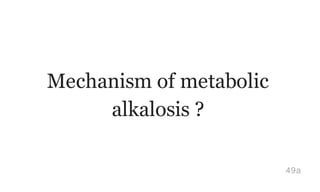
Mechanism of metabolic
alkalosis ?
49a
✪ Activation of (RAAS) is a key factor
✪ Aldosterone ➜ reabsorption of Na+ in exchange
for H+ in the DCT
✪ ECF depletion (vomiting, diuretics) ➜ Na+ and
Cl- loss activation of RAAS➜ ↑ aldosterone levels
✪ In Hypokalemia, K+ shift from cells ➜ ECF.
Alkalosis is caused by shift of H+ into cells to
maintain neutrality
49b
Rx of metabolic alkalosis ?
50a
❂ Stop precipitants
❂ Hydrate with NaCl (concept of saline responsive vs non-
responsive, urinary Cl <20 if responsive).
❂ +/- correct albumin
❂ Correct KCl (Cl most helpful, K disappears into depleted
intracellular space)
❂ More difficult where CCF, CRF, liver disease ➜ ↑aldosteronism
in presence of ↑ECF. Prefer K
❂ Acetazolamide: increase urinary SID. Carbonic Anhydrase
inhibitor. 250 - 500 mg bd
❂ Dialysis
50b

Acid base balance interpretation

  • 1.
  • 2.
    ‫اﻟﺮﺣﯿﻢ‬ ‫اﻟﺮﺣﻤﻦ‬ ‫ﷲ‬‫ﺑﺴﻢ‬ ♻ This is a summarized presentation about acid base balance & its practical application in the ICU. ♻ I hope this will help in simplifying this important ICU topic. ♻ All comments are welcome & highly appreciated. 1a
  • 3.
    1b Dr. Sherif Badrawy Digitally signedby Dr. Sherif Badrawy DN: cn=Dr. Sherif Badrawy, o=KKUH, ou=Critical Care, email=sherif_badrawy@ya hoo.com, c=SA Date: 2015.08.25 18:40:56 +03'00'
  • 4.
  • 5.
    Screening test fordetecting abnormal low MW solutes (e.g. ethanol, methanol & ethylene glycol [Normal is < 10] ↑Osmolar Gap ➜ >10 ➜ indirect evidence for the presence of an abnormal solute in significant amounts 2b
  • 6.
  • 7.
    Osmolality - Osmolarity Osmolality(measured), Osmolarity (calculated) 3b
  • 8.
  • 9.
    mOsm/kg Measured in laboratoryand returned as the plasma osmolality 4b
  • 10.
  • 11.
    mOsm/l Osmolarity = (1.86x [Na+]) + [glucose] + [urea] + 9 (using values measured in mmol/l) 5b
  • 12.
  • 13.
    Expected PCO2 =1.5 x HCO3 + 8 ± 2 6b
  • 14.
  • 15.
    Expected PCO2 =0.7 x HCO3 + 21 ± 2 7b
  • 16.
  • 17.
  • 18.
  • 19.
  • 20.
    How to calculatemetabolic compensation in respiratory acidosis and alkalosis (aka the 1-2-3-4-5 rule) 10a
  • 21.
  • 22.
    Adverse effects ofmetabolic acidosis 11a
  • 23.
    ◒ ↓myocardial contractility, arrhythmias,VC ◒ Pulmonary VC, hyperventilation ◒ ↓Splanchnic and renal blood flow ◒ ↑metabolic rate, catabolism, ↓ATP synthesis, ↓2,3DPG synthesis 11b
  • 24.
    Working out aMetabolic Acidosis ◒ Calculate AG or AGc, if: ◒ High: 12a
  • 25.
    ◒ Unmeasured anionslikely ➜ measure osmolality. ➜ If there is no obvious cause for an elevated AGc, ➜ specific assays (glucose, renal function, rhabdomyolysis, L-lactate, D-lactate, β- hydroxybutyrate, salicylate) ◒ Calculate osmolar gap. If high AG and high OG then ketones, lactate, ethanol, ethylene glycol, methanol, mannitol. 12b
  • 26.
    Working out aMetabolic Acidosis ◒ Calculate AG or AGc, if: ◒ Normal: 13a
  • 27.
  • 28.
    Working out aMetabolic Acidosis ◒ Calculate AG or AGc, if: ◒ Low: 14a
  • 29.
    - Lab error:↑Cl, ↓Na - ↓anions (eg Alb) - ↑cations: Ca, Mg, IgG, Li 14b
  • 30.
    Causes of NormalAnion gap metabolic acidosis ? 15a
  • 31.
    【U S ED C A R PAR T S】 ✺ U ⇨ Ureterosigmoidostomy ✺ S ⇨ saline administration (in the face of renal dysfunction) ✺ E ⇨ Endocrine〘Addisons〙 ✺ D ⇨ Diarrhea ✺ C ⇨ Carbonic anhydrase inhibitors ✺ A ⇨ Ammonium chloride ✺ R ⇨ Renal tubular acidosis ✺ PAR ⇨PARathyroid Adenoma ✺ T ⇨ Triamterene, amiloride ✺ S ⇨ Spironolactone 15b
  • 32.
    Causes of HighAnion gap metabolic acidosis ? 16a
  • 33.
    【MUDPILES】 ★ M-Methanol ★ U-Uremia(chronic renal failure) ★ D-Diabetic ketoacidosis ★ P-Propylene glycol,Paraldehyde ★ I-Infection, Iron, Isoniazid, Inborn errors of metabolism ★ L-Lactic acidosis ★ E-Ethylene glyco,Ethanol ★ S-Salicylates 16b
  • 34.
  • 35.
    ✪ Increase inunmeasured cations (Increased Li, K, Ca, Mg, and IgG) ✪ Decreased unmeasured anions (Decreased PO4, albumin) ✪ Chloride over-estimation (anion) (Hypercholesterolemia) 17b
  • 36.
  • 37.
    24 X PC02/[HC03] [H+]= 24 x (40/24) = 40 nEq/L 18b
  • 38.
  • 39.
    Na - (CL+ HC03) = 12 ±4 mEq/L (range = 8 to 16 mEq/L) 19b
  • 40.
    Influence of Albuminon the Anion Gap 20a
  • 41.
    albumin is themajor unmeasured anion in plasma. This means that a decrease in serum albumin will decrease the AG,(e.g., a high AG metabolic acidosis can present with a normal AG in the presence of hypoalbuminemia). 20b
  • 42.
  • 43.
    AGc = AG+ 0.25 × (40 - albumin) 21b
  • 44.
    What is theGap-Gap ? 22a
  • 45.
    In the presenceof a high AG metabolic acidosis, it is possible to detect another metabolic acid-base disorder (a normal AG metabolic acidosis or a metabolic alkalosis) by comparing the AG excess to the HC03 deficit 22b
  • 46.
  • 47.
    AG Excess /HC03Deficit = (AG - 12)/(24 - HC03) 23b
  • 48.
  • 49.
    ☼ Mixed MetabolicAcidoses ↑AG metabolic acidosis the ↓in serum HC03 = the ↑in AG, and the AG excess/HC03 deficit ratio is unity (=1) when a hyperchloremic acidosis appears, the↓in HCO3 is > ↑in the AG, and the ratio (AG excess/HCO3 deficit) falls below unity (<1),( as 24- HCO3 ➜ will be a bigger number dt ↓in HCO3). ∴Gap-Gap <1 indicates the coexistence of a ↑AG metabolic acidosis + normal AG metabolic acidosis 24b
  • 50.
  • 51.
    ☼ Metabolic Acidosisand Alkalosis When alkali is added in the presence of a ↑AG metabolic acidosis, the ↓in HCO3 is < the ↑in AG, and the gap-gap (AG excess /HCO3 deficit) is greater than unity (>1). ∴Gap-Gap > 1 indicates the coexistence of a ↑AG metabolic acidosis + normal AG metabolic Alkalosis 25b
  • 52.
  • 53.
  • 54.
  • 55.
    a level from2 mmols/l to 5 mmol/l. 27b
  • 56.
  • 57.
    - when levelsare greater than 5 mmols/l - As levels rise above 5mmols/l, the associated mortality rate can become very high. - The brief and often very high lactate levels that occur with severe exercise or generalised convulsions (eg up to 30 mmol/l) are associated with an extremely low mortality rate so the absolute lactate level (alone) is not a good predictor of outcome unless the cause of the high level is also considered. 28b
  • 58.
  • 59.
    Each day thebody produce > 1500 mmols of lactate (about 20 mmols/kg/day) ➜ blood stream a ➜ metabolised mostly in the liver 29b
  • 60.
    Relationship of lactateto pyruvate 30a
  • 61.
    - Lactate isproduced from pyruvate in a reaction catalysed by lactate dehydrogenase This reaction considered to be always in an equilibrium situation. Normally the ratio of lactate to pyruvate in the cell is 10 to 1. 30b
  • 62.
    Type A LacticAcidosis : 31a
  • 63.
    【Inadequate Tissue OxygenDelivery】 (i)Anaerobic muscular activity (eg sprinting, generalised convulsions) (ii)Tissue hypoperfusion (eg shock -septic, cardiogenic or hypovolaemic; hypotension; cardiac arrest; acute heart failure; regional hypoperfusion esp mesenteric ischaemia) (iii) Reduced tissue oxygen delivery or utilisation (eg hypoxaemia, CO poisoning, severe anaemia) 31b
  • 64.
    levels at whichType A Lactic Acidosis occurs 32a
  • 65.
    - If hypoxaemiais the only factor present, it needs to be severe (eg paO2 < 35mmHg) to ppt lactic acidosis dt protection afforded by the body's compensatory mechanisms which ↑tissue blood flow. Similarly anaemia needs to be severe (eg [Hb] <5g/dl) if present alone because tissue blood flow is increased in compensation. 32b
  • 66.
    Type B LacticAcidosis 33a
  • 67.
    no clinical evidenceof reduction in tissue oxygen delivery. 33b
  • 68.
  • 69.
    Associated with underlyingdiseases - LUKE leukaemia, lymphoma - TIPS thiamine deficiency, infection, pancreatitis, short bowel syndrome - FAILURES hepatic, renal , diabetic failures 34b
  • 70.
  • 71.
    Assoc with drugs& toxins (eg metformin, cyanide, beta-agonists, methanol, adrenaline, salicylates, nitroprusside, ethanol intoxication in chronic alcoholics, anti-retroviral drugs, paracetamol, fructose, sorbitol, isoniazid) 35b
  • 72.
  • 73.
    Assoc with inbornerrors of metabolism (eg congenital forms of lactic acidosis with various enzyme defects eg pyruvate dehydrogenase deficiency) 36b
  • 74.
  • 75.
    D-lactate generated bybacterial fermentation in the bowel can enter the systemic circulation and produce a metabolic acidosis, often combined with a metabolic encephalopathy, 【after extensive small bowel resection or after jejunoileal bypass】 for morbid obesity, can ↑anion gap, but the standard lab assay for lactate measures only l-lactate. If d-lactic acidosis is suspected, you must request a specific d- lactate assay. 37b
  • 76.
    The principles ofmanagement of patients with lactic acidosis are: 38a
  • 77.
    (i) Diagnose andcorrect the underlying condition (if possible) (ii) Restore adequate tissue oxygen delivery (esp restore adequate perfusion) (iii) Ensure appropriate compensatory hyperventilation where possible 38b
  • 78.
    patients with severeacidosis (pH <7.1), HD unstable, a trial infusion of HCO3 can be attempted by administering 1/2 of the estimated bicarbonate deficit 39a
  • 79.
    HCO3 deficit (mEq)=0.6x wt (kg) x (15-plasma HCO3) 39b
  • 80.
    Use of bicarbonatein Lactic Acidosis 40a
  • 81.
    two RCT ofbicarbonate in lactic acidosis and shock found no beneficial effects on cardiac function or any other effects of pH correction 40b
  • 82.
    potential SEs ofbicarbonate in Lactic Acidosis 41a
  • 83.
    (i) acute hypercapnia (ii)ionised hypocalcaemia (iii) intracellular acidosis due to CO2 crossing cell membranes rapidly (iv) acute intravascular overload (v) bicarbonate ↑lactate production by ↑activity of the rate limiting enzyme phosphofructokinase, ➜ shifts Hb-O2 dissociation curve, ↑O2 affinity of Hb ➜ ↓DO2 to tissue 41b
  • 84.
  • 85.
    ❂ PHTN inwhom pulmonary VC may ↑by acidosis ❂ significant IHD in whom severe acidosis ↓threshold for arrhythmia ❂ TCA or Aspirin overdose ❂ Consider slow bicarbonate infusion to keep pH > 7.15 42b
  • 86.
  • 87.
    ☼ Lactate isa question not any answer: exclude occult sepsis, inadequate resuscitation, localised ischaemia or CVS failure ☼ Stop NRTIs in HIV 43b
  • 88.
  • 89.
    50 to 100mL/kg 44b
  • 90.
    Uses of Ethyleneglycol 45a
  • 91.
  • 92.
    Etiology of Hypokalemiawith alkalosis ? 46a
  • 93.
    ❂ Vomiting ❂ Diuretics ❂Cushing's syndrome ❂ Conn's syndrome (primary hyperaldosteronism) 46b
  • 94.
    Etiology of Hypokalemiawith acidosis ? 47a
  • 95.
    ❂ Diarrhea ❂ RTA ❂Acetazolamide ❂ Partially treated DKA 47b
  • 96.
    Causes of MetabolicAlkalosis ? 48a
  • 97.
    loss of hydrogenions or a gain of bicarbonate 【CLEVER PD】 ✵ Contraction (volume) ✵ Liquorice☯ ✵ Endo: (Conn's/Cushing's/Bartter's)☯ ✵ Vomiting/ aspiration (e.g.Peptic ulcer➜ pyloric stenosis, NG suction) ✵ Excess Alkali☯ ✵ Refeeding Alkalosis☯ ✵ Post-hypercapnia ✵ Diuretics ☯ = Associated with High Urine Cl levels 48b
  • 98.
  • 99.
    ✪ Activation of(RAAS) is a key factor ✪ Aldosterone ➜ reabsorption of Na+ in exchange for H+ in the DCT ✪ ECF depletion (vomiting, diuretics) ➜ Na+ and Cl- loss activation of RAAS➜ ↑ aldosterone levels ✪ In Hypokalemia, K+ shift from cells ➜ ECF. Alkalosis is caused by shift of H+ into cells to maintain neutrality 49b
  • 100.
    Rx of metabolicalkalosis ? 50a
  • 101.
    ❂ Stop precipitants ❂Hydrate with NaCl (concept of saline responsive vs non- responsive, urinary Cl <20 if responsive). ❂ +/- correct albumin ❂ Correct KCl (Cl most helpful, K disappears into depleted intracellular space) ❂ More difficult where CCF, CRF, liver disease ➜ ↑aldosteronism in presence of ↑ECF. Prefer K ❂ Acetazolamide: increase urinary SID. Carbonic Anhydrase inhibitor. 250 - 500 mg bd ❂ Dialysis 50b