Mobile Computing
GSM and CDMA
Prepared by:
Shalini Toluchuri(041)
 Mobile technology a generic term used to refer to a variety of devices
that allow people to access data and information from where ever they
are.
 "Mobile Technology: being able to use a computing device even when
being mobile and therefore changing location. Portability is one aspect of
mobile technology.“
Mobile Technology
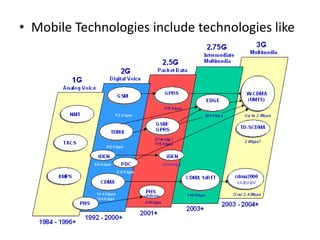
• Mobile Technologies include technologies like
GSM TECHNOLOGY
GSM stands for Global System for Mobile
Communications
Introduction
• 1982 -Conference of European Posts and Telegraphs (CEPT) formed Groupe
Special Mobile (GSM) to develop a public land mobile system.
• Later named as Global System for Mobile Communications..
 The proposed GSM system had to meet certain criteria. They are as
follows….
 Good speech quality
 Low terminal and service cost
 Support for international roaming
 Ability to support handheld terminals
 Support for range of new services and facilities
 Spectral efficiency
 ISDN ( Integrated Services Digital Network) Compatibility)
Architecture of the GSM
network:
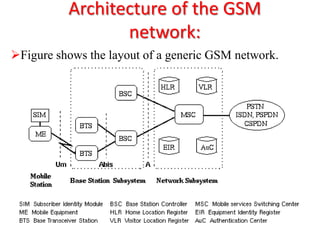
Figure shows the layout of a generic GSM network.
The GSM network can be divided into three broad parts.
The Mobile Station is carried by the subscriber.
The Base Station Subsystem controls the radio link with the Mobile
Station.
The Network Subsystem, the main part of which is the (Mobile
services Switching Center) MSC, performs the switching of calls between
the mobile users, and between mobile and fixed network users. The MSC
also handles the mobility management operations.
Techniques used in GSM
 In the GSM system, TDMA in combination with FDMA is used .Thus, only
a single mobile is using a given frequency/timeslot combination at any
particular time.
 Frequency D iv isio n M ult iple A ccess ( FD M A ) :
Each call is carried on a separate frequency channel. Provides multiuser
access by separating the used frequencies.
 Time Div isio n Multiple Access (TDMA):
Each frequency channel is further divided into a set of timeslots; each
timeslot carries the data of a voice call. Provides multiuser access by
chopping up the channel into sequential time slices.
Basic GSM Services:
1 . SMS . .
2 . Vo ice Mail. .
3 . A d v ice o f Ch arg e . .
4 . Ro amin g . .
5 . Call h o ld . .
6 . Call w aitin g . .
7 . Co n f er en ce call. .
Application of GSM
 Various GSM applications include GSM modems, GSM terminals, GPRS
amalgamation, GSM security, GSM remote monitoring.
 Application of GSM is dependent upon its frequency. Some countries in the
world use GSM-900 or E-GSM. The frequency in E-GSM is extended to
about 920 to 960MHZ.Latest mobile phones support E-GSM.GSM
technology allows you to use any mobile handset and everywhere. Once
you’re connected to the GSM technology you do not have to worry about
the network coverage and frequency.
Advantages of GSM
1. Less signal deterioration inside buildings.
2. Ability to use repeaters.
3. Talktime is generally higher in GSM phones due to the pulse nature of
transmission.
4. The availability of SIM allows users to switch networks and handsets at
will, aside from a subsidy lock.
5. GSM covers virtually all parts of the world so international roaming is not
a problem.
6. The much bigger number of subscribers globally creates a better network
effect for GSM handset makers, carriers and end users.
7. High transmission quality of audio and reliability for
wireless, uninterrupted phone calls at higher speeds (e.g. from cars, trains)
Disadvantages of GSM:
1) Interferes with some electronics, especially certain audio
amplifiers.
2) Intellectual property is concentrated among a few industry
participants, creating barriers to entry for new entrants and limiting
competition among phone manufacturers.
3) GSM has a fixed maximum cell site range of 120 km, which is
imposed by technical limitations.
4) High complexity of the system.
Conclusion:
 Gsm is a digital mobile telephone system that is widely used and uses a
combination of TDMA and FDMA technologies.
 GSM has provided us with international roaming and clarity of voice
due to its wide infrastructure..
CDMA stands for “Code Division
Multiple Access”.
Introduction
• CDMA is a military technology first used during World War II by English
allies to foil German attempts at jamming transmissions. The allies decided
to transmit over several frequencies, instead of one, making it difficult for
the Germans to pick up the complete signal.
• Because Qualcomm created communications chips for CDMA
technology, it was privy to the classified information. Once the information
became public, Qualcomm claimed patents on the technology and became
the first to commercialize it.
CDMA
• In data communication, the idea of allowing several transmitters to send
information simultaneously over a single communication channel. This
allows several users to share a band of frequencies (see bandwidth). This
concept is called multiple access.
• CDMA is a “spread spectrum” technology, which means that it spreads the
information contained in a particular signal of interest over a much greater
bandwidth than the original signal.
• The core principle of spread spectrum is the use of noise-like carrier
waves, and, as the name implies, bandwidths much wider than that required
for simple point-to-point communication at the same data rate.
Three Types of Spread Spectrum Communications
• There are three ways to spread the bandwidth of the
signal:
• Frequency hopping
• Time hopping
• Direct sequence.
• CDMA uses Direct Sequence Spread Spectrum system
and Frequency Hopping Spread Spectrum .
• CDMA system works directly on 64 kbit/sec digital
signals.
How it works?
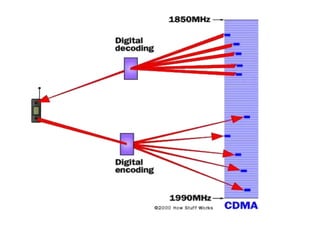
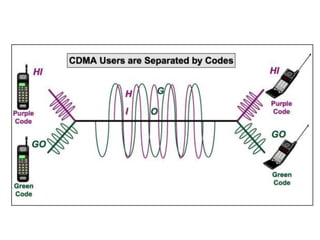
• In CDMA, both data and voice are separated from signals using codes and
then transmitted using a wide frequency range. Because of this, there are
more space left for data transfer.
• As a result, CDMA uses much wider signals than those used in other
technologies. Wideband signals reduce interference and allow one cell
frequency reuse. There is no time division, and all users use the entire
carrier, all of the time.
• CDMA does not assign a specific frequency to each user. Instead, every
channel uses the full available spectrum. Individual conversations are
encoded with a pseudo-random digital sequence.
• CDMA consistently provides better capacity for voice and data
communications than other commercial mobile technologies, allowing
more subscribers to connect at any given time
• CDMA changes the nature of the subscriber station from a analog device to
a digital device.
• CDMA receivers do not eliminate analog processing entirely, but they
separate communication channels by means of a modulation that is applied
and removed in the digital domain, not on the basis of frequency.
Benefits of CDMA
• CDMA CAPACITY INCREASES
• IMPROVED CALL QUALITY
• SIMPLIFIED SYSTEM PLANNING
• ENHANCED PRIVACY
• IMPROVED COVERAGE
• INCREASED PORTABLE TALKTIME
• BANDWIDTH ON DEMAND
Uses
• Excellent call quality and low current draw.
• Less costly to implement
• Provides three to five times the calling capacity than GSM and TDMA
• It provides more than 10 times the capacity of the analog cell phone system
(AMPS).
• Used by the military for secure phone calls.
• Difficult to jam and detect
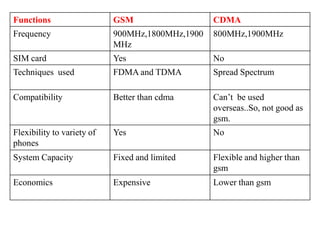
Functions GSM CDMA
Frequency 900MHz,1800MHz,1900
MHz
800MHz,1900MHz
SIM card Yes No
Techniques used FDMA and TDMA Spread Spectrum
Compatibility Better than cdma Can’t be used
overseas..So, not good as
gsm.
Flexibility to variety of
phones
Yes No
System Capacity Fixed and limited Flexible and higher than
gsm
Economics Expensive Lower than gsm
Conclusion:
• In GSM you use a wider variety of phones with your service, it also allows you
to take any GSM hardware and make it "your phone" instantly, including the
ability to carry your contacts right on the SIM card.
• CDMA consistently provides better capacity for voice and data communications
than other commercial mobile technologies, allowing more subscribers to
connect at any given time.GSM and CDMA are both frontier technologies
having some advantages and disadvantages. It depends upon the subscriber’s
choice which technology best suits their needs.
References:
 Mobile Computing Technology, Applications
and Service Creation – Asoke K Talukder,
Hasan Ahmed, Roopa R yavagal
www.google.com
www.wikipedia.com
www.scribd.com
Think much, speak
little, write less……

GSM & CDMA

  • 1.
    Mobile Computing GSM andCDMA Prepared by: Shalini Toluchuri(041)
  • 2.
     Mobile technologya generic term used to refer to a variety of devices that allow people to access data and information from where ever they are.  "Mobile Technology: being able to use a computing device even when being mobile and therefore changing location. Portability is one aspect of mobile technology.“ Mobile Technology
  • 3.
    • Mobile Technologiesinclude technologies like
  • 4.
    GSM TECHNOLOGY GSM standsfor Global System for Mobile Communications
  • 5.
    Introduction • 1982 -Conferenceof European Posts and Telegraphs (CEPT) formed Groupe Special Mobile (GSM) to develop a public land mobile system. • Later named as Global System for Mobile Communications..
  • 6.
     The proposedGSM system had to meet certain criteria. They are as follows….  Good speech quality  Low terminal and service cost  Support for international roaming  Ability to support handheld terminals  Support for range of new services and facilities  Spectral efficiency  ISDN ( Integrated Services Digital Network) Compatibility)
  • 7.
    Architecture of theGSM network: Figure shows the layout of a generic GSM network.
  • 8.
    The GSM networkcan be divided into three broad parts. The Mobile Station is carried by the subscriber. The Base Station Subsystem controls the radio link with the Mobile Station. The Network Subsystem, the main part of which is the (Mobile services Switching Center) MSC, performs the switching of calls between the mobile users, and between mobile and fixed network users. The MSC also handles the mobility management operations.
  • 9.
    Techniques used inGSM  In the GSM system, TDMA in combination with FDMA is used .Thus, only a single mobile is using a given frequency/timeslot combination at any particular time.  Frequency D iv isio n M ult iple A ccess ( FD M A ) : Each call is carried on a separate frequency channel. Provides multiuser access by separating the used frequencies.  Time Div isio n Multiple Access (TDMA): Each frequency channel is further divided into a set of timeslots; each timeslot carries the data of a voice call. Provides multiuser access by chopping up the channel into sequential time slices.
  • 10.
    Basic GSM Services: 1. SMS . . 2 . Vo ice Mail. . 3 . A d v ice o f Ch arg e . . 4 . Ro amin g . . 5 . Call h o ld . . 6 . Call w aitin g . . 7 . Co n f er en ce call. .
  • 11.
    Application of GSM Various GSM applications include GSM modems, GSM terminals, GPRS amalgamation, GSM security, GSM remote monitoring.  Application of GSM is dependent upon its frequency. Some countries in the world use GSM-900 or E-GSM. The frequency in E-GSM is extended to about 920 to 960MHZ.Latest mobile phones support E-GSM.GSM technology allows you to use any mobile handset and everywhere. Once you’re connected to the GSM technology you do not have to worry about the network coverage and frequency.
  • 12.
    Advantages of GSM 1.Less signal deterioration inside buildings. 2. Ability to use repeaters. 3. Talktime is generally higher in GSM phones due to the pulse nature of transmission. 4. The availability of SIM allows users to switch networks and handsets at will, aside from a subsidy lock. 5. GSM covers virtually all parts of the world so international roaming is not a problem. 6. The much bigger number of subscribers globally creates a better network effect for GSM handset makers, carriers and end users. 7. High transmission quality of audio and reliability for wireless, uninterrupted phone calls at higher speeds (e.g. from cars, trains)
  • 13.
    Disadvantages of GSM: 1)Interferes with some electronics, especially certain audio amplifiers. 2) Intellectual property is concentrated among a few industry participants, creating barriers to entry for new entrants and limiting competition among phone manufacturers. 3) GSM has a fixed maximum cell site range of 120 km, which is imposed by technical limitations. 4) High complexity of the system.
  • 14.
    Conclusion:  Gsm isa digital mobile telephone system that is widely used and uses a combination of TDMA and FDMA technologies.  GSM has provided us with international roaming and clarity of voice due to its wide infrastructure..
  • 15.
    CDMA stands for“Code Division Multiple Access”.
  • 16.
    Introduction • CDMA isa military technology first used during World War II by English allies to foil German attempts at jamming transmissions. The allies decided to transmit over several frequencies, instead of one, making it difficult for the Germans to pick up the complete signal. • Because Qualcomm created communications chips for CDMA technology, it was privy to the classified information. Once the information became public, Qualcomm claimed patents on the technology and became the first to commercialize it.
  • 17.
    CDMA • In datacommunication, the idea of allowing several transmitters to send information simultaneously over a single communication channel. This allows several users to share a band of frequencies (see bandwidth). This concept is called multiple access. • CDMA is a “spread spectrum” technology, which means that it spreads the information contained in a particular signal of interest over a much greater bandwidth than the original signal. • The core principle of spread spectrum is the use of noise-like carrier waves, and, as the name implies, bandwidths much wider than that required for simple point-to-point communication at the same data rate.
  • 18.
    Three Types ofSpread Spectrum Communications • There are three ways to spread the bandwidth of the signal: • Frequency hopping • Time hopping • Direct sequence. • CDMA uses Direct Sequence Spread Spectrum system and Frequency Hopping Spread Spectrum . • CDMA system works directly on 64 kbit/sec digital signals.
  • 19.
    How it works? •In CDMA, both data and voice are separated from signals using codes and then transmitted using a wide frequency range. Because of this, there are more space left for data transfer. • As a result, CDMA uses much wider signals than those used in other technologies. Wideband signals reduce interference and allow one cell frequency reuse. There is no time division, and all users use the entire carrier, all of the time.
  • 20.
    • CDMA doesnot assign a specific frequency to each user. Instead, every channel uses the full available spectrum. Individual conversations are encoded with a pseudo-random digital sequence. • CDMA consistently provides better capacity for voice and data communications than other commercial mobile technologies, allowing more subscribers to connect at any given time
  • 22.
    • CDMA changesthe nature of the subscriber station from a analog device to a digital device. • CDMA receivers do not eliminate analog processing entirely, but they separate communication channels by means of a modulation that is applied and removed in the digital domain, not on the basis of frequency.
  • 24.
    Benefits of CDMA •CDMA CAPACITY INCREASES • IMPROVED CALL QUALITY • SIMPLIFIED SYSTEM PLANNING • ENHANCED PRIVACY • IMPROVED COVERAGE • INCREASED PORTABLE TALKTIME • BANDWIDTH ON DEMAND
  • 25.
    Uses • Excellent callquality and low current draw. • Less costly to implement • Provides three to five times the calling capacity than GSM and TDMA • It provides more than 10 times the capacity of the analog cell phone system (AMPS). • Used by the military for secure phone calls. • Difficult to jam and detect
  • 27.
    Functions GSM CDMA Frequency900MHz,1800MHz,1900 MHz 800MHz,1900MHz SIM card Yes No Techniques used FDMA and TDMA Spread Spectrum Compatibility Better than cdma Can’t be used overseas..So, not good as gsm. Flexibility to variety of phones Yes No System Capacity Fixed and limited Flexible and higher than gsm Economics Expensive Lower than gsm
  • 28.
    Conclusion: • In GSMyou use a wider variety of phones with your service, it also allows you to take any GSM hardware and make it "your phone" instantly, including the ability to carry your contacts right on the SIM card. • CDMA consistently provides better capacity for voice and data communications than other commercial mobile technologies, allowing more subscribers to connect at any given time.GSM and CDMA are both frontier technologies having some advantages and disadvantages. It depends upon the subscriber’s choice which technology best suits their needs.
  • 29.
    References:  Mobile ComputingTechnology, Applications and Service Creation – Asoke K Talukder, Hasan Ahmed, Roopa R yavagal www.google.com www.wikipedia.com www.scribd.com
  • 30.
    Think much, speak little,write less……

Editor's Notes