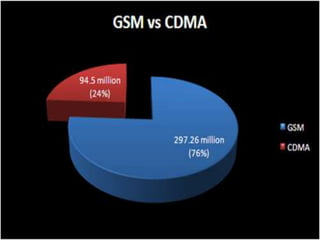
In cellular service there are two main competing network
technologies:

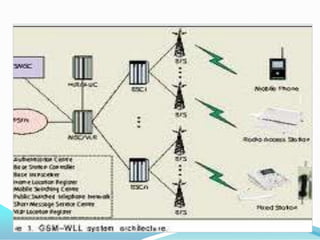
Global System for Mobile Communications (GSM) and
Code Division Multiple Access (CDMA).

Cellular carriers including Sprint PCS, Cingular Wireless,
Verizon and T-Mobile use one or the other.

Understanding the difference between GSM and CDMA will
allow you to choose a carrier that uses the preferable network
technology for your needs.
The GSM Association is an international organization
founded in 1987, dedicated to providing, developing, and
overseeing the worldwide wireless standard of GSM.

 CDMA, a proprietary standard designed by Qualcomm
in the United States, has been the dominant network
standard for North America and parts of Asia.

However, GSM networks continue to make inroads in
the United States, as CDMA networks make progress in
other parts of the world.
GSM: History
 Developed by Group Spéciale Mobile (founded 1982)
 which was an initiative of CEPT ( Conference of European
 Post and Telecommunication )
 Aim : to replace the incompatible analog system
 Presently the responsibility of GSM standardization resides
 with special mobile group under ETSI ( European
 telecommunication Standards Institute )
Full set of specifications phase-I became available in 1990
 Under ETSI, GSM is named as “ Global System for Mobile
 communication “.
CDMA: History
  In July 1985, seven industry veterans, decided they wanted to
   build “Quality Communications” and outlined a plan that has
   evolved into one of the telecommunications industry’s greatest
   start-up success stories: Qualcomm Incorporated.
  Introduction in 1988, OmniTRACS has grown into the largest
   satellite-based commercial mobile system for the transportation
   industry today.
  In 1989, the Telecommunications Industry Association (TIA)
   endorsed a digital technology called Time Division Multiple
   Access (TDMA ).
  Qualcomm introduced Code Division Multiple Access (CDMA),
   a superior technology for wireless and data products that
   changed the global face of wireless communications forever.
 Coverage:

The most important factor is getting service in the areas
you will be using your phone.

Upon viewing competitors' coverage maps you may
discover that only GSM or CDMA carriers offer cellular
service in your area.

If so, there is no decision to be made, but most people will
find that they do have a choice.
Data Transfer Speed:

With the advent of cellular phones doing double and triple
duty as streaming video devices, podcast receivers and email
devices, speed is important to those who use the phone for
more than making calls.
CDMA has been traditionally faster than GSM, though
both technologies continue to rapidly leapfrog along this
path.

Both boast "3G" standards, or 3rd generation
technologies.
What is 2G ?

   Second Generation (2G) wireless cellular mobile
   services was a step ahead of First Generation( 1G)
   services by providing the facility of short message
   service(SMS) unlike 1G that had its prime focus on
   verbal communication. A typical 2G G.S.M network
   service ranges from 800/900MHz or 1800/1900
   spectrum.
How is 2G different from 3G?

  In comparison to 2G customers will have to pay a
  relatively high license fee for 3G.

  The network construction and maintenance for 3G is
  much expensive than 2G.

  From the point of view of customers, expenditure will
  be excessively high if they make access to various
  facets of 3G.
How 3G Works

  3G technology is the modified form of second
   generation it is better to say that all the best features of
   different versions of 2nd generation are combined into
   third generation.
  Resultantly 3G Technology is known as Smartphone
   with high data transfer rate, WiFi hotspots
   connectivity and multimedia features.
  Three important technologies which make the 3G
   standard are CDMA 2000, WCDMA (UMTS), and TD-
   SCDMA.
Main 3G Services
   The point to be noted is that 3G gives clarity of voice as
    well can talk with out any disturbance.

   Not only these but also have entertainments such as
    Fast Communication, Internet, Mobile T.V, Video
    Conferencing, Video Calls, Multi Media Messaging
    Service (MMS), 3D gaming, Multi-Gaming etc are also
    available with 3G phones.
Main 4G Features

  Technology has come up with the latest of its type
   namely 4G
  Fourth Generation that is 4G in addition to that of the
   services of 3G some additional features such as Multi-
   Media Newspapers, also to watch T.V programs with
   the clarity as to that of an ordinary T.V. In addition, we
   can send Data much faster that that of the previous
   generations.
EVDO, also known as CDMA2000, is CDMA's answer
to the need for speed with a downstream rate of about 2
megabits per second, though some reports suggest real
world speeds are closer to 300-700 kilobits per second
(kbps).

This is comparable to basic DSL. As of fall
2005,EVDO is in the process of being deployed. It is not
available everywhere and requires a phone that is CDMA
2000 ready.

GSM's answer is EDGE (Enhanced Data Rates for
GSM Evolution), which boasts data rates of up to 384
kbps with real world speeds reported closer to 70-140
kbps.
With added technologies still in the works that
include UMTS (Universal Mobile Telephone Standard)
and HSDPA (High Speed Downlink Packet Access),
speeds reportedly increase to about 275—380 kbps.


This technology is also known as W-CDMA, but is
incompatible with CDMA networks.


An EDGE-ready phone is required.


In the case of EVDO, theoretical high traffic can
degrade speed and performance, while the EDGE
network is more susceptible to interference.
Subscriber Identity Module (SIM) cards:

 Only GSM phones use SIM cards.

 The removable SIM card allows phones to be instantly
 activated, interchanged, swapped out and upgraded, all
 without carrier intervention.

 The SIM itself is tied to the network, rather than the
 actual phone.

 Phones that are card-enabled can be used with any
 GSM carrier.
 Some CDMA2000 cell phones support R-UIM cards
  (Removable User Identity Module) which are used to store
  account information and contact lists.

 If you want to change your phone, you have to contact your
  carrier and have them reprogram your new phone.

 Also need to re-enter your contact list and calendar
  information into your new phone.

 CDMA phones are slowly catching up with R-UIM cards, but
 cell phones that make use of this technology as still rare.
Outline
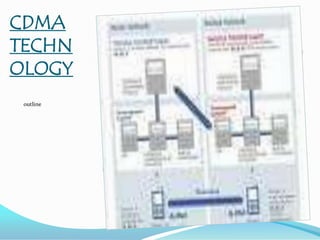
CDMA
TECHN
OLOGY
 outline
Roaming:

 For the most part, both networks have fairly concentrated
coverage in major cities and along major highways.

GSM carriers, however, have roaming contracts with other
GSM carriers, allowing wider coverage of more rural areas,
generally speaking, often without roaming charges to the
customer.

CDMA networks may not cover rural areas as well as
GSM carriers, and though they may contract with GSM
cells for roaming in more rural areas, the charge to the
customer will generally be significantly higher.
Which technology is the best ?
   If you travel a lot to foreign countries, you might want to opt for a
    GSM phone for a better coverage.

   If you intend to use the phone for mobile web browsing,
    watching television or downloading MP3s, you might be better
    off with a CDMA phone.

   If you do, a GSM phone is best for you since you can swap the
    SIM card to a new device without having to re-enter your
    personal data.
 Today, CDMA and its core principles provide the backbone for
  wireless communications.


 “Films have a certain place in a certain time period,
  but technology is forever.” - Hedy Lamarr
THANK YOU

Gsm&cdma

  • 2.
    In cellular servicethere are two main competing network technologies: Global System for Mobile Communications (GSM) and Code Division Multiple Access (CDMA). Cellular carriers including Sprint PCS, Cingular Wireless, Verizon and T-Mobile use one or the other. Understanding the difference between GSM and CDMA will allow you to choose a carrier that uses the preferable network technology for your needs.
  • 3.
    The GSM Associationis an international organization founded in 1987, dedicated to providing, developing, and overseeing the worldwide wireless standard of GSM.  CDMA, a proprietary standard designed by Qualcomm in the United States, has been the dominant network standard for North America and parts of Asia. However, GSM networks continue to make inroads in the United States, as CDMA networks make progress in other parts of the world.
  • 4.
    GSM: History  Developedby Group Spéciale Mobile (founded 1982) which was an initiative of CEPT ( Conference of European Post and Telecommunication )  Aim : to replace the incompatible analog system  Presently the responsibility of GSM standardization resides with special mobile group under ETSI ( European telecommunication Standards Institute ) Full set of specifications phase-I became available in 1990  Under ETSI, GSM is named as “ Global System for Mobile communication “.
  • 5.
    CDMA: History In July 1985, seven industry veterans, decided they wanted to build “Quality Communications” and outlined a plan that has evolved into one of the telecommunications industry’s greatest start-up success stories: Qualcomm Incorporated.  Introduction in 1988, OmniTRACS has grown into the largest satellite-based commercial mobile system for the transportation industry today.  In 1989, the Telecommunications Industry Association (TIA) endorsed a digital technology called Time Division Multiple Access (TDMA ).  Qualcomm introduced Code Division Multiple Access (CDMA), a superior technology for wireless and data products that changed the global face of wireless communications forever.
  • 6.
     Coverage: The mostimportant factor is getting service in the areas you will be using your phone. Upon viewing competitors' coverage maps you may discover that only GSM or CDMA carriers offer cellular service in your area. If so, there is no decision to be made, but most people will find that they do have a choice.
  • 7.
    Data Transfer Speed: Withthe advent of cellular phones doing double and triple duty as streaming video devices, podcast receivers and email devices, speed is important to those who use the phone for more than making calls. CDMA has been traditionally faster than GSM, though both technologies continue to rapidly leapfrog along this path. Both boast "3G" standards, or 3rd generation technologies.
  • 8.
    What is 2G?  Second Generation (2G) wireless cellular mobile services was a step ahead of First Generation( 1G) services by providing the facility of short message service(SMS) unlike 1G that had its prime focus on verbal communication. A typical 2G G.S.M network service ranges from 800/900MHz or 1800/1900 spectrum.
  • 9.
    How is 2Gdifferent from 3G?  In comparison to 2G customers will have to pay a relatively high license fee for 3G.  The network construction and maintenance for 3G is much expensive than 2G.  From the point of view of customers, expenditure will be excessively high if they make access to various facets of 3G.
  • 10.
    How 3G Works  3G technology is the modified form of second generation it is better to say that all the best features of different versions of 2nd generation are combined into third generation.  Resultantly 3G Technology is known as Smartphone with high data transfer rate, WiFi hotspots connectivity and multimedia features.  Three important technologies which make the 3G standard are CDMA 2000, WCDMA (UMTS), and TD- SCDMA.
  • 11.
    Main 3G Services  The point to be noted is that 3G gives clarity of voice as well can talk with out any disturbance.  Not only these but also have entertainments such as Fast Communication, Internet, Mobile T.V, Video Conferencing, Video Calls, Multi Media Messaging Service (MMS), 3D gaming, Multi-Gaming etc are also available with 3G phones.
  • 12.
    Main 4G Features  Technology has come up with the latest of its type namely 4G  Fourth Generation that is 4G in addition to that of the services of 3G some additional features such as Multi- Media Newspapers, also to watch T.V programs with the clarity as to that of an ordinary T.V. In addition, we can send Data much faster that that of the previous generations.
  • 13.
    EVDO, also knownas CDMA2000, is CDMA's answer to the need for speed with a downstream rate of about 2 megabits per second, though some reports suggest real world speeds are closer to 300-700 kilobits per second (kbps). This is comparable to basic DSL. As of fall 2005,EVDO is in the process of being deployed. It is not available everywhere and requires a phone that is CDMA 2000 ready. GSM's answer is EDGE (Enhanced Data Rates for GSM Evolution), which boasts data rates of up to 384 kbps with real world speeds reported closer to 70-140 kbps.
  • 14.
    With added technologiesstill in the works that include UMTS (Universal Mobile Telephone Standard) and HSDPA (High Speed Downlink Packet Access), speeds reportedly increase to about 275—380 kbps. This technology is also known as W-CDMA, but is incompatible with CDMA networks. An EDGE-ready phone is required. In the case of EVDO, theoretical high traffic can degrade speed and performance, while the EDGE network is more susceptible to interference.
  • 15.
    Subscriber Identity Module(SIM) cards: Only GSM phones use SIM cards. The removable SIM card allows phones to be instantly activated, interchanged, swapped out and upgraded, all without carrier intervention. The SIM itself is tied to the network, rather than the actual phone. Phones that are card-enabled can be used with any GSM carrier.
  • 16.
     Some CDMA2000cell phones support R-UIM cards (Removable User Identity Module) which are used to store account information and contact lists.  If you want to change your phone, you have to contact your carrier and have them reprogram your new phone.  Also need to re-enter your contact list and calendar information into your new phone.  CDMA phones are slowly catching up with R-UIM cards, but cell phones that make use of this technology as still rare.
  • 17.
  • 18.
  • 19.
    Roaming:  For themost part, both networks have fairly concentrated coverage in major cities and along major highways. GSM carriers, however, have roaming contracts with other GSM carriers, allowing wider coverage of more rural areas, generally speaking, often without roaming charges to the customer. CDMA networks may not cover rural areas as well as GSM carriers, and though they may contract with GSM cells for roaming in more rural areas, the charge to the customer will generally be significantly higher.
  • 20.
    Which technology isthe best ?  If you travel a lot to foreign countries, you might want to opt for a GSM phone for a better coverage.  If you intend to use the phone for mobile web browsing, watching television or downloading MP3s, you might be better off with a CDMA phone.  If you do, a GSM phone is best for you since you can swap the SIM card to a new device without having to re-enter your personal data.
  • 22.
     Today, CDMAand its core principles provide the backbone for wireless communications.  “Films have a certain place in a certain time period, but technology is forever.” - Hedy Lamarr
  • 23.