MULTIPLE ACCES
TECHNIQUES FOR
WIRELESS
COMMUNICATION
SAMMAR ZAHRA
International Islamic University, Islamabad
FDMA
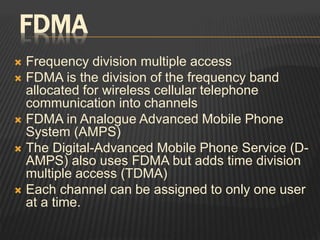
 Frequency division multiple access
 FDMA is the division of the frequency band
allocated for wireless cellular telephone
communication into channels
 FDMA in Analogue Advanced Mobile Phone
System (AMPS)
 The Digital-Advanced Mobile Phone Service (D-
AMPS) also uses FDMA but adds time division
multiple access (TDMA)
 Each channel can be assigned to only one user
at a time.
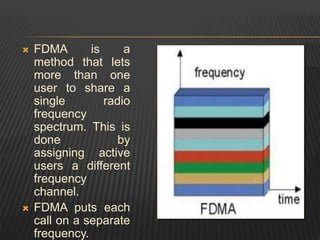
 FDMA is a
method that lets
more than one
user to share a
single radio
frequency
spectrum. This is
done by
assigning active
users a different
frequency
channel.
 FDMA puts each
call on a separate
frequency.
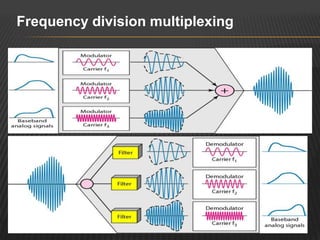
Frequency division multiplexing
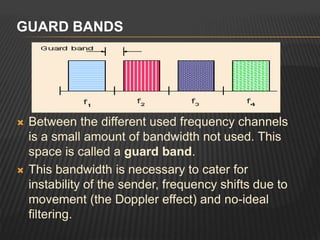
 Between the different used frequency channels
is a small amount of bandwidth not used. This
space is called a guard band.
 This bandwidth is necessary to cater for
instability of the sender, frequency shifts due to
movement (the Doppler effect) and no-ideal
filtering.
GUARD BANDS
MAIN FEATURES
 Continuous transmission
 Narrow bandwidth
 Low overhead
 Simple hardware at mobile unit and BS : (1) no digital
processing needed (2) ease of framing and synchronization.
 FDMA can be used with both analogue and digital signal.
 FDMA requires high-performing filters in the radio hardware,
in contrast to TDMA and CDMA.
 FDMA is not vulnerable to the timing problems that TDMA
has.
 Due to the frequency filtering, FDMA is not sensitive to near-
far problem.
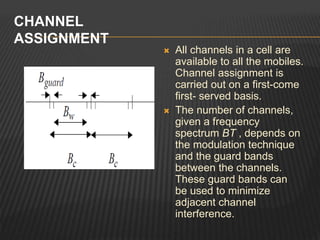
 All channels in a cell are
available to all the mobiles.
Channel assignment is
carried out on a first-come
first- served basis.
 The number of channels,
given a frequency
spectrum BT , depends on
the modulation technique
and the guard bands
between the channels.
These guard bands can
be used to minimize
adjacent channel
interference.
CHANNEL
ASSIGNMENT
 If channel is not in use, it sits idle
 Channel bandwidth is relatively narrow (30kHz)
 Simple algorithmically, and from a hardware standpoint
 Fairly efficient when the number of stations is small and
the traffic is uniformly constant
 Capacity increase can be obtained by reducing the
information bit rate and using efficient digital code
 No need for network timing
 No restriction regarding the type of baseband or type of
modulation
ADVANTAGE
S
DISADVANTAGES
 The presence of guard bands
 Requires right RF filtering to minimize adjacent
channel interference
 Maximum bit rate per channel is fixed
 Small inhibiting flexibility in bit rate capability
 Does not differ significantly from analog system
TDMA
 TDMA : Time Division Multiple Access.
 TDMA is digital transmission technology that allows a
number of users to access a single radio-frequency (RF)
channel without interference by allocating unique time
slots to each user within each channel.
 TDMA divides each cellular channel into three time slots
in order to increase the amount of data that can be
carried.
TDMA
 The reason for choosing
TDMA for all standards was that
it enables some vital features for
system operation in an
advanced cellular or PCS
environment.
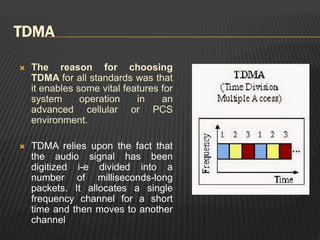
 TDMA relies upon the fact that
the audio signal has been
digitized i-e divided into a
number of milliseconds-long
packets. It allocates a single
frequency channel for a short
time and then moves to another
channel.
SYNCHRONIZATION IN TDMA
 “CLOCK” is required for TDMA.
 All transmitters and receivers must be aware of this ``clock'' to schedule
their transmissions and receptions and transmissions are synchronized.
 In cellular telephone systems a clock signal indicates the beginning of time-
slots is transmitted by the base stations. From this signals, mobile stations
can determine when their turn comes up.
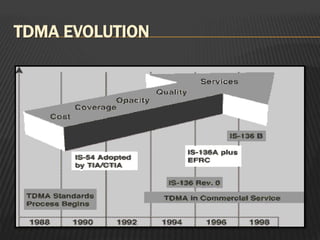
TDMA EVOLUTION
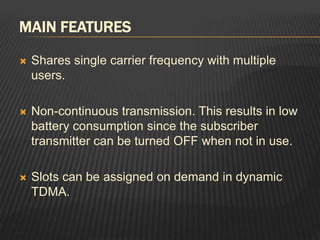
MAIN FEATURES
 Shares single carrier frequency with multiple
users.
 Non-continuous transmission. This results in low
battery consumption since the subscriber
transmitter can be turned OFF when not in use.
 Slots can be assigned on demand in dynamic
TDMA.
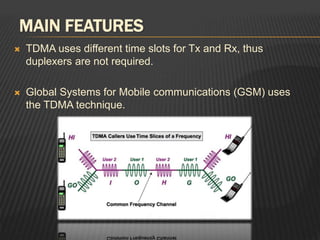
MAIN FEATURES
 TDMA uses different time slots for Tx and Rx, thus
duplexers are not required.
 Global Systems for Mobile communications (GSM) uses
the TDMA technique.
ADVANTAGES
1. It carry data rates of 64 kbps to 120 Mbps .
2. It provides the user with extended battery life and talk
time.
3. It is the most cost effective technology to convert an
analogue system to digital.
4. TDMA technology separates users according to time, it
ensures that there will be no interference
5. TDMA allows the operator to do services like fax, voice
band data, and SMS as well as bandwidth-intensive
application such as multimedia and videoconferencing.
DISADVANTAGES
1. Each user has a predefined
time slot.When moving from
one cell to other, if all the
time slots in this cell are full
the user might be
disconnected.
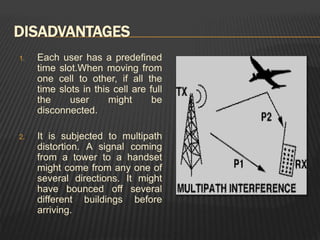
2. It is subjected to multipath
distortion. A signal coming
from a tower to a handset
might come from any one of
several directions. It might
have bounced off several
different buildings before
arriving.
CDMA
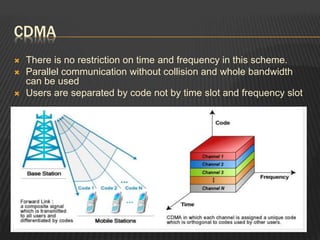
 There is no restriction on time and frequency in this scheme.
 Parallel communication without collision and whole bandwidth
can be used
 Users are separated by code not by time slot and frequency slot
CDMA ANALOGY
 10 people in a room.
 5 speak English, 2 speak Spanish, 2 speak
Chinese, and 1 speaks Russian.
 Everyone is talking at relatively the same
time over the same medium – the air.
 Who can listen to whom and why?
 Who can’t you understand?
 Who can’t speak to anyone else?
12.20
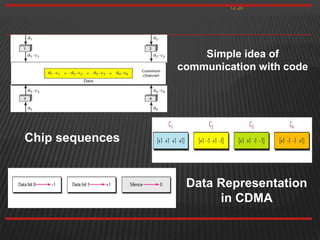
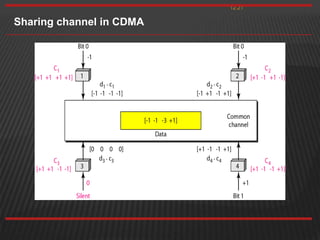
Simple idea of
communication with code
Chip sequences
Data Representation
in CDMA
12.21
Sharing channel in CDMA
12.22
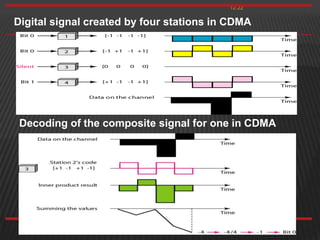
Digital signal created by four stations in CDMA
Decoding of the composite signal for one in CDMA
12.23
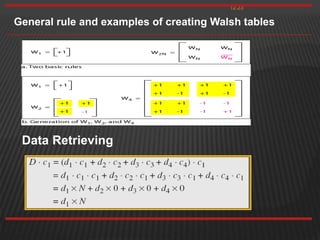
General rule and examples of creating Walsh tables
Data Retrieving
24
ADVANTAGES
 Potentially larger capacity (more users can communicate
simultaneously)
If users don’t use the medium all the time (e.g., they are just reading e-
mail), CDMA will allow much more users to communicate
simultaneously. In other words, CDMA will use the resource (the radio
spectrum) more efficiently.
Provides larger spread spectrum, thus more robust against noise bursts and
multipath frequency selective fading
 GSM bandwidth = 200 kHz
 IS-95 bandwidth = 1.25 MHz
 W-CDMA (3G) bandwidth = 10MHz
The transition from one BS to another (handoff) is not abrupt, as in TDMA, and
provides better quality
No absolute limit on the number of users
 Easy addition of more users
 Impossible for hackers to decipher the code sent
 Better signal quality
DISADVANTAGES
 As the number of users increases, the overall
quality of service decreases
 Self-jamming
 Near- Far- problem arises

Fdma tdma-cdma-151223125532

  • 1.
    MULTIPLE ACCES TECHNIQUES FOR WIRELESS COMMUNICATION SAMMARZAHRA International Islamic University, Islamabad
  • 2.
    FDMA  Frequency divisionmultiple access  FDMA is the division of the frequency band allocated for wireless cellular telephone communication into channels  FDMA in Analogue Advanced Mobile Phone System (AMPS)  The Digital-Advanced Mobile Phone Service (D- AMPS) also uses FDMA but adds time division multiple access (TDMA)  Each channel can be assigned to only one user at a time.
  • 3.
     FDMA isa method that lets more than one user to share a single radio frequency spectrum. This is done by assigning active users a different frequency channel.  FDMA puts each call on a separate frequency.
  • 4.
  • 5.
     Between thedifferent used frequency channels is a small amount of bandwidth not used. This space is called a guard band.  This bandwidth is necessary to cater for instability of the sender, frequency shifts due to movement (the Doppler effect) and no-ideal filtering. GUARD BANDS
  • 6.
    MAIN FEATURES  Continuoustransmission  Narrow bandwidth  Low overhead  Simple hardware at mobile unit and BS : (1) no digital processing needed (2) ease of framing and synchronization.  FDMA can be used with both analogue and digital signal.  FDMA requires high-performing filters in the radio hardware, in contrast to TDMA and CDMA.  FDMA is not vulnerable to the timing problems that TDMA has.  Due to the frequency filtering, FDMA is not sensitive to near- far problem.
  • 7.
     All channelsin a cell are available to all the mobiles. Channel assignment is carried out on a first-come first- served basis.  The number of channels, given a frequency spectrum BT , depends on the modulation technique and the guard bands between the channels. These guard bands can be used to minimize adjacent channel interference. CHANNEL ASSIGNMENT
  • 8.
     If channelis not in use, it sits idle  Channel bandwidth is relatively narrow (30kHz)  Simple algorithmically, and from a hardware standpoint  Fairly efficient when the number of stations is small and the traffic is uniformly constant  Capacity increase can be obtained by reducing the information bit rate and using efficient digital code  No need for network timing  No restriction regarding the type of baseband or type of modulation ADVANTAGE S
  • 9.
    DISADVANTAGES  The presenceof guard bands  Requires right RF filtering to minimize adjacent channel interference  Maximum bit rate per channel is fixed  Small inhibiting flexibility in bit rate capability  Does not differ significantly from analog system
  • 10.
    TDMA  TDMA :Time Division Multiple Access.  TDMA is digital transmission technology that allows a number of users to access a single radio-frequency (RF) channel without interference by allocating unique time slots to each user within each channel.  TDMA divides each cellular channel into three time slots in order to increase the amount of data that can be carried.
  • 11.
    TDMA  The reasonfor choosing TDMA for all standards was that it enables some vital features for system operation in an advanced cellular or PCS environment.  TDMA relies upon the fact that the audio signal has been digitized i-e divided into a number of milliseconds-long packets. It allocates a single frequency channel for a short time and then moves to another channel.
  • 12.
    SYNCHRONIZATION IN TDMA “CLOCK” is required for TDMA.  All transmitters and receivers must be aware of this ``clock'' to schedule their transmissions and receptions and transmissions are synchronized.  In cellular telephone systems a clock signal indicates the beginning of time- slots is transmitted by the base stations. From this signals, mobile stations can determine when their turn comes up.
  • 13.
  • 14.
    MAIN FEATURES  Sharessingle carrier frequency with multiple users.  Non-continuous transmission. This results in low battery consumption since the subscriber transmitter can be turned OFF when not in use.  Slots can be assigned on demand in dynamic TDMA.
  • 15.
    MAIN FEATURES  TDMAuses different time slots for Tx and Rx, thus duplexers are not required.  Global Systems for Mobile communications (GSM) uses the TDMA technique.
  • 16.
    ADVANTAGES 1. It carrydata rates of 64 kbps to 120 Mbps . 2. It provides the user with extended battery life and talk time. 3. It is the most cost effective technology to convert an analogue system to digital. 4. TDMA technology separates users according to time, it ensures that there will be no interference 5. TDMA allows the operator to do services like fax, voice band data, and SMS as well as bandwidth-intensive application such as multimedia and videoconferencing.
  • 17.
    DISADVANTAGES 1. Each userhas a predefined time slot.When moving from one cell to other, if all the time slots in this cell are full the user might be disconnected. 2. It is subjected to multipath distortion. A signal coming from a tower to a handset might come from any one of several directions. It might have bounced off several different buildings before arriving.
  • 18.
    CDMA  There isno restriction on time and frequency in this scheme.  Parallel communication without collision and whole bandwidth can be used  Users are separated by code not by time slot and frequency slot
  • 19.
    CDMA ANALOGY  10people in a room.  5 speak English, 2 speak Spanish, 2 speak Chinese, and 1 speaks Russian.  Everyone is talking at relatively the same time over the same medium – the air.  Who can listen to whom and why?  Who can’t you understand?  Who can’t speak to anyone else?
  • 20.
    12.20 Simple idea of communicationwith code Chip sequences Data Representation in CDMA
  • 21.
  • 22.
    12.22 Digital signal createdby four stations in CDMA Decoding of the composite signal for one in CDMA
  • 23.
    12.23 General rule andexamples of creating Walsh tables Data Retrieving
  • 24.
    24 ADVANTAGES  Potentially largercapacity (more users can communicate simultaneously) If users don’t use the medium all the time (e.g., they are just reading e- mail), CDMA will allow much more users to communicate simultaneously. In other words, CDMA will use the resource (the radio spectrum) more efficiently. Provides larger spread spectrum, thus more robust against noise bursts and multipath frequency selective fading  GSM bandwidth = 200 kHz  IS-95 bandwidth = 1.25 MHz  W-CDMA (3G) bandwidth = 10MHz The transition from one BS to another (handoff) is not abrupt, as in TDMA, and provides better quality No absolute limit on the number of users  Easy addition of more users  Impossible for hackers to decipher the code sent  Better signal quality
  • 25.
    DISADVANTAGES  As thenumber of users increases, the overall quality of service decreases  Self-jamming  Near- Far- problem arises