GSM vs CDMATECHNOLOGY
SHAFAQUE GHAYAS SATTAR
ECE11030
4th Year 7th Semester
Outline of the Presentation
• GSMTechnology
• Techniques used in GSM
• Features of GSM
• CDMATechnology
• Features of CDMA
• CDMA vs GSM
• Advantages of CDMA:
• Disadvantages of CDMA
• Advantages of GSM
• Disadvantages of GSM
• Reference
WHAT IS GSM?
• 1982 – European Telecommunications Standards Institute (ETSI) formed Grouped Special
Mobile(GSM) to develop a public land mobile system.
• Later named as Global System for Mobile Communications.
GSMTECHNOLOGY
Techniques used in GSM
In the GSM system, TDMA in combination with FDMA is used .Thus, only a
single mobile is using a given frequency/timeslot combination at any particular
time.
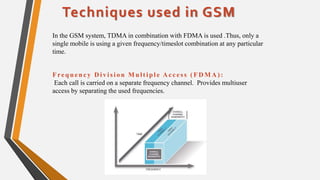
Frequency D iv isio n M ult iple A ccess ( FD M A ) :
Each call is carried on a separate frequency channel. Provides multiuser
access by separating the used frequencies.
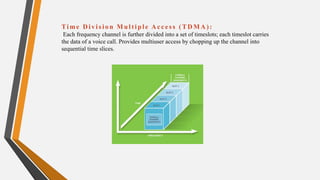
Time Div isio n Multiple Access (TDMA):
Each frequency channel is further divided into a set of timeslots; each timeslot carries
the data of a voice call. Provides multiuser access by chopping up the channel into
sequential time slices.
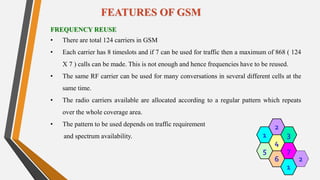
FREQUENCY REUSE
• There are total 124 carriers in GSM
• Each carrier has 8 timeslots and if 7 can be used for traffic then a maximum of 868 ( 124
X 7 ) calls can be made. This is not enough and hence frequencies have to be reused.
• The same RF carrier can be used for many conversations in several different cells at the
same time.
• The radio carriers available are allocated according to a regular pattern which repeats
over the whole coverage area.
• The pattern to be used depends on traffic requirement
and spectrum availability. 2
1
FEATURES OF GSM
6
4
3
7
2
5
1
2
1
CDMATechnology
What is CDMA Technology?
Code division multiple access (CDMA) is a channel access method used by various radio
communication technologies. CDMA is an example of multiple access, which is where
several transmitters can send information simultaneously over a single communication
channel
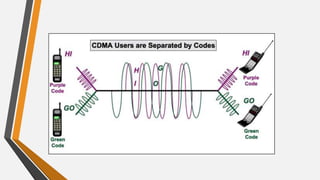
Multiple Access in CDMA:
• Each user is assigned a unique PN code.
• Each user transmits its information by spreading with unique code.
• Direct Sequence spread spectrum is used.
• Users are separated by code not by time slot and frequency slot.
FEATURES OF CDMA
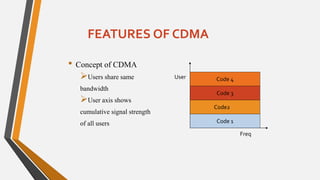
• Concept of CDMA
Users share same
bandwidth
User axis shows
cumulative signal strength
of all users Code 1
Code2
Code 3
Code 4
Freq
User
CDMA vs GSM
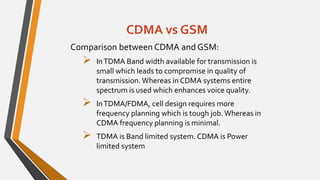
Comparison between CDMA and GSM:
 InTDMA Band width available for transmission is
small which leads to compromise in quality of
transmission. Whereas in CDMA systems entire
spectrum is used which enhances voice quality.
 InTDMA/FDMA, cell design requires more
frequency planning which is tough job.Whereas in
CDMA frequency planning is minimal.
 TDMA is Band limited system. CDMA is Power
limited system
Advantages of CDMA:
• Increased cellular communications security.
• Simultaneous conversations.
• Increased efficiency, meaning that the carrier can serve more subscribers.
• Low power requirements and little cell-to-cell coordination needed by operators.
• Extended reach - beneficial to rural users situated far from cells.
Disadvantages of CDMA
• Due to its proprietary nature, all of CDMA's flaws are not known to the engineering
community.
• CDMA is relatively not popular, and the network is not as mature as GSM.
• CDMA cannot offer international roaming, a large GSM advantage.
ADVANTAGES OF GSM
• Less signal deterioration inside buildings.
• Talk time is generally higher in GSM phones due to the pulse nature of transmission.
• The availability of SIM allows users to switch networks and handsets at will, aside from
a subsidy lock.
• GSM covers virtually all parts of the world so international roaming is not a problem.
• GSM is already used worldwide with over 450 million subscribers.The much bigger number
of subscribers globally creates a better network effect for GSM handset makers, carriers and
end users.
DISADVANTAGES OF GSM
• Released and Missed Calls
Conferring to Cellular Newscast, call superiority difficulties, with dropped calls and missed
calls are shared difficulties with GSM expertise.
• Safety Issues
ZDNet UK GSM has a grave safety flaw, established by a hacker who was capable to
interrupt telephone calls from an amount of GSM-based cellular headphones.
The GSM Association is an international organization
founded in 1987, dedicated to providing, developing, and
overseeing the worldwide wireless standard of GSM.
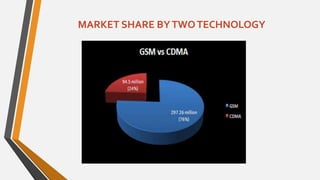
 CDMA, a proprietary standard designed by Qualcomm in
the United States, has been the dominant network standard
for North America and parts of Asia.
However, GSM networks continue to make inroads in
the United States, as CDMA networks make progress in
other parts of the world.
MARKET SHARE BYTWOTECHNOLOGY
Reference
• http://en.wikipedia.org/
• Mobile Computing Technology, Applications and Service
Creation – Asoke K Talukder, Hasan Ahmed, Roopa R
yavagal
• http://www.howstuffworks.com/
Thank you

GSM vs CDMA

  • 1.
    GSM vs CDMATECHNOLOGY SHAFAQUEGHAYAS SATTAR ECE11030 4th Year 7th Semester
  • 2.
    Outline of thePresentation • GSMTechnology • Techniques used in GSM • Features of GSM • CDMATechnology • Features of CDMA • CDMA vs GSM • Advantages of CDMA: • Disadvantages of CDMA • Advantages of GSM • Disadvantages of GSM • Reference
  • 3.
    WHAT IS GSM? •1982 – European Telecommunications Standards Institute (ETSI) formed Grouped Special Mobile(GSM) to develop a public land mobile system. • Later named as Global System for Mobile Communications. GSMTECHNOLOGY
  • 4.
    Techniques used inGSM In the GSM system, TDMA in combination with FDMA is used .Thus, only a single mobile is using a given frequency/timeslot combination at any particular time. Frequency D iv isio n M ult iple A ccess ( FD M A ) : Each call is carried on a separate frequency channel. Provides multiuser access by separating the used frequencies.
  • 5.
    Time Div ision Multiple Access (TDMA): Each frequency channel is further divided into a set of timeslots; each timeslot carries the data of a voice call. Provides multiuser access by chopping up the channel into sequential time slices.
  • 6.
    FREQUENCY REUSE • Thereare total 124 carriers in GSM • Each carrier has 8 timeslots and if 7 can be used for traffic then a maximum of 868 ( 124 X 7 ) calls can be made. This is not enough and hence frequencies have to be reused. • The same RF carrier can be used for many conversations in several different cells at the same time. • The radio carriers available are allocated according to a regular pattern which repeats over the whole coverage area. • The pattern to be used depends on traffic requirement and spectrum availability. 2 1 FEATURES OF GSM 6 4 3 7 2 5 1 2 1
  • 7.
    CDMATechnology What is CDMATechnology? Code division multiple access (CDMA) is a channel access method used by various radio communication technologies. CDMA is an example of multiple access, which is where several transmitters can send information simultaneously over a single communication channel Multiple Access in CDMA: • Each user is assigned a unique PN code. • Each user transmits its information by spreading with unique code. • Direct Sequence spread spectrum is used. • Users are separated by code not by time slot and frequency slot.
  • 8.
    FEATURES OF CDMA •Concept of CDMA Users share same bandwidth User axis shows cumulative signal strength of all users Code 1 Code2 Code 3 Code 4 Freq User
  • 10.
    CDMA vs GSM Comparisonbetween CDMA and GSM:  InTDMA Band width available for transmission is small which leads to compromise in quality of transmission. Whereas in CDMA systems entire spectrum is used which enhances voice quality.  InTDMA/FDMA, cell design requires more frequency planning which is tough job.Whereas in CDMA frequency planning is minimal.  TDMA is Band limited system. CDMA is Power limited system
  • 11.
    Advantages of CDMA: •Increased cellular communications security. • Simultaneous conversations. • Increased efficiency, meaning that the carrier can serve more subscribers. • Low power requirements and little cell-to-cell coordination needed by operators. • Extended reach - beneficial to rural users situated far from cells. Disadvantages of CDMA • Due to its proprietary nature, all of CDMA's flaws are not known to the engineering community. • CDMA is relatively not popular, and the network is not as mature as GSM. • CDMA cannot offer international roaming, a large GSM advantage.
  • 12.
    ADVANTAGES OF GSM •Less signal deterioration inside buildings. • Talk time is generally higher in GSM phones due to the pulse nature of transmission. • The availability of SIM allows users to switch networks and handsets at will, aside from a subsidy lock. • GSM covers virtually all parts of the world so international roaming is not a problem. • GSM is already used worldwide with over 450 million subscribers.The much bigger number of subscribers globally creates a better network effect for GSM handset makers, carriers and end users.
  • 13.
    DISADVANTAGES OF GSM •Released and Missed Calls Conferring to Cellular Newscast, call superiority difficulties, with dropped calls and missed calls are shared difficulties with GSM expertise. • Safety Issues ZDNet UK GSM has a grave safety flaw, established by a hacker who was capable to interrupt telephone calls from an amount of GSM-based cellular headphones.
  • 14.
    The GSM Associationis an international organization founded in 1987, dedicated to providing, developing, and overseeing the worldwide wireless standard of GSM.  CDMA, a proprietary standard designed by Qualcomm in the United States, has been the dominant network standard for North America and parts of Asia. However, GSM networks continue to make inroads in the United States, as CDMA networks make progress in other parts of the world.
  • 16.
  • 17.
    Reference • http://en.wikipedia.org/ • MobileComputing Technology, Applications and Service Creation – Asoke K Talukder, Hasan Ahmed, Roopa R yavagal • http://www.howstuffworks.com/
  • 18.