Turbo CodesTurbo Codes
SUBMITTED BY,SUBMITTED BY,
S. VASANTHA KUMARANS. VASANTHA KUMARAN
M.TECH [ECE] FIRST YEARM.TECH [ECE] FIRST YEAR
REG NO:REG NO:: 16304027: 16304027
AgendaAgenda
Objectives
Error Correction Codes
Turbo Codes Technology
Turbo decoding
Turbo Codes Performance
Application
Conclusion
ObjectivesObjectives
◦ Studying channel coding
◦ Understanding channel capacity
◦ Ways to increase data rate
◦ Provide reliable communication link
Error Correction CodingError Correction Coding
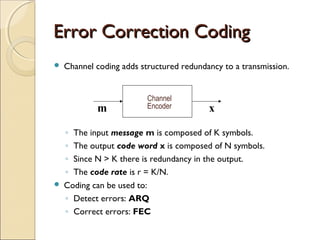
 Channel coding adds structured redundancy to a transmission.
◦ The input message m is composed of K symbols.
◦ The output code word x is composed of N symbols.
◦ Since N > K there is redundancy in the output.
◦ The code rate is r = K/N.
 Coding can be used to:
◦ Detect errors: ARQ
◦ Correct errors: FEC
Channel
Encoderm x
Error Correction CodesError Correction Codes
Block
Convolutional
Turbo code
◦ Technically a block code
◦ Works like both Block and Convolutional
codes
Block CodeBlock Code
Most common is Hamming Code
Take a block of length, k (information
sequence)
Then encode them into a codeword, the
last (n-k) bits are called parity bits
Parity bits used for error checking and
correcting
Convolutional CodesConvolutional Codes
Continuous or Streaming coding
Viterbi and Soft Output Viterbi are the
most common
Turbo CodesTurbo Codes
Mix between Convolutional and Block
codes
Require a Block code
HOWEVER, they use shift registers like
Convolutional Codes
Turbo Codes HistoryTurbo Codes History
IEEE International Comm conf 1993 in
Geneva
Berrou, Glavieux. : ‘Near Shannon Limit
Error-Correcting Coding : Turbo codes’
Provided virtually error free
communication at data date/power
efficiencies beyond most expert though
The Turbo-PrincipleThe Turbo-Principle
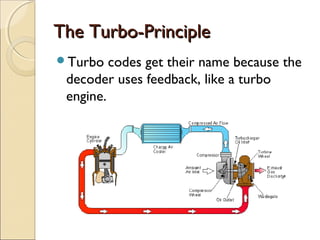
Turbo codes get their name because the
decoder uses feedback, like a turbo
engine.
Communication SystemCommunication System
Structural modular approach
Channel
Coding
Source
Coding
Modulation
Formatting
Digitization
Multiplexing
Access
techniques
send
receive
Channel CodingChannel Coding
Accounting for the channel
Can be categorized into
◦ Wave form signal design
 Better detectible signals.
◦ Structured sequences
 Added redundancy
Objective: provide coded signals with
better distance properties
Binary Symmetric ChannelBinary Symmetric Channel
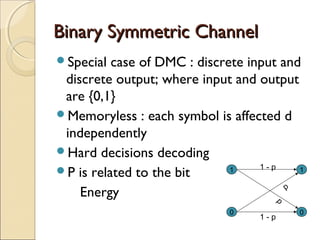
Special case of DMC : discrete input and
discrete output; where input and output
are {0,1}
Memoryless : each symbol is affected d
independently
Hard decisions decoding
P is related to the bit
Energy
1
00
11 - p
1 - p
p
p
Gaussian ChannelGaussian Channel
 descrete inputs with continuous property
Noise get added to the signals passing
through it
Noise is a Gaussian random variable with
zero mean and variance σ2
The resulting pdf is
2
2
2
)(
2
1
)|( σ
πσ
kuz
k euzp
−−
=
Likelihood of uk
Why use ECCWhy use ECC
Consider the following trade offs
◦ Error performance vs. bandwidth
 High redendency consumes bw
◦ Power vs. bandwidth
 Reduction in Eb/N0
◦ Data rate vs. bandwidth
 Higher rate
Error Correction MechanismsError Correction Mechanisms
Backward Error correction
◦ Error detection capability
◦ Communication cost
◦ Real time traffic
Forward Error Correction
◦ Detection and correction of errors
◦ More complex receivers
◦ DSP cost
Forward Error CorrectionForward Error Correction
Block Codes
◦ Data split into blocks
◦ Checks are within the block
Convolutional code
◦ Bit streamed data
◦ Involves memory
Turbo codes
◦ Uses conv. Codes
◦ Special properties
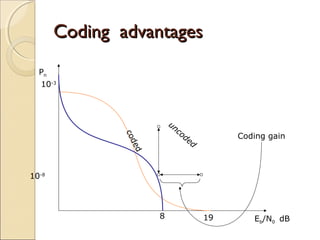
Coding advantagesCoding advantages
Pn
Eb/N0 dB
uncoded
coded
10-8
10-3
8 19
Coding gain
Coding disadvantagesCoding disadvantages
More bandwidth due to redundant
Processing Delay
Design Complexity
Turbo codesTurbo codes
Parallel concatenated
◦ The k-bit block is encoded N times with
different versions (order)
◦ Pro the sequence remains RTZ is 1/2Nv
◦ Randomness with 2 encoders; error pro of
10-5
◦ Permutations are to fix dmin
Turbo EncoderTurbo Encoder
Input
RSC
RSC
Interleaver
Systematic codeword
random
X
Y1
Y2
Turbo EncoderTurbo Encoder
The output stream of data consists of the
systematic data, parity bits from
encoder1, and parity bits from encoder2
Through the use of the interleaver, the
decoder will have two independent looks
at the same data, and can use both
streams to decode the information
sequence
Turbo DecodingTurbo Decoding
Criterion
◦ For n probabilistic processors working
together to estimate common symbols, all of
them should agree on the symbols with the
probabilities as a single decoder could do
Turbo DecodingTurbo Decoding
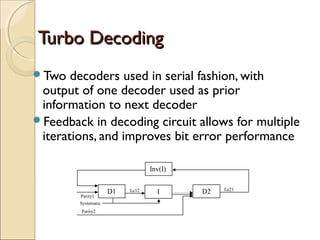
Two decoders used in serial fashion, with
output of one decoder used as prior
information to next decoder
Feedback in decoding circuit allows for multiple
iterations, and improves bit error performance
D1 D2I
Inv(I)
Parity2
Parity1
Le12 Le21
Systematic
Turbo DecoderTurbo Decoder
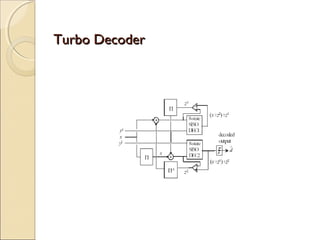
• The inputs to the decoders are the Log
likelihood ratio (LLR) for the individual symbol
d.
• LLR value for the symbol d is defined ( Berrou)
as
Steps in Turbo DecodingSteps in Turbo Decoding
Evaluate the path metrics
Trace back to obtain the decisions (x)
Trace back using alternate paths to obtain the
metric differences
Compute the minimum of all possible metric
differences for that stage
Obtain the reliability of decision
Pass this reliability of decision to next decoder
Iterate the above steps
Turbo Codes PerformanceTurbo Codes Performance
Turbo Codes ApplicationsTurbo Codes Applications
Deep space exploration
◦ France SMART-1 probe
JPL equipped Pathfinder 1997
Mobile 3G systems
◦ In use in Japan
◦ UMTS
◦ NTT DoCoMo
 Turbo codes : pictures/video/mail
 Convolutional codes : voice
ConclusionConclusion
Turbo codes achieved the theorical limits
with small gap
Give rise to new codes : Low Density
Parity Check (LDPC)
Needs
◦ Improvements in decoding delay
Turbo Codes

Turbo Codes

  • 1.
    Turbo CodesTurbo Codes SUBMITTEDBY,SUBMITTED BY, S. VASANTHA KUMARANS. VASANTHA KUMARAN M.TECH [ECE] FIRST YEARM.TECH [ECE] FIRST YEAR REG NO:REG NO:: 16304027: 16304027
  • 2.
    AgendaAgenda Objectives Error Correction Codes TurboCodes Technology Turbo decoding Turbo Codes Performance Application Conclusion
  • 3.
    ObjectivesObjectives ◦ Studying channelcoding ◦ Understanding channel capacity ◦ Ways to increase data rate ◦ Provide reliable communication link
  • 4.
    Error Correction CodingErrorCorrection Coding  Channel coding adds structured redundancy to a transmission. ◦ The input message m is composed of K symbols. ◦ The output code word x is composed of N symbols. ◦ Since N > K there is redundancy in the output. ◦ The code rate is r = K/N.  Coding can be used to: ◦ Detect errors: ARQ ◦ Correct errors: FEC Channel Encoderm x
  • 5.
    Error Correction CodesErrorCorrection Codes Block Convolutional Turbo code ◦ Technically a block code ◦ Works like both Block and Convolutional codes
  • 6.
    Block CodeBlock Code Mostcommon is Hamming Code Take a block of length, k (information sequence) Then encode them into a codeword, the last (n-k) bits are called parity bits Parity bits used for error checking and correcting
  • 7.
    Convolutional CodesConvolutional Codes Continuousor Streaming coding Viterbi and Soft Output Viterbi are the most common
  • 8.
    Turbo CodesTurbo Codes Mixbetween Convolutional and Block codes Require a Block code HOWEVER, they use shift registers like Convolutional Codes
  • 9.
    Turbo Codes HistoryTurboCodes History IEEE International Comm conf 1993 in Geneva Berrou, Glavieux. : ‘Near Shannon Limit Error-Correcting Coding : Turbo codes’ Provided virtually error free communication at data date/power efficiencies beyond most expert though
  • 10.
    The Turbo-PrincipleThe Turbo-Principle Turbocodes get their name because the decoder uses feedback, like a turbo engine.
  • 11.
    Communication SystemCommunication System Structuralmodular approach Channel Coding Source Coding Modulation Formatting Digitization Multiplexing Access techniques send receive
  • 12.
    Channel CodingChannel Coding Accountingfor the channel Can be categorized into ◦ Wave form signal design  Better detectible signals. ◦ Structured sequences  Added redundancy Objective: provide coded signals with better distance properties
  • 13.
    Binary Symmetric ChannelBinarySymmetric Channel Special case of DMC : discrete input and discrete output; where input and output are {0,1} Memoryless : each symbol is affected d independently Hard decisions decoding P is related to the bit Energy 1 00 11 - p 1 - p p p
  • 14.
    Gaussian ChannelGaussian Channel descrete inputs with continuous property Noise get added to the signals passing through it Noise is a Gaussian random variable with zero mean and variance σ2 The resulting pdf is 2 2 2 )( 2 1 )|( σ πσ kuz k euzp −− = Likelihood of uk
  • 15.
    Why use ECCWhyuse ECC Consider the following trade offs ◦ Error performance vs. bandwidth  High redendency consumes bw ◦ Power vs. bandwidth  Reduction in Eb/N0 ◦ Data rate vs. bandwidth  Higher rate
  • 16.
    Error Correction MechanismsErrorCorrection Mechanisms Backward Error correction ◦ Error detection capability ◦ Communication cost ◦ Real time traffic Forward Error Correction ◦ Detection and correction of errors ◦ More complex receivers ◦ DSP cost
  • 17.
    Forward Error CorrectionForwardError Correction Block Codes ◦ Data split into blocks ◦ Checks are within the block Convolutional code ◦ Bit streamed data ◦ Involves memory Turbo codes ◦ Uses conv. Codes ◦ Special properties
  • 18.
    Coding advantagesCoding advantages Pn Eb/N0dB uncoded coded 10-8 10-3 8 19 Coding gain
  • 19.
    Coding disadvantagesCoding disadvantages Morebandwidth due to redundant Processing Delay Design Complexity
  • 20.
    Turbo codesTurbo codes Parallelconcatenated ◦ The k-bit block is encoded N times with different versions (order) ◦ Pro the sequence remains RTZ is 1/2Nv ◦ Randomness with 2 encoders; error pro of 10-5 ◦ Permutations are to fix dmin
  • 21.
  • 22.
    Turbo EncoderTurbo Encoder Theoutput stream of data consists of the systematic data, parity bits from encoder1, and parity bits from encoder2 Through the use of the interleaver, the decoder will have two independent looks at the same data, and can use both streams to decode the information sequence
  • 23.
    Turbo DecodingTurbo Decoding Criterion ◦For n probabilistic processors working together to estimate common symbols, all of them should agree on the symbols with the probabilities as a single decoder could do
  • 24.
    Turbo DecodingTurbo Decoding Twodecoders used in serial fashion, with output of one decoder used as prior information to next decoder Feedback in decoding circuit allows for multiple iterations, and improves bit error performance D1 D2I Inv(I) Parity2 Parity1 Le12 Le21 Systematic
  • 25.
  • 26.
    Turbo DecoderTurbo Decoder •The inputs to the decoders are the Log likelihood ratio (LLR) for the individual symbol d. • LLR value for the symbol d is defined ( Berrou) as
  • 27.
    Steps in TurboDecodingSteps in Turbo Decoding Evaluate the path metrics Trace back to obtain the decisions (x) Trace back using alternate paths to obtain the metric differences Compute the minimum of all possible metric differences for that stage Obtain the reliability of decision Pass this reliability of decision to next decoder Iterate the above steps
  • 28.
  • 29.
    Turbo Codes ApplicationsTurboCodes Applications Deep space exploration ◦ France SMART-1 probe JPL equipped Pathfinder 1997 Mobile 3G systems ◦ In use in Japan ◦ UMTS ◦ NTT DoCoMo  Turbo codes : pictures/video/mail  Convolutional codes : voice
  • 30.
    ConclusionConclusion Turbo codes achievedthe theorical limits with small gap Give rise to new codes : Low Density Parity Check (LDPC) Needs ◦ Improvements in decoding delay