Compare with
GSM,TDMA & CDMA
Outline
 GSM
 TDMA
 CDMA
 Compare
What is GSM?
Definition: GSM stands for Global System for Mobile
Communication and is an open, digital cellular technology used for
transmitting mobile voice and data services.
Characteristics:
 Fully digital system using 900,1800 MHz frequency band.
 TDMA over radio carriers(200 KHz carrier spacing).
 User/terminal authentication for fraud control.
 Encryption of speech and data transmission over the radio path.
 Full international roaming capability.
 Compatibility with ISDN.
 Support of Short Message Service (SMS).
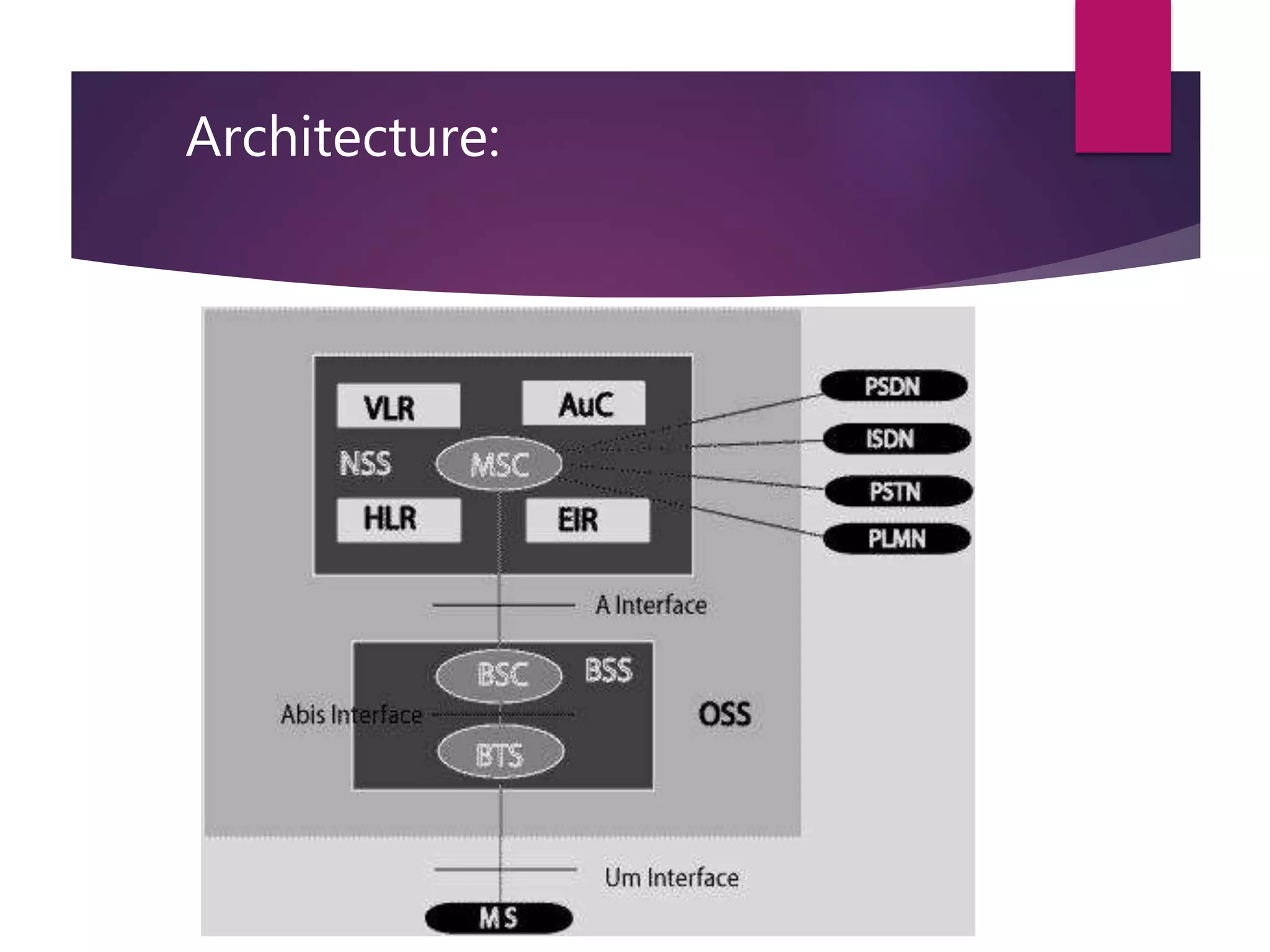
Architecture:
What is TDMA?
Time division multiple access
is a channel access method
which allows several users to
share the same frequency
channel by dividing the signal
into different time slots .
TDMA is used in the digital 2G
cellular systems such as GSM ,
Personal Digital Cellular (PDC)
and in the Digital Enhanced
Cordless Telecommunications
(DECT) standard for portable
phones.
Characteristics of TDMA
 Shares single carrier frequency with multiple users
 Non-continuous transmission makes handoff simpler
 Slots can be assigned on demand in dynamic TDMA
 Less stringent power control than CDMA due to reduced intra cell
interference
 Higher synchronization overhead than CDMA
 Advanced equalization may be necessary for high data rates if the
channel is "frequency selective" and creates Inter symbol
interference
 Cell breathing (borrowing resources from adjacent cells) is more
complicated than in CDMA
 Frequency/slot allocation complexity
 Pulsating power envelop: Interference with other devices
What is CDMA?
Definition:
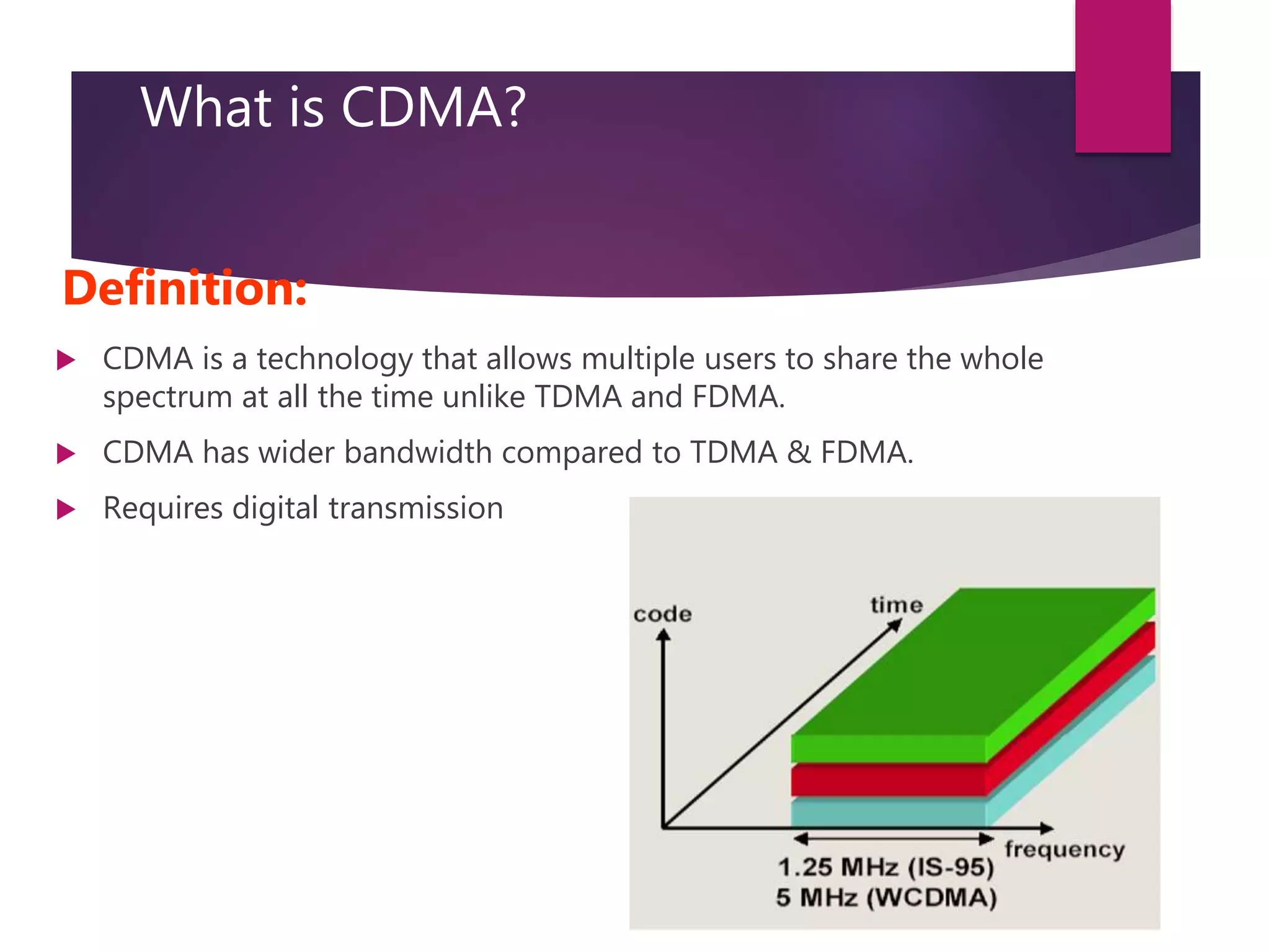
 CDMA is a technology that allows multiple users to share the whole
spectrum at all the time unlike TDMA and FDMA.
 CDMA has wider bandwidth compared to TDMA & FDMA.
 Requires digital transmission
CDMA: basic principles
 In CDMA each user is assigned a unique code sequence (spreading
 code), which it uses to encode its data signal.
 The receiver, knowing the code sequence of the user, decodes the
 received signal and recovers the original data.
 The bandwidth of the coded data signal is chosen to be much largerthan the
bandwidth of the original data signal, that is, the encoding
 process enlarges (spreads) the spectrum of the data signal.
CDMA is based on spread-spectrum modulation.
 If multiple users transmit a spread-spectrum signal at the same time,the
receiver will still be able to distinguish between users, provided that each
user has a unique code that has a sufficiently low crosscorrelation with the
other codes.
Compare Between CDMA,TDMA and GSM

Compare Between CDMA,TDMA and GSM

  • 1.
  • 2.
  • 3.
    What is GSM? Definition:GSM stands for Global System for Mobile Communication and is an open, digital cellular technology used for transmitting mobile voice and data services. Characteristics:  Fully digital system using 900,1800 MHz frequency band.  TDMA over radio carriers(200 KHz carrier spacing).  User/terminal authentication for fraud control.  Encryption of speech and data transmission over the radio path.  Full international roaming capability.  Compatibility with ISDN.  Support of Short Message Service (SMS).
  • 4.
  • 5.
    What is TDMA? Timedivision multiple access is a channel access method which allows several users to share the same frequency channel by dividing the signal into different time slots . TDMA is used in the digital 2G cellular systems such as GSM , Personal Digital Cellular (PDC) and in the Digital Enhanced Cordless Telecommunications (DECT) standard for portable phones.
  • 6.
    Characteristics of TDMA Shares single carrier frequency with multiple users  Non-continuous transmission makes handoff simpler  Slots can be assigned on demand in dynamic TDMA  Less stringent power control than CDMA due to reduced intra cell interference  Higher synchronization overhead than CDMA  Advanced equalization may be necessary for high data rates if the channel is "frequency selective" and creates Inter symbol interference  Cell breathing (borrowing resources from adjacent cells) is more complicated than in CDMA  Frequency/slot allocation complexity  Pulsating power envelop: Interference with other devices
  • 7.
    What is CDMA? Definition: CDMA is a technology that allows multiple users to share the whole spectrum at all the time unlike TDMA and FDMA.  CDMA has wider bandwidth compared to TDMA & FDMA.  Requires digital transmission
  • 8.
    CDMA: basic principles In CDMA each user is assigned a unique code sequence (spreading  code), which it uses to encode its data signal.  The receiver, knowing the code sequence of the user, decodes the  received signal and recovers the original data.  The bandwidth of the coded data signal is chosen to be much largerthan the bandwidth of the original data signal, that is, the encoding  process enlarges (spreads) the spectrum of the data signal. CDMA is based on spread-spectrum modulation.  If multiple users transmit a spread-spectrum signal at the same time,the receiver will still be able to distinguish between users, provided that each user has a unique code that has a sufficiently low crosscorrelation with the other codes.