Downloaded 817 times





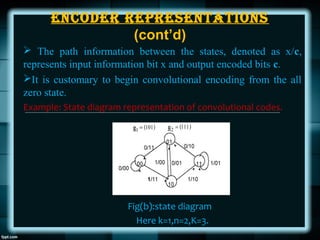
![ For example, the two generator vectors for the encoder in
Fig(a) are g1 = [111] and g2 = [101], where the subscripts 1 and 2
denote the corresponding output terminals.
II. State Diagram Representation
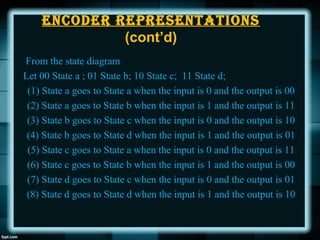
In the state diagram, the state information of the encoder
is shown in the circles. Each new input information bit causes
a transition from one state to another.
Contents of the rightmost (K-1) shift register stages define
the states of the encoder. The transition of an encoder from
one state to another, as caused by input bits, is depicted in the
state diagram.
enCoder rePreSentationS
(cont’d)](https://image.slidesharecdn.com/adcassignment-151101050734-lva1-app6892/85/Convolutional-Codes-And-Their-Decoding-13-320.jpg)






The document provides an in-depth overview of convolutional codes and their decoding processes, including representations like generator, state, tree, and trellis diagrams. It elaborates on convolutional encoders, their functionality through shift registers, and the parameters that define them, as well as two primary decoding methods: Fano algorithm for sequential decoding and Viterbi algorithm for maximum likelihood decoding. The advantages of convolutional codes in error correction for digital communication are also discussed, alongside practical applications in various cellular standards and NASA's use.


