Principles of Doppler ultrasound
Samir Haffar M.D.
Department of Internal Medicine
 General principles
 Spectral-specific parameters
 Color-specific parameters
 Power Doppler imaging
 Normal flow in arteries
 Normal flow in veins
Principles of Doppler ultrasound
 General principles of Doppler ultrasound
Christian Doppler (1803 – 1853)
Famous for what is called now the “Doppler effect”
1841 Professor of mathematics & physics
Prague polytechnic
1842 Published his famous book
“On the colored light of the binary stars
& some other stars of the heavens”
1850 Head of institute of experimental physics
Vienna University
Austrian physicist
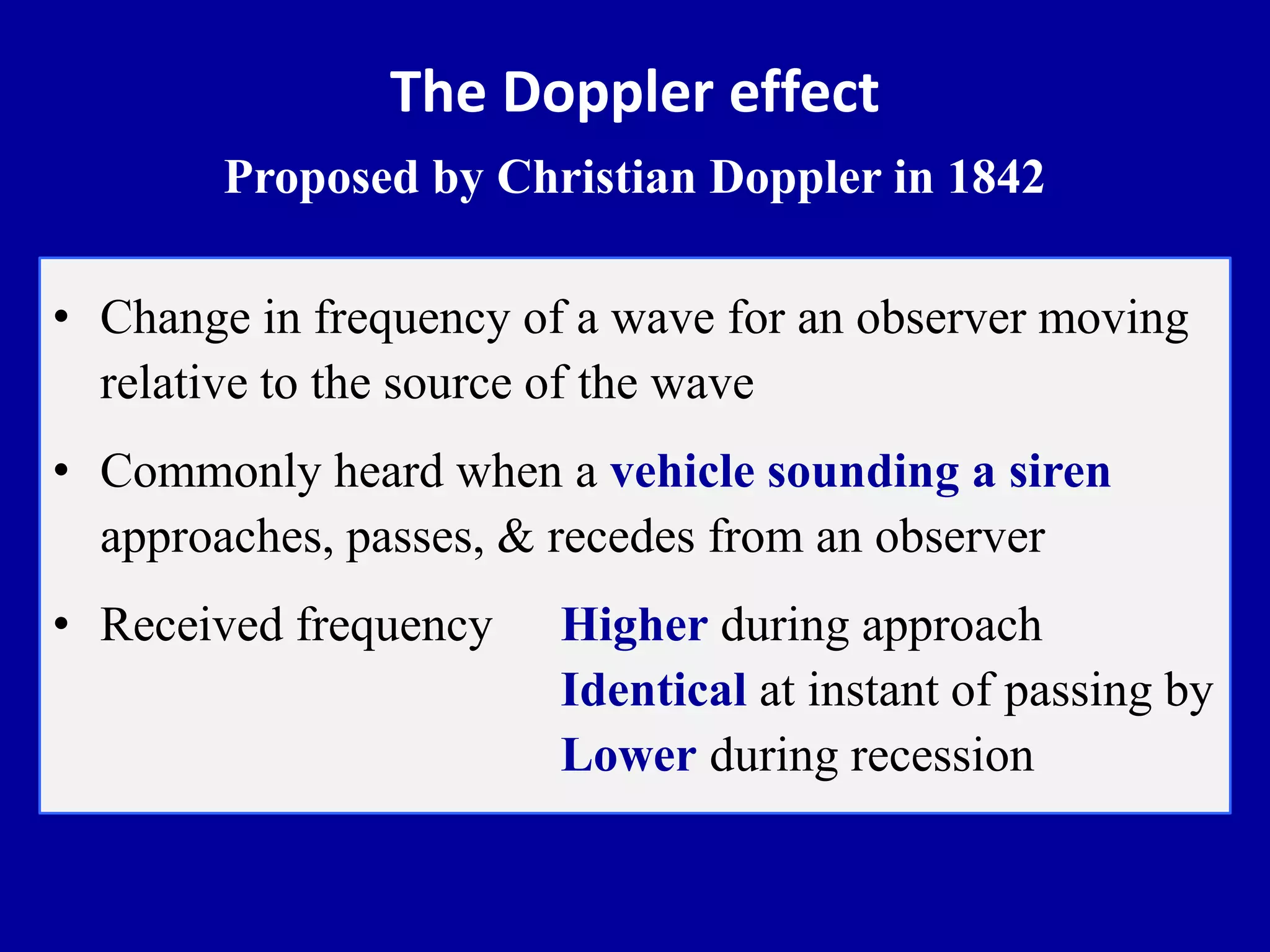
The Doppler effect
Proposed by Christian Doppler in 1842
• Change in frequency of a wave for an observer moving
relative to the source of the wave
• Commonly heard when a vehicle sounding a siren
approaches, passes, & recedes from an observer
• Received frequency Higher during approach
Identical at instant of passing by
Lower during recession
What is the Doppler phenomenon?
Thrush A, Hartshorne T. Peripheral vascular ultrasound: how, why and when.
Elsevier Churchill Livingstone, London, 2nd edition, 2005.
= ft
> ft
= ft
< ft
What is the Doppler phenomenon?
Doppler shift frequency (fd): ft – fr
Thrush A, Hartshorne T. Peripheral vascular ultrasound: How, why and when.
Elsevier Churchill Livingstone, London, 2nd edition, 2005.
ft
fr
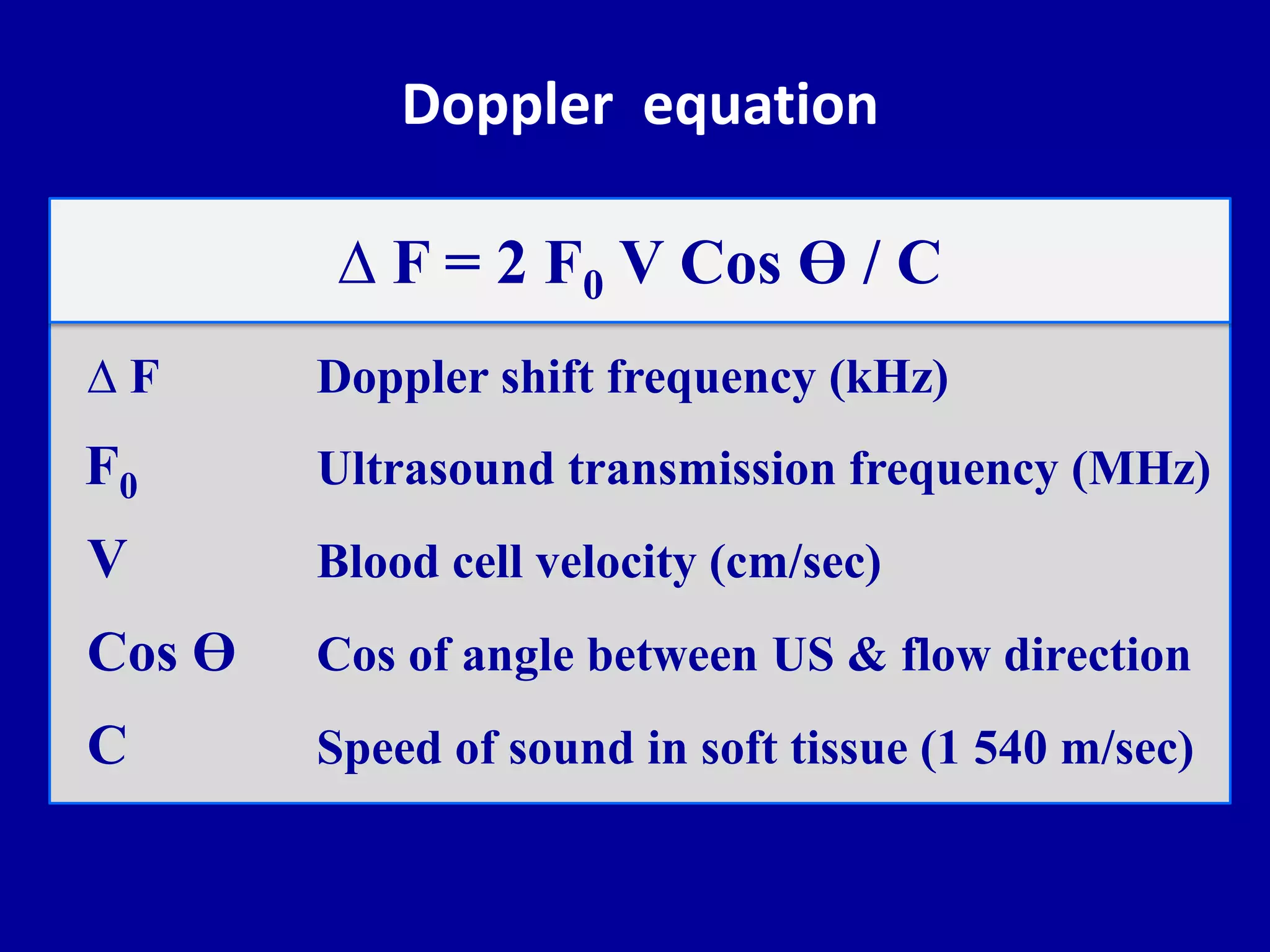
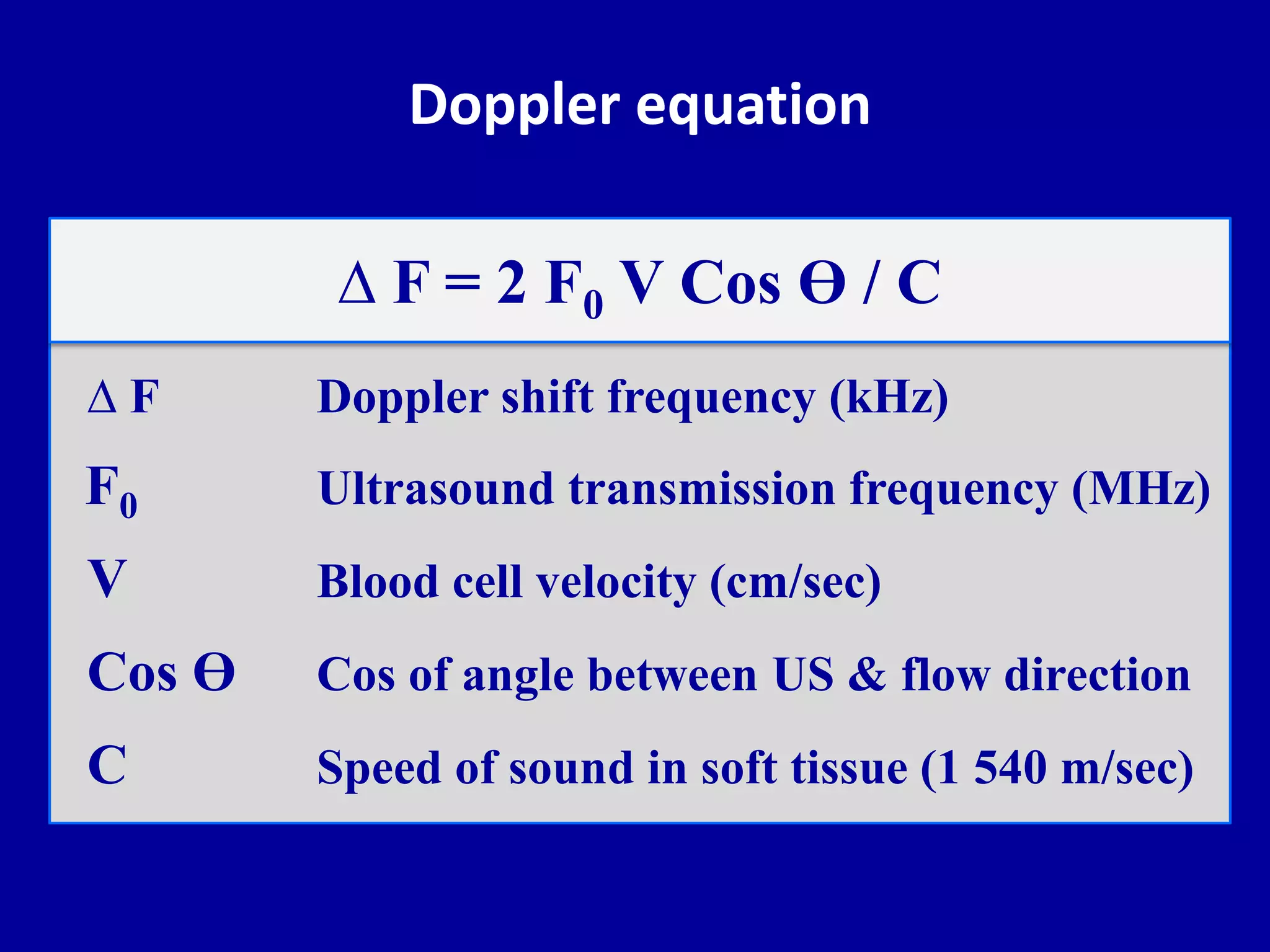
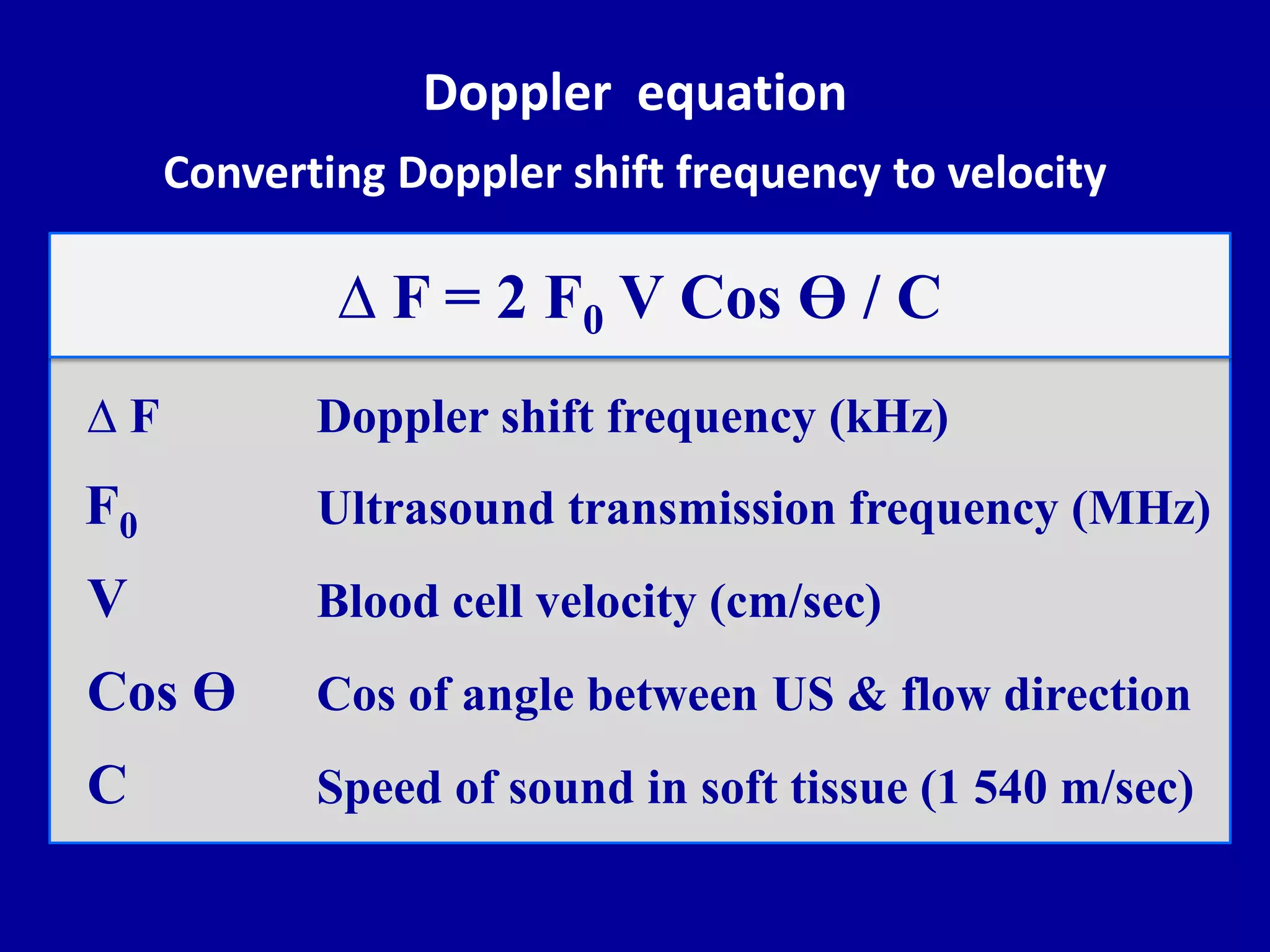
Doppler equation
∆ F Doppler shift frequency (kHz)
F0 Ultrasound transmission frequency (MHz)
V Blood cell velocity (cm/sec)
Cos Ө Cos of angle between US & flow direction
C Speed of sound in soft tissue (1 540 m/sec)
∆ F = 2 F0 V Cos Ө / C
Goals of Doppler
• Detection flow in a vessel
• Detection direction of flow
• Detection type of flow: Arterial or venous
Normal or abnormal
• Measurement the velocity of flow
Types of Doppler
 Continuous wave Doppler
 Spectral Doppler (duplex)
 Spectral & color Doppler (triplex)
 Power Doppler
All Doppler ultrasound examinations should
be performed with:
Tahmasebpour HR et al. RadioGraphics 2005 ; 25 : 1561 – 1575.
• Gray-scale US
• Color Doppler
• Spectral Doppler
• Power Doppler
 Spectral-specific parameters
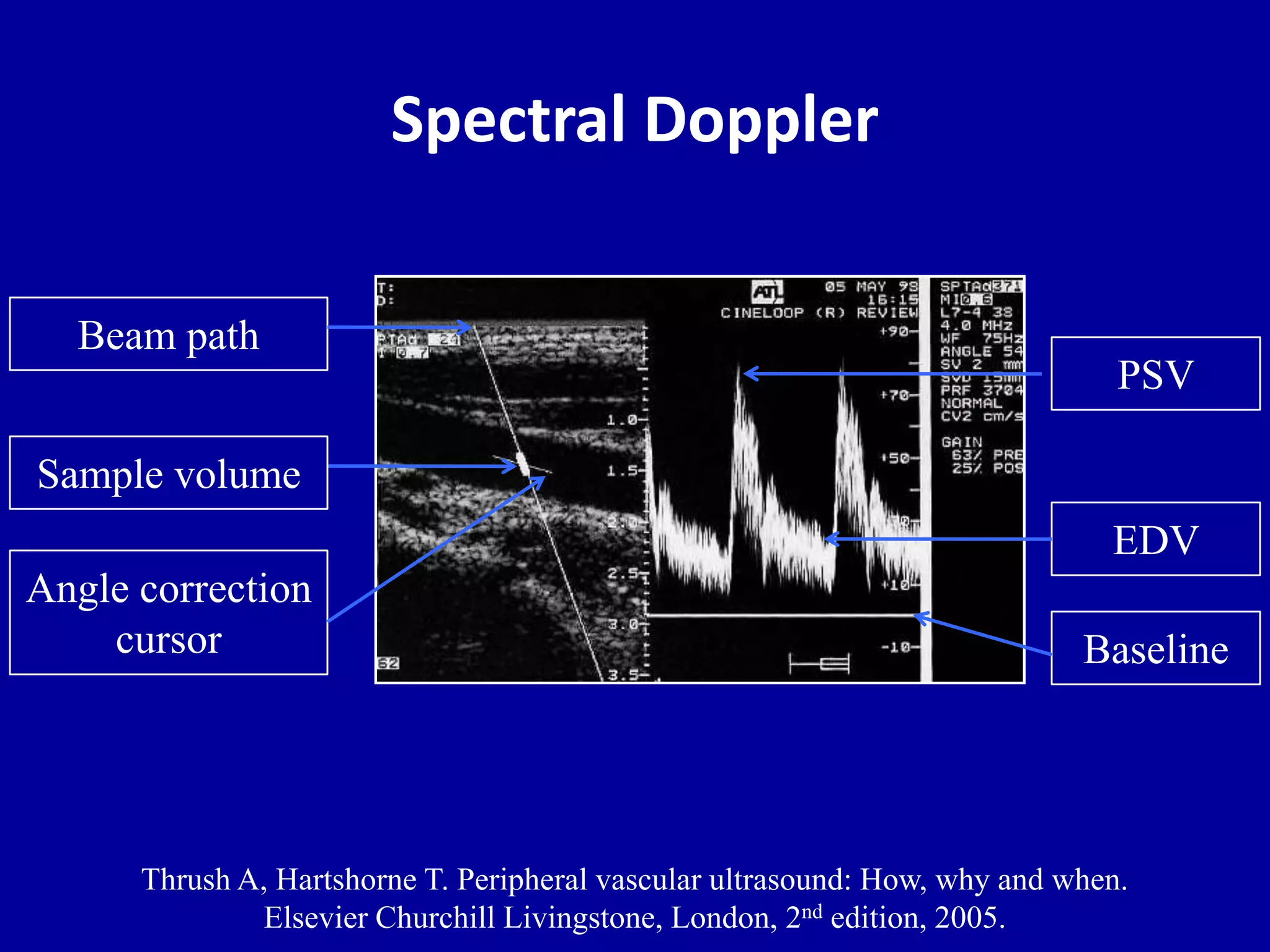
Spectral Doppler
Angle correction
cursor
Beam path
Sample volume
Baseline
EDV
Thrush A, Hartshorne T. Peripheral vascular ultrasound: How, why and when.
Elsevier Churchill Livingstone, London, 2nd edition, 2005.
PSV
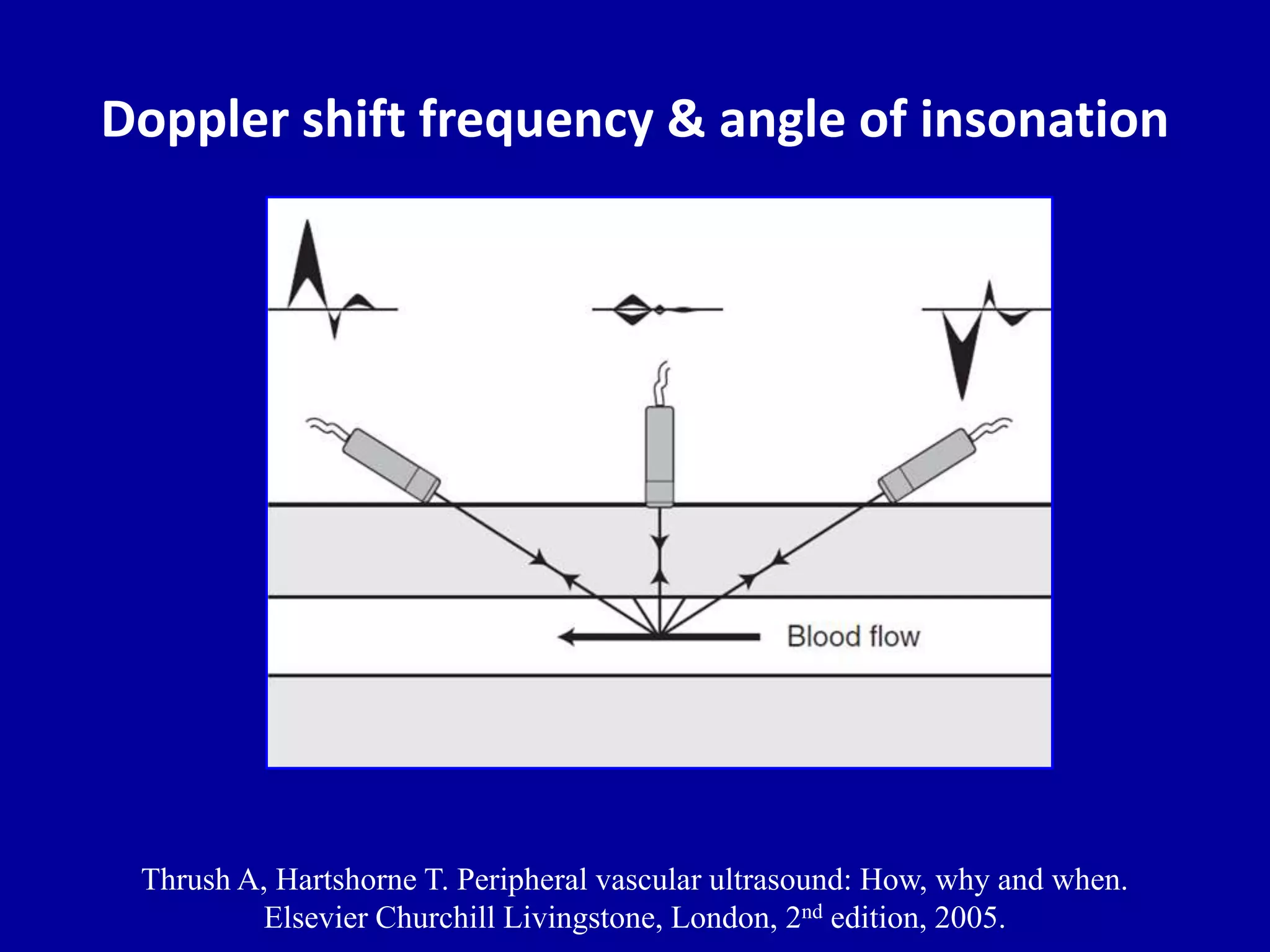
Doppler shift frequency & angle of insonation
Thrush A, Hartshorne T. Peripheral vascular ultrasound: How, why and when.
Elsevier Churchill Livingstone, London, 2nd edition, 2005.
Use of spectral baseline
Normal baseline
Inverted baseline
Dropping baseline
Sample volume length
Large sample volume lengthSmall sample volume length
Thrush A, Hartshorne T. Peripheral vascular ultrasound: How, why and when.
Elsevier Churchill Livingstone, London, 2nd edition, 2005.
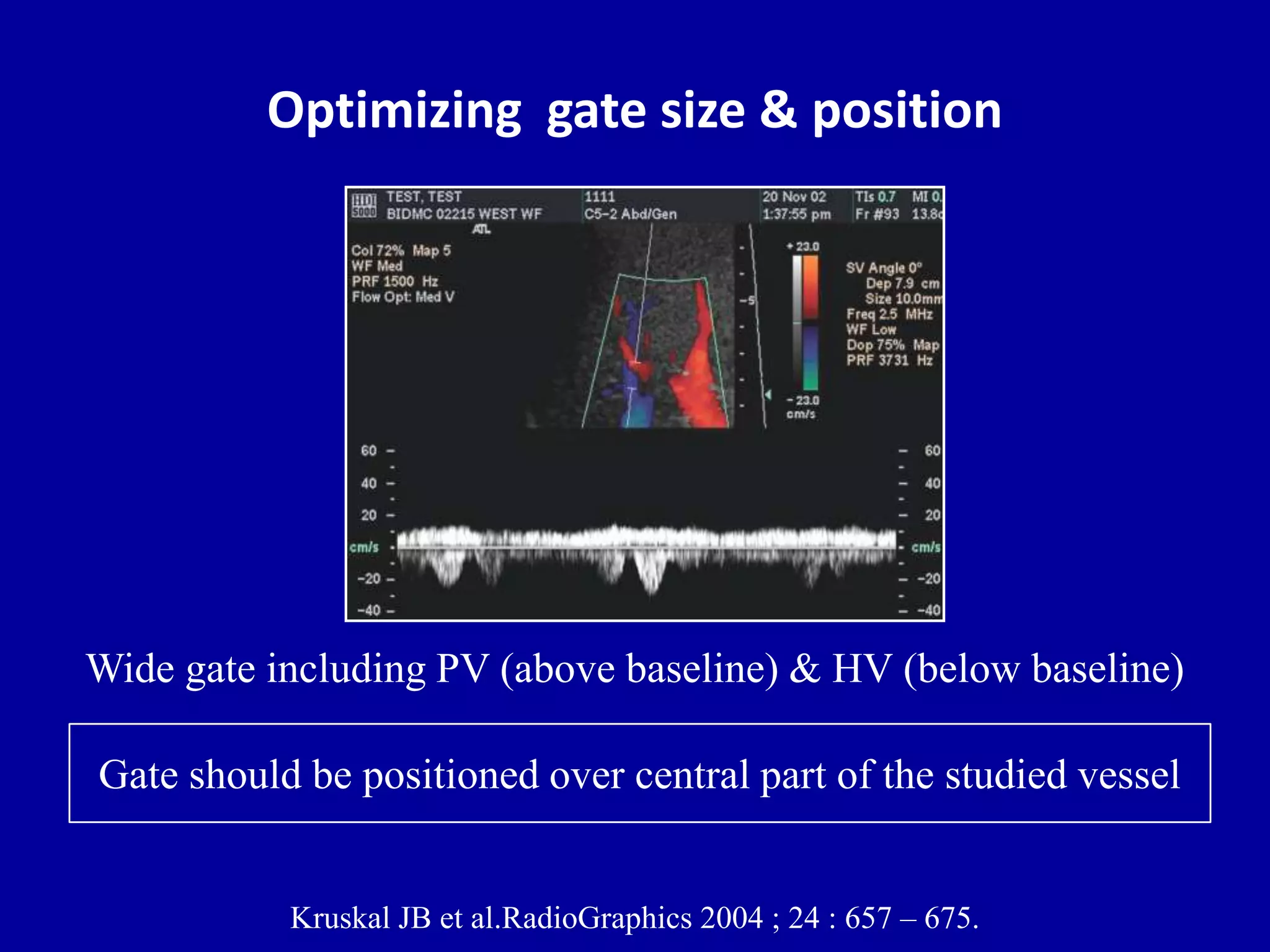
Optimizing gate size & position
Kruskal JB et al.RadioGraphics 2004 ; 24 : 657 – 675.
Wide gate including PV (above baseline) & HV (below baseline)
Gate should be positioned over central part of the studied vessel
Doppler equation
∆ F Doppler shift frequency (kHz)
F0 Ultrasound transmission frequency (MHz)
V Blood cell velocity (cm/sec)
Cos Ө Cos of angle between US & flow direction
C Speed of sound in soft tissue (1 540 m/sec)
∆ F = 2 F0 V Cos Ө / C
Percentage error in velocity measurements
& angle of insonation
In order to minimize this error,
angles of insonation > 60% should not be used
Optimizing Doppler angle
Larger the angle, greater the error
• Ideally should be zero Usually not possible
• Smallest angle possible Not under our control
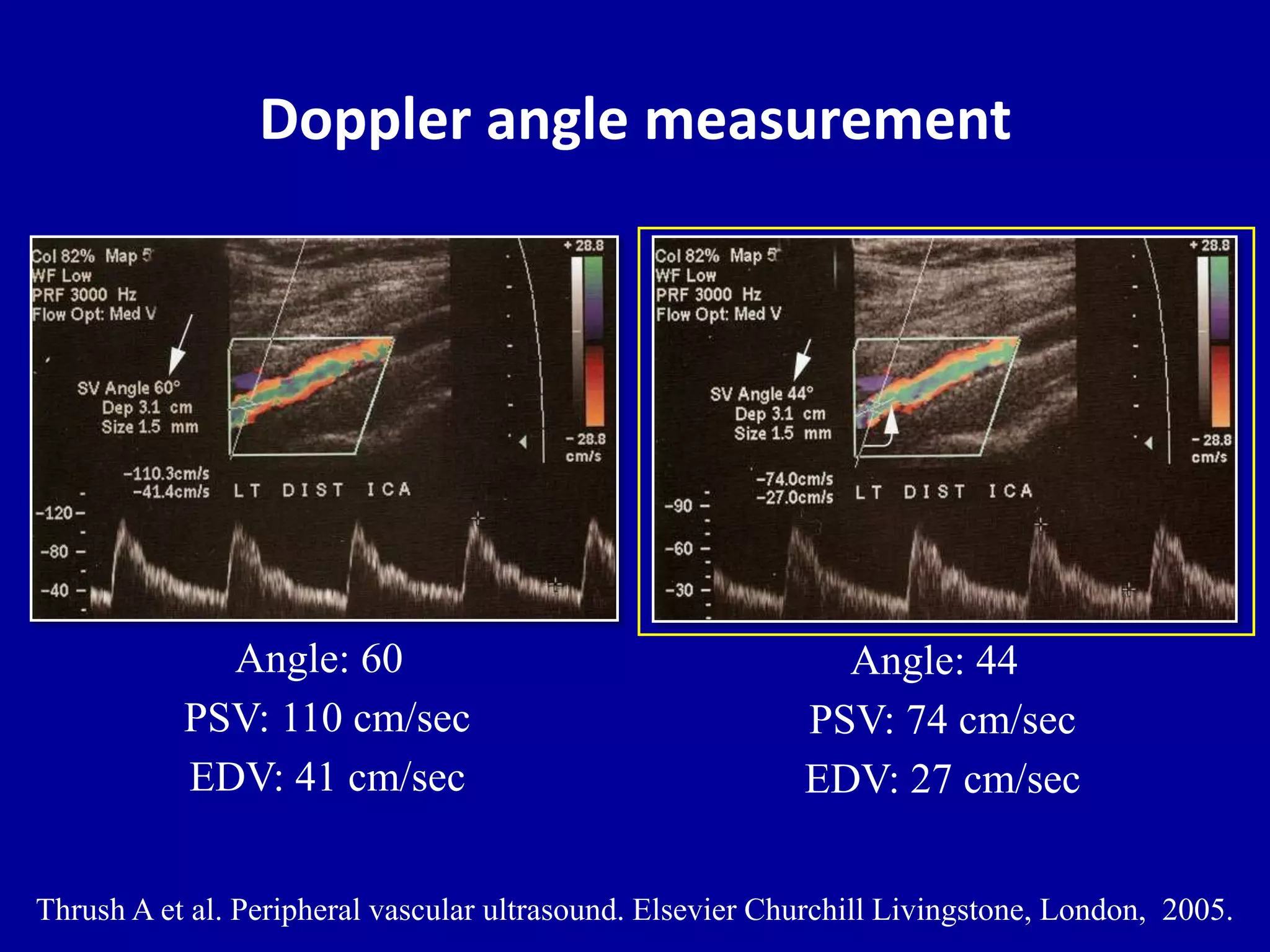
• Do not use angle > 60 Great error in velocity
• Angle 90 Complete loss of flow
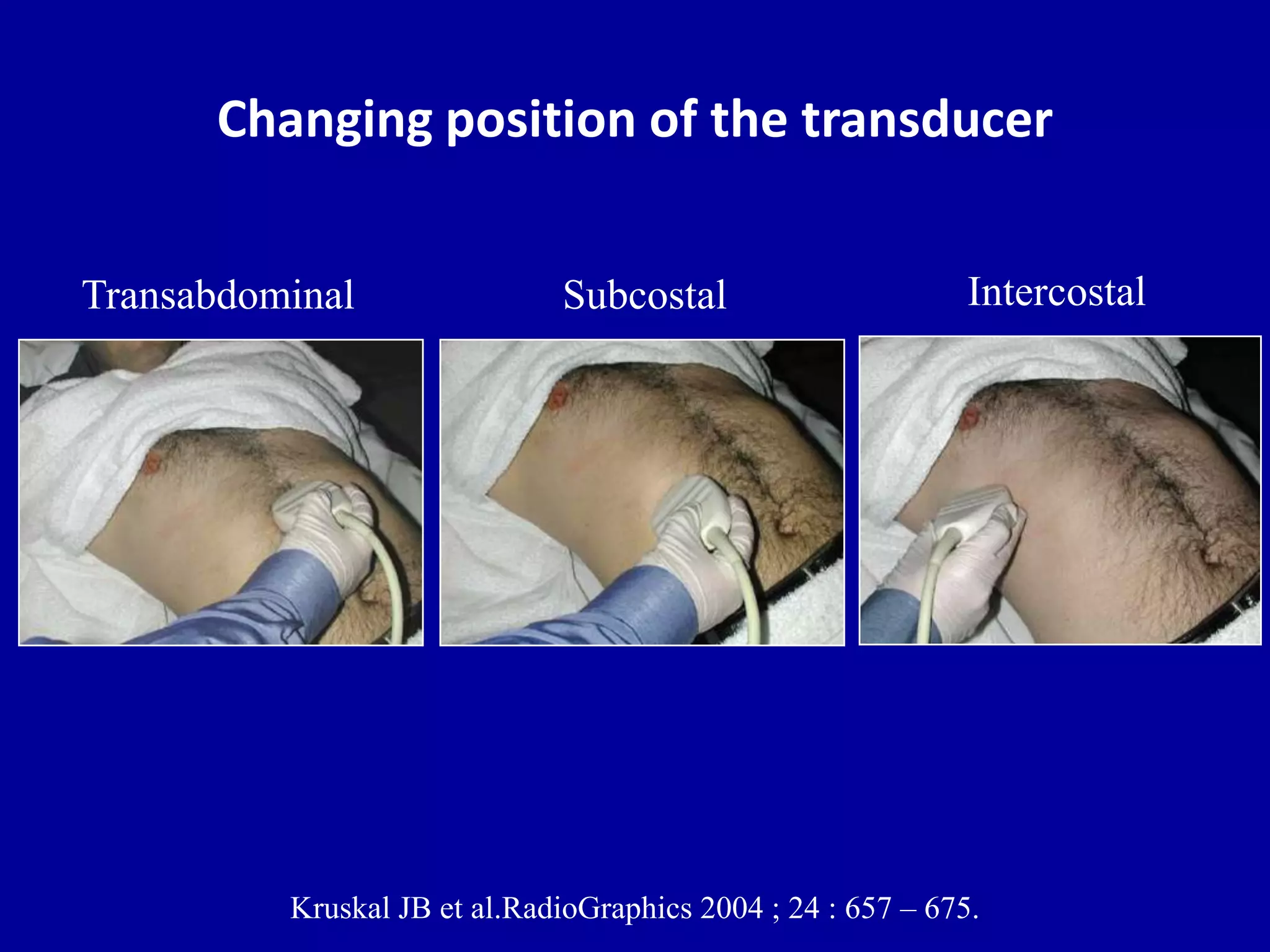
• Transducer position Obtain smaller angle
• Different US systems May be different results
Thrush A, Hartshorne T. Peripheral vascular ultrasound: How, why and when.
Elsevier Churchill Livingstone, London, 2nd edition, 2005.
Doppler angle measurement
Angle: 60
PSV: 110 cm/sec
EDV: 41 cm/sec
Angle: 44
PSV: 74 cm/sec
EDV: 27 cm/sec
Thrush A et al. Peripheral vascular ultrasound. Elsevier Churchill Livingstone, London, 2005.
Changing position of the transducer
IntercostalTransabdominal Subcostal
Kruskal JB et al.RadioGraphics 2004 ; 24 : 657 – 675.
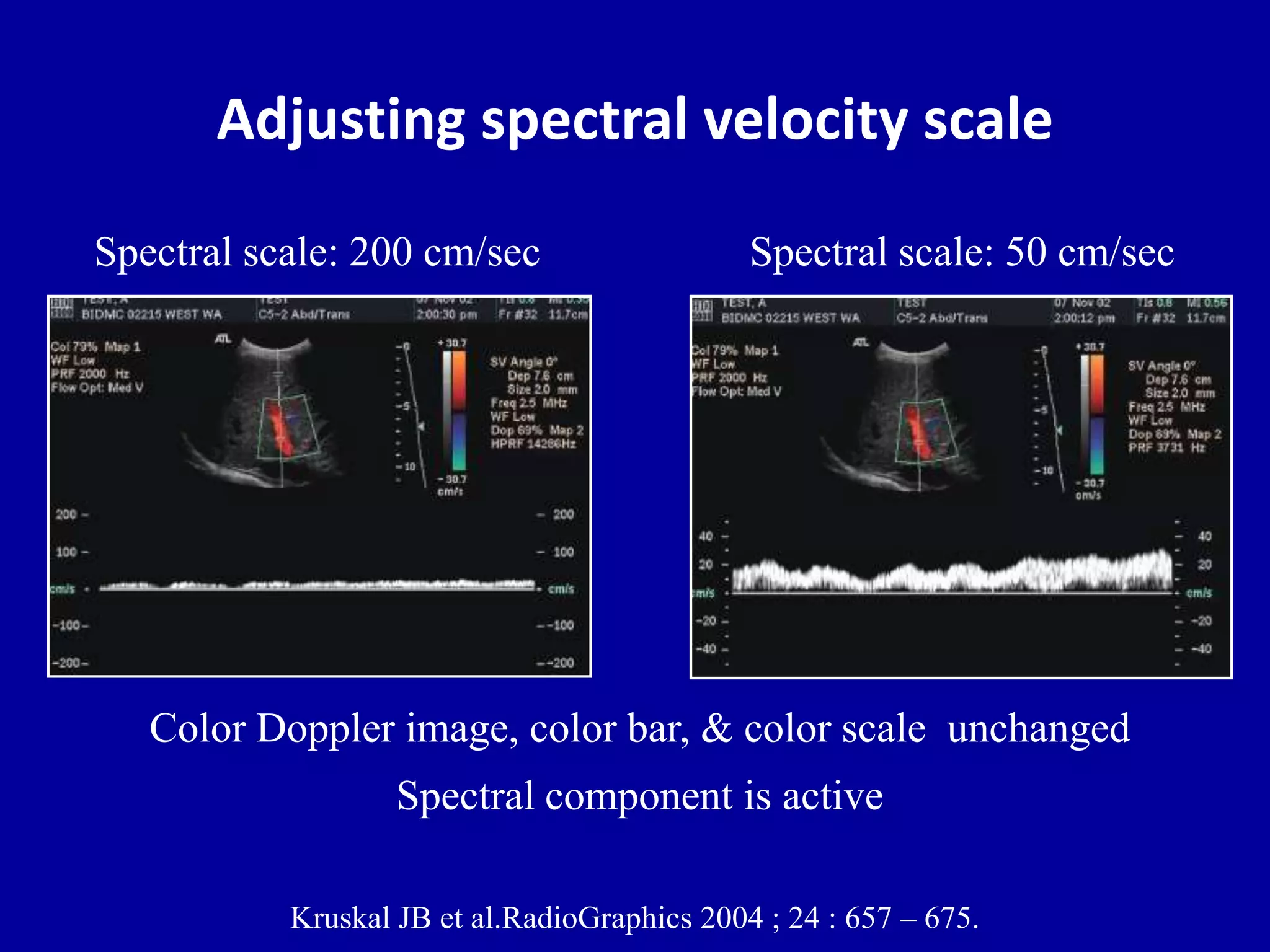
Adjusting spectral velocity scale
Spectral scale: 200 cm/sec Spectral scale: 50 cm/sec
Kruskal JB et al.RadioGraphics 2004 ; 24 : 657 – 675.
Color Doppler image, color bar, & color scale unchanged
Spectral component is active
Adjusting spectral Doppler gain
Gain setting 0% Gain setting 38%
Gain setting 77% Gain setting 100%
Kruskal JB et al.RadioGraphics 2004 ; 24 : 657 – 675.
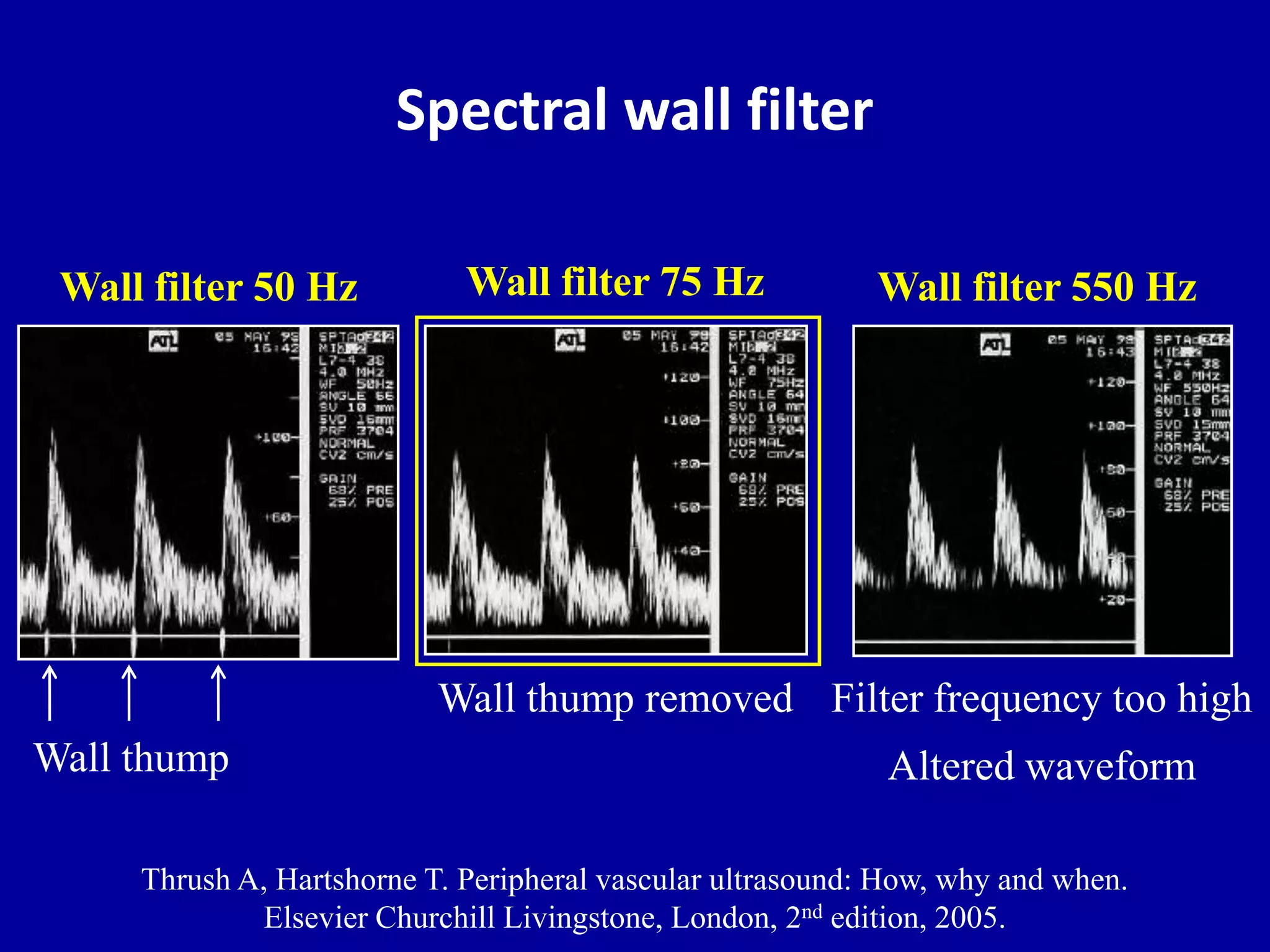
Spectral wall filter
Wall filter 75 Hz
Wall thump removed
Wall filter 550 Hz
Filter frequency too high
Altered waveform
Wall filter 50 Hz
Wall thump
Thrush A, Hartshorne T. Peripheral vascular ultrasound: How, why and when.
Elsevier Churchill Livingstone, London, 2nd edition, 2005.
Spectral aliasing
CCA
Dropping baseline Increasing scalePeaks cross baseline
Rubens DJ et al. Doppler artifacts & pitfalls.
Ultrasound Clin 2006 ; 1 : 79 – 109.
 Color-specific parameters
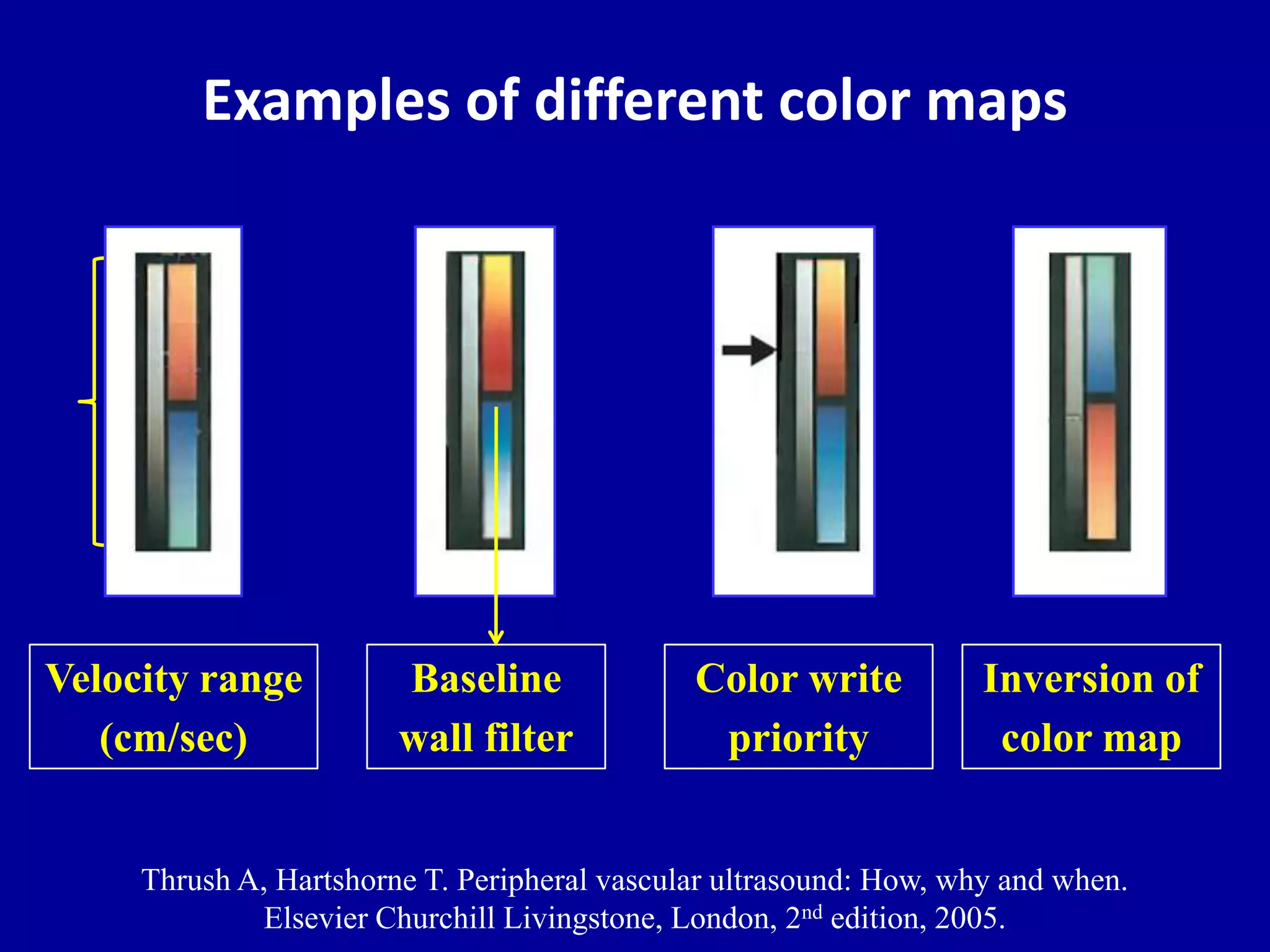
Color map
Baseline
Wall filter
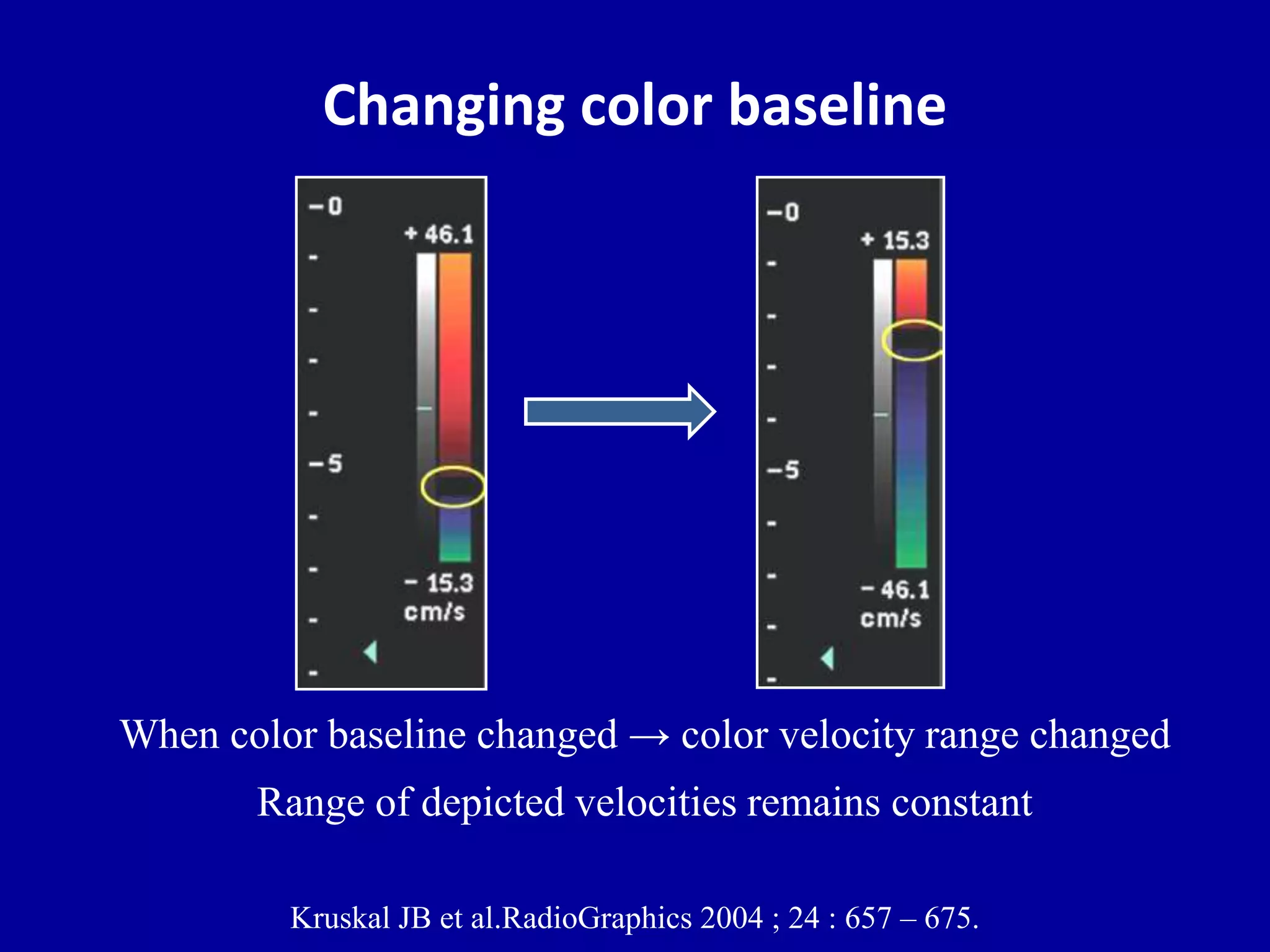
Changing color baseline
Kruskal JB et al.RadioGraphics 2004 ; 24 : 657 – 675.
When color baseline changed → color velocity range changed
Range of depicted velocities remains constant
Examples of different color maps
Thrush A, Hartshorne T. Peripheral vascular ultrasound: How, why and when.
Elsevier Churchill Livingstone, London, 2nd edition, 2005.
Velocity range
(cm/sec)
Inversion of
color map
Color write
priority
Baseline
wall filter
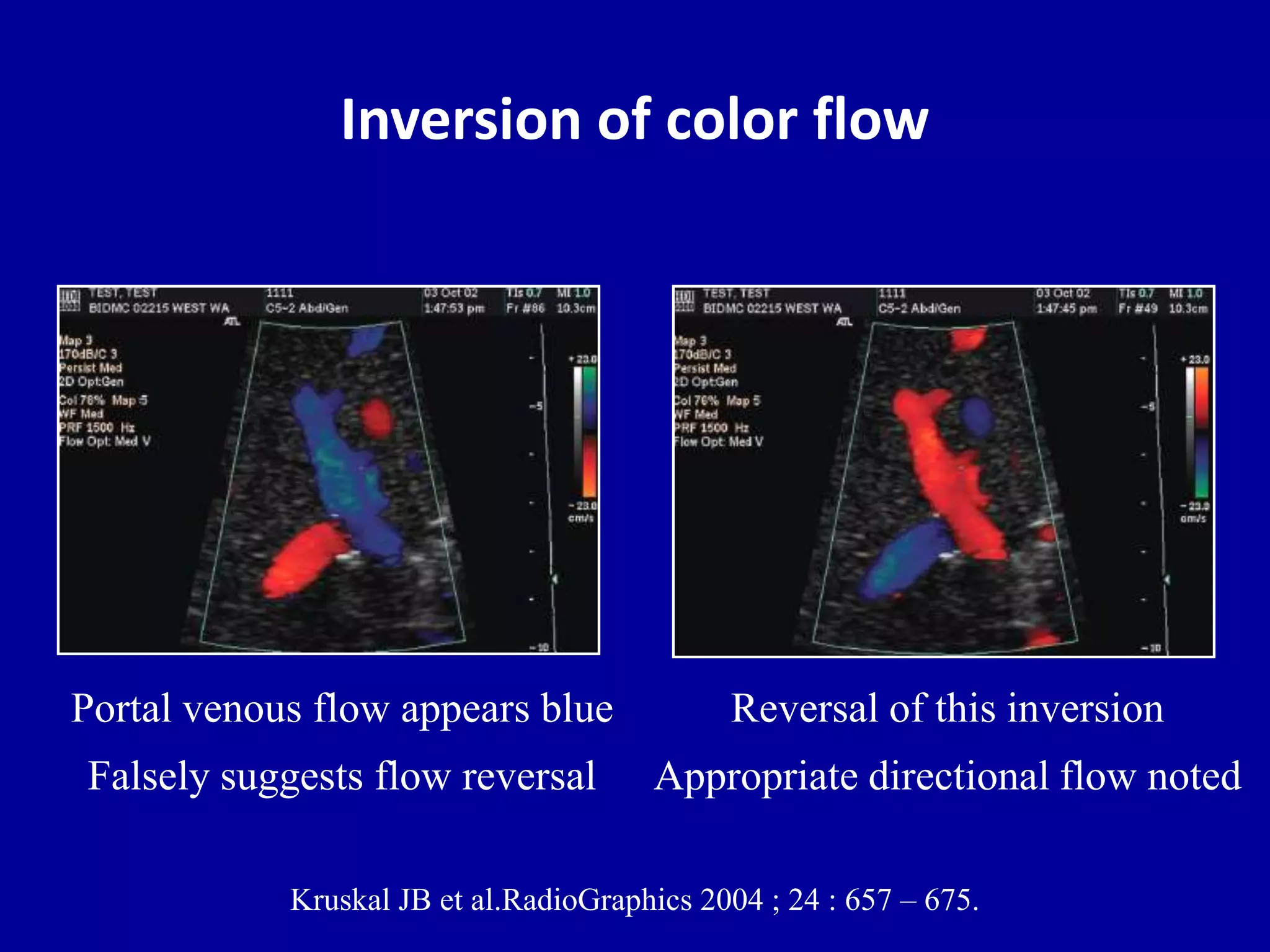
Inversion of color flow
Kruskal JB et al.RadioGraphics 2004 ; 24 : 657 – 675.
Reversal of this inversion
Appropriate directional flow noted
Portal venous flow appears blue
Falsely suggests flow reversal
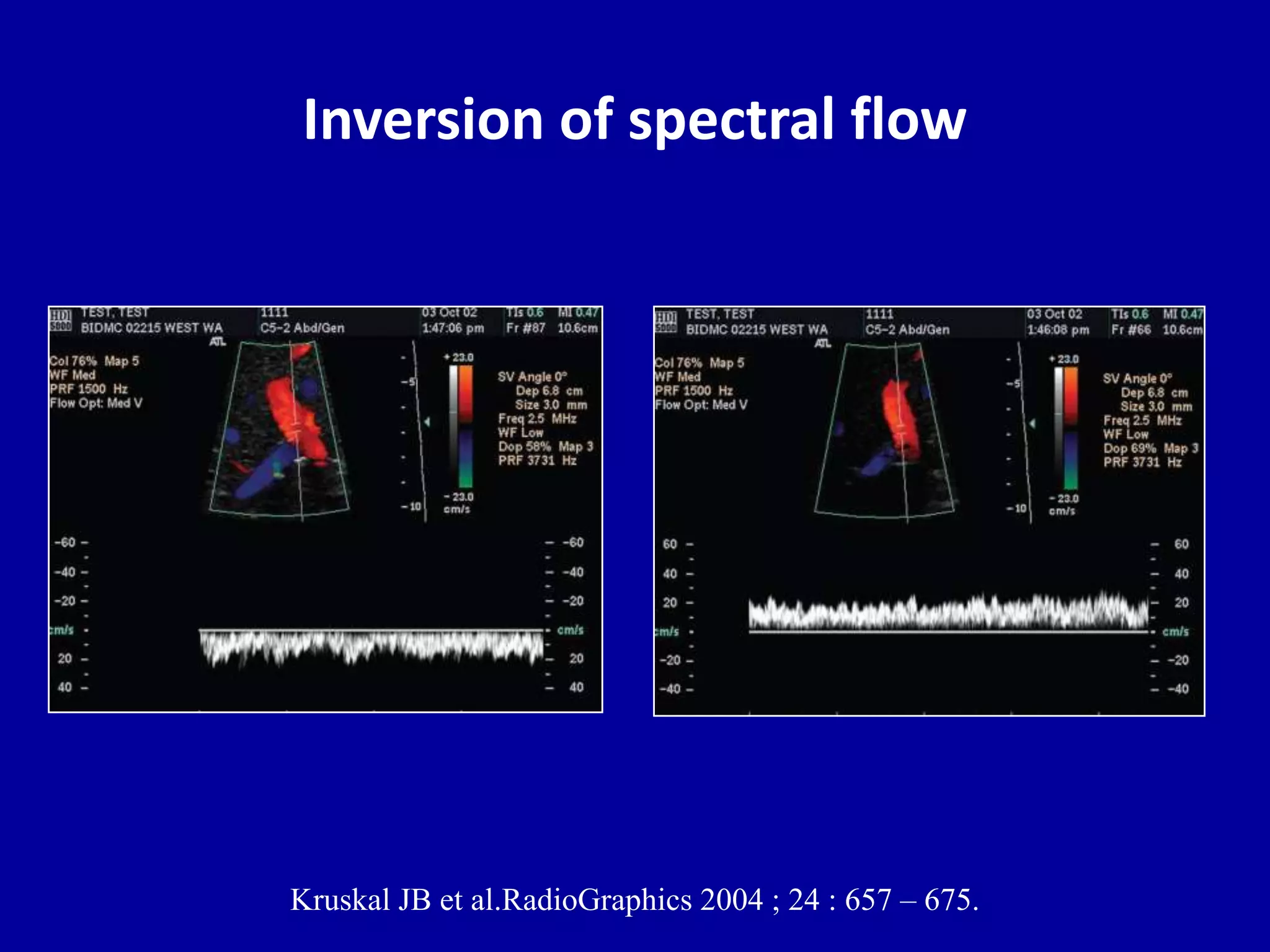
Inversion of spectral flow
Kruskal JB et al.RadioGraphics 2004 ; 24 : 657 – 675.
Color box size / Overlay
Kruskal JB et al.RadioGraphics 2004 ; 24 : 657 – 675.
Oversized color box
↑ frame rate & ↓ resolution
Reduced color box size
↓ frame rate & ↑ resolution
Color box should be as small & superficial as possible
Doppler angle effects
Thrush A, Hartshorne T. Peripheral vascular ultrasound: How, why and when.
Elsevier Churchill Livingstone, London, 2nd edition, 2005.
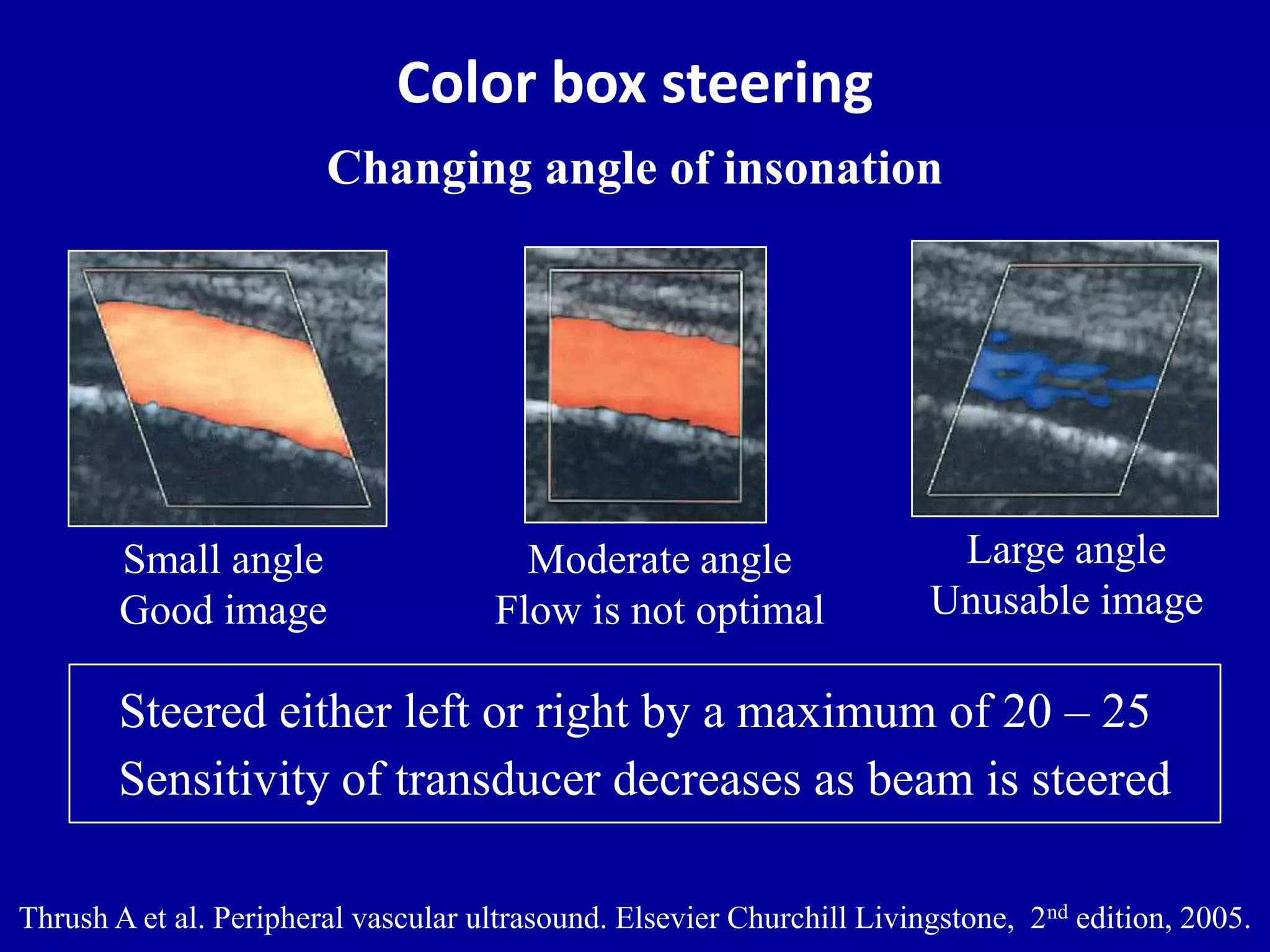
Color box steering
Changing angle of insonation
Large angle
Unusable image
Small angle
Good image
Moderate angle
Flow is not optimal
Steered either left or right by a maximum of 20 – 25
Sensitivity of transducer decreases as beam is steered
Thrush A et al. Peripheral vascular ultrasound. Elsevier Churchill Livingstone, 2nd edition, 2005.
Color box steered in more than one direction to
demonstrate flow in the whole vessel
Color box steering
Thrush A et al. Peripheral vascular ultrasound. Elsevier Churchill Livingstone, 2nd edition, 2005.
Adjusting color velocity scale
Kruskal JB et al.RadioGraphics 2004 ; 24 : 657 – 675.
Color velocity scale 2 cm/sec
Color aliasing in PV & its branches
High color velocity scale (69 cm/sec)
Apparent absence of flow in PV
Color velocity scale 30 cm/sec
Normal flow in a patent PV
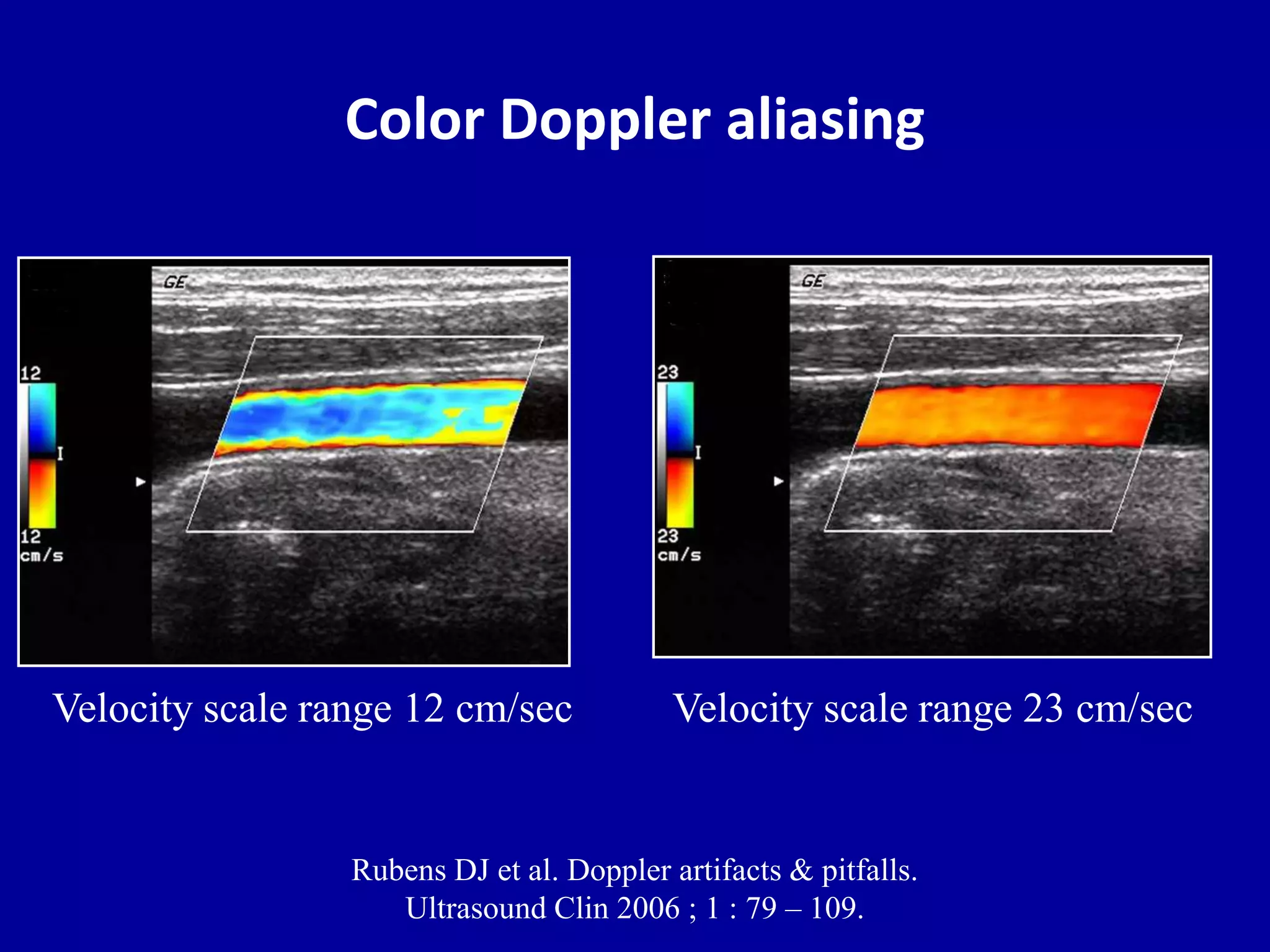
Color Doppler aliasing
Velocity scale range 12 cm/sec Velocity scale range 23 cm/sec
Rubens DJ et al. Doppler artifacts & pitfalls.
Ultrasound Clin 2006 ; 1 : 79 – 109.
Portal vein pseudo-clot
Velocity scale: 20 cm/s Velocity scale: 7 cm/s
Adjusting color gain
Kruskal JB et al.RadioGraphics 2004 ; 24 : 657 – 675.
Color gain should be set as high as possible
without displaying random color speckles
Color gain 44% Color gain 65% Color gain 100%
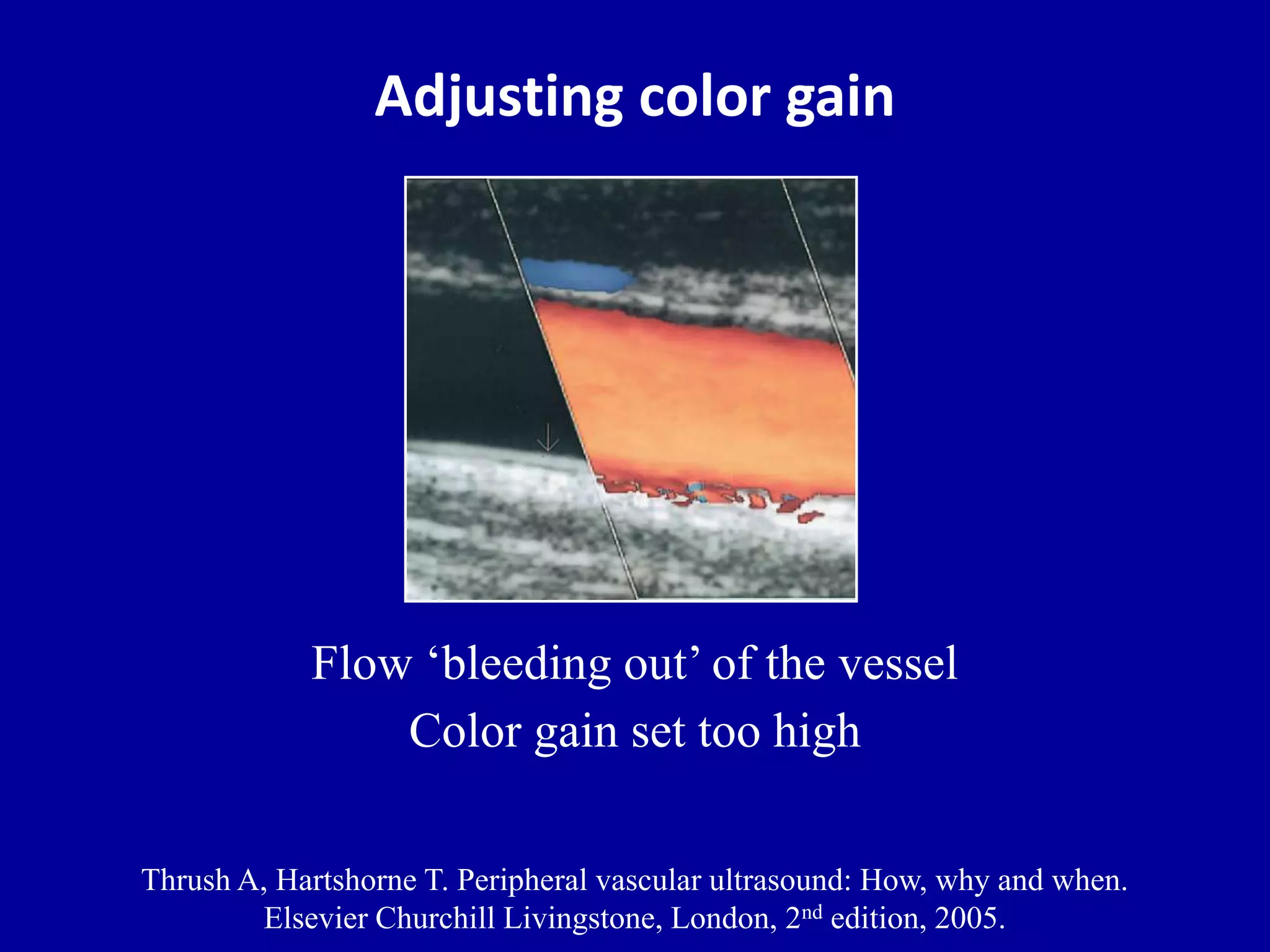
Adjusting color gain
Flow „bleeding out‟ of the vessel
Color gain set too high
Thrush A, Hartshorne T. Peripheral vascular ultrasound: How, why and when.
Elsevier Churchill Livingstone, London, 2nd edition, 2005.
Adjusting color wall filter
Filter setting displayed on color scale (horizontal arrow)
Filter too high
Removing low flow
Filter setting reduced
Display low flow
Thrush A, Hartshorne T. Peripheral vascular ultrasound: How, why and when.
Elsevier Churchill Livingstone, London, 2nd edition, 2005.
Pseudo-thrombosis of main PV
Adjusting velocity & angle of insonation
Velocity: 24 cm/sec
Wall filter: medium
Angle 90
Velocity: 7 cm/sec
Wall filter: medium
Angle < 90
Radiol Clin N Am 2006 ; 44 : 805 – 835.
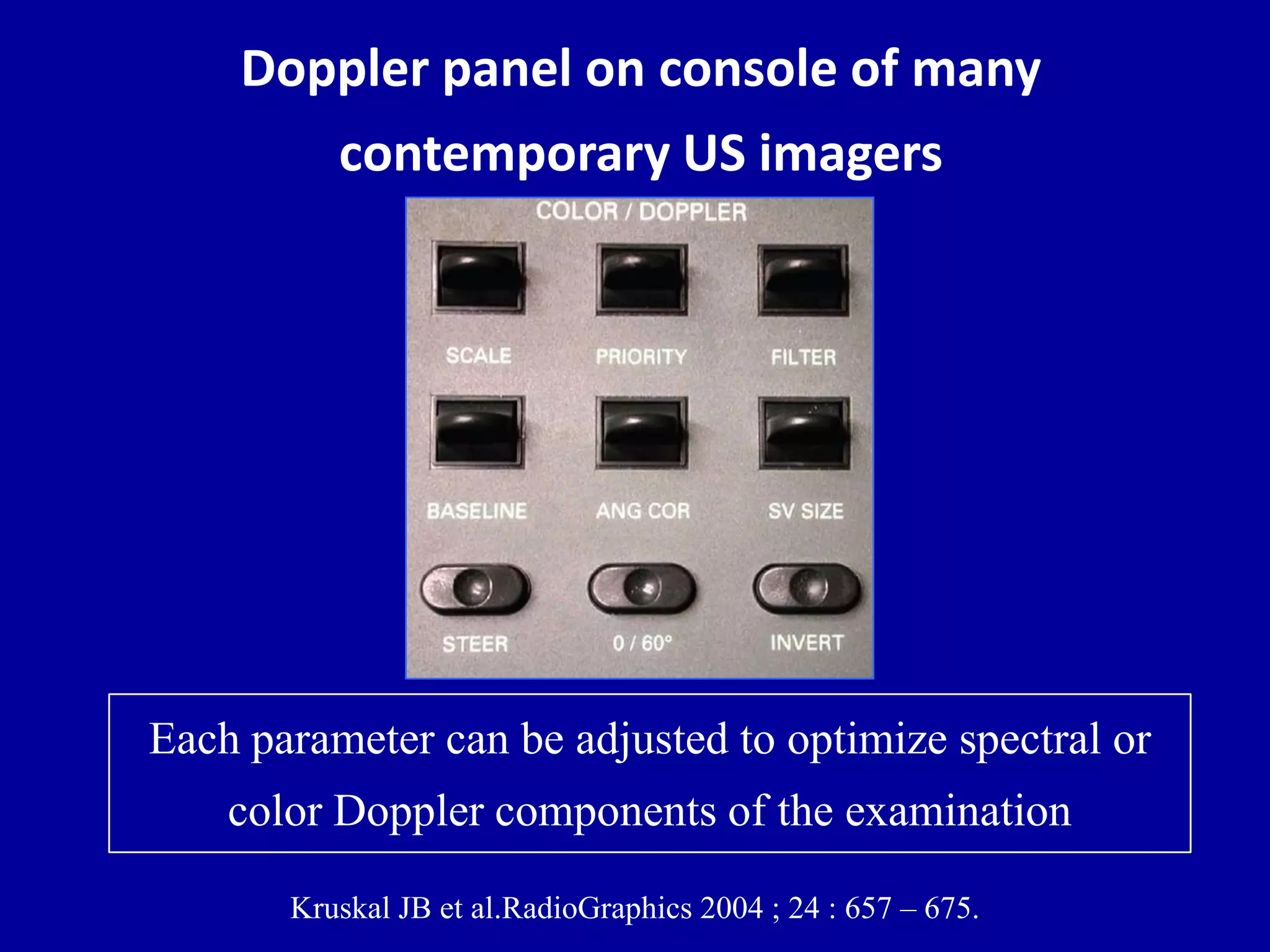
Doppler panel on console of many
contemporary US imagers
Each parameter can be adjusted to optimize spectral or
color Doppler components of the examination
Kruskal JB et al.RadioGraphics 2004 ; 24 : 657 – 675.
Clinical & tissue-specific presets
• Clinical option General
Adult
Obstetric (etc…)
• Tissue-specific preset Abdomen
Renal
Transplant (etc...)
Kruskal JB et al.RadioGraphics 2004 ; 24 : 657 – 675.
Once a transducer selected
preset choices includes:
Guidelines for optimal Doppler examination
 Adjust gain & filter
 Adjust velocity scale & baseline
 Doppler angle < 60 by steering & probe position
 Color box as small & superficial as possible
 Sample volume size: 2/3 of vessel width in the center
 Avoid transducer motion
Rubens DJ et al. Doppler artifacts & pitfalls.
Ultrasound Clin 2006 ; 1 : 79 – 109.
 Power Doppler imaging
Advantages of power mode Doppler
• No aliasing
• Angle independent
• Increased sensitivity to detect low-velocity flow
Distinguish pre-occlusive from occlusive lesions
Superior depiction of plaque surface morphology
• Useful in imaging tortuous vessels
• Increases accuracy of grading stenosis
Power Doppler imaging
Large plaque ulcer
ICA
Narrow flow channel in ICA
“string sign” or “trickle flow ”
Disadvantages of power Doppler imaging
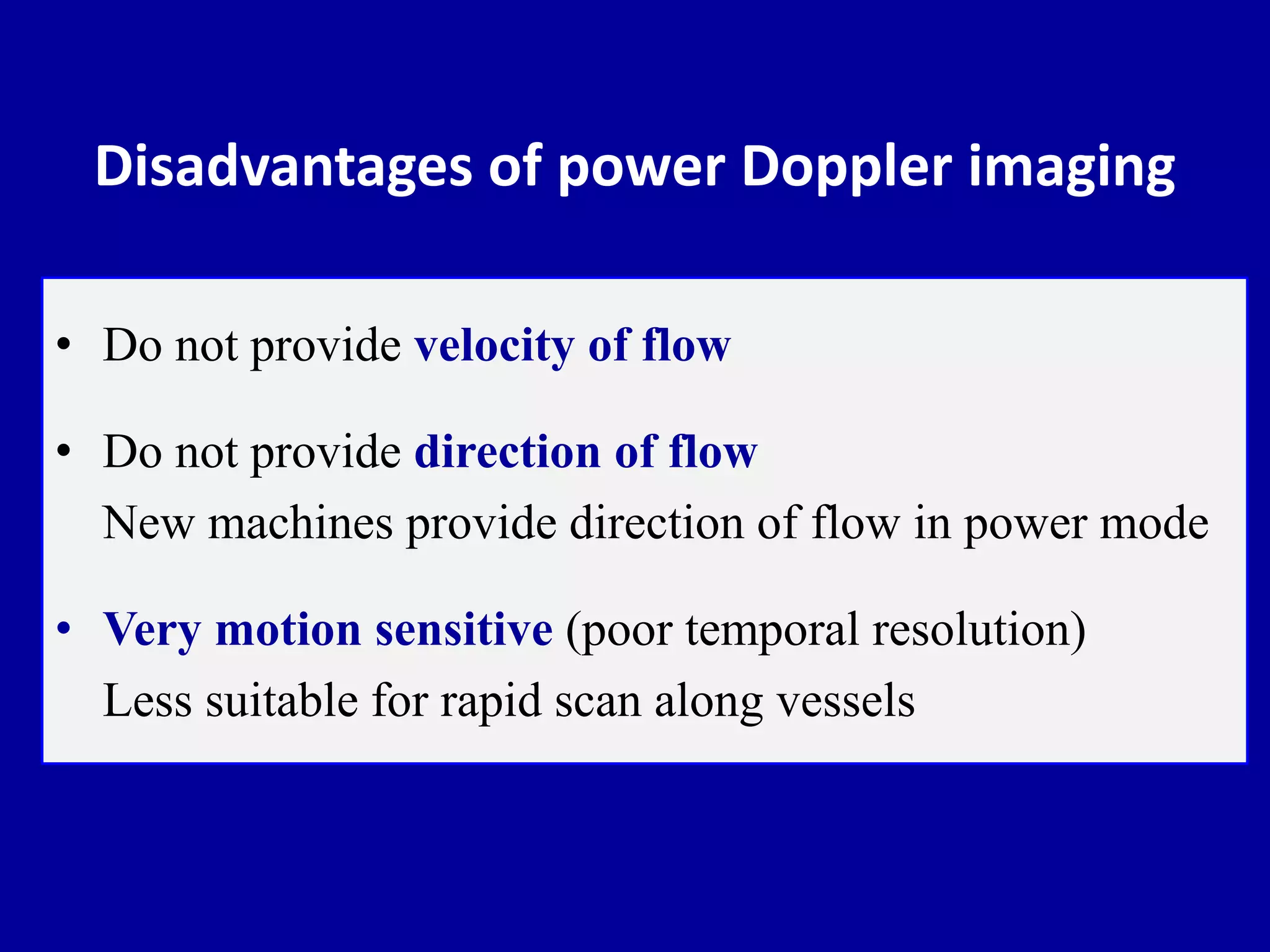
• Do not provide velocity of flow
• Do not provide direction of flow
New machines provide direction of flow in power mode
• Very motion sensitive (poor temporal resolution)
Less suitable for rapid scan along vessels
 Normal flow in arteries & veins
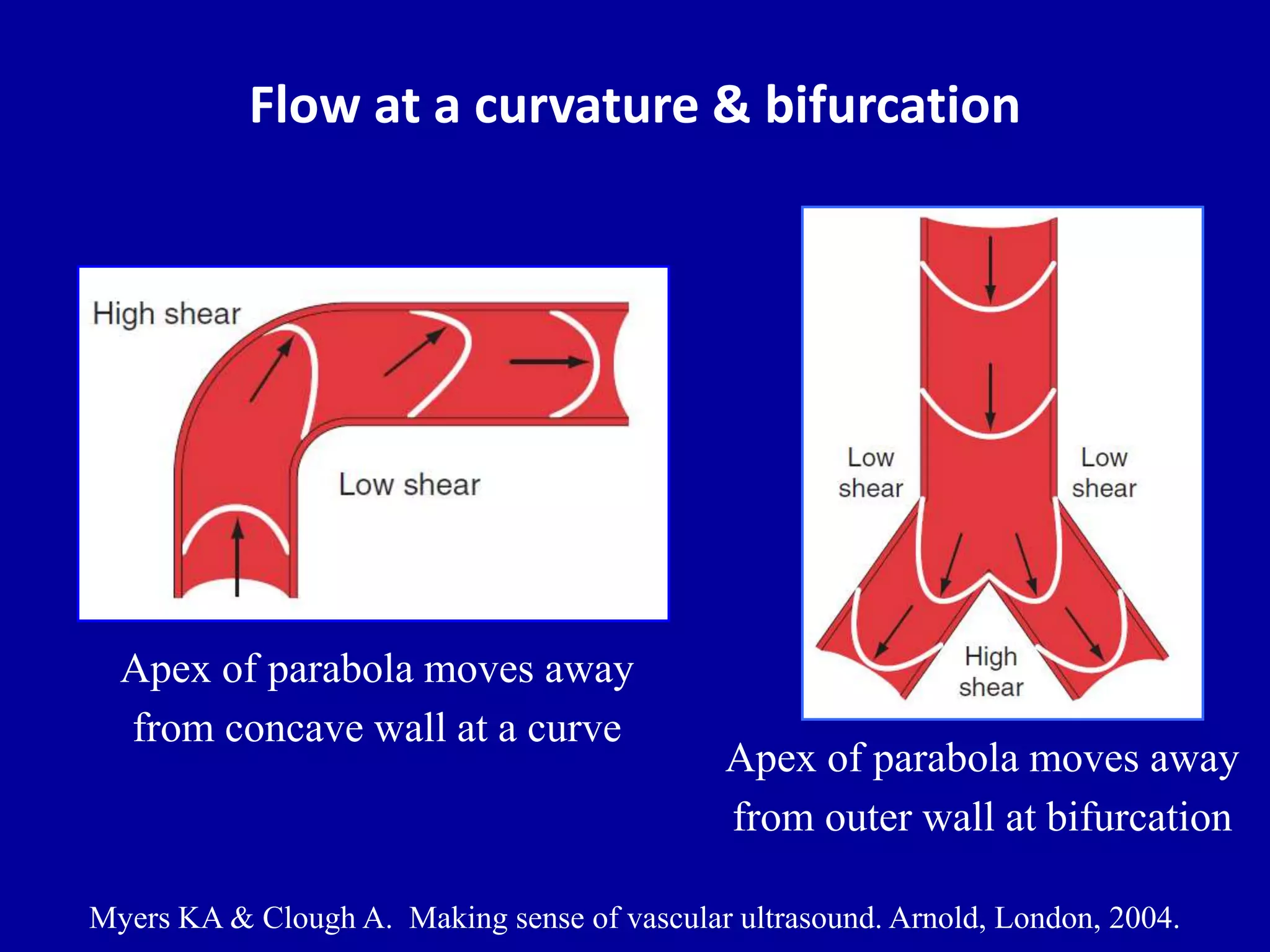
Flow at a curvature & bifurcation
Myers KA & Clough A. Making sense of vascular ultrasound. Arnold, London, 2004.
Apex of parabola moves away
from concave wall at a curve
Apex of parabola moves away
from outer wall at bifurcation
Flow around curves in a vessel
Tortuous ICA
Thrush A, Hartshorne T. Peripheral vascular ultrasound: How, why and when.
Elsevier Churchill Livingstone, London, 2nd edition, 2005.
A B
A
PSV outside the bend 70 cm/sec
B
PSV inside the bend 55 cm/sec
Normal flow reversal zone in ICA
Opposite to origin of the ECAHigh velocities near flow divider
Reversal on opposite side to flow divider
Thrush A et al. Peripheral vascular ultrasound. Elsevier Churchill Livingstone, London, 2005.
High & low resistance arterial flow
High-resistance flow
SFA
Low-resistance flow
ICA
Myers KA & Clough A. Making sense of vascular ultrasound. Arnold, London, 2004.
Arterial high resistance flow
Typical normal Doppler spectra
Normal anterior tibial arteryTriphasic flow
Pulsatility index
Most commonly used of all indices
S Systolic
D Minimum diastolic
M Mean
PI S – D / M
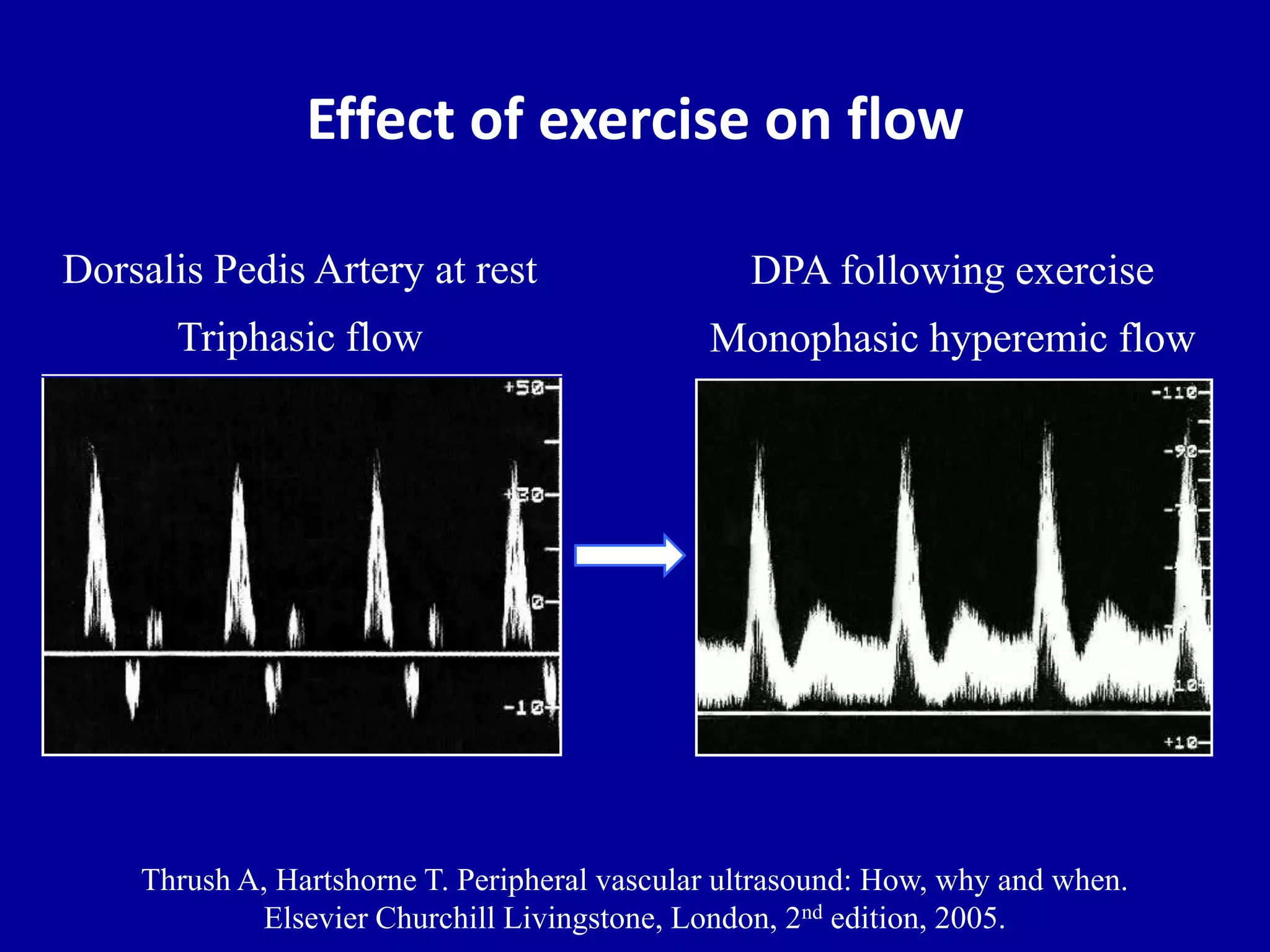
Effect of exercise on flow
Dorsalis Pedis Artery at rest
Triphasic flow
Thrush A, Hartshorne T. Peripheral vascular ultrasound: How, why and when.
Elsevier Churchill Livingstone, London, 2nd edition, 2005.
DPA following exercise
Monophasic hyperemic flow
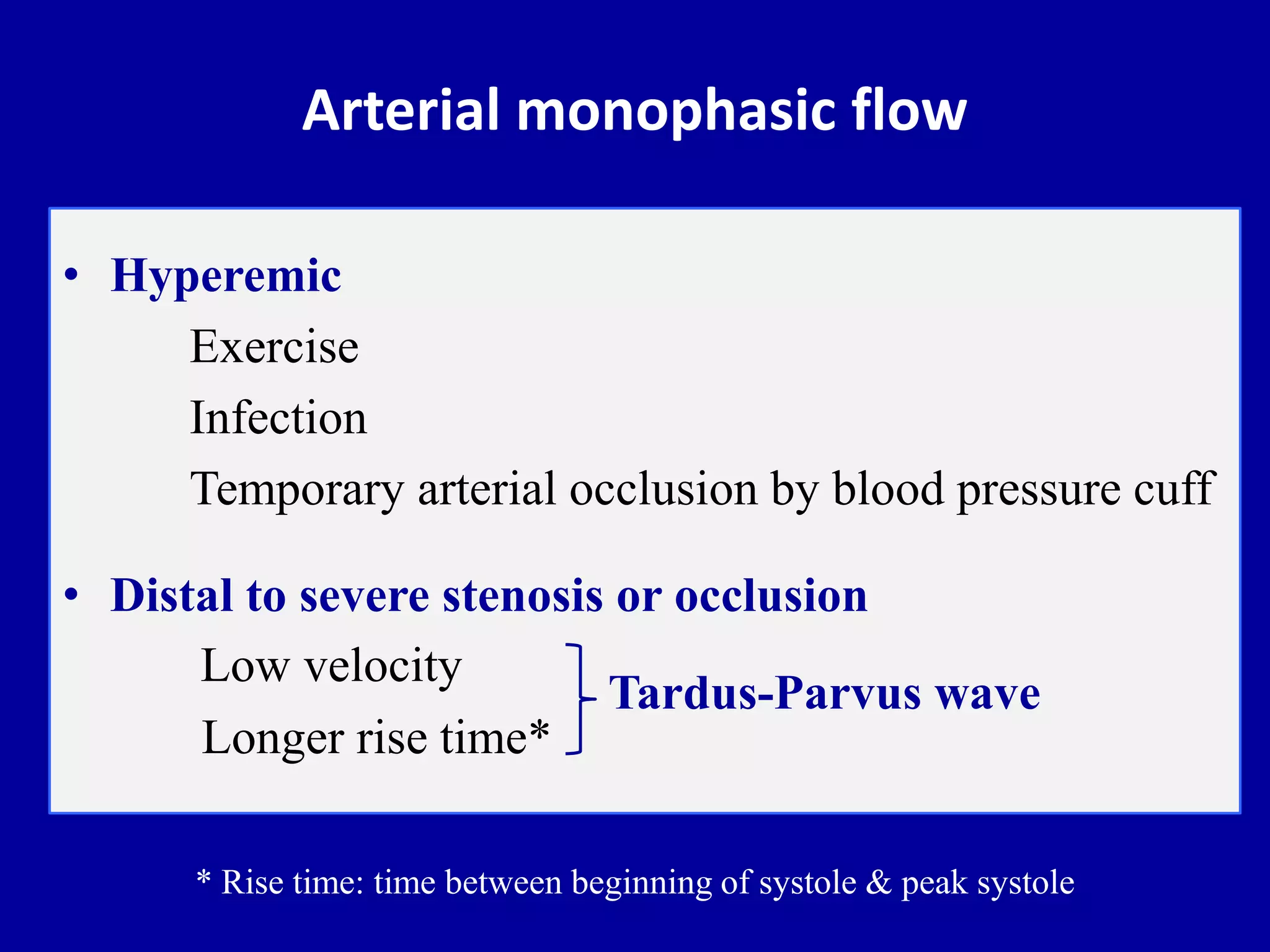
Arterial monophasic flow
• Hyperemic
Exercise
Infection
Temporary arterial occlusion by blood pressure cuff
• Distal to severe stenosis or occlusion
Low velocity
Longer rise time*
Tardus-Parvus wave
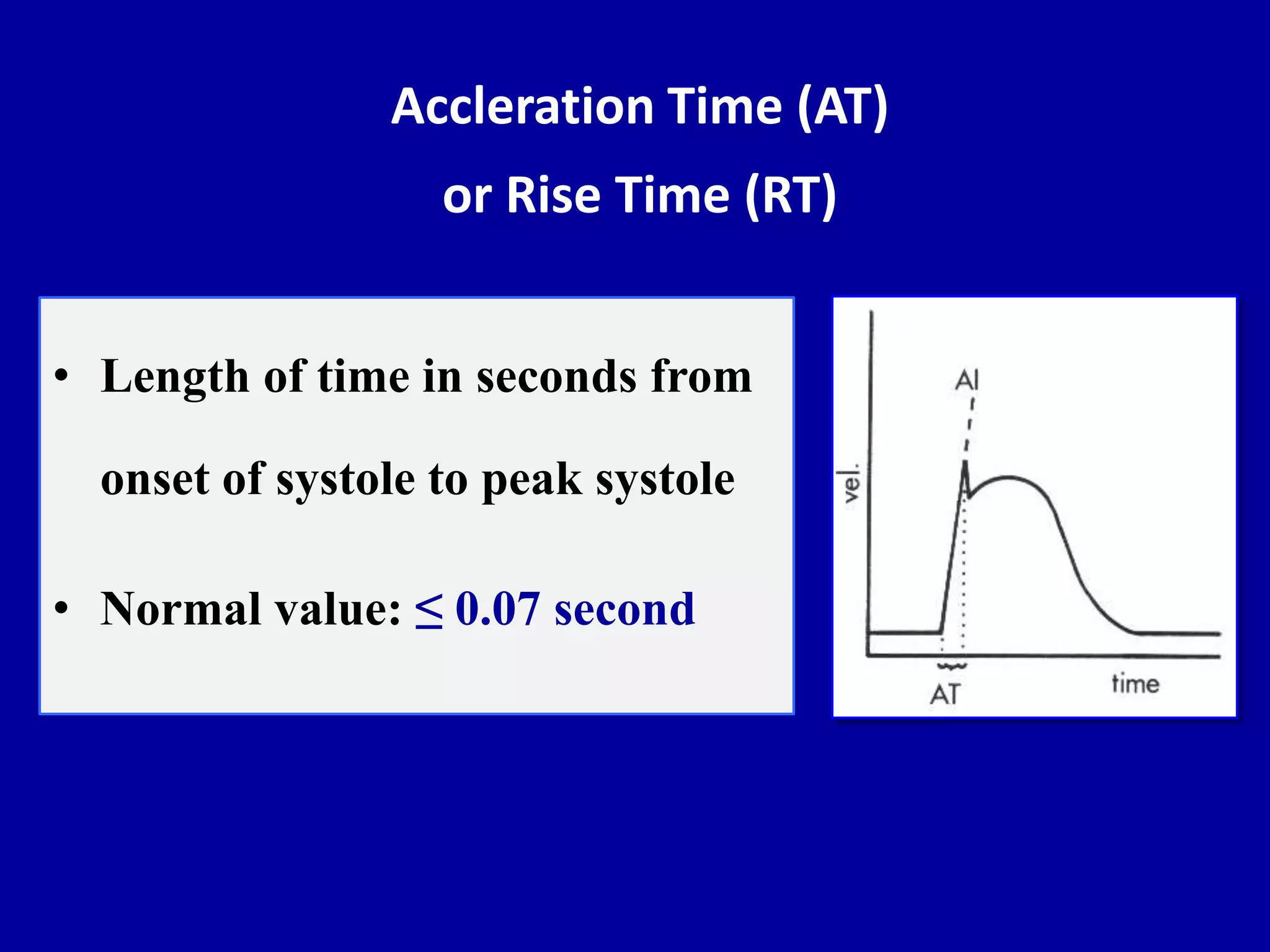
* Rise time: time between beginning of systole & peak systole
Tardus-Parvus wave
Distal to severe stenosis or occlusion
Thrush A, Hartshorne T. Peripheral vascular ultrasound: How, why and when.
Elsevier Churchill Livingstone, London, 2nd edition, 2005.
Tardus: Longer rise time
Parvus: Low PSV
Arterial low resistance flow
Typical normal Doppler spectra
Normal internal carotid artery
Pourcelot’s resistance index
RI S – ED / S
Normal 50 – 70 %
Abnormal > 80 %
Accleration Time (AT)
or Rise Time (RT)
• Length of time in seconds from
onset of systole to peak systole
• Normal value: ≤ 0.07 second
Acceleration index
AI =
X (KHz)
Probe frequency (MHz)
Normal value: > 3.8 cm/s2
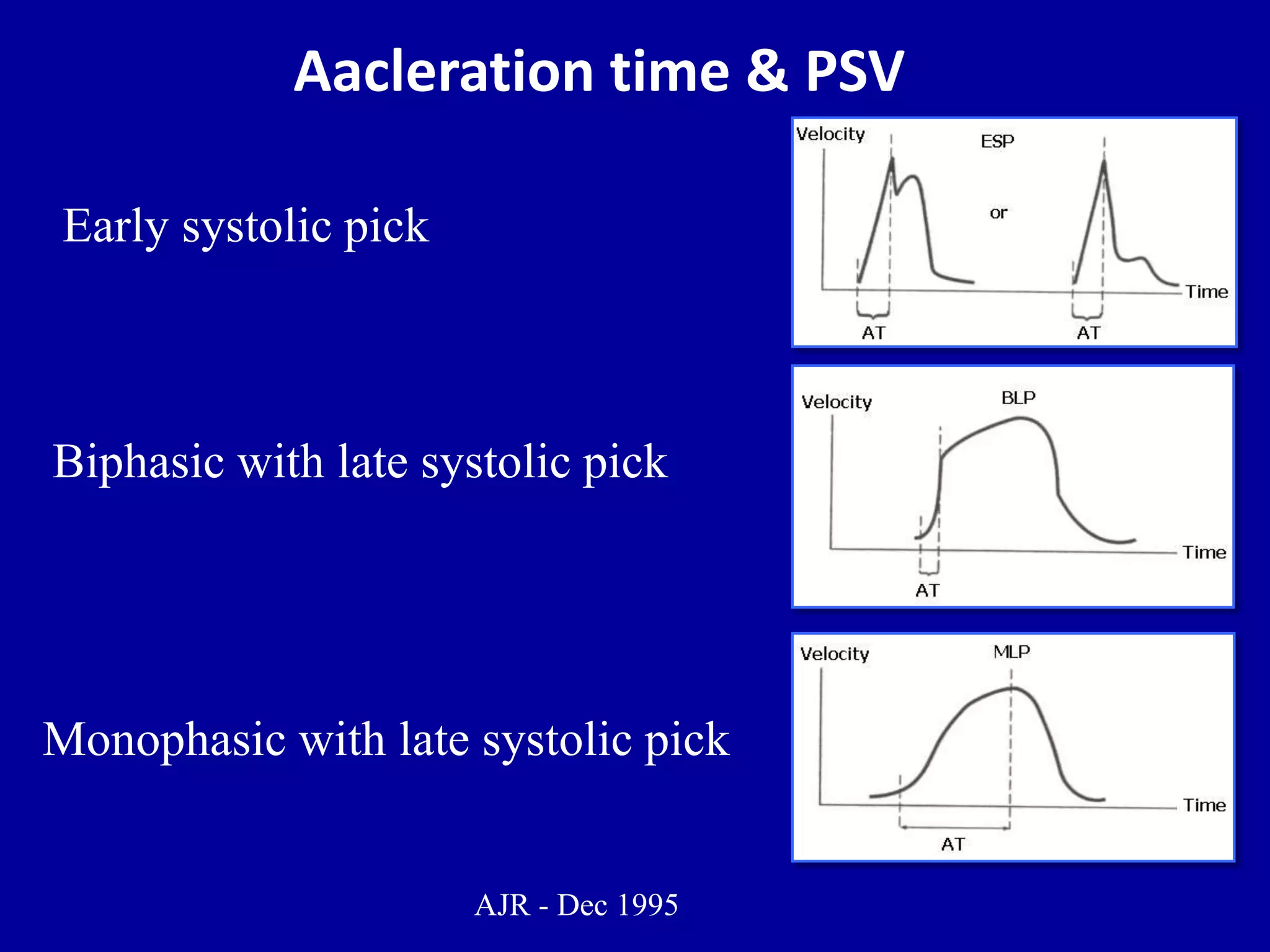
Aacleration time & PSV
Early systolic pick
AJR - Dec 1995
Biphasic with late systolic pick
Monophasic with late systolic pick
AT & AI according to degree of stenosis
Moderate stenosis
50 – 85%
Normal Severe stenosis
> 85 %
Measurement of volume flow
Volume = Cross-sectional area Mean velocity 60
(ml/min) (cm2) (cm/sec)
Cross-sectional area (cm2): π d2 / 4
d: diameter
Doppler equation
Converting Doppler shift frequency to velocity
∆ F Doppler shift frequency (kHz)
F0 Ultrasound transmission frequency (MHz)
V Blood cell velocity (cm/sec)
Cos Ө Cos of angle between US & flow direction
C Speed of sound in soft tissue (1 540 m/sec)
∆ F = 2 F0 V Cos Ө / C
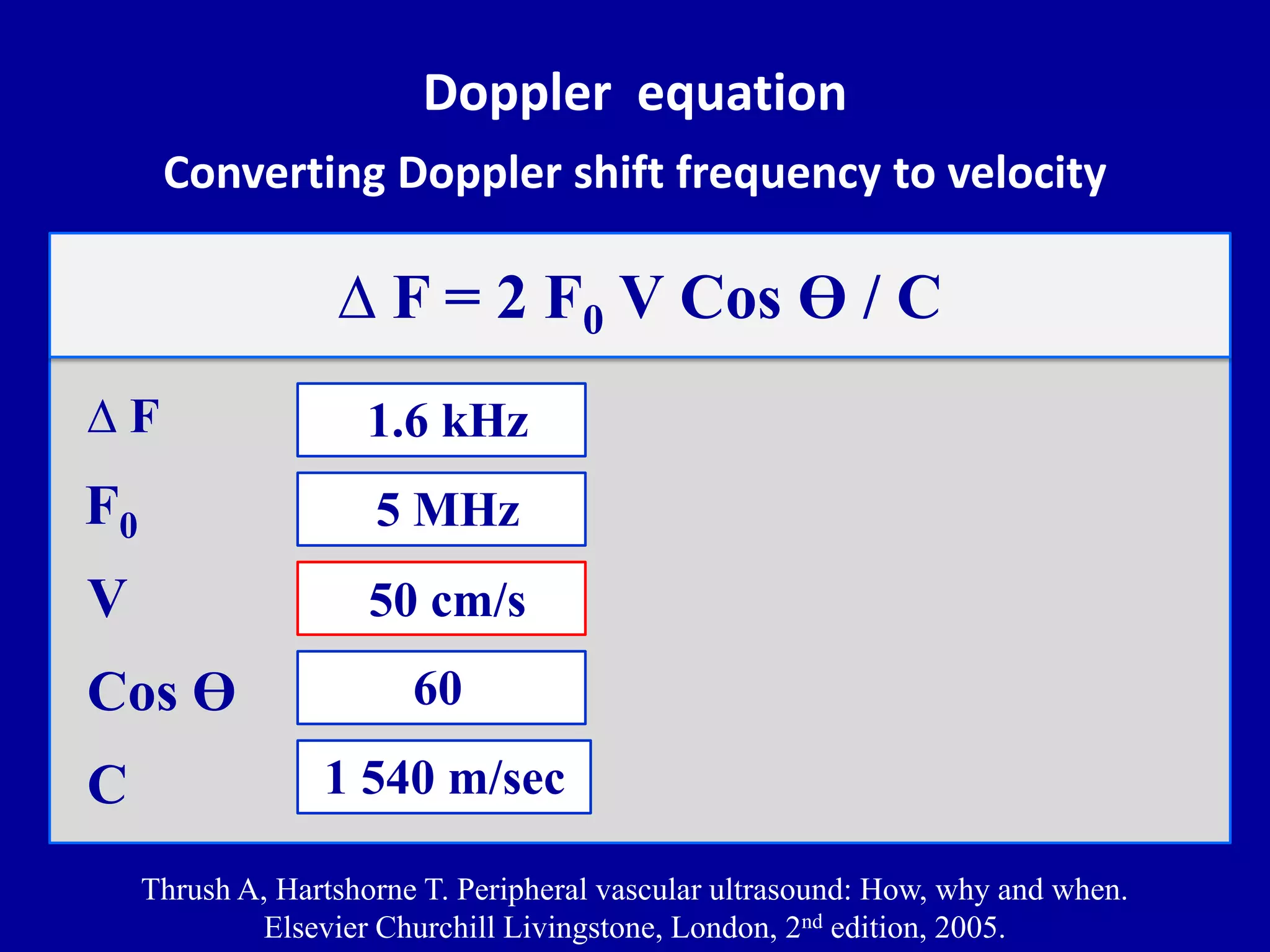
∆ F
F0
V ?
Cos Ө
C
∆ F = 2 F0 V Cos Ө / C
50 cm/s
1.6 kHz
5 MHz
60
1 540 m/sec
Thrush A, Hartshorne T. Peripheral vascular ultrasound: How, why and when.
Elsevier Churchill Livingstone, London, 2nd edition, 2005.
Doppler equation
Converting Doppler shift frequency to velocity
Blood flow & PSV changes related
to severity of arterial stenosis
Myers KA & Clough A. Making sense of vascular ultrasound. Arnold, London, 2004.
Flow through a stenosis
Thrush A, Hartshorne T. Peripheral vascular ultrasound: How, why and when.
Elsevier Churchill Livingstone, London, 2nd edition, 2005.
Increased velocity through stenosis
Flow reversal beyond stenosis
CCA
IJV
ICA
 Color from red to turquoise
 Posterior wall – deep blue
Pic Systolic Velocity ratio
Robbin ML et al. Ultrasound Clin 2006 ; 1 : 111 – 131.
Proximal: 2 cm proximal to stenosis
Same Doppler angle if possible
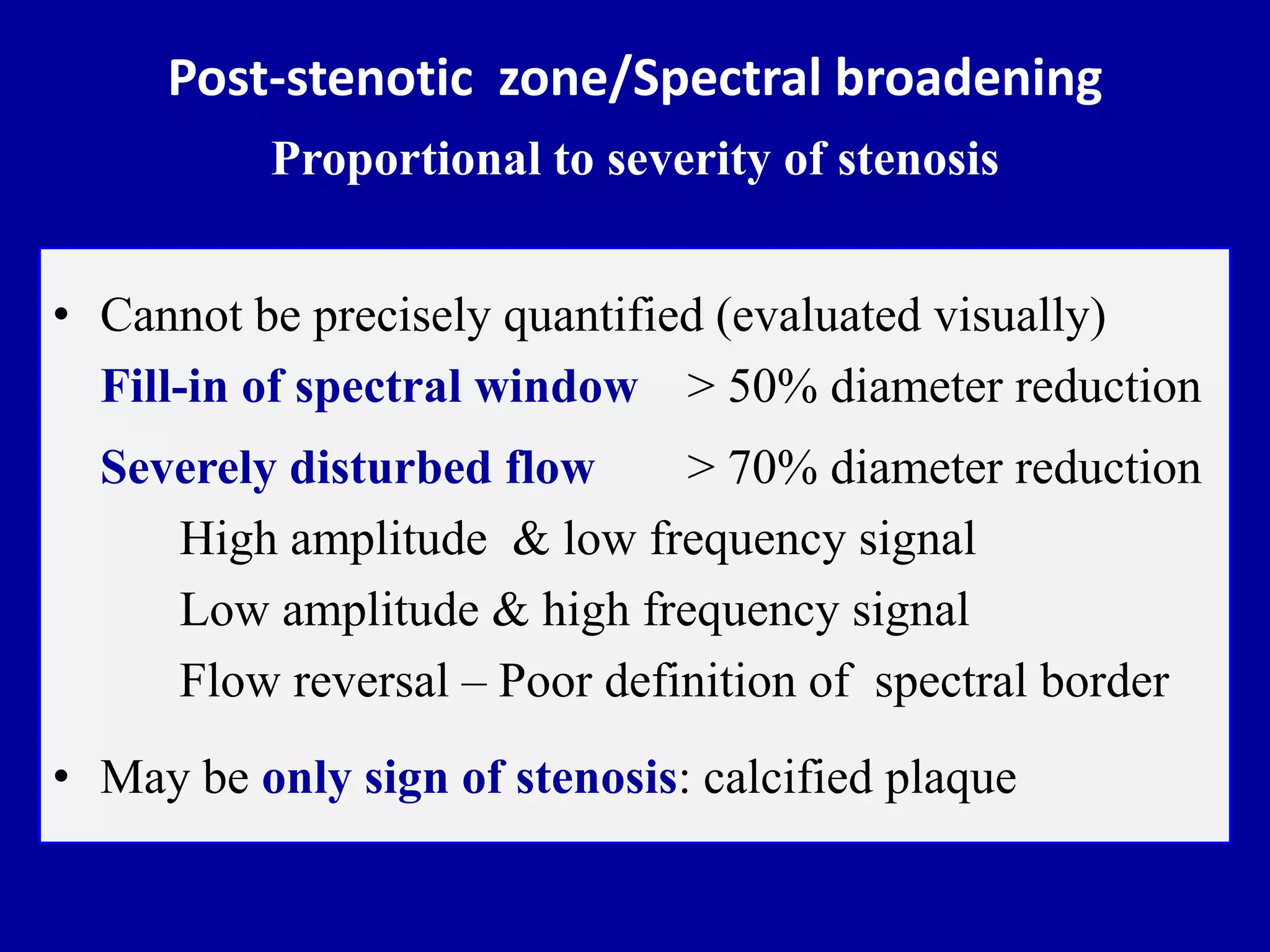
Post-stenotic zone/Spectral broadening
Proportional to severity of stenosis
• Cannot be precisely quantified (evaluated visually)
Fill-in of spectral window > 50% diameter reduction
Severely disturbed flow > 70% diameter reduction
High amplitude & low frequency signal
Low amplitude & high frequency signal
Flow reversal – Poor definition of spectral border
• May be only sign of stenosis: calcified plaque
Spectral broadening
Immediate post-stenotic zone
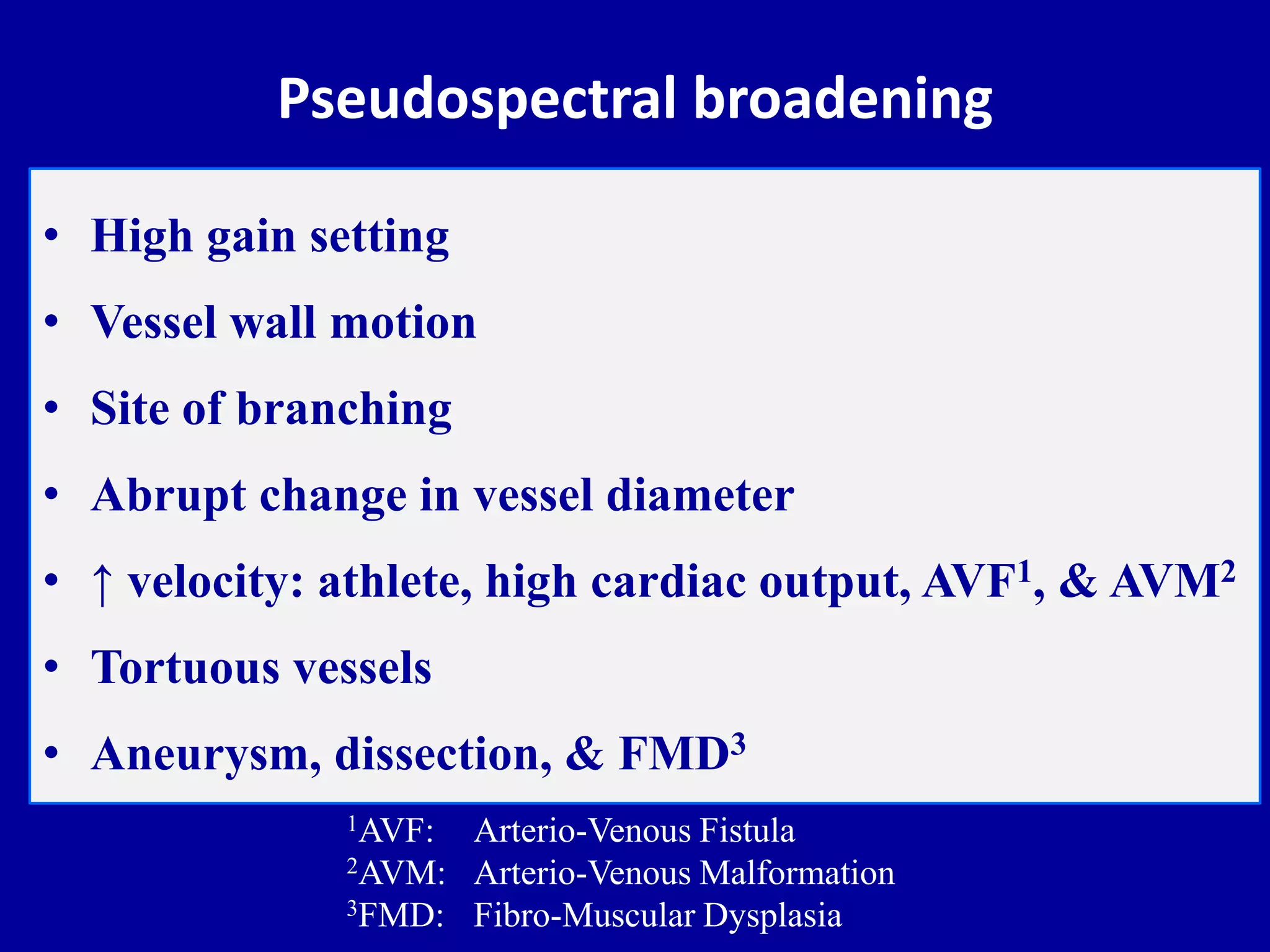
Pseudospectral broadening
• High gain setting
• Vessel wall motion
• Site of branching
• Abrupt change in vessel diameter
• ↑ velocity: athlete, high cardiac output, AVF1, & AVM2
• Tortuous vessels
• Aneurysm, dissection, & FMD3
1AVF: Arterio-Venous Fistula
2AVM: Arterio-Venous Malformation
3FMD: Fibro-Muscular Dysplasia
Color Doppler bruit
Extensive soft tisuue color Doppler bruit surrounds
the carotid bifurcation with 90% ICA stenosis
Venous valve
Two cups of a valve clearly seen
It is uncommon to see venous valves with this clarity
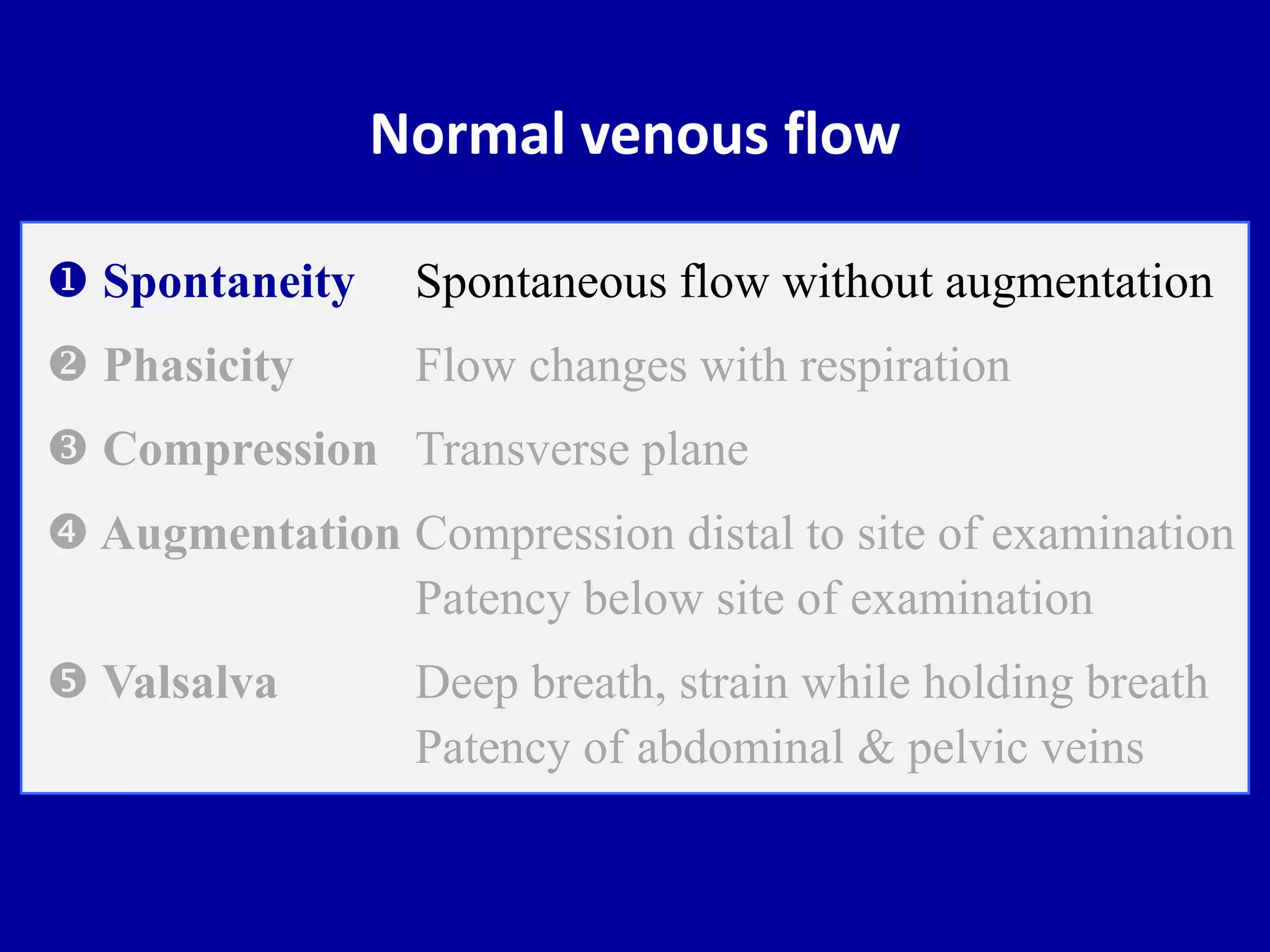
Normal venous flow
 Spontaneity Spontaneous flow without augmentation
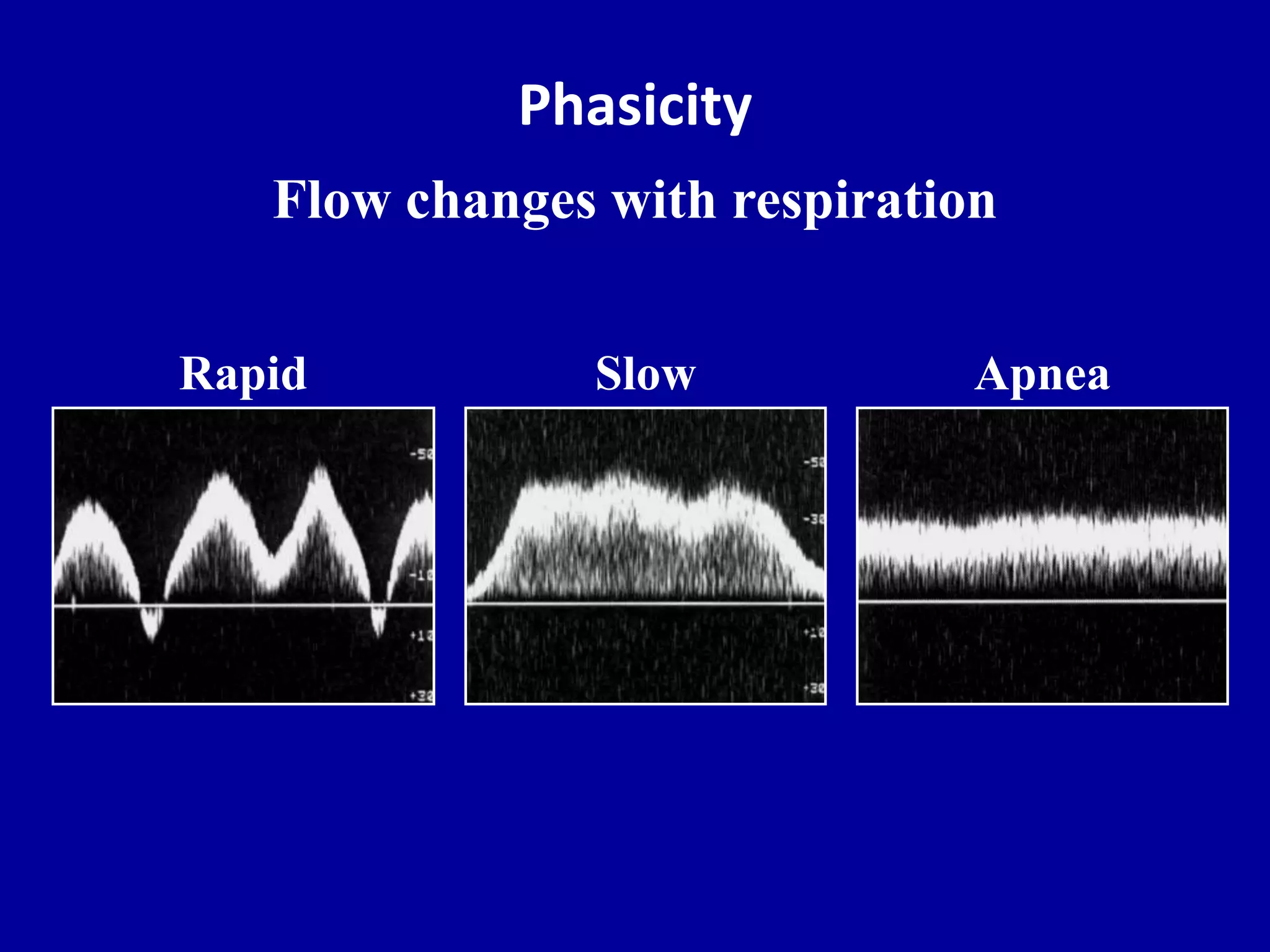
 Phasicity Flow changes with respiration
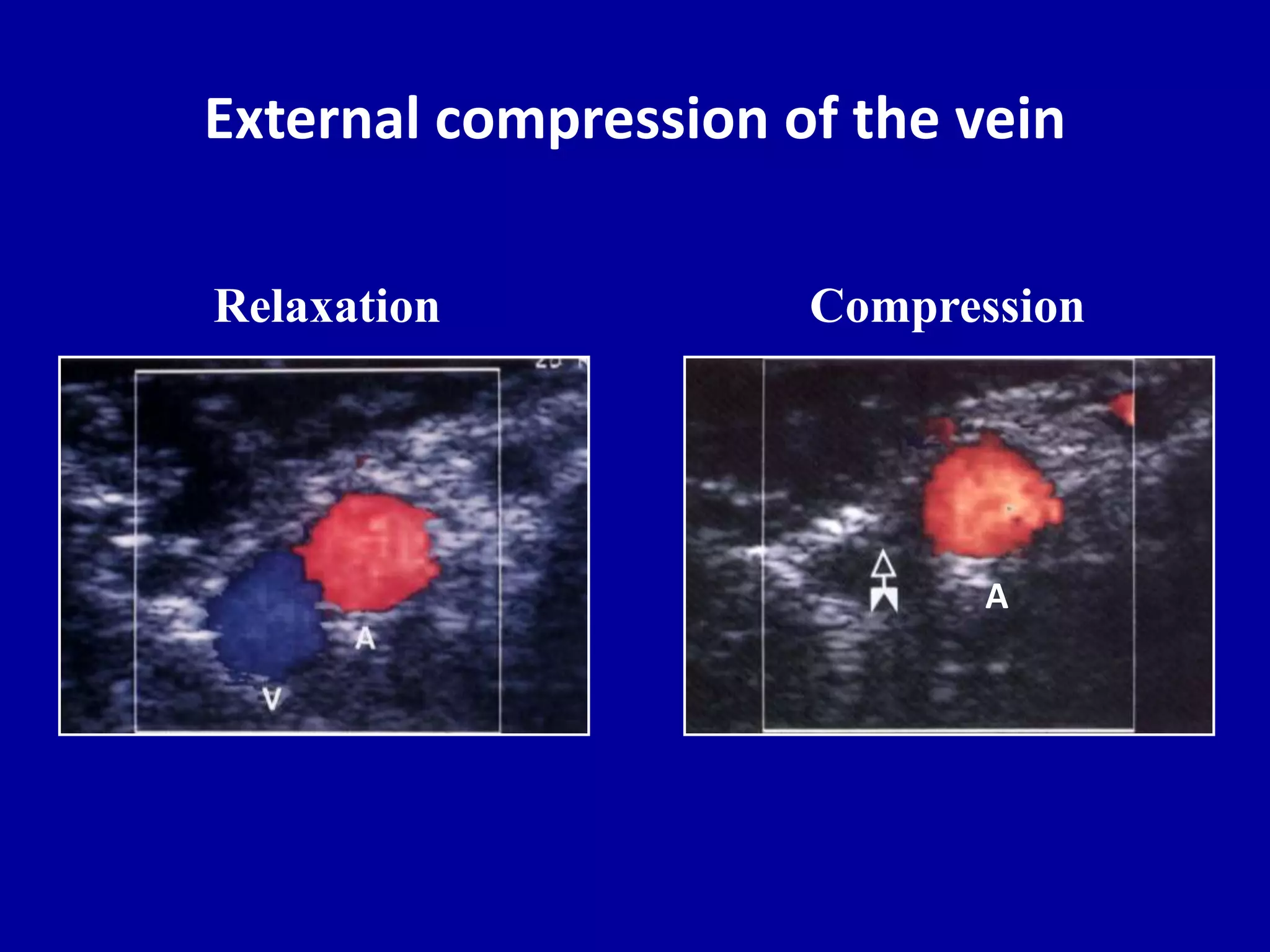
 Compression Transverse plane
 Augmentation Compression distal to site of examination
Patency below site of examination
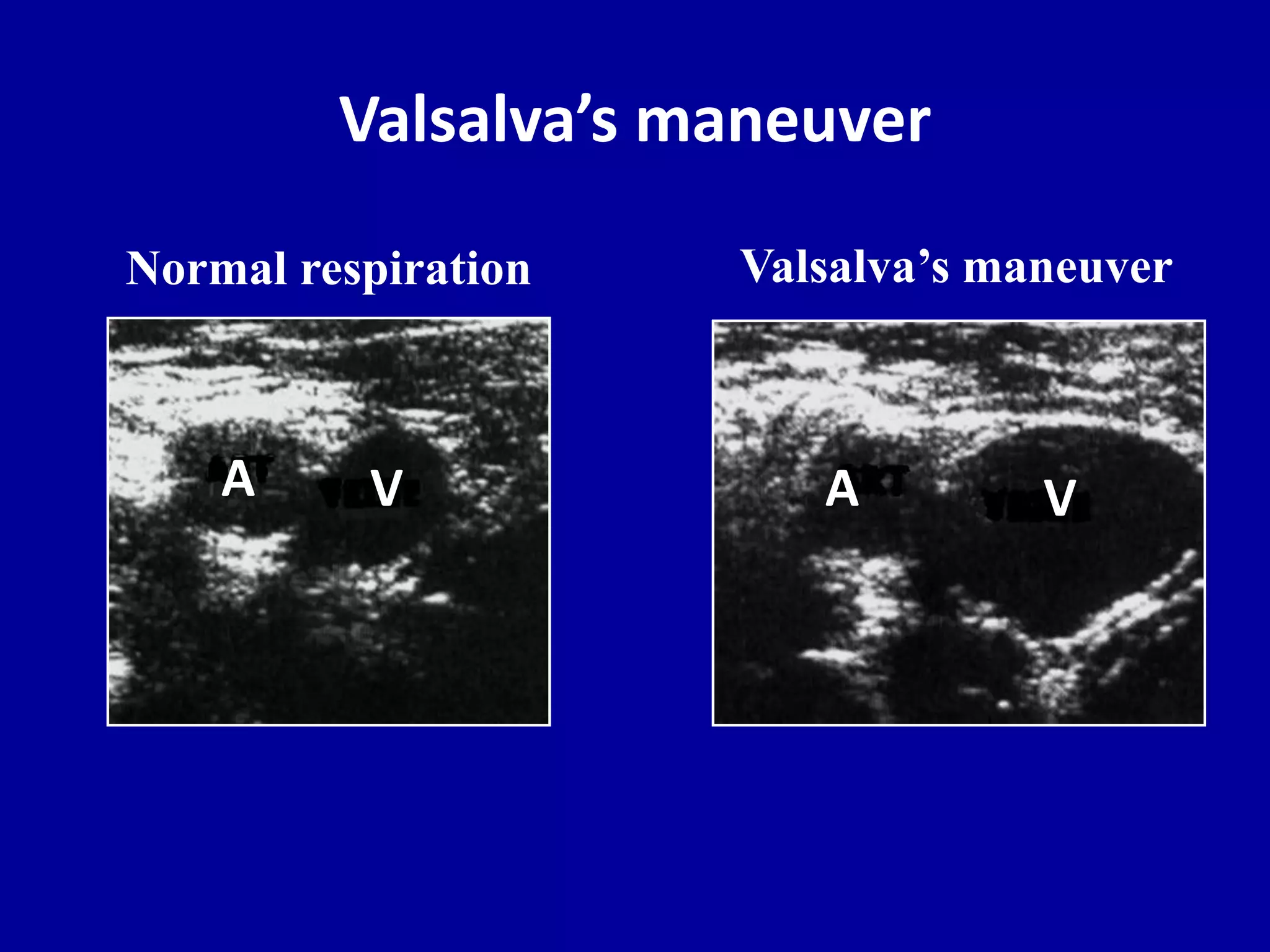
 Valsalva Deep breath, strain while holding breath
Patency of abdominal & pelvic veins
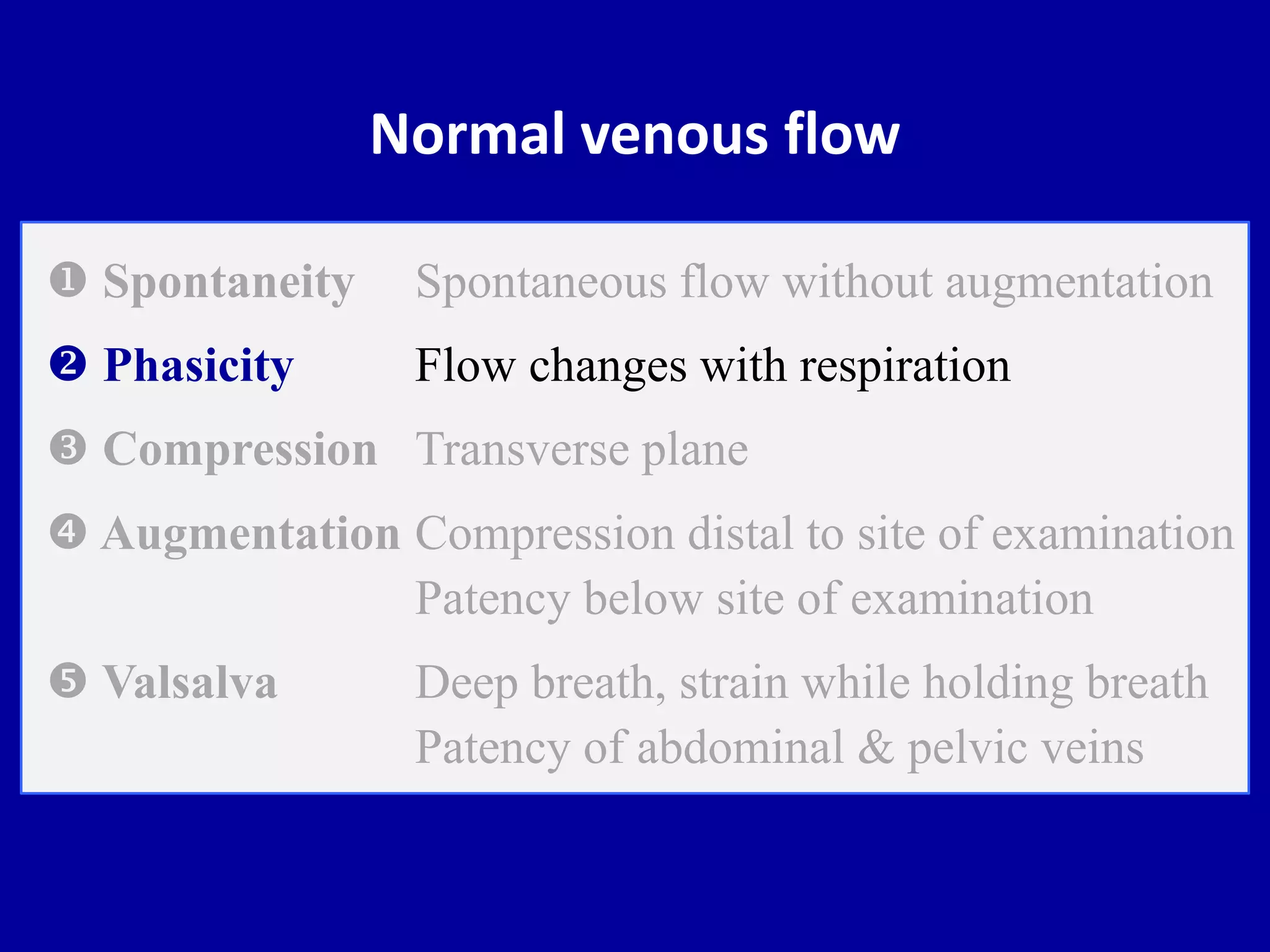
Normal venous flow
 Spontaneity Spontaneous flow without augmentation
 Phasicity Flow changes with respiration
 Compression Transverse plane
 Augmentation Compression distal to site of examination
Patency below site of examination
 Valsalva Deep breath, strain while holding breath
Patency of abdominal & pelvic veins
Phasicity
Flow changes with respiration
Slow ApneaRapid
Normal venous flow
 Spontaneity Spontaneous flow without augmentation
 Phasicity Flow changes with respiration
 Compression Transverse plane
 Augmentation Compression distal to site of examination
Patency below site of examination
 Valsalva Deep breath, strain while holding breath
Patency of abdominal & pelvic veins
Compressibility of veins
Do not press too hard since the normal vein collapses
very easily making it difficult to find11
Incompressibility = Thrombus
Do not compress vein more than necessary in recent thrombus
Fear of detaching thrombus to cause PE
Myers KA & Clough A. Making sense of vascular ultrasound. Arnold, London, 2004.
External compression of the vein
Relaxation Compression
A
Normal venous flow
 Spontaneity Spontaneous flow without augmentation
 Phasicity Flow changes with respiration
 Compression Transverse plane
 Augmentation Compression distal to site of examination
Patency below site of examination
 Valsalva Deep breath, strain while holding breath
Patency of abdominal & pelvic veins
Augmented flow in popliteal vein
Aug Competent vein
Normal venous flow
 Spontaneity Spontaneous flow without augmentation
 Phasicity Flow changes with respiration
 Compression Transverse plane
 Augmentation Compression distal to site of examination
Patency below site of examination
 Valsalva Deep breath, strain while holding breath
Patency of abdominal & pelvic veins
Valsalva’s maneuver
Valsalva’s maneuver
A V
Normal respiration
A V
Valsalva maneuver
Start
Valsalva
End
Valsalva
Competent vein
Indicate on the report whether
the examination was excellent, good or poor
Emphasize if a scan is suboptimal
Myers KA & Clough A. Making sense of vascular ultrasound. Arnold, London, 2004.
References
Arnold – 2004 Elsevier – 2005 Elsevier Mosby – 2005
Thank You

Principles of Doppler ultrasound

  • 1.
    Principles of Dopplerultrasound Samir Haffar M.D. Department of Internal Medicine
  • 2.
     General principles Spectral-specific parameters  Color-specific parameters  Power Doppler imaging  Normal flow in arteries  Normal flow in veins Principles of Doppler ultrasound
  • 3.
     General principlesof Doppler ultrasound
  • 4.
    Christian Doppler (1803– 1853) Famous for what is called now the “Doppler effect” 1841 Professor of mathematics & physics Prague polytechnic 1842 Published his famous book “On the colored light of the binary stars & some other stars of the heavens” 1850 Head of institute of experimental physics Vienna University Austrian physicist
  • 5.
    The Doppler effect Proposedby Christian Doppler in 1842 • Change in frequency of a wave for an observer moving relative to the source of the wave • Commonly heard when a vehicle sounding a siren approaches, passes, & recedes from an observer • Received frequency Higher during approach Identical at instant of passing by Lower during recession
  • 6.
    What is theDoppler phenomenon? Thrush A, Hartshorne T. Peripheral vascular ultrasound: how, why and when. Elsevier Churchill Livingstone, London, 2nd edition, 2005. = ft > ft = ft < ft
  • 7.
    What is theDoppler phenomenon? Doppler shift frequency (fd): ft – fr Thrush A, Hartshorne T. Peripheral vascular ultrasound: How, why and when. Elsevier Churchill Livingstone, London, 2nd edition, 2005. ft fr
  • 8.
    Doppler equation ∆ FDoppler shift frequency (kHz) F0 Ultrasound transmission frequency (MHz) V Blood cell velocity (cm/sec) Cos Ө Cos of angle between US & flow direction C Speed of sound in soft tissue (1 540 m/sec) ∆ F = 2 F0 V Cos Ө / C
  • 9.
    Goals of Doppler •Detection flow in a vessel • Detection direction of flow • Detection type of flow: Arterial or venous Normal or abnormal • Measurement the velocity of flow
  • 10.
    Types of Doppler Continuous wave Doppler  Spectral Doppler (duplex)  Spectral & color Doppler (triplex)  Power Doppler
  • 11.
    All Doppler ultrasoundexaminations should be performed with: Tahmasebpour HR et al. RadioGraphics 2005 ; 25 : 1561 – 1575. • Gray-scale US • Color Doppler • Spectral Doppler • Power Doppler
  • 12.
  • 13.
    Spectral Doppler Angle correction cursor Beampath Sample volume Baseline EDV Thrush A, Hartshorne T. Peripheral vascular ultrasound: How, why and when. Elsevier Churchill Livingstone, London, 2nd edition, 2005. PSV
  • 14.
    Doppler shift frequency& angle of insonation Thrush A, Hartshorne T. Peripheral vascular ultrasound: How, why and when. Elsevier Churchill Livingstone, London, 2nd edition, 2005.
  • 15.
    Use of spectralbaseline Normal baseline Inverted baseline Dropping baseline
  • 16.
    Sample volume length Largesample volume lengthSmall sample volume length Thrush A, Hartshorne T. Peripheral vascular ultrasound: How, why and when. Elsevier Churchill Livingstone, London, 2nd edition, 2005.
  • 17.
    Optimizing gate size& position Kruskal JB et al.RadioGraphics 2004 ; 24 : 657 – 675. Wide gate including PV (above baseline) & HV (below baseline) Gate should be positioned over central part of the studied vessel
  • 18.
    Doppler equation ∆ FDoppler shift frequency (kHz) F0 Ultrasound transmission frequency (MHz) V Blood cell velocity (cm/sec) Cos Ө Cos of angle between US & flow direction C Speed of sound in soft tissue (1 540 m/sec) ∆ F = 2 F0 V Cos Ө / C
  • 19.
    Percentage error invelocity measurements & angle of insonation In order to minimize this error, angles of insonation > 60% should not be used
  • 20.
    Optimizing Doppler angle Largerthe angle, greater the error • Ideally should be zero Usually not possible • Smallest angle possible Not under our control • Do not use angle > 60 Great error in velocity • Angle 90 Complete loss of flow • Transducer position Obtain smaller angle • Different US systems May be different results Thrush A, Hartshorne T. Peripheral vascular ultrasound: How, why and when. Elsevier Churchill Livingstone, London, 2nd edition, 2005.
  • 21.
    Doppler angle measurement Angle:60 PSV: 110 cm/sec EDV: 41 cm/sec Angle: 44 PSV: 74 cm/sec EDV: 27 cm/sec Thrush A et al. Peripheral vascular ultrasound. Elsevier Churchill Livingstone, London, 2005.
  • 22.
    Changing position ofthe transducer IntercostalTransabdominal Subcostal Kruskal JB et al.RadioGraphics 2004 ; 24 : 657 – 675.
  • 23.
    Adjusting spectral velocityscale Spectral scale: 200 cm/sec Spectral scale: 50 cm/sec Kruskal JB et al.RadioGraphics 2004 ; 24 : 657 – 675. Color Doppler image, color bar, & color scale unchanged Spectral component is active
  • 24.
    Adjusting spectral Dopplergain Gain setting 0% Gain setting 38% Gain setting 77% Gain setting 100% Kruskal JB et al.RadioGraphics 2004 ; 24 : 657 – 675.
  • 25.
    Spectral wall filter Wallfilter 75 Hz Wall thump removed Wall filter 550 Hz Filter frequency too high Altered waveform Wall filter 50 Hz Wall thump Thrush A, Hartshorne T. Peripheral vascular ultrasound: How, why and when. Elsevier Churchill Livingstone, London, 2nd edition, 2005.
  • 26.
    Spectral aliasing CCA Dropping baselineIncreasing scalePeaks cross baseline Rubens DJ et al. Doppler artifacts & pitfalls. Ultrasound Clin 2006 ; 1 : 79 – 109.
  • 27.
  • 28.
  • 29.
    Changing color baseline KruskalJB et al.RadioGraphics 2004 ; 24 : 657 – 675. When color baseline changed → color velocity range changed Range of depicted velocities remains constant
  • 30.
    Examples of differentcolor maps Thrush A, Hartshorne T. Peripheral vascular ultrasound: How, why and when. Elsevier Churchill Livingstone, London, 2nd edition, 2005. Velocity range (cm/sec) Inversion of color map Color write priority Baseline wall filter
  • 31.
    Inversion of colorflow Kruskal JB et al.RadioGraphics 2004 ; 24 : 657 – 675. Reversal of this inversion Appropriate directional flow noted Portal venous flow appears blue Falsely suggests flow reversal
  • 32.
    Inversion of spectralflow Kruskal JB et al.RadioGraphics 2004 ; 24 : 657 – 675.
  • 33.
    Color box size/ Overlay Kruskal JB et al.RadioGraphics 2004 ; 24 : 657 – 675. Oversized color box ↑ frame rate & ↓ resolution Reduced color box size ↓ frame rate & ↑ resolution Color box should be as small & superficial as possible
  • 34.
    Doppler angle effects ThrushA, Hartshorne T. Peripheral vascular ultrasound: How, why and when. Elsevier Churchill Livingstone, London, 2nd edition, 2005.
  • 35.
    Color box steering Changingangle of insonation Large angle Unusable image Small angle Good image Moderate angle Flow is not optimal Steered either left or right by a maximum of 20 – 25 Sensitivity of transducer decreases as beam is steered Thrush A et al. Peripheral vascular ultrasound. Elsevier Churchill Livingstone, 2nd edition, 2005.
  • 36.
    Color box steeredin more than one direction to demonstrate flow in the whole vessel Color box steering Thrush A et al. Peripheral vascular ultrasound. Elsevier Churchill Livingstone, 2nd edition, 2005.
  • 37.
    Adjusting color velocityscale Kruskal JB et al.RadioGraphics 2004 ; 24 : 657 – 675. Color velocity scale 2 cm/sec Color aliasing in PV & its branches High color velocity scale (69 cm/sec) Apparent absence of flow in PV Color velocity scale 30 cm/sec Normal flow in a patent PV
  • 38.
    Color Doppler aliasing Velocityscale range 12 cm/sec Velocity scale range 23 cm/sec Rubens DJ et al. Doppler artifacts & pitfalls. Ultrasound Clin 2006 ; 1 : 79 – 109.
  • 39.
    Portal vein pseudo-clot Velocityscale: 20 cm/s Velocity scale: 7 cm/s
  • 40.
    Adjusting color gain KruskalJB et al.RadioGraphics 2004 ; 24 : 657 – 675. Color gain should be set as high as possible without displaying random color speckles Color gain 44% Color gain 65% Color gain 100%
  • 41.
    Adjusting color gain Flow„bleeding out‟ of the vessel Color gain set too high Thrush A, Hartshorne T. Peripheral vascular ultrasound: How, why and when. Elsevier Churchill Livingstone, London, 2nd edition, 2005.
  • 42.
    Adjusting color wallfilter Filter setting displayed on color scale (horizontal arrow) Filter too high Removing low flow Filter setting reduced Display low flow Thrush A, Hartshorne T. Peripheral vascular ultrasound: How, why and when. Elsevier Churchill Livingstone, London, 2nd edition, 2005.
  • 43.
    Pseudo-thrombosis of mainPV Adjusting velocity & angle of insonation Velocity: 24 cm/sec Wall filter: medium Angle 90 Velocity: 7 cm/sec Wall filter: medium Angle < 90 Radiol Clin N Am 2006 ; 44 : 805 – 835.
  • 44.
    Doppler panel onconsole of many contemporary US imagers Each parameter can be adjusted to optimize spectral or color Doppler components of the examination Kruskal JB et al.RadioGraphics 2004 ; 24 : 657 – 675.
  • 45.
    Clinical & tissue-specificpresets • Clinical option General Adult Obstetric (etc…) • Tissue-specific preset Abdomen Renal Transplant (etc...) Kruskal JB et al.RadioGraphics 2004 ; 24 : 657 – 675. Once a transducer selected preset choices includes:
  • 46.
    Guidelines for optimalDoppler examination  Adjust gain & filter  Adjust velocity scale & baseline  Doppler angle < 60 by steering & probe position  Color box as small & superficial as possible  Sample volume size: 2/3 of vessel width in the center  Avoid transducer motion Rubens DJ et al. Doppler artifacts & pitfalls. Ultrasound Clin 2006 ; 1 : 79 – 109.
  • 47.
  • 48.
    Advantages of powermode Doppler • No aliasing • Angle independent • Increased sensitivity to detect low-velocity flow Distinguish pre-occlusive from occlusive lesions Superior depiction of plaque surface morphology • Useful in imaging tortuous vessels • Increases accuracy of grading stenosis
  • 49.
    Power Doppler imaging Largeplaque ulcer ICA Narrow flow channel in ICA “string sign” or “trickle flow ”
  • 50.
    Disadvantages of powerDoppler imaging • Do not provide velocity of flow • Do not provide direction of flow New machines provide direction of flow in power mode • Very motion sensitive (poor temporal resolution) Less suitable for rapid scan along vessels
  • 51.
     Normal flowin arteries & veins
  • 52.
    Flow at acurvature & bifurcation Myers KA & Clough A. Making sense of vascular ultrasound. Arnold, London, 2004. Apex of parabola moves away from concave wall at a curve Apex of parabola moves away from outer wall at bifurcation
  • 53.
    Flow around curvesin a vessel Tortuous ICA Thrush A, Hartshorne T. Peripheral vascular ultrasound: How, why and when. Elsevier Churchill Livingstone, London, 2nd edition, 2005. A B A PSV outside the bend 70 cm/sec B PSV inside the bend 55 cm/sec
  • 54.
    Normal flow reversalzone in ICA Opposite to origin of the ECAHigh velocities near flow divider Reversal on opposite side to flow divider Thrush A et al. Peripheral vascular ultrasound. Elsevier Churchill Livingstone, London, 2005.
  • 55.
    High & lowresistance arterial flow High-resistance flow SFA Low-resistance flow ICA Myers KA & Clough A. Making sense of vascular ultrasound. Arnold, London, 2004.
  • 56.
    Arterial high resistanceflow Typical normal Doppler spectra Normal anterior tibial arteryTriphasic flow
  • 57.
    Pulsatility index Most commonlyused of all indices S Systolic D Minimum diastolic M Mean PI S – D / M
  • 58.
    Effect of exerciseon flow Dorsalis Pedis Artery at rest Triphasic flow Thrush A, Hartshorne T. Peripheral vascular ultrasound: How, why and when. Elsevier Churchill Livingstone, London, 2nd edition, 2005. DPA following exercise Monophasic hyperemic flow
  • 59.
    Arterial monophasic flow •Hyperemic Exercise Infection Temporary arterial occlusion by blood pressure cuff • Distal to severe stenosis or occlusion Low velocity Longer rise time* Tardus-Parvus wave * Rise time: time between beginning of systole & peak systole
  • 60.
    Tardus-Parvus wave Distal tosevere stenosis or occlusion Thrush A, Hartshorne T. Peripheral vascular ultrasound: How, why and when. Elsevier Churchill Livingstone, London, 2nd edition, 2005. Tardus: Longer rise time Parvus: Low PSV
  • 61.
    Arterial low resistanceflow Typical normal Doppler spectra Normal internal carotid artery
  • 62.
    Pourcelot’s resistance index RIS – ED / S Normal 50 – 70 % Abnormal > 80 %
  • 63.
    Accleration Time (AT) orRise Time (RT) • Length of time in seconds from onset of systole to peak systole • Normal value: ≤ 0.07 second
  • 64.
    Acceleration index AI = X(KHz) Probe frequency (MHz) Normal value: > 3.8 cm/s2
  • 65.
    Aacleration time &PSV Early systolic pick AJR - Dec 1995 Biphasic with late systolic pick Monophasic with late systolic pick
  • 66.
    AT & AIaccording to degree of stenosis Moderate stenosis 50 – 85% Normal Severe stenosis > 85 %
  • 67.
    Measurement of volumeflow Volume = Cross-sectional area Mean velocity 60 (ml/min) (cm2) (cm/sec) Cross-sectional area (cm2): π d2 / 4 d: diameter
  • 68.
    Doppler equation Converting Dopplershift frequency to velocity ∆ F Doppler shift frequency (kHz) F0 Ultrasound transmission frequency (MHz) V Blood cell velocity (cm/sec) Cos Ө Cos of angle between US & flow direction C Speed of sound in soft tissue (1 540 m/sec) ∆ F = 2 F0 V Cos Ө / C
  • 69.
    ∆ F F0 V ? CosӨ C ∆ F = 2 F0 V Cos Ө / C 50 cm/s 1.6 kHz 5 MHz 60 1 540 m/sec Thrush A, Hartshorne T. Peripheral vascular ultrasound: How, why and when. Elsevier Churchill Livingstone, London, 2nd edition, 2005. Doppler equation Converting Doppler shift frequency to velocity
  • 70.
    Blood flow &PSV changes related to severity of arterial stenosis Myers KA & Clough A. Making sense of vascular ultrasound. Arnold, London, 2004.
  • 71.
    Flow through astenosis Thrush A, Hartshorne T. Peripheral vascular ultrasound: How, why and when. Elsevier Churchill Livingstone, London, 2nd edition, 2005. Increased velocity through stenosis Flow reversal beyond stenosis CCA IJV ICA  Color from red to turquoise  Posterior wall – deep blue
  • 72.
    Pic Systolic Velocityratio Robbin ML et al. Ultrasound Clin 2006 ; 1 : 111 – 131. Proximal: 2 cm proximal to stenosis Same Doppler angle if possible
  • 73.
    Post-stenotic zone/Spectral broadening Proportionalto severity of stenosis • Cannot be precisely quantified (evaluated visually) Fill-in of spectral window > 50% diameter reduction Severely disturbed flow > 70% diameter reduction High amplitude & low frequency signal Low amplitude & high frequency signal Flow reversal – Poor definition of spectral border • May be only sign of stenosis: calcified plaque
  • 74.
  • 75.
    Pseudospectral broadening • Highgain setting • Vessel wall motion • Site of branching • Abrupt change in vessel diameter • ↑ velocity: athlete, high cardiac output, AVF1, & AVM2 • Tortuous vessels • Aneurysm, dissection, & FMD3 1AVF: Arterio-Venous Fistula 2AVM: Arterio-Venous Malformation 3FMD: Fibro-Muscular Dysplasia
  • 76.
    Color Doppler bruit Extensivesoft tisuue color Doppler bruit surrounds the carotid bifurcation with 90% ICA stenosis
  • 77.
    Venous valve Two cupsof a valve clearly seen It is uncommon to see venous valves with this clarity
  • 78.
    Normal venous flow Spontaneity Spontaneous flow without augmentation  Phasicity Flow changes with respiration  Compression Transverse plane  Augmentation Compression distal to site of examination Patency below site of examination  Valsalva Deep breath, strain while holding breath Patency of abdominal & pelvic veins
  • 79.
    Normal venous flow Spontaneity Spontaneous flow without augmentation  Phasicity Flow changes with respiration  Compression Transverse plane  Augmentation Compression distal to site of examination Patency below site of examination  Valsalva Deep breath, strain while holding breath Patency of abdominal & pelvic veins
  • 80.
    Phasicity Flow changes withrespiration Slow ApneaRapid
  • 81.
    Normal venous flow Spontaneity Spontaneous flow without augmentation  Phasicity Flow changes with respiration  Compression Transverse plane  Augmentation Compression distal to site of examination Patency below site of examination  Valsalva Deep breath, strain while holding breath Patency of abdominal & pelvic veins
  • 82.
    Compressibility of veins Donot press too hard since the normal vein collapses very easily making it difficult to find11
  • 83.
    Incompressibility = Thrombus Donot compress vein more than necessary in recent thrombus Fear of detaching thrombus to cause PE Myers KA & Clough A. Making sense of vascular ultrasound. Arnold, London, 2004.
  • 84.
    External compression ofthe vein Relaxation Compression A
  • 85.
    Normal venous flow Spontaneity Spontaneous flow without augmentation  Phasicity Flow changes with respiration  Compression Transverse plane  Augmentation Compression distal to site of examination Patency below site of examination  Valsalva Deep breath, strain while holding breath Patency of abdominal & pelvic veins
  • 86.
    Augmented flow inpopliteal vein Aug Competent vein
  • 87.
    Normal venous flow Spontaneity Spontaneous flow without augmentation  Phasicity Flow changes with respiration  Compression Transverse plane  Augmentation Compression distal to site of examination Patency below site of examination  Valsalva Deep breath, strain while holding breath Patency of abdominal & pelvic veins
  • 88.
  • 89.
  • 90.
    Indicate on thereport whether the examination was excellent, good or poor Emphasize if a scan is suboptimal Myers KA & Clough A. Making sense of vascular ultrasound. Arnold, London, 2004.
  • 91.
    References Arnold – 2004Elsevier – 2005 Elsevier Mosby – 2005
  • 92.

Editor's Notes

  • #9 Ө (theta), also referred to as the Doppler angle,is the angle between the transmitted beam and the direction ofblood flow within the blood vessel (the reflector path). Converting Doppler shift frequencies to velocity measurements.
  • #19 Ө (theta), also referred to as the Doppler angle,is the angle between the transmitted beam and the direction ofblood flow within the blood vessel (the reflector path). Converting Doppler shift frequencies to velocity measurements.
  • #20 The larger the angle of insonation, the greater the potential source of error in velocity measurement.
  • #31 Because each pixel is displayed either as gray-scale or color, increasing the color priority will permit color information to be displayed where low-intensity signals may be present, such as at the periphery of vessels. Alternatively, increasing the gray-scale priority will result in grayscale information being depicted and displacingcolor data. Depending on the manufacturer, many US imagers permit adjustment of the color priority on a scale that is often depicted adjacent to the color bar.
  • #34 The frame rate is the rate per second at which complete images are produced.With pulse-echo imaging alone, the frame rate can exceed 50 images per second.However, the time required to produce color flow images is much longer, which significantly lowers the frame rate. The frame rate in color imaging is dependent on several factors.For example, the size and position of the color box have a great effect on the frame rate. The width of the box is especially important: The wider the box, the more scan lines are required and the longer it will taketo acquire the data to produce the image.
  • #42 Arrow shows position of posterior artery wall
  • #61 Tardus: slowed systolic accelerationParvus: low-amplitude systolic peak
  • #65 AI: acceleration index Systolic upslope/transducer frequency (cm/s2)
  • #68 Doppler spectrum showing the measurement of PSV &amp; EDV.Mean velocity can be calculated from the Doppler spectrum, displayed by the black line. A large sample volume allow the blood velocity at anterior and posterior walls, as well as in center of the vessel, to be estimated but may not detect the flow along the lateral wall. Time-averaged mean velocity (TAM) can be found by averaging the mean velocity over one or more complete cardiac cycles. Volume flow can be calculated by multiplying the TAM measurement by the cross-sectional area of the vessel.Reference:Thrush A, Hartshorne T. Peripheral vascular ultrasound: How, why and when.Elsevier Churchill Livingstone, London, 2nd edition, 2005.
  • #69 Ө (theta), also referred to as the Doppler angle,is the angle between the transmitted beam and the direction ofblood flow within the blood vessel (the reflector path). Converting Doppler shift frequencies to velocity measurements.
  • #70 Ө (theta), also referred to as the Doppler angle,is the angle between the transmitted beam and the direction ofblood flow within the blood vessel (the reflector path). Converting Doppler shift frequencies to velocity measurements.
  • #77 Turbulence in an artery causes its wall to vibrate and this produces a noise propagated through tissues that can be heard with a stethoscope or seen on an ultrasound scan.It may require an increase in velocity by exercising to reduce peripheral resistance to cause sufficient turbulence to allow a bruit to be heard.