DR/ABD ALLAH NAZEER. MD.
Basic Principles of Ultrasound.
Ultrasound Definition
Physics.
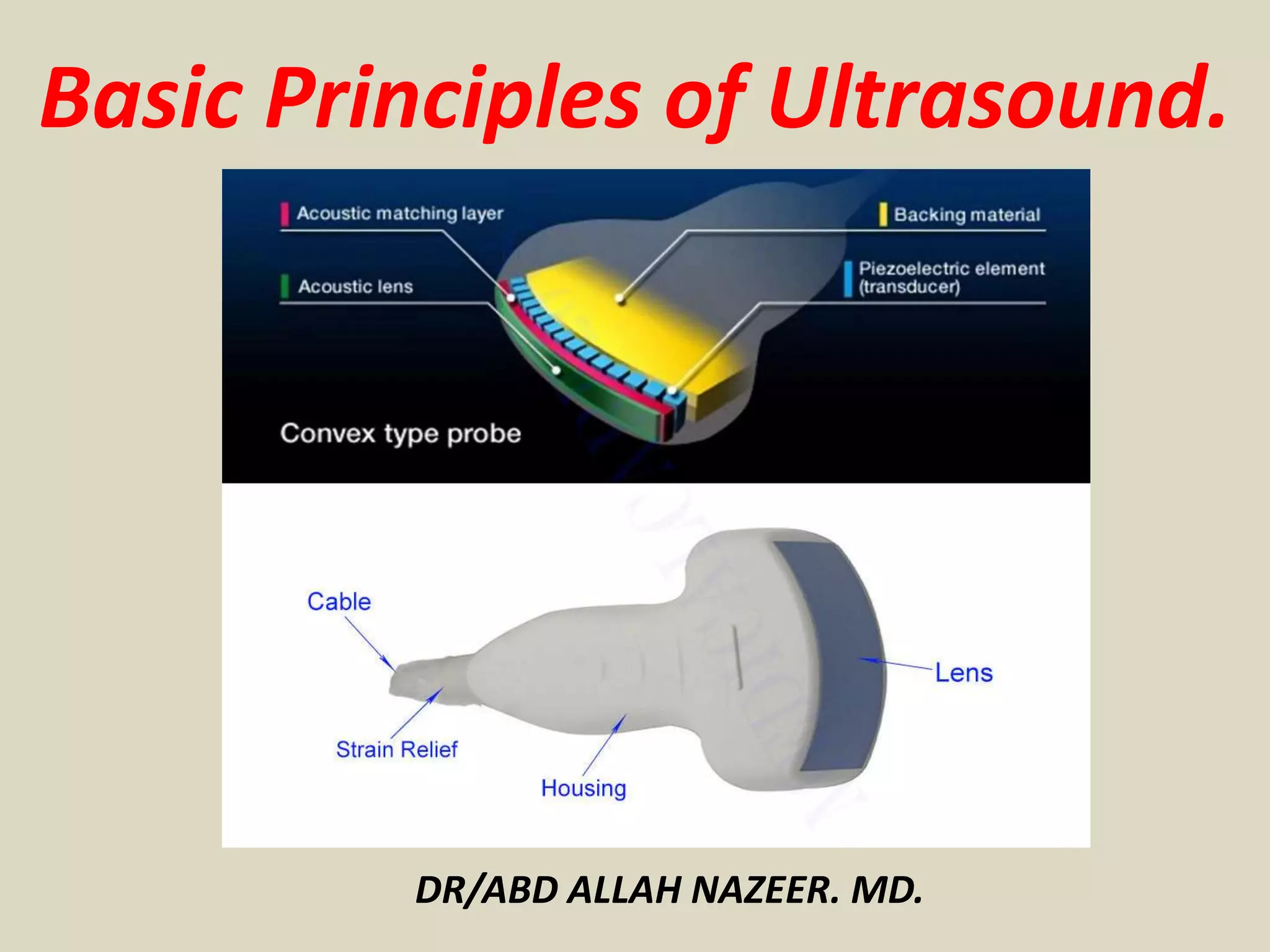
Transducer.
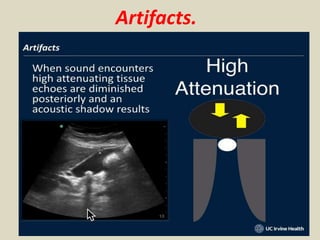
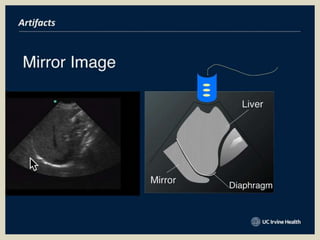
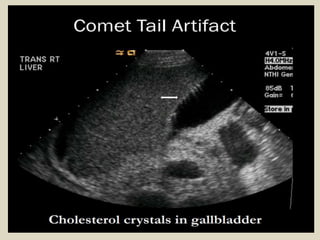
Artifacts.
Terminology.
Sound is a mechanical, longitudinal wave
that travels in a straight line and
measured by cycle per second by
Hertz(Hz) unit. Audible Sound 20-20,000
Hz.
Sound requires a medium through which to
travel.
Ultrasound is a mechanical, longitudinal
pressure wave with a frequency exceeding
the upper limit of human hearing, which is
20,000 Hz or 20 kHz. Medical Ultrasound
is > 2MHz,(2MHz to 16MHz).
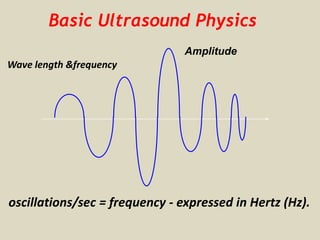
Basic Ultrasound Physics
Amplitude
oscillations/sec = frequency - expressed in Hertz (Hz).
Wave length &frequency
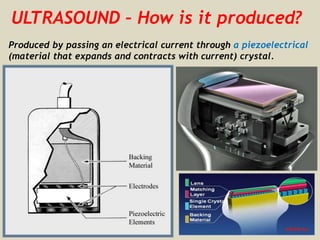
ULTRASOUND – How is it produced?
Produced by passing an electrical current through a piezoelectrical
(material that expands and contracts with current) crystal.
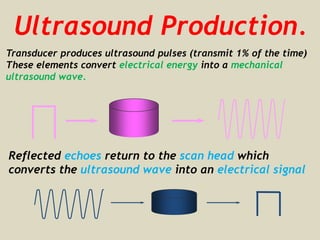
Ultrasound Production.
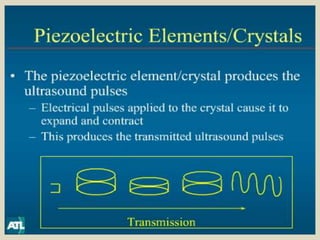
Transducer produces ultrasound pulses (transmit 1% of the time)
These elements convert electrical energy into a mechanical
ultrasound wave.
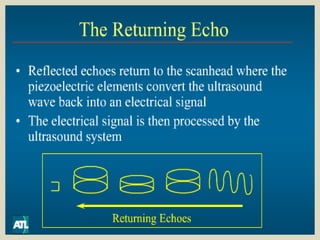
Reflected echoes return to the scan head which
converts the ultrasound wave into an electrical signal
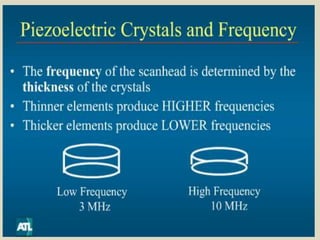
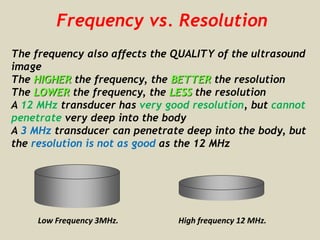
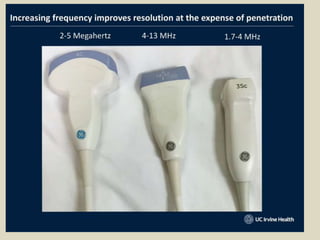
Frequency vs. Resolution
The frequency also affects the QUALITY of the ultrasound
image
The HIGHER the frequency, the BETTER the resolution
The LOWER the frequency, the LESS the resolution
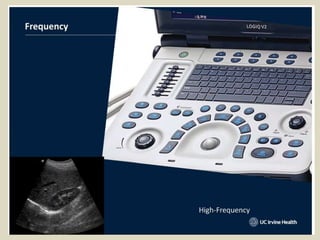
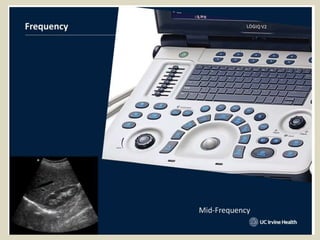
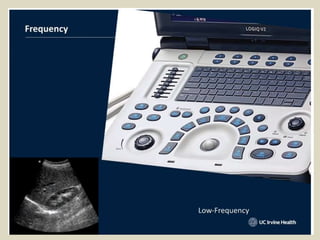
A 12 MHz transducer has very good resolution, but cannot
penetrate very deep into the body
A 3 MHz transducer can penetrate deep into the body, but
the resolution is not as good as the 12 MHz
Low Frequency 3MHz. High frequency 12 MHz.
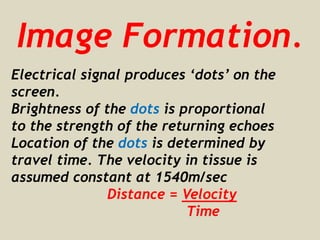
Image Formation.
Electrical signal produces ‘dots’ on the
screen.
Brightness of the dots is proportional
to the strength of the returning echoes
Location of the dots is determined by
travel time. The velocity in tissue is
assumed constant at 1540m/sec
Distance = Velocity
Time
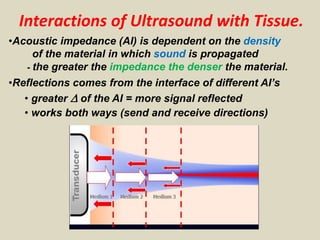
Interactions of Ultrasound with Tissue.
•Acoustic impedance (AI) is dependent on the density
of the material in which sound is propagated
- the greater the impedance the denser the material.
•Reflections comes from the interface of different AI’s
• greater  of the AI = more signal reflected
• works both ways (send and receive directions)
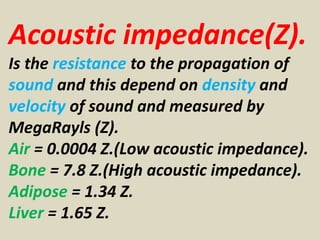
Acoustic impedance(Z).
Is the resistance to the propagation of
sound and this depend on density and
velocity of sound and measured by
MegaRayls (Z).
Air = 0.0004 Z.(Low acoustic impedance).
Bone = 7.8 Z.(High acoustic impedance).
Adipose = 1.34 Z.
Liver = 1.65 Z.
Interactions of Ultrasound
with Tissue
Reflection.
Refraction.
Transmission.
Attenuation.
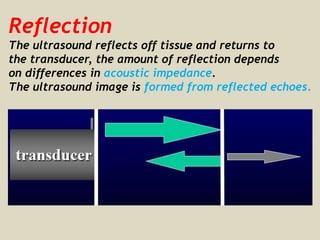
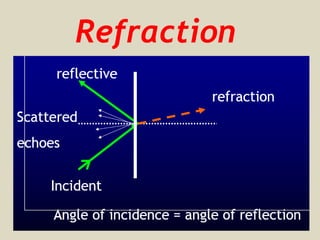
Reflection
The ultrasound reflects off tissue and returns to
the transducer, the amount of reflection depends
on differences in acoustic impedance.
The ultrasound image is formed from reflected echoes.
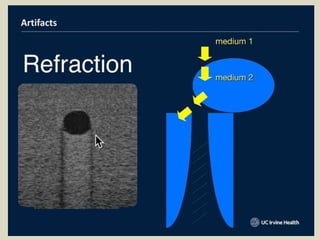
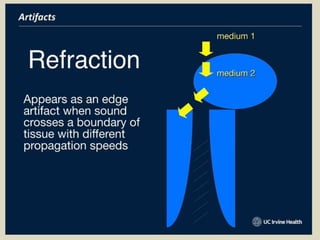
Refraction
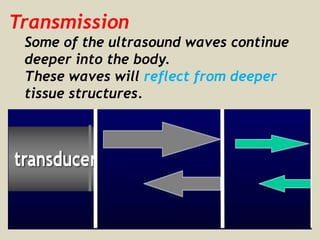
Transmission
Some of the ultrasound waves continue
deeper into the body.
These waves will reflect from deeper
tissue structures.
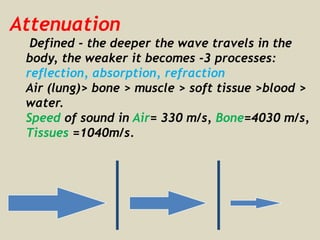
Attenuation
Defined - the deeper the wave travels in the
body, the weaker it becomes -3 processes:
reflection, absorption, refraction
Air (lung)> bone > muscle > soft tissue >blood >
water.
Speed of sound in Air= 330 m/s, Bone=4030 m/s,
Tissues =1040m/s.
Machines and
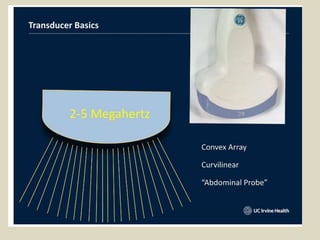
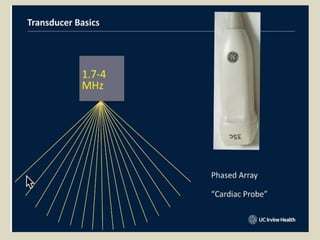
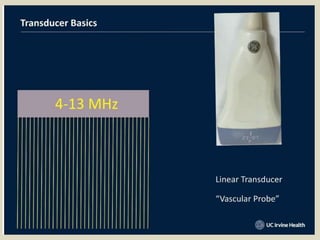
Transducers.
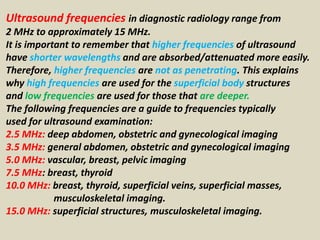
Ultrasound frequencies in diagnostic radiology range from
2 MHz to approximately 15 MHz.
It is important to remember that higher frequencies of ultrasound
have shorter wavelengths and are absorbed/attenuated more easily.
Therefore, higher frequencies are not as penetrating. This explains
why high frequencies are used for the superficial body structures
and low frequencies are used for those that are deeper.
The following frequencies are a guide to frequencies typically
used for ultrasound examination:
2.5 MHz: deep abdomen, obstetric and gynecological imaging
3.5 MHz: general abdomen, obstetric and gynecological imaging
5.0 MHz: vascular, breast, pelvic imaging
7.5 MHz: breast, thyroid
10.0 MHz: breast, thyroid, superficial veins, superficial masses,
musculoskeletal imaging.
15.0 MHz: superficial structures, musculoskeletal imaging.
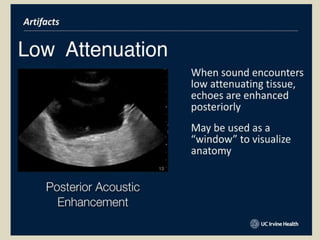
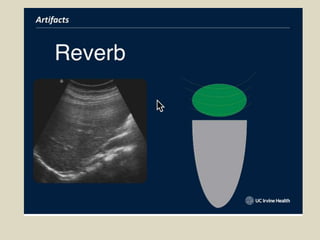
Artifacts.
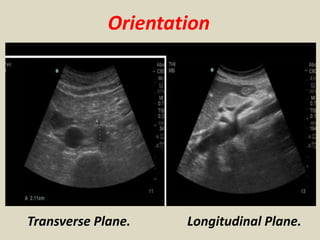
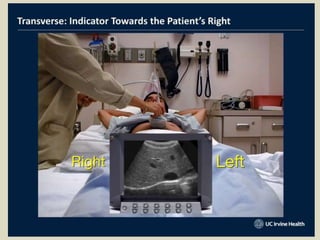
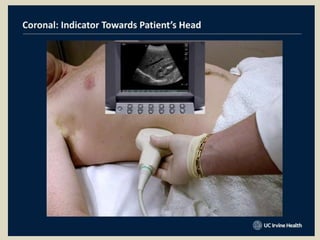
Orientation
Longitudinal Plane.Transverse Plane.
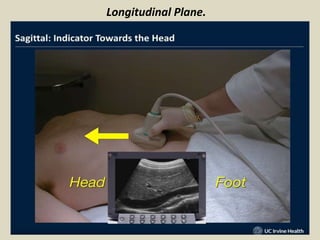
Longitudinal Plane.
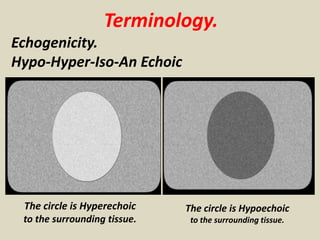
Terminology.
Echogenicity.
Hypo-Hyper-Iso-An Echoic
The circle is Hyperechoic
to the surrounding tissue.
The circle is Hypoechoic
to the surrounding tissue.
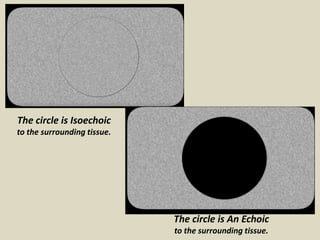
The circle is Isoechoic
to the surrounding tissue.
The circle is An Echoic
to the surrounding tissue.
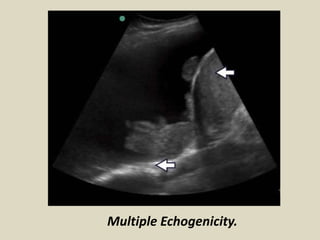
Multiple Echogenicity.
Thank You.

Presentation1, basic principle of ultrasound.

  • 1.
    DR/ABD ALLAH NAZEER.MD. Basic Principles of Ultrasound.
  • 2.
  • 3.
    Sound is amechanical, longitudinal wave that travels in a straight line and measured by cycle per second by Hertz(Hz) unit. Audible Sound 20-20,000 Hz. Sound requires a medium through which to travel. Ultrasound is a mechanical, longitudinal pressure wave with a frequency exceeding the upper limit of human hearing, which is 20,000 Hz or 20 kHz. Medical Ultrasound is > 2MHz,(2MHz to 16MHz).
  • 4.
    Basic Ultrasound Physics Amplitude oscillations/sec= frequency - expressed in Hertz (Hz). Wave length &frequency
  • 5.
    ULTRASOUND – Howis it produced? Produced by passing an electrical current through a piezoelectrical (material that expands and contracts with current) crystal.
  • 9.
    Ultrasound Production. Transducer producesultrasound pulses (transmit 1% of the time) These elements convert electrical energy into a mechanical ultrasound wave. Reflected echoes return to the scan head which converts the ultrasound wave into an electrical signal
  • 10.
    Frequency vs. Resolution Thefrequency also affects the QUALITY of the ultrasound image The HIGHER the frequency, the BETTER the resolution The LOWER the frequency, the LESS the resolution A 12 MHz transducer has very good resolution, but cannot penetrate very deep into the body A 3 MHz transducer can penetrate deep into the body, but the resolution is not as good as the 12 MHz Low Frequency 3MHz. High frequency 12 MHz.
  • 11.
    Image Formation. Electrical signalproduces ‘dots’ on the screen. Brightness of the dots is proportional to the strength of the returning echoes Location of the dots is determined by travel time. The velocity in tissue is assumed constant at 1540m/sec Distance = Velocity Time
  • 12.
    Interactions of Ultrasoundwith Tissue. •Acoustic impedance (AI) is dependent on the density of the material in which sound is propagated - the greater the impedance the denser the material. •Reflections comes from the interface of different AI’s • greater  of the AI = more signal reflected • works both ways (send and receive directions)
  • 13.
    Acoustic impedance(Z). Is theresistance to the propagation of sound and this depend on density and velocity of sound and measured by MegaRayls (Z). Air = 0.0004 Z.(Low acoustic impedance). Bone = 7.8 Z.(High acoustic impedance). Adipose = 1.34 Z. Liver = 1.65 Z.
  • 14.
    Interactions of Ultrasound withTissue Reflection. Refraction. Transmission. Attenuation.
  • 15.
    Reflection The ultrasound reflectsoff tissue and returns to the transducer, the amount of reflection depends on differences in acoustic impedance. The ultrasound image is formed from reflected echoes.
  • 16.
  • 17.
    Transmission Some of theultrasound waves continue deeper into the body. These waves will reflect from deeper tissue structures.
  • 18.
    Attenuation Defined - thedeeper the wave travels in the body, the weaker it becomes -3 processes: reflection, absorption, refraction Air (lung)> bone > muscle > soft tissue >blood > water. Speed of sound in Air= 330 m/s, Bone=4030 m/s, Tissues =1040m/s.
  • 19.
  • 25.
    Ultrasound frequencies indiagnostic radiology range from 2 MHz to approximately 15 MHz. It is important to remember that higher frequencies of ultrasound have shorter wavelengths and are absorbed/attenuated more easily. Therefore, higher frequencies are not as penetrating. This explains why high frequencies are used for the superficial body structures and low frequencies are used for those that are deeper. The following frequencies are a guide to frequencies typically used for ultrasound examination: 2.5 MHz: deep abdomen, obstetric and gynecological imaging 3.5 MHz: general abdomen, obstetric and gynecological imaging 5.0 MHz: vascular, breast, pelvic imaging 7.5 MHz: breast, thyroid 10.0 MHz: breast, thyroid, superficial veins, superficial masses, musculoskeletal imaging. 15.0 MHz: superficial structures, musculoskeletal imaging.
  • 34.
  • 42.
  • 43.
  • 46.
    Terminology. Echogenicity. Hypo-Hyper-Iso-An Echoic The circleis Hyperechoic to the surrounding tissue. The circle is Hypoechoic to the surrounding tissue.
  • 47.
    The circle isIsoechoic to the surrounding tissue. The circle is An Echoic to the surrounding tissue.
  • 48.
  • 50.