INTERVENTIONAL RADIOLOGY
& ANGIOGRAPHY

DR.RABIA SHAH
INTERVENTIONAL RADIOLOGY
A subspecialty which provides minimally invasive
techniques with the help of imaging modalities to
diagnose or treat a condition.
Minimally invasive
Local anesthesia
Early recovery
8 out of 10 procedures use skin incisions smaller

than 5 mm.
9 out of 10 procedures use only local anaesthetic,

sometimes with sedation.
Up to 8 out of 10 patients go home the same day
INTERVENTIONAL RADIOLOGY
Stent placement
Embolization
Thrombolysis
Balloon angioplasty
Atherectomy
Electrophysiology
Percutaneous biopsy
Abscess drainage
Percutaneous nephrostomy
Percutaneous Biliary drainage
Radiofrequency ablation
ANGIOGRAPHY
The radiologic examination of vessels after the
introduction of a contrast medium.
HISTORY
The first angiogram was performed only months
after Roentgen's discovery of X rays.
Which was when?
Two physicians injected mercury salts into an
amputated hand and created an image of the arteries
Post mortem injection of mercury salts in
Jan,1896.
Interventional radiologic procedures began in

1930s with angiography.
In early 1960s Mason Jones pioneered

transbrachial selective coronary angiography.
Later in 1960s transfemoral angiography was

developed.
BASIC PRINCIPLES
Arterial access
In 1953 Seldinger described a method for

catheterization of vessels.

A percutaneous technique for arterial and venous

access.

Femoral artery is most commonly used.
SELDINGER TECHNIQUE
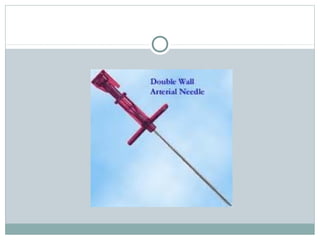
Seldinger needle.
18gauge single use,sterile needle.
2 parts-- a solid inner needle(stylet) & an outer thin

wall needle for smooth passage.

a hub---good instrument balance
winged handle---good control.
Site cleaned, area draped, local anesthetic given.
The seldinger needle is introduced into the artery.
When pulsating blood returns, the stylet is

removed.
A guide wire is inserted through the needle.
With guide wire in vessel, needle is removed.
Catheter is threaded onto the guide wire.
Under fluoro, the catheter is then advanced and

the guide wire is removed.
GUIDEWIRES
Guide the catheter.
Allow safe introduction of catheter into the

vessel.

Made of stainless steel.
Usually about 145cm long
An inner core wire that is tapered at the end to a

soft flexible tip.
Covered by a coating—teflon, heparin and recently

hydrophilic polymers(glide wires) are used.
Coating reduces friction, gives strength to GW.
Tips at the end of GW

Straight
 J- tipped—prevents subintimal dissection of artery.

CATHETERS
•Many

shapes and sizes.

•diameter

is given in French(Fr)—3Fr=1mm.

•Straight-

end hole only—smaller vessels/minimal

contrast.
•Pigtail-

circular tip with multiple side holes —
larger vessels/ more contrast.
H1 or Head hunter tip– used for femoral approach

to brachiocephalic vessels.
Simmons catheter is highly curved --- for sharply

angled vessels--cerebral and visceral angiography.
C2 or Cobra catheter has angled tip joined to a

gentle curve—celiac, renal & mesenteric arteries.
Judkins catheters

Right(lesser curve) & left(greater curve) for right &
left coronary arteries.
Amplatz catheters

Right & left coronary arteries
Contrast Media
Initially ionic iodine compounds were used.
Now non ionic contrast media in practice—low

adverse reactions and low physiologic problems.
INDICATIONS
Diagnosis & presence of ischemic heart disease.
After revascularization procedures
Congenital heart lesions & anomalies of great

vessels.

Valve disease, myocardial disease & ventricular

function.
Atheroma
Aneurysms
Arteriovenous malformations
Arterial ischemia
 Trauma
Patient preparation
Explain procedure & risk to the patient.
History & physical examination.
Lab tests.
Consent
Pre procedure I/V fluids.
Medication to relieve anxiety.
Monitoring during and after procedure
ECG, Automatic BP measurement & pulse oximetry.
Life saving drugs and equipments.
Immobile for minimum 4hrs after.
Vital signs monitored.
Puncture site inspected.
Contra-indications
Contrast allergy
Impaired renal function
Blood- clotting disorders
Anti coagulant medication
Unstable cardio pulmonary/ neurological status
Risks
Bleeding at puncture site
Thrombus formation
Embolus formation –plaque dislodged from vessel
wall by catheter
Dissection of vessel
Puncture site infection ( contaminated sterile field)
Contrast reaction
INTERVENTIONAL RADIOLOGY SUITE
Specifically designed to accommodate the quantity of

equipment needed & the large number of people
involved in the procedure.
Interventional radiology suite
Procedure Room
 Room

size- 400-600
square feet
 Easily cleaned
(floors, wall, etc.)
 Outlets needed for
O2, suction.
 At least three means
of access.

Control Room
 100-150

square feet
 Easy access and
communication to
procedure room
 Operating console
with Computers,
monitors .
EQUIPMENTS
The X-ray apparatus for interventional radiology is
more massive,flexible,expensive & advanced.
More heat load and serial images.
X RAY TUBE
Two ceiling track-mounted X-ray tubes alongwith
an image intensified fluoroscope mounted on C or an
L arm.
A large diameter massive anode disc(15cm
diameter, 5cm thick) to accommodate heat load.
Cathodes designed for magnification & serial
radiography.
A large focal spot of 1mm for heat load.
A small focal spot( no more than 0.3mm) is

necessary for spatial resolution of small vessel
magnification.
Power rating of 80kW—for rapid sequence serial

radiography.
Anode heat capacity of 1 MHU—to accommodate

heat load.
Generators
High frequency and high voltage generators
Three phase,12 pulse power.
Patient couch
Stationary couch with a floating,tilting or rotating
table top.
Controls for couch positioning are located on side

of table and also on a floor switch.
May also have a computer controlled stepping

capability.
Image receptor
2 different types.
Cinefluorographic camera—now obsolete.
Nowadays Digital image receptors are used with a

television camera pickup tube or a charge-coupled
device(CCD).
THANKS

Interventional radiology & angiography

  • 1.
  • 2.
    INTERVENTIONAL RADIOLOGY A subspecialtywhich provides minimally invasive techniques with the help of imaging modalities to diagnose or treat a condition. Minimally invasive Local anesthesia Early recovery
  • 3.
    8 out of10 procedures use skin incisions smaller than 5 mm. 9 out of 10 procedures use only local anaesthetic, sometimes with sedation. Up to 8 out of 10 patients go home the same day
  • 4.
  • 5.
    Percutaneous biopsy Abscess drainage Percutaneousnephrostomy Percutaneous Biliary drainage Radiofrequency ablation
  • 6.
    ANGIOGRAPHY The radiologic examinationof vessels after the introduction of a contrast medium.
  • 7.
    HISTORY The first angiogramwas performed only months after Roentgen's discovery of X rays. Which was when? Two physicians injected mercury salts into an amputated hand and created an image of the arteries
  • 8.
    Post mortem injectionof mercury salts in Jan,1896.
  • 9.
    Interventional radiologic proceduresbegan in 1930s with angiography. In early 1960s Mason Jones pioneered transbrachial selective coronary angiography. Later in 1960s transfemoral angiography was developed.
  • 10.
    BASIC PRINCIPLES Arterial access In1953 Seldinger described a method for catheterization of vessels. A percutaneous technique for arterial and venous access. Femoral artery is most commonly used.
  • 11.
    SELDINGER TECHNIQUE Seldinger needle. 18gaugesingle use,sterile needle. 2 parts-- a solid inner needle(stylet) & an outer thin wall needle for smooth passage. a hub---good instrument balance winged handle---good control.
  • 14.
    Site cleaned, areadraped, local anesthetic given. The seldinger needle is introduced into the artery. When pulsating blood returns, the stylet is removed.
  • 15.
    A guide wireis inserted through the needle. With guide wire in vessel, needle is removed. Catheter is threaded onto the guide wire. Under fluoro, the catheter is then advanced and the guide wire is removed.
  • 17.
    GUIDEWIRES Guide the catheter. Allowsafe introduction of catheter into the vessel. Made of stainless steel. Usually about 145cm long An inner core wire that is tapered at the end to a soft flexible tip.
  • 18.
    Covered by acoating—teflon, heparin and recently hydrophilic polymers(glide wires) are used. Coating reduces friction, gives strength to GW. Tips at the end of GW Straight  J- tipped—prevents subintimal dissection of artery. 
  • 22.
    CATHETERS •Many shapes and sizes. •diameter isgiven in French(Fr)—3Fr=1mm. •Straight- end hole only—smaller vessels/minimal contrast. •Pigtail- circular tip with multiple side holes — larger vessels/ more contrast.
  • 23.
    H1 or Headhunter tip– used for femoral approach to brachiocephalic vessels. Simmons catheter is highly curved --- for sharply angled vessels--cerebral and visceral angiography. C2 or Cobra catheter has angled tip joined to a gentle curve—celiac, renal & mesenteric arteries.
  • 25.
    Judkins catheters Right(lesser curve)& left(greater curve) for right & left coronary arteries. Amplatz catheters Right & left coronary arteries
  • 28.
    Contrast Media Initially ioniciodine compounds were used. Now non ionic contrast media in practice—low adverse reactions and low physiologic problems.
  • 29.
    INDICATIONS Diagnosis & presenceof ischemic heart disease. After revascularization procedures Congenital heart lesions & anomalies of great vessels. Valve disease, myocardial disease & ventricular function.
  • 30.
  • 31.
    Patient preparation Explain procedure& risk to the patient. History & physical examination. Lab tests. Consent Pre procedure I/V fluids. Medication to relieve anxiety.
  • 32.
    Monitoring during andafter procedure ECG, Automatic BP measurement & pulse oximetry. Life saving drugs and equipments. Immobile for minimum 4hrs after. Vital signs monitored. Puncture site inspected.
  • 33.
    Contra-indications Contrast allergy Impaired renalfunction Blood- clotting disorders Anti coagulant medication Unstable cardio pulmonary/ neurological status
  • 34.
    Risks Bleeding at puncturesite Thrombus formation Embolus formation –plaque dislodged from vessel wall by catheter Dissection of vessel Puncture site infection ( contaminated sterile field) Contrast reaction
  • 35.
    INTERVENTIONAL RADIOLOGY SUITE Specificallydesigned to accommodate the quantity of equipment needed & the large number of people involved in the procedure.
  • 36.
    Interventional radiology suite ProcedureRoom  Room size- 400-600 square feet  Easily cleaned (floors, wall, etc.)  Outlets needed for O2, suction.  At least three means of access. Control Room  100-150 square feet  Easy access and communication to procedure room  Operating console with Computers, monitors .
  • 37.
    EQUIPMENTS The X-ray apparatusfor interventional radiology is more massive,flexible,expensive & advanced. More heat load and serial images.
  • 39.
    X RAY TUBE Twoceiling track-mounted X-ray tubes alongwith an image intensified fluoroscope mounted on C or an L arm. A large diameter massive anode disc(15cm diameter, 5cm thick) to accommodate heat load. Cathodes designed for magnification & serial radiography.
  • 40.
    A large focalspot of 1mm for heat load. A small focal spot( no more than 0.3mm) is necessary for spatial resolution of small vessel magnification.
  • 41.
    Power rating of80kW—for rapid sequence serial radiography. Anode heat capacity of 1 MHU—to accommodate heat load.
  • 42.
    Generators High frequency andhigh voltage generators Three phase,12 pulse power.
  • 43.
    Patient couch Stationary couchwith a floating,tilting or rotating table top. Controls for couch positioning are located on side of table and also on a floor switch. May also have a computer controlled stepping capability.
  • 44.
    Image receptor 2 differenttypes. Cinefluorographic camera—now obsolete. Nowadays Digital image receptors are used with a television camera pickup tube or a charge-coupled device(CCD).
  • 45.