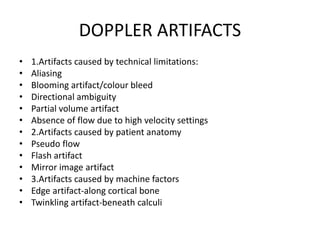
Doppler ultrasound utilizes the Doppler effect to detect moving structures in the body. It works by transmitting ultrasound pulses and detecting changes in frequency between transmitted and received signals based on the movement of reflective structures like blood cells. There are different Doppler modes including continuous wave, pulsed wave, color flow, and spectral Doppler which provide quantitative or qualitative assessments of flow. Optimization of Doppler techniques and understanding artifacts can improve diagnostic accuracy. Recent innovations continue enhancing Doppler ultrasound capabilities.











![Doppler principles [1]](https://cdn.slidesharecdn.com/ss_thumbnails/dopplerprinciples1-210517111539-thumbnail.jpg?width=640&height=640&fit=bounds)


