ULTRASOUND PHYSICS
TRANSDUCERS
TRANSDUCER JELLY
SEMINAR BY
DR NAVNI GARG
CHARACTERISTICS OF SOUND
• A sound beam is similar to x-ray beam in that
both are waves transmitting energy but
important difference is that x-rays pass
through a vacuum where as sound require a
material medium ( solid , liquid , gas ) for
transmission, they will not pass through the
vacuum.
• Sound must be generated mechanically by
vibrating body matter
HISTORY OF ULTRASOUND
• Piezoelectricity discovered by Pierre
and Jacques Curie in 1880 using
natural quartz
• SONAR was first used in 1940s war
time
• Diagnostic medical applications in
use since late 1950’s
• A : uniform distribution of
molecules in a medium
• B: movement of the piston
to the right produces a
zone of compression
• C: withdrawl of the piston
to left produces a zone of
rarefraction
• D: alternate movement of
the piston to right and left
establishes a longitudinal
wave in the medium
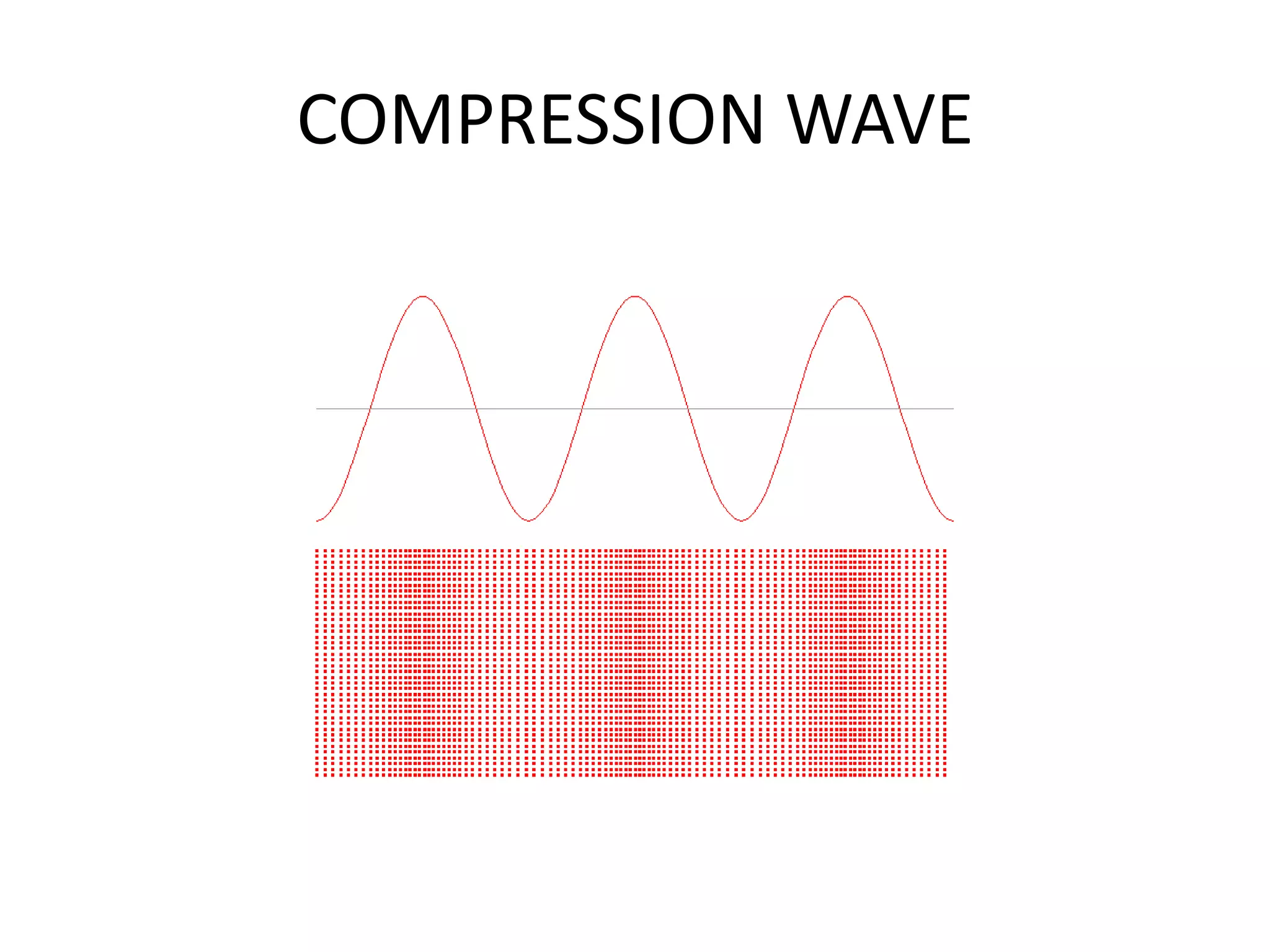
COMPRESSION WAVE
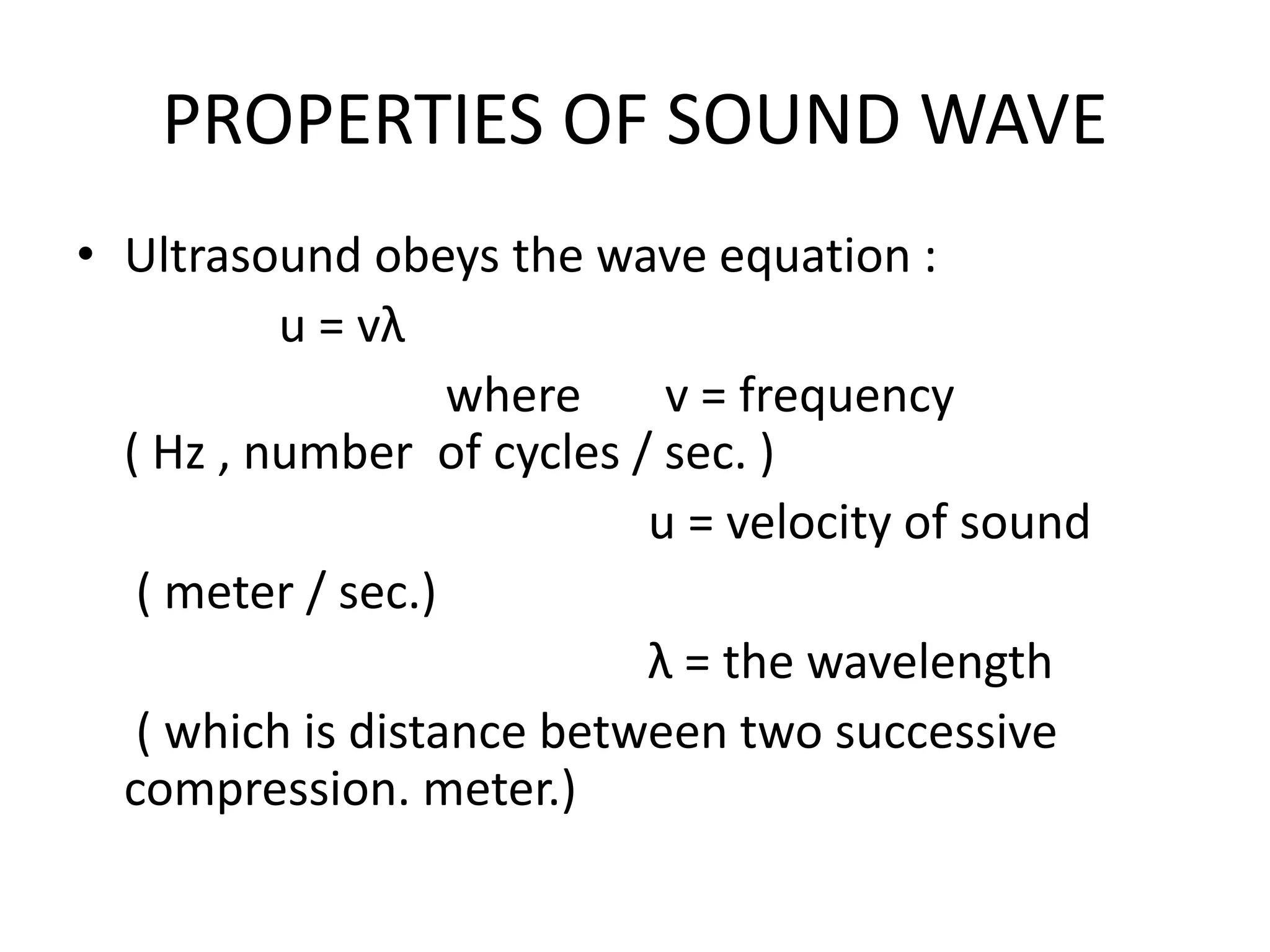
PROPERTIES OF SOUND WAVE
• Ultrasound obeys the wave equation :
u = vλ
where v = frequency
( Hz , number of cycles / sec. )
u = velocity of sound
( meter / sec.)
λ = the wavelength
( which is distance between two successive
compression. meter.)
FREQUENCY
• Frequency refers to the number of
cycles of compressions and rarefactions
in a sound wave per second, with one
cycle per second being 1 hertz.
• Medically used ultrasound involves 1-10
MHz frequencies .(1 -10 million Hz
/sec.).
WAVELENGTH
• The wavelength is the distance traveled by
sound in one cycle, or the distance between
two identical points in the wave cycle i.e. the
distance from a point of peak compression to
the next point of peak compression.
• It is inversely proportional to the frequency.
Wavelength is one of the main factors
affecting axial resolution of an
ultrasound image
• Smaller wavelength
• Higher frequency
• Higher resolution
• Lesser penetration
• Therefore, higher frequency
probes (5 to 10 MHz)
provide better resolution
but can be applied only for
superficial structures and in
children.
• Higher wavelength
• Lesser frequency
• Less resolution
• Deeper penetration
• Lower frequency probes (2
to 5MHz) provide better
penetration albeit lower
resolution and can be used
to image deeper structures.
PROPAGATION VELOCITY
• The propagation velocity is the velocity at
which sound travels through a particular
medium
• Dependant on the compressibility and density
of the medium.
• The average velocity of sound in soft tissues
such as the chest wall and heart is 1540
metres/second.
COMPRESSIBILITY
• The velocity of sound is inversely related to
the compressibility of the conducting material.
That means less compressibility of material ,
the more rapidly transmits the sound.
• Sound waves move slowly in the gas because
the molecules are far apart and are easily
compressed.
• Solids > liquids > gases
DENSITY
• Dense materials have large molecules with
large inertia : difficult to move or stop once in
motion
• Propagation of sound requires rhythmic
starting and stopping of particles
• Density is inversely related to velocity
AMPLITUDE/INTENSITY
• It is a measure of the degree of change within
a medium, caused by the passage of a sound
wave and relates to the severity of the
disturbance
• Determined by the length of oscillation of
particle
• Greater amplitude = more intense sound
• Sound intensity is measured in
decibel (dB).
• Ultrasonic intensities are expressed
in power / unit area (watts/cm2)
TRANSDUCER
• Transducer is the device which generates
ultrasound wave .
• Transducers are used to convert an electric
signal into ultrasonic energy that can be
transmitted into tissue , and to convert
ultrasonic energy reflected back from the
tissue into an electric signal.
COMPOSITION OF TRANSDUCER
• The most important component is a thin (0.5
mm) piezoelectric crystal element located near
the face of the transducer .
• The piezoelectric crystal consist of lead zirconate
titanate or PZT.
• The front and back faces of the crystal are coated
with a thin conducting film to ensure good
contact with the two electrodes that will supply
the electric field used to strain the crystal.
• Crystal is made up of numerous dipoles
arranged in a geometric pattern.
• Dipole is a polarized molecule, one end
positive and other end negative .
• The positive and negative ends arranged so
that an electric field will cause them to realign
thus changing the dimensions of the crystal.
• No current flows through the crystal
• Plating electrodes behave as capacitors
and it is the voltage between them that
produces the electric field which causes
change in crystal shape
• When the high frequency voltage pulse is
applied across the crystal , the crystal vibrates
like a cymbal that has been struck a sharp
blow and generates sound waves.
• The backing block must stop the crystal
vibration within a microsecond because the
transducer must be ready immediately to
receive reflected waves (echoes) from tissue
interface.
• As the sound pulse passes through the body
,echoes reflect back towards the transducer
from each tissue interface. These echoes carry
energy and they transmit their energy to the
transducer , causing a physical compression of
the crystal element . This compression forces
the tiny dipoles to change their orientation ,
which induces a voltage between the
electrodes
• The voltage is amplified and serves as the
ultrasonic signal for display on television
monitor.
• Compression force and associated voltage are
responsible for the name piezoelectricity
which means “ pressure “ electricity.
• Naturally occurring materials possess
piezoelectric properties : Quartz
• Man made material ( ferroelectrics ) :
Barium titanate
lead zirconate titanate
• Curie Temperature :
is the temperature at which polarization is
lost.
• Heating the piezoelectric crystal above the
Curie temperature reduces it to a useless
piece of ceramic so transducer should never
be autoclaved.
Resonant frequency :
• The thickness of piezoelectric crystal
determines its natural frequency called its
resonant frequency.
• The crystal is designed so that its thickness is
equal to exactly half the wavelength of the
ultrasound to be produced by the transducers.
• Thickness = wavelength/2
Transducer Q Factor :
• Two characteristics :- purity of sound & the length
of time that the sound persists.
• A high Q transducer produces a nearly pure
sound made up of narrow range of frequencies.
• A low Q transducer produces whole spectrum of
sound covering wider range of frequencies.
• The interval between initiation of the wave and
complete cessation of vibration is called the “ ring
down time “.
• High Q : useful for doppler USG transducers
because it furnishes narrow range of sound
frequencies
• Low Q : useful for organ imaging because it
can furnish short ultrasound pulses and will
respond to a broad range of returning
frequencies
• The Q factor can be controlled by altering the
characteristic of the damping block.
• Damping block consist of powered rubber and
tungsten blended with an epoxy resin.
• Ratio of tungsten to resin is chosen to satisfy
the impedance requirements
• Rubber is added to increase the attenuation of
sound in the backing block.
RECEPTION OF ULTRASOUND
• 1. Reflection :
• Both ultrasound and light obey the law of
reflection , the angle of incidence and the
angle of reflection are equal.
• The factor that determines the percent of the
incident beam undergoing reflection is a
property , peculiar to various tissues , called
acoustic impendence
• Acoustic impendence Z = p u rayls
• where p is density , u is velocity
of sound in cm/sec.
• The velocity of sound in all soft tissue is
virtually same 1540 m/sec.
• So , Z α p. example air and bone.
• As sound waves pass from one tissue to
another , the amount of reflection is
determined by the difference in the
impedances of the two tissues .
• At a particular angle of incidence known as
the critical angle , total reflection occurs at the
skin
REFRACTION
• This occurs when an ultrasound beam passes,
at an angle other than 90 degrees, from one
tissue into another with change in velocity.
• It increase with the increasing angle of
incidence .
• It passes deeper into the body where it gives
rise to artifacts.
• If angle of incidence is less than 3 degrees,
very little refraction seen.
ABSORPTION
• Due to friction among molecules in their back –
forth movement , reduction in intensity of the
ultrasound beam occurs as it traverse matter.
Friction results in degradation of part of
molecules kinetic energy to heat.
• The greater the frequency , the greater the
attenuation coefficient. This means high
frequency beam shows less penetration than a
low frequency beam.
• Attenuation in soft tissue is 1 dB/cm/MHz
TYPES OF ELECTRONIC SCANNING
LINEAR ARRAY PHASED ARRAY
TYPES OF TRANSDUCERS
The ultrasound transducers differ in
construction according to
• Piezoelectric crystal arrangement
• Aperture ( footprint )
• Operating frequency ( which is directly related
to the penetration depth )
SECTOR TRANSDUCER
• Crystal arrangement : phased array
• Footprint size : small
• Operating frequency : 1-5 MHz
• Ultrasound beam shape : sector, almost
triangular
• Use : small acoustic windows ,mainly ECHO,
gynecological ultrasound, upper body
ultrasound
LINEAR TRANSDUCER
• Crystal arrangement : linear
• Footprint size: usually big ( small for hockey
transducers )
• Operating frequency : 3-12 MHz
• Ultrasound beam shape : rectangular
• Use : USG of superficial structures e.g.
obstetrics ultrasound , breast,thyroid,vascular
ultrasound
CONVEX TRANSDUCER
• Crystal arrangement : curvilinear
• Footprint size : big ( small for the micro convex
transducers )
• Operating frequency : 1-5 MHz
• Ultrasound beam shape
• Use : useful in all USG types except ECHO,
typically abdominal ,pelvic and lung ( micro
convex transducer )
TRANSDUCER JELLY/COUPLING AGENT
• Air and other gases impede sound waves
• At tissue-air interface, more than 99.9% of the
beam is reflected so none is available for further
imaging
• Jelly acts as a special aqueous conductive
medium for the sound waves
• Prevents the formation of bubbles between the
transducer and the patient’s skin
• Acts as a lubricant
PROPERTIES
• Non allergenic
• Odourless
• Non staining
• Harmless
• Neutral ph
• Easily removable with tissue or towel
USG GEL INGREDIENTS
• Water
• Carbomer : synthetic high molecular weight polymer of
acrylic acid cross linked with allyl sucrose and
containing 50-68% of carboxylic acid groups.
Neutralized with alkali hydroxide to make it water
soluble.
• EDTA
• Propylene glycol : organic oil compound that doesnot
irritate the skin and helps retain moisture
• Glycerine and trolamine : neutral colorless gel that
absorbs moisture from air
• Colorant : occasionally used, usually blue color
Thank you

ULTRASOUND PHYSICS

  • 1.
  • 2.
    CHARACTERISTICS OF SOUND •A sound beam is similar to x-ray beam in that both are waves transmitting energy but important difference is that x-rays pass through a vacuum where as sound require a material medium ( solid , liquid , gas ) for transmission, they will not pass through the vacuum. • Sound must be generated mechanically by vibrating body matter
  • 3.
    HISTORY OF ULTRASOUND •Piezoelectricity discovered by Pierre and Jacques Curie in 1880 using natural quartz • SONAR was first used in 1940s war time • Diagnostic medical applications in use since late 1950’s
  • 4.
    • A :uniform distribution of molecules in a medium • B: movement of the piston to the right produces a zone of compression • C: withdrawl of the piston to left produces a zone of rarefraction • D: alternate movement of the piston to right and left establishes a longitudinal wave in the medium
  • 5.
  • 6.
    PROPERTIES OF SOUNDWAVE • Ultrasound obeys the wave equation : u = vλ where v = frequency ( Hz , number of cycles / sec. ) u = velocity of sound ( meter / sec.) λ = the wavelength ( which is distance between two successive compression. meter.)
  • 7.
    FREQUENCY • Frequency refersto the number of cycles of compressions and rarefactions in a sound wave per second, with one cycle per second being 1 hertz. • Medically used ultrasound involves 1-10 MHz frequencies .(1 -10 million Hz /sec.).
  • 8.
    WAVELENGTH • The wavelengthis the distance traveled by sound in one cycle, or the distance between two identical points in the wave cycle i.e. the distance from a point of peak compression to the next point of peak compression. • It is inversely proportional to the frequency.
  • 10.
    Wavelength is oneof the main factors affecting axial resolution of an ultrasound image • Smaller wavelength • Higher frequency • Higher resolution • Lesser penetration • Therefore, higher frequency probes (5 to 10 MHz) provide better resolution but can be applied only for superficial structures and in children. • Higher wavelength • Lesser frequency • Less resolution • Deeper penetration • Lower frequency probes (2 to 5MHz) provide better penetration albeit lower resolution and can be used to image deeper structures.
  • 11.
    PROPAGATION VELOCITY • Thepropagation velocity is the velocity at which sound travels through a particular medium • Dependant on the compressibility and density of the medium. • The average velocity of sound in soft tissues such as the chest wall and heart is 1540 metres/second.
  • 12.
    COMPRESSIBILITY • The velocityof sound is inversely related to the compressibility of the conducting material. That means less compressibility of material , the more rapidly transmits the sound. • Sound waves move slowly in the gas because the molecules are far apart and are easily compressed. • Solids > liquids > gases
  • 13.
    DENSITY • Dense materialshave large molecules with large inertia : difficult to move or stop once in motion • Propagation of sound requires rhythmic starting and stopping of particles • Density is inversely related to velocity
  • 15.
    AMPLITUDE/INTENSITY • It isa measure of the degree of change within a medium, caused by the passage of a sound wave and relates to the severity of the disturbance • Determined by the length of oscillation of particle • Greater amplitude = more intense sound
  • 16.
    • Sound intensityis measured in decibel (dB). • Ultrasonic intensities are expressed in power / unit area (watts/cm2)
  • 17.
    TRANSDUCER • Transducer isthe device which generates ultrasound wave . • Transducers are used to convert an electric signal into ultrasonic energy that can be transmitted into tissue , and to convert ultrasonic energy reflected back from the tissue into an electric signal.
  • 18.
  • 19.
    • The mostimportant component is a thin (0.5 mm) piezoelectric crystal element located near the face of the transducer . • The piezoelectric crystal consist of lead zirconate titanate or PZT. • The front and back faces of the crystal are coated with a thin conducting film to ensure good contact with the two electrodes that will supply the electric field used to strain the crystal.
  • 20.
    • Crystal ismade up of numerous dipoles arranged in a geometric pattern. • Dipole is a polarized molecule, one end positive and other end negative . • The positive and negative ends arranged so that an electric field will cause them to realign thus changing the dimensions of the crystal.
  • 22.
    • No currentflows through the crystal • Plating electrodes behave as capacitors and it is the voltage between them that produces the electric field which causes change in crystal shape
  • 23.
    • When thehigh frequency voltage pulse is applied across the crystal , the crystal vibrates like a cymbal that has been struck a sharp blow and generates sound waves. • The backing block must stop the crystal vibration within a microsecond because the transducer must be ready immediately to receive reflected waves (echoes) from tissue interface.
  • 24.
    • As thesound pulse passes through the body ,echoes reflect back towards the transducer from each tissue interface. These echoes carry energy and they transmit their energy to the transducer , causing a physical compression of the crystal element . This compression forces the tiny dipoles to change their orientation , which induces a voltage between the electrodes
  • 25.
    • The voltageis amplified and serves as the ultrasonic signal for display on television monitor. • Compression force and associated voltage are responsible for the name piezoelectricity which means “ pressure “ electricity.
  • 26.
    • Naturally occurringmaterials possess piezoelectric properties : Quartz • Man made material ( ferroelectrics ) : Barium titanate lead zirconate titanate
  • 27.
    • Curie Temperature: is the temperature at which polarization is lost. • Heating the piezoelectric crystal above the Curie temperature reduces it to a useless piece of ceramic so transducer should never be autoclaved.
  • 28.
    Resonant frequency : •The thickness of piezoelectric crystal determines its natural frequency called its resonant frequency. • The crystal is designed so that its thickness is equal to exactly half the wavelength of the ultrasound to be produced by the transducers. • Thickness = wavelength/2
  • 29.
    Transducer Q Factor: • Two characteristics :- purity of sound & the length of time that the sound persists. • A high Q transducer produces a nearly pure sound made up of narrow range of frequencies. • A low Q transducer produces whole spectrum of sound covering wider range of frequencies. • The interval between initiation of the wave and complete cessation of vibration is called the “ ring down time “.
  • 30.
    • High Q: useful for doppler USG transducers because it furnishes narrow range of sound frequencies • Low Q : useful for organ imaging because it can furnish short ultrasound pulses and will respond to a broad range of returning frequencies
  • 31.
    • The Qfactor can be controlled by altering the characteristic of the damping block. • Damping block consist of powered rubber and tungsten blended with an epoxy resin. • Ratio of tungsten to resin is chosen to satisfy the impedance requirements • Rubber is added to increase the attenuation of sound in the backing block.
  • 32.
    RECEPTION OF ULTRASOUND •1. Reflection : • Both ultrasound and light obey the law of reflection , the angle of incidence and the angle of reflection are equal. • The factor that determines the percent of the incident beam undergoing reflection is a property , peculiar to various tissues , called acoustic impendence
  • 34.
    • Acoustic impendenceZ = p u rayls • where p is density , u is velocity of sound in cm/sec. • The velocity of sound in all soft tissue is virtually same 1540 m/sec. • So , Z α p. example air and bone.
  • 35.
    • As soundwaves pass from one tissue to another , the amount of reflection is determined by the difference in the impedances of the two tissues .
  • 37.
    • At aparticular angle of incidence known as the critical angle , total reflection occurs at the skin
  • 38.
    REFRACTION • This occurswhen an ultrasound beam passes, at an angle other than 90 degrees, from one tissue into another with change in velocity. • It increase with the increasing angle of incidence . • It passes deeper into the body where it gives rise to artifacts. • If angle of incidence is less than 3 degrees, very little refraction seen.
  • 39.
    ABSORPTION • Due tofriction among molecules in their back – forth movement , reduction in intensity of the ultrasound beam occurs as it traverse matter. Friction results in degradation of part of molecules kinetic energy to heat. • The greater the frequency , the greater the attenuation coefficient. This means high frequency beam shows less penetration than a low frequency beam. • Attenuation in soft tissue is 1 dB/cm/MHz
  • 40.
    TYPES OF ELECTRONICSCANNING LINEAR ARRAY PHASED ARRAY
  • 42.
    TYPES OF TRANSDUCERS Theultrasound transducers differ in construction according to • Piezoelectric crystal arrangement • Aperture ( footprint ) • Operating frequency ( which is directly related to the penetration depth )
  • 43.
    SECTOR TRANSDUCER • Crystalarrangement : phased array • Footprint size : small • Operating frequency : 1-5 MHz • Ultrasound beam shape : sector, almost triangular • Use : small acoustic windows ,mainly ECHO, gynecological ultrasound, upper body ultrasound
  • 44.
    LINEAR TRANSDUCER • Crystalarrangement : linear • Footprint size: usually big ( small for hockey transducers ) • Operating frequency : 3-12 MHz • Ultrasound beam shape : rectangular • Use : USG of superficial structures e.g. obstetrics ultrasound , breast,thyroid,vascular ultrasound
  • 45.
    CONVEX TRANSDUCER • Crystalarrangement : curvilinear • Footprint size : big ( small for the micro convex transducers ) • Operating frequency : 1-5 MHz • Ultrasound beam shape • Use : useful in all USG types except ECHO, typically abdominal ,pelvic and lung ( micro convex transducer )
  • 47.
    TRANSDUCER JELLY/COUPLING AGENT •Air and other gases impede sound waves • At tissue-air interface, more than 99.9% of the beam is reflected so none is available for further imaging • Jelly acts as a special aqueous conductive medium for the sound waves • Prevents the formation of bubbles between the transducer and the patient’s skin • Acts as a lubricant
  • 48.
    PROPERTIES • Non allergenic •Odourless • Non staining • Harmless • Neutral ph • Easily removable with tissue or towel
  • 49.
    USG GEL INGREDIENTS •Water • Carbomer : synthetic high molecular weight polymer of acrylic acid cross linked with allyl sucrose and containing 50-68% of carboxylic acid groups. Neutralized with alkali hydroxide to make it water soluble. • EDTA • Propylene glycol : organic oil compound that doesnot irritate the skin and helps retain moisture • Glycerine and trolamine : neutral colorless gel that absorbs moisture from air • Colorant : occasionally used, usually blue color
  • 50.