DOPPLER PHYSICS
Dr.Abhilasha singh
DNB Resident
Dept of Radiodiagnosis
Ramkrishna care hospital,Raipur
PRINCIPLE OF DOPPLER
ULTRASOUND
•
•
•
BASIS – ‘ DOPPLER EFFECT’
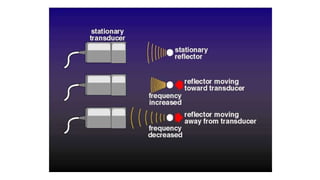
Change in the perceived frequency of
sound emitted by a moving source.
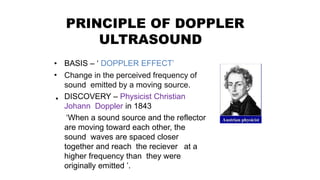
DISCOVERY – Physicist Christian
Johann Doppler in 1843
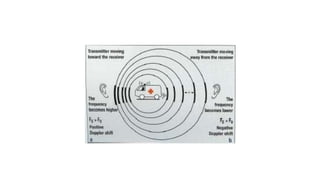
‘When a sound source and the reflector
are moving toward each other, the
sound waves are spaced closer
together and reach the reciever at a
higher frequency than they were
originally emitted ’.
 In ultrasound, the Doppler effect used to measure
blood
• flow velocity.
 Ultrasound reflected from red blood cells will
change in frequency according to the blood
flow velocity.
 When direction of blood flow is towards the
transducer, the echoes from blood reflected
back to the transducer will have a higher
frequency than the one emitted from the
transducer.
 When the direction is away from the transducer,
the echoes will have a lower frequency than
those emitted.
 The difference in frequency between transmitted
and received echoes is called the Doppler
frequency shift, and this shift in frequency is
proportional to the blood flow velocity.
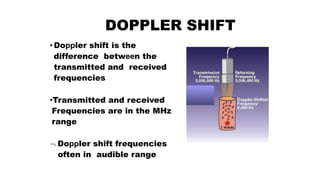
•Doppler shift is the
difference between the
transmitted and received
frequencies
•Transmitted and received
Frequencies are in the MHz
range
 Doppler shift frequencies
often in audible range
DOPPLER SHIFT
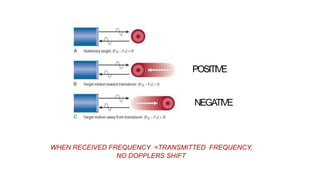
POSITIVE
NEGATIVE
WHEN RECEIVED FREQUENCY =TRANSMITTED FREQUENCY,
NO DOPPLERS SHIFT
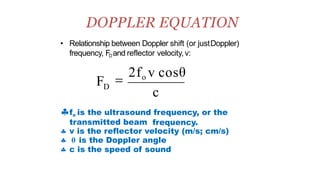
• Relationship between Doppler shift (or justDoppler)
frequency, FDand reflector velocity,v:
fo is the ultrasound frequency, or the
transmitted beam frequency.
 v is the reflector velocity (m/s; cm/s)
 θ is the Doppler angle
 c is the speed of sound
DOPPLER EQUATION
c
FD

2fo v cosθ
FACTORS AFFECTING DOPPLER SHIFT
1. Doppler angle
2. Transducer frequency
3. Scattering of US by blood
4. Blood flow characteristic
1. DOPPLER ANGLE
 Also known as the angle of insonation.
 Estimated by a process known as angle correction,
which involves aligning an indicator on the duplex
image along the longitudinal axis of the vessel.
 Few considerations that affect the performance of a
Doppler examination:
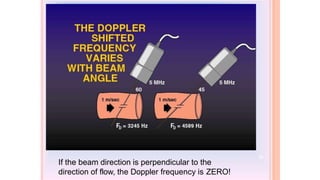
The cosine of 90° is zero, so if the ultrasound beam is
perpendicular to the direction of blood flow, there will be no
Doppler shift and it will appear as if there is no flow in the
vessel
The angle of insonation should also be less than 60° at all
times, since the cosine function has a steeper curve above
this angle, and errors in angle correction will be magnified
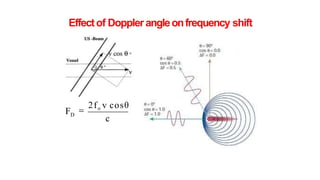
Effectof Dopplerangleonfrequency shift
c
FD

2fo v cosθ
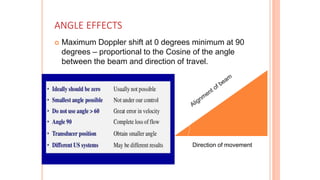
ANGLE EFFECTS
 Maximum Doppler shift at 0 degrees minimum at 90
degrees – proportional to the Cosine of the angle
between the beam and direction of travel.
Direction of movement
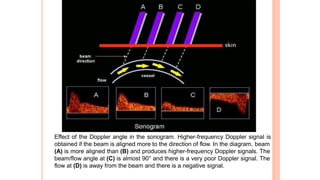
Effect of the Doppler angle in the sonogram. Higher-frequency Doppler signal is
obtained if the beam is aligned more to the direction of flow. In the diagram, beam
(A) is more aligned than (B) and produces higher-frequency Doppler signals. The
beam/flow angle at (C) is almost 90° and there is a very poor Doppler signal. The
flow at (D) is away from the beam and there is a negative signal.
11
If the beam direction is perpendicular to the
direction of flow, the Doppler frequency is ZERO!
2. TRANSDUCER FREQUENCY
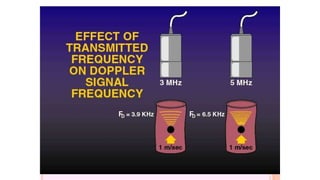
 Increase in transducer frequency causes increased
doppler frequency shift.
 At frequencies between 2-10 MHz, doppler shift
comparatively small & in audible range (shift from 0-
10 KHz) for most physiological motion (for velocity
range from 0-100 cm/s).
 Change of frequency → measurable → movement of
reflector towards/away from transducer.
 Depending on ↑ or ↓ in frequency → direction of
movement.
F
2fo vcosθ
D 
c
13
3. SCATTERING OF US BY BLOOD
 Smooth wall of blood vessel → specular reflection
→ strong echoes.
 Us wavelength > size of RBCs → scattering of
wave in all directions (Rayleigh-Tyndall scattering).
Size of echo from blood → ↓.
 Intensity of scattered us ↑ with 4th power of
frequency as images of vessel lumen differ
significantly with instruments of different frequency.
4. CHARACTERISTICS OF BLOOD FLOW
 Blood (viscous medium) → wall exerts drag effect on
moving blood → slow movement near the wall than center.
 Non pulsatile flow with low velocity → parabolic velocity
profile → laminar flow.
 Fast /accelerated flow → same velocity all over → plug
flow.
 Major artery → plug flow during systole & laminar flow
during diastole. Venous flow → laminar.
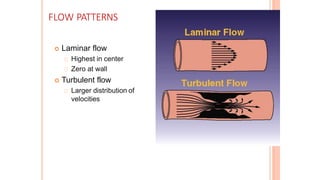
FLOW PATTERNS
 Laminar flow
Highest in center
Zero at wall
 Turbulent flow
Larger distribution of
velocities
16
DOPPLER ULTRASOUND
MODES/INSTRUMENTATIONS
 Continuous wave Doppler
 Pulsed wave Doppler
 Spectral doppler
 Colour doppler
 Power doppler
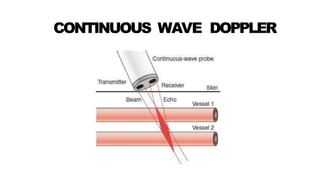
CONTINUOUS WAVE DOPPLER
 Simplest form
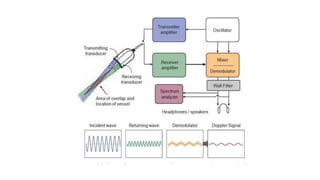
 Uses separate transmit & receive crystals that
continuously transmit and receive ultrasound.
 Able to detect the presence and direction of flow, -
unable to distinguish signals arising from vessels at
different depths.
( THEREFORE IT LACKS RANGE RESOLUTION.)
 Portable and inexpensive.
CONTINUOUS WAVE DOPPLER
Advantages:
Simple, Good quality
low noise signal,
No aliasing.
Disadvantages:
Lacks depth resolution,
Confusing superimposition,
Application:
Superficial structures,e.g carotid artery, limb
arteries.
21
•
•
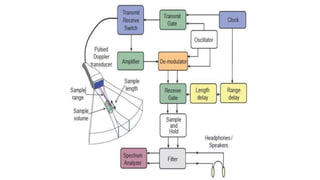
Uses brief pulses of ultrasound energy using
only one crystal.
The echo delay time ( Te ) can be converted
into distance and the DEPTH of echo source
can be determined
The sensitive volume from which flow data
are sampled can be controlled in terms of
shape, depth, and position.
•
PULSED-WAVE (PW) DOPPLER
PULSED WAVE DOPPLER
PULSE REPETITION FREQUENCY(PRF)-No. of pulses transmitted per second
• With increasing scanning depth PRF decreases as
more time is needed for the echoes to return
• At a minimum, the PRF must be at least twice the
frequency of the Doppler signal to construct the
signal successfully.
• This sets upper limit to the flow velocities to be ac
urately recorded
• Use higher PRF setting for high flow velocities, low
PRF for slow venous flow
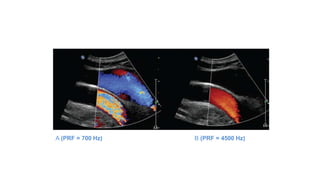
A (PRF = 700 Hz) B (PRF = 4500 Hz)
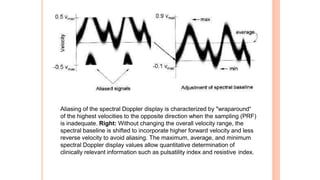
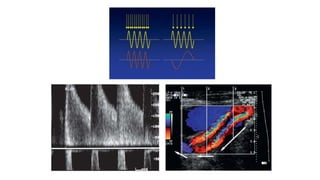
Aliasing of the spectral Doppler display is characterized by "wraparound“
of the highest velocities to the opposite direction when the sampling (PRF)
is inadequate. Right: Without changing the overall velocity range, the
spectral baseline is shifted to incorporate higher forward velocity and less
reverse velocity to avoid aliasing. The maximum, average, and minimum
spectral Doppler display values allow quantitative determination of
clinically relevant information such as pulsatility index and resistive index.
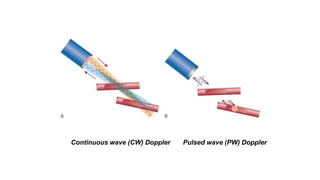
Continuous wave (CW) Doppler Pulsed wave (PW) Doppler
DUPLEX ULTRASOUND SCANNING
Duplex ultrasound instruments are real-time B-
mode scanners with built-in Doppler
capabilities.
● B-mode Imager ( Outline anatomic structures )
● Pulsed-Doppler ( Flow and movement patterns )
 The Doppler gate is positioned over the vessel of interest
with size (length and width) appropriate for evaluation of
blood velocity, and at an orientation (angle with respect to
the interrogating US beam) that represents the Doppler
angle.
 When switched to Doppler mode, the scanner electronics
determines the proper timing to extract data only from
within the user-defined gate.
 The duplex system allows estimation of the blood velocity
directly from the Doppler shift frequency, since the velocity
of sound and the transducer frequency are known, while the
Doppler angle can be estimated from the B-mode image and
input into the scanner computer for calculation.
 Once the velocity is known, flow (in units of cm3/s) is
estimated as the product of the vessel’s cross- sectional
area (cm2) times the velocity (cm/s).
 Advantages:
Selection of site & sample volume for
Doppler.
No overlap of information from other
vessels/structures.
Measurement of vessel angle in 2-3 sec.
 Disadvantages:
Angle restriction if same transducer for
imaging &
Doppler.
Flow information from one site in image
SPECTRAL DOPPLER
SPECTRAL DOPPLER
• Ultrasound is emitted in pulses similar to B-
mode
• Gate is used to determine the interval after
emission when returning signals are received
and therefore the depth from which the
sample is taken.
• The Doppler shift data are displayed in
graphic form as a time-varying plot of the
frequency spectrum of the returning signal.
• A fast Fourier transformation is used to perform
the frequency analysis.
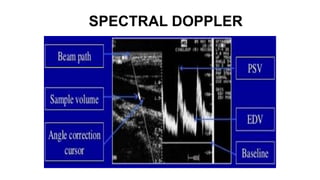
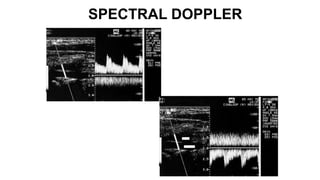
• SPECTRAL ANALYSIS shows the Doppler
shift spectrum and direction ,usually
displayed as the maximum velocity rather
than frequency
Provides QUANTITATIVE INFORMATION•
The resulting Doppler frequency
spectrum displays the following :
 Variation with time of the Doppler
frequencies present in the volume
sampled.
 The envelope of the spectrum, representing the
maximum frequencies present at any given
point in time.
 The width of the spectrum at any point, indicating
the range of frequencies present.
SPECTRAL DOPPLER
SPECTRAL DOPPLER
DOPPLER SPECTRUM
ASSESSMENT
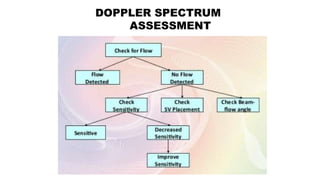
Assess the following
1.Presence of flow
2.Direction of flow
3.Amplitude
4.Window
5.Pulsatility
DOPPLER SPECTRUM
ASSESSMENT
DOPPLER SPECTRUM
ASSESSMENT
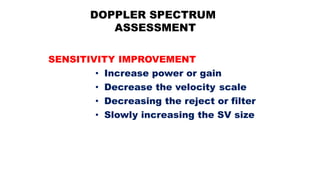
SENSITIVITY IMPROVEMENT
• Increase power or gain
• Decrease the velocity scale
• Decreasing the reject or filter
• Slowly increasing the SV size
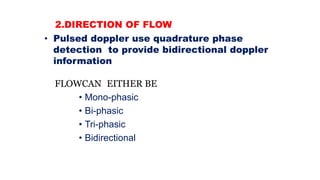
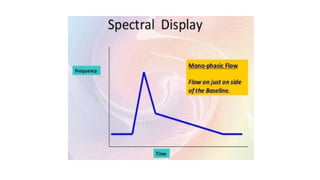
2.DIRECTION OF FLOW
• Pulsed doppler use quadrature phase
detection to provide bidirectional doppler
information
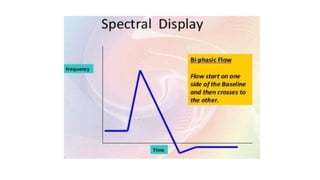
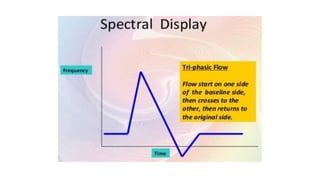
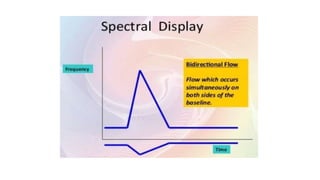
FLOWCAN EITHER BE
• Mono-phasic
• Bi-phasic
• Tri-phasic
• Bidirectional
• The spectrum displays echo amplitude by
varying the brightnes of the display
The amplitude of the echoes are determined
by
•
•
•
•
Echo intensity
Power
Gain
Dynamic range
3 . AMPLITUDE



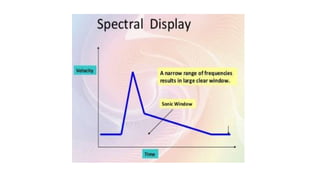
Recieved doppler shift consists of a range of
frequencies
Narrow range of frequencies will result in a
narrow display line.
The clear underneath the spectrum is called the
window
4. WINDOW
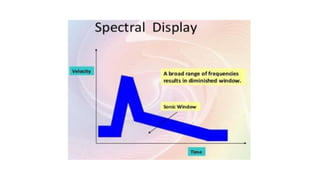
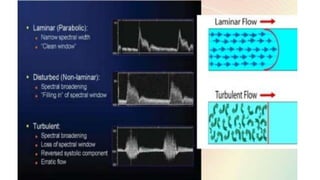
SPECTRUM BROADENING :
• Refers to presence of a large range of flow velocities
at a given point in the pulse cycle and, by indicating
turbulance,is an important criterion of high grade vessel
narrowing
• Loss of spectral window is called SPECTRAL
BROADENING
OCCURS-
• As the blood decelerates in diastole
• SV placed close to the vessel wall
• In small vessels ( parabolic velocity profile )
• Tortous vessels
• Low flow states
• Excessive gain/power/dynamic range
IT IS HALLMARK OF DISTURBED AND/OR
TURBULENT FLOW
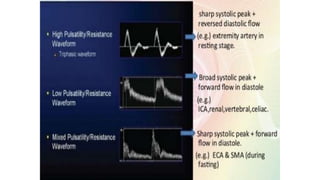
5 . PULSATILITY
• Measures the difference between the maximum
and minimum velocities within the cardiac cycle
• Indices are unit less
• All increase in value as flow pulsatility increases
• Can be measured without knowledge of the
doppler angle
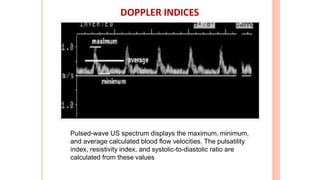
Pulsed-wave US spectrum displays the maximum, minimum,
and average calculated blood flow velocities. The pulsatility
index, resistivity index, and systolic-to-diastolic ratio are
calculated from these values
DOPPLER INDICES
DOPPLER INDICES
•
•
•
•
•
PI = S-D/Vm ( GOSLING )
RI = S-D/S ( POURCELOT )
S /D Ratio
Acceleration time ( AT) & Acceleration Index ( AI)
SPECTRAL BROADENING
Changes in doppler indices from normal may help
in early identification of rejection of transplanted
organs,parenchymal dysfunction, and malignancy.
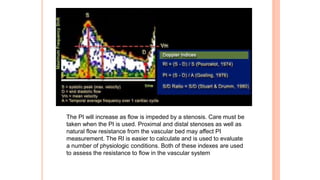
The PI will increase as flow is impeded by a stenosis. Care must be
taken when the PI is used. Proximal and distal stenoses as well as
natural flow resistance from the vascular bed may affect PI
measurement. The RI is easier to calculate and is used to evaluate
a number of physiologic conditions. Both of these indexes are used
to assess the resistance to flow in the vascular system
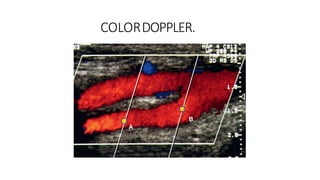
COLOUR DOPPLER
COLOUR DOPPLER
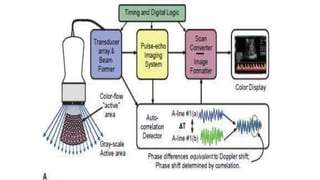
• Based on pulsed doppler technique .
• Doppler shifts - converted to colour and the
moving blood is displayed in colors that
correspond to its velocity and direction.
• Positive Doppler shifts are encoded as red and
negative shifts are encoded as blue.
• Velocity of the flow is represented in shades of
color - faster - brighter
COLORDOPPLER.
B
A
•
•
•
•
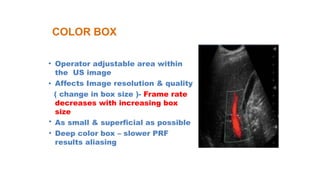
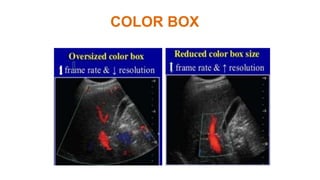
COLOR BOX
Operator adjustable area within
the US image
Affects Image resolution & quality
( change in box size )- Frame rate
decreases with increasing box
size
As small & superficial as possible
Deep color box – slower PRF
results aliasing
COLOR BOX
COLOUR DOPPLER
Advantages
 It provides an overall view of flow in
organ or structure
 Provides directional information about
flow,
 Provides velocity information about
flow and shows turbulent type flow
• Limitations :
• SEMI QUANTITATIVE
• Angle dependence
• Aliasing
• Artifacts caused by the noise
• Inability to display entire doppler spectrum in the
image
• Poor temporal resolution
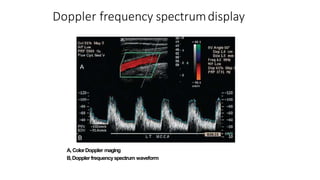
Doppler frequency spectrumdisplay
B
A, ColorDoppler maging
B,Doppler frequencyspectrum waveform
A
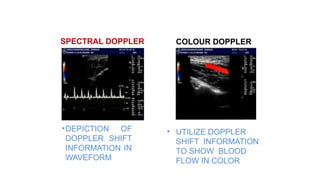
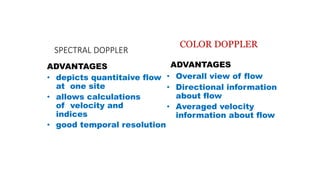
SPECTRAL DOPPLER
•DEPICTION OF
DOPPLER SHIFT
INFORMATION IN
WAVEFORM
COLOUR DOPPLER
• UTILIZE DOPPLER
SHIFT INFORMATION
TO SHOW BLOOD
FLOW IN COLOR
SPECTRAL DOPPLER
ADVANTAGES
• depicts quantitaive flow
at one site
• allows calculations
of velocity and
indices
• good temporal resolution
COLOR DOPPLER
ADVANTAGES
• Overall view of flow
• Directional information
about flow
• Averaged velocity
information about flow
POWER DOPPLER
POWER DOPPLER
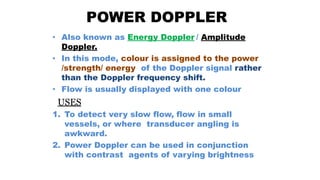
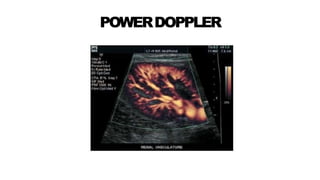
• Also known as Energy Doppler / Amplitude
Doppler.
• In this mode, colour is assigned to the power
/strength/ energy of the Doppler signal rather
than the Doppler frequency shift.
• Flow is usually displayed with one colour
USES
1. To detect very slow flow, flow in small
vessels, or where transducer angling is
awkward.
2. Power Doppler can be used in conjunction
with contrast agents of varying brightness
POWERDOPPLER
POWERDOPPLER
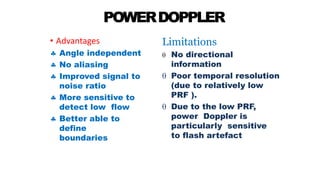
• Advantages
 Angle independent
 No aliasing
 Improved signal to
noise ratio
 More sensitive to
detect low flow
 Better able to
define
boundaries
Limitations
 No directional
information
 Poor temporal resolution
(due to relatively low
PRF ).
 Due to the low PRF,
power Doppler is
particularly sensitive
to flash artefact
OPTIMISATION OF COLORFLOW
DOPPLER EXAMINATION
1. TransducerFrequency.
• For superficial structures 7-10MHZ is
used. For deep abdominal structures –
3MHZ – 5MHZ is optimal.
• Choice of transducer frequency is paramount
because the intensity of the scattered sound
varies in proportion to the 4th power of the
Doppler frequency.
2.Doppler Angle.
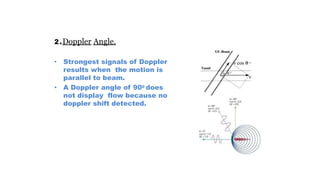
• Strongest signals of Doppler
results when the motion is
parallel to beam.
• A Doppler angle of 900 does
not display flow because no
doppler shift detected.
3. Sample Volume.
•
•
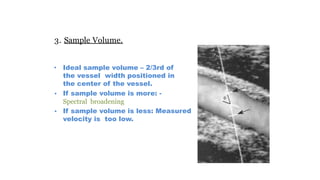
• Ideal sample volume – 2/3rd of
the vessel width positioned in
the center of the vessel.
If sample volume is more: -
Spectral broadening
If sample volume is less: Measured
velocity is too low.
4. Wall Filters.
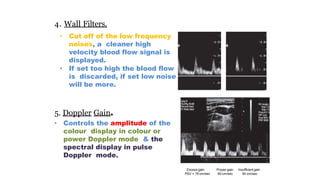
• Cut off of the low frequency
noises, a cleaner high
velocity blood flow signal is
displayed.
• If set too high the blood flow
is discarded, if set low noise
will be more.
5. Doppler Gain.
• Controls the amplitude of the
colour display in colour or
power Doppler mode & the
spectral display in pulse
Doppler mode.
Excess gain
PSV = 75 cm/sec
Proper gain
60 cm/sec
Insufficent gain
50 cm/sec
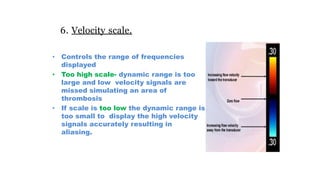
6. Velocity scale.
• Controls the range of frequencies
displayed
• Too high scale- dynamic range is too
large and low velocity signals are
missed simulating an area of
thrombosis
• If scale is too low the dynamic range is
too small to display the high velocity
signals accurately resulting in
aliasing.
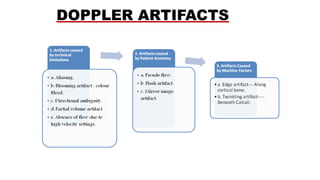
DOPPLER ARTIFACTS
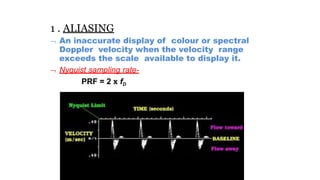
1 . ALIASING
 An inaccurate display of colour or spectral
Doppler velocity when the velocity range
exceeds the scale available to display it.
 Nyquist sampling rate-
PRF = 2 x fD
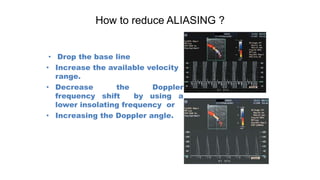
How to reduce ALIASING ?
• Drop the base line
• Increase the available velocity
range.
• Decrease the Doppler
frequency shift by using a
lower insolating frequency or
• Increasing the Doppler angle.
• Power Doppler has no aliasing because it has
no directional or velocity component.
Advantage: -
• 1. useful for localizing the highest velocity
region.
• 2. It is used in identifying the abnormal area
in TIPSS & in localizing AV fistulae.
Disadvantage:- high velocity may not be accurately
measured.
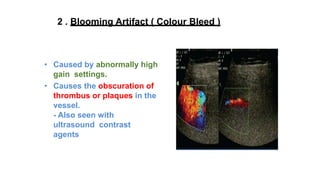
• Caused by abnormally high
gain settings.
• Causes the obscuration of
thrombus or plaques in the
vessel.
- Also seen with
ultrasound contrast
agents
2 . Blooming Artifact ( Colour Bleed )
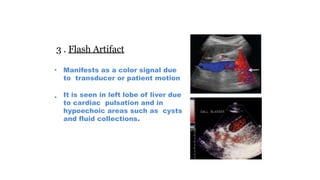
3 . Flash Artifact
• Manifests as a color signal due
to transducer or patient motion
It is seen in left lobe of liver due
to cardiac pulsation and in
hypoechoic areas such as cysts
and fluid collections.
•
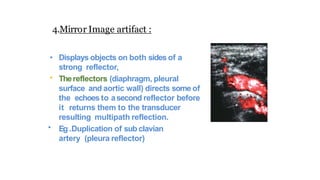
4.Mirror Image artifact :
•
•
• Displays objects on both sides of a
strong reflector,
Thereflectors (diaphragm, pleural
surface and aortic wall) directs some of
the echoes to asecond reflector before
it returns them to the transducer
resulting multipath reflection.
Eg .Duplication of sub clavian
artery (pleura reflector)
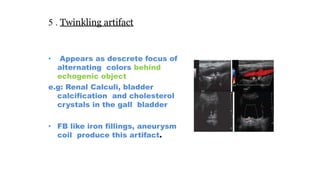
5 . Twinkling artifact
• Appears as descrete focus of
alternating colors behind
echogenic object
e.g: Renal Calculi, bladder
calcification and cholesterol
crystals in the gall bladder
• FB like iron fillings, aneurysm
coil produce this artifact.
GUIDELINES FOR AN OPTIMAL
COLOUR FLOW DOPPLER
EXAMINATION.
• The colour flow box should be kept as small
& superficial as possible
Adjust the gain and filter settings
Adjust the velocity scale (PRF) and baseline
according to the flow conditions.
•
•
• Obtain an optimal Doppler angle by adjusting
the beam steering and probe position. ( 600
or less )
• Adjust the pulsed Doppler sample volume
size (gate) appropriately (2/3rd of the vessel
diameter)
• AVOID TRANSDUCER MOTION.
THANK YOU….

Doppler physics ppt

  • 1.
    DOPPLER PHYSICS Dr.Abhilasha singh DNBResident Dept of Radiodiagnosis Ramkrishna care hospital,Raipur
  • 2.
    PRINCIPLE OF DOPPLER ULTRASOUND • • • BASIS– ‘ DOPPLER EFFECT’ Change in the perceived frequency of sound emitted by a moving source. DISCOVERY – Physicist Christian Johann Doppler in 1843 ‘When a sound source and the reflector are moving toward each other, the sound waves are spaced closer together and reach the reciever at a higher frequency than they were originally emitted ’.
  • 4.
     In ultrasound,the Doppler effect used to measure blood • flow velocity.  Ultrasound reflected from red blood cells will change in frequency according to the blood flow velocity.  When direction of blood flow is towards the transducer, the echoes from blood reflected back to the transducer will have a higher frequency than the one emitted from the transducer.  When the direction is away from the transducer, the echoes will have a lower frequency than those emitted.  The difference in frequency between transmitted and received echoes is called the Doppler frequency shift, and this shift in frequency is proportional to the blood flow velocity.
  • 6.
    •Doppler shift isthe difference between the transmitted and received frequencies •Transmitted and received Frequencies are in the MHz range  Doppler shift frequencies often in audible range DOPPLER SHIFT
  • 7.
    POSITIVE NEGATIVE WHEN RECEIVED FREQUENCY=TRANSMITTED FREQUENCY, NO DOPPLERS SHIFT
  • 8.
    • Relationship betweenDoppler shift (or justDoppler) frequency, FDand reflector velocity,v: fo is the ultrasound frequency, or the transmitted beam frequency.  v is the reflector velocity (m/s; cm/s)  θ is the Doppler angle  c is the speed of sound DOPPLER EQUATION c FD  2fo v cosθ
  • 9.
    FACTORS AFFECTING DOPPLERSHIFT 1. Doppler angle 2. Transducer frequency 3. Scattering of US by blood 4. Blood flow characteristic
  • 10.
    1. DOPPLER ANGLE Also known as the angle of insonation.  Estimated by a process known as angle correction, which involves aligning an indicator on the duplex image along the longitudinal axis of the vessel.  Few considerations that affect the performance of a Doppler examination: The cosine of 90° is zero, so if the ultrasound beam is perpendicular to the direction of blood flow, there will be no Doppler shift and it will appear as if there is no flow in the vessel The angle of insonation should also be less than 60° at all times, since the cosine function has a steeper curve above this angle, and errors in angle correction will be magnified
  • 11.
  • 12.
    ANGLE EFFECTS  MaximumDoppler shift at 0 degrees minimum at 90 degrees – proportional to the Cosine of the angle between the beam and direction of travel. Direction of movement
  • 13.
    Effect of theDoppler angle in the sonogram. Higher-frequency Doppler signal is obtained if the beam is aligned more to the direction of flow. In the diagram, beam (A) is more aligned than (B) and produces higher-frequency Doppler signals. The beam/flow angle at (C) is almost 90° and there is a very poor Doppler signal. The flow at (D) is away from the beam and there is a negative signal.
  • 14.
    11 If the beamdirection is perpendicular to the direction of flow, the Doppler frequency is ZERO!
  • 15.
    2. TRANSDUCER FREQUENCY Increase in transducer frequency causes increased doppler frequency shift.  At frequencies between 2-10 MHz, doppler shift comparatively small & in audible range (shift from 0- 10 KHz) for most physiological motion (for velocity range from 0-100 cm/s).  Change of frequency → measurable → movement of reflector towards/away from transducer.  Depending on ↑ or ↓ in frequency → direction of movement.
  • 16.
  • 17.
    3. SCATTERING OFUS BY BLOOD  Smooth wall of blood vessel → specular reflection → strong echoes.  Us wavelength > size of RBCs → scattering of wave in all directions (Rayleigh-Tyndall scattering). Size of echo from blood → ↓.  Intensity of scattered us ↑ with 4th power of frequency as images of vessel lumen differ significantly with instruments of different frequency.
  • 18.
    4. CHARACTERISTICS OFBLOOD FLOW  Blood (viscous medium) → wall exerts drag effect on moving blood → slow movement near the wall than center.  Non pulsatile flow with low velocity → parabolic velocity profile → laminar flow.  Fast /accelerated flow → same velocity all over → plug flow.  Major artery → plug flow during systole & laminar flow during diastole. Venous flow → laminar.
  • 19.
    FLOW PATTERNS  Laminarflow Highest in center Zero at wall  Turbulent flow Larger distribution of velocities 16
  • 20.
    DOPPLER ULTRASOUND MODES/INSTRUMENTATIONS  Continuouswave Doppler  Pulsed wave Doppler  Spectral doppler  Colour doppler  Power doppler
  • 21.
    CONTINUOUS WAVE DOPPLER Simplest form  Uses separate transmit & receive crystals that continuously transmit and receive ultrasound.  Able to detect the presence and direction of flow, - unable to distinguish signals arising from vessels at different depths. ( THEREFORE IT LACKS RANGE RESOLUTION.)  Portable and inexpensive.
  • 22.
  • 24.
    Advantages: Simple, Good quality lownoise signal, No aliasing. Disadvantages: Lacks depth resolution, Confusing superimposition, Application: Superficial structures,e.g carotid artery, limb arteries. 21
  • 25.
    • • Uses brief pulsesof ultrasound energy using only one crystal. The echo delay time ( Te ) can be converted into distance and the DEPTH of echo source can be determined The sensitive volume from which flow data are sampled can be controlled in terms of shape, depth, and position. • PULSED-WAVE (PW) DOPPLER
  • 27.
    PULSED WAVE DOPPLER PULSEREPETITION FREQUENCY(PRF)-No. of pulses transmitted per second • With increasing scanning depth PRF decreases as more time is needed for the echoes to return • At a minimum, the PRF must be at least twice the frequency of the Doppler signal to construct the signal successfully. • This sets upper limit to the flow velocities to be ac urately recorded • Use higher PRF setting for high flow velocities, low PRF for slow venous flow
  • 28.
    A (PRF =700 Hz) B (PRF = 4500 Hz)
  • 29.
    Aliasing of thespectral Doppler display is characterized by "wraparound“ of the highest velocities to the opposite direction when the sampling (PRF) is inadequate. Right: Without changing the overall velocity range, the spectral baseline is shifted to incorporate higher forward velocity and less reverse velocity to avoid aliasing. The maximum, average, and minimum spectral Doppler display values allow quantitative determination of clinically relevant information such as pulsatility index and resistive index.
  • 30.
    Continuous wave (CW)Doppler Pulsed wave (PW) Doppler
  • 31.
    DUPLEX ULTRASOUND SCANNING Duplexultrasound instruments are real-time B- mode scanners with built-in Doppler capabilities. ● B-mode Imager ( Outline anatomic structures ) ● Pulsed-Doppler ( Flow and movement patterns )
  • 32.
     The Dopplergate is positioned over the vessel of interest with size (length and width) appropriate for evaluation of blood velocity, and at an orientation (angle with respect to the interrogating US beam) that represents the Doppler angle.  When switched to Doppler mode, the scanner electronics determines the proper timing to extract data only from within the user-defined gate.  The duplex system allows estimation of the blood velocity directly from the Doppler shift frequency, since the velocity of sound and the transducer frequency are known, while the Doppler angle can be estimated from the B-mode image and input into the scanner computer for calculation.  Once the velocity is known, flow (in units of cm3/s) is estimated as the product of the vessel’s cross- sectional area (cm2) times the velocity (cm/s).
  • 33.
     Advantages: Selection ofsite & sample volume for Doppler. No overlap of information from other vessels/structures. Measurement of vessel angle in 2-3 sec.  Disadvantages: Angle restriction if same transducer for imaging & Doppler. Flow information from one site in image
  • 34.
  • 35.
    SPECTRAL DOPPLER • Ultrasoundis emitted in pulses similar to B- mode • Gate is used to determine the interval after emission when returning signals are received and therefore the depth from which the sample is taken. • The Doppler shift data are displayed in graphic form as a time-varying plot of the frequency spectrum of the returning signal. • A fast Fourier transformation is used to perform the frequency analysis.
  • 36.
    • SPECTRAL ANALYSISshows the Doppler shift spectrum and direction ,usually displayed as the maximum velocity rather than frequency Provides QUANTITATIVE INFORMATION•
  • 37.
    The resulting Dopplerfrequency spectrum displays the following :  Variation with time of the Doppler frequencies present in the volume sampled.  The envelope of the spectrum, representing the maximum frequencies present at any given point in time.  The width of the spectrum at any point, indicating the range of frequencies present.
  • 38.
  • 39.
  • 40.
    DOPPLER SPECTRUM ASSESSMENT Assess thefollowing 1.Presence of flow 2.Direction of flow 3.Amplitude 4.Window 5.Pulsatility
  • 41.
  • 42.
    DOPPLER SPECTRUM ASSESSMENT SENSITIVITY IMPROVEMENT •Increase power or gain • Decrease the velocity scale • Decreasing the reject or filter • Slowly increasing the SV size
  • 43.
    2.DIRECTION OF FLOW •Pulsed doppler use quadrature phase detection to provide bidirectional doppler information FLOWCAN EITHER BE • Mono-phasic • Bi-phasic • Tri-phasic • Bidirectional
  • 48.
    • The spectrumdisplays echo amplitude by varying the brightnes of the display The amplitude of the echoes are determined by • • • • Echo intensity Power Gain Dynamic range 3 . AMPLITUDE
  • 49.
       Recieved doppler shiftconsists of a range of frequencies Narrow range of frequencies will result in a narrow display line. The clear underneath the spectrum is called the window 4. WINDOW
  • 52.
    SPECTRUM BROADENING : •Refers to presence of a large range of flow velocities at a given point in the pulse cycle and, by indicating turbulance,is an important criterion of high grade vessel narrowing • Loss of spectral window is called SPECTRAL BROADENING OCCURS- • As the blood decelerates in diastole • SV placed close to the vessel wall • In small vessels ( parabolic velocity profile )
  • 53.
    • Tortous vessels •Low flow states • Excessive gain/power/dynamic range IT IS HALLMARK OF DISTURBED AND/OR TURBULENT FLOW
  • 55.
    5 . PULSATILITY •Measures the difference between the maximum and minimum velocities within the cardiac cycle • Indices are unit less • All increase in value as flow pulsatility increases • Can be measured without knowledge of the doppler angle
  • 57.
    Pulsed-wave US spectrumdisplays the maximum, minimum, and average calculated blood flow velocities. The pulsatility index, resistivity index, and systolic-to-diastolic ratio are calculated from these values DOPPLER INDICES
  • 58.
    DOPPLER INDICES • • • • • PI =S-D/Vm ( GOSLING ) RI = S-D/S ( POURCELOT ) S /D Ratio Acceleration time ( AT) & Acceleration Index ( AI) SPECTRAL BROADENING Changes in doppler indices from normal may help in early identification of rejection of transplanted organs,parenchymal dysfunction, and malignancy.
  • 59.
    The PI willincrease as flow is impeded by a stenosis. Care must be taken when the PI is used. Proximal and distal stenoses as well as natural flow resistance from the vascular bed may affect PI measurement. The RI is easier to calculate and is used to evaluate a number of physiologic conditions. Both of these indexes are used to assess the resistance to flow in the vascular system
  • 60.
  • 61.
    COLOUR DOPPLER • Basedon pulsed doppler technique . • Doppler shifts - converted to colour and the moving blood is displayed in colors that correspond to its velocity and direction. • Positive Doppler shifts are encoded as red and negative shifts are encoded as blue. • Velocity of the flow is represented in shades of color - faster - brighter
  • 63.
  • 64.
    • • • • COLOR BOX Operator adjustablearea within the US image Affects Image resolution & quality ( change in box size )- Frame rate decreases with increasing box size As small & superficial as possible Deep color box – slower PRF results aliasing
  • 65.
  • 66.
    COLOUR DOPPLER Advantages  Itprovides an overall view of flow in organ or structure  Provides directional information about flow,  Provides velocity information about flow and shows turbulent type flow
  • 67.
    • Limitations : •SEMI QUANTITATIVE • Angle dependence • Aliasing • Artifacts caused by the noise • Inability to display entire doppler spectrum in the image • Poor temporal resolution
  • 68.
    Doppler frequency spectrumdisplay B A,ColorDoppler maging B,Doppler frequencyspectrum waveform A
  • 69.
    SPECTRAL DOPPLER •DEPICTION OF DOPPLERSHIFT INFORMATION IN WAVEFORM COLOUR DOPPLER • UTILIZE DOPPLER SHIFT INFORMATION TO SHOW BLOOD FLOW IN COLOR
  • 70.
    SPECTRAL DOPPLER ADVANTAGES • depictsquantitaive flow at one site • allows calculations of velocity and indices • good temporal resolution COLOR DOPPLER ADVANTAGES • Overall view of flow • Directional information about flow • Averaged velocity information about flow
  • 71.
  • 72.
    POWER DOPPLER • Alsoknown as Energy Doppler / Amplitude Doppler. • In this mode, colour is assigned to the power /strength/ energy of the Doppler signal rather than the Doppler frequency shift. • Flow is usually displayed with one colour USES 1. To detect very slow flow, flow in small vessels, or where transducer angling is awkward. 2. Power Doppler can be used in conjunction with contrast agents of varying brightness
  • 73.
  • 74.
    POWERDOPPLER • Advantages  Angleindependent  No aliasing  Improved signal to noise ratio  More sensitive to detect low flow  Better able to define boundaries Limitations  No directional information  Poor temporal resolution (due to relatively low PRF ).  Due to the low PRF, power Doppler is particularly sensitive to flash artefact
  • 75.
    OPTIMISATION OF COLORFLOW DOPPLEREXAMINATION 1. TransducerFrequency. • For superficial structures 7-10MHZ is used. For deep abdominal structures – 3MHZ – 5MHZ is optimal. • Choice of transducer frequency is paramount because the intensity of the scattered sound varies in proportion to the 4th power of the Doppler frequency.
  • 76.
    2.Doppler Angle. • Strongestsignals of Doppler results when the motion is parallel to beam. • A Doppler angle of 900 does not display flow because no doppler shift detected.
  • 77.
    3. Sample Volume. • • •Ideal sample volume – 2/3rd of the vessel width positioned in the center of the vessel. If sample volume is more: - Spectral broadening If sample volume is less: Measured velocity is too low.
  • 78.
    4. Wall Filters. •Cut off of the low frequency noises, a cleaner high velocity blood flow signal is displayed. • If set too high the blood flow is discarded, if set low noise will be more. 5. Doppler Gain. • Controls the amplitude of the colour display in colour or power Doppler mode & the spectral display in pulse Doppler mode. Excess gain PSV = 75 cm/sec Proper gain 60 cm/sec Insufficent gain 50 cm/sec
  • 79.
    6. Velocity scale. •Controls the range of frequencies displayed • Too high scale- dynamic range is too large and low velocity signals are missed simulating an area of thrombosis • If scale is too low the dynamic range is too small to display the high velocity signals accurately resulting in aliasing.
  • 80.
  • 81.
    1 . ALIASING An inaccurate display of colour or spectral Doppler velocity when the velocity range exceeds the scale available to display it.  Nyquist sampling rate- PRF = 2 x fD
  • 83.
    How to reduceALIASING ? • Drop the base line • Increase the available velocity range. • Decrease the Doppler frequency shift by using a lower insolating frequency or • Increasing the Doppler angle.
  • 84.
    • Power Dopplerhas no aliasing because it has no directional or velocity component. Advantage: - • 1. useful for localizing the highest velocity region. • 2. It is used in identifying the abnormal area in TIPSS & in localizing AV fistulae. Disadvantage:- high velocity may not be accurately measured.
  • 85.
    • Caused byabnormally high gain settings. • Causes the obscuration of thrombus or plaques in the vessel. - Also seen with ultrasound contrast agents 2 . Blooming Artifact ( Colour Bleed )
  • 86.
    3 . FlashArtifact • Manifests as a color signal due to transducer or patient motion It is seen in left lobe of liver due to cardiac pulsation and in hypoechoic areas such as cysts and fluid collections. •
  • 87.
    4.Mirror Image artifact: • • • Displays objects on both sides of a strong reflector, Thereflectors (diaphragm, pleural surface and aortic wall) directs some of the echoes to asecond reflector before it returns them to the transducer resulting multipath reflection. Eg .Duplication of sub clavian artery (pleura reflector)
  • 88.
    5 . Twinklingartifact • Appears as descrete focus of alternating colors behind echogenic object e.g: Renal Calculi, bladder calcification and cholesterol crystals in the gall bladder • FB like iron fillings, aneurysm coil produce this artifact.
  • 89.
    GUIDELINES FOR ANOPTIMAL COLOUR FLOW DOPPLER EXAMINATION. • The colour flow box should be kept as small & superficial as possible Adjust the gain and filter settings Adjust the velocity scale (PRF) and baseline according to the flow conditions. • •
  • 90.
    • Obtain anoptimal Doppler angle by adjusting the beam steering and probe position. ( 600 or less ) • Adjust the pulsed Doppler sample volume size (gate) appropriately (2/3rd of the vessel diameter) • AVOID TRANSDUCER MOTION.
  • 91.