Chapter N°18:
Language and Regional Variation
LANGUAGE AND WRITTEN EXPRESSION
IV
Student: Soto Valic, Gabriela Rocio
The Study of Language
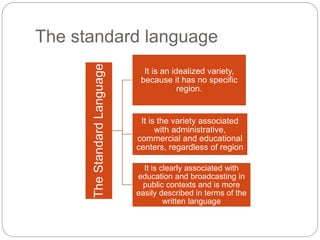
The standard language
TheStandardLanguage
It is an idealized variety,
because it has no specific
region.
It is the variety associated
with administrative,
commercial and educational
centers, regardless of region
It is clearly associated with
education and broadcasting in
public contexts and is more
easily described in terms of the
written language
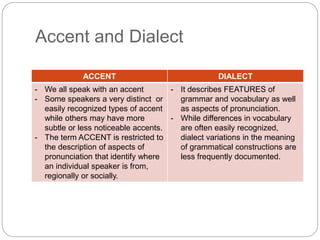
Accent and Dialect
ACCENT DIALECT
- We all speak with an accent
- Some speakers a very distinct or
easily recognized types of accent
while others may have more
subtle or less noticeable accents.
- The term ACCENT is restricted to
the description of aspects of
pronunciation that identify where
an individual speaker is from,
regionally or socially.
- It describes FEATURES of
grammar and vocabulary as well
as aspects of pronunciation.
- While differences in vocabulary
are often easily recognized,
dialect variations in the meaning
of grammatical constructions are
less frequently documented.
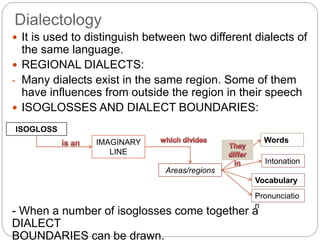
Dialectology
 It is used to distinguish between two different dialects of
the same language.
 REGIONAL DIALECTS:
- Many dialects exist in the same region. Some of them
have influences from outside the region in their speech
 ISOGLOSSES AND DIALECT BOUNDARIES:
- When a number of isoglosses come together a
DIALECT
BOUNDARIES can be drawn.
IMAGINARY
LINE
ISOGLOSS
Areas/regions
Words
Pronunciatio
n
Intonation
Vocabulary
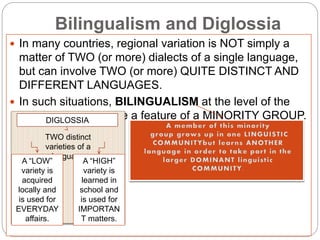
Bilingualism and Diglossia
 In many countries, regional variation is NOT simply a
matter of TWO (or more) dialects of a single language,
but can involve TWO (or more) QUITE DISTINCT AND
DIFFERENT LANGUAGES.
 In such situations, BILINGUALISM at the level of the
individual tends to be a feature of a MINORITY GROUP.DIGLOSSIA
TWO distinct
varieties of a
language
A “LOW”
variety is
acquired
locally and
is used for
EVERYDAY
affairs.
A “HIGH”
variety is
learned in
school and
is used for
IMPORTAN
T matters.
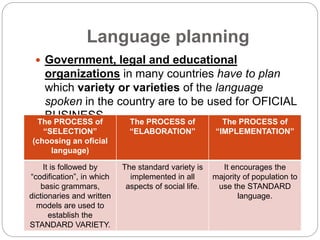
Language planning
 Government, legal and educational
organizations in many countries have to plan
which variety or varieties of the language
spoken in the country are to be used for OFICIAL
BUSINESS.The PROCESS of
“SELECTION”
(choosing an oficial
language)
The PROCESS of
“ELABORATION”
The PROCESS of
“IMPLEMENTATION”
It is followed by
“codification”, in which
basic grammars,
dictionaries and written
models are used to
establish the
STANDARD VARIETY.
The standard variety is
implemented in all
aspects of social life.
It encourages the
majority of population to
use the STANDARD
language.
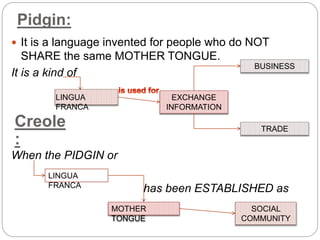
Pidgin:
 It is a language invented for people who do NOT
SHARE the same MOTHER TONGUE.
It is a kind of
When the PIDGIN or
has been ESTABLISHED as
in a
LINGUA
FRANCA
BUSINESS
EXCHANGE
INFORMATION
TRADE
Creole
:
MOTHER
TONGUE
LINGUA
FRANCA
SOCIAL
COMMUNITY
Bibliography:
 Yule, G (2016). The Study of Language. Chapters
18. U.K.: CUP.

"The study of language" - Chapter 18

  • 1.
    Chapter N°18: Language andRegional Variation LANGUAGE AND WRITTEN EXPRESSION IV Student: Soto Valic, Gabriela Rocio The Study of Language
  • 2.
    The standard language TheStandardLanguage Itis an idealized variety, because it has no specific region. It is the variety associated with administrative, commercial and educational centers, regardless of region It is clearly associated with education and broadcasting in public contexts and is more easily described in terms of the written language
  • 3.
    Accent and Dialect ACCENTDIALECT - We all speak with an accent - Some speakers a very distinct or easily recognized types of accent while others may have more subtle or less noticeable accents. - The term ACCENT is restricted to the description of aspects of pronunciation that identify where an individual speaker is from, regionally or socially. - It describes FEATURES of grammar and vocabulary as well as aspects of pronunciation. - While differences in vocabulary are often easily recognized, dialect variations in the meaning of grammatical constructions are less frequently documented.
  • 4.
    Dialectology  It isused to distinguish between two different dialects of the same language.  REGIONAL DIALECTS: - Many dialects exist in the same region. Some of them have influences from outside the region in their speech  ISOGLOSSES AND DIALECT BOUNDARIES: - When a number of isoglosses come together a DIALECT BOUNDARIES can be drawn. IMAGINARY LINE ISOGLOSS Areas/regions Words Pronunciatio n Intonation Vocabulary
  • 5.
    Bilingualism and Diglossia In many countries, regional variation is NOT simply a matter of TWO (or more) dialects of a single language, but can involve TWO (or more) QUITE DISTINCT AND DIFFERENT LANGUAGES.  In such situations, BILINGUALISM at the level of the individual tends to be a feature of a MINORITY GROUP.DIGLOSSIA TWO distinct varieties of a language A “LOW” variety is acquired locally and is used for EVERYDAY affairs. A “HIGH” variety is learned in school and is used for IMPORTAN T matters.
  • 6.
    Language planning  Government,legal and educational organizations in many countries have to plan which variety or varieties of the language spoken in the country are to be used for OFICIAL BUSINESS.The PROCESS of “SELECTION” (choosing an oficial language) The PROCESS of “ELABORATION” The PROCESS of “IMPLEMENTATION” It is followed by “codification”, in which basic grammars, dictionaries and written models are used to establish the STANDARD VARIETY. The standard variety is implemented in all aspects of social life. It encourages the majority of population to use the STANDARD language.
  • 7.
    Pidgin:  It isa language invented for people who do NOT SHARE the same MOTHER TONGUE. It is a kind of When the PIDGIN or has been ESTABLISHED as in a LINGUA FRANCA BUSINESS EXCHANGE INFORMATION TRADE Creole : MOTHER TONGUE LINGUA FRANCA SOCIAL COMMUNITY
  • 8.
    Bibliography:  Yule, G(2016). The Study of Language. Chapters 18. U.K.: CUP.