


Yogesh Bhatt
151/2013
What Pidgin is ?
Varieties of Pidgin
Expanded Pidgin
Characteristics of Pidgin
WHAT IS A PIDGIN
A pidgin or pidgin language, is a simplified
language that develops as a means of
communication between two or more groups
that do not have a language in common.
It is most commonly employed in situations
such as trade, or where both groups speak
languages different from the language of the
country in which they reside (but where there
is no common language between the groups).
WHAT IS A PIDGIN
According to Peter Trudgill ..
“Pidgin is a term used to apply to situations
where two or more groups of speakers who do
not have a native language in common are in
social contact with one another or come into
such contact.”
ETYMOLOGY
CHARACTERISTICS
 Developed from two language as a result of
reduction, simplification of „input material, internal
innovation, and regularization of structure.
 Language so formed is different from its
antecedent languages, but some vocabulary is
taken from native languages.
 is nobody's mother tongue, and it is not a real
language at all so do not have native speakers.
 It has no elaborate grammar.
 Limited functions (esp. trade)
EXPANDED PIDGIN
 Pidgins usually have limited life-span; can die out
when the interactions that they serve end (e.g.,
the end of a trade route)
 Pidgins will survive longer if at least two
substratum language groups are involved.
E.g. Non-European language groups not in frequent
contact with each other until arrival of trans-oceanic
trade will continue to use the Pidgin created.
EXPANDED PIDGINS
So the pidgin becomes a link language among the
non-Europeans, who sometimes continue to develop
and use it after the Europeans have left in many
West African countries and South Pacific islands.
So it can become an expanded pidgin, like the
Nigerian pidgin Genesis, and remain in wide use.
Grammar and vocabulary expand as types of
interaction become broader and more complex.
But still no native speakers…..
EXPANDED PIDGINS
What happens when they have children?
What language will the children speak?
The children will be native speakers of the
pidgin, and they will grow up with other children
having similar language backgrounds.
As they grow up and become involved in broad
range of activities
(education, music, religion), their language
becomes more complex in terms of
grammar, vocabulary, and discourse.
EXPANDED PIDGINS
The pidgin has now developed into a
Creole, which is “the mother tongue of a
community.”
Creoles can become dominant languages of
communities and even post-colonial nations
e.g., Jamaica, Haiti
VARIETIES OF PIDGINS
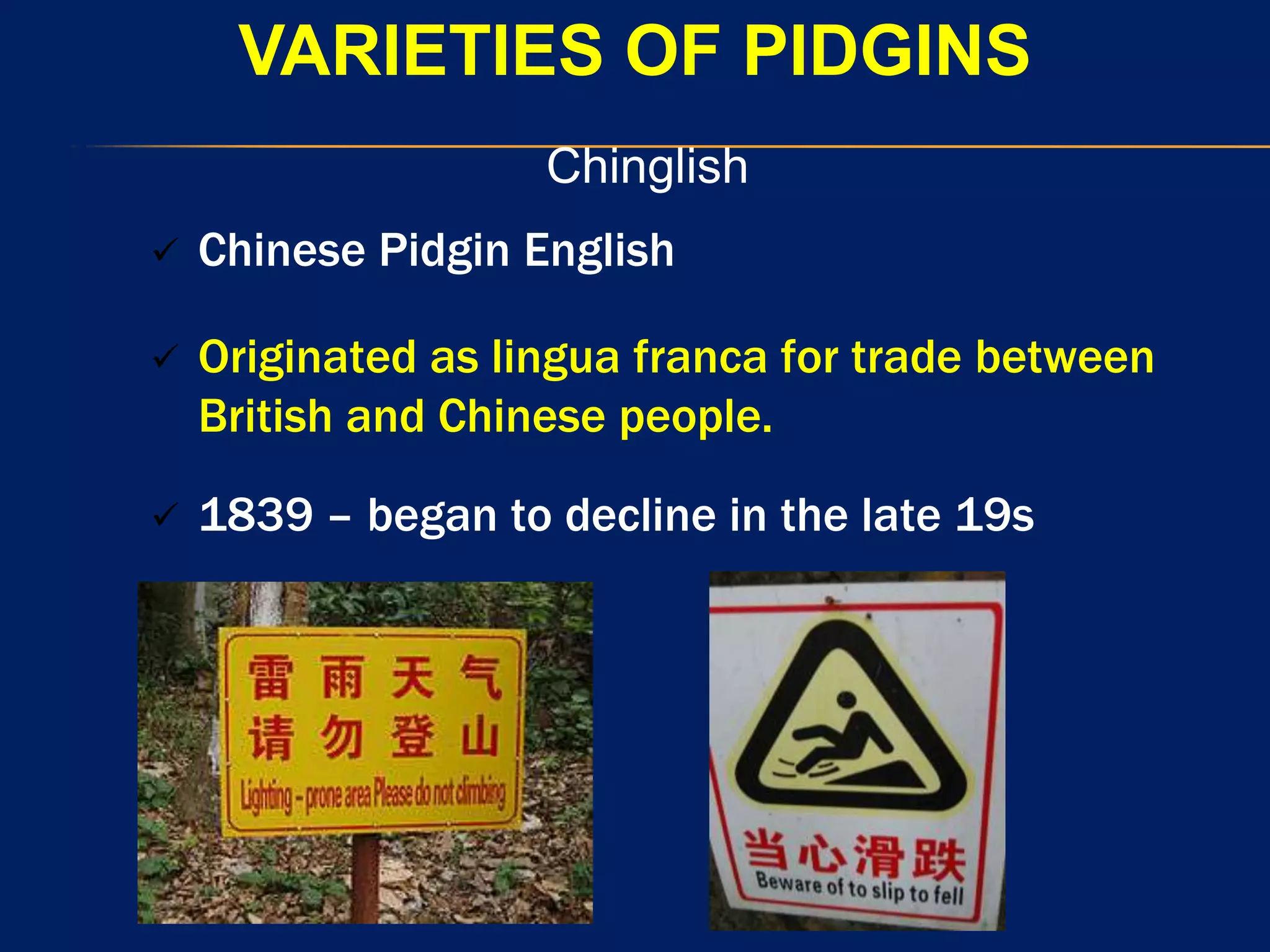
Chinglish
 Chinese Pidgin English
 Originated as lingua franca for trade between
British and Chinese people.
 1839 – began to decline in the late 19s
VARIETIES OF PIDGINS
 Maroon Spirit Language (Jamaica, West Africa, )
 West African Pidgin (West Africa, Equatorial
Guinea, Sierra Leone )
 African Pidgin
 Cameroon Pidgin English
 Tok Pisin (Papua New Guinea)
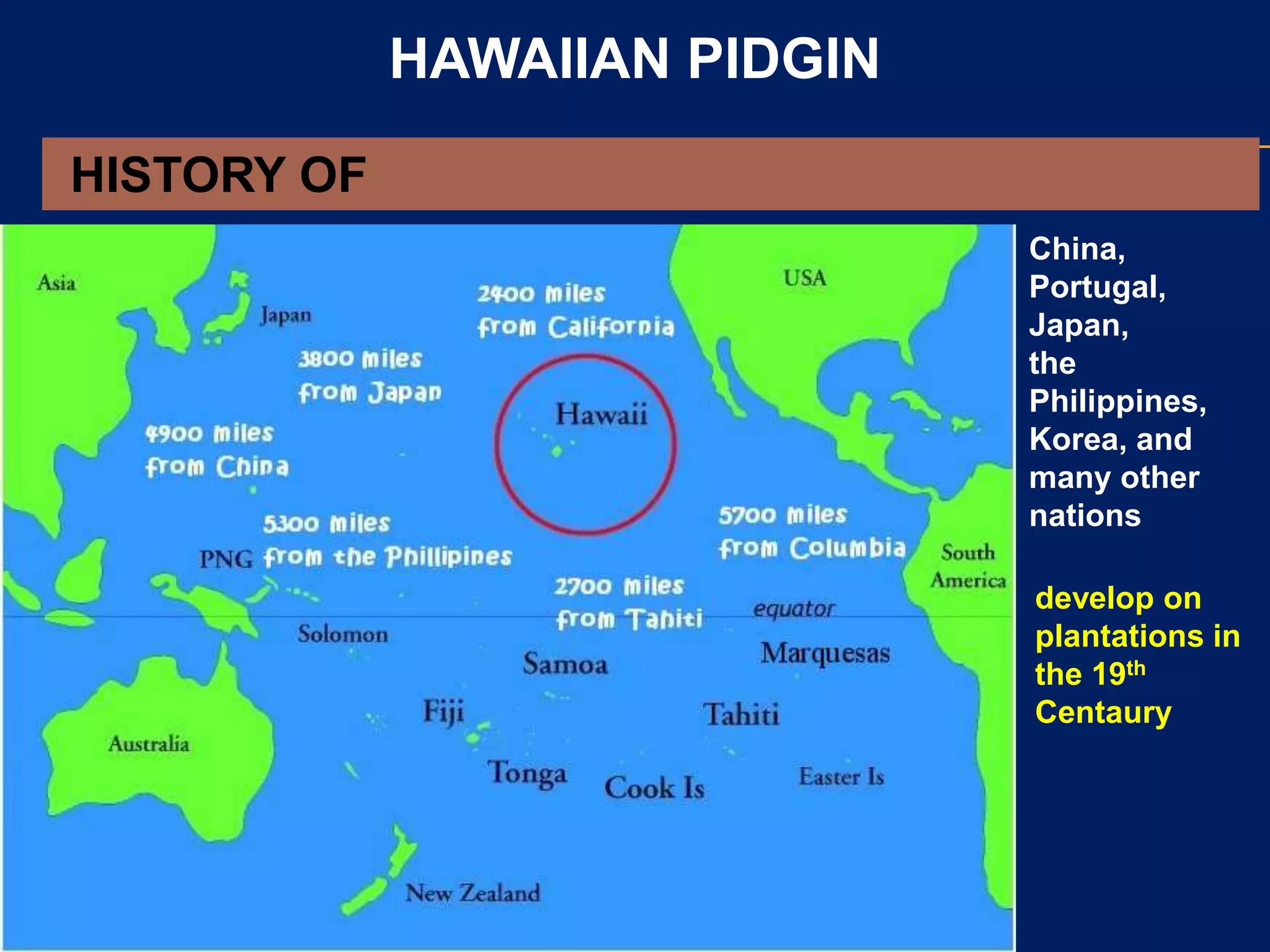
HAWAIIAN PIDGIN
HISTORY OF
China,
Portugal,
Japan,
the
Philippines,
Korea, and
many other
nations
develop on
plantations in
the 19th
Centaury
EXPANDED PIDGINS
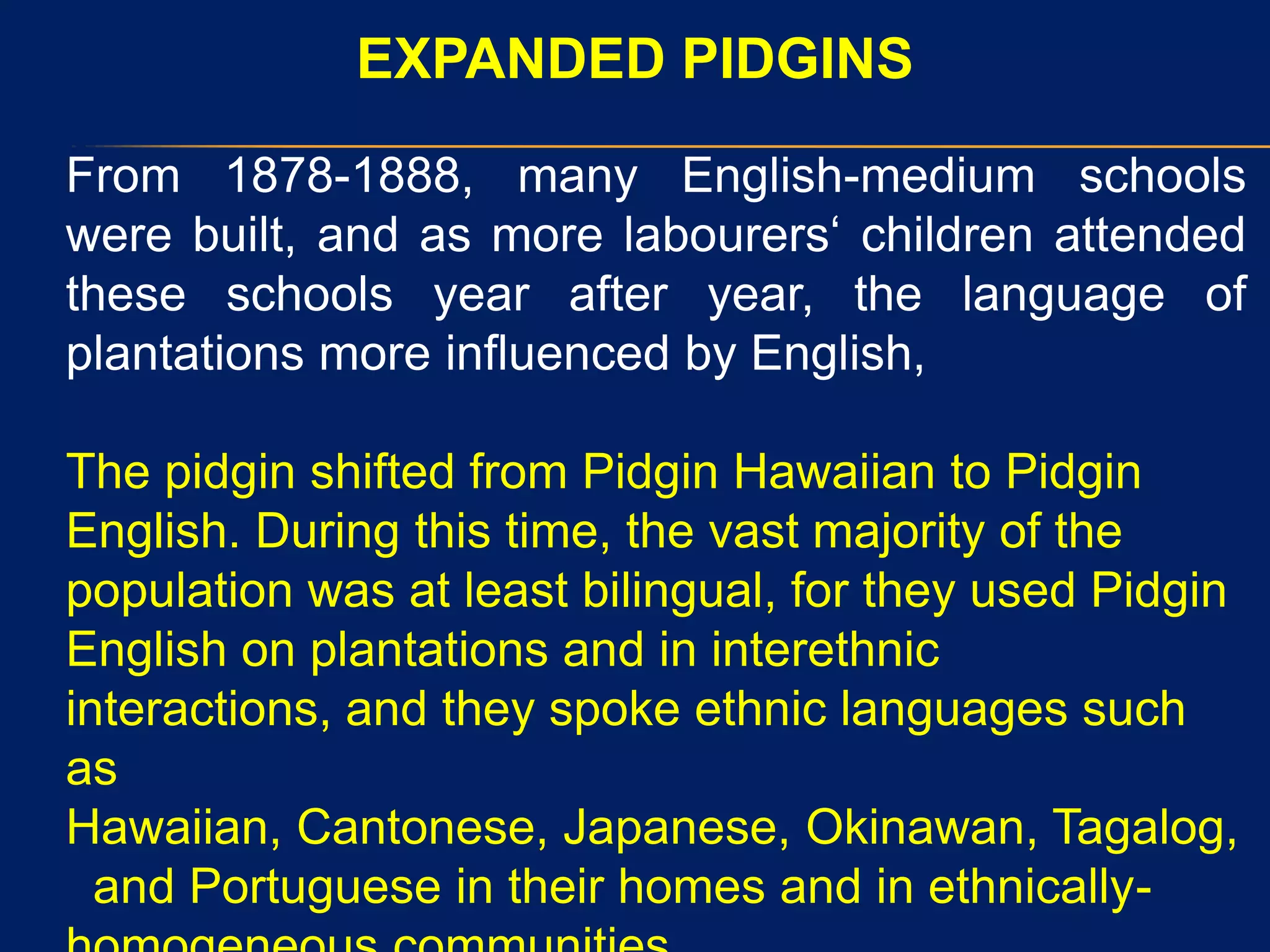
From 1878-1888, many English-medium schools
were built, and as more labourers„ children attended
these schools year after year, the language of
plantations more influenced by English,
The pidgin shifted from Pidgin Hawaiian to Pidgin
English. During this time, the vast majority of the
population was at least bilingual, for they used Pidgin
English on plantations and in interethnic
interactions, and they spoke ethnic languages such
as
Hawaiian, Cantonese, Japanese, Okinawan, Tagalog,
and Portuguese in their homes and in ethnically-
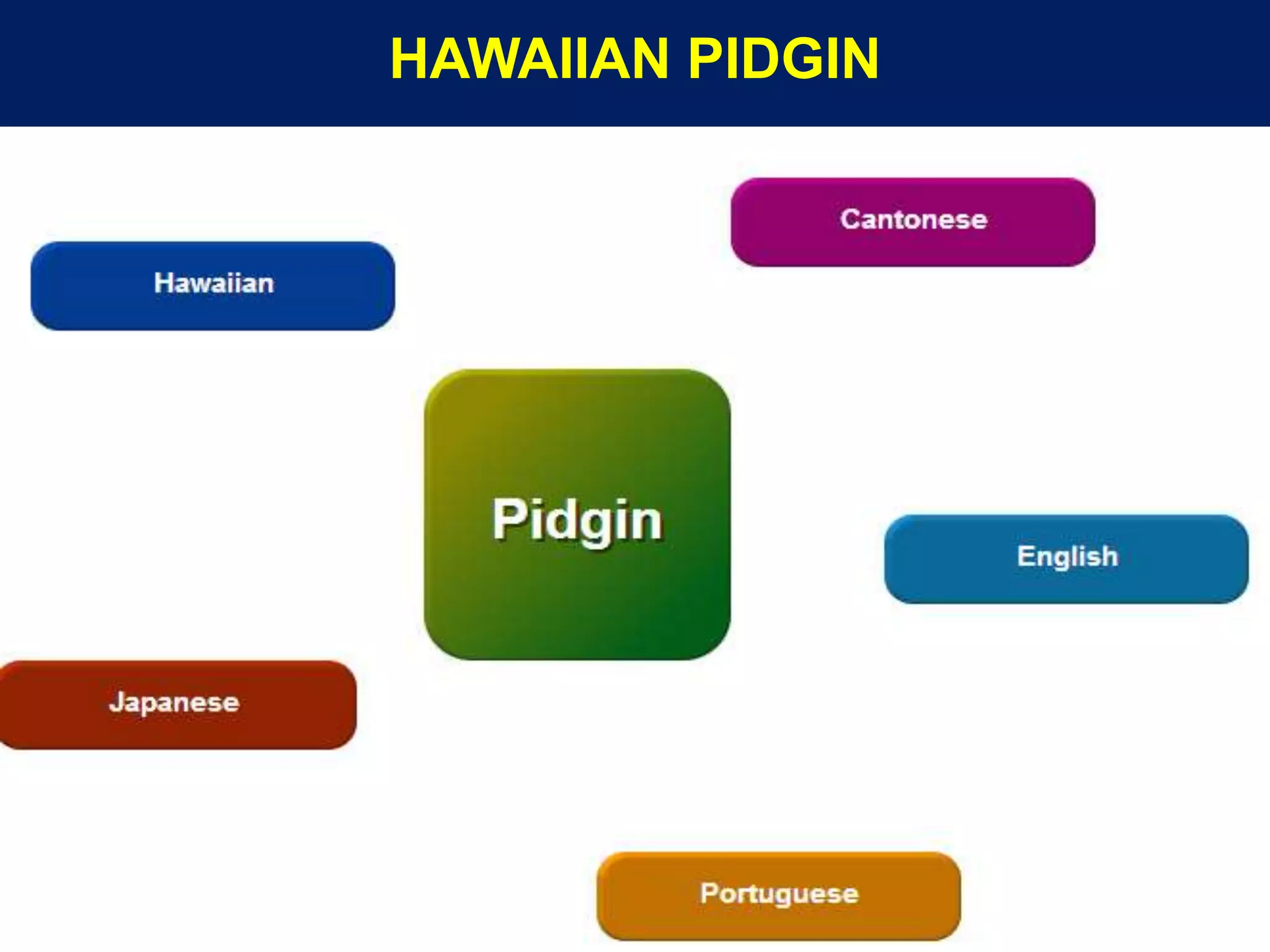
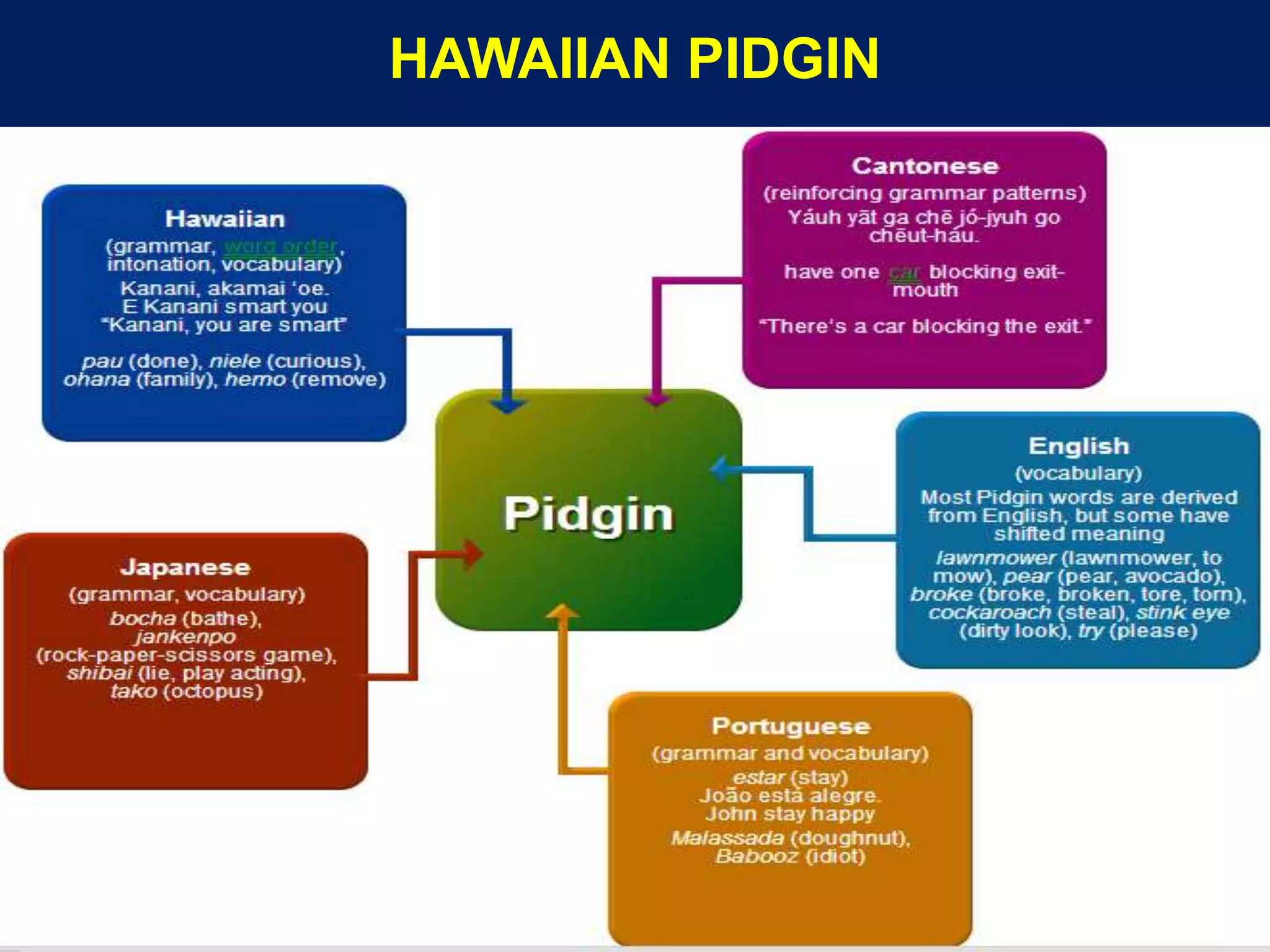
HAWAIIAN PIDGIN
HAWAIIAN PIDGIN
EXPANDED PIDGINS
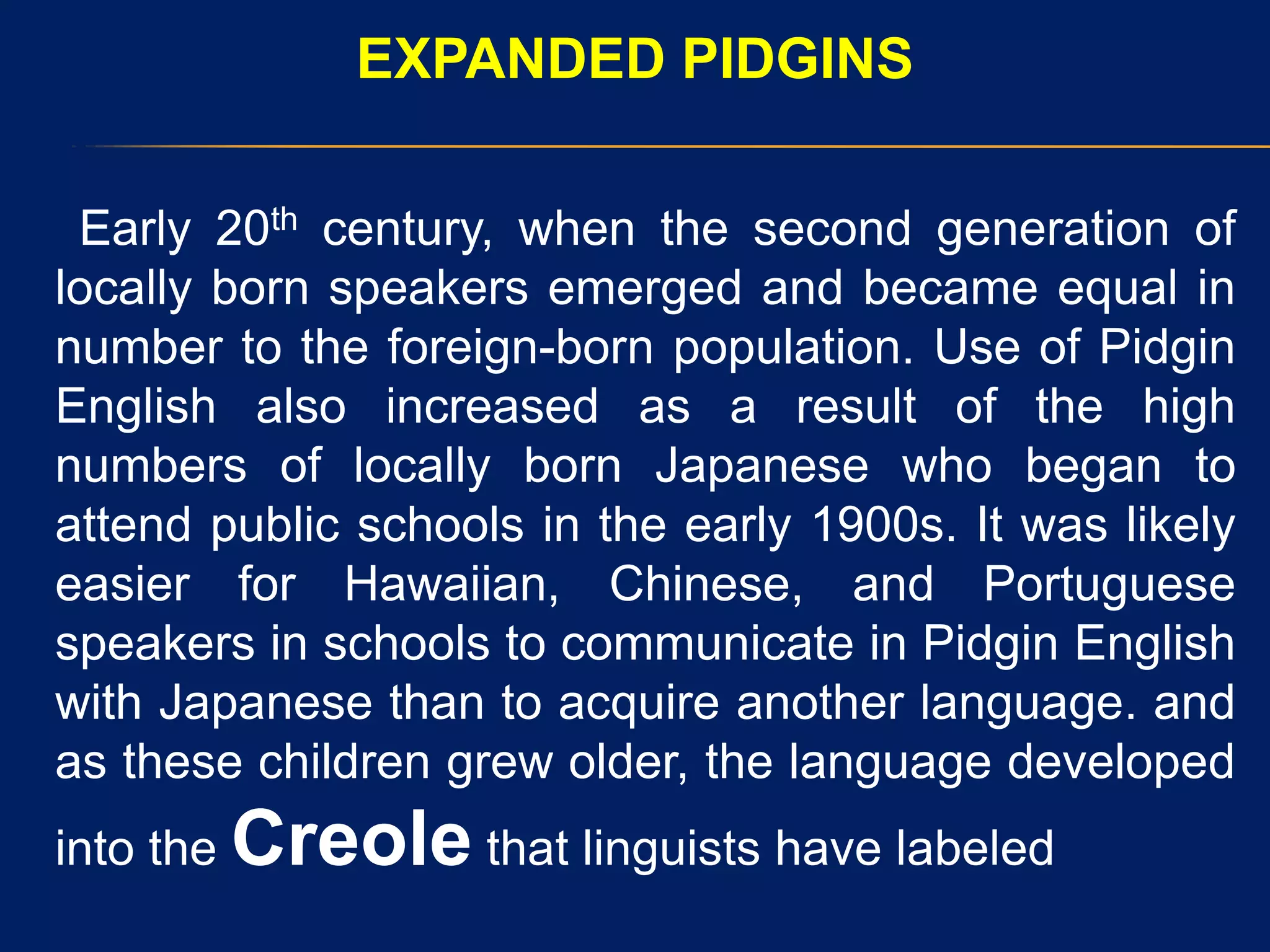
Early 20th century, when the second generation of
locally born speakers emerged and became equal in
number to the foreign-born population. Use of Pidgin
English also increased as a result of the high
numbers of locally born Japanese who began to
attend public schools in the early 1900s. It was likely
easier for Hawaiian, Chinese, and Portuguese
speakers in schools to communicate in Pidgin English
with Japanese than to acquire another language. and
as these children grew older, the language developed
into the Creole that linguists have labeled
CONCLUSION
 simplified language that develops as a means of
communication between two or more groups that
do not have a language in common.
 Language so formed is different from its
antecedent languages
 is nobody's mother tongue, and it is not a real
language at all so do not have native speakers.
 It has no elaborate grammar.
 Limited functions (esp. trade)
Thank you

Pidgins and its origion

  • 1.
  • 2.
    What Pidgin is? Varieties of Pidgin Expanded Pidgin Characteristics of Pidgin
  • 3.
    WHAT IS APIDGIN A pidgin or pidgin language, is a simplified language that develops as a means of communication between two or more groups that do not have a language in common. It is most commonly employed in situations such as trade, or where both groups speak languages different from the language of the country in which they reside (but where there is no common language between the groups).
  • 4.
    WHAT IS APIDGIN According to Peter Trudgill .. “Pidgin is a term used to apply to situations where two or more groups of speakers who do not have a native language in common are in social contact with one another or come into such contact.”
  • 5.
  • 6.
    CHARACTERISTICS  Developed fromtwo language as a result of reduction, simplification of „input material, internal innovation, and regularization of structure.  Language so formed is different from its antecedent languages, but some vocabulary is taken from native languages.  is nobody's mother tongue, and it is not a real language at all so do not have native speakers.  It has no elaborate grammar.  Limited functions (esp. trade)
  • 7.
    EXPANDED PIDGIN  Pidginsusually have limited life-span; can die out when the interactions that they serve end (e.g., the end of a trade route)  Pidgins will survive longer if at least two substratum language groups are involved. E.g. Non-European language groups not in frequent contact with each other until arrival of trans-oceanic trade will continue to use the Pidgin created.
  • 8.
    EXPANDED PIDGINS So thepidgin becomes a link language among the non-Europeans, who sometimes continue to develop and use it after the Europeans have left in many West African countries and South Pacific islands. So it can become an expanded pidgin, like the Nigerian pidgin Genesis, and remain in wide use. Grammar and vocabulary expand as types of interaction become broader and more complex. But still no native speakers…..
  • 9.
    EXPANDED PIDGINS What happenswhen they have children? What language will the children speak? The children will be native speakers of the pidgin, and they will grow up with other children having similar language backgrounds. As they grow up and become involved in broad range of activities (education, music, religion), their language becomes more complex in terms of grammar, vocabulary, and discourse.
  • 10.
    EXPANDED PIDGINS The pidginhas now developed into a Creole, which is “the mother tongue of a community.” Creoles can become dominant languages of communities and even post-colonial nations e.g., Jamaica, Haiti
  • 11.
    VARIETIES OF PIDGINS Chinglish Chinese Pidgin English  Originated as lingua franca for trade between British and Chinese people.  1839 – began to decline in the late 19s
  • 12.
    VARIETIES OF PIDGINS Maroon Spirit Language (Jamaica, West Africa, )  West African Pidgin (West Africa, Equatorial Guinea, Sierra Leone )  African Pidgin  Cameroon Pidgin English  Tok Pisin (Papua New Guinea)
  • 13.
    HAWAIIAN PIDGIN HISTORY OF China, Portugal, Japan, the Philippines, Korea,and many other nations develop on plantations in the 19th Centaury
  • 14.
    EXPANDED PIDGINS From 1878-1888,many English-medium schools were built, and as more labourers„ children attended these schools year after year, the language of plantations more influenced by English, The pidgin shifted from Pidgin Hawaiian to Pidgin English. During this time, the vast majority of the population was at least bilingual, for they used Pidgin English on plantations and in interethnic interactions, and they spoke ethnic languages such as Hawaiian, Cantonese, Japanese, Okinawan, Tagalog, and Portuguese in their homes and in ethnically-
  • 15.
  • 16.
  • 17.
    EXPANDED PIDGINS Early 20thcentury, when the second generation of locally born speakers emerged and became equal in number to the foreign-born population. Use of Pidgin English also increased as a result of the high numbers of locally born Japanese who began to attend public schools in the early 1900s. It was likely easier for Hawaiian, Chinese, and Portuguese speakers in schools to communicate in Pidgin English with Japanese than to acquire another language. and as these children grew older, the language developed into the Creole that linguists have labeled
  • 19.
    CONCLUSION  simplified languagethat develops as a means of communication between two or more groups that do not have a language in common.  Language so formed is different from its antecedent languages  is nobody's mother tongue, and it is not a real language at all so do not have native speakers.  It has no elaborate grammar.  Limited functions (esp. trade)
  • 20.